
The bathroom is your home’s ultimate sanctuary—a place of relaxation and rejuvenation. When designing this space, many homeowners face a frustrating dilemma: they crave the high-end, warm aesthetic of natural hardwood, but they rightfully fear the inevitable water damage that comes with a high-humidity environment. For decades, mixing wood and water was a recipe for disaster, leading to warped planks, expensive repairs, and hidden mold.
Fortunately, flooring technology has evolved. This is your definitive, building-science-backed guide to waterproof bathroom flooring. We are looking beyond the surface to explore the best wood-look flooring options on the market today. In this comprehensive guide, we will diagnose common moisture problems, compare top-tier materials like hybrid hardwood, luxury vinyl plank (LVP), and porcelain tile, provide high-end design inspiration, and detail the bulletproof installation methods required to protect your investment. Whether you are recovering from a leak or planning a complete bathroom remodel flooring upgrade, you will find the exact solutions you need right here.
- The Allure and the Risk: Why Traditional Wood Fails in Bathrooms
- Demystifying Waterproof vs. Moisture-Resistant Bathroom Flooring
- Top Durable Waterproof Hardwood Alternatives
- Waterproof Wood-Look Flooring Ideas & Design Inspiration
- Bulletproof Installation: How to Install Hybrid Hardwood in Bathrooms
- Bathroom Flooring Remodel Solutions: Budgeting and ROI
- Conclusion
- References & Authoritative Sources
The Allure and the Risk: Why Traditional Wood Fails in Bathrooms
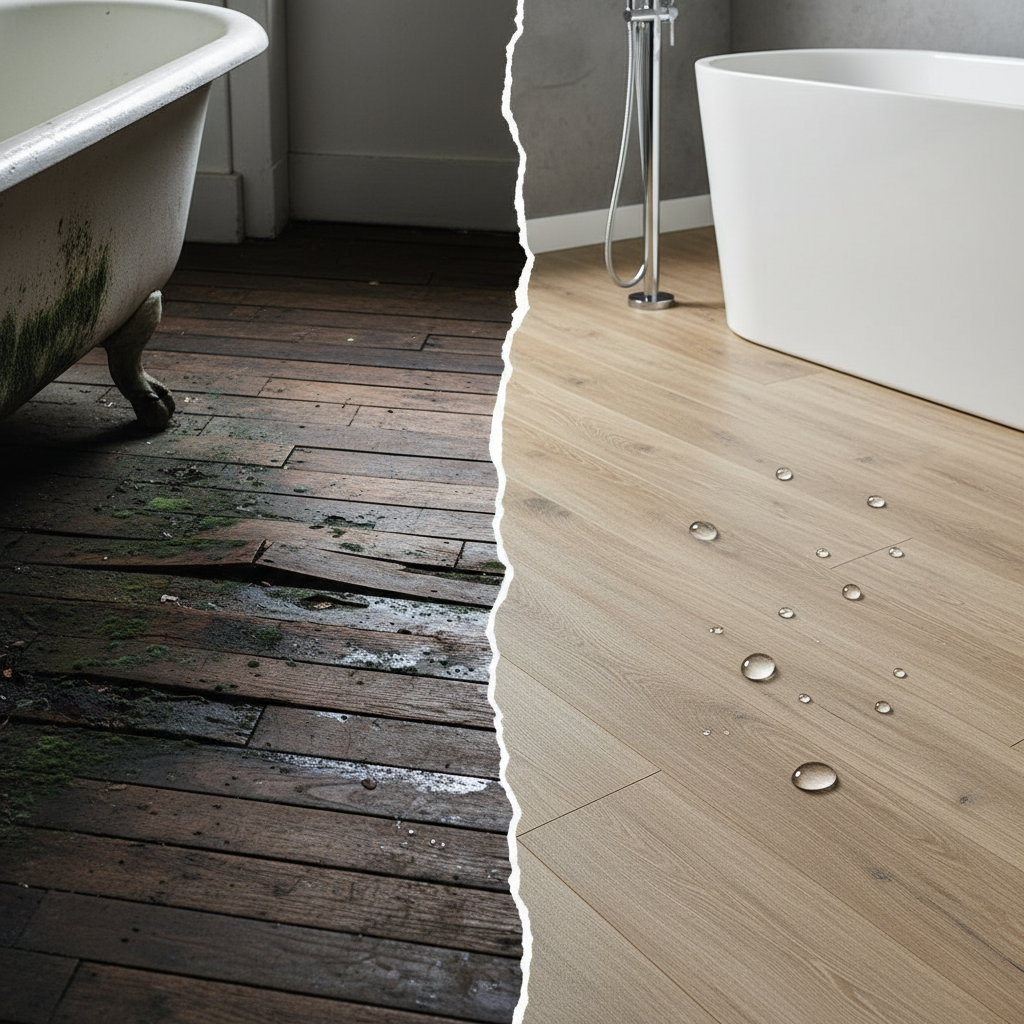
To understand why traditional solid hardwood is a liability in a bathroom, we must look at the physics of wood and water. Wood is a hygroscopic material, meaning it naturally absorbs and releases moisture depending on its environment. According to the National Wood Flooring Association (NWFA), wood flooring can expand up to 1/4 inch across a 10-foot span with significant relative humidity changes [1]. In a bathroom, where steam from showers and splashes from tubs are daily occurrences, this expansion and contraction cycle is extreme.
When diagnosing a warped wood floor in a bathroom, building science points to two primary physical reactions: “cupping” and “crowning.” Cupping occurs when the edges of a wood plank are higher than its center, indicating that the moisture source is coming from the bottom up (such as a damp subfloor). Conversely, crowning happens when the center of the board swells higher than the edges, which typically points to top-down moisture, like standing water left on the floor’s surface. Understanding these dynamics is critical for diagnosing bathroom flooring moisture problems and highlights the urgent need for truly waterproof alternatives.
Diagnosing Bathroom Flooring Moisture Problems
If you are noticing musty smells, peeling edges on older vinyl, or soft spots underfoot, you are likely dealing with a moisture problem. Diagnosing the root cause is the first step toward a permanent solution.
A diagnostic checklist for bathroom floors should map specific symptoms to their likely causes. For instance, efflorescence (a white, powdery residue) on concrete or peeling adhesive often points to a lack of a proper vapor barrier. It is a staggering building science fact that concrete subfloors can emit moisture vapor at rates exceeding 3 lbs per 1000 square feet—more than enough to cause traditional impermeable flooring to fail [2]. If your bathroom is situated over an unconditioned crawlspace or basement, upward vapor drive is a constant threat. Professionals utilize specific moisture testing methods, such as the Calcium Chloride test or in-situ Relative Humidity probes, to accurately measure this vapor emission before any new flooring is laid.
The Hidden Threat: Water Damaged Bathroom Floors and Mold
For homeowners currently dealing with water damaged bathroom floors from a burst pipe or overflowing toilet, the situation is urgent. The most critical hidden threat is mold, which can begin to grow within 24 to 48 hours of water exposure on organic flooring materials and subfloors [3].
To navigate this crisis, follow this basic Triage Guide:
- Stop the Source: Immediately shut off the water supply.
- Assess the Surface: If the water is clean and was caught within a few hours, aggressive DIY drying with high-volume fans and commercial dehumidifiers may save the surface.
- Evaluate the Subfloor: If water has seeped through the seams of laminate or traditional hardwood, the subfloor is likely soaked.
- Call the Professionals: If the floor is buckling, if the water was contaminated (grey or black water), or if 48 hours have passed, professional remediation is required. The Institute of Inspection, Cleaning and Restoration Certification (IICRC) and the EPA provide strict guidelines on mold cleanup and water damage restoration, emphasizing that structural rot and black mold are not DIY fixes [3], [4].
Demystifying Waterproof vs. Moisture-Resistant Bathroom Flooring
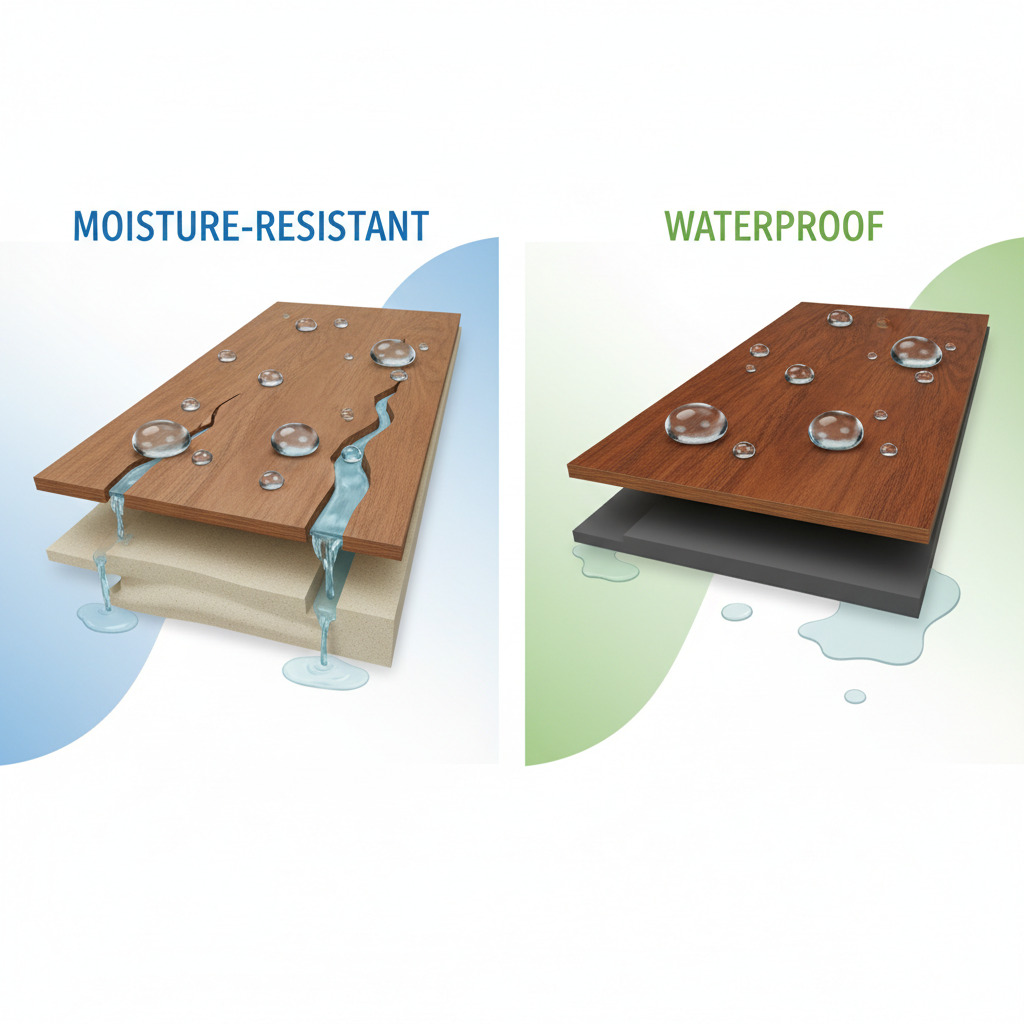
When shopping for a durable waterproof hardwood alternative, you will inevitably encounter confusing marketing jargon. The terms “waterproof” and “moisture-resistant” are often used interchangeably by salespeople, but in building science, they mean entirely different things.
According to industry manufacturing standards highlighted by Floor Covering Installer Magazine, “moisture-resistant” flooring can handle occasional, quickly wiped-up spills and ambient humidity [5]. However, this resistance often only applies to the top wear layer. The core of the plank (especially in traditional laminate) and the seams remain highly vulnerable. If water sits long enough to penetrate the joints, the core will swell and the floor will fail.
“Waterproof” flooring, on the other hand, means the material itself is impervious to water from top to bottom. Even if submerged, the structural integrity of a 100% waterproof plank will not degrade, making it the only acceptable choice for full bathrooms with showers or tubs.
Top Durable Waterproof Hardwood Alternatives
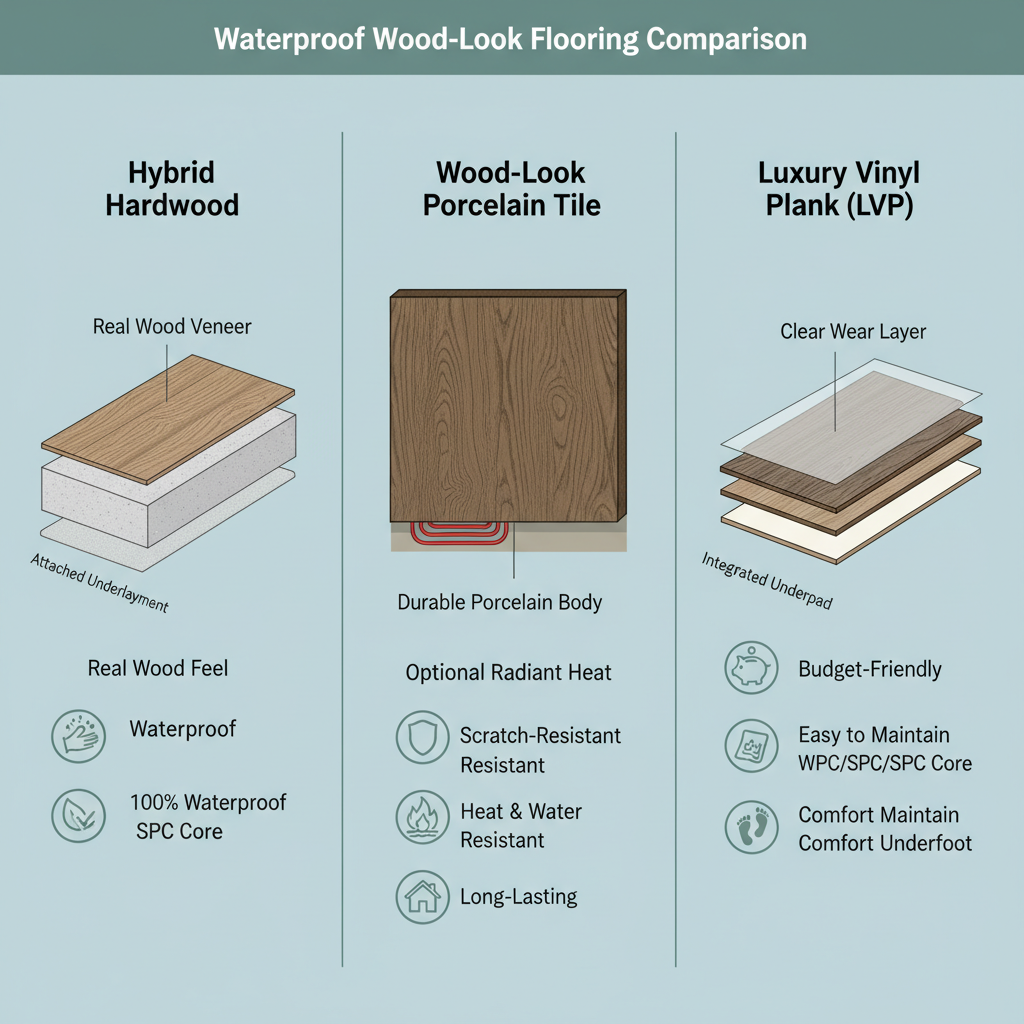
To help you choose the best waterproof wood flooring for bathrooms, we evaluate materials based on a “Bathroom Durability Score.” This proprietary framework ranks flooring based on simulated water-submersion resilience, scratch resistance, slip resistance (Coefficient of Friction, or COF ratings), and compatibility with radiant heating systems.
Hybrid Hardwood Floors: The Best of Both Worlds
Hybrid hardwood floors are revolutionizing the industry by offering the authentic texture of nature with the resilience of synthetic engineering. If you were to look at a 3D exploded diagram of a hybrid plank, you would see a highly durable, UV-cured top finish protecting a thin slice of genuine real-wood veneer. Below this veneer lies the secret weapon: a 100% waterproof rigid core (often made of stone polymer composite), backed by an attached acoustic underlayment.
Because the core is waterproof and the wood veneer is sealed, hybrid hardwood can typically withstand topical moisture for up to 72 hours without warping or cupping [1]. It provides the exact look and feel of solid hardwood because the top layer is real wood. However, homeowners should be aware of one limitation: because the real-wood veneer is thin, hybrid floors generally cannot be sanded and refinished multiple times like traditional solid hardwood.
Wood-Look Porcelain Tile: Ultimate Scratch & Water Resistance
For the absolute highest Bathroom Durability Score, wood-look porcelain tile reigns supreme. Porcelain is fired at extremely high temperatures, resulting in a dense, highly durable material. The Tile Council of North America (TCNA) notes that wood-look porcelain tile has a water absorption rate of less than 0.5%, making it completely impervious to water [6].
Furthermore, porcelain tile typically boasts a PEI (Porcelain Enamel Institute) rating of 4 or 5, making it incredibly scratch-resistant—perfect for households with large dogs or heavy foot traffic [6]. When textured properly, it also provides excellent slip resistance. Its only drawback is that it can feel cold and hard underfoot, though this is easily remedied by installing a radiant floor heating system beneath the tile.
Luxury Vinyl Plank (LVP): The Budget-Friendly Waterproof Champion
Luxury Vinyl Plank (LVP) is the undisputed champion of budget-friendly, waterproof bathroom flooring. In fact, vinyl flooring accounts for over 30% of new bathroom floor installations due to its 100% waterproof properties and ease of installation [7].
Modern LVP utilizes high-definition photographic layers to mimic the look of wood with astonishing realism. According to standards set by the Resilient Floor Covering Institute (RFCI), high-quality LVP features a thick wear layer that resists scratches and a waterproof core (WPC or SPC) that will not swell when exposed to leaks [7]. It is softer and warmer underfoot than porcelain tile, making it a highly comfortable and practical choice for any bathroom remodel.
Waterproof Wood-Look Flooring Ideas & Design Inspiration
Choosing a durable material doesn’t mean sacrificing aesthetics. Waterproof wood look flooring ideas can elevate your bathroom into a spa-like retreat or a modern farmhouse haven.
For a “Designer’s Take,” we look to principles championed by the American Society of Interior Designers (ASID). When matching wood tones with bathroom fixtures, contrast is key [8]. If you have a crisp, white, modern bathroom, a rich, dark walnut wood-look LVP can ground the space and add necessary warmth. Conversely, for a smaller bathroom, light white-oak hybrid hardwood can make the room feel airy and expansive. Don’t be afraid to utilize complex laying patterns; installing waterproof planks in a herringbone or chevron pattern instantly elevates the space from standard to custom-built luxury.
Mastering the Details: Grout Lines and Transition Strips
The secret to maintaining the illusion of real wood when using porcelain tile lies in the grout. Expert designers recommend selecting a grout color that is one shade darker than the darkest tone in your wood-look tile. This mimics the natural shadows that occur between real hardwood planks, creating a seamless visual flow.
Additionally, pay close attention to transition strips. Moving from a waterproof bathroom floor to a hallway carpet or hardwood requires a thoughtfully matched T-molding or reducer to ensure the design remains cohesive and tripping hazards are eliminated.
Bulletproof Installation: How to Install Hybrid Hardwood in Bathrooms
Even the most expensive waterproof flooring will fail if installed incorrectly. Improper installation, particularly the lack of expansion gaps and poor perimeter sealing, accounts for over 80% of waterproof flooring failures [9]. If you are researching how to install hybrid hardwood in bathrooms, following the strict standards set by the North American Laminate Flooring Association (NALFA) for floating floors is non-negotiable [9].
Subfloor Preparation and Moisture Barriers
The foundation of a bulletproof installation is a flat, clean, and dry subfloor. If installing over a concrete slab, you must address moisture vapor. This requires understanding the difference between a vapor retarder (which slows moisture) and a vapor barrier (which stops it). For concrete bathroom subfloors, a 6-mil polyethylene vapor barrier is typically required before laying a floating floor. If installing over wood joists and a plywood subfloor, ensure all rotted wood from previous leaks is completely replaced and the surface is leveled with a Portland cement-based patching compound.
Perimeter Sealing and Expansion Gaps (The 100% Silicone Rule)
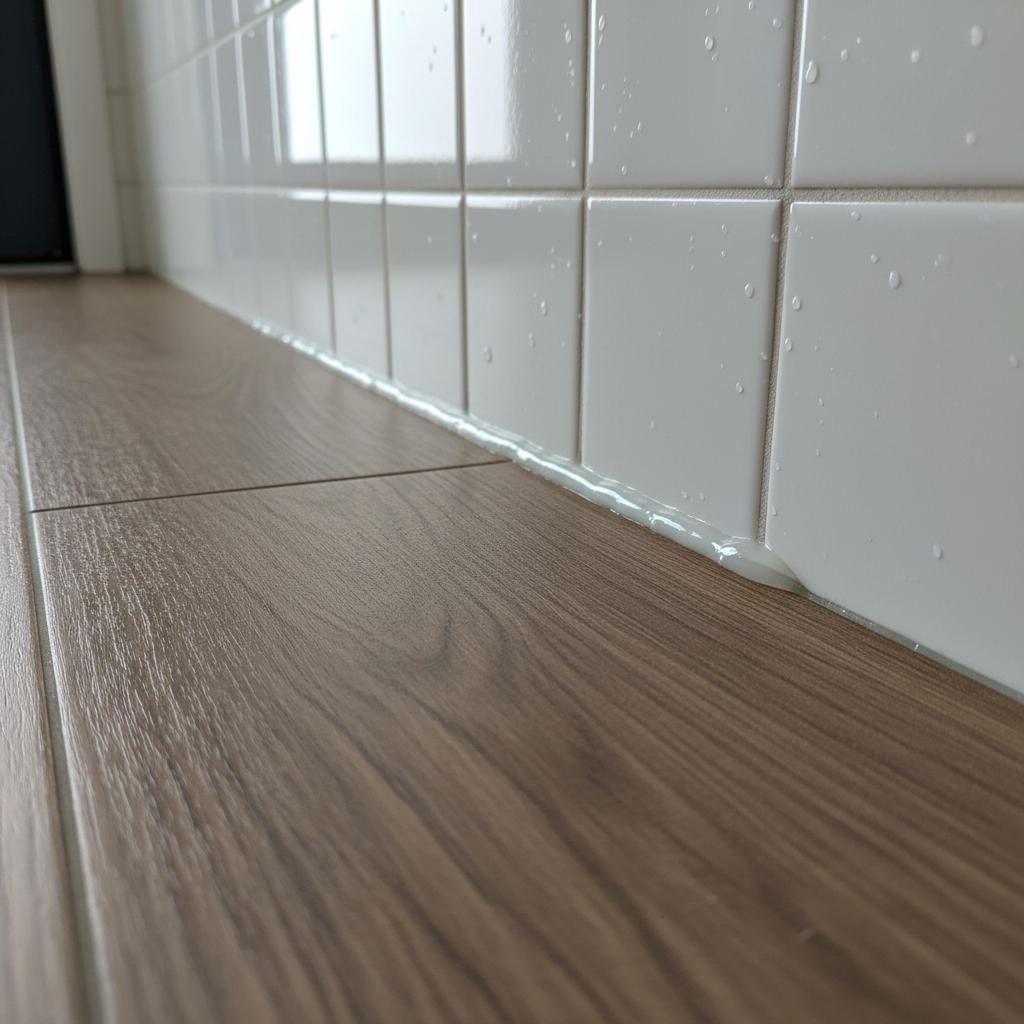
Water rarely damages waterproof planks from the top; it destroys floors by seeping underneath them through the perimeters. Because hybrid hardwood and LVP are floating floors, they require a 1/4-inch expansion gap around the entire perimeter of the room to accommodate temperature fluctuations.
Contractor’s Corner: To make this gap watertight, you must employ the “100% Silicone Rule.” After the floor is laid, fill the expansion gap between the flooring and the wall (or tub base) with a flexible, 100% silicone sealant before installing the baseboards. Furthermore, undercutting door jambs is critical in wet areas. Instead of cutting the flooring to fit around the door frame (which leaves an ugly, unsealable gap), use a jamb saw to cut the bottom of the door frame so the flooring can slide neatly underneath, allowing for a hidden, silicone-sealed expansion gap. Special care and heavy silicone must also be applied around tricky obstacles like toilet flanges to prevent hidden leaks.
Bathroom Flooring Remodel Solutions: Budgeting and ROI
A bathroom flooring remodel is a significant investment, but it is one that pays dividends in home equity. According to Remodeling Magazine’s Cost vs. Value Report, the average ROI for a mid-range bathroom remodel is approximately 60-70%, with flooring serving as a key visual and functional component of that valuation [10].
Good, Better, Best: Tiered Remodeling Guide
To help you budget your bathroom flooring remodel solutions, we have aligned materials with a tiered framework based on guidelines from the National Kitchen & Bath Association (NKBA) [11]:
- Good (Budget-Friendly, High Utility): Luxury Vinyl Plank (LVP). Ideal for quick updates, guest baths, and DIYers. It offers a fast renovation timeline and 100% waterproof peace of mind.
- Better (Mid-Range, Authentic Feel): Hybrid Hardwood. Perfect for master bathrooms where the authentic feel of real wood is desired without the moisture risk. Requires careful perimeter sealing.
- Best (High-End, Lifetime Durability): Wood-Look Porcelain Tile with Radiant Heating. The ultimate luxury choice. It requires a longer installation timeline and professional labor but offers lifetime durability and unmatched scratch resistance.
Remember, a true flooring remodel goes beyond the planks. To ensure a watertight seal and an updated aesthetic, factor the cost of new baseboards, shoe molding, and an updated toilet flange into your overall project budget.
Conclusion
Achieving the warm, luxurious aesthetic of a wood-look bathroom is entirely possible—and incredibly durable—when you prioritize building science and proper installation over mere aesthetics. By looking beyond the surface and understanding the critical differences between moisture-resistant and 100% waterproof materials, you can protect your home from the hidden threats of warping and mold. Whether you choose the budget-friendly resilience of LVP, the authentic texture of hybrid hardwood, or the lifetime durability of porcelain tile, success lies in the details of subfloor prep and silicone sealing. We encourage you to consult with a local certified flooring installer to begin your remodel safely and bring your waterproof wood-look vision to life.
Disclaimer: Consult a licensed general contractor or IICRC-certified professional for severe water damage, structural rot, or black mold remediation. Flooring warranties vary; always refer to the manufacturer’s specific installation guidelines.
References & Authoritative Sources
- National Wood Flooring Association (NWFA). (N.D.). Guidelines on Moisture and Wood Flooring Compatibility. Retrieved from NWFA industry standards.
- Building Science Corporation / Journal of Light Construction (JLC). (N.D.). Moisture Dynamics and Vapor Emission Rates in Concrete Subfloors.
- Institute of Inspection, Cleaning and Restoration Certification (IICRC). (N.D.). Standards for Professional Water Damage Restoration and Mold Remediation.
- Environmental Protection Agency (EPA). (N.D.). Official Guidelines on Mold Cleanup and Prevention in Homes.
- Floor Covering Installer Magazine. (N.D.). Defining Material Limitations: Moisture-Resistant vs. Waterproof Flooring.
- Tile Council of North America (TCNA). (N.D.). Porcelain Tile Durability Standards, Water Absorption, and PEI Ratings.
- Resilient Floor Covering Institute (RFCI). (N.D.). Industry Standards and Market Data for Luxury Vinyl Flooring.
- American Society of Interior Designers (ASID). (N.D.). Interior Design Standards and Aesthetic Curation for Bathroom Remodeling.
- North American Laminate Flooring Association (NALFA). (N.D.). Floating Floor Installation Standards and Failure Statistics.
- Remodeling Magazine. (N.D.). Cost vs. Value Report: Average ROI for Mid-Range Bathroom Remodels.
- National Kitchen & Bath Association (NKBA). (N.D.). Professional Standards for Bathroom Design, Budgeting, and Remodeling.
