
That heart-stopping moment when a glass of red wine topples over, a pet has an accident, or melting snow pools by the door—it’s an anxiety every owner of traditional hardwood floors knows well. For decades, the timeless beauty of real wood has come with a non-negotiable compromise: a constant vulnerability to water, scratches, and the general chaos of a busy life. We’ve been told to accept this as the price of admission.
This guide is here to dismantle that myth. The idea of a truly “indestructible” wood floor might be a fantasy, but modern flooring technology has come incredibly close to making everyday worries obsolete. We’re cutting through the confusing marketing hype to give you a clear, honest comparison between revolutionary waterproof hybrid hardwood and the traditional solid wood you grew up with.
In this definitive guide, we will explore the science behind why traditional wood fails, deconstruct the advanced technology of its waterproof successor, and put them head-to-head in a showdown of durability, cost, and longevity. By the end, you’ll have the expert knowledge to choose the perfect, worry-free wood floor for your home and your life.
- Why Traditional Hardwood Floors Are So Vulnerable
- The Solution Arrives: What Is Waterproof Hybrid Hardwood?
- The Ultimate Showdown: Hybrid Hardwood vs. Traditional Hardwood
- A Deep Dive on Durability: Choosing a Floor That Lasts
- Installation Insights: Can Hybrid Hardwood Go Where Wood Can’t?
- Maintenance and Repair: Protecting Your Investment
- Conclusion: Choose the Right Floor for Your Reality
- References & Authoritative Sources
Why Traditional Hardwood Floors Are So Vulnerable
Before we can appreciate the solution, we must first understand the problem. Traditional solid hardwood is, at its core, a natural, porous material. Its organic structure is precisely what gives it beauty and warmth, but it’s also the source of its greatest weaknesses when it comes to moisture and wear.
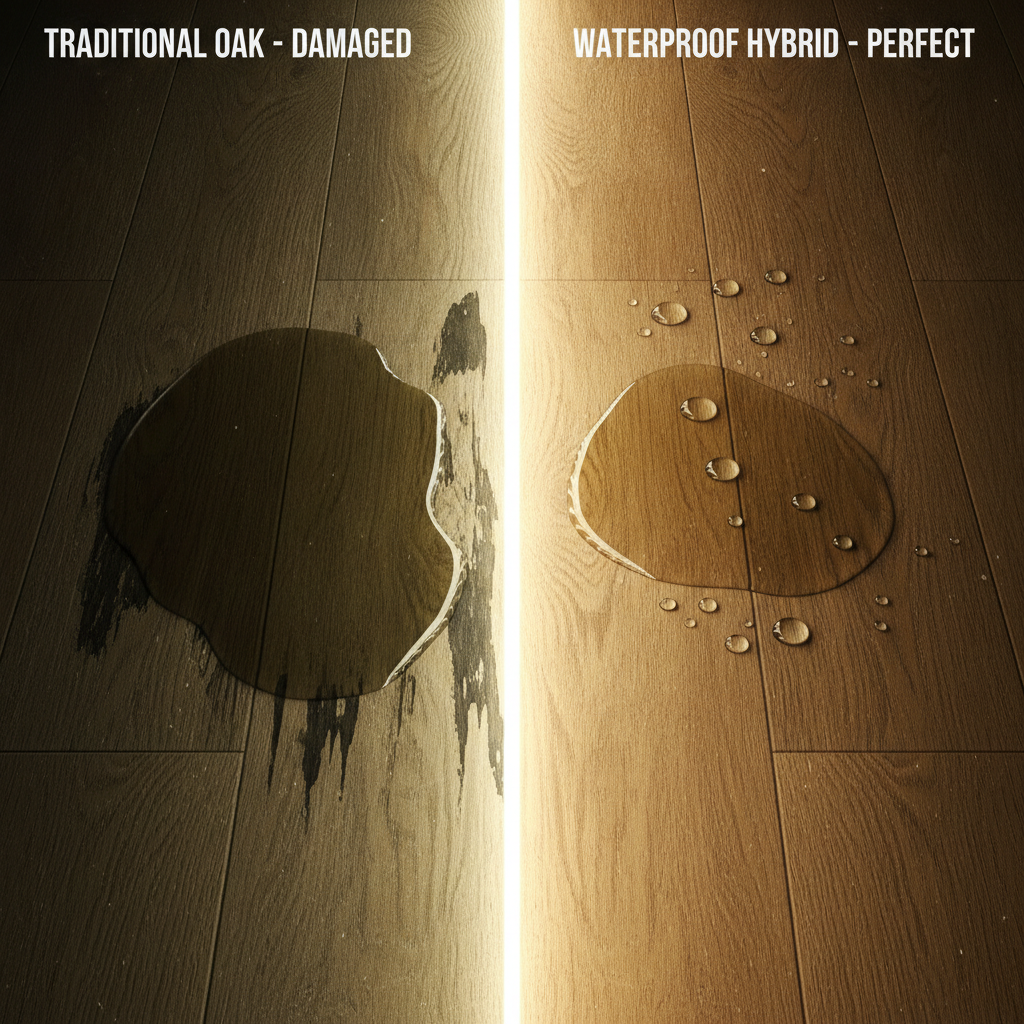
The Science of Wood and Water: Cupping, Crowning, and Buckling Explained
Wood is a hygroscopic material, meaning it naturally absorbs and releases moisture from the air to match its surrounding environment. This process of reaching a balance is known as achieving Equilibrium Moisture Content (EMC) [1]. When this balance is disrupted by a leak, high humidity, or improper acclimation, the results can be disastrous for your floors.
As wood fibers absorb excess moisture, they swell and expand. This expansion is the root cause of several common types of hardwood floor water damage:
- Cupping: The edges of a plank become higher than its center, creating a concave, “cupped” shape. This happens when there is more moisture on the bottom of the board than on the top, often from a damp subfloor.
- Crowning: The opposite of cupping, where the center of the plank is higher than its edges. This typically occurs after a floor that was cupping has been sanded flat before it was fully dried, trapping moisture in the belly of the board.
- Buckling: The most severe form of water damage, where the flooring expands so much that it lifts completely off the subfloor, sometimes by several inches. This is usually caused by a significant flooding event.
According to the National Wood Flooring Association (NWFA), the industry-governing body, maintaining an indoor relative humidity between 35% and 55% is critical for the stability of solid wood flooring [3]. Furthermore, the subfloor must be properly prepared; for example, a concrete subfloor should have a moisture content of less than 3 lbs per 1000 sq ft per 24 hours before wood installation to prevent these issues [3].
If you experience a leak, immediate action is crucial. An IICRC-certified water damage technician would advise you to first stop the source of the water, then immediately remove all surface water with towels or a wet-vac. Next, use fans and dehumidifiers to aggressively dry the area and promote airflow to prevent long-term damage and mold growth [2].
The Durability Dilemma: Scratches, Dents, and Everyday Wear
Beyond moisture, there’s the daily battle against physical damage. From a dog’s claws skittering across the floor to a dropped toy or dragged furniture, scratches and dents are a constant concern.
The industry standard for measuring a wood species’ resistance to denting is the Janka Hardness Test [4]. This test measures the force required to embed a steel ball into the wood. A high-Janka wood like Brazilian Walnut (rated around 3680) is significantly more dent-resistant than a softer wood like Red Oak (rated around 1290).
However, as professional floor refinishers often point out, homeowners can put too much emphasis on the Janka rating. The reality is that the factory-applied finish is your floor’s true first line of defense against scratches and stains. A high-quality, multi-layer finish on a medium-hardness wood will often outperform a high-Janka wood with a poor finish in a real-world family environment.
The Solution Arrives: What Is Waterproof Hybrid Hardwood?
Frustrated by the inherent vulnerabilities of traditional wood, engineers sought to create a new category of flooring: one that delivered the authentic beauty of real wood without the performance compromises. The result is waterproof hybrid hardwood, an advanced hardwood solution that represents a true technological leap.
At its core, hybrid hardwood is an engineered composite product. It’s not solid wood, but it’s not fake wood, either. It cleverly combines the best attributes of multiple materials to create a high-performance floor.
Deconstructing the Plank: Real Wood Veneer + Stone-Polymer Core
To truly understand hybrid hardwood, you have to look at its layers. Answering the question “Is it real wood?” requires a nuanced “Yes, and…”
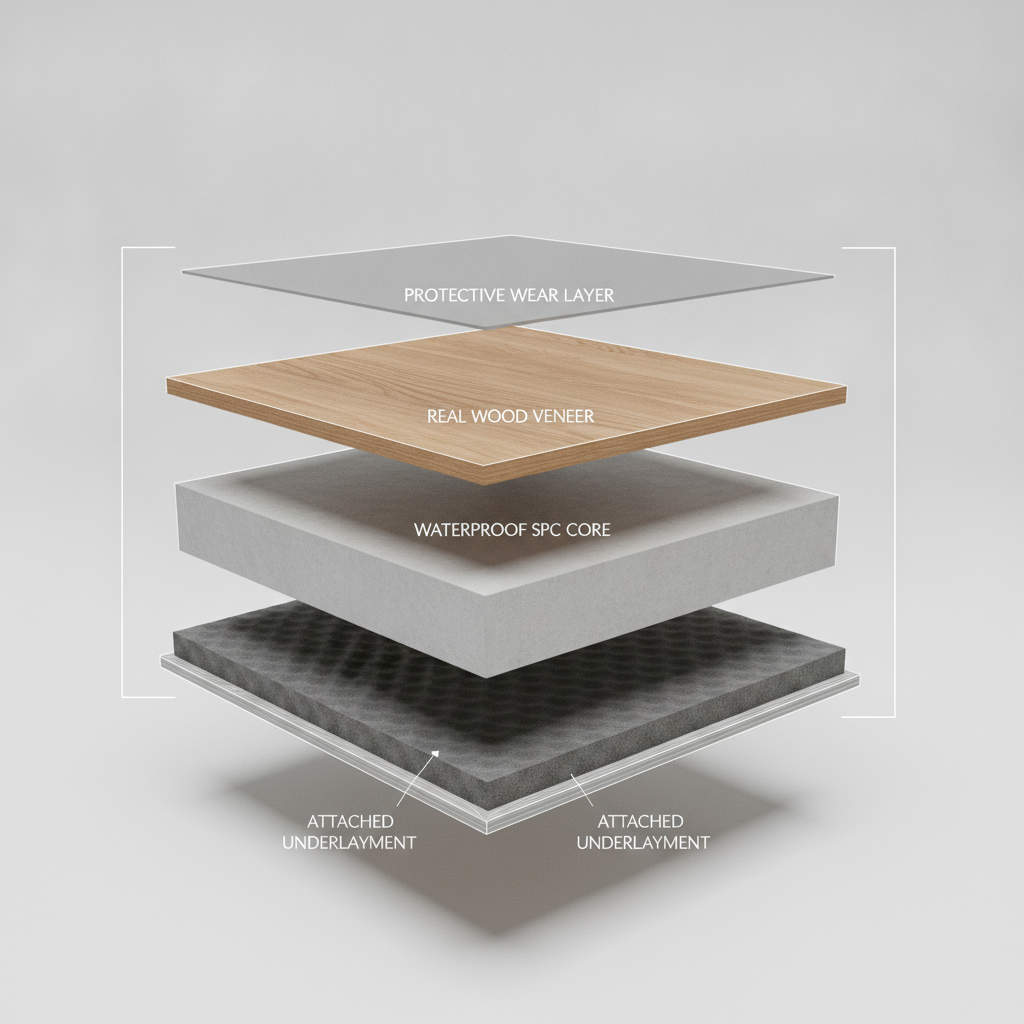
- Protective Wear Layer: The top is a transparent, highly durable coating, often infused with aluminum oxide or ceramic particles, that provides commercial-grade scratch and stain resistance.
- Real Wood Veneer: Directly beneath the wear layer is a thin slice of genuine hardwood—species like oak, hickory, or maple. This veneer, typically 1.2mm to 2mm thick, provides the unique grain, texture, and natural beauty that can’t be replicated.
- Waterproof Core: This is the game-changing innovation. The wood veneer is bonded to a rigid, 100% waterproof core. Most commonly, this is a Stone-Polymer Composite (SPC) core, a dense mixture of natural limestone powder, polyvinyl chloride, and stabilizers [5]. This core is completely inert to water; it will not swell, warp, or buckle, no matter how wet it gets.
- Attached Underlayment: Most hybrid planks come with a pre-attached underlayment, often made of IXPE foam, which provides sound absorption, cushioning underfoot, and a moisture barrier.
This construction leads to common questions and misconceptions, which are best addressed directly.
Hybrid Hardwood: Myth vs. Reality
| Myth | Reality |
|---|---|
| “It’s just fancy laminate or vinyl flooring.” | False. Laminate uses a photographic image of wood, and vinyl (LVP) is entirely synthetic. Hybrid hardwood uses a layer of real, genuine hardwood, giving it authentic texture and visual depth. |
| “It’s fake wood.” | False. The part you see and touch is real wood. The innovation is the high-performance waterproof core it’s bonded to. |
| “It feels cheap and hollow underfoot.” | Not necessarily. The dense SPC core and attached underlayment give it a solid, substantial feel, especially when compared to older laminate products. |
| “You can’t refinish it, so it’s disposable.” | It’s true that the thin veneer cannot be sanded and refinished like solid wood. However, its ultra-durable topcoat is designed to resist the damage that would necessitate refinishing in the first place. |
Waterproof vs. Water-Resistant: A Critical Distinction
One of the most confusing areas for consumers is the difference between “waterproof” and “water-resistant.” These terms are not interchangeable, and understanding the distinction is crucial.
- Waterproof: This term describes the core material of the plank itself. A waterproof floor, like one with an SPC core, can be fully submerged in water for an extended period and will not swell, warp, or structurally degrade. This claim is backed by scientific standards like the ASTM D1037 water absorption test, which measures how much mass a material gains after being soaked [6].
- Water-Resistant: This term typically describes the surface of a floor. A traditional solid or engineered wood floor with a good finish is water-resistant, meaning it can repel topical spills for a short time, giving you a window to clean them up. However, if water sits too long or seeps between the planks, it will be absorbed by the wood core, leading to damage.
The waterproof integrity of a hybrid floor system also relies on a tight plank locking mechanism. These precision-milled locking systems create a seam that is highly resistant to water seeping through to the subfloor, protecting not just the planks but the entire structure of your home.
Flooring Moisture Defense Comparison
| Feature | Waterproof Hybrid Hardwood | Water-Resistant Solid Hardwood | Luxury Vinyl Plank (LVP) |
|---|---|---|---|
| Core Material | 100% Waterproof SPC (Stone-Polymer) Core | Solid Wood (Porous & Absorbent) | 100% Waterproof Vinyl Core |
| Moisture Protection | Plank core is impervious to water. Tight seams resist seepage. | Surface finish repels spills temporarily. Seams are vulnerable. | Plank core is impervious to water. Tight seams resist seepage. |
| Best Use Case | Kitchens, bathrooms, basements, any room in the house. | Living rooms, bedrooms, dining rooms (dry areas). | Kitchens, bathrooms, basements, any room in the house. |
| Failure Mode | Subfloor can still be damaged if water gets around the perimeter. | Cupping, crowning, buckling, gapping, mold. | Subfloor can still be damaged if water gets around the perimeter. |
The Ultimate Showdown: Hybrid Hardwood vs. Traditional Hardwood
With the technology explained, it’s time for a direct, head-to-head comparison across the factors that matter most to homeowners.
Feature-by-Feature Comparison
| Feature | Waterproof Hybrid Hardwood | Traditional Solid Hardwood |
|---|---|---|
| Water Resistance | Winner. 100% waterproof core. Can be installed in bathrooms, kitchens, and basements. | Highly vulnerable. Water can cause permanent damage like cupping and buckling. Not for wet areas. |
| Durability/Scratch Resistance | Winner. Commercial-grade wear layer (e.g., aluminum oxide) offers superior scratch resistance. | Varies by species (Janka rating) and finish, but generally more prone to scratches and dents. |
| Refinishing & Lifespan | Cannot be sanded and refinished. Lifespan is tied to the durability of the wear layer (25-35+ years). | Winner. Can be sanded and refinished 4-6 times, offering a potential lifespan of 80-100+ years. |
| Cost (Installed) | Moderate to High ($7 – $15 per sq. ft.). | Moderate to Very High ($8 – $20+ per sq. ft.). |
| Aesthetics | Authentic real wood surface. Planks can be wider and longer due to core stability. | Tie. The timeless standard for beauty. Offers endless species, stain, and finish combinations. |
| Installation Areas | Winner. Approved for all levels of the home, including below-grade (basements). | Not recommended for below-grade or high-moisture areas. |
| Resale Value | Adds good value, especially the “waterproof” feature in kitchens and basements. | Winner. Considered a premium, long-term investment that adds significant value to a home. |
According to real estate professionals, while traditional hardwood is still seen as a gold standard, the practical benefits of waterproof flooring are becoming a major selling point, especially for families [7].
Refinishing and Lifespan: The 100-Year Floor vs. The Modern Solution
The single biggest advantage of traditional solid hardwood is its potential for renewal. When the floor becomes scratched and worn after a decade or two of use, it can be sanded down to bare wood and refinished to look brand new. This process can be repeated 4-6 times, giving solid hardwood a potential lifespan of 80-100 years or more [8].
Waterproof hybrid hardwood, with its thin 1.2mm-2mm wood veneer, cannot be sanded. Its lifespan is determined by the durability of its factory-applied wear layer. While this may seem like a disadvantage, these high-tech finishes are engineered to withstand decades of heavy use, often coming with 25-year, 35-year, or even lifetime residential wear warranties [9]. The trade-off is simple: incredible upfront durability versus the option of future renewal.
Cost Comparison: Upfront Investment vs. Long-Term Value
On average, the material and installation costs for both products are in a similar premium range. Solid hardwood can have a higher ceiling for exotic species and complex installations. However, the true cost calculation must include long-term value and risk. A single plumbing leak or appliance failure can lead to a multi-thousand-dollar repair or replacement bill for a solid hardwood floor—a risk that is virtually eliminated with a waterproof hybrid floor. The warranty on a hybrid floor often covers topical moisture and manufacturing defects for decades, providing peace of mind that is a significant part of its value proposition [9].
Feel, Sound, and Aesthetics: Addressing the Intangibles
One of the most cited content gaps when comparing these floors is the discussion of feel and sound. Traditional solid hardwood, nailed to a wood subfloor, has a uniquely solid, warm feel and a quiet sound underfoot that many people love.
Hybrid hardwood, as a “floating floor” installed over a pad, can sometimes feel different. However, modern products have largely solved this. The dense SPC core provides a rigid, substantial feel, not the hollow or “clicky” sound of older laminates. The pre-attached IXPE foam underlayment does an excellent job of absorbing sound, making for a quiet and comfortable floor. Aesthetically, both offer the genuine beauty of wood because both use real wood as the visual surface.
A Deep Dive on Durability: Choosing a Floor That Lasts
For households with pets, children, and high traffic, durability is paramount. This goes beyond just being waterproof and extends to resisting the daily onslaught of scratches, scuffs, and impacts.
Durability Tier List for a Busy Household
| Tier | Flooring Type | Best For… | Why? |
|---|---|---|---|
| S-Tier | Waterproof Hybrid Hardwood (with Aluminum Oxide) | Homes with large dogs, active kids, and high traffic in areas like kitchens and entryways. | Combines a commercial-grade, scratch-resistant wear layer with a 100% waterproof and dent-resistant core. The ultimate “peace of mind” floor. |
| A-Tier | Solid Hardwood (High Janka + Premium Finish) | Living rooms and bedrooms in active homes; for those who prioritize refinishing ability. | Species like Brazilian Walnut or Hickory (Janka ~3680 / ~1820) paired with a factory-applied aluminum oxide finish offer excellent dent and scratch resistance. |
| B-Tier | Luxury Vinyl Plank (LVP) | Basements, laundry rooms, or for budget-conscious families who need maximum waterproofness and durability. | Extremely durable and waterproof, but lacks the authentic look and feel of real wood. |
| C-Tier | Solid Hardwood (Medium Janka + Standard Finish) | Lower-traffic areas like formal dining rooms or home offices. | Classic choices like Red Oak (Janka ~1290) are beautiful but will show wear and scratches more easily from pets and kids without a top-tier finish. |
More Than Janka: Why the Finish is Your First Line of Defense
As mentioned, the Janka rating only tells half the story. The clear wear layer on top of the wood is what you, your kids, and your pets actually live on. High-performance hardwood, whether hybrid or solid, utilizes advanced finishing technology.
The best factory-applied finishes consist of 7-10 layers of UV-cured urethane with an aluminum oxide or ceramic particle infusion. This creates an incredibly hard and durable surface that resists abrasion. Look for products with a commercial wear rating, such as an AC4 or AC5 rating, which indicates the finish is tough enough for light or general commercial settings and will easily stand up to residential traffic. Objective measures of performance, like the ASTM Taber Test for abrasion resistance, are used by manufacturers to validate these durability claims [10].
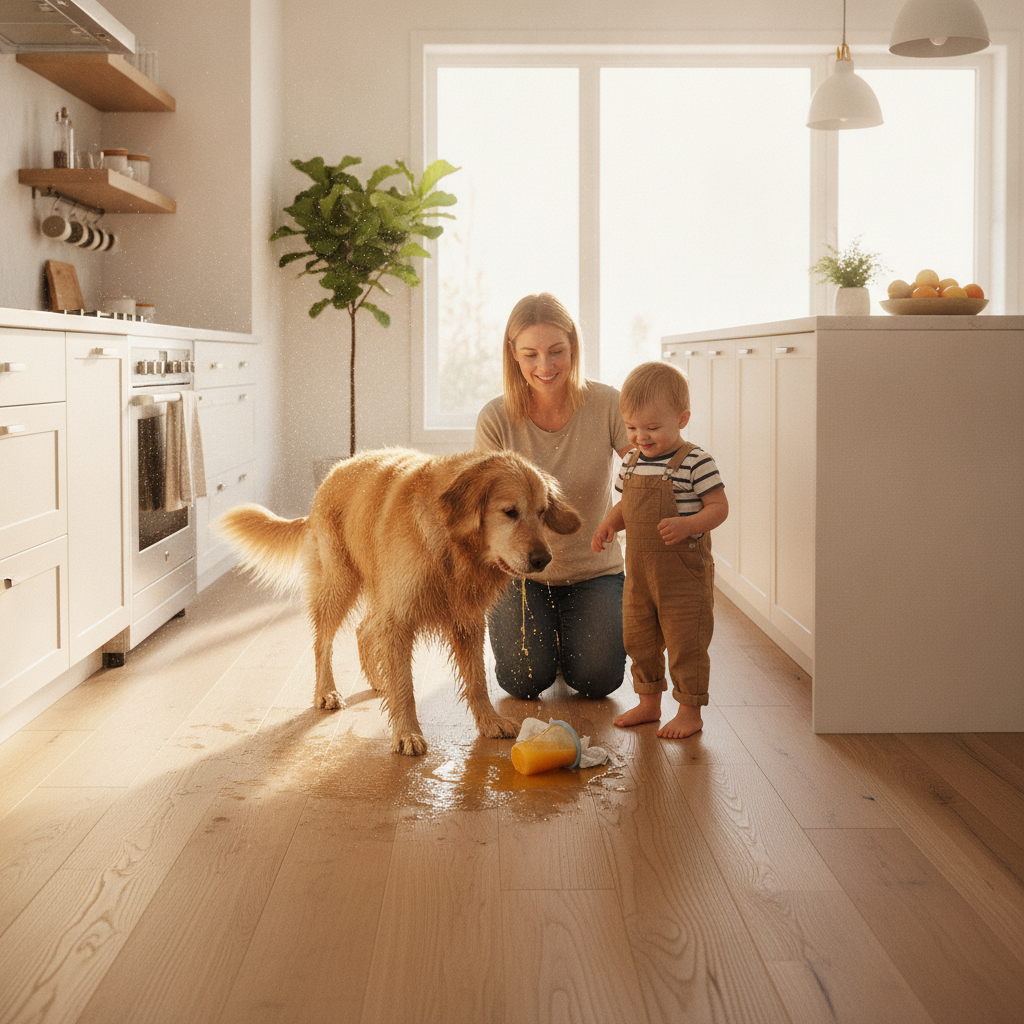
Best Flooring for Pets and Kids: The Ultimate Test
When choosing a floor for a family with pets and kids, three factors rise to the top: scratch resistance, safety, and health.
- Scratch Resistance: Hybrid hardwood’s aluminum oxide topcoat is the clear winner here, offering the best defense against pet claws.
- Safety & Traction: Extremely smooth, glossy floors can be hazardous for pets, potentially leading to joint issues. The American Kennel Club (AKC) recommends floors with texture and a matte or satin finish to provide better traction [11]. Many hybrid and solid hardwood floors offer wire-brushed or hand-scraped textures that are ideal for this.
- Health & Air Quality: Flooring can be a significant source of Volatile Organic Compounds (VOCs), which can impact indoor air quality. For the health of your family, look for products with third-party certifications like FloorScore or Greenguard Gold. These certifications ensure the flooring meets strict, low-VOC emissions standards, making them a safer choice for your home [12].
Installation Insights: Can Hybrid Hardwood Go Where Wood Can’t?
One of the most significant advantages of waterproof hybrid hardwood is its versatility. Thanks to its stable, waterproof SPC core, it can be safely installed in areas that have always been off-limits to traditional wood.
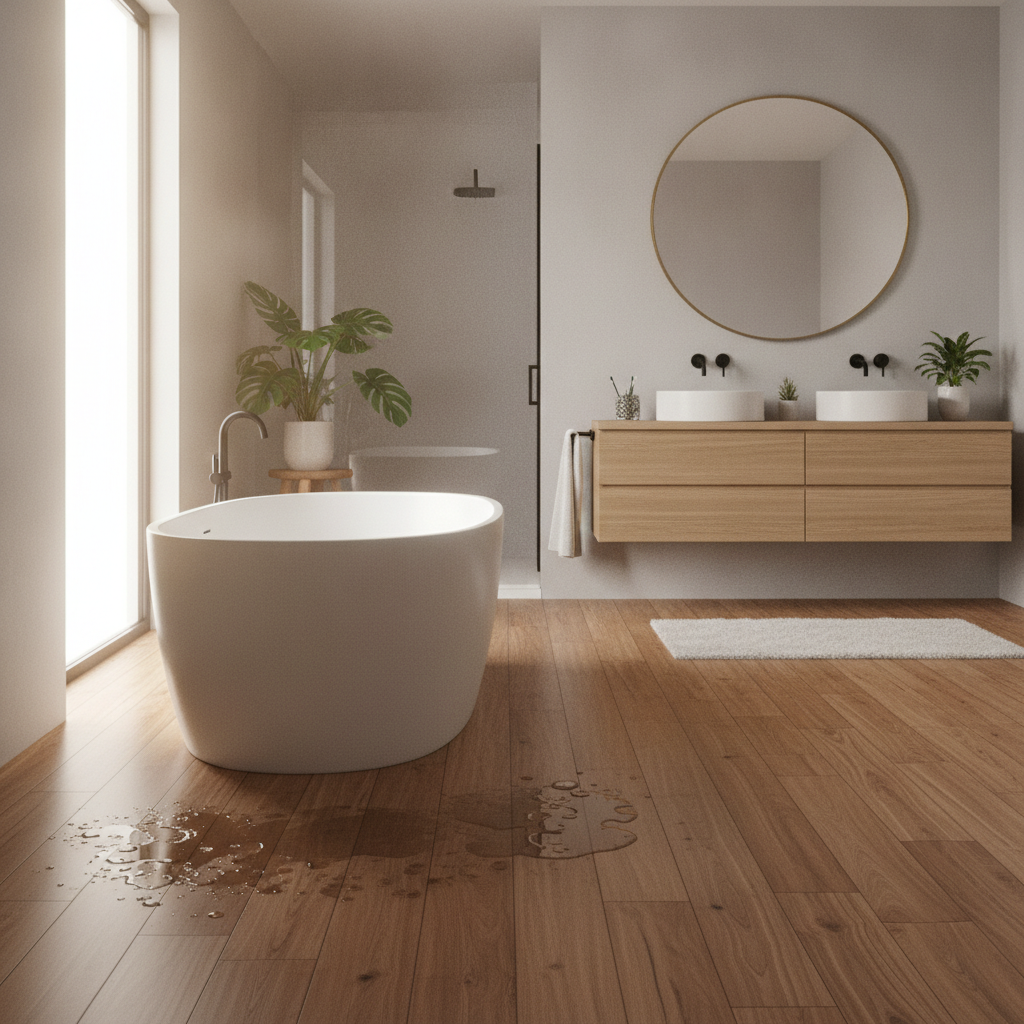
The Bathroom Test: A Definitive Guide
So, is hybrid hardwood flooring good for bathrooms? The answer is a qualified “Yes, but only if installed correctly.”
While the planks themselves are 100% waterproof, the seams and the perimeter of the room are potential points of water intrusion. If water gets under the floor, it can damage the subfloor and lead to mold growth. To prevent this, a successful bathroom installation is non-negotiable and must follow manufacturer specifications to the letter.
Bathroom Installation: Do’s and Don’ts
| Do | Don’t |
|---|---|
| DO read the manufacturer’s warranty carefully for any clauses related to full-bath installs. | DON’T assume all “waterproof” floors are warranted for a bathroom with a shower or tub. |
| DO ensure the subfloor is clean, flat, and dry before starting. | DON’T install directly over a damaged or wet subfloor. |
| DO use 100% silicone sealant in the expansion gap around the entire perimeter of the room. | DON’T nail or glue down baseboards so tightly that they prevent the floor from expanding. |
| DO seal around toilets, tubs, and vanities with silicone. | DON’T forget to seal any pipes or vents that penetrate the flooring. |
As experts from the Tile Council of North America (TCNA) would confirm, the principle of creating a sealed, waterproof “pan” is essential in any wet area, regardless of the flooring material used [13]. For hybrid hardwood, this is achieved with a proper vapor barrier and meticulous sealing of all edges.
Basements and Below-Grade Installations
Basements present a unique challenge due to the risk of moisture wicking up through the concrete slab, a phenomenon known as hydrostatic pressure. For this reason, the NWFA guidelines explicitly state that solid hardwood should never be installed below grade (below ground level) [3].
This is where waterproof hybrid flooring shines. Its SPC core is completely unaffected by topical moisture or vapor emissions from the concrete. This makes it an ideal solution for creating a warm, beautiful, and worry-free living space in a basement. However, even with a waterproof floor, it is still critical to test the subfloor for moisture and use an appropriate vapor barrier to protect the overall health of the structure and prevent mold.
Maintenance and Repair: Protecting Your Investment
No floor is truly indestructible, and accidents will happen. Knowing how to maintain and repair your floor is key to protecting your investment for the long term.
A Decision Tree for Scratches: To DIY or Call a Pro?
When you discover a scratch, the first step is to assess its severity. Using the wrong method can make the damage look even worse.
- Level 1: Minor Scuffs (DIY): For light scratches that are only in the top finish, a manufacturer-approved cleaner or a simple trick like rubbing the meat of a walnut into the scratch can sometimes hide it.
- Level 2: Deeper Scratches (DIY Kits): For scratches that have removed the finish but not the wood’s color, a stain pen or a scratch repair kit from brands like Minwax or Bona can be effective [15]. The key is to perfectly match the color and sheen of your floor’s finish. Before attempting a repair, it’s crucial to identify if your finish is polyurethane (most common) or a penetrating oil/wax finish, as the repair methods are completely different.
- Level 3: Severe Gouges (Professional Help): For deep scratches that have removed the wood’s color or for widespread damage, it’s time to call a professional. For traditional hardwood, a “screen and recoat” can fix widespread surface-level scratches for about $1-$2 per square foot. A full sand and refinish, required for deep damage, costs between $3-$7 per square foot. For hybrid hardwood, a professional can sometimes replace a single damaged plank without having to replace the entire floor.
Conclusion: Choose the Right Floor for Your Reality
The debate between waterproof hybrid hardwood and traditional hardwood isn’t about which one is definitively “better”—it’s about which one is better for you. The myth of the indestructible wood floor has been replaced by the reality of specialized flooring technology. You no longer have to accept a floor that dictates how you live your life.
Traditional solid hardwood remains the undisputed champion of longevity and timeless, renewable beauty. For the homeowner who values that 100-year potential and lives in a way that can protect it, it is a magnificent investment.
Waterproof hybrid hardwood is the modern problem-solver. It offers the authentic look of real wood with a level of durability and water protection that finally allows you to have wood floors in your kitchen, bathroom, and basement without fear. For a busy family with kids, pets, and a life full of unpredictable moments, it provides invaluable peace of mind.
You are now equipped with the expert knowledge to see past the marketing slogans and understand the science in the showroom. You can confidently choose a floor that not only matches your home’s aesthetic but, more importantly, matches the reality of your life.
Download our free ‘Floor Selection Checklist’ to take with you to the showroom, ensuring you ask the right questions and choose the perfect, durable wood floor for your home.
References & Authoritative Sources
- U.S. Forest Products Laboratory. (N.D.). Wood Handbook, Chapter 13: Moisture Relations and Physical Properties of Wood.
- Institute of Inspection, Cleaning and Restoration Certification (IICRC). (N.D.). S500 Standard for Professional Water Damage Restoration.
- National Wood Flooring Association (NWFA). (N.D.). Installation Guidelines.
- Janka Hardness Test. (N.D.). Standardized test methodology for measuring the hardness and dent resistance of wood species.
- Floor Covering Institute. (N.D.). Technical definitions and standards for flooring materials, including Stone-Polymer Composite (SPC).
- ASTM International. (N.D.). ASTM D1037: Standard Test Methods for Evaluating Properties of Wood-Base Fiber and Particle Panel Materials.
- Realtor.com / Zillow. (N.D.). Data reports on home features that affect resale value.
- World Floor Covering Association (WFCA). (N.D.). Industry resource for flooring trends, product information, and lifecycle analysis.
- Pergo / Armstrong. (N.D.). Manufacturer technical data sheets and warranties.
- ASTM International. (N.D.). ASTM D4060: Standard Test Method for Abrasion Resistance of Organic Coatings by the Taber Abraser.
- American Kennel Club (AKC). (N.D.). Expert advice on dog-friendly home design and surfaces.
- Greenguard Certification / FloorScore. (N.D.). Third-party certification programs for low-VOC emissions and indoor air quality standards.
- Tile Council of North America (TCNA). (N.D.). TCNA Handbook for Ceramic, Glass, and Stone Tile Installation.
- Mohawk Flooring. (N.D.). Manufacturer Installation Guide.
- Bona / Minwax. (N.D.). Manufacturer guides for floor finish repair products.
