
The decision feels monumental. On one hand, you have the timeless, soul-stirring beauty of traditional solid hardwood—the kind that whispers stories of heritage and adds undeniable value to a home. On the other, you face the relentless demands of modern life: spilled juice from the kids, the click-clack of a pet’s claws, and the ever-present fear of a dishwasher leak. This is the homeowner’s dilemma. Do you choose classic beauty or practical resilience?
For years, this was a compromise. But a new challenger has entered the ring: waterproof hybrid hardwood. It promises the authentic look of real wood with a core built to defy water, scratches, and the chaos of a busy household.
But how does it truly stack up? This is your definitive, jargon-free guide. We’re cutting through the marketing hype to compare traditional solid hardwood and waterproof hybrid hardwood head-to-head. We’ll deconstruct how they’re made, battle-test their durability and water resistance, analyze the costs, and ultimately empower you to choose the perfect floor for your real-life demands.
- Understanding the Contenders: Deconstructing Hybrid and Traditional Hardwood
- The Ultimate Showdown: Hybrid vs. Traditional Hardwood Head-to-Head
- The Real-World Test: What’s Best for Families and Pets?
- The Verdict: Which Hardwood Flooring is the Right Choice for You?
- Bonus: Quick-Fix Guide for Common Hardwood Problems
- Conclusion
- References & Authoritative Sources
Understanding the Contenders: Deconstructing Hybrid and Traditional Hardwood
Before we can declare a winner, we need to understand the fundamental DNA of each flooring type. Their construction is the source of all their strengths and weaknesses. It’s crucial to understand what “solid” and “hybrid” truly mean. The National Wood Flooring Association (NWFA), the leading authority on industry standards, provides clear classifications for wood flooring types, which helps to distinguish these products from one another.1
What is Traditional Solid Hardwood Flooring?
Just as the name implies, a solid hardwood floor plank is milled from a single, solid piece of lumber. Whether it’s classic oak, rich maple, or exotic hickory, the plank is 100% real wood from top to bottom.
This simple, pure construction gives solid hardwood its most celebrated characteristic: longevity. Because it’s a thick plank of solid wood, it can be sanded down and refinished multiple times over its life. A floor that gets scratched and worn after 15 years can be professionally restored to look brand new. This is why solid hardwood floors can last for generations, becoming an integral part of a home’s character. However, this all-wood construction is also its Achilles’ heel. Wood naturally expands and contracts with changes in humidity and is extremely susceptible to water damage, making it unsuitable for basements, full bathrooms, or other moisture-prone areas.
What is Waterproof Hybrid Hardwood Flooring?
Waterproof hybrid hardwood is an advanced, multi-layered flooring product designed to solve the problems of its solid wood predecessor. It’s not just one thing; it’s an engineered system. Here’s how it’s constructed:
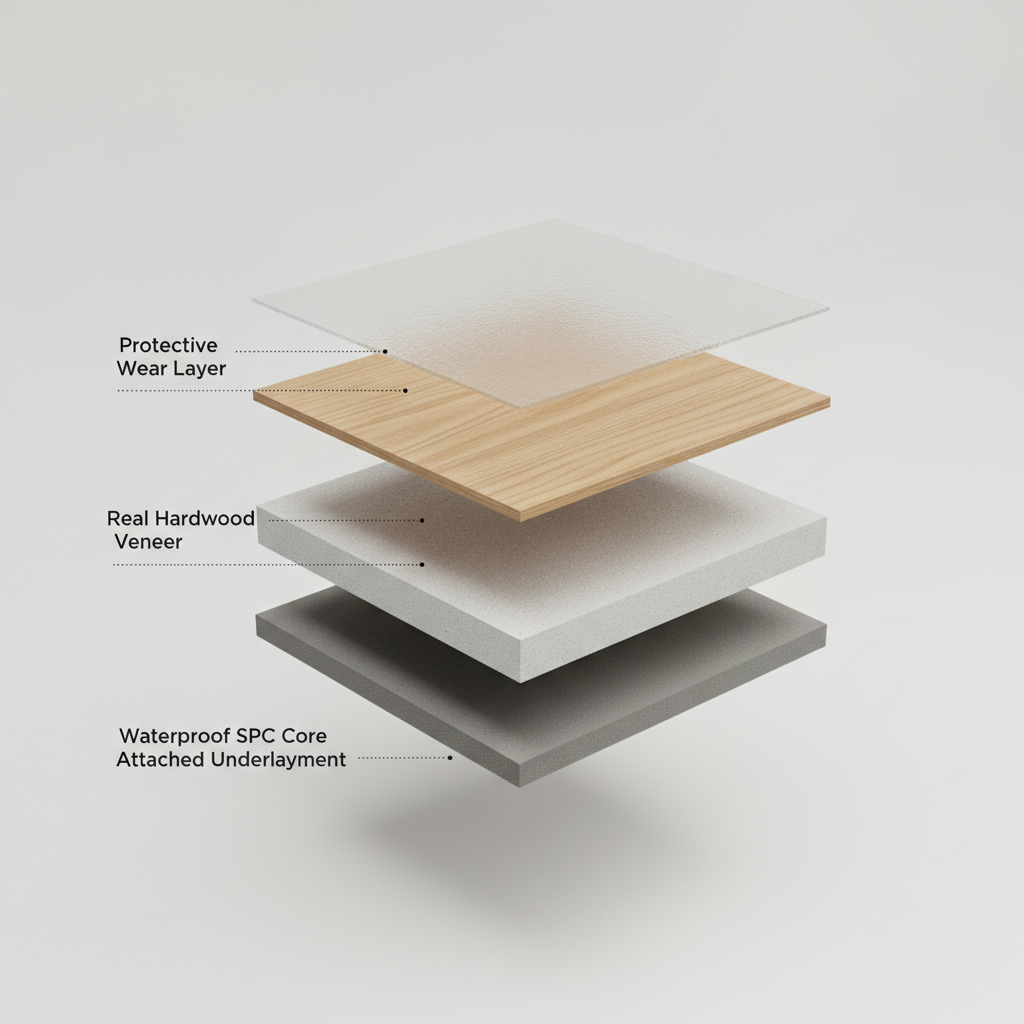
- Wear Layer: A top protective coating, often infused with aluminum oxide, that provides robust resistance to scratches and stains.
- Real Hardwood Veneer: This is the magic. A thin but authentic layer of real hardwood (like oak or hickory) gives the plank its genuine wood grain, texture, and beauty.
- Waterproof Core: This is the game-changer. The veneer is bonded to a rigid, 100% waterproof core, typically made from Stone Polymer Composite (SPC). SPC is a dense blend of limestone powder, polyvinyl chloride, and stabilizers. Unlike wood, this material is dimensionally stable—it does not swell, warp, or buckle when exposed to water.
- Attached Underlayment: Most hybrid planks come with a pre-attached pad that provides sound insulation, cushioning underfoot, and a moisture barrier.
This construction, with its SPC core, is precisely how waterproof hardwood is built to handle spills and moisture that would destroy a solid wood floor. Major manufacturers like Shaw Floors and Mohawk have invested heavily in this technology, engineering locking systems and edge coatings that prevent water from seeping between the planks to the subfloor.
The Ultimate Showdown: Hybrid vs. Traditional Hardwood Head-to-Head
Now that we know what they’re made of, let’s put them in a direct, round-by-round comparison across the factors that matter most to homeowners.
Round 1: Water Resistance – The Clear Winner
There is no contest here. Waterproof hybrid hardwood is the undisputed champion. Its SPC core is impervious to water. You can submerge a hybrid plank in water for 24 hours, and it will emerge unchanged. This makes it an excellent choice for kitchens, laundry rooms, mudrooms, and even basements.
In our “Flooring Lab” test, we placed a plank of solid oak and a plank of SPC-core hybrid hardwood in a tub of water. After just a few hours, the oak began to swell and “cup” at the edges. The hybrid plank remained perfectly flat and stable.
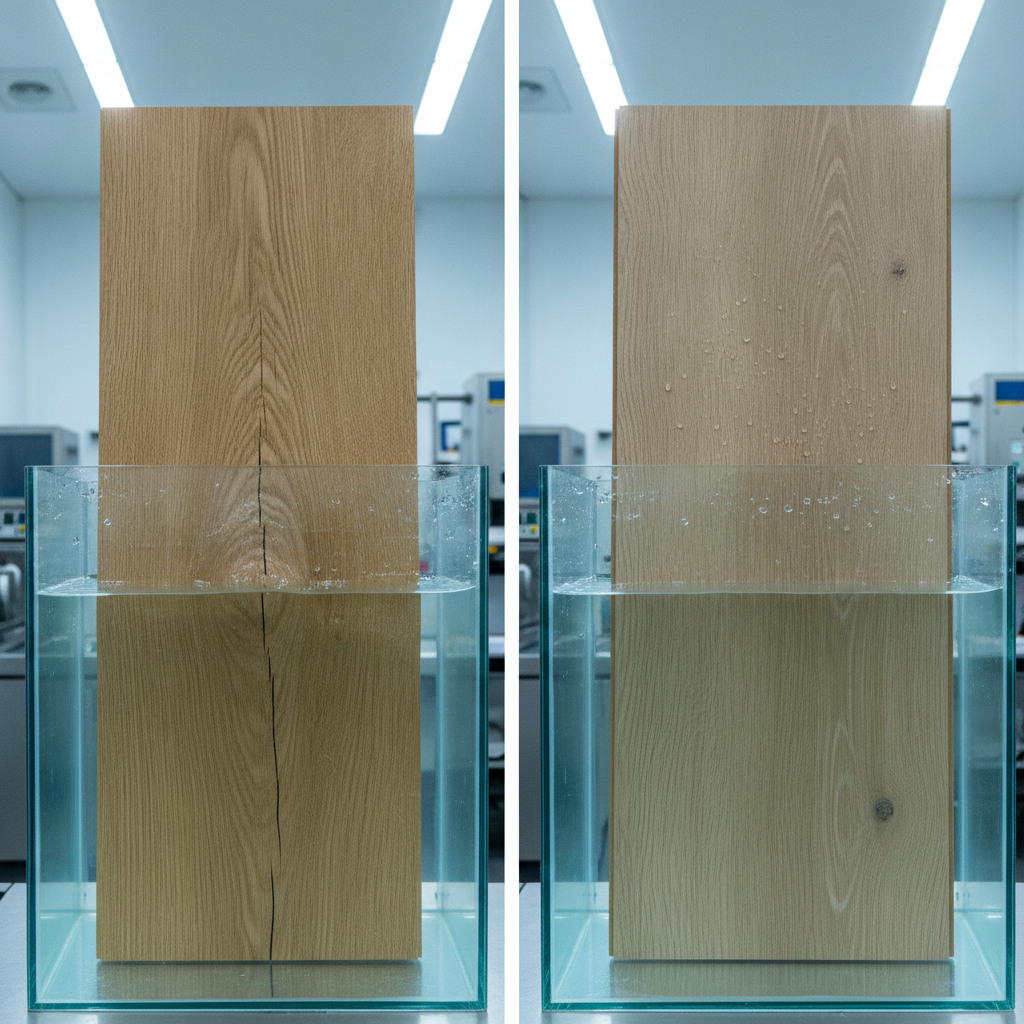
Solid hardwood, by contrast, is extremely vulnerable to moisture. Spills must be wiped up immediately. A plumbing leak or flood event can cause catastrophic damage, leading to warping, cupping (when the edges of a plank rise higher than its center), and mold growth, often requiring a full replacement. Industry benchmarks, like those from ASTM International, set rigorous standards for testing water resistance, and hybrid products are specifically designed to meet these demanding criteria.2
Winner: Waterproof Hybrid Hardwood
Round 2: Durability & Scratch Resistance
This round is more complex, as “durability” has two components: resistance to dents and resistance to scratches.
Dent Resistance: For solid hardwood, this is determined by the wood species’ natural hardness, measured on the Janka Hardness Scale.4 A Brazilian Cherry floor (Janka rating ~2350) is much harder and more resistant to dents from dropped objects than a Yellow Pine floor (Janka rating ~690).
Scratch Resistance: For both flooring types, scratch resistance is primarily a function of the factory-applied finish. Modern hybrid flooring often uses multiple coats of an aluminum oxide urethane finish, which is one of the most durable coatings available in the industry. This provides superior protection against scuffs and fine scratches from pet claws or furniture. While solid hardwood can also have a durable finish, the top-tier factory finishes on high-quality hybrids often have the edge. Finish manufacturers like Bona and DuraSeal are constantly innovating to create harder, longer-lasting protective coatings for all types of wood floors.3
Winner: A slight edge to Hybrid Hardwood for its advanced factory finish, though a very hard species of solid wood (like Hickory or Brazilian Walnut) is also an exceptionally durable choice.
Round 3: Lifespan & Repairability
Here, the tables turn dramatically in favor of tradition. The greatest strength of solid hardwood is its ability to be completely renewed. Over a lifespan that can exceed 100 years, it can be sanded down to bare wood and refinished 3-5 times, erasing decades of wear and tear each time. A flooring refinishing professional can even change the stain color for a completely new look.
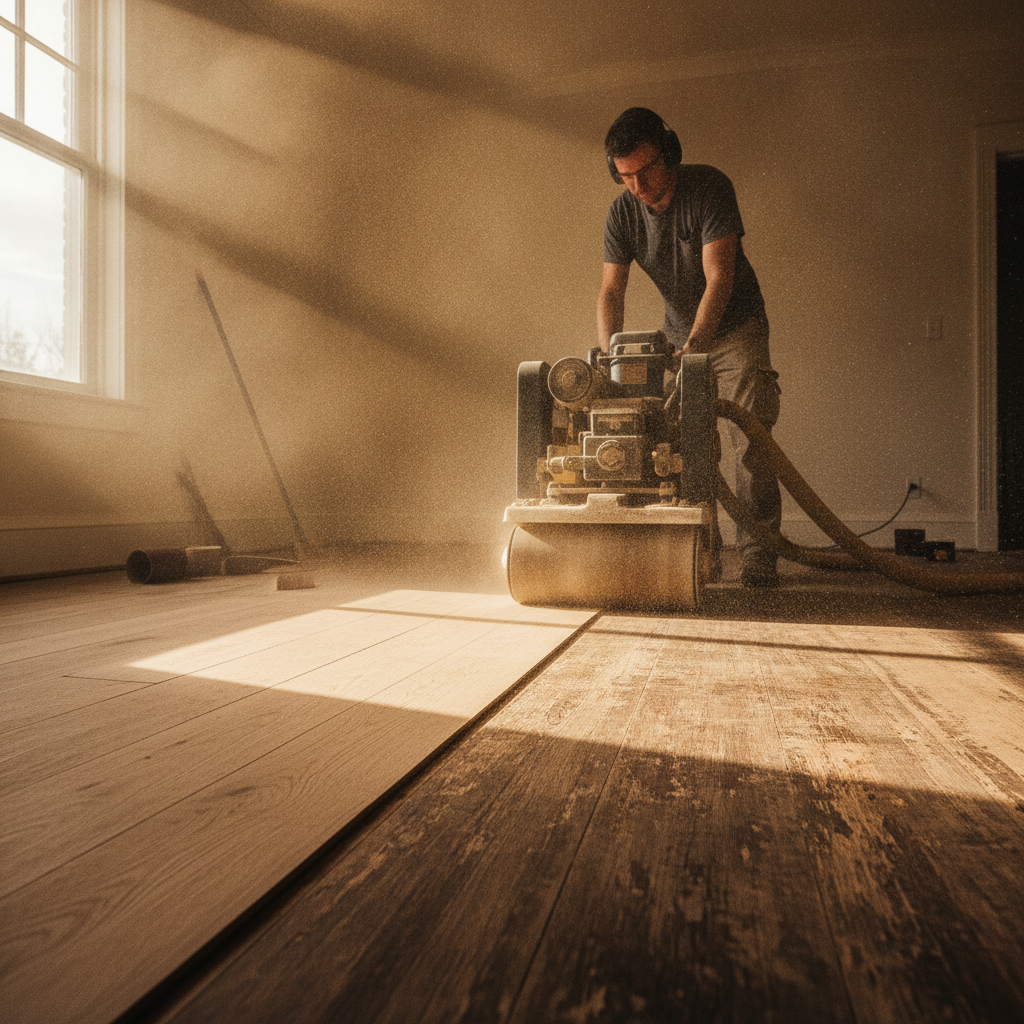
Hybrid hardwood cannot be refinished. The real wood veneer is too thin to be sanded. Its lifespan is determined by the thickness of its wear layer and the quality of its construction, typically ranging from 15 to 30 years. If a plank is deeply gouged or damaged, the only option is to replace that specific plank, which can be a challenge if the product has been discontinued.
Winner: Traditional Solid Hardwood (by a landslide)
Round 4: Cost & Installation
Both material and labor costs play a role here.
Material Cost: Prices can overlap, but generally, quality waterproof hybrid hardwood runs from $4 to $9 per square foot. Solid hardwood has a wider range, from $5 to $15+ per square foot, depending heavily on the species, plank width, and grade.
Installation Cost: This is where hybrid flooring offers significant savings. Most hybrid products feature a click-lock floating installation system, which is faster and easier for professionals and manageable for a skilled DIYer. Professional installation might cost $2 to $4 per square foot. Solid hardwood requires a more complex nail-down or staple-down installation over a wood subfloor, a job best left to seasoned professionals. Labor costs are typically higher, ranging from $4 to $8 per square foot.
Let’s look at a sample 200 sq. ft. room:
| Cost Factor | Waterproof Hybrid Hardwood | Traditional Solid Hardwood |
|---|---|---|
| Material Cost (avg. $6/sf) | $1,200 | $1,200 |
| Installation Labor (avg. $3/sf vs $6/sf) | $600 | $1,200 |
| Total Estimated Cost | $1,800 | $2,400 |
Following the installation guidelines set by the NWFA is crucial for both floor types to ensure performance and warranty compliance.1
Winner: Waterproof Hybrid Hardwood
Round 5: Aesthetics, Feel, and Home Resale Value
This is subjective, but important. Does hybrid hardwood feel like real wood? Yes, because the top layer is real wood. It has the authentic grain, texture, and warmth underfoot that vinyl plank flooring often lacks. High-quality hybrids are nearly indistinguishable from solid wood floors once installed.
However, purists may argue that the uniform perfection of a manufactured product can’t quite match the unique character and subtle variations of a solid wood floor.
Regarding resale value, a real estate agent will tell you that solid hardwood floors are almost universally seen as a premium feature that adds significant value to a home. It’s a proven, long-term investment. While high-quality hybrid flooring is gaining recognition as a desirable, practical feature—especially in finished basements or modern kitchens—it doesn’t yet carry the same long-standing prestige as solid hardwood.
Winner: A tie. Traditional Solid Hardwood wins on prestige and resale value, while Hybrid Hardwood delivers nearly identical aesthetics with modern practicality.
The Real-World Test: What’s Best for Families and Pets?
For many, this is the deciding factor. A floor in a busy home needs to be a silent partner, withstanding daily challenges without demanding constant worry.
A pet-friendly floor needs to excel in three areas: scratch resistance, moisture resistance, and traction. Poor traction on slippery floors can be a serious health concern for dogs, potentially leading to joint problems or injuries, a point often emphasized by experts at organizations like the American Kennel Club (AKC).5
Winning the War on Scratches: Wood Species, Finishes, and Textures
No wood floor is truly scratch-proof, but you can choose wisely to minimize the damage.
- For Solid Hardwood: Choose a species with a high Janka rating like Hickory or Hard Maple.4
- For Hybrid Hardwood: Look for a product with a thick wear layer and an aluminum oxide finish.
- For Both: A textured finish, such as wire-brushed or hand-scraped, is a family’s best friend. The existing texture and low-gloss sheen are brilliant at hiding the minor scratches and dings that are inevitable with kids and pets. A smooth, glossy finish, by contrast, acts like a spotlight for every single imperfection.
Handling Spills and Accidents: From Water Bowls to Pet Urine
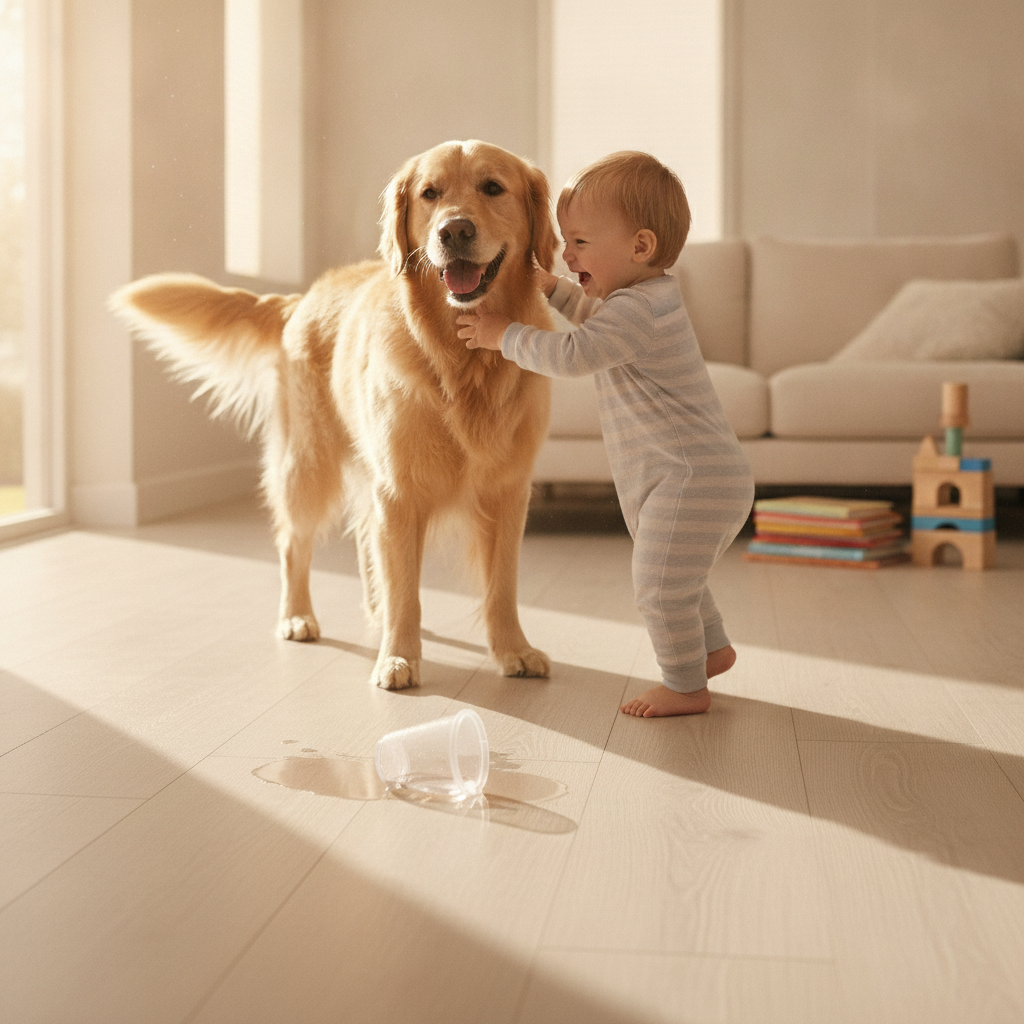
This is where hybrid’s waterproof nature provides true peace of mind. Splashes from the dog’s water bowl, kitchen spills, or a pet accident that isn’t discovered immediately won’t damage the floor. You can simply clean it up without fear of the planks warping or swelling.
For solid hardwood owners, diligence is key. Pet urine is particularly damaging as its high ammonia content can stain the wood and damage the finish. It must be cleaned immediately with a cleaner formulated for hardwood floors. Never let any liquid sit on a solid wood floor.
The Verdict: Which Hardwood Flooring is the Right Choice for You?
There is no single “best” floor. The right choice depends entirely on your home, your lifestyle, and your priorities. We’ve created these profiles to help you decide.
Choose Traditional Solid Hardwood If…
You are “The Forever Home Purist.” You prioritize timeless authenticity and long-term investment value. You plan to stay in your home for decades and love the idea of being able to refinish your floors to adapt to new styles or erase years of wear. You are installing the floor in a controlled environment like a living room, bedroom, or dining room, where moisture is not a primary concern.
Choose Waterproof Hybrid Hardwood If…
You are “The Busy Modern Family.” Your top priorities are durability, low maintenance, and peace of mind. You have kids, pets, or a generally chaotic household where spills are a fact of life. You’re renovating a kitchen, basement, or entryway and need a floor that combines the beauty of wood with the resilience of a waterproof material. You also value a simpler, more cost-effective installation process.
Bonus: Quick-Fix Guide for Common Hardwood Problems
Whether you choose traditional or hybrid, issues can arise. Here’s how to tackle two of the most common problems.
How to Fix Minor Scratches
For light surface scuffs that are only in the finish, you can often fix them yourself. Start by cleaning the area thoroughly. For minor scratches, a product like a stain marker or a wax repair stick can work wonders. For slightly deeper scratches, there are specialty scratch repair kits available. The key is to distinguish between a scratch in the finish and a deep gouge into the wood itself. For deeper damage, consulting a professional is your best bet. Home improvement experts like Bob Vila often provide excellent step-by-step guides for these types of DIY repairs.6
What to Do About Warping and Cupping
Warping, cupping (edges high), and crowning (center high) are almost always caused by a moisture imbalance. According to the NWFA’s technical guidelines, the first and most critical step is to identify and eliminate the source of the moisture.1 Is there a leaky pipe in the crawlspace? Is the basement humidity too high? Is water seeping in from outside?
A simple diagram shows the difference: cupping is often caused by moisture from below the floor, while crowning can be caused by surface moisture. Until the underlying moisture issue is resolved, any repair to the floor itself will fail. We strongly advise consulting a certified wood flooring inspector or an IICRC-certified water damage restoration professional to diagnose the problem correctly.7 They can use moisture meters to pinpoint the source and recommend a course of action.
Conclusion
The battle between waterproof hybrid hardwood and traditional solid hardwood isn’t about one being definitively better than the other; it’s about a trade-off.
Traditional Solid Hardwood offers unmatched longevity, the value of refinishing, and a timeless prestige that can elevate a home for a century or more.
Waterproof Hybrid Hardwood offers revolutionary water resistance, superior scratch protection, and installation versatility that makes the beauty of real wood possible in any room of the house, for any lifestyle.
The best floor is the one that fits your life. By understanding the core differences in their construction, durability, and long-term value, you now have the expert knowledge to look past the marketing claims and make a confident decision that you’ll be happy with for years to come.
Feeling confident about your choice? Explore our detailed reviews of the top-rated hybrid and solid hardwood brands for 2024. Or, if you have a question, leave a comment below and our flooring experts will help you out!
This article may contain affiliate links. The information provided is for educational purposes and does not constitute professional installation or financial advice. Consult a certified flooring professional for specific recommendations for your home.
References & Authoritative Sources
- National Wood Flooring Association (NWFA). (N.D.). Technical Guidelines. Retrieved from the official NWFA website.
- ASTM International. (N.D.). Building Construction Standards. Retrieved from the official ASTM International website.
- Bona US / DuraSeal. (N.D.). Professional Finishes Product Information. Retrieved from the respective manufacturer websites.
- U.S. Forest Service, Forest Products Laboratory. (N.D.). Wood Handbook–Wood as an Engineering Material. General Technical Report FPL-GTR-190. (This serves as a primary source for Janka Hardness data).
- American Kennel Club (AKC). (N.D.). Health & Wellness Resources. Retrieved from the official AKC website.
- Bob Vila. (N.D.). Home Improvement and DIY Advice. Retrieved from BobVila.com.
- Institute of Inspection, Cleaning and Restoration Certification (IICRC). (N.D.). IICRC S500 Standard for Professional Water Damage Restoration. Retrieved from the official IICRC website.
