
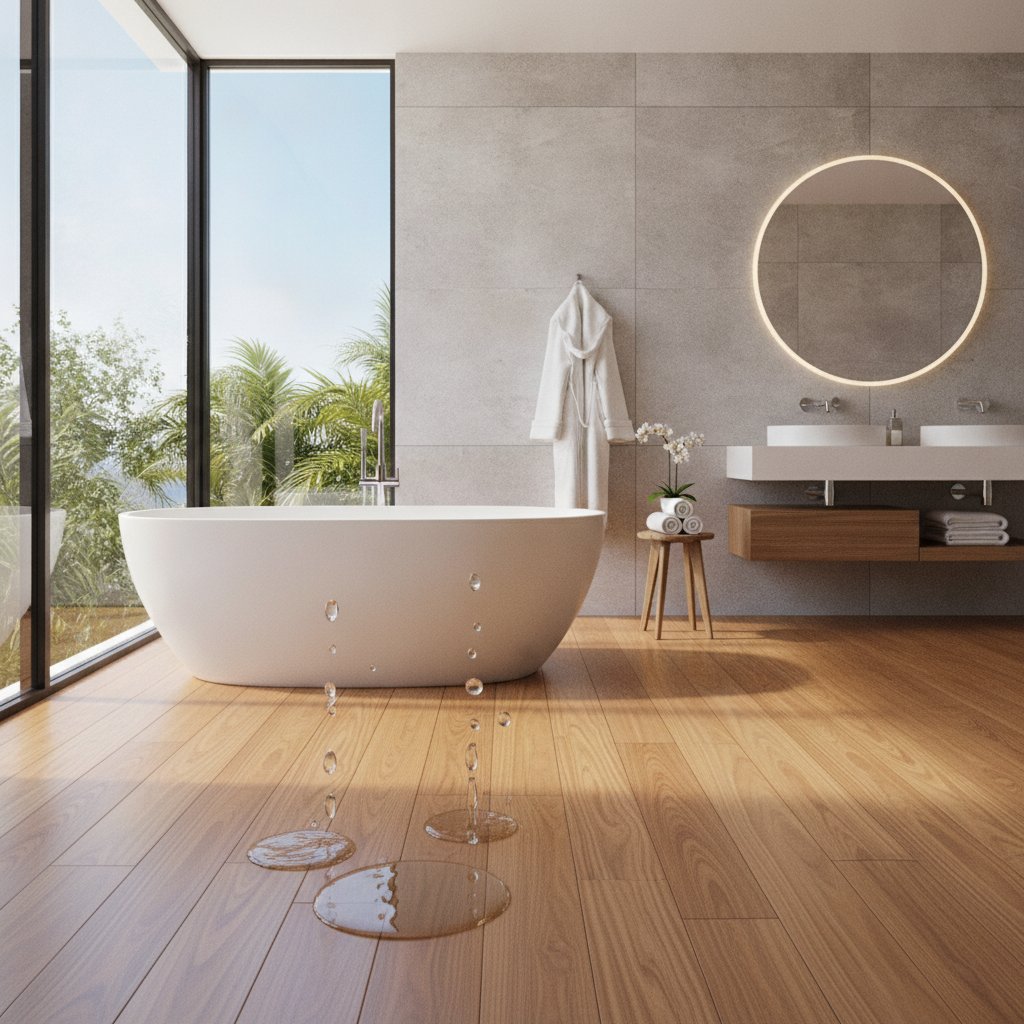
The dream is as alluring as it is timeless: the warm, natural beauty of hardwood floors flowing seamlessly through every room of your home, including the kitchen and bathrooms. But this dream often collides with a harsh reality—the constant fear of spills, leaks, and moisture causing devastating water damage like warping, cupping, and buckling. For years, this fear has made tile and vinyl the default, practical choices for these high-moisture spaces.
Enter “waterproof hardwood,” a revolutionary flooring category that promises the best of both worlds. But with so many new products and confusing marketing terms, it’s easy to feel overwhelmed. Is it truly waterproof? Is it real wood? Is it the right choice for your home and your budget?
This is where the hype ends and the truth begins. This definitive guide will cut through the noise to give you the clear, honest information you need. We will demystify the terminology, take a deep dive into the technology behind these floors, and provide a head-to-head comparison with other top waterproof options. By the end, you’ll have a bulletproof framework for choosing, installing, and protecting the perfect floor for your kitchen and bath, allowing you to make a confident investment and avoid costly mistakes.
- Decoding the Terms: Waterproof vs. Water-Resistant Flooring
- What Is Hybrid & ‘Waterproof’ Hardwood Flooring, Really?
- The Best Waterproof Flooring for Kitchens and Bathrooms: A Head-to-Head Comparison
- Installation & Prevention: The Keys to a Truly Waterproof Floor
- Troubleshooting: Identifying and Responding to Water Damage
- Conclusion
- Authoritative Sources & References
Decoding the Terms: Waterproof vs. Water-Resistant Flooring
The single greatest source of confusion for homeowners lies in the difference between “waterproof” and “water-resistant.” These terms are often used interchangeably in marketing, but they represent fundamentally different levels of protection. Understanding this distinction is the first step to making a smart flooring choice.
Water-Resistant: This term typically means the surface of the flooring can resist the penetration of water for a specific period. Think of it as spill-proof. Most water-resistant floors have a warranty that covers topical moisture—like a spilled glass of water—for a set time, often between 24 and 72 hours. If the spill is cleaned up within that window, the floor should be fine. However, water that seeps between the planks or gets to the core of the board can still cause damage.
Waterproof: A truly waterproof floor means the core material of the plank itself is impervious to water. It will not swell, warp, or degrade even when fully submerged for an extended period. This is the level of protection needed for areas with high moisture potential, like bathrooms and basements.
To help visualize this, consider the “Spectrum of Water Resistance”:
- Low Resistance (Avoid in Wet Areas): Traditional Solid Hardwood, Carpet.
- Moderate Resistance (Suitable for Kitchens with Caution): Engineered Hardwood, Water-Resistant Laminate. These can handle topical spills if cleaned quickly.
- High Resistance / Waterproof (Ideal for Kitchens & Baths): Hybrid Hardwood (with a waterproof core), Luxury Vinyl Plank (LVP), Porcelain & Ceramic Tile. The core materials of these floors are designed to be unaffected by water.
Always check the manufacturer’s warranty. It will explicitly state what is covered, for how long, and under what conditions. This document is the ultimate source of truth, cutting through any marketing claims.
What Is Hybrid & ‘Waterproof’ Hardwood Flooring, Really?
Now, let’s dissect the product at the heart of this revolution: “waterproof hardwood.” The name itself can be misleading. This is not solid wood that has been magically treated to repel water. Instead, it’s a sophisticated, multi-layered engineered product known as hybrid flooring.
A typical hybrid hardwood plank is constructed with several layers, each serving a specific purpose:
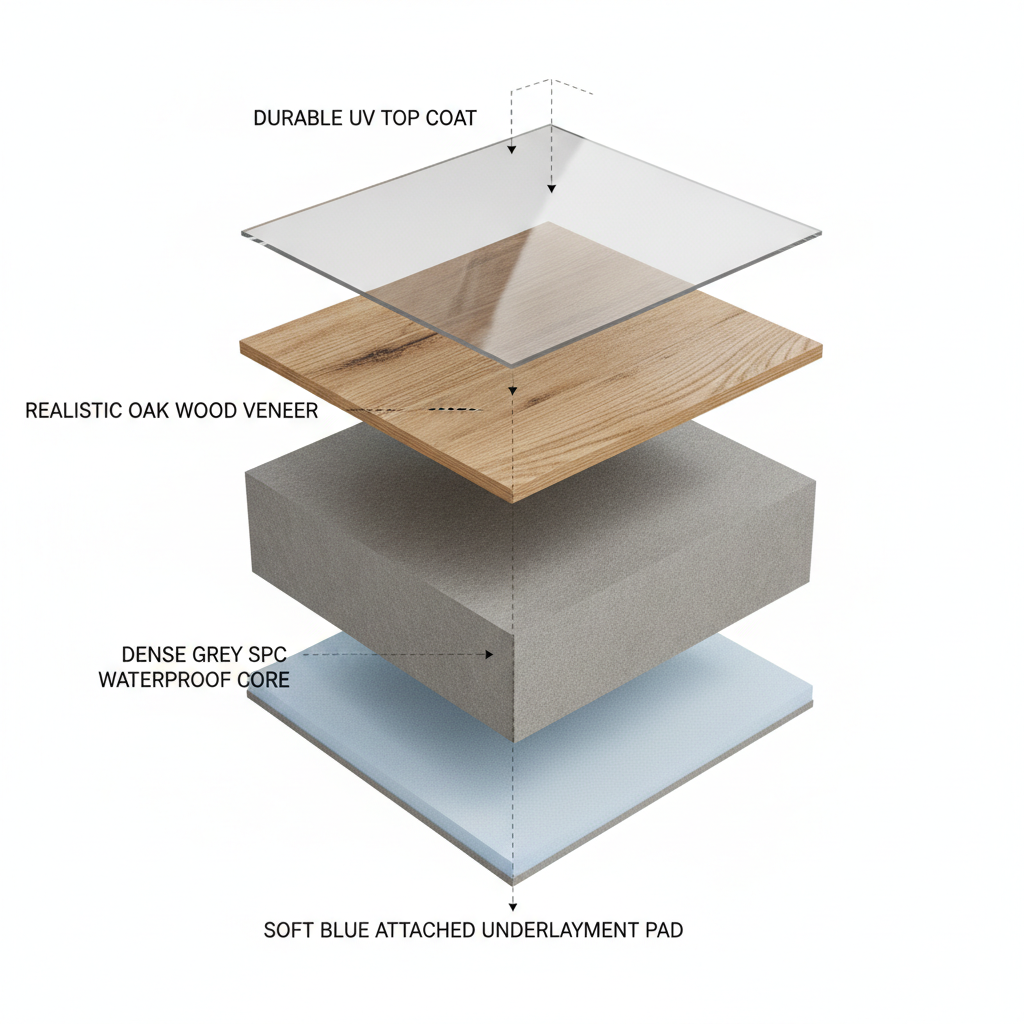
- UV Coating: A top layer that provides durability, stain resistance, and protection from fading.
- Real Wood Veneer: This is the key to its authentic beauty. A thin slice of genuine hardwood (like oak, hickory, or maple) gives the floor its unique grain, texture, and color.
- Waterproof Core: The engine of the plank. This is a high-density, 100% waterproof composite material that provides structural stability and protection from moisture.
- Underlayment: Many hybrid products come with an attached pad that provides sound absorption, comfort underfoot, and a moisture barrier.
Myth vs. Fact: Waterproof Hardwood
- Myth: Waterproof hardwood is solid wood that’s been treated.
- Fact: It’s an engineered hybrid product. Its “waterproof” quality comes from its composite core, not the wood veneer on top. The National Wood Flooring Association (NWFA) provides clear standards that differentiate solid, engineered, and hybrid flooring constructions [1].
The Core of the Matter: SPC vs. WPC
The waterproof core is what truly defines a hybrid floor. There are two main types, and the difference between them impacts the floor’s feel, durability, and cost. According to the Resilient Floor Covering Institute (RFCI), these rigid core products represent a significant advancement in flooring technology [2].
- SPC (Stone Polymer Composite): This core is made from a mixture of limestone (calcium carbonate), PVC, and stabilizers. It is extremely dense, rigid, and durable. Think of SPC as being more rigid and durable like a tile.
- WPC (Wood Polymer Composite): This core contains a mix of recycled wood pulp, PVC, and a foaming agent, which makes it lighter and less dense than SPC. WPC offers more comfort and quietness underfoot.
Here’s a quick comparison:
| Feature | SPC (Stone Polymer Composite) | WPC (Wood Polymer Composite) |
|---|---|---|
| Density | Higher | Lower |
| Dent Resistance | Excellent (better against heavy impacts) | Good (more prone to dents from heavy furniture) |
| Feel Underfoot | Harder, more rigid | Softer, more resilient |
| Cost | Often slightly less expensive | Often slightly more expensive |
Pros and Cons: Is Hybrid Hardwood Right for You?
With a clearer understanding of its construction, you can now weigh the benefits and drawbacks to see if this innovative flooring is the right fit for your home.
| Pros | Cons |
|---|---|
| Authentic Wood Beauty: Features a genuine hardwood veneer, offering a look that printed floors can’t perfectly replicate. | Cannot Be Refinished: The wood veneer is typically too thin (1-2mm) to be sanded and refinished. Deep scratches or significant wear are permanent. |
| 100% Waterproof Core: The SPC or WPC core will not swell or warp, making it perfect for kitchens, bathrooms, and basements. | Higher Cost: Generally more expensive than luxury vinyl plank and laminate flooring options. |
| High Durability: The rigid core provides excellent dent and impact resistance, especially with SPC. | Veneer Can Still Scratch/Dent: While the core is tough, the real wood veneer on top has the same durability as any other wood of its species and can be scratched or dented. |
| Easy Installation: Most products use a click-lock system for a simple floating installation. | Pattern Repeats: As a manufactured product, you may notice some repetition in the wood grain patterns across planks. |
Is Hybrid Hardwood a Fit? A Quick Checklist
- Is the authentic look and feel of real wood in a wet area your top priority? (Yes/No)
- Are you okay with the fact that the floor cannot be refinished in the future? (Yes/No)
- Is the floor for a high-traffic area with heavy furniture or large pets? (If yes, lean towards an SPC core). (Yes/No)
- Is your budget flexible enough to accommodate a premium flooring product? (Yes/No)
If you answered “Yes” to most of these, hybrid hardwood is an excellent contender for your project.
The Best Waterproof Flooring for Kitchens and Bathrooms: A Head-to-Head Comparison
Hybrid hardwood is a fantastic innovation, but it’s not the only player in the game. To make the best decision, it’s essential to compare it against the other leading waterproof and water-resistant options. The National Kitchen & Bath Association (NKBA) recommends selecting materials based on water resistance, durability, and slip resistance for these critical zones [3].
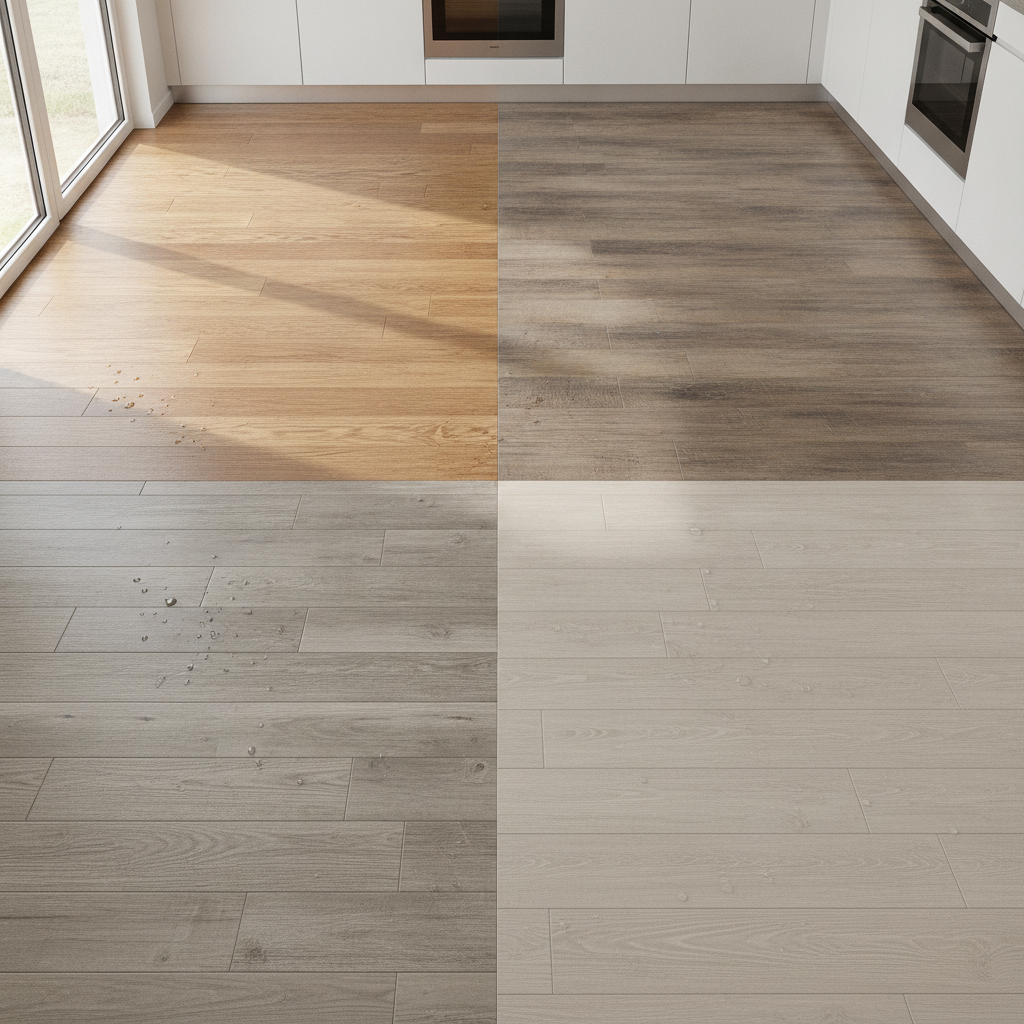
Here’s how the top contenders stack up:
| Feature | Hybrid Hardwood | Luxury Vinyl Plank (LVP) | Porcelain Tile | Waterproof Laminate |
|---|---|---|---|---|
| Waterproofing | 5/5 | 5/5 | 5/5 | 3/5 |
| Durability | 4/5 | 4/5 | 5/5 | 4/5 |
| Cost | 2/5 | 4/5 | 3/5 | 4/5 |
| DIY-Friendliness | 4/5 | 5/5 | 2/5 | 5/5 |
| Realism | 5/5 | 4/5 | 3/5 | 4/5 |
As design professionals often note, the best choice balances technical performance with the desired aesthetic. Let’s look at each option more closely.
Option 1: Luxury Vinyl Plank (LVP)
LVP is arguably the most popular waterproof flooring solution today, and for good reason. It is made of 100% synthetic materials, primarily PVC, making it completely impervious to water. Its durability comes from a transparent top wear layer, measured in mils (thousandths of an inch). For residential kitchens and baths, look for a wear layer of at least 12mil; for high-traffic homes or light commercial use, 20mil or more is recommended.
Modern LVP has achieved stunning realism thanks to high-definition printing and technologies like Embossed in Register (EIR), which aligns the surface texture with the printed wood grain image, creating an incredibly convincing look and feel. Leading brands like Coretec and Shaw Floorte offer a vast array of styles to suit any design.
Option 2: Wood-Look Porcelain Tile
For ultimate durability and water protection, nothing beats porcelain tile. It is a type of ceramic fired at extremely high temperatures, making it denser, less porous, and more water-resistant than standard ceramic tile. The Tile Council of North America (TCNA) uses the PEI (Porcelain Enamel Institute) rating to classify tile’s resistance to abrasion; a PEI rating of 3 is suitable for residential floors, while 4 or 5 is ideal for heavy traffic [4].
A common pain point with tile has always been grout, which can stain and degrade. However, modern epoxy grout solves this problem. It’s a non-porous, highly durable alternative that is virtually stain-proof and never needs to be sealed. And for those who dislike the cold feel of tile, installing in-floor radiant heating underneath is an increasingly popular and luxurious solution.
Option 3: Modern Waterproof Laminate
Laminate flooring has come a long way from the easily damaged product of the past. While its core is still made of wood fiber (HDF – high-density fiberboard), modern “waterproof” or “water-resistant” laminates employ advanced technology to protect that core. This includes hydrophobic coatings that repel water from the surface and sealed or waxed bevels that prevent water from seeping between the planks.
Manufacturer demonstrations often show water pooling on the surface for 24 hours or more without any effect. However, it’s crucial to understand its limitation: this protection is topical. Water that gets around the perimeter of the room from a major leak can still reach the HDF core and cause damage. It’s an excellent choice for kitchens but riskier for full bathrooms where standing water is more common.
Installation & Prevention: The Keys to a Truly Waterproof Floor
Choosing a waterproof material is only half the battle. The most expensive, high-tech flooring can fail if it’s not installed correctly. Proper installation and holistic moisture management are what create a truly waterproof system that protects your home for years to come.
Installer’s Corner: Q&A with the Pros
Q: What’s the #1 mistake homeowners make installing bathroom flooring?
A: Ignoring the subfloor. They lay beautiful, waterproof flooring over a subfloor that is uneven, dirty, or, worst of all, has existing moisture issues. This guarantees failure. The second biggest mistake is improper sealing around the perimeter, especially at the tub and toilet.Q: How important is an expansion gap?
A: It’s non-negotiable for any floating floor (LVP, laminate, hybrid). All floors expand and contract with temperature changes. Without a gap around the perimeter (hidden by baseboards), the floor will buckle and warp.
According to industry handbooks, like those from the TCNA and waterproofing system manufacturers like Schluter, a successful installation in a wet area is a system of components working together [5]. A simple step-by-step process for properly caulking around a toilet base and bathtub edge with 100% silicone caulk is essential to creating a waterproof seal that prevents surface water from getting underneath the floor.
Don’t Ignore the Subfloor
Your new floor is only as good as the foundation it’s laid on. A proper subfloor must be:
- Flat: The NWFA specifies that subfloors should be flat to within 3/16 of an inch over a 10-foot span [1]. High spots must be ground down and low spots filled with a leveling compound.
- Dry: Before installation, use a moisture meter to ensure the subfloor (whether wood or concrete) is within the acceptable moisture content range specified by the flooring manufacturer.
- Sound: It must be structurally solid, with no squeaks, soft spots, or rot.
If you encounter any of these issues, it’s critical to address them before laying a single plank. A “When to Call a Pro” checklist for subfloor issues includes signs of rot, persistent moisture readings, or significant unlevelness that requires extensive grinding or leveling.
Beyond the Floor: Ventilation and Maintenance
Long-term moisture prevention requires looking beyond the floor itself. Proper bathroom ventilation is your first line of defense against humidity that can lead to mold, mildew, and long-term moisture problems.
You can perform a simple “tissue test” to check your exhaust fan’s effectiveness: turn the fan on and hold a single square of toilet tissue up to the grill. If the fan holds the tissue in place, it’s working. If it falls, the fan is not moving enough air and may need cleaning or replacement. Building codes, as outlined by the International Code Council (ICC), specify minimum airflow requirements (measured in CFM, or cubic feet per minute) for bathroom fans to ensure adequate ventilation [6].
A simple maintenance checklist can also extend the life of your floor and prevent issues:
- Use high-quality bath mats to absorb water.
- Wipe up spills and puddles promptly.
- Run your exhaust fan during and for 15-20 minutes after every shower.
- Annually inspect the caulk around your tub, shower, and toilet for any cracks or gaps and re-caulk as needed.
Troubleshooting: Identifying and Responding to Water Damage
Even with the best preventative measures, accidents can happen. If you discover signs of water damage on your existing floors, it’s important to act quickly and methodically. The Institute of Inspection, Cleaning and Restoration Certification (IICRC) provides the industry S500 standard for professional water damage restoration [7].
First, identify the type of damage you see. In wood and laminate floors, this often presents in three ways:
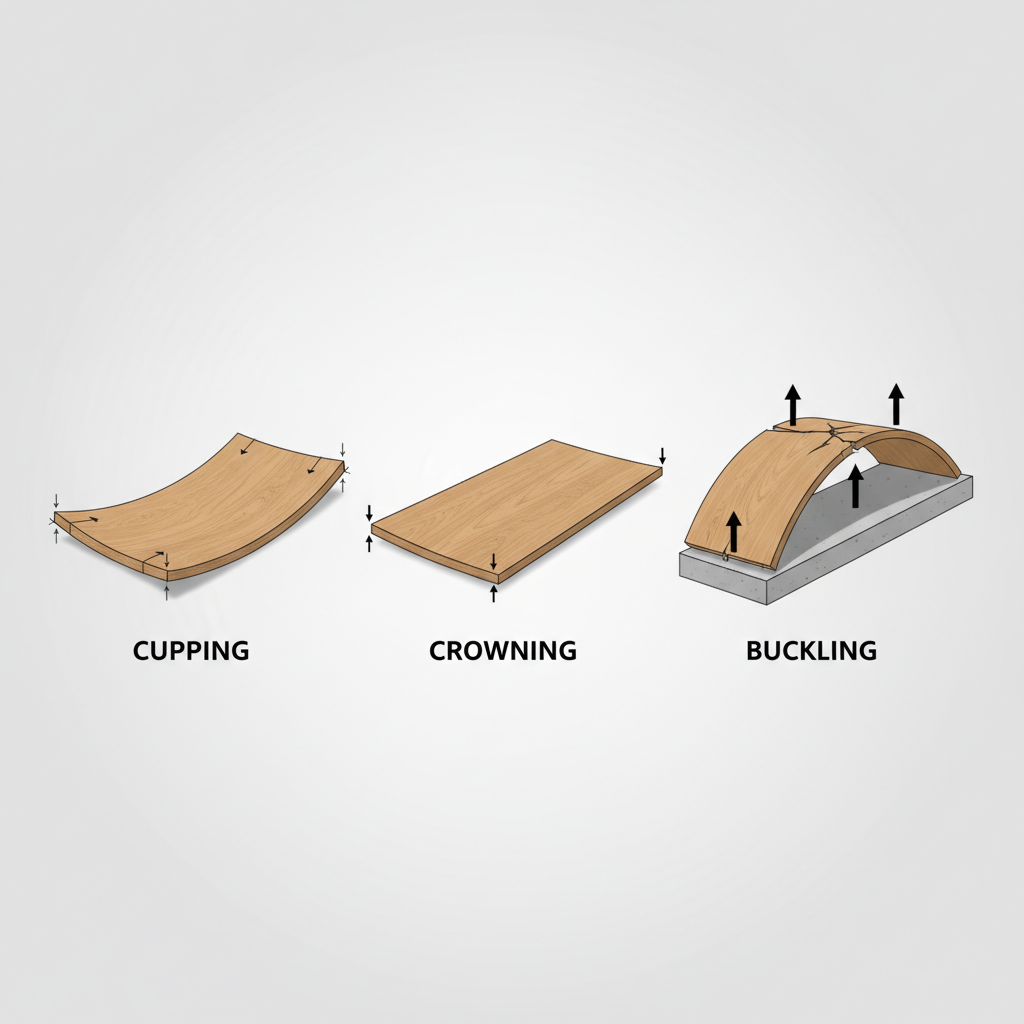
- Cupping: The edges of the plank are higher than the center, creating a concave shape. This happens when the bottom of the board absorbs more moisture than the top.
- Crowning: The center of the plank is higher than the edges, creating a convex shape. This often occurs after a cupped floor has been sanded too early, before it has fully dried.
- Buckling: The flooring lifts up and detaches from the subfloor, often in dramatic peaks. This is a sign of a major water event.
If you find water damage, your first steps should be to stop the source of the water, remove any standing water, and use fans and dehumidifiers to begin drying the area. For anything more than a small, contained spill, it is crucial to consult a professional. As FEMA guidance on flood cleanup highlights, significant water intrusion carries health risks from contamination and mold growth, which require professional remediation [8].
Conclusion
The quest for the perfect kitchen and bathroom floor no longer requires a compromise between beauty and durability. The evolution of flooring technology has given homeowners an incredible array of choices that deliver the warm, inviting look of wood without the traditional anxieties of water damage.
Here are the key takeaways to guide your decision:
- Terminology is Key: “Waterproof” means the core won’t be damaged by water, while “water-resistant” refers to topical protection for a limited time. Understanding your warranty is paramount.
- ‘Waterproof Hardwood’ is a Hybrid: This premium product offers the unmatched beauty of a real wood veneer on top of a resilient, waterproof composite core. Its primary trade-off is its inability to be refinished.
- The Best Choice is a Balance: Your ideal floor lies at the intersection of your aesthetic goals, lifestyle demands, and budget. LVP offers incredible value and realism, porcelain tile provides ultimate durability, and modern laminate is a strong contender for kitchens.
Armed with this knowledge, you can see past the marketing hype and focus on the technology and performance that truly matter. You can now confidently select the right material, insist on proper installation, and implement the simple maintenance that will protect your investment and keep your home beautiful and worry-free for years to come.
Ready to start your project? Browse our curated selection of waterproof flooring options or schedule a free consultation with one of our flooring experts today to get personalized advice for your home.
The information provided is for educational purposes only. Flooring installation can be complex, especially in wet areas. Always consult with a certified flooring professional and refer to manufacturer guidelines to ensure proper installation and warranty compliance.
Authoritative Sources & References
- National Wood Flooring Association (NWFA). General Reference to Standards and Guidelines for Wood Flooring Construction and Installation.
- Resilient Floor Covering Institute (RFCI). General Reference to Technical Information on Resilient Flooring Products, including Rigid Core.
- National Kitchen & Bath Association (NKBA). General Reference to Design and Material Guidelines for Kitchens and Bathrooms.
- Tile Council of North America (TCNA). General Reference to Standards and Handbooks for the Ceramic Tile Industry, including PEI Ratings.
- Schluter Systems. General Reference to Industry Standards for Tile Installation and Waterproofing Systems.
- International Code Council (ICC). General Reference to Building Codes, including Standards for Bathroom Ventilation.
- Institute of Inspection, Cleaning and Restoration Certification (IICRC). General Reference to the S500 Standard for Professional Water Damage Restoration.
- Federal Emergency Management Agency (FEMA). General Reference to Public Guidance on Flood Cleanup and Safety.
