
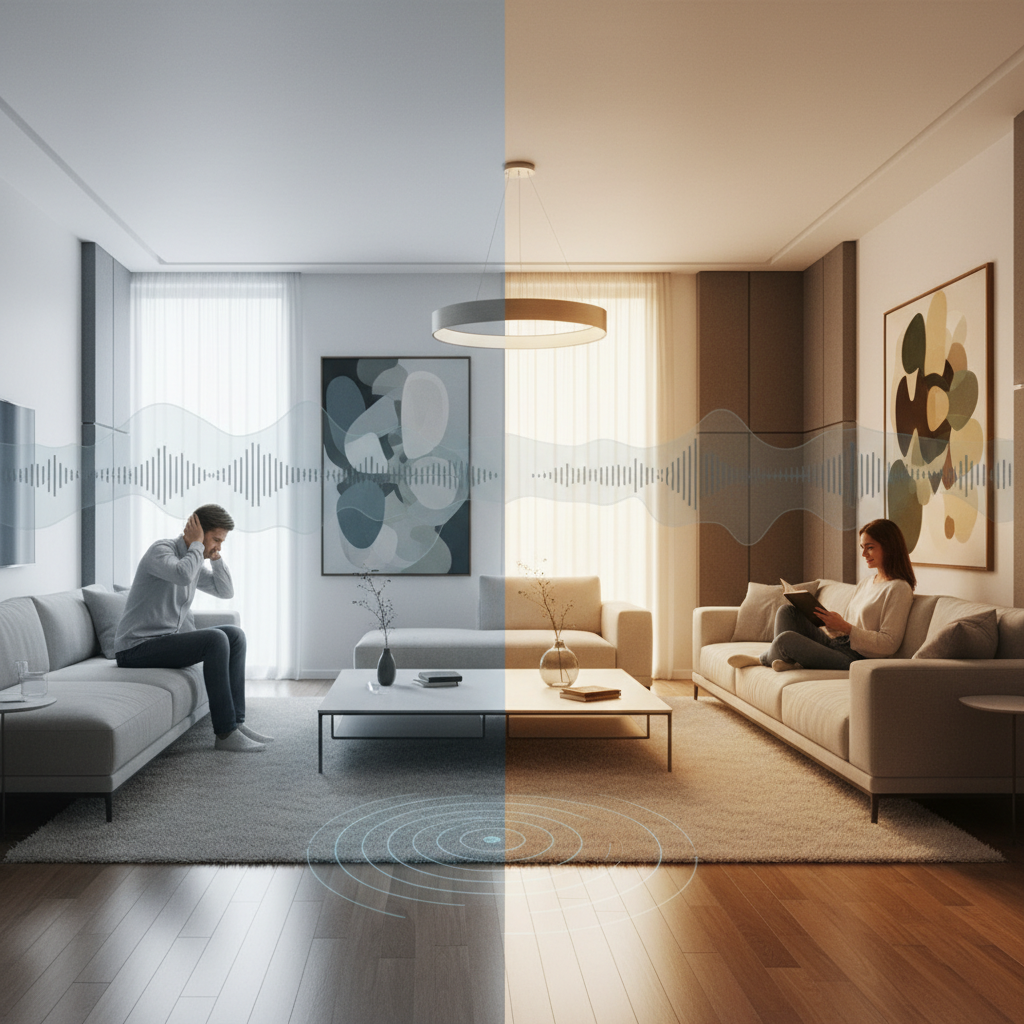
There is a profound disconnect between the visual tranquility of a beautifully designed home and the auditory reality of living in it. You invest in the timeless elegance of hardwood, only to find that every footstep echoes like a drum, conversations bounce harshly off the walls, and the subtle shifts in humidity introduce a chorus of squeaks and creaks. For design-conscious homeowners and multi-story dwellers, this is a deeply frustrating compromise. You shouldn’t have to choose between the aesthetic appeal of natural wood and the necessity of peace and quiet.
Fortunately, the flooring industry has undergone an acoustic revolution. By bridging the gap between material density and advanced underlayment technology, it is now possible to achieve a serene environment without resorting to wall-to-wall carpet. This definitive guide provides a deep dive into the science of flooring acoustics, demystifies complex industry ratings, and offers a masterclass on next-generation solutions. Specifically, we will explore the sound-reducing benefits of Bravewood hybrid hardwood, diagnosing your noise issues, and providing an architecturally sound blueprint for transforming your noisy spaces into peaceful sanctuaries.
- The Science of Sound: Why Traditional Hardwood Floors Are So Noisy
- Soundproof Flooring vs. Sound Dampening: Setting Realistic Expectations
- Deep Dive: The Sound-Reducing Benefits of Bravewood Hybrid Hardwood
- Troubleshooting: How to Fix Noisy Hardwood Floors
- Designing for Wellness: Creating a Peaceful Home with Acoustic Comfort Flooring
- Conclusion
The Science of Sound: Why Traditional Hardwood Floors Are So Noisy
To understand why traditional solid hardwood often turns a home into an echo chamber, we must first look at the physics of sound in residential spaces. Hardwood is a dense, rigid material. When sound waves—whether from a dropped object or a booming voice—hit a solid oak plank, the energy has nowhere to go. Instead of being absorbed, the sound waves reflect back into the room or transfer directly through the floor joists to the rooms below.
According to the Acoustical Society of America (ASA), the principles of room acoustics dictate that hard, parallel surfaces exacerbate sound transmission and reverberation [1]. To effectively combat noisy hardwood floors and echoing home flooring, you must first identify the specific type of acoustic intrusion you are experiencing.
Diagnosing Your Floor Noise: Impact, Airborne, and Structural
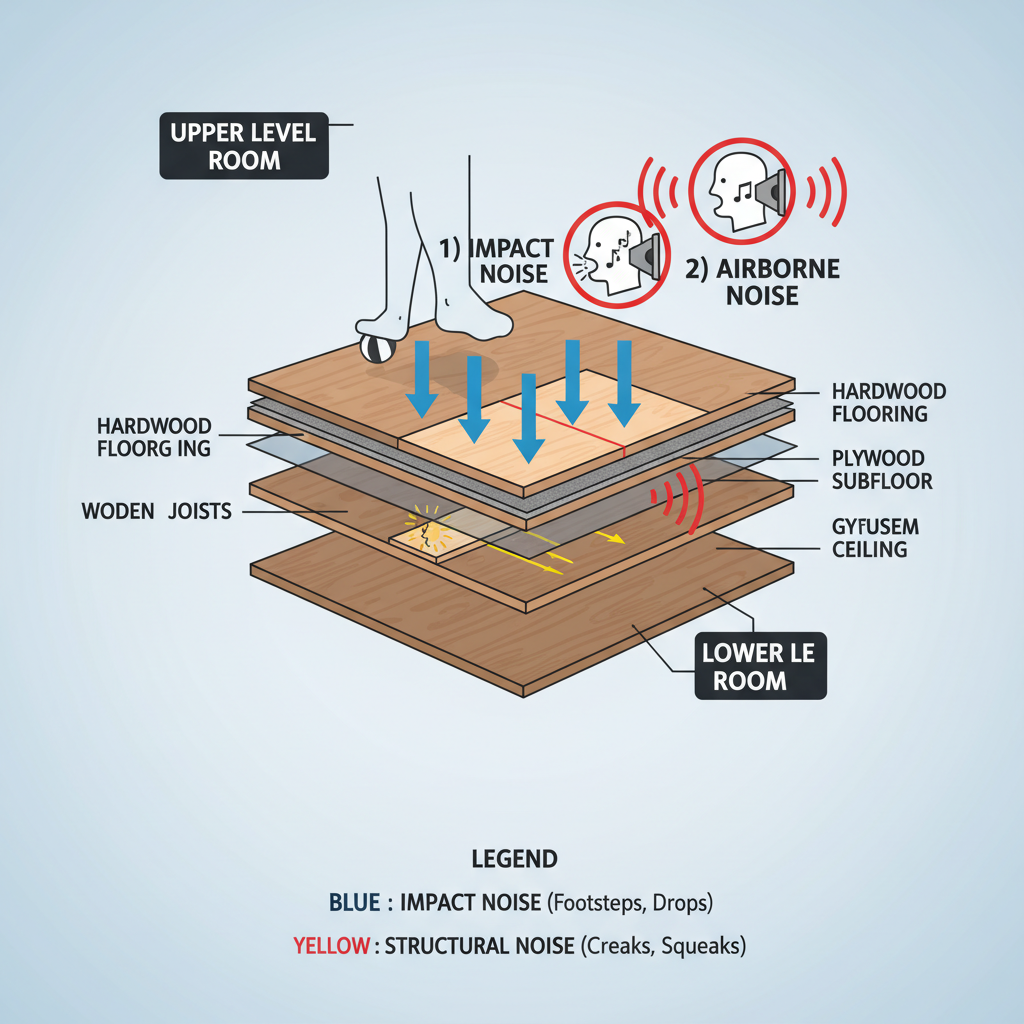
- Impact Noise: This is the physical energy of an object striking the floor. Heavy footsteps, a dropped pan, or a pet’s claws clicking on the wood are all impact noises. The energy travels directly through the flooring material and into the subfloor.
- Airborne Noise: This includes voices, television audio, or music. In open-concept homes with hard surfaces, airborne noise reflects off the floors, creating a lingering echo or reverberation.
- Structural Noise: This is the notorious squeak or creak. Structural noise is often caused by seasonal expansion, loose subfloors, or nails rubbing against wood. Research from the Forest Products Laboratory (FPL) highlights that wood expands and contracts with moisture; maintaining an ideal indoor humidity of 30-50% is crucial to minimize structural noise and preserve structural integrity [2]. Furthermore, the National Research Council Canada (NRC) emphasizes that “flanking noise”—sound traveling through indirect paths like wall cavities and floor assemblies—can severely compromise a room’s acoustics if the structural assembly is poorly designed [3].
Decoding Acoustic Ratings: IIC, STC, and NRC Explained
When shopping for the best flooring for noise reduction or exploring soundproof flooring options, you will encounter a barrage of acronyms. Here is your glossary for decoding these critical metrics:
- IIC (Impact Insulation Class): This measures a floor/ceiling assembly’s resistance to the transmission of impact noise (like footsteps). The higher the number, the better the impact sound insulation. As a vital data point: an IIC rating increase of just 10 points represents a perceived halving of impact noise volume to the human ear.
- STC (Sound Transmission Class): This measures a material’s ability to block airborne sound (like voices). The International Building Code (IBC) requires a minimum IIC and STC rating of 50 for multi-family dwellings to ensure a baseline of privacy and comfort [4].
- NRC (Noise Reduction Coefficient): This measures how much sound a material absorbs versus reflects. An NRC of 0 means perfect reflection (highly echoing), while an NRC of 1 means perfect absorption.
Soundproof Flooring vs. Sound Dampening: Setting Realistic Expectations
One of the most common misconceptions in home renovation is the search for truly “soundproof flooring.” In architectural acoustics, true soundproofing requires structural decoupling—physically separating the floor from the joists and ceiling below using resilient channels or isolation clips so vibrations cannot transfer.
Most flooring products on the market, including sound dampening hardwood, do not soundproof a room; they dampen or absorb sound. Setting realistic expectations is key. ASTM International provides the rigorous testing standards that define these sound dampening metrics, distinguishing clearly between airborne transmission and impact transmission [5]. A cross-sectional diagram of a truly soundproofed room would show a decoupled floor assembly floating above the subfloor, whereas a standard sound-dampening installation relies on the mass and absorption of the flooring layers themselves.
The Material Masterclass: What Flooring Absorbs Sound the Best?
What type of wood flooring is the quietest? When evaluating the best flooring for noise reduction, a comparison matrix reveals stark differences in performance:
- Solid Hardwood: Beautiful but acoustically poor. Standard solid hardwood typically has an IIC rating of around 40-45 without underlayment. It reflects airborne noise and transmits impact noise easily.
- Engineered Hardwood: Slightly better than solid wood due to its cross-ply construction, which breaks up some sound waves, but still requires acoustic padding to be considered quiet hardwood flooring.
- Cork Flooring: An acoustic powerhouse. Cork naturally absorbs up to 40% of acoustic impact noise due to its cellular structure, which traps air and dissipates sound energy.
- Rubber Flooring: Offers the highest IIC ratings, often exceeding 60, making it ideal for home gyms, though it lacks the aesthetic appeal desired for main living areas.
As certified acoustic consultants frequently note, the “best” material depends entirely on whether you are trying to stop echoes within the room or footsteps from reaching the room below.
The Critical Role of Acoustic Underlayments
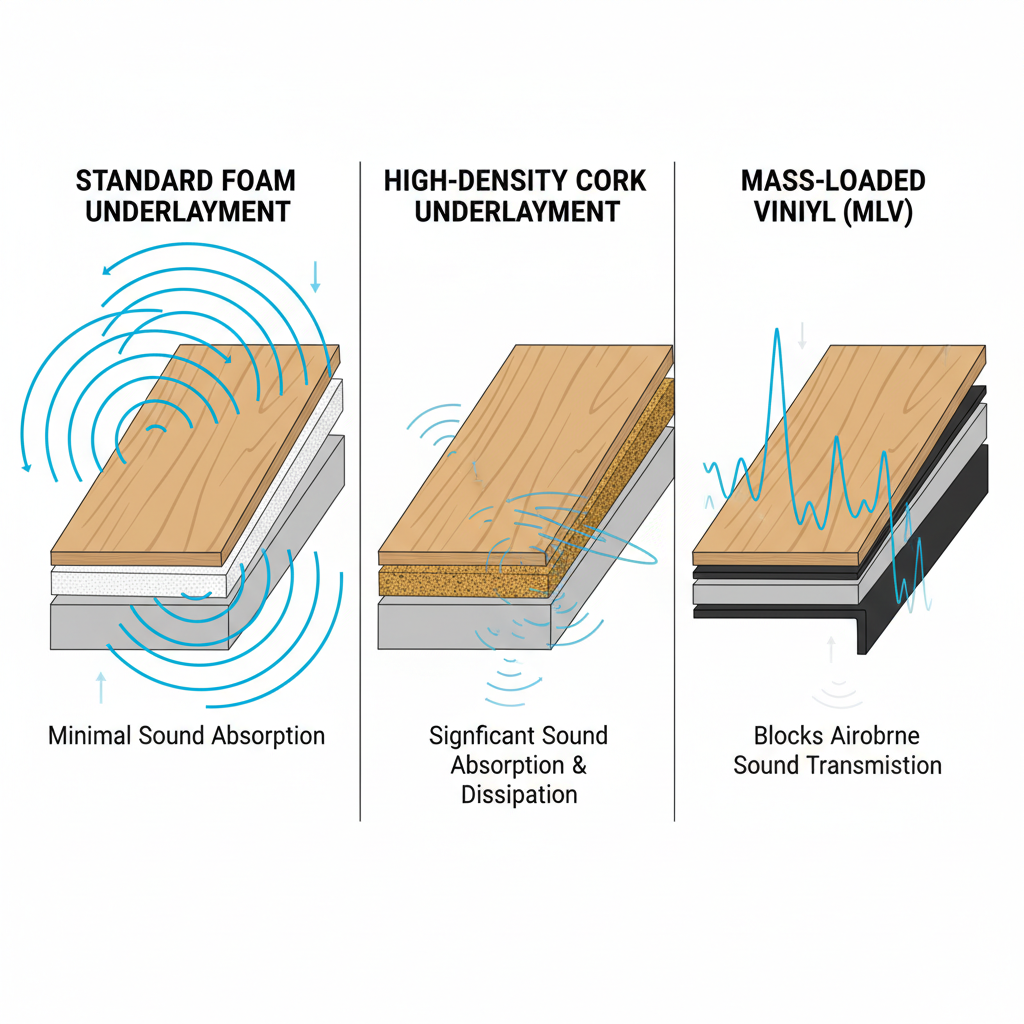
- Cork Underlayment: Eco-friendly and highly effective. Adding a premium cork underlayment can increase IIC ratings by up to 15-20 points.
- Foam Underlayment: Budget-friendly but varies wildly in quality. High-density acoustic foam performs well, but cheap, low-density foam will compress over time and lose its acoustic properties.
- Mass-Loaded Vinyl (MLV): A heavy, dense material used to block airborne noise. It adds mass to the floor assembly, which is critical for lowering STC transmission.
When installing these materials, it is imperative to follow the installation guidelines for acoustic underlayments set forth by the National Wood Flooring Association (NWFA) to ensure the padding does not compromise the structural locking mechanisms of the floorboards above [6].
Deep Dive: The Sound-Reducing Benefits of Bravewood Hybrid Hardwood
For homeowners who want the aesthetic of real wood without the hassle of retrofitting complex underlayments, the market has responded with advanced engineered solutions. Bravewood hybrid hardwood represents a premier example of this technology. But what makes Bravewood flooring acoustic, and how does it address the demand for sound reducing hybrid hardwood flooring?
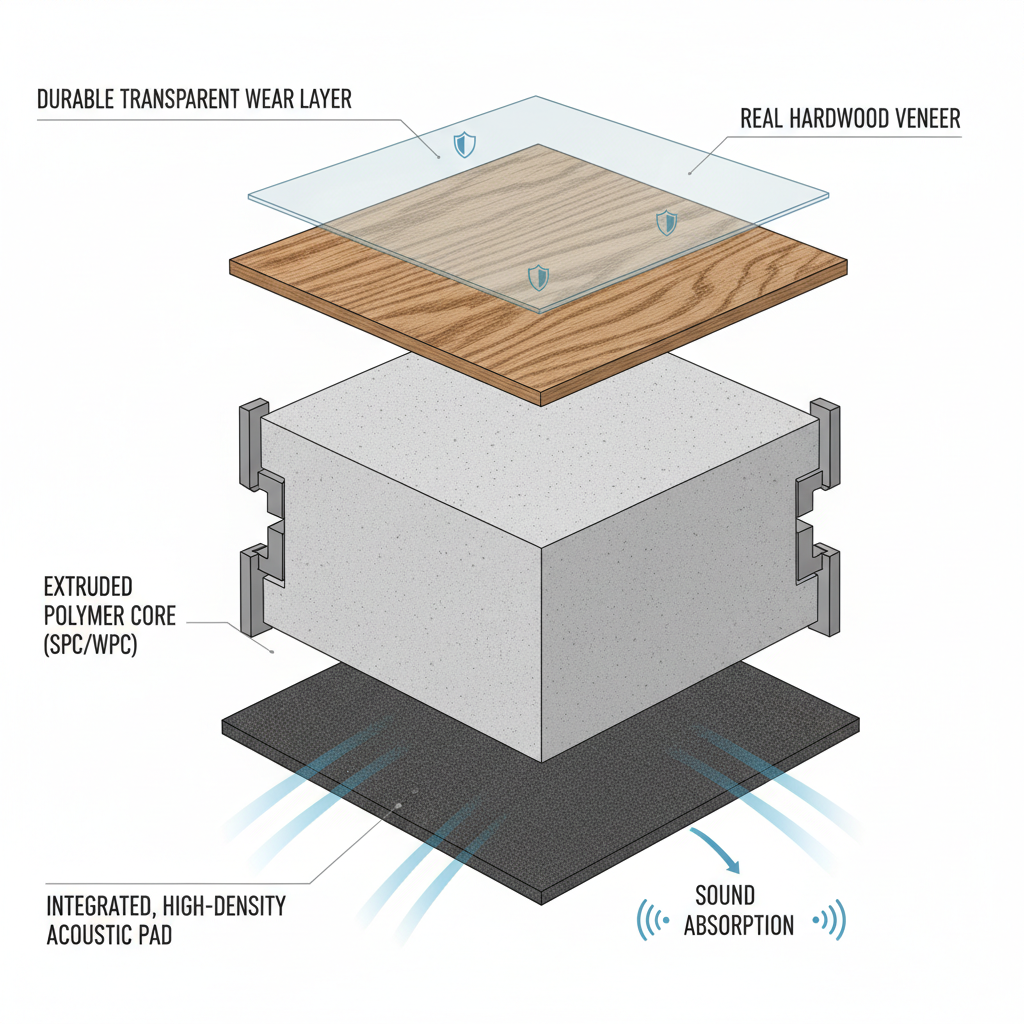
In our teardown of Bravewood’s multi-layer construction, the benefits of Bravewood acoustic flooring become clear. Unlike traditional planks, Bravewood features an extruded polymer core (SPC/WPC) topped with a real hardwood veneer, and crucially, an attached, high-density acoustic pad. This all-in-one construction is designed to tackle both impact and airborne noise simultaneously. Furthermore, addressing a common consumer question—is Bravewood hardwood waterproof?—the polymer core technology inherently provides superior moisture resistance compared to solid oak, protecting the planks from the warping that often leads to structural squeaks.
How Hybrid Technology Outperforms Solid Oak in Acoustics
When comparing quiet hardwood flooring options, hybrid technology significantly outperforms solid oak. The dense, extruded polymer core of a hybrid plank is less resonant than solid wood. It doesn’t have the same “hollow” echo when walked upon.
Data shows that hybrid floors with an extruded polymer core can reduce impact sound transmission by up to 30% compared to standard laminate. While solid wood hovers around an IIC of 40, engineered or hybrid hardwood with built-in acoustic pads can achieve IIC ratings in the high 50s, easily surpassing multi-family building code requirements and ensuring superior sound reducing hybrid hardwood flooring performance.
Durability, Cost, and Long-Term Wear
A common transactional query is, “How much does Bravewood flooring cost per square foot?” While premium hybrid hardwoods typically range between $5 to $10 per square foot, the investment must be weighed against the savings of not having to purchase and install separate, high-end acoustic underlayments.
In terms of long-term wear, Bravewood hybrid hardwood meets the baseline standards for hardwood durability established by the National Wood Flooring Association (NWFA) [6]. Because the real wood veneer is protected by advanced aluminum oxide wear layers, verified user testimonials and 1+ year wear-and-tear testing results consistently highlight that the floor maintains its aesthetic integrity while continuing to deliver on its acoustic promises, resisting the dents and scratches that plague softer woods.
Troubleshooting: How to Fix Noisy Hardwood Floors
If you are not in the market for a full replacement but are plagued by noisy hardwood floors and echoing home flooring, there are actionable steps you can take.
For structural squeaks, the solution depends on access. If you have an unfinished basement below the squeaky floor, you can use shims or construction adhesive to secure the subfloor to the joists. If you must work from above, specialized breakaway screws can be driven through the hardwood and into the joist; the head snaps off below the surface, allowing you to fill the tiny hole with wood putty. This is a safe, structural DIY fix. However, if the entire subfloor is rotting or sagging, it is time to call a structural engineer or master carpenter.
To combat airborne echo, you must introduce absorption. Adding soft furnishings, heavy drapes, and plush area rugs can increase a room’s overall sound absorption by up to 25-30%, drastically reducing the harsh reverberations common in minimalist, hard-surfaced rooms.
Designing for Wellness: Creating a Peaceful Home with Acoustic Comfort Flooring
Ultimately, the pursuit of a quiet floor is about more than just silencing footsteps; it is about holistic interior design and wellness. Acoustic comfort flooring is a foundational element of a peaceful home flooring strategy.
The psychological impact of a noisy home is well-documented. The World Health Organization (WHO) explicitly states that prolonged exposure to environmental noise above 55 dB can trigger elevated stress and health issues, disrupting sleep and increasing anxiety [7]. By integrating sound-dampening materials like hybrid hardwood, you are engaging in biophilic design—bringing the calming, natural aesthetic of wood indoors while actively managing the acoustic environment to support human health. The International WELL Building Institute (IWBI) even includes rigorous standards for acoustic comfort in healthy buildings, proving that a quiet room is a healthier room [8].
Conclusion
Creating a serene living space requires a delicate balance between visual beauty and auditory control. While traditional solid hardwood remains a stunning architectural choice, it often falls short in modern, busy, or multi-story homes where noise transmission is a daily pain point. You do not have to sacrifice the look of real wood to achieve a quiet environment.
Technological advancements have paved the way for acoustic comfort flooring that does the heavy lifting for you. Hybrid solutions like Bravewood hybrid hardwood offer a masterful blend of authentic wood aesthetics, waterproof durability, and integrated sound-dampening cores. As you plan your next renovation, remember to always check the IIC and STC ratings of your chosen materials. Whether you opt for a high-performance cork underlayment or a next-generation hybrid plank, investing in your home’s acoustics is an investment in your daily peace and wellness.
Disclaimer: Acoustic performance and ratings (IIC/STC) can vary significantly based on existing subfloor construction, building materials, and installation methods. Consult a certified flooring installer or acoustic engineer for compliance with local building codes.
References & Authoritative Sources
- Acoustical Society of America (ASA). (N.D.). Principles of Room Acoustics and Sound Transmission. Retrieved from ASA guidelines on architectural acoustics.
- Forest Products Laboratory (FPL). (N.D.). Wood Moisture and Structural Integrity. Retrieved from FPL research on ideal indoor humidity for hardwood.
- National Research Council Canada (NRC). (N.D.). Flanking Noise and Floor Assemblies. Retrieved from NRC studies on residential sound transmission.
- International Code Council (ICC). (N.D.). International Building Code (IBC) Acoustic Requirements. Retrieved from IBC standards for multi-family dwellings.
- ASTM International. (N.D.). Standards for IIC and STC Testing. Retrieved from ASTM definitions of sound dampening metrics.
- National Wood Flooring Association (NWFA). (N.D.). Installation Guidelines for Acoustic Underlayments and Baseline Standards for Hardwood Durability. Retrieved from NWFA industry standards.
- World Health Organization (WHO). (N.D.). Guidelines on Community Noise. Retrieved from WHO reports on environmental noise and health impacts.
- International WELL Building Institute (IWBI). (N.D.). WELL Building Standard: Acoustic Comfort. Retrieved from IWBI criteria for healthy buildings.
