
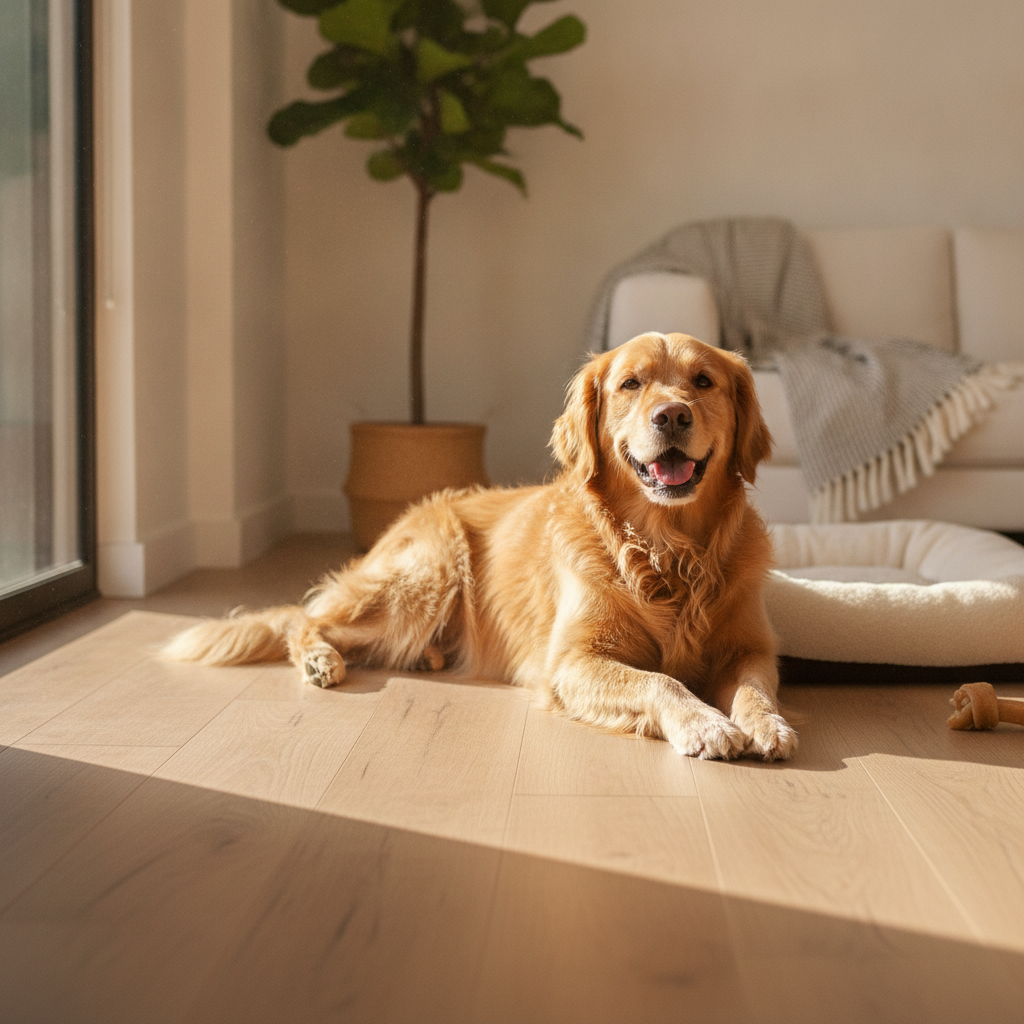
That tell-tale click-clack-click of your dog’s nails on your brand-new floor is a sound that can send a shiver down any pet owner’s spine. It’s the sound of your investment being put to the ultimate test. Or perhaps you’re all too familiar with the quiet panic of discovering a pet accident, praying it hasn’t seeped in, stained, or warped the surface. You love your furry family members, but the constant battle to protect your floors is exhausting.
This is not just another list of “top 5 floors for pets.” This is your definitive lifecycle guide. We’re here to empower you with the technical knowledge to confidently choose the right pet-friendly flooring, the practical skills to maintain it, and the expert techniques to repair common damage. We will move beyond marketing claims to give you data-driven insights.
In this guide, you’ll learn to identify the real damage your pets can cause, decode the science behind durability ratings and waterproof technology, compare the top flooring champions head-to-head, and master the essential maintenance and repair skills that will bring you peace of mind for years to come.
- Why Your Pet Deserves the Right Floor: Common Types of Flooring Damage
- The Science of Durability: Decoding Pet-Proof Flooring Technology
- The 2024 Champions: A Head-to-Head Comparison of Pet-Friendly Flooring
- Beyond Durability: Critical Factors for Your Pet’s Health and Comfort
- The Pet Owner’s Maintenance & Repair Manual
- Conclusion: Making the Best Flooring Choice for You and Your Furry Family
- References & Authoritative Sources
Why Your Pet Deserves the Right Floor: Common Types of Flooring Damage
If you’re worried about your floors, you’re not alone. According to the American Pet Products Association (APPA), a staggering 70% of U.S. households own a pet, making the challenge of finding durable flooring a near-universal issue for homeowners.1 Understanding the specific ways our beloved animals impact our floors is the first step toward finding the perfect solution.
To help you gauge your current situation, consider using a simple Damage Assessment Scorecard. Rate your current floors on a scale of 1-5 for issues like visible scratches, stain permanence, and water resistance. This will clarify your biggest pain points and guide your focus as you explore the options below.
The #1 Culprit: Scratches, Scuffs, and Gouges
The most visible and immediate type of damage comes from claws. This isn’t just about aesthetics; deep scratches can compromise your floor’s protective top layer, leaving it vulnerable to moisture and dirt. The impact varies significantly based on your pet’s size, weight, and energy level. A playful 80-pound Labrador will inflict far more wear than a calm 10-pound cat.
However, even cats contribute to surface wear through scratching or “kneading.” For dog owners, especially those with scratch-resistant flooring for large dogs, the daily grind of claws can quickly turn a beautiful surface into a network of scuffs and gouges.
As one professional wood floor refinisher notes, “The most common and costly repairs we handle are deep dog scratches on hardwood floors. Many homeowners don’t realize that by the time they see a deep gouge, the damage has often gone through the finish and into the wood itself, requiring a full sand and refinish.”
The Silent Destroyer: Urine Stains, Odors, and Water Damage
From puppy training accidents to the occasional upset stomach or a perpetually messy water bowl, moisture is a constant threat. The problem with pet urine goes beyond a simple stain. It contains uric acid crystals, which don’t dissolve in water or traditional cleaners. This is why the odor can return on humid days or seem impossible to eliminate completely.2 When these acidic compounds seep into porous materials like unsealed hardwood or the core of traditional laminate, they can cause permanent discoloration, delamination, and a lingering smell that’s nearly impossible to remove.
Even simple water from a spilled bowl, if left to sit, can cause planks to swell, warp, and buckle. This makes choosing truly waterproof flooring for pets, not just water-resistant, a critical decision for long-term durability.
Addressing a Content Gap: Noise and Acoustics
One often-overlooked aspect of pet-friendly flooring is sound. The material you choose can dramatically alter your home’s acoustic environment. Hard surfaces like tile or traditional hardwood can amplify the sound of claws, creating a constant clicking that can be disruptive. Softer materials or those installed with an acoustic underlayment can dampen this noise, creating a more peaceful living space.
Expert Insight: A home designer might advise, “When selecting flooring for a multi-pet household, consider the acoustic impact. LVP with an attached cork backing or laminate with a high-quality foam underlayment can significantly reduce the ‘tap-dancing’ sound of pet nails, contributing to a calmer, quieter home.”
The Science of Durability: Decoding Pet-Proof Flooring Technology
To find truly durable flooring for pets, you need to look past the showroom shine and understand the technology that makes a floor tough. Marketers use a lot of jargon, but understanding a few key metrics will allow you to compare products like a pro and choose the best scratch-proof flooring based on hard data. Industry standards, like those set by ASTM International for material testing, provide an unbiased benchmark for quality and performance.3
Scratch Resistance Explained: Wear Layers, AC Ratings, and the Janka Scale
When a floor is marketed as “scratch-resistant,” it’s referring to its ability to withstand abrasion. This is measured in different ways for different materials:
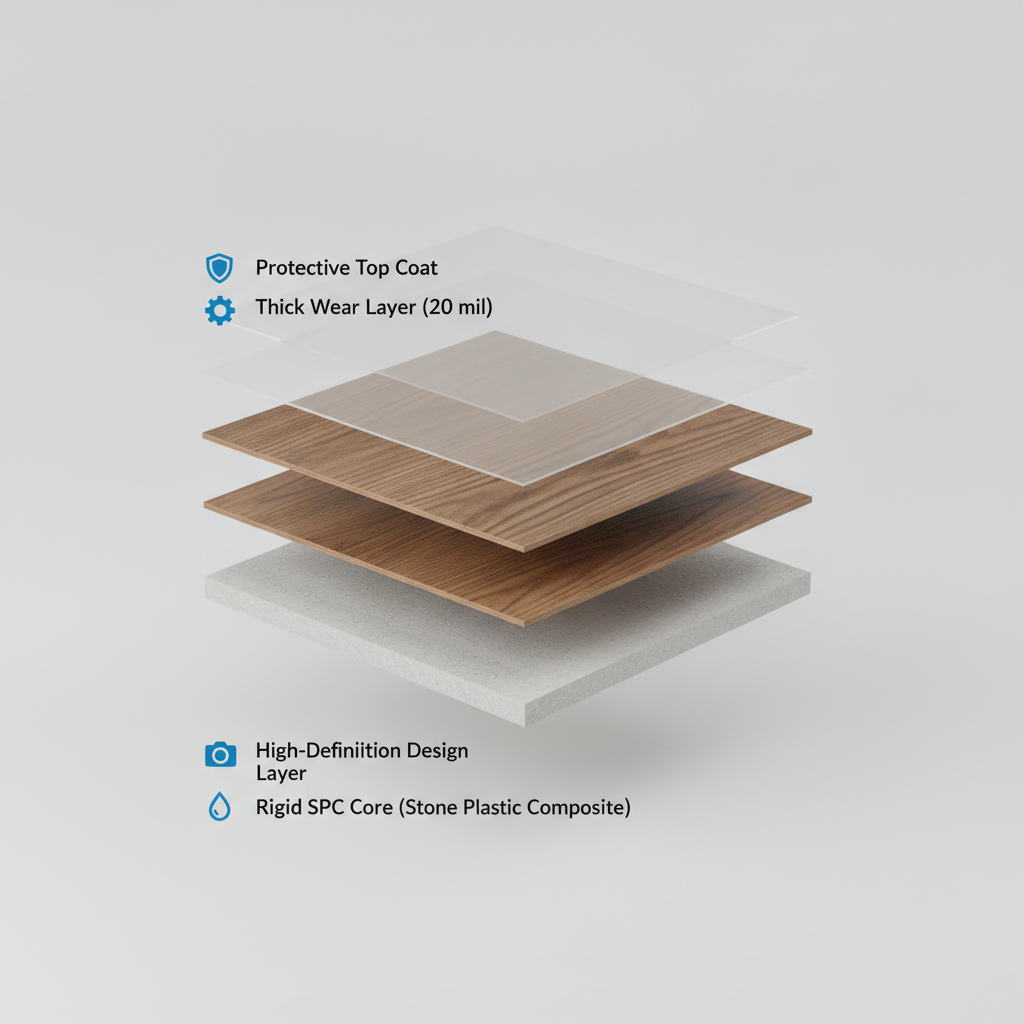
- Wear Layer (Vinyl Flooring): This is the transparent top coating that protects the photographic layer of luxury vinyl plank (LVP). It’s measured in mils (one-thousandth of an inch). For homes with pets, especially large dogs, look for a wear layer of at least 20 mils. Anything less may not stand up to heavy claw traffic.
- AC Rating (Laminate Flooring): The Abrasion Class (AC) rating measures a laminate floor’s durability. The scale runs from AC1 (light residential use) to AC5 (heavy commercial use). For pet owners, an AC4 or AC5 rating is highly recommended. According to the Floor Covering Institute, these ratings signify that the floor can withstand the traffic of a commercial environment, making it more than a match for even the most active pets.4
- Janka Hardness Scale (Hardwood): This test measures the force required to embed a steel ball into a piece of wood. As the authority on wood flooring, the National Wood Flooring Association (NWFA) uses this scale to rate the dent and wear resistance of different wood species.5 A higher number means a harder, more scratch-resistant wood (e.g., Brazilian Walnut at 3684) compared to a softer wood (e.g., Douglas Fir at 660).
Waterproof vs. Water-Resistant: A Critical Distinction
This is one of the most confusing and critical distinctions for pet owners.
- Water-Resistant: This means the surface of the floor can repel water for a limited time. Spills need to be wiped up quickly. If moisture seeps through the seams into the core (often made of wood fiber), the planks can swell and be permanently damaged.
- Waterproof: This means the flooring material itself is impervious to water. The planks will not swell, buckle, or degrade, even if submerged. This is a feature of materials like luxury vinyl and porcelain tile.
A certified flooring installer would emphasize, “The product might be waterproof, but the installation is what makes the system waterproof. If you don’t have a level subfloor and the planks don’t lock together perfectly, water can still find its way underneath to the subfloor, where it can cause mold and rot. Proper installation is non-negotiable.”
The Core of the Matter: SPC vs. WPC in Hybrid Flooring
When looking at waterproof hybrid hardwood or luxury vinyl, you’ll encounter two core types: SPC and WPC.
- WPC (Wood Plastic Composite): This core contains wood pulp and foaming agents, making it lighter and softer underfoot. It offers good sound insulation but is less dense.
- SPC (Stone Plastic Composite): This core is made from a mixture of limestone powder, PVC, and stabilizers. It is much denser, heavier, and more dimensionally stable than WPC. This makes SPC flooring significantly more resistant to dents from heavy furniture or dropped objects and less susceptible to expansion and contraction with temperature changes.
Leading manufacturers who pioneered these technologies often recommend SPC for its superior toughness in high-traffic homes. The Resilient Floor Covering Institute (RFCI) provides standards for these materials, ensuring quality and performance claims are met.6 For most pet owners, the added rigidity and dent resistance of an SPC core make it the superior choice.
The 2024 Champions: A Head-to-Head Comparison of Pet-Friendly Flooring
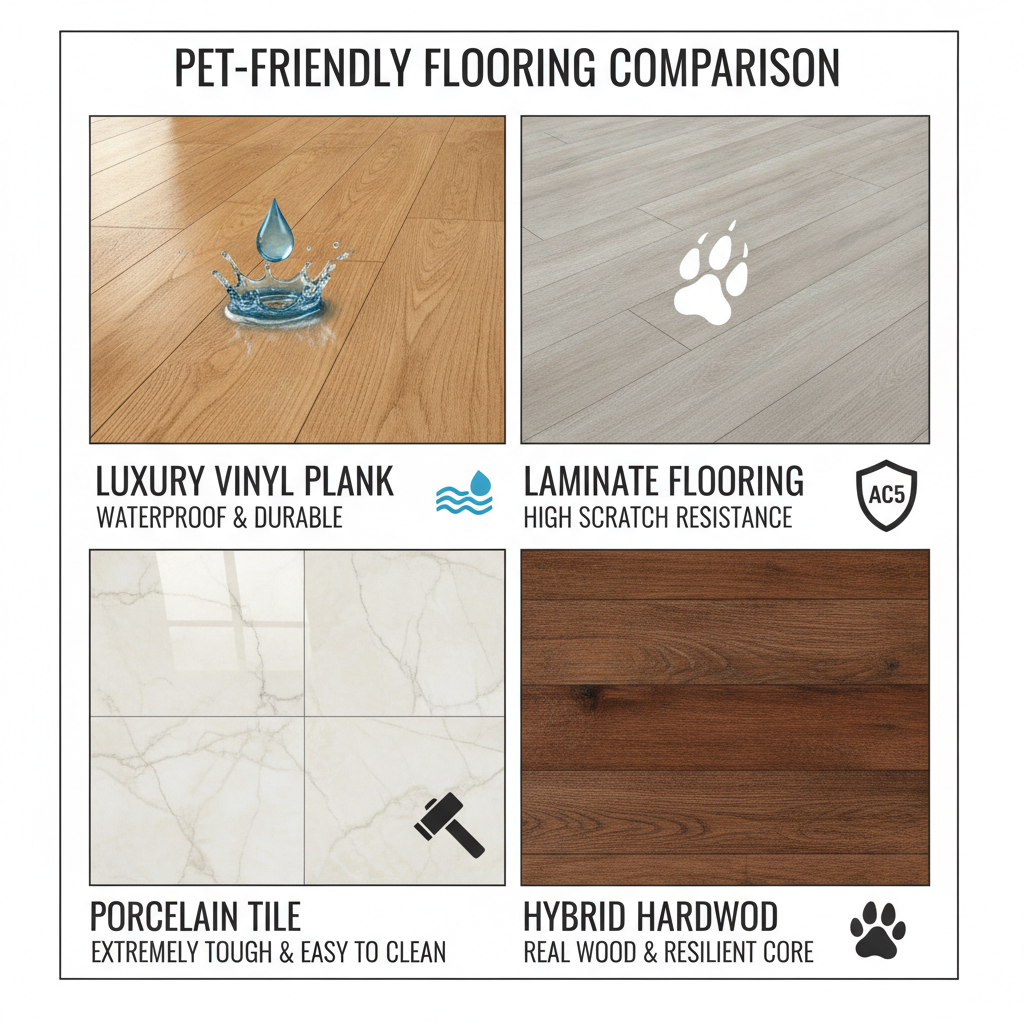
Now that you understand the technology, let’s compare the top contenders. There is no single “best” flooring for every pet and every home. The right choice depends on your budget, lifestyle, and aesthetic preferences. Each option below includes a “Durability Scorecard” to help you compare at a glance.
1. Luxury Vinyl Plank/Tile (LVP/LVT): The All-Around Winner
LVP/LVT has become the go-to choice for pet owners for good reason. It masterfully combines durability, style, and ease of maintenance. Modern LVP with an SPC core is 100% waterproof, making it fearless in the face of pet accidents and spilled water bowls. Its commercial-grade wear layer provides excellent protection against scratches.
- Pros: 100% waterproof (with SPC core), highly scratch and stain-resistant, easy to clean, quieter and softer underfoot than tile, huge variety of realistic wood and stone looks.
- Cons: Can be dented by extremely heavy objects, quality varies significantly by brand and wear layer thickness.
Durability Scorecard:
- Scratch Resistance: 4/5 (with 20 mil+ wear layer)
- Waterproofing: 5/5 (with SPC core)
- Ease of Cleaning: 5/5
- Pet Comfort: 4/5
For homes with large dogs, flooring experts universally recommend a wear layer of 20 mil or more to ensure long-lasting protection.
2. Modern Laminate Flooring: Scratch Resistance Redefined
Forget the laminate of the 90s. Today’s high-quality laminate flooring is a durability powerhouse, especially when it comes to scratch resistance. Thanks to its incredibly tough, aluminum-oxide top layer, laminate with a high AC rating is often even more scratch-resistant than LVP. While the core is traditionally made of wood fiber, many modern lines now feature enhanced water resistance and can withstand topical moisture for 24-72 hours.
- Pros: Exceptional scratch resistance (best in class), budget-friendly, highly realistic wood looks, easy to install.
- Cons: Not fully waterproof (core can be damaged by standing water), can be noisy without a quality underlayment, can be slippery if not textured.
Durability Scorecard:
- Scratch Resistance: 5/5 (with AC4 or AC5 rating)
- Waterproofing: 3/5 (water-resistant surface only)
- Ease of Cleaning: 4/5
- Pet Comfort: 3/5
Pro Tip: To maximize water resistance with laminate, a certified installer will advise using a vapor barrier underlayment, applying silicone sealant around the perimeter of the room and any cutouts (like pipes or vents), and immediately wiping up any spills.
3. Porcelain & Ceramic Tile: The Indestructible Option
When absolute, unquestionable durability is the top priority, tile is the answer. As the Tile Council of North America (TCNA) confirms, porcelain tile with a PEI rating of 4 or 5 is designed for heavy commercial traffic and is virtually impervious to scratches from dog claws.7 It’s also 100% waterproof and will not be damaged by any pet accident.
- Pros: Virtually scratch-proof, 100% waterproof, extremely durable and long-lasting, easy to clean the surface.
- Cons: Grout lines can stain and are difficult to clean, hard and cold underfoot, can be slippery, unforgiving when items are dropped.
Durability Scorecard:
- Scratch Resistance: 5/5
- Waterproofing: 5/5
- Ease of Cleaning: 3/5 (due to grout)
- Pet Comfort: 2/5
Grout Solutions for Pet Owners: A major pain point with tile is the grout. To combat this, opt for dark-colored grout to hide dirt. Better yet, invest in epoxy grout, which is non-porous and highly resistant to stains and bacteria, or ensure traditional grout is sealed properly and regularly.
4. Waterproof Hybrid Hardwood: The Best of Both Worlds?
For those who refuse to compromise on the authentic beauty of real wood, waterproof hybrid hardwood is a revolutionary option. This flooring is constructed with a thin veneer of genuine hardwood bonded to a rigid SPC core. This gives you the look and feel of real wood on the surface, with the 100% waterproof and dent-resistant stability of a stone-composite core underneath.
- Pros: Authentic wood surface, 100% waterproof core, more dimensionally stable than solid hardwood, can be installed in kitchens and basements.
- Cons: The real wood veneer is still susceptible to scratches and dents (though more resistant than solid wood), it is a premium-priced product, cannot be refinished.
Durability Scorecard:
- Scratch Resistance: 3/5 (veneer can scratch)
- Waterproofing: 5/5 (core is waterproof)
- Ease of Cleaning: 4/5
- Pet Comfort: 4/5
Brand Showdown:
| Feature | Shaw Floorte Hardwood | Mohawk UltraWood | Cali Bamboo GeoWood |
|---|---|---|---|
| Core Type | SPC | HDF (High Density Fiberboard) | SPC |
| Waterproof? | Yes (Core) | Yes (Surface + Core) | Yes (Core) |
| Veneer | Real Hardwood | Real Hardwood | Real Hardwood/Bamboo |
| Warranty | Lifetime Residential | Lifetime Residential | 50 Year Residential |
As one user on Reddit’s r/HomeImprovement noted, “We went with a hybrid hardwood in our living room. It looks amazing, and we don’t panic about the dog’s water bowl anymore. But we are still careful about his claws—it’s tough, but it’s still real wood on top.”8
Beyond Durability: Critical Factors for Your Pet’s Health and Comfort
A truly pet-friendly floor isn’t just about preventing damage; it’s about creating a safe and comfortable environment for your four-legged family members. Focusing only on durability is a common mistake that can neglect your pet’s well-being.
Ask the Vets: A veterinarian specializing in canine mobility might say, “Traction is incredibly important, especially for senior dogs or breeds prone to hip dysplasia. Constantly slipping on slick floors puts unnatural stress on their joints, which can lead to or exacerbate arthritis and other mobility issues. Choosing a floor with some texture can make a world of difference in their long-term health.”
Traction and Safety: Preventing Slips and Joint Strain
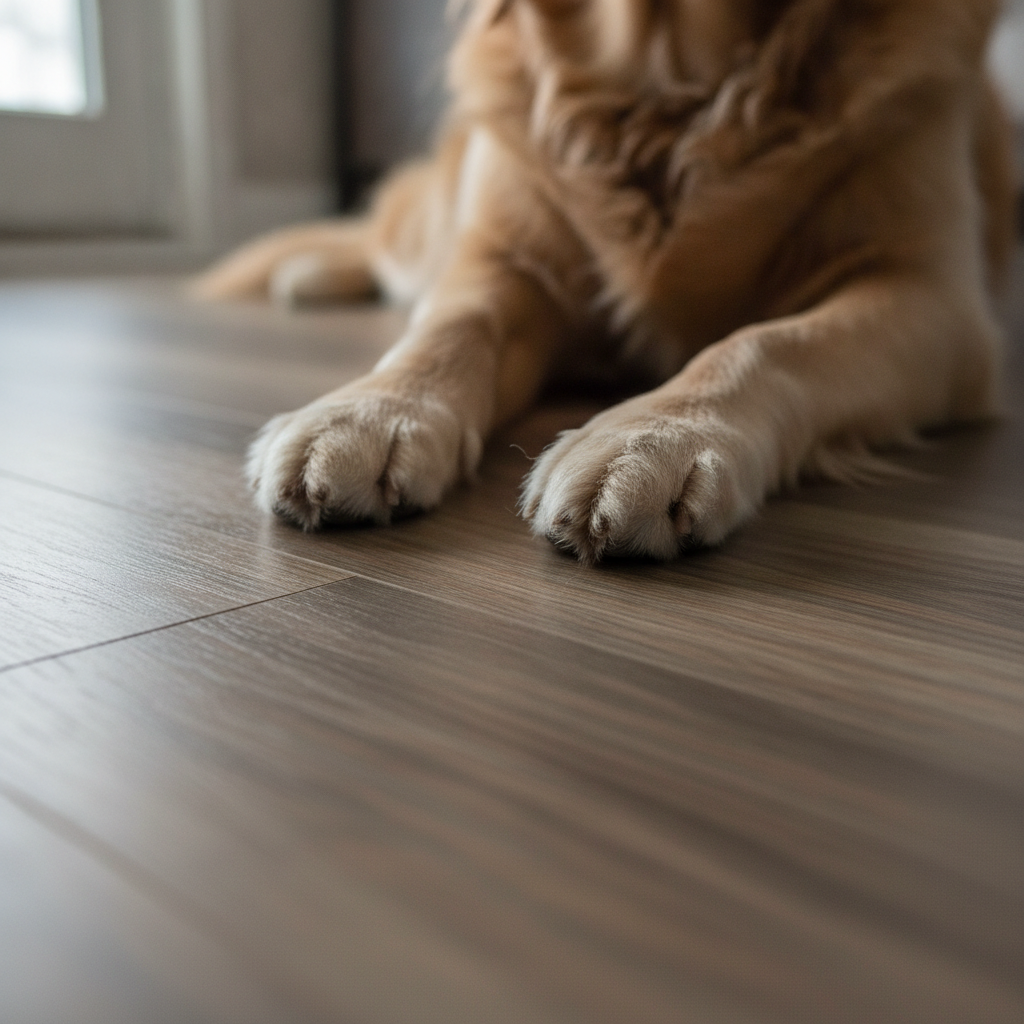
Slick, high-gloss floors can be like an ice rink for pets, leading to slips, falls, and potential injuries. As the American Kennel Club (AKC) often advises for senior pet care, providing a non-slip surface is a key part of creating a safe home environment.9 When choosing a floor, look for options with an embossed or textured surface that mimics the grain of real wood or the feel of stone. These textures provide crucial grip for paws, giving your pet more confidence and stability as they move through the house.
Air Quality and Toxins: Look for FloorScore® Certification
Our pets spend most of their lives on or near the floor, breathing in whatever air is down there. Many flooring products can release Volatile Organic Compounds (VOCs), which can be harmful to both pets and people. To ensure you’re choosing a safe, non-toxic option, look for FloorScore® certification. This is a stringent, independent, third-party certification that tests for compliance with strict indoor air quality standards.10 Choosing a FloorScore® certified product means you’re bringing a healthier floor into your home.
The Pet Owner’s Maintenance & Repair Manual
Choosing the right floor is half the battle; knowing how to care for it is what ensures it lasts a lifetime. A proper maintenance routine and the knowledge to tackle common repairs will save you stress and money. The cleaning experts at the Good Housekeeping Institute Cleaning Lab consistently show that using the right tools and techniques for your specific floor type is the key to effective maintenance.11
Daily & Weekly Cleaning for a Pet-Friendly Home
A consistent cleaning routine is your best defense against dirt and damage. Matte or low-sheen finishes are excellent at hiding minor dust, hair, and paw prints, while high-gloss finishes will show everything.
Your Pet Mess Cleaning Kit:
- Microfiber Dust Mop: For daily sweeping of hair and dander.
- Pet-Specific Vacuum: One with a brushless head for hard surfaces to avoid scattering debris.
- pH-Neutral Floor Cleaner: Safe for most surfaces and won’t damage the finish.
- High-Quality Enzymatic Cleaner: An absolute must-have for any pet accident.
- Microfiber Cleaning Cloths: For blotting spills and applying cleaners.
Experts from The Cleaning Institute emphasize using pH-neutral cleaners, as acidic or alkaline solutions can dull the finish of your floor over time.12
How to Fix Scratches on Hardwood Floors: A Step-by-Step Guide
Seeing a scratch on your beautiful hardwood can be heartbreaking, but many can be fixed. The critical first step is to identify your floor’s finish, as this dictates the repair method.
- For Light Surface Scuffs (in the finish): Often, these can be buffed out. Use a soft cloth with a small amount of a manufacturer-recommended polish or paste wax. For polyurethane finishes, a product like a Minwax® Wood Finish™ Stain Marker can often hide the scratch perfectly.13
- For Deeper Scratches (into the wood):
- Clean the area thoroughly.
- Use a wood stain pen or a wax stick that matches your floor’s color to fill in the scratch.
- Wipe away any excess immediately.
- For very deep gouges, you may need a color-matched wood filler putty. Apply it, let it dry completely, and then lightly sand it smooth before applying a matching stain and topcoat.
Always follow the guidelines from the National Wood Flooring Association (NWFA) and your specific flooring manufacturer for the best results.14
Winning the War on Urine: Removing Stains and Odors for Good
To defeat pet urine, you must neutralize the uric acid. Here is the professional protocol, reflecting standards from the IICRC.15
- Blot, Don’t Rub: Immediately absorb as much of the fresh urine as possible with a clean cloth or paper towels.
- Saturate with Enzymatic Cleaner: Generously spray a high-quality enzymatic cleaner on the area. Don’t be shy; you need the cleaner to reach as deep as the urine did.
- Wait: Let the cleaner sit for the time recommended by the manufacturer (often 15-30 minutes, or even longer for old stains). The enzymes need time to break down the uric acid crystals.
- Blot Again: Blot the area dry with a clean cloth.
- Let It Air Dry: Allow the area to air dry completely, which could take up to 24 hours. Keep pets away from the area during this time.
For finding old, hidden stains, a UV blacklight is an invaluable tool. In a dark room, old urine stains will glow, allowing you to find and treat every single spot.
Safety First: Always test any cleaner or repair product on an inconspicuous area of your floor first (like inside a closet or under a large piece of furniture) to ensure it doesn’t cause discoloration or damage.
Conclusion: Making the Best Flooring Choice for You and Your Furry Family
The journey to finding the perfect pet-friendly flooring can feel overwhelming, but it doesn’t have to be. As we’ve seen, there is no single “best” floor, but there is a perfect floor for your home, your pet, and your lifestyle. By focusing on the key factors—scratch resistance, waterproof technology, your pet’s comfort and safety, and your budget—you can move beyond the marketing hype.
You are now equipped with the knowledge to decode durability ratings, understand the difference between materials like LVP and laminate, and ask the right questions of any salesperson or installer. You have the power to make a confident, informed decision that will not only enhance the beauty of your home but also bring you lasting peace of mind. The goal is to create a space where you can relax and enjoy life with your furry family, without constantly worrying about the floor beneath your feet (and paws).
Have you found the perfect pet-friendly floor? Share your experiences and questions in the comments below to help other pet owners in their journey!
This article may contain affiliate links. The information provided is for educational purposes and does not constitute professional installation advice. Always consult a certified flooring professional for your specific project.
References & Authoritative Sources
- American Pet Products Association (APPA). (N.D.). Pet Industry Market Size, Trends & Ownership Statistics. Retrieved from APPA’s official website.
- Nature’s Miracle. (N.D.). How Do Enzyme Cleaners Work?. Retrieved from Nature’s Miracle’s product information resources.
- ASTM International. (N.D.). Homepage. Retrieved from www.astm.org.
- National Wood Flooring Association (NWFA). (N.D.). Janka Hardness. Retrieved from NWFA’s technical resources for consumers.
- Floor Covering Institute. (N.D.). Laminate Flooring AC Ratings. Retrieved from the institute’s official publications or website.
- Resilient Floor Covering Institute (RFCI). (N.D.). Homepage. Retrieved from rfci.com.
- Tile Council of North America (TCNA). (N.D.). PEI Rating. Retrieved from TCNA’s consumer education resources.
- Reddit. (Various Dates). User discussions on flooring choices. Retrieved from r/HomeImprovement.
- American Kennel Club (AKC). (N.D.). Making Your Home Comfortable for a Senior Dog. Retrieved from AKC’s health and wellness articles.
- SCS Global Services. (N.D.). FloorScore®. Retrieved from www.scsglobalservices.com/services/floorscore.
- Good Housekeeping Institute. (N.D.). Cleaning Lab resources. Retrieved from Good Housekeeping’s official website.
- The American Cleaning Institute. (N.D.). Cleaning Product Chemistry. Retrieved from www.cleaninginstitute.org.
- Minwax / Bona. (N.D.). Product usage guides and repair recommendations. Retrieved from the manufacturers’ official websites.
- Institute of Inspection, Cleaning and Restoration Certification (IICRC). (N.D.). IICRC Standards. Retrieved from iicrc.org.
