
There is a unique frustration in watching an expensive, meticulously chosen hardwood or luxury vinyl floor prematurely fade, yellow, or degrade under the glare of the sun. For homeowners with heavily sunlit spaces—such as sunrooms, south-facing living areas, or homes featuring large architectural glass facades—standard flooring often surrenders to the elements long before its time. The core problem extends far beyond mere aesthetic fading; it is a battle against unseen structural degradation caused by relentless ultraviolet (UV) radiation and infrared heat.
This article serves as your definitive, science-backed guide to understanding and combatting sun damage. We will explore how to diagnose microscopic UV degradation and, more importantly, how to invest in generational, ROI-positive technologies. From the proprietary brilliance of Adamantine finishes and high-mil Luxury Vinyl Plank (LVP) to the truly fade-proof nature of kiln-fired porcelain, this guide will help you secure vibrant, durable floors that stand the test of time and sunlight.
- The Science of Sun Damage: Fading, Yellowing, and Structural Degradation
- Fade-Proof vs. Fade-Resistant: Setting Realistic Flooring Expectations
- Adamantine Flooring: The Generational Investment in UV Resistance
- High-Mil LVP and Advanced UV Protection for Floors
- Holistic Prevention and Triage for Sun-Damaged Floors
- Conclusion
- References & Authoritative Sources
The Science of Sun Damage: Fading, Yellowing, and Structural Degradation
When sunlight pours across a room, it brings a destructive combination of UVA rays, UVB rays, and infrared heat. UV floor discoloration is not just an aesthetic annoyance; it is a clinical symptom of material breakdown. According to principles detailed by Floor Coverings Cambridge, the chemical bonds within wood fibers, synthetic dyes, and surface finishes are actively dismantled by UV radiation [1].
This photochemical degradation dries out wood fibers, compromising their structural integrity and making them susceptible to warping and splintering. In synthetic materials like standard vinyl, prolonged UV exposure leaches out plasticizers, leading to severe brittleness and cracking. Furthermore, the type of finish applied to the floor plays a massive role in its visual aging. Oil-based polyurethanes undergo a specific chemical reaction when exposed to infrared and UV light, causing them to yellow or “amber” over time. In contrast, high-quality water-based finishes maintain their clarity, protecting the floor without altering its hue.
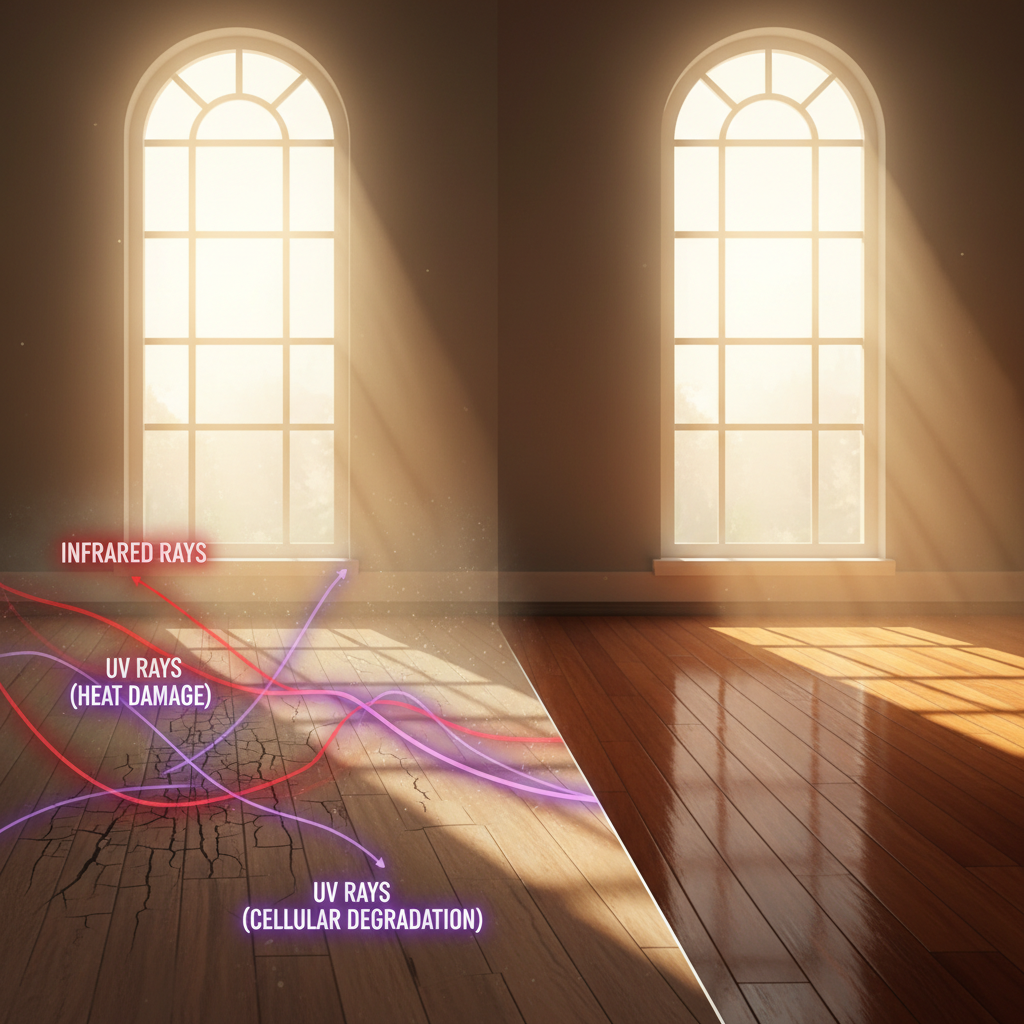
UV Bleaching vs. UV Darkening: How Different Woods React
Sun damaged floors manifest differently depending on the organic makeup of the wood species. The photochemical reactions are highly specific: exotic woods, such as Brazilian Cherry or Tigerwood, contain photosensitive extractives that cause them to darken rapidly when exposed to sunlight. Conversely, domestic woods like Red Oak, White Oak, and Maple tend to bleach and lighten, losing their rich natural tones.
Experts at Naperville Hardwood note that this process is not a slow, decades-long evolution; severe sun damage and noticeable discoloration can occur in as little as 11 months of direct exposure [2]. Understanding your specific wood species’ reaction is the first step in diagnosing and treating the damage.
The Fading Floor Test: Diagnosing True Sun Damage
Before assuming your floors are permanently ruined, it is crucial to perform what industry professionals call the “Fading Floor Test.” Often, what appears to be fading floor colors is actually a buildup of chemical residue, old waxes, or dirt that has dulled the finish and mimics the appearance of sun damage.
To diagnose true sun damage, clean a small, inconspicuous sunlit section using a manufacturer-approved hardwood floor cleaner. Crucially, advise against wet mopping as a cleaning solution for faded floors, as introducing excess water to a potentially compromised finish can cause irreversible swelling and damage. If the color remains dull and uneven after safe cleaning, you are likely dealing with true photochemical degradation. It is also important to recognize the role of infrared heat in this process. As noted by American Window Film, infrared heat accelerates finish degradation independently of UV light, essentially “baking” the finish and causing it to lose its protective elasticity [3].
Fade-Proof vs. Fade-Resistant: Setting Realistic Flooring Expectations
For high-budget renovators and homeowners looking to protect their investments, establishing realistic expectations is vital. The terms “fade-proof” and “fade-resistant” are often used interchangeably in marketing, but they represent vastly different material capabilities.
When budgeting for premium sun-resistant flooring, accurate pricing data is essential for calculating ROI. Premium hardwood materials typically cost between $3 to $12 per square foot, with installation adding an additional $4 to $8 per square foot (totaling $7 to $20 per square foot). For homes with large glass facades and significant architectural sun exposure, choosing the right material the first time prevents the costly cycle of premature replacement.
Truly Fade-Proof: The Kiln-Fired Power of Porcelain and Ceramic
If your goal is to find fade proof durable floors that are 100% immune to UV light, you must look toward inorganic materials. Porcelain and ceramic tiles are the only truly fade-proof options available on the market.
The secret to their absolute colorfastness lies in their manufacturing process. Porcelain tiles are fired in kilns at extremely high temperatures (often exceeding 2,200°F). This process vitrifies the material, permanently embedding the color and glaze into the body of the tile. Because they contain no organic compounds or reactive dyes, they cannot be photochemically altered by the sun. The Tile Council of North America (TCNA) frequently cites these high-temperature firing standards when recommending architectural materials for extreme outdoor and sunroom flooring applications [4].
Highly Fade-Resistant: Premium Engineered Hardwood
If the warmth of wood is non-negotiable, you must pivot from “fade-proof” to “highly fade-resistant.” The best sun resistant premium flooring in the organic category is found in high-end engineered hardwoods.
Unlike standard solid wood, premium eco-friendly flooring lines, such as those produced by Gaia Flooring, utilize advanced UV-cured finishes applied in factory-controlled settings [5]. These finishes are instantly hardened by intense UV lights during manufacturing, creating a dense, cross-linked surface that offers superior resistance to everyday sunlight, dramatically slowing the bleaching or darkening process.
Adamantine Flooring: The Generational Investment in UV Resistance
For those seeking the pinnacle of resilient flooring, Adamantine flooring represents a generational investment. Moving beyond traditional polyurethane, Adamantine technology is engineered to solve the dual threats of physical wear and UV degradation, positioning it as the ultimate premium solution for sunlit homes.
The core of Adamantine’s durability is rooted in materials science, specifically the use of aluminum oxide (corundum) nanoparticles. According to Materials Science Journals, aluminum oxide is one of the hardest minerals on earth, ranking just below diamonds on the Mohs hardness scale [6]. When integrated into a flooring finish, it creates an impenetrable shield. Furthermore, the Adamantine Technical Support Center highlights that this finish is often paired with a 100% waterproof hybrid core, ensuring that the floor is impervious to both topical moisture and intense solar radiation [7].
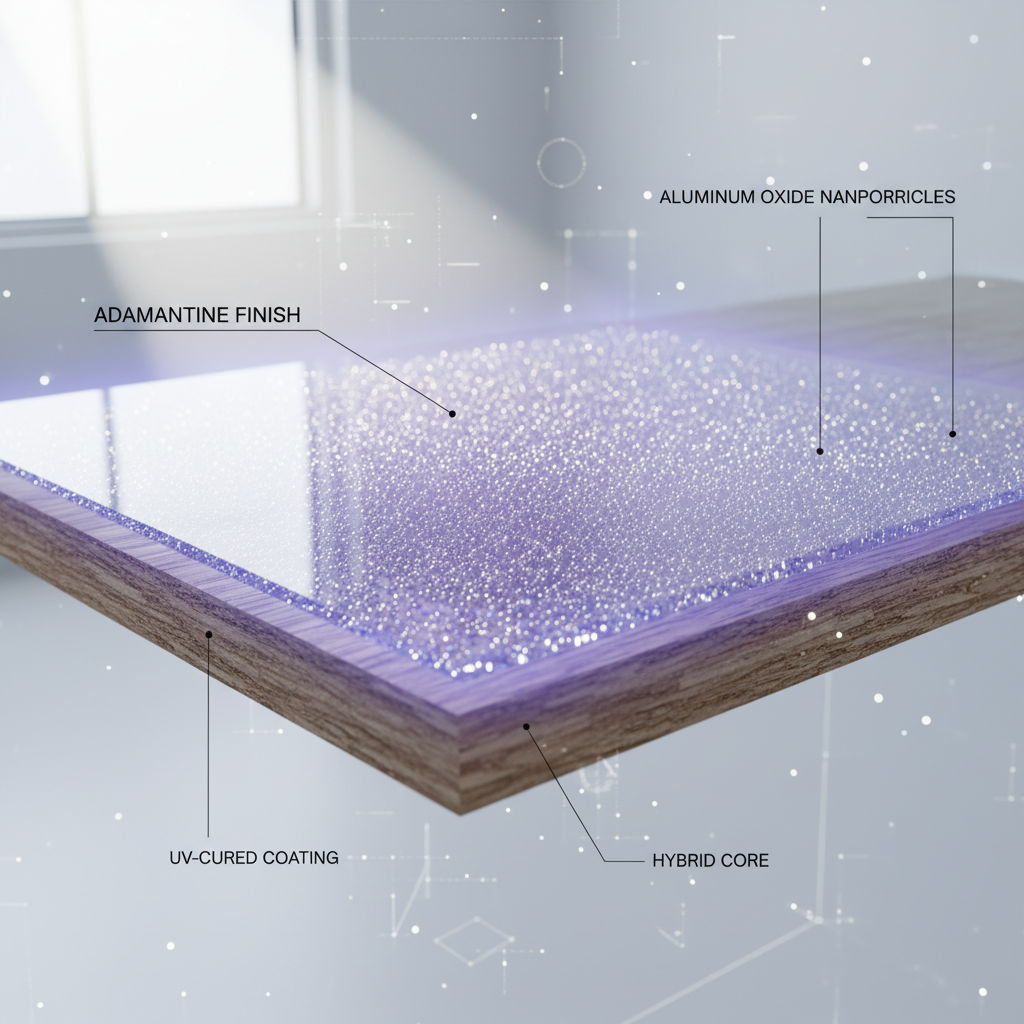
How Aluminum Oxide Nanoparticles and UV-Curing Work
The brilliance of Adamantine UV resistant flooring options lies in their dual-action protection. The aluminum oxide nanoparticles provide an extreme physical barrier against scratches, scuffs, and micro-abrasions. Simultaneously, the advanced UV-curing process locks in the chemical structure of the finish, preventing the oxidation that leads to fading and yellowing. This proprietary synergy is what allows Adamantine flooring to maintain vibrant color stability for 25+ years, even in rooms bathed in daily sunlight.
Hardness & UV Scale Comparison: Adamantine vs. Traditional Polyurethane
When compared directly to traditional finishes, the performance metrics of Adamantine flooring are staggering. In high-traffic, sunlit areas, standard polyurethane quickly shows micro-scratches, which then catch the light and exacerbate the appearance of fading.
Adamantine finishes provide 3x greater scratch resistance than traditional polyurethane. Furthermore, thanks to its dense hybrid core construction, it provides 50% more dent resistance than traditional hardwood. This combination ensures that the floor not only retains its color but maintains a smooth, unblemished surface that reflects light beautifully for decades.
High-Mil LVP and Advanced UV Protection for Floors
Luxury Vinyl Plank (LVP) has evolved into a highly technical, solution-focused option for homeowners demanding fade proof durable floors. The secret to modern LVP’s success lies in its complex anatomy: a waterproof core, a high-definition printed design layer, a transparent wear layer, and a topical coating of UV inhibitors.
The transparent wear layer is the unsung hero, acting as a physical and chemical shield that protects the printed visual layer beneath it from UV radiation. Manufacturer warranties are heavily tied to the thickness and quality of this wear layer, serving as a reliable metric for the floor’s expected lifespan and fade resistance, as frequently noted by industry authorities like Flooring America [8].
Decoding Wear Layers: The Sunlight Exposure Matrix
To achieve optimal UV protection for floors, consumers must match the LVP wear layer thickness (measured in “mils,” or thousandths of an inch) to the room’s cardinal direction and sunlight intensity. We call this the Sunlight Exposure Matrix.
Standard residential LVP requires a wear layer of at least 12 mil (0.3mm). However, for south-facing or west-facing rooms that endure intense, prolonged sunlight, Dalton Flooring Center specifications dictate that a wear layer of 20 mil (0.5mm) or higher is absolutely necessary to prevent degradation [9]. For the ultimate protection in sunrooms, premium residential and commercial options feature wear layers up to 28 mil, providing an incredibly thick barrier against UV penetration.
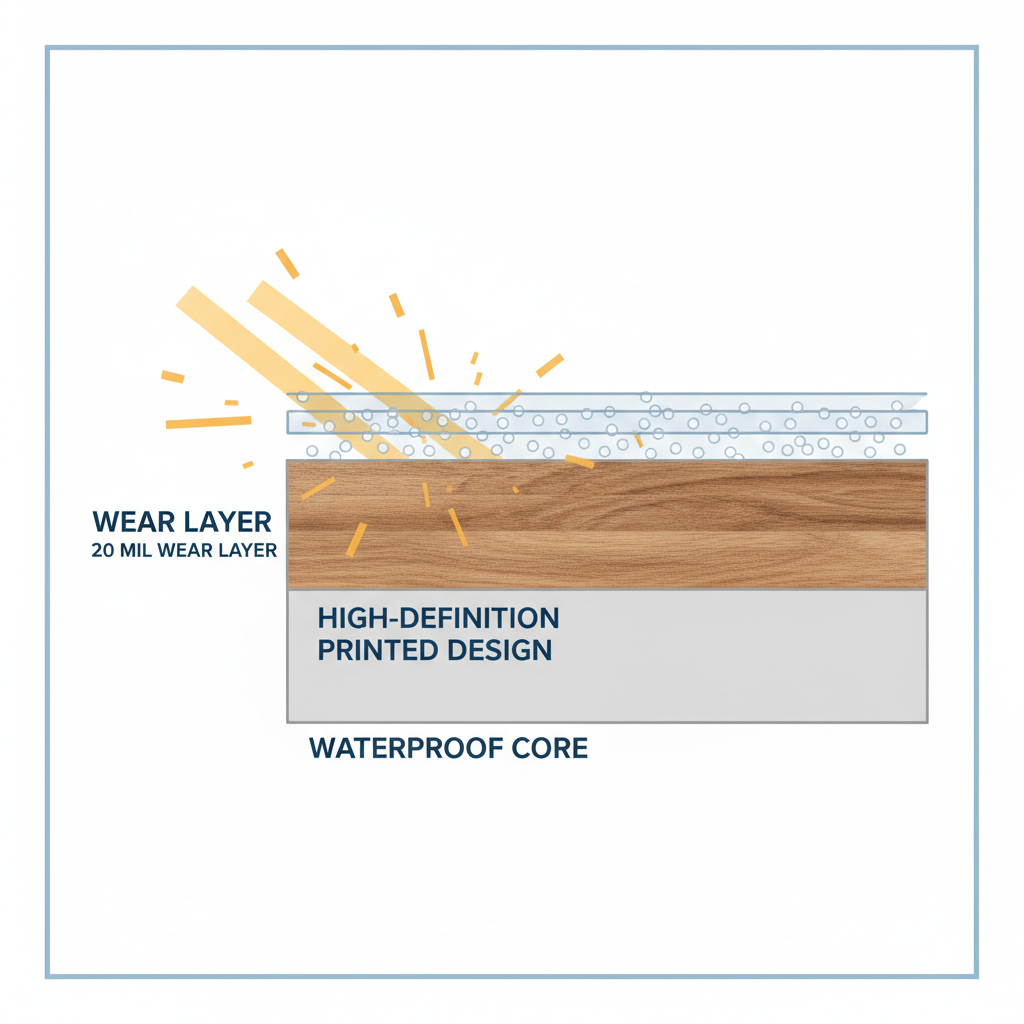
Ceramic Bead Technology and Bold Color Trends
Modern interior design is moving away from purely neutral tones, embracing vibrant floor color retention with trending bold hues like rich reds, deep greens, and striking blues. However, bold colors are notoriously difficult to protect; when they fade, they do so unevenly, creating a visual distraction.
To protect these high-contrast designs, premium LVP utilizes specialized ceramic bead technology suspended within the wear layer. These microscopic ceramic spheres act to physically deflect and scatter harmful UV rays before they can reach the printed design layer. As highlighted by LX Hausys, an authority on resilient flooring color trends, this technology is non-negotiable for homeowners who want to incorporate bold interior design implications without sacrificing long-term durability [10].
Holistic Prevention and Triage for Sun-Damaged Floors
Even with advanced flooring technologies, holistic prevention is the best strategy for preserving your investment. Furthermore, understanding the interplay between UV damage and environmental factors is critical. For instance, indoor humidity should be strictly maintained between 30% and 50%. When UV heat dries out wood fibers, low humidity compounds the issue, leading to severe structural warping and gapping.
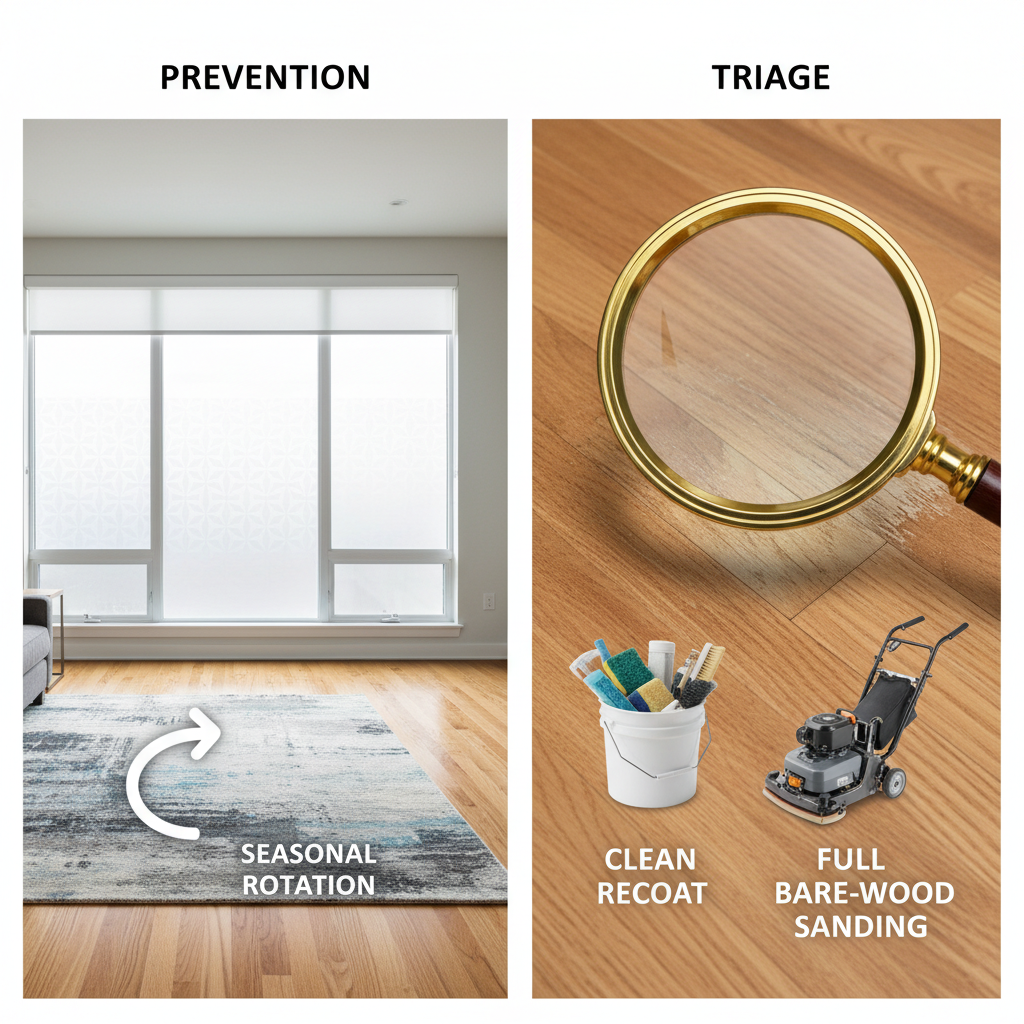
Physical and Chemical Barriers: Window Films to Water-Based Finishes
Learning how to prevent floors from fading requires a multi-layered approach. The most effective physical barrier is the installation of architectural window films, which can block up to 99% of harmful UVA and UVB rays while still allowing visible light to enter the room. Implementing seasonal rug rotation schedules also prevents the dreaded “rug outline” effect.
Chemically, the choice of stain and finish is paramount. Impressions Flooring Collection notes the distinct photochemistry of wood stains under UV light: dye-based stains are highly photo-reactive and will fade rapidly, whereas pigment-based stains use physical earth minerals that hold their color beautifully in high-light areas [11]. When finishing the floor, always opt for professional-grade water-based finishes with built-in UV inhibitors, such as those formulated by Basic Coatings, to completely avoid the yellowing associated with oil-based polyurethanes [12].
The Triage Guide: Clean ReCoat vs. Full Bare-Wood Sanding
If you are already dealing with sun damaged floors, you need a diagnostic framework to determine the necessary level of intervention. The industry standard is the “3mm rule”: UV fading and photochemical damage often penetrate up to 3 mm deep into the wood grain.
If the damage is purely superficial—affecting only the topcoat of the finish—you may be a candidate for a professional “Clean ReCoat.” This process, championed by groups like ReCoat Revolution, involves chemically cleaning and lightly abrading the existing finish before applying a fresh, UV-inhibiting topcoat, saving thousands of dollars [13]. However, if the UV radiation has penetrated past the finish and altered the actual wood fibers (bleaching or darkening the wood itself), a Clean ReCoat will not fix the color. In this scenario, Professional Flooring Contractors dictate that a full bare-wood sanding is required to physically remove the damaged 3mm of wood before re-staining and refinishing [14].
Conclusion
The battle against sun-damaged flooring requires moving beyond temporary aesthetic fixes and understanding the profound difference between surface fading and structural UV degradation. While kiln-fired porcelain remains the only truly 100% fade-proof option on the market, modern engineering has provided incredible alternatives. Generational technologies like Adamantine flooring, with its aluminum oxide and UV-cured brilliance, alongside 20+ mil LVP fortified with ceramic bead technology, offer unparalleled, ROI-positive resistance for the most sunlit homes.
Assess your home’s sunlight exposure using our Sunlight Exposure Matrix criteria, and consult with a premium flooring specialist to request samples of Adamantine or high-mil LVP for your next renovation. Protect your investment, and let the sun shine in without fear.
*Disclaimer: The diagnostic and triage advice provided is for informational purposes. Always consult a certified flooring professional before attempting to sand or chemically treat sun-damaged hardwood.*
References & Authoritative Sources
- Floor Coverings Cambridge. (N.D.). Chemical Breakdown of Dyes and Finishes Caused by UV Radiation.
- Naperville Hardwood. (N.D.). Wood Species Behavior and Finish Reactions.
- American Window Film. (N.D.). UVA/UVB and Infrared Heat Blocking.
- Tile Council of North America (TCNA). (N.D.). Ceramic and Porcelain Tile Standards for Outdoor and Sunroom Flooring.
- Gaia Flooring. (N.D.). Eco-Friendly, UV-Resistant Engineered Hardwood.
- Materials Science Journals. (N.D.). Aluminum Oxide Nanoparticle Durability and Hardness.
- Adamantine Technical Support Center. (N.D.). Application Guidelines and Finish Specifications.
- Flooring America. (N.D.). Flooring Durability Metrics and Warranties.
- Dalton Flooring Center. (N.D.). LVP Wear Layer Specifications and UV Technology.
- LX Hausys. (N.D.). Resilient Flooring Color Trends and Manufacturing.
- Impressions Flooring Collection. (N.D.). Wood Stain Chemistry and Photo-Reactivity.
- Basic Coatings. (N.D.). Professional Wood Floor Finishes and UV Inhibitors.
- ReCoat Revolution. (N.D.). Floor Restoration and Recoating Processes.
- Professional Flooring Contractors. (N.D.). Sanding and Refinishing Techniques.
