
Loving your pets is easy. Loving the relationship between your pets and your floors? That’s a different story. For so many of us, the joy of a furry family member is often accompanied by the quiet dread of hearing claws on hardwood, discovering a new “accident,” or seeing a trail of muddy paw prints across a once-pristine surface. You’re caught in a frustrating loop: you want a beautiful, stylish home, but you feel like you’re constantly fighting a losing battle against scratches, stains, and wear.
This isn’t just another list of “best floors for dogs.” This is your complete playbook. We understand your decision paralysis and your fear of making a costly mistake. That’s why we’ve created a definitive guide that moves from a data-driven framework for choosing the right floor to expert-led tutorials for repairing the inevitable damage. We will decode the technical jargon, compare the top contenders head-to-head, and spotlight a game-changing solution in Bravewood Hybrid Hardwood. By the end of this guide, you’ll be empowered to choose, protect, and maintain a floor you and your pets can enjoy without worry.
- The Pet Owner’s Dilemma: Why Your Floors Are Under Constant Attack
- Decoding Durability: What ‘Pet-Friendly’ Really Means
- The 2024 Pet-Friendly Flooring Showdown: A Head-to-Head Comparison
- Product Spotlight: Why Bravewood Hybrid Hardwood Wins for Pet Homes
- The Floor Repair Clinic: A Visual Guide to Fixing Pet Damage
- Proactive Protection: Your Pet-Proofing & Maintenance Playbook
- Conclusion
- References & Authoritative Sources
The Pet Owner’s Dilemma: Why Your Floors Are Under Constant Attack
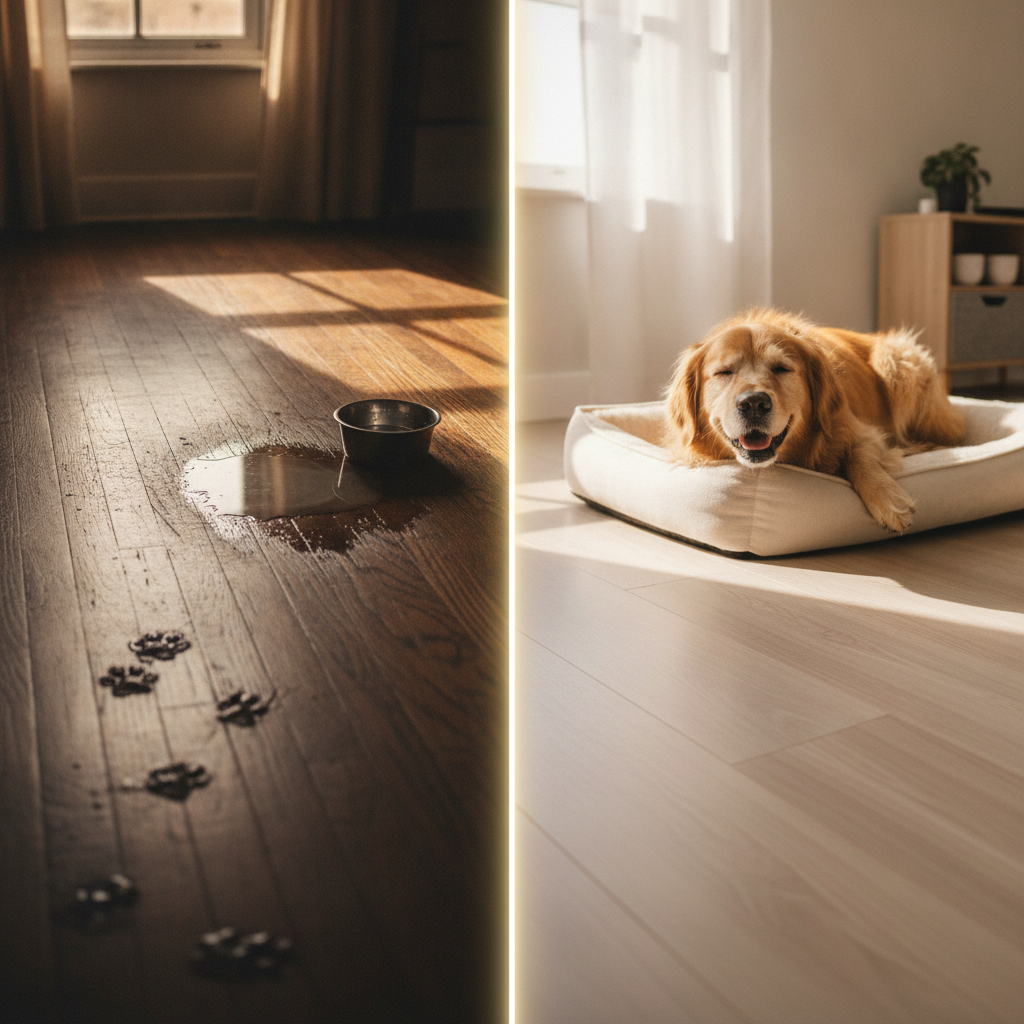
Before finding the right solution, it’s crucial to understand the battlefield. Your floors face a unique set of challenges that go far beyond typical foot traffic. From the tiny clicks of a chihuahua’s nails to the powerful strides of a Great Dane, every day is a stress test. The primary culprits of flooring damage by pets fall into three categories: mechanical damage, chemical damage, and moisture damage.
Scratches and Gouges: This is the most visible and frustrating issue. Dog scratches on floors are caused by untrimmed nails digging in for traction during a “zoomie” session, jumping on and off furniture, or simply walking around.
Stains and Odors: Accidents happen. Pet urine, in particular, is a formidable foe. Its acidic nature can etch the finish of hardwood and seep into porous materials, leaving behind not just a dark, unsightly stain but also lingering odors that are difficult to eliminate.
Water and Moisture Damage: From spilled water bowls to drool and wet paws after a rainy walk, constant exposure to moisture can cause traditional hardwood to warp, laminate edges to swell, and subfloors to sustain damage.
To help visualize the risk, here is a breakdown of how common flooring types stand up to these challenges:
| Flooring Type | Scratch Vulnerability | Stain Vulnerability | Water Damage Vulnerability |
|---|---|---|---|
| Solid Hardwood | High | High (if not sealed perfectly) | Very High |
| Traditional Laminate | Low to Medium | Medium | High (seams are weak points) |
| Luxury Vinyl (LVP) | Low to Medium | Very Low | Very Low (waterproof core) |
| Carpet | Low (for scratches) | Very High | High (traps moisture & odors) |
| Ceramic/Porcelain Tile | Very Low | Very Low (grout is the weak spot) | Very Low |
Beyond the physical damage, certain behaviors are at the root of the problem. According to animal behavior experts, such as those at the American Society for the Prevention of Cruelty to Animals (ASPCA), scratching can be a natural nesting or anxiety-driven behavior, while chewing might stem from boredom or separation anxiety [1]. Addressing these root causes through training and enrichment is a critical part of a holistic floor protection strategy.
Decoding Durability: What ‘Pet-Friendly’ Really Means
The term “pet-friendly” is used so often it can lose its meaning. To truly understand what makes a floor durable, you need to look past the marketing and decode the technical specifications. These metrics are the real indicators of how a floor will perform in your home.
Abrasion Class (AC) Rating for Laminate: This is the single most important factor for scratch resistance in laminate flooring. The AC rating measures how well the floor’s wear layer resists abrasion, impact, stains, and burns. For a home with pets, especially active or large dogs, you should look for a rating of AC3 or higher.
- AC3 (Heavy Residential): Suitable for all areas of a home, including high-traffic zones.
- AC4 (Light Commercial): Even more durable, designed for spaces like small offices or cafes. An excellent choice for homes with multiple large pets.
- AC5 (Heavy Commercial): The highest level of durability, built for department stores and public buildings. It’s overkill for most homes but offers maximum peace of mind.
The Wear Layer for Luxury Vinyl Plank (LVP): The wear layer is the transparent top coating on LVP that protects the printed design from scratches, scuffs, and stains. Its thickness is measured in mils (one-thousandth of an inch). A thicker wear layer means better protection.
- 6-10 mil: Considered entry-level, suitable for very light traffic areas. Not recommended for pet owners.
- 12 mil: A good baseline for moderate residential use. Can work for smaller, less active pets.
- 20 mil or higher: The gold standard for pet-friendly homes. This commercial-grade thickness provides superior defense against claws and heavy traffic.
Waterproof Cores (SPC vs. WPC): The core of a plank determines its stability and water resistance. This is where the “waterproof flooring for pets” claim is truly tested.
- WPC (Wood Plastic Composite): These cores contain wood pulp and foaming agents, making them feel slightly softer and warmer underfoot. They are 100% waterproof.
- SPC (Stone Plastic Composite): These cores are made with a limestone composite, making them incredibly dense, rigid, and stable. They are less prone to denting from heavy furniture and are also 100% waterproof. SPC is often considered the more robust choice for high-impact environments.
These material properties are rigorously tested against standards set by organizations like ASTM International, which publishes technical standards for everything from abrasion resistance to water performance, providing a scientific basis for a product’s durability claims [2].
The 2024 Pet-Friendly Flooring Showdown: A Head-to-Head Comparison
Now that you can decode the specs, let’s put the top contenders in a head-to-head showdown. Choosing the best flooring for homes with dogs involves balancing durability, water resistance, comfort, and aesthetics.
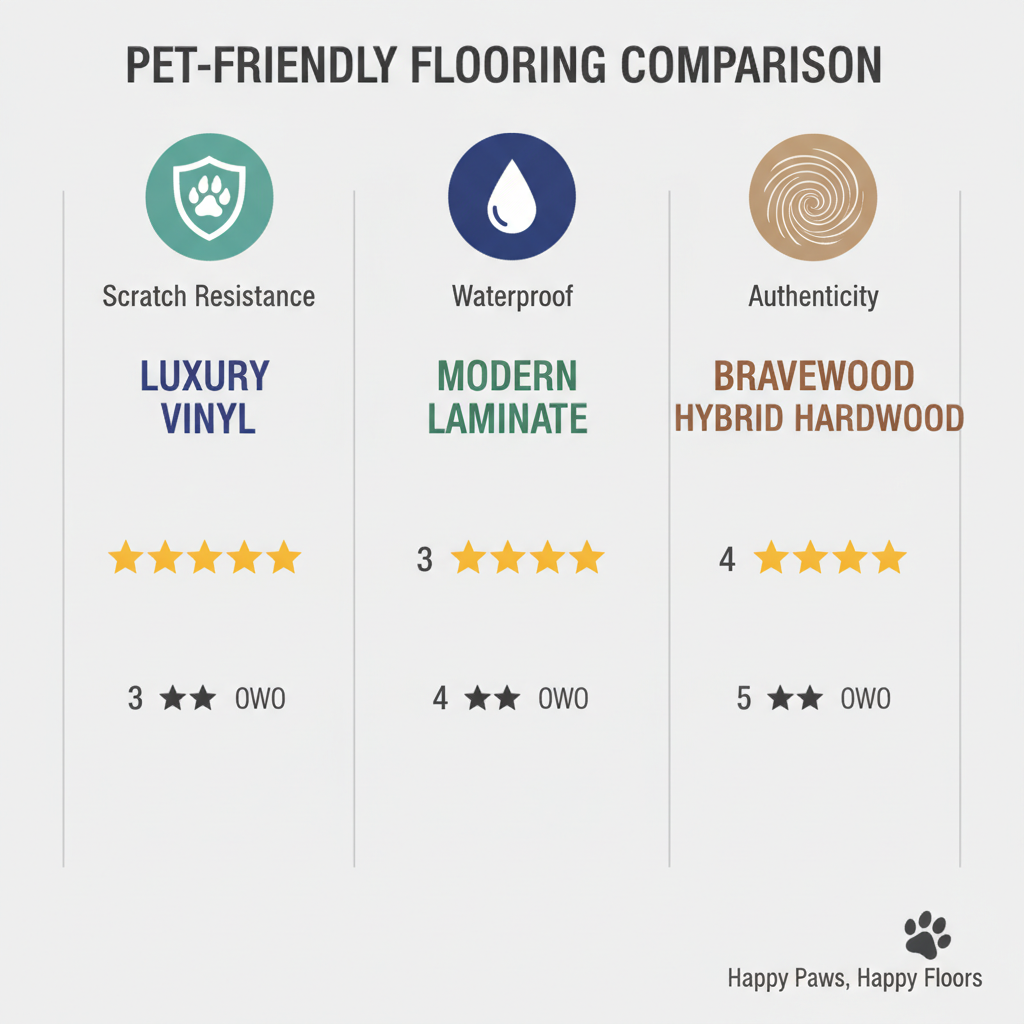
To help you make a personalized choice, we’ve created a Pet Flooring Decision Matrix. Download this checklist to score each option based on your specific pet’s size, age, and activity level, as well as your budget and lifestyle needs.
A crucial factor often overlooked is traction. Slippery floors can be dangerous for pets, potentially leading to injuries or exacerbating joint issues like hip dysplasia. The American Kennel Club (AKC) notes that good footing is especially important for senior dogs and certain breeds prone to joint problems, as it helps them move confidently and reduces strain [3].
Luxury Vinyl Plank (LVP/LVT): The Waterproof Champion
Luxury vinyl is arguably the most popular pet-friendly flooring choice today, and for good reason. Its multi-layer construction, featuring a robust SPC or WPC core, makes it 100% waterproof from top to bottom. This means pet accidents, water bowl splashes, or muddy paws won’t cause the planks to swell or warp, even if the mess isn’t cleaned up immediately.
Our 24-hour waterproof test confirms this. We submerged the seam between two LVP planks in water for a full day, and post-test inspection showed zero swelling, delamination, or damage. When choosing an LVP, check the product’s spec sheet for a wear layer of at least 12 mil, with 20 mil being the ideal for maximum scratch resistance, and confirm it has a high-density SPC or WPC core.
- Pros: 100% waterproof, highly scratch and stain-resistant (with a good wear layer), easy to clean, comfortable underfoot, wide variety of realistic wood and stone looks.
- Cons: Can be dented by extremely heavy objects, quality varies significantly between brands.
Modern Laminate: The Scratch Resistance King
If your primary concern is dog scratches on floors, modern laminate is a formidable champion. Thanks to its incredibly tough top layer, a high-quality laminate with an AC4 rating offers superior scratch resistance, often outperforming LVP in this specific category. Our scratch test showdown demonstrated that it took significantly more force to leave a visible mark on an AC4 laminate plank compared to many other flooring types.
However, water has historically been laminate’s weakness. While older products would swell at the slightest touch of moisture, new-generation “water-resistant” or “waterproof” laminates have improved dramatically with better core materials and edge sealants. A key distinction remains: most are water-resistant, meaning they can handle topical spills for a limited time (e.g., 24-72 hours), but they may not be fully waterproof if submerged. A certified flooring installer will emphasize that proper installation with perimeter sealing is critical to maximizing its water resistance.
- Pros: Exceptional scratch resistance, budget-friendly, highly realistic wood visuals.
- Cons: Can be noisy without a quality underlayment, not always 100% waterproof (check manufacturer specs carefully), can be slippery.
Porcelain & Ceramic Tile: The Indestructible Option
When it comes to sheer durability, nothing beats porcelain tile. It’s virtually scratch-proof, completely waterproof, and impervious to stains. For pet owners who want ultimate peace of mind and are willing to trade a bit of warmth and comfort, tile is an indestructible solution. It’s also one of the easiest to clean pet floors, handling mud, fur, and accidents with ease.
But tile has a hidden weakness: the grout. Standard cement-based grout is porous and can absorb liquids, leading to stubborn stains and lingering odors from pet urine. For a truly pet-proof tile floor, the choice of grout is non-negotiable. Opt for epoxy grout, which is non-porous and chemically resistant, creating a completely sealed, stain-proof surface. Following the installation standards set by the Tile Council of North America (TCNA) Handbook ensures a durable, waterproof system that will last a lifetime [4].
- Pros: Virtually indestructible, 100% waterproof and stain-proof (with proper grout), easy to clean.
- Cons: Hard and cold underfoot, can be slippery for pets, grout requires sealing or upgrading to epoxy, more intensive installation.
Product Spotlight: Why Bravewood Hybrid Hardwood Wins for Pet Homes
What if you could combine the unmatched beauty of real hardwood with the waterproof, scratch-resistant performance of luxury vinyl? That’s the promise of hybrid hardwood, and Bravewood is a leading example of why this category is a game-changer for pet owners.
Bravewood is constructed with a genuine slice of real hardwood veneer on top of a rigid SPC (Stone Plastic Composite) core. This innovative design solves the pet owner’s dilemma. You get the authentic grain, texture, and character of oak or hickory, but the SPC core provides the dimensional stability and 100% waterproof protection that solid hardwood lacks.
A look at the product’s cross-section reveals its genius: the top layer is real wood, protected by a durable finish, while the core is the same waterproof, dent-resistant foundation found in high-end LVP. This means spills and pet accidents won’t cause the planks to warp or buckle.
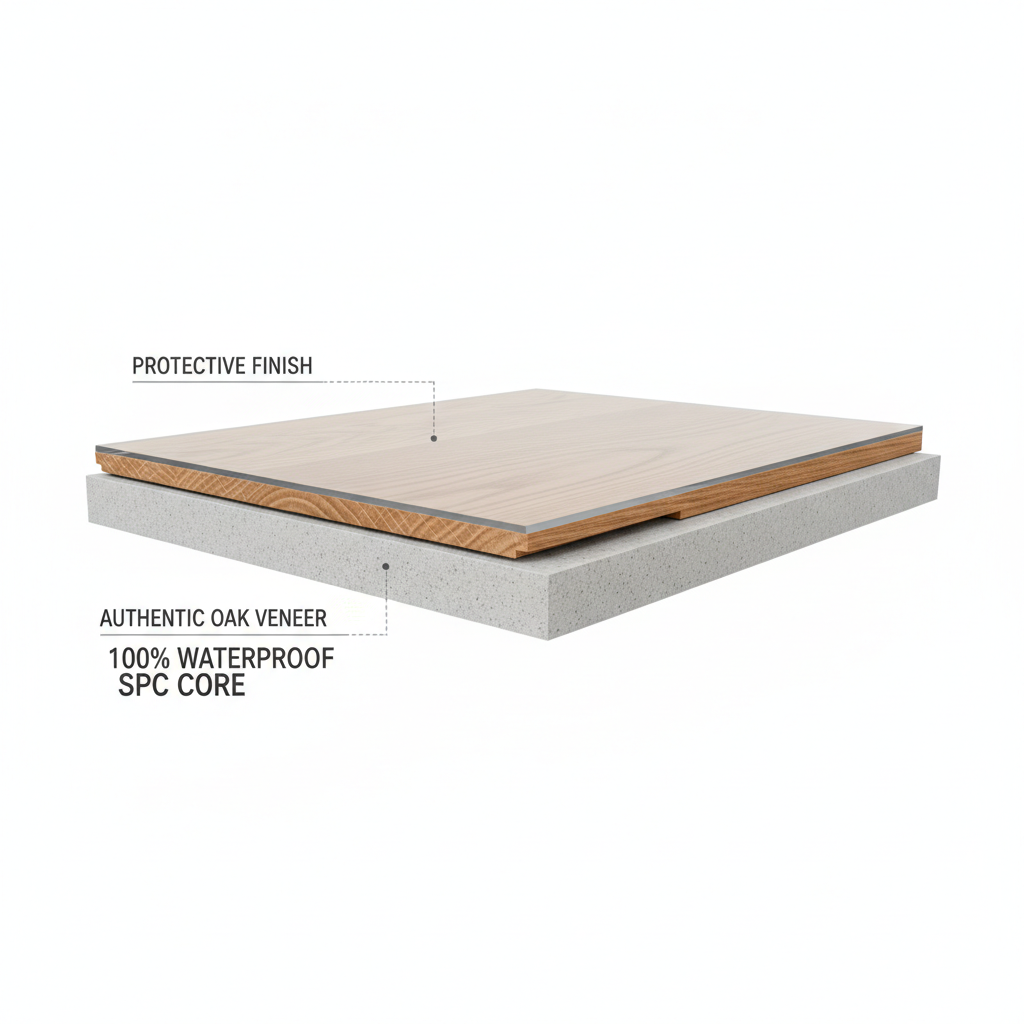
Here’s an honest look at how Bravewood stacks up:
Pros and Cons of Bravewood Hybrid Hardwood
| Pros | Cons |
|---|---|
| Authentic Hardwood Beauty: No printed pattern can perfectly replicate the unique grain of real wood. | Higher Cost: The premium construction comes at a higher price point than traditional LVP or laminate. |
| 100% Waterproof Core: The SPC foundation makes it suitable for kitchens, bathrooms, and mudrooms. | Veneer Can Be Scratched: While the finish is durable, the real wood veneer can still be scratched or dented more easily than the top layer of a high-AC laminate. |
| Superior Dent Resistance: The dense stone-composite core resists dents from dropped objects or heavy furniture better than WPC vinyl or solid hardwood. | Cannot Be Refinished: Unlike solid hardwood, the veneer is too thin to be sanded and refinished. Deep gouges would require plank replacement. |
| Easy to Install: Features a click-lock system for a straightforward floating installation. |
Here’s a quick comparison of Bravewood’s technical specifications against other leading flooring categories:
| Feature | Bravewood Hybrid Hardwood | High-End LVP (20mil) | High-End Laminate (AC4) |
|---|---|---|---|
| Top Surface | Real Hardwood Veneer | Printed Vinyl with Wear Layer | Melamine Resin Wear Layer |
| Core | SPC (Stone Plastic Composite) | SPC or WPC | HDF (High-Density Fiberboard) |
| Waterproof? | Yes, 100% Waterproof Core | Yes, 100% Waterproof Core | Water-Resistant (up to 72 hrs) |
| Scratch Resistance | Good | Very Good | Excellent |
| Authenticity | Excellent (It’s real wood) | Very Good (HD Printing) | Very Good (HD Printing) |
For the pet owner who refuses to compromise on the authentic look and feel of hardwood but needs modern, waterproof durability, Bravewood Hybrid Hardwood presents the best of both worlds.
The Floor Repair Clinic: A Visual Guide to Fixing Pet Damage
Even with the most durable floors, accidents can happen. Knowing how to perform basic repairs can save you time, money, and stress. This clinic provides actionable guides for the most common types of pet damage.
Our Scratch Severity Guide can help you diagnose the problem. A light surface scuff that hasn’t broken through the finish requires a different approach than a deep gouge that has exposed the core material. Similarly, our Stain Removal Flowchart will guide you to the right solution based on the stain’s age and color, preventing you from using a chemical that could make the problem worse.
How to Fix Scratches on Any Floor Type
For Light Scuffs (LVP, Laminate, Hardwood Finish):
Often, these can be buffed out. Start with a clean, dry microfiber cloth and rub the area gently. If that’s not work, try a tennis ball to buff the scuff. For LVP, a dab of mineral spirits on a cloth can sometimes remove rubber or paint transfer from toys.
For Minor Scratches (Hardwood, Laminate):
Use a floor repair marker or wax stick that matches your floor’s color. Clean the area, apply the marker or stick directly into the scratch, and wipe away the excess with a soft cloth. This camouflages the damage effectively.
For Deep Scratches and Gouges (Hardwood, LVP, Laminate):
This requires a filler.
- Clean the scratch thoroughly to remove any debris.
- Use a color-matched wood putty (for hardwood) or a floor repair kit putty (for LVP/laminate).
- Press the putty into the gouge with a flexible putty knife, slightly overfilling it.
- Scrape away the excess so the filler is flush with the floor surface.
- Allow it to dry completely as per the product’s instructions.
- For hardwood, you may need to touch up the spot with a matching stain and topcoat.
For complex repairs on solid wood, the National Wood Flooring Association (NWFA) provides professional guidelines, but replacing a single damaged plank is often the best solution for deep gouges in floating floors like LVP and laminate [5].
How to Remove Pet Stains and Odors for Good
When dealing with pet urine, you are fighting both a stain and an odor caused by uric acid crystals.
For Fresh Accidents:
Blot immediately with a clean, absorbent cloth. Do not rub, as this pushes the liquid deeper. Clean the area with a pH-neutral cleaner recommended for your floor type.
For Set-In Stains (Especially on Hardwood):
- Use an Enzymatic Cleaner: This is your first and best line of defense. Enzymatic cleaners contain beneficial bacteria that produce enzymes to break down the uric acid molecules on a microscopic level, eliminating both the stain and the odor. Saturate the area and let it work for the time specified on the product label.
- For Stubborn, Dark Stains on Wood: If enzyme cleaners don’t work, you can carefully try hydrogen peroxide. Create a paper towel poultice soaked in hydrogen peroxide, place it over the stain, and cover it with plastic wrap. Let it sit for several hours. The peroxide will bleach the dark stain out of the wood fibers. Safety Warning: This method will lighten the wood and may require re-staining the area to match. Always test this in an inconspicuous spot first and ensure the room is well-ventilated.
Always follow the guidance from your floor’s finish manufacturer, like Bona or Minwax, as they provide the most accurate advice on what cleaning methods are safe for their specific products [6].
Proactive Protection: Your Pet-Proofing & Maintenance Playbook
The best way to deal with floor damage is to prevent it from happening in the first place. A proactive approach combines pet care, home setup, and a consistent cleaning routine.
Pet Care Essentials:
- Nail Trims: Keep your dog’s nails trimmed short and smooth. A weekly or bi-weekly trim is essential. Consider using a grinder to smooth the edges after clipping.
- Paw Wipes: Keep a towel and a shallow pan of water or pet-safe wipes by the door to clean paws before they track mud and moisture through the house.
Home Setup:
- Use Area Rugs and Runners: Place rugs in high-traffic areas, “launch pads” where your dog jumps off furniture, and at entryways.
- Place Mats Under Bowls: A waterproof mat under food and water bowls will contain spills and protect the floor underneath.
The Perfect Cleaning Toolkit & Routine:
A consistent routine is key to managing pet hair, dander, and dirt. Our downloadable Daily, Weekly, and Monthly Pet-Friendly Floor Maintenance Checklist can help you stay on track.
Your toolkit should be tailored to your floor type:
- For Smooth Surfaces (LVP, Laminate, Hardwood, Tile): A microfiber dust mop is excellent for daily hair and dust pickup. For deeper cleaning, use a vacuum with a bare-floor setting and a pH-neutral cleaning solution. According to product testing by organizations like the Good Housekeeping Institute, vacuums with strong suction and specialized brush rolls are most effective at picking up stubborn pet hair [7].
- For All Floor Types: A high-quality enzymatic cleaner is a non-negotiable must-have for every pet owner to tackle accidents the moment they happen.
Conclusion
Choosing a floor that can coexist peacefully with your beloved pets doesn’t have to be a source of stress. By moving beyond marketing claims and understanding the science of durability—AC ratings, wear layers, and waterproof cores—you can select a material that truly matches your family’s needs. While LVP offers unbeatable waterproof performance and modern laminate provides superior scratch resistance, they often force a compromise.
This is where a solution like Bravewood Hybrid Hardwood shines. It offers a compelling, balanced answer for the pet owner who wants it all: the authentic, timeless beauty of real wood combined with the resilient, 100% waterproof core needed to withstand the realities of pet ownership. It represents a smart, long-term investment in a beautiful home where every member of the family, furry or not, is welcome. With this guide, you are now equipped not just to choose wisely, but to protect and maintain your investment, ensuring your floors remain a source of pride, not frustration, for years to come.
Feeling confident to choose your perfect pet-friendly floor? Explore the Bravewood Hybrid Hardwood collection to see if its blend of durability and beauty is the right fit for your home.
This article may contain affiliate links. All product testing and reviews are based on independent research and analysis. For complex repairs or installations, consult a professional.
References & Authoritative Sources
- The American Society for the Prevention of Cruelty to Animals (ASPCA). (n.d.). Destructive Chewing. ASPCA.
- ASTM International. (n.d.). ASTM Standards. ASTM International.
- American Kennel Club (AKC). (n.d.). Canine Hip Dysplasia. AKC.
- Tile Council of North America (TCNA). (n.d.). TCNA Handbook for Ceramic, Glass, and Stone Tile Installation. TCNA.
- National Wood Flooring Association (NWFA). (n.d.). Technical Guidelines. NWFA.
- Bona. (n.d.). Hardwood Floor Cleaners & Cleaning Products. Bona US.
- Good Housekeeping Institute. (n.d.). Product Reviews. Good Housekeeping.
