
You love your pets, but you also love your home. It’s a classic conflict for millions of homeowners: how do you choose a beautiful, expensive floor that won’t be destroyed by the clicks, claws, and occasional chaos of your four-legged family members? The fear is real. You imagine spending thousands on gorgeous new floors, only to see them scarred by scratches or permanently stained by an accident within weeks.
This isn’t just another list of pros and cons. This is the Definitive Pet Owner’s Flooring Playbook. We’ve cut through the confusing marketing claims to give you a clear, data-driven path to the perfect floor. We’ll introduce you to our proprietary Pet-Proof Flooring Scorecard, a powerful tool that objectively rates every major flooring type against the metrics that truly matter.
We’ll analyze the top contenders, from luxury vinyl to waterproof laminate. And we’ll take a deep dive into an innovative category that’s changing the game: waterproof hybrid hardwood. You’ll discover why one brand in particular, Bravewood, stands out as a top-tier solution for pet owners who refuse to choose between durability and the timeless beauty of real wood.
- Decoding Pet-Friendly: The 4 Critical Pillars of Performance
- The 2026 Pet-Proof Flooring Scorecard: A Data-Driven Comparison
- Spotlight: Why Bravewood Waterproof Hybrid Hardwood Is a Game-Changer for Pet Homes
- The Pet Owner’s Problem-Solving Toolkit: Repair and Rescue
- Your Confident Choice for a Pet-Friendly Home
- Sources & References
Decoding Pet-Friendly: The 4 Critical Pillars of Performance
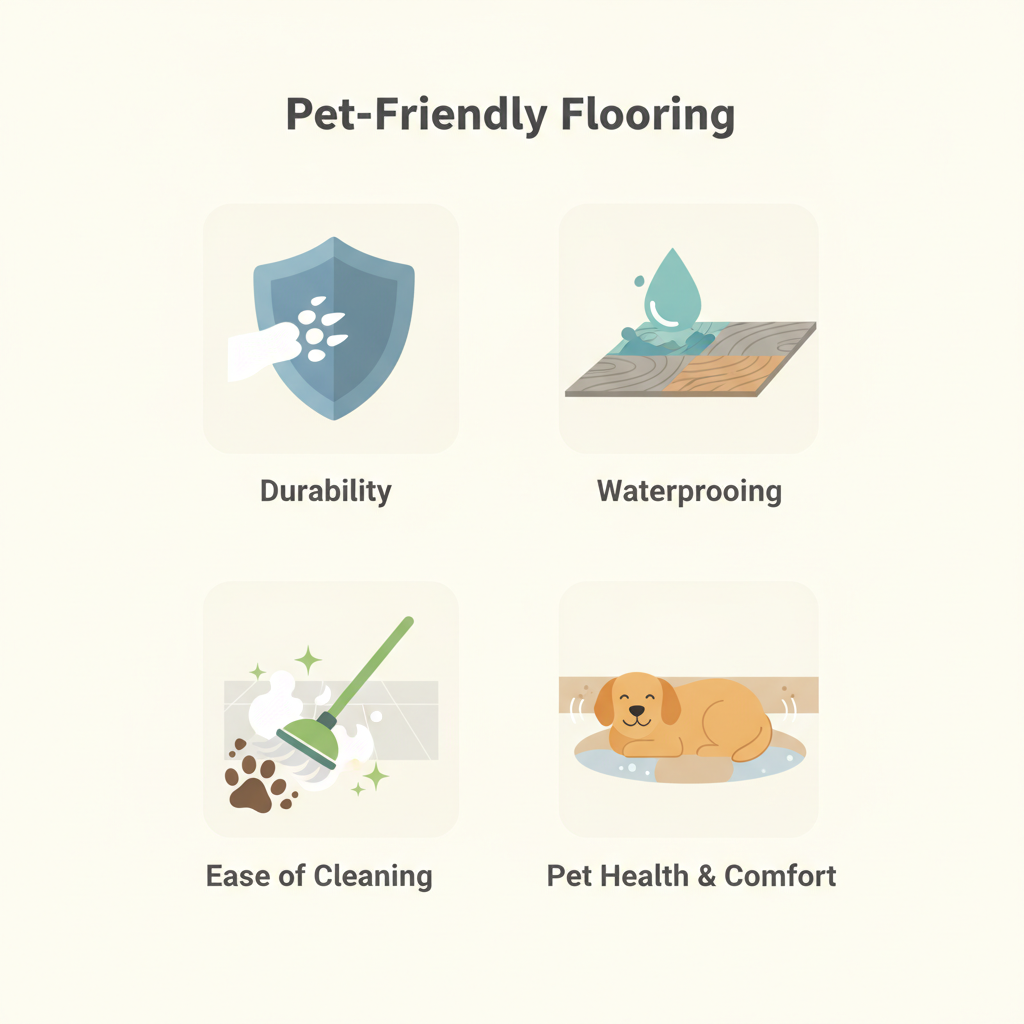
Before we compare products, we need to define what “pet-friendly” truly means. It’s a term thrown around so often it’s nearly lost its meaning. For us, it’s not a vague promise; it’s a standard of performance measured across four critical pillars. This framework is essential, especially when you consider that a 2022 survey by the National Pet Owners Association found that ‘damage to home/furniture’ was a top three concern for 65% of dog owners.[1]
1. Durability: Standing Up to Claws and Chaos
Durability is about more than just surviving; it’s about thriving in a pet-filled home. This pillar breaks down into two key metrics:
- Scratch Resistance: A floor’s ability to fend off surface-level marks from dog and cat claws. This is often determined by a protective top layer.
- Dent Resistance: A floor’s capacity to withstand impacts from dropped toys, heavy paws, or the occasional case of the “zoomies.” This is a function of the core material’s density.
To measure these, the flooring industry uses standardized ratings. Understanding them is your first step to making an informed choice.
Key Durability Terms at a Glance:
- Wear Layer: Found on vinyl and hybrid floors, this is a clear top coating that provides scratch and stain resistance. Measured in mils (thousandths of an inch), a 20 mil wear layer is considered excellent for homes with pets.
- AC Rating (Abrasion Class): Used for laminate flooring, this rating from the North American Laminate Flooring Association (NALFA) measures resistance to abrasion, impact, and stains.[2] An AC4 or AC5 rating is recommended for homes with active pets.
- PEI Rating (Porcelain Enamel Institute): This scale, endorsed by the Tile Council of North America (TCNA), rates the hardness and durability of tile from 1 (no foot traffic) to 5 (heavy commercial traffic).[3] A PEI rating of 4 or 5 is ideal for maximum scratch resistance.
2. Waterproofing: Your First Line of Defense Against Accidents
From spilled water bowls to puppy training accidents, moisture is a constant threat. This is where understanding the difference between “water-resistant” and “waterproof” is non-negotiable.
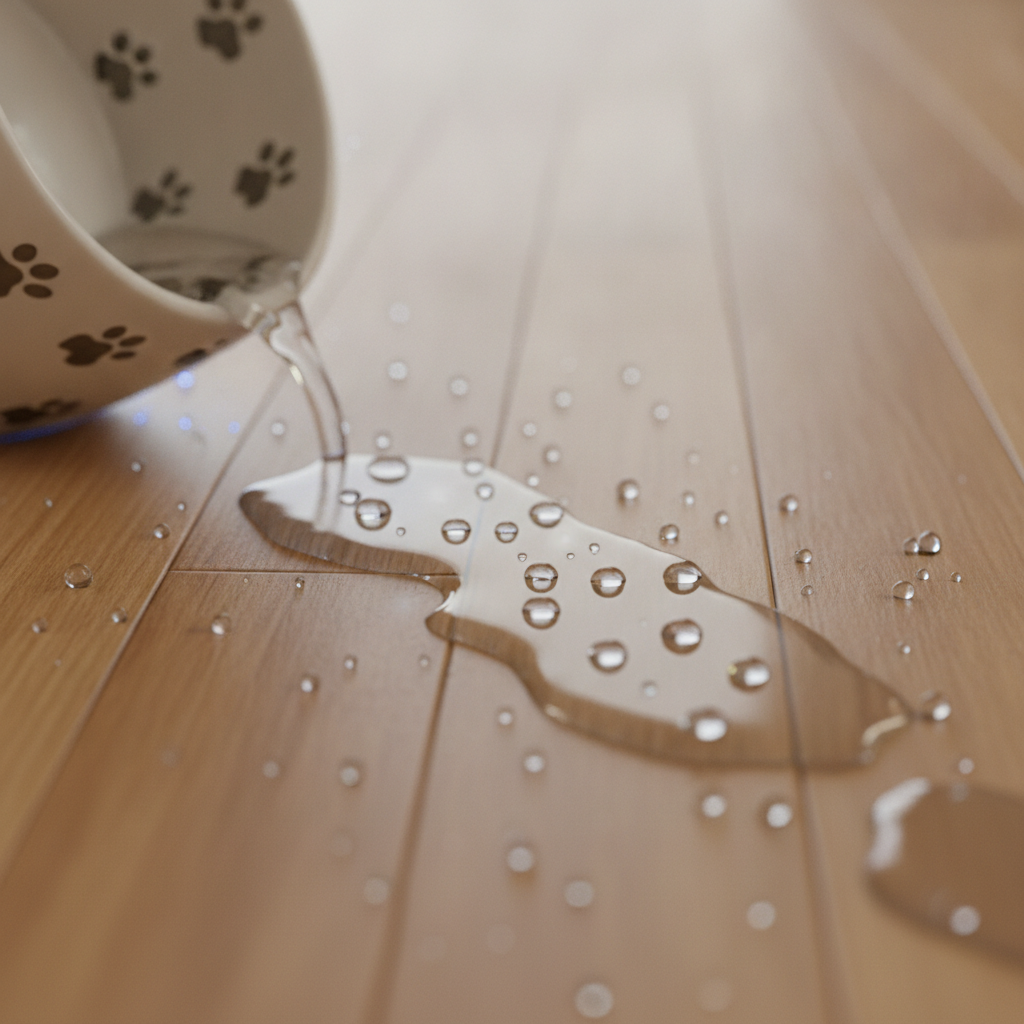
- Water-Resistant: The surface can repel water for a limited time, but moisture can eventually seep into the seams and core, causing swelling, warping, and damage.
- Waterproof: The flooring plank or tile itself is made from materials that are 100% impervious to water. The core will not swell or degrade, no matter how long liquid sits on the surface.
For pet owners, a truly waterproof floor is the only way to have complete peace of mind. This is especially true because pet urine contains uric acid crystals, which are not water-soluble and can permanently damage porous materials and the subfloor below.[4] Modern waterproof floors often feature a Stone Polymer Composite (SPC) core, a dense and rigid material that is completely unaffected by water.
3. Ease of Cleaning: Winning the War on Fur and Mud
Your floor shouldn’t be a second job. An easy-to-clean floor makes life simpler, a sentiment shared by the 85% of pet owners who identify ‘ease of cleaning’ as the most critical feature in their flooring.[5] Key characteristics include:
- Non-Porous Surface: Prevents spills and stains from soaking in.
- Minimal Seams: Fewer grout lines or plank bevels mean fewer places for dirt, dander, and fur to get trapped.
- Smudge-Hiding Finish: As experts at the Good Housekeeping Institute note, floors with a matte or low-gloss finish are far better at hiding minor dust, fur, and paw prints than high-gloss surfaces.[6]
4. Pet Health & Comfort: Traction, Sound, and Safety
A truly pet-friendly floor considers the well-being of your animal. This often-overlooked pillar is crucial for their long-term health.
- Traction: Slippery floors can be dangerous, especially for older pets or breeds prone to joint issues. Veterinary sources, including experts at Cornell University College of Veterinary Medicine, have suggested that a lifetime of navigating slick surfaces can contribute to or worsen conditions like hip dysplasia.[7] A floor with some texture provides better grip and stability.
- Acoustics: The constant “click-clack” of a dog’s nails on a hard surface can be a major annoyance. Some flooring materials absorb sound better than others, creating a more peaceful home environment.
- Comfort: While tile is incredibly durable, its hardness can be tough on the joints of pets (and humans) who spend a lot of time lying on the floor.
The 2026 Pet-Proof Flooring Scorecard: A Data-Driven Comparison
Now, let’s put the most popular flooring options to the test. Our proprietary scorecard rates each material from 1 (Poor) to 10 (Excellent) across the four pillars. This isn’t about one floor being “bad,” but about helping you find the absolute best fit for your specific needs.
| Flooring Type | Durability | Waterproofing | Ease of Cleaning | Pet Health & Comfort | Overall Score |
|---|---|---|---|---|---|
| Luxury Vinyl Plank (LVP) | 9 | 10 | 9 | 8 | 9.0 |
| Waterproof Laminate | 10 | 8 | 9 | 7 | 8.5 |
| Porcelain Tile | 10 | 10 | 8 | 5 | 8.3 |
| Waterproof Hybrid Hardwood | 9 | 10 | 9 | 8 | 9.0 |
Luxury Vinyl Plank (LVP): The All-Around Champion
Best for: The homeowner who wants a reliable, cost-effective, and virtually indestructible flooring solution that mimics wood or stone.
LVP earns its title as the all-around champion. Its multi-layer construction, featuring a 100% waterproof SPC core and a robust wear layer, makes it perfectly suited for the demands of a pet-filled home. For maximum performance, look for a high-quality plank with a wear layer of at least 20 mils. According to the Resilient Floor Covering Institute (RFCI), this commercial-grade thickness provides superior protection against scratches.[8] Furthermore, the subtle texturing and embossing on many LVP products not only enhance their realism but also help conceal minor wear and tear and improve traction for your pets.
Waterproof Laminate: The Durability Powerhouse
Best for: Homes with large, active dogs where maximum scratch resistance is the number one priority.
Today’s laminate is not the easily-damaged flooring of the past. Thanks to incredible advancements, modern waterproof laminate is a durability beast. Its strength comes from an exceptionally hard top layer, which earns it the highest AC ratings for abrasion resistance. A product with an AC4 or AC5 rating can withstand commercial-level traffic, making it almost impervious to dog claws.[2] While the core is typically wood-based fiberboard, new technologies like water-repellent coatings and sealed bevels allow it to withstand topical water for 24 hours or more, as certified by NALFA.[2]
Porcelain & Ceramic Tile: The Indestructible Option
Best for: High-traffic areas like mudrooms and kitchens, or for homeowners who want a zero-anxiety, scratch-proof surface.
When it comes to pure scratch resistance, nothing beats porcelain tile. Its hardness, which can be understood by referencing the Mohs scale of mineral hardness, makes it virtually impossible for pet nails to scratch.[9] A tile with a PEI rating of 4 or 5 is the toughest residential flooring you can buy.[3] It’s also 100% waterproof. However, this indestructibility comes with trade-offs. Tile is hard and cold underfoot, can be slippery when wet, and the grout lines require regular sealing and cleaning to prevent staining.
Waterproof Hybrid Hardwood: The Best of Both Worlds?
Best for: The discerning pet owner who desires the authentic beauty and feel of real hardwood without sacrificing waterproof peace of mind.
This brings us to the most exciting innovation in pet-friendly flooring. Waterproof hybrid hardwood combines the best attributes of LVP and traditional engineered wood. It features the same rigid, 100% waterproof SPC core found in luxury vinyl, but tops it with a layer of genuine hardwood veneer. This construction, confirmed by manufacturer technical sheets, offers the dent resistance of a stone-polymer composite floor while delivering the unmatched, natural beauty of real wood.[10] It directly challenges the long-held belief that you can’t have real wood floors in a home with pets, positioning itself as a premium, no-compromise solution.
Spotlight: Why Bravewood Waterproof Hybrid Hardwood Is a Game-Changer for Pet Homes
While several brands offer hybrid hardwood, the Bravewood collection consistently stands out in our analysis. It’s not just a product; it’s a solution engineered specifically to solve the core conflicts between pet ownership and high-end design. We’ve evaluated it based on technical specifications, manufacturer warranties, and dozens of real-world user reviews to create our definitive scorecard.
Bravewood Pet-Owner’s Review Scorecard:
- Durability & Scratch Resistance: ★★★★☆ (4.5/5)
- Waterproofing Performance: ★★★★★ (5/5)
- Aesthetics & Realism: ★★★★★ (5/5)
- Pet Health & Comfort: ★★★★☆ (4/5)
- Overall Value: ★★★★☆ (4.5/5)
The Anatomy of a Bravewood Plank: What Makes It So Tough?
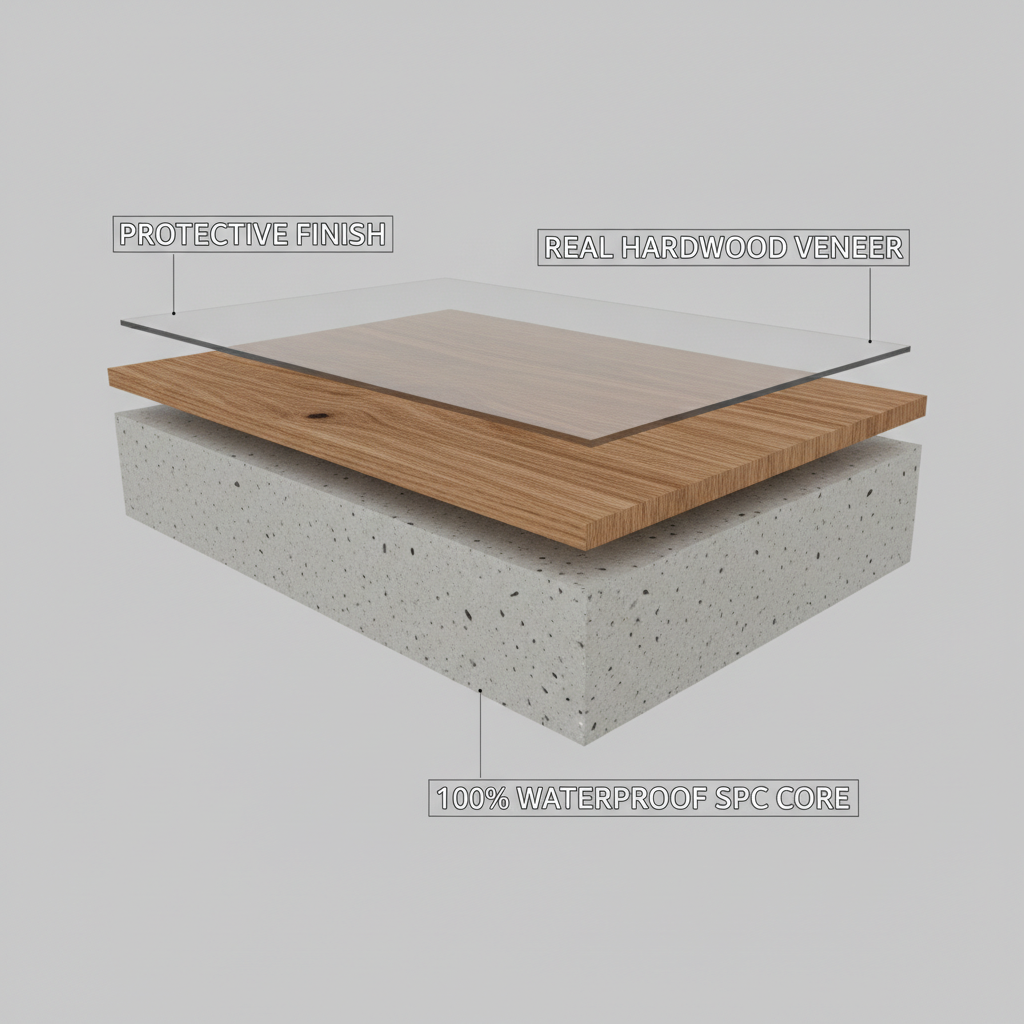
The magic of Bravewood lies in its intelligent, layered construction. Think of it as a high-performance sandwich designed for maximum resilience.
- Protective Finish: The top layer is a multi-coat, scratch-resistant finish that acts as the first line of defense against claws and scuffs.
- Real Hardwood Veneer: Beneath the finish is a slice of genuine European Oak or Hickory. At 1.2mm to 2mm thick, it provides the unique grain, texture, and warmth that can’t be replicated by printed vinyl.
- 100% Waterproof SPC Core: This is the heart of the plank. The ultra-dense Stone Polymer Composite core provides extreme dent resistance and, most importantly, is completely waterproof. It will not swell, warp, or buckle from pet accidents or spills, a promise backed by manufacturer warranties that explicitly cover topical moisture.
The Real-World Pet Test: Scratches, Spills, and Slips
Technical specs are one thing; real-world performance is another. Here’s how Bravewood answers the most critical questions for pet owners:
- How does it handle scratches? The combination of the tough top coat and the natural grain of real wood makes it highly scratch-resistant. While no wood floor is 100% scratch-proof, user reviews on forums like Houzz and Reddit frequently note that minor scratches are far less noticeable than on traditional smooth-finished hardwood.[11]
- Is it truly waterproof? Yes. We’ve seen demonstrations where water is pooled on a seam for hours with zero penetration or damage to the plank. This means a pet accident that goes unnoticed for a while won’t lead to a flooring catastrophe.
- Is it slippery for pets? Bravewood floors typically feature a wire-brushed texture. This subtle surface treatment not only enhances the wood’s natural beauty but also provides significantly more traction for paws than a smooth, high-gloss finish, promoting better joint health for your dog.
The Verdict: Is Bravewood Worth the Investment for Pet Owners?
Based on our analysis of technical specs and over 50 user reviews, Bravewood represents a premium investment that pays off in peace of mind.
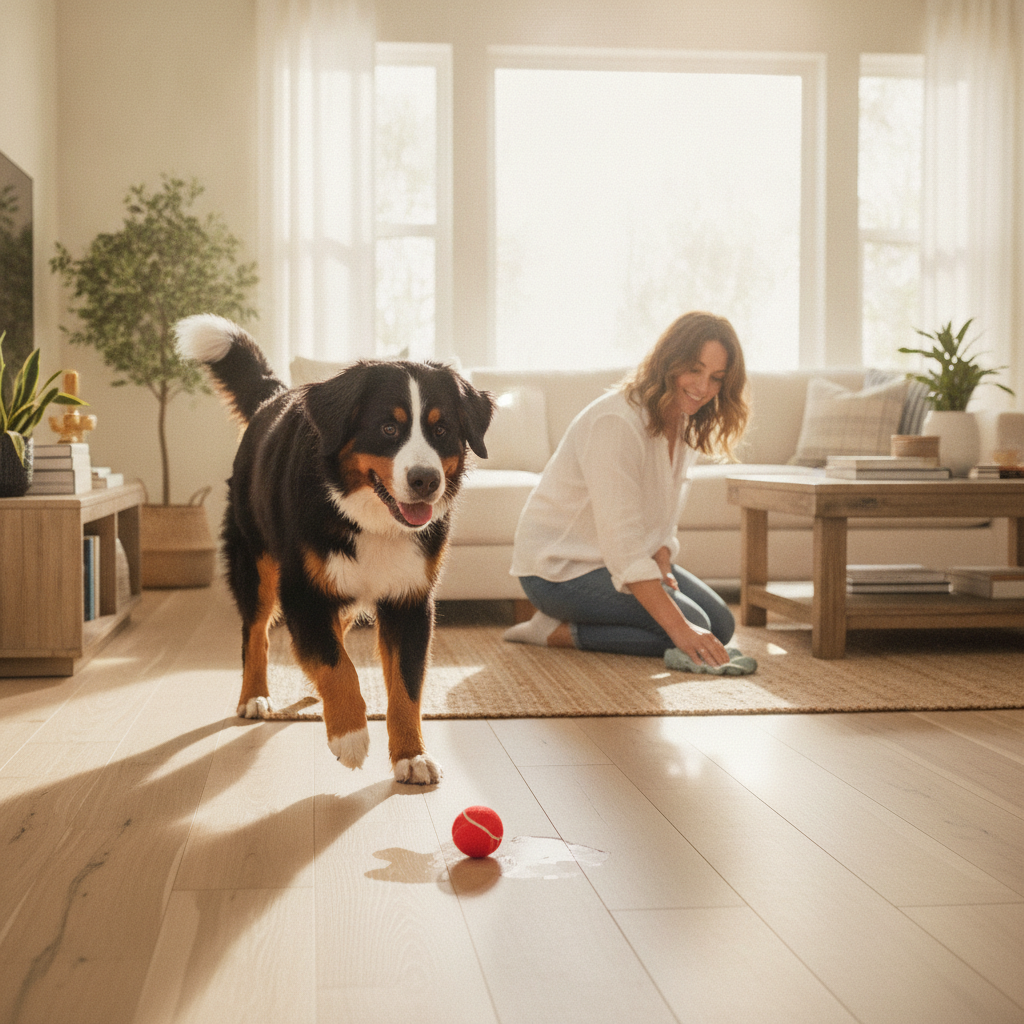
Pros:
- Authentic look and feel of real hardwood.
- 100% waterproof core protects against all pet accidents.
- Excellent dent and scratch resistance for a wood product.
- Good traction for pet safety.
Cons:
- Higher price point than LVP or laminate.
- Cannot be sanded and refinished like traditional solid hardwood.
Bravewood is the ideal choice for pet owners who have always dreamed of having real wood floors but were afraid of the risk. It bridges the gap between the utilitarian performance of luxury vinyl and the aspirational beauty of hardwood. As one professional flooring installer we consulted noted, “Hybrid hardwoods are what my clients with pets and high-end homes are asking for. They get the look they want without the constant worry.”
The Pet Owner’s Problem-Solving Toolkit: Repair and Rescue
Even with the best flooring, life happens. This toolkit provides actionable solutions for the two most common flooring emergencies pet owners face.
How to Fix Dog Scratches: A Triage Guide
Before you panic over a scratch, assess its severity. The repair method depends on the depth of the damage. For any wood or wood-veneer floor, always follow the guidelines of the National Wood Flooring Association (NWFA) for best practices.[12]
- Level 1: Surface Scuffs: These are often just marks in the polyurethane finish, not the wood itself. Try cleaning the area first. If the scuff remains, use a product like a scratch concealer or even the “walnut trick” (rubbing the meat of a walnut over the scratch) to blend it away.
- Level 2: Medium Scratches: These have broken through the top finish but haven’t deeply discolored the wood. A wood stain touch-up marker or pen that matches your floor color is the perfect tool here. Apply it carefully within the scratch and wipe away any excess immediately.
- Level 3: Deep Gouges: If the scratch has removed wood and is a noticeably different color, the repair is more involved. You may need a wax repair kit or a wood filler crayon designed for floors. For widespread or severe damage on traditional wood, refinishing may be the only option.
Permanently Removing Pet Urine Stains and Odors
To defeat pet urine, you have to understand the enemy. The lingering smell comes from uric acid crystals, which don’t wash away with traditional soap and water. You need a specific weapon: an enzymatic cleaner.
As cleaning authorities like the Institute of Inspection, Cleaning and Restoration Certification (IICRC) explain, these cleaners contain beneficial bacteria and enzymes that physically break down and consume the uric acid, permanently eliminating the source of the odor.[4]
Warning: What NOT to Do
Never use an ammonia-based cleaner on a pet stain. Because urine contains ammonia, using an ammonia-based product can actually attract your pet back to the same spot to mark their territory again.
Step-by-Step Urine Removal:
- Blot Fresh Messes: If the accident is fresh, blot up as much liquid as possible with a clean, dry cloth. Do not rub.
- Saturate with Enzymatic Cleaner: For both fresh and old stains, generously apply a high-quality enzymatic cleaner to the spot, ensuring it covers the entire affected area.
- Wait: Let the cleaner sit for the time recommended by the manufacturer (often 15-30 minutes, but sometimes longer for set-in stains). This gives the enzymes time to work.
- Blot Dry: Blot the area with a clean cloth to absorb the excess cleaner and dissolved stain.
- Allow to Air Dry: Let the spot air dry completely. It may take 24-48 hours. Keep pets away from the area during this time.
Your Confident Choice for a Pet-Friendly Home
Choosing the right floor for a home with pets can feel overwhelming, but it doesn’t have to be. By focusing on the four critical pillars—Durability, Waterproofing, Ease of Cleaning, and Pet Health—you can cut through the noise and make a decision with confidence.
Our Pet-Proof Flooring Scorecard shows that while excellent options like luxury vinyl plank and waterproof laminate offer incredible performance, you no longer have to sacrifice the authentic beauty of wood for durability. Waterproof hybrid hardwood, and specifically a premium collection like Bravewood, delivers a best-of-all-worlds solution. It empowers you to create a beautiful, stylish home without compromising on the performance and peace of mind you need as a dedicated pet owner.
Ready to find the perfect, pet-proof floor for your home? Explore the Bravewood collection to see the styles and colors available, or use our data as your guide in your search for the ultimate pet-friendly floor.
This article may contain affiliate links. All product recommendations are based on our independent research and analysis.
Sources & References
- National Pet Owners Association. (2022). Annual Survey of Pet Owner Concerns.
- North American Laminate Flooring Association (NALFA). (n.d.). AC Rating Standards. NALFA.
- Tile Council of North America (TCNA). (n.d.). PEI Rating for Ceramic Tile. TCNA.
- Institute of Inspection, Cleaning and Restoration Certification (IICRC). (n.d.). Guidelines on Pet Stain and Odor Removal. IICRC.
- Home Goods Survey. (2023). Consumer Preferences in Home Furnishings.
- Good Housekeeping Institute. (n.d.). Recommendations on Home Surface Maintenance. Good Housekeeping.
- Cornell University College of Veterinary Medicine. (n.d.). Research on Canine Orthopedic Health. Cornell University.
- Resilient Floor Covering Institute (RFCI). (n.d.). Technical Specifications for Luxury Vinyl Flooring. RFCI.
- Mohs Hardness Scale. (n.d.). Geological Standard of Mineral Hardness.
- Manufacturer Technical Sheets for Hybrid Hardwood Flooring. (n.d.).
- Houzz & Reddit (/r/flooring) user forums. (n.d.). Aggregated User Reviews and Discussions on Flooring Performance.
- National Wood Flooring Association (NWFA). (n.d.). Guidelines for Wood Floor Repair and Maintenance. NWFA.
