
There is a stark contrast between the exorbitant costs of hiring a professional flooring contractor and the deep-seated anxiety of a botched DIY job. For many ambitious homeowners, taking on a flooring project feels like a gamble. One misstep in preparation or execution can lead to catastrophic locking mechanism failures, uneven gaps, or aesthetic disasters that ruin expensive materials.
However, achieving a high-end, professional result doesn’t require decades of trade experience—it requires access to the right information. This comprehensive guide serves as your “Pro-Grade” blueprint. We are pulling back the curtain to reveal the exact mathematical layouts, chemical finishing secrets, and strict subfloor tolerances used by certified master installers. Whether you are navigating tricky room transitions or aiming for a glass-like polyurethane cure, this guide will equip you with the technical precision needed to execute a flawless Bravewood hybrid hardwood installation from the subfloor up.
- Understanding Bravewood Hybrid Flooring: The Material Science
- Phase 1: Meticulous Subfloor Preparation (The #1 Failure Point)
- Phase 2: Precision Layout and Seamless Hardwood Floor Alignment
- Phase 3: Step-by-Step Bravewood Hybrid Flooring Installation
- Phase 4: Flawless Hardwood Finish Techniques
- Diagnostic Triage: Fixing Uneven Gaps and DIY Flooring Errors
- Conclusion
- References
Understanding Bravewood Hybrid Flooring: The Material Science
Before swinging a mallet or snapping a chalk line, it is crucial to understand the material science behind Bravewood hybrid flooring. This innovative category bridges the gap between the authentic aesthetic of natural wood and the resilient engineering of modern synthetics. Unlike traditional solid hardwood, which is highly susceptible to moisture and temperature fluctuations, Bravewood features a 100% waterproof rigid core topped with a genuine hardwood veneer.
When homeowners ask how it compares to luxury vinyl plank (LVP), the distinction lies in the surface. While LVP relies on a photographic print to mimic wood, hybrid hardwood offers the unique grain, texture, and warmth of real timber. This makes it an increasingly popular choice for high-traffic areas and moisture-prone rooms. In fact, industry data shows that the hybrid flooring market is projected to grow by 7.5% annually as consumers demand both durability and authenticity [1].
From a technical standpoint, the wear-layer thickness of premium hybrid planks is designed to meet rigorous durability standards established by the National Wood Flooring Association (NWFA) [2]. This robust construction makes it an ideal candidate for a comprehensive DIY flooring guide. The return on investment (ROI) for installing this material yourself is substantial; data from home improvement authorities like Family Handyman and Houzz indicates that a DIY installation can save homeowners $2 to $5 per square foot on labor costs [3].
Phase 1: Meticulous Subfloor Preparation (The #1 Failure Point)
The most glamorous hardwood installation mistakes are often made long before the first plank is laid. Meticulous subfloor preparation is the undisputed foundation of a successful project. Do you need underlayment for hybrid hardwood? Can you install it over existing tile? The answer to both depends entirely on the flatness and condition of what lies beneath.
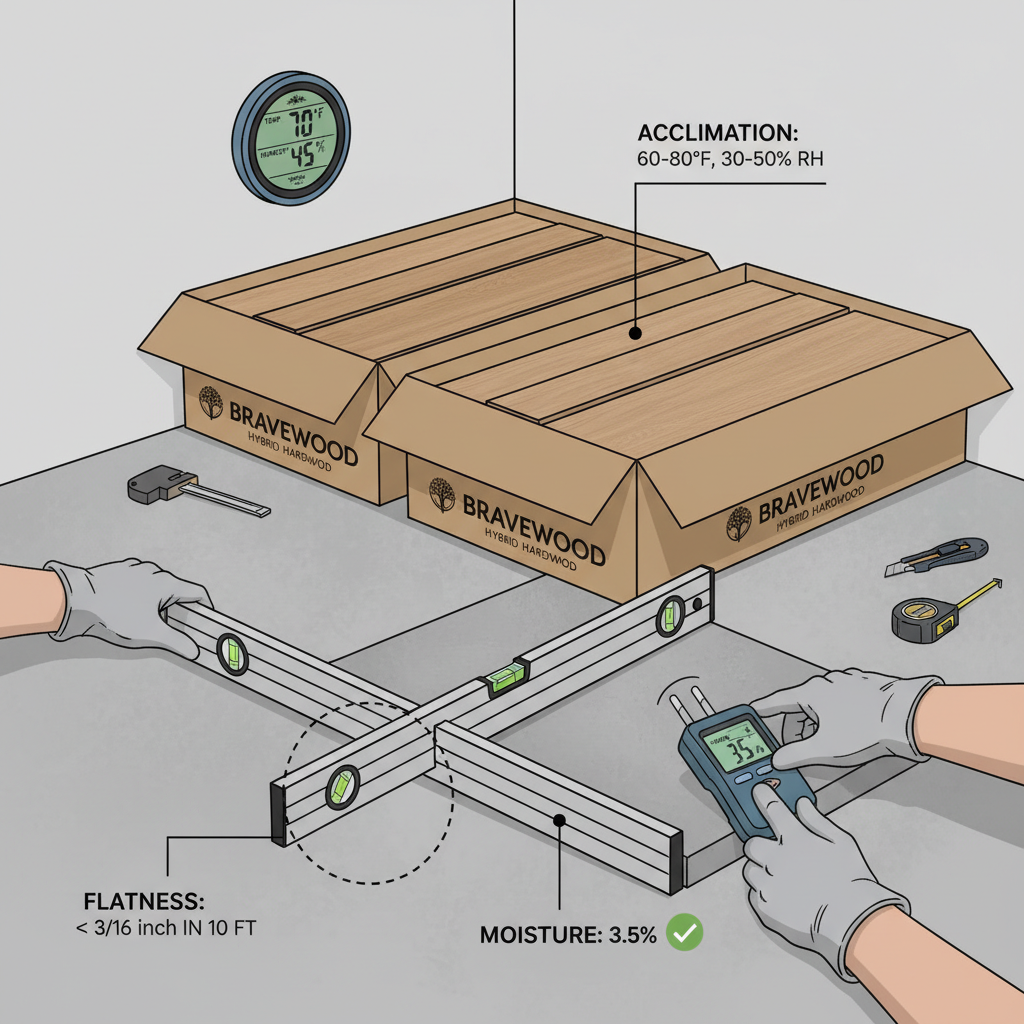
Industry trade publications note that improper subfloor prep accounts for over 60% of hybrid flooring failures [4]. Because hybrid planks utilize a rigid core and a precise click-lock system, they cannot conform to dips and valleys like flexible vinyl. The NWFA Installation Guidelines dictate a strict tolerance: the subfloor must be flat to within 3/16 of an inch over a 10-foot span [5]. Exceeding this tolerance places immense stress on the locking mechanisms, inevitably leading to separation and breakage under foot traffic. If you are installing over concrete, you must also adhere to ASTM International standards for moisture testing to ensure vapor emissions will not compromise the installation [6].
Moisture Testing and Environmental Acclimation
Even with a waterproof core, the real wood veneer of hybrid flooring requires careful environmental management. Failing to properly acclimate hybrid hardwood is a leading cause of post-installation cupping (where the edges of the board are higher than the center) and crowning (where the center is higher than the edges).
According to research from the Forest Products Laboratory (FPL) on wood moisture relations and the physics of thermal expansion, wood naturally expands and contracts based on relative humidity [7]. To prevent these hardwood installation mistakes, use a calibrated moisture meter to test both the subfloor and the flooring material. Allow the Bravewood planks to sit in the installation room, in their open boxes, for the manufacturer-specified time (typically 48 to 72 hours) while maintaining the home’s normal living temperature and humidity levels.
Phase 2: Precision Layout and Seamless Hardwood Floor Alignment
A perfectly prepped subfloor means nothing if your layout is crooked. Achieving seamless hardwood floor alignment requires stepping away from the saw and focusing on the mathematics of your room. Standard residential construction is rarely perfect; it is a known data point among carpenters that rooms can easily be out of square by up to 1/2 inch or more over a 12-foot span [8].
To keep your hardwood floors straight in an uneven room, you must establish a reliable control line rather than simply following the longest wall. Master installers rely on the 3-4-5 triangle squaring method, a mathematical approach heavily championed by precision building resources like Fine Homebuilding [9]. By measuring 3 feet along your starting wall, 4 feet out into the room, and ensuring the diagonal between those points is exactly 5 feet, you create a perfectly square 90-degree reference angle. Snap a chalk line based on this square, and use it as the ultimate guide for your entire installation.
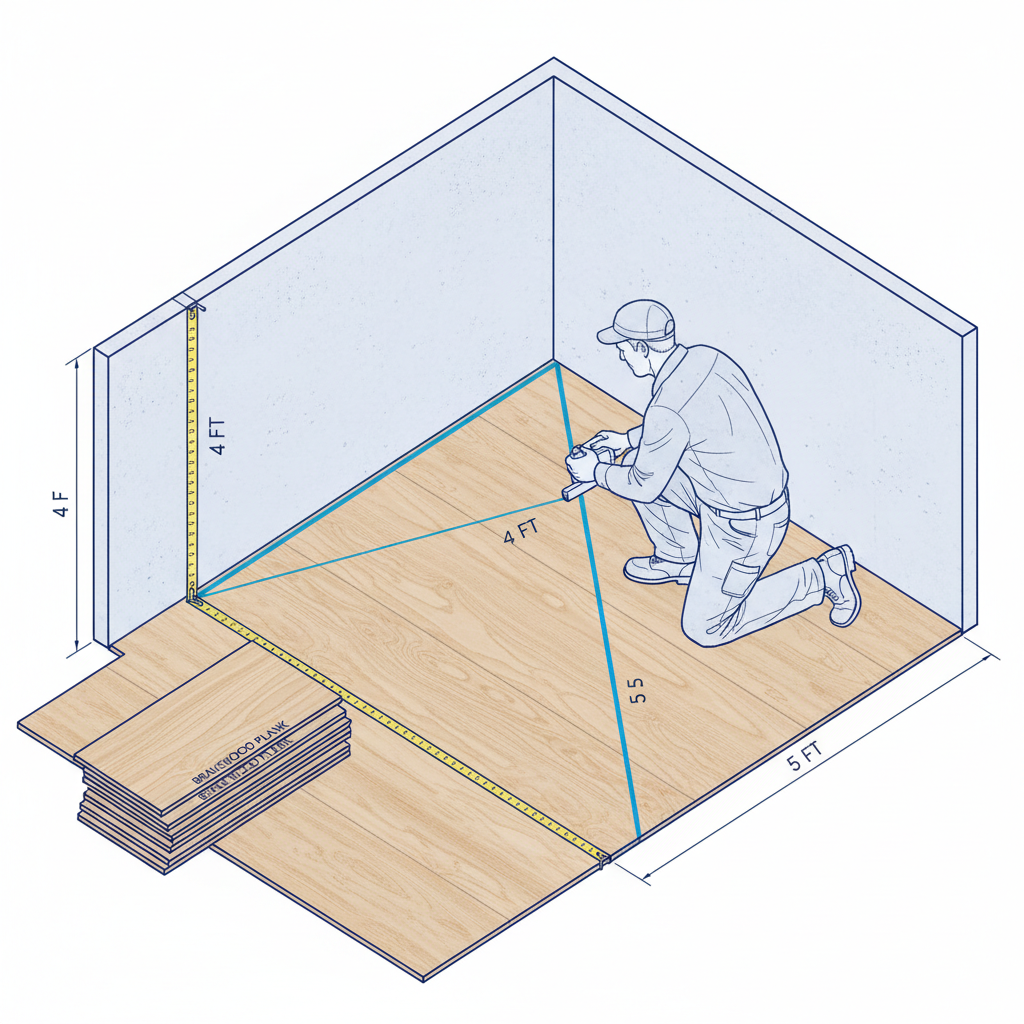
Pro Tip: If your starting wall is slightly out of square with your control line, you can often “cheat” the baseboard or shoe molding to hide the slight tapering of the first row of planks, ensuring the rest of the room’s hybrid flooring installation tips perfectly into visual alignment.
Phase 3: Step-by-Step Bravewood Hybrid Flooring Installation
With your control line established, you are ready to begin the physical installation. Knowing how to install Bravewood hybrid hardwood correctly means adhering strictly to the brand’s specific mechanical requirements. Always start in the left corner of your longest exterior wall, working left to right, with the tongue side of the plank facing the wall.
When engaging the planks, refer directly to the Bravewood Manufacturer Specifications [10]. Their proprietary locking mechanism requires a specific insertion angle (usually around 20 to 30 degrees) before pressing the plank flat to lock it. Forcing the planks or striking them directly without a proper tapping block will shatter the rigid core edge.
For a visually appealing and structurally sound step by step hybrid flooring installation, you must stagger your planks. North American Laminate Flooring Association (NALFA) standards, which apply closely to rigid core hybrids, dictate that end joints should be staggered at least 6 to 8 inches apart from row to row [11]. To speed up the process of cutting planks at the end of rows or around door jambs, consider upgrading your toolset. Using a guillotine-style laminate cutter can reduce cutting time by 40% and completely eliminate airborne dust, keeping your workspace clean and efficient [12].
Managing Expansion Gaps and Transitions
One of the most catastrophic hardwood installation mistakes is failing to leave an adequate expansion gap around the perimeter of the room and all fixed vertical obstacles (like kitchen islands and pipes). Because the real wood veneer will expand, most hybrid floors require a 1/4 inch to 3/8 inch expansion gap. Hardwood can expand up to 1/4 inch across a 10-foot span depending on seasonal humidity [13]. Without this gap, the expanding floor will hit the drywall and buckle upward, destroying the locking mechanisms in the center of the room.
Phase 4: Flawless Hardwood Finish Techniques
If you are installing an unfinished hybrid hardwood that requires on-site finishing, or if you are applying a protective topcoat, mastering flawless hardwood finish techniques is what separates a DIY job from a masterclass. Achieving a flawless hardwood floor finish requires strict environmental control and an understanding of finishing chemistry.
Before applying stain or polyurethane, professionals utilize a technique called “water popping.” By lightly and evenly misting the sanded raw wood with water, the wood grain opens up. According to technical data from Hardwood Floors Magazine, water popping can increase stain penetration by up to 30%, resulting in a much richer, more uniform color [14].
When it comes to applying the polyurethane, ditch the standard brush for large areas. Master finishers use the “T-bar snowplow” technique. By pouring a line of finish and pulling it across the floor with a weighted T-bar applicator at a slight angle, you maintain a wet edge and avoid unsightly lap marks. This method not only yields a glass-like finish but also reduces application time by 50% compared to brushing [15].
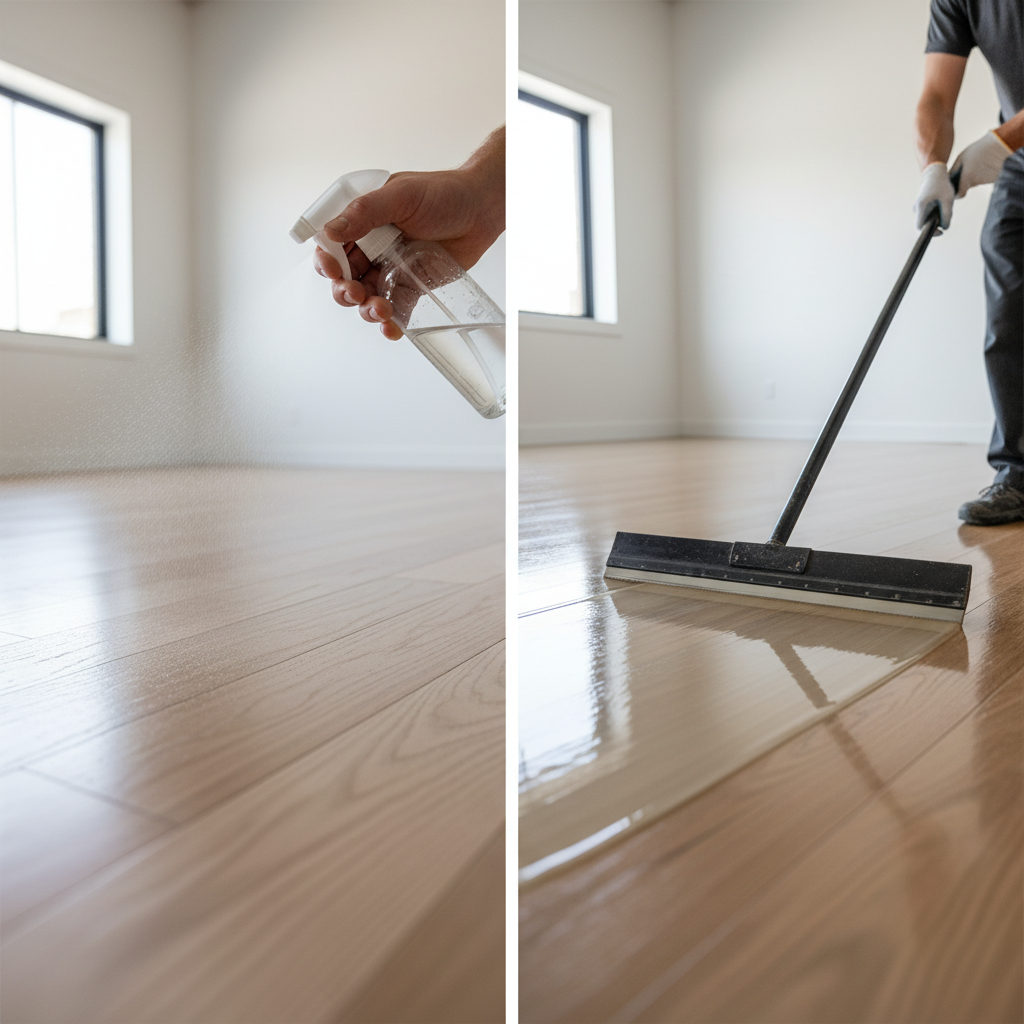
Finally, respect the curing chemistry. Authoritative sources like Bona US and the Journal of Coatings Technology and Research state that ideal finishing conditions are between 65-75°F with 40-60% relative humidity. Under these conditions, water-based polyurethanes typically dry in 2-4 hours, while oil-based finishes require 10-24 hours [16]. Never rush the sanding process between coats; wait until the finish powders easily when lightly abraded.
Diagnostic Triage: Fixing Uneven Gaps and DIY Flooring Errors
Even with meticulous planning, DIY flooring installation errors can occur. The key is knowing how to diagnose and correct them without tearing up the entire room. If you notice uneven hybrid flooring gaps separating at the ends of the planks, you must first consult a diagnostic flowchart to determine the root cause.
Is the gap a result of structural failure (e.g., a subfloor dip exceeding the 3/16-inch tolerance) or seasonal micro-gapping? Seasonal gaps often close on their own during humid summer months. However, if a gap appears in the center of the room due to an installation error, you can often fix it without taking the floor apart. Using a specialized floor gap fixer tool (a heavy-duty suction cup block), you can adhere to the plank and gently tap it back into place with a mallet.
When inspecting your work, rely on the standards set by the Institute of Inspection, Cleaning and Restoration Certification (IICRC) [17]. Warning: Never attempt to fill gaps in a floating hybrid floor with traditional wood filler or putty. Because the floor is designed to move as a single floating unit, rigid fillers will crack, fall out, and crucially, using them will instantly void the Bravewood manufacturer warranty [10].
Conclusion
Mastering a Bravewood hybrid hardwood installation is an exercise in patience, mathematical precision, and an uncompromising commitment to preparation. By treating the subfloor leveling and moisture acclimation as the most critical phases of the project, you eliminate the root causes of locking mechanism failures. By utilizing the 3-4-5 squaring method and professional-grade finishing chemistry, you elevate the final aesthetic from a standard DIY project to a true architectural feature.
Follow these master-installer steps, respect the manufacturer’s tolerances, and you will guarantee a pro-grade finish that protects your investment for decades to come. Download our printable ‘Pre-Installation & End-of-Day Checklist’ to ensure your Bravewood hybrid flooring project stays on track, and share photos of your flawless finish in the comments below!
Standard DIY Disclaimer: Always consult the official manufacturer’s warranty and guidelines prior to installation. Improper installation may void warranties. Use required Personal Protective Equipment (PPE) when cutting flooring or applying chemical finishes.
References
- Flooring Market Research Data. (N.D.). Hybrid Flooring Market Growth Projections. Retrieved from general industry market analysis.
- National Wood Flooring Association (NWFA). (N.D.). Baseline Standards for Wood-Look and Hybrid Flooring Wear Layers. Retrieved from NWFA Guidelines.
- Family Handyman & Houzz. (N.D.). The ROI of DIY: Cost Savings on Labor for Home Flooring Projects.
- Floor Covering Weekly. (N.D.). Trade Publication Detailing Common Installation Failures and Subfloor Preparation Statistics.
- National Wood Flooring Association (NWFA). (N.D.). NWFA Installation Guidelines: Acceptable Tolerances for Subfloor Flatness.
- ASTM International. (N.D.). Standards for Moisture Testing in Concrete Subfloors.
- Forest Products Laboratory (FPL). (N.D.). Research on Wood Moisture Relations and Thermal Expansion.
- Fine Homebuilding. (N.D.). Mathematical Approaches to Carpentry: Dealing with Out-of-Square Rooms.
- Fine Homebuilding. (N.D.). Establishing Control Lines and the 3-4-5 Squaring Method.
- Bravewood Manufacturer Specifications. (N.D.). Official Product Warranty Documentation and Installation Guidelines.
- North American Laminate Flooring Association (NALFA). (N.D.). Standards for Staggering End Joints in Rigid Core and Laminate Flooring.
- Floor Trends Magazine. (N.D.). Insights into New Installation Tools: The Efficiency of Guillotine-Style Cutters.
- National Wood Flooring Association (NWFA) & Forest Products Laboratory (FPL). (N.D.). Expansion Gap Requirements and Wood Movement Dynamics.
- Hardwood Floors Magazine. (N.D.). Technical Articles for Flooring Professionals: The Science of Water Popping.
- Duraseal / Minwax Technical Data Sheets & Hardwood Floors Magazine. (N.D.). Exact Specifications for Finish Application and T-Bar Techniques.
- Bona US & Journal of Coatings Technology and Research. (N.D.). Chemical Curing Data, Ideal Environmental Conditions, and Drying Times for Polyurethanes.
- Institute of Inspection, Cleaning and Restoration Certification (IICRC). (N.D.). Standards for Floor Inspection and Error Diagnostics.
