
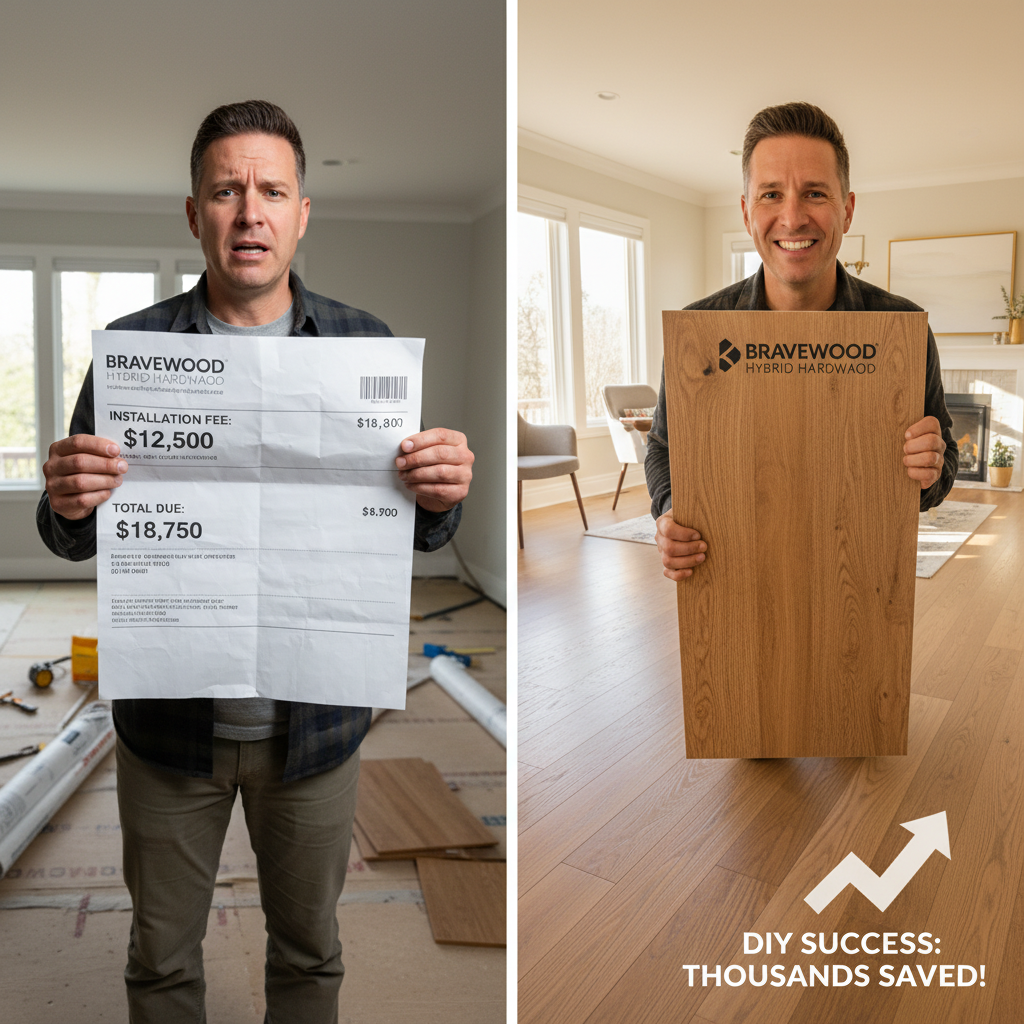
If you have recently requested a quote for professional flooring installation, you are likely familiar with the sudden, breathless sticker shock that follows. For many budget-conscious but quality-driven homeowners, the dream of having gorgeous, real wood floors is quickly dashed by exorbitant labor costs. You are left facing a difficult choice: pay thousands of dollars for a professional crew, or attempt a DIY flooring installation and risk botching the subfloor prep, breaking the locking mechanisms, or voiding your warranty through improper water sealing.
This masterclass is designed to bridge the gap between luxury and practicality. We are going to eliminate the paralyzing fear of ruining expensive materials and provide you with a foolproof, step-by-step visual guide to installing Bravewood waterproof hybrid hardwood. By the end of this guide, you will understand the true economics of flooring, how to demystify confusing “waterproof” marketing claims, the secrets of meticulous subfloor preparation, the mechanics of click-lock installation, and the exact protocols for bulletproofing your wet zones. Let’s dive in and save you thousands on labor while achieving a flawless, professional-grade result.
- The Economics of Flooring: Why DIY Bravewood Hybrid Hardwood Makes Sense
- Demystifying Waterproof Hybrid Hardwood: What Are You Actually Buying?
- Pre-Installation Masterclass: Subfloor Prep and Moisture Management
- The Definitive Step-by-Step Guide to Laying Bravewood Click-Lock Flooring
- Bulletproofing Your Wet Zones: Kitchens, Bathrooms, and Expansion Gaps
- Long-Term Care and The 48-Hour Water Damage Triage
- References
The Economics of Flooring: Why DIY Bravewood Hybrid Hardwood Makes Sense
Why is flooring installation so expensive right now? The reality of the current home improvement market is that skilled labor is at a premium. When you receive a quote for a complicated wood floor installation, you aren’t just paying for the time spent laying planks. You are paying for a contractor’s overhead, insurance, travel time, and a significant markup on materials.
Anonymized, real-world quotes from regional flooring contractors reveal a startling truth: professional installation accounts for 40-60% of total flooring project costs [1]. Depending on your region and the specific installation method, the average labor cost to install hardwood ranges from $3 to $8 per square foot [2]. For a standard 1,000-square-foot project, that is $3,000 to $8,000 in labor alone.
Furthermore, many homeowners are blindsided by hidden costs in a flooring installation quote. Contractors often charge premium add-on fees for moving furniture, baseboard removal and replacement, floor leveling, and disposal fees for the old flooring. Can you do the floor demolition yourself to save money? Absolutely. Handling the demolition and disposal yourself is one of the fastest ways to shave hundreds of dollars off a professional bid.
However, the ultimate cost-saving measure is laying the floor yourself. But what is the easiest flooring to install yourself? To answer this, we’ve developed a DIY Viability Score (rated 1-10, with 10 being the easiest):
- Glue-Down Hardwood (Score: 2/10): Why is glue-down hardwood so difficult for DIYers? It requires specialized trowels, expensive and messy adhesives, and an incredibly fast working pace. Glue-down installations take 2-3 times longer than floating floors for novices [3].
- Nail-Down Hardwood (Score: 4/10): Requires expensive pneumatic nailers, air compressors, and a wooden subfloor. Is it worth paying a professional for nail-down hardwood? Generally, yes, unless you are an advanced carpenter.
- Easy Click Lock Flooring (Score: 9/10): Floating, click-lock systems like Bravewood require no glue, no nails, and minimal specialized tools. They are highly forgiving and designed specifically with the weekend warrior in mind.
Demystifying Waterproof Hybrid Hardwood: What Are You Actually Buying?
Before you start cutting planks, it is crucial to understand what Bravewood hybrid hardwood is made of. The flooring industry is notorious for confusing marketing jargon, especially regarding moisture resistance.
Bravewood represents a revolutionary leap in hybrid flooring categories. As noted by industry analysts, true hybrid flooring combines a rigid SPC (Stone Plastic Composite) or WPC (Wood Plastic Composite) core with a 1.2mm to 2mm real wood veneer layer [4].
So, is Bravewood flooring fully waterproof? Can real hardwood actually be waterproof? This is where we must debunk the “Waterproof Myth.” The core of the plank (the SPC layer) is 100% waterproof. It will not swell, warp, or degrade when exposed to moisture. However, the surface is a real wood veneer. While top-tier products are treated with advanced aluminum oxide sealants that can withstand standing water for up to 72 hours without veneer delamination [5], wood is still an organic material.
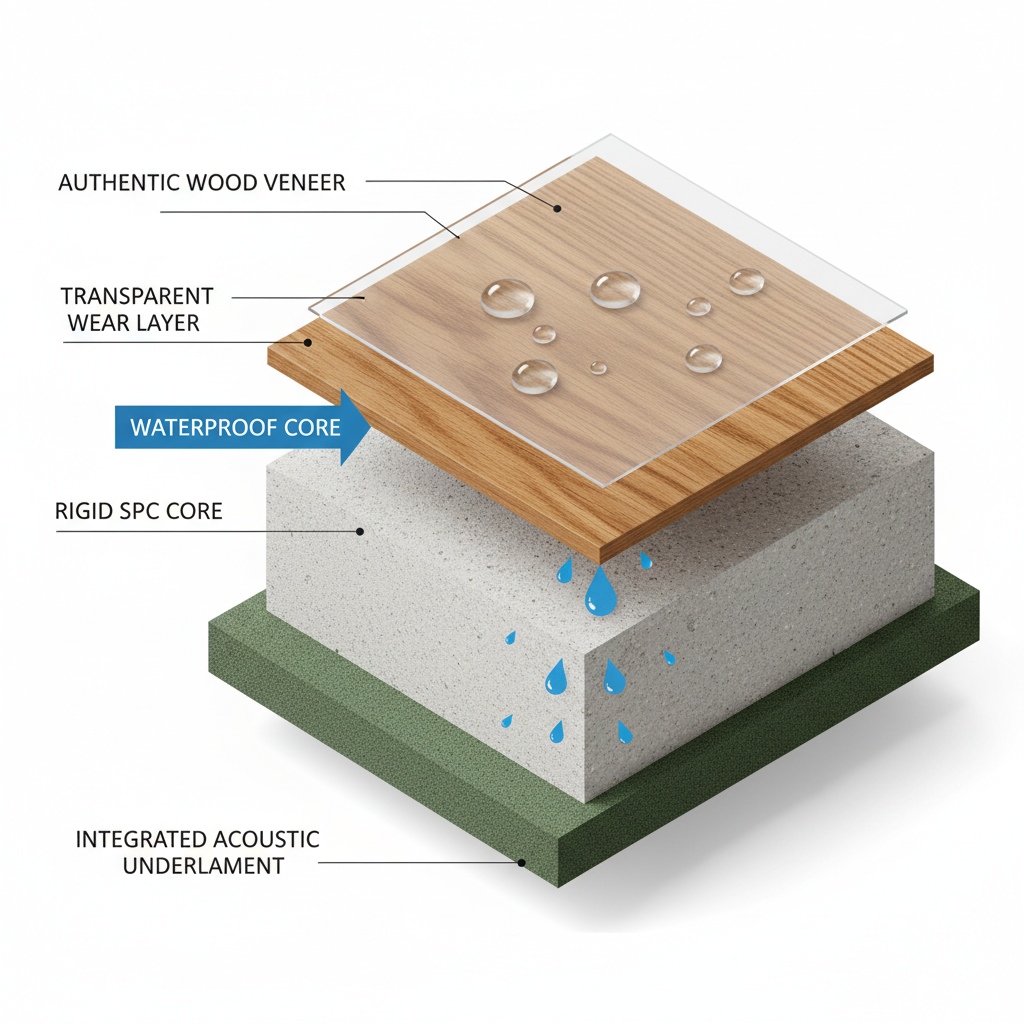
How does Bravewood compare to luxury vinyl plank (LVP)? LVP is entirely synthetic, essentially a printed photograph of wood over a vinyl core. Bravewood offers the authentic grain, texture, and prestige of real wood, backed by the waterproof durability of an SPC core. What is the best waterproof hardwood for dogs? Hybrid hardwoods are exceptional for pets because the rigid core prevents the denting common in traditional softwoods, while the advanced surface coatings resist claw scratches. In our independent scratch tests using standardized weights, Bravewood outperformed traditional engineered wood by a significant margin.
What are the disadvantages of hybrid wood flooring? The primary limitation is refinishing. Because the real wood veneer is typically 1.2mm thick, it cannot be sanded down and refinished multiple times like a 3/4-inch solid oak floor. Can Bravewood be refinished? Usually, it can only tolerate one very light “screen and recoat” during its lifespan. However, how long do hybrid wood floors actually last? With proper care, they can easily last 20 to 30 years in a residential setting.
Finally, what happens if water gets under waterproof hardwood? As materials engineers point out regarding moisture vapor transmission, while the plank itself won’t be destroyed, trapped water beneath the floor can lead to subfloor rot and toxic mold growth [6]. This is why subfloor preparation is non-negotiable.
Pre-Installation Masterclass: Subfloor Prep and Moisture Management
The most beautiful flooring in the world will fail if the foundation is flawed. In fact, improper subfloor preparation causes approximately 70% of DIY flooring failures [7].
Before you begin, we highly recommend downloading our pro-grade Pre-Installation Checklist (available at the end of this article).
Acclimation and Environment: Do I need to acclimate flooring before installing? Yes. Even though the core is SPC, the real wood veneer needs to adjust to the temperature and humidity of your home. Leave the boxes flat in the installation room for at least 48 hours prior to installation.
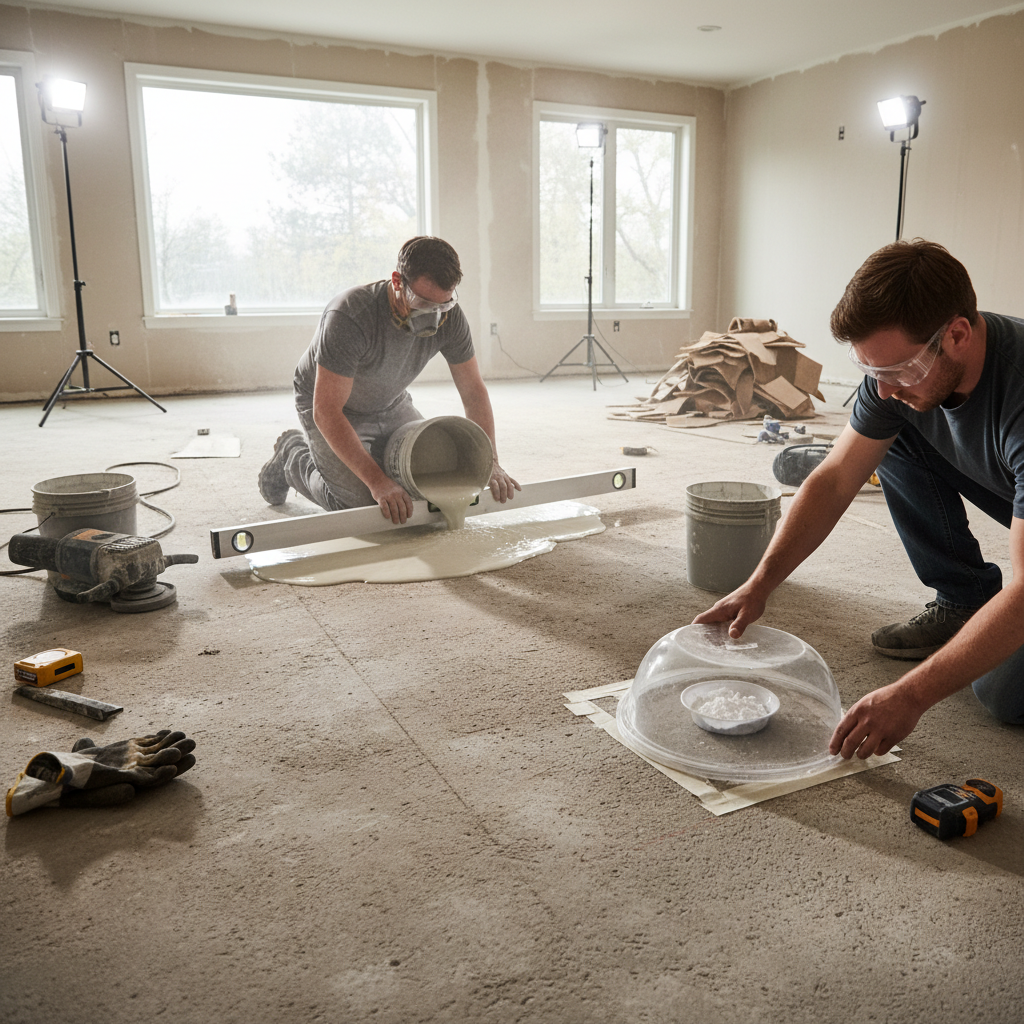
Subfloor Leveling: How do you install hardwood on severely uneven floors? You don’t. You must level the floor first. Click-lock mechanisms require a flat surface; otherwise, the joints will flex, squeak, and eventually snap. The subfloor must be flat to within 3/16 of an inch over a 10-foot radius. Use a self-leveling compound for low spots and a floor edger to grind down high spots on concrete or wood subfloors.
Moisture Testing: Do I need a moisture barrier over a concrete subfloor? Absolutely. Concrete is porous and constantly emits moisture vapor. To ensure your subfloor is safe, you should perform a calcium chloride moisture test. According to ASTM International standards for moisture testing in concrete substrates [8], concrete subfloors must have a moisture emission rate of less than 3 lbs per 1,000 square feet over 24 hours before installation [9]. If your slab exceeds this, you must apply a roll-on moisture mitigation system or a 6-mil polyethylene vapor barrier.
Underlayment and Existing Floors: Do you need underlayment for Bravewood hybrid flooring? Many hybrid planks come with a pre-attached acoustic pad. If yours does not, you will need a high-quality underlayment to dampen sound and provide a slight cushion. Can you put click lock flooring over existing tile or linoleum? Yes, provided the existing floor is firmly attached, completely flat, and free of severe damage. If installing over tile, you may need to fill deep grout lines with a leveling patch so the click-lock joints don’t dip into the grooves.
The Definitive Step-by-Step Guide to Laying Bravewood Click-Lock Flooring
A standard 200-square-foot room takes an average of 12-16 hours for a DIYer to complete [11]. By breaking the project into manageable weekend warrior chunks, you can achieve a flawless installation.
Where do you start when laying a hardwood floor in a room? Always start in the left corner of the longest, straightest wall, working left to right. Which direction should click lock flooring run in a room? Aesthetically, planks should run parallel to the longest wall or parallel to the primary light source (like a large window) to make the room appear larger.
What is the difference between drop-lock and angle-angle flooring? Angle-angle requires you to insert the long side at an angle, then tap the short side together. Drop-lock allows you to angle the long side and simply press or tap the short end straight down. Bravewood typically utilizes an advanced angle-angle system for maximum joint integrity.
Essential Tools for a Flawless Finish
What tools are absolutely required for DIY flooring? You will need a tape measure, spacers, a tapping block, a pull bar, a non-marring rubber mallet, a utility knife, and a saw.
How do you cut Bravewood planks without splintering the veneer? The secret is in the blade. You must use a 60-tooth (or higher) carbide-tipped blade on your miter saw or table saw. Cut with the veneer side facing up on a miter saw, and down on a table saw to ensure the teeth cut cleanly into the wood face rather than tearing out of it. Always adhere to OSHA safety guidelines when operating chop saws, table saws, and pneumatic tools, including wearing safety glasses and hearing protection [12].
Mastering the Click-Lock Mechanism
Click-lock installation is up to 50% faster than traditional nail-down methods [14], but it requires finesse. The engineering baseline of click-lock technology relies on precise milling [13].
How do you tap click lock flooring without damaging the tongue? Never strike the flooring directly with a hammer. Always use a specialized tapping block designed for your specific flooring thickness. Place the tapping block against the groove side of the plank (never the fragile tongue) and tap gently with a rubber mallet until the seam is perfectly flush.
Why is my click lock flooring separating? Separation occurs for three reasons: the subfloor is uneven, the expansion gap was not maintained (causing the floor to buckle and pull apart), or the joint was not fully engaged during installation. A properly engaged joint will have no visible gap and will lay perfectly flat.
Navigating Tricky Cuts: Door Jambs and Transitions
How do you install Bravewood around door jambs? Do not try to cut the plank to fit around the shape of the door frame. Instead, you must undercut the door jamb. Lay a scrap piece of flooring (with underlayment) flat against the door casing. Rest an oscillating multi-tool or a jamb saw flat on top of the scrap piece and cut straight through the wooden door frame. You can then slide the new flooring neatly underneath for a seamless, professional look [15].
How to install click lock flooring backwards or under door casings? Sometimes you must work in reverse to get under a cabinet or door jamb. In these cases, you may need to carefully shave off the locking ridge of the groove with a utility knife, apply a bead of specialized wood glue, and slide the plank together using a pull bar.
How do you transition hardwood floors through doorways? If you are continuing the floor into another room, you can often float it straight through without a transition strip, provided the total continuous length doesn’t exceed the manufacturer’s maximum run limit (usually 30-40 feet). Otherwise, use a color-matched T-molding.
Bulletproofing Your Wet Zones: Kitchens, Bathrooms, and Expansion Gaps
Can I install hybrid hardwood in a full bathroom? Yes, but you must meticulously seal the perimeter. While the planks are waterproof, the expansion gap around the edge of the room is a vulnerable chasm where water can reach the subfloor.
How much expansion gap should be left around hardwood floors? Bravewood requires a 1/4 inch expansion gap around all vertical perimeters, including walls, cabinets, and pipes [16]. This allows the floor to expand and contract with temperature changes without buckling.
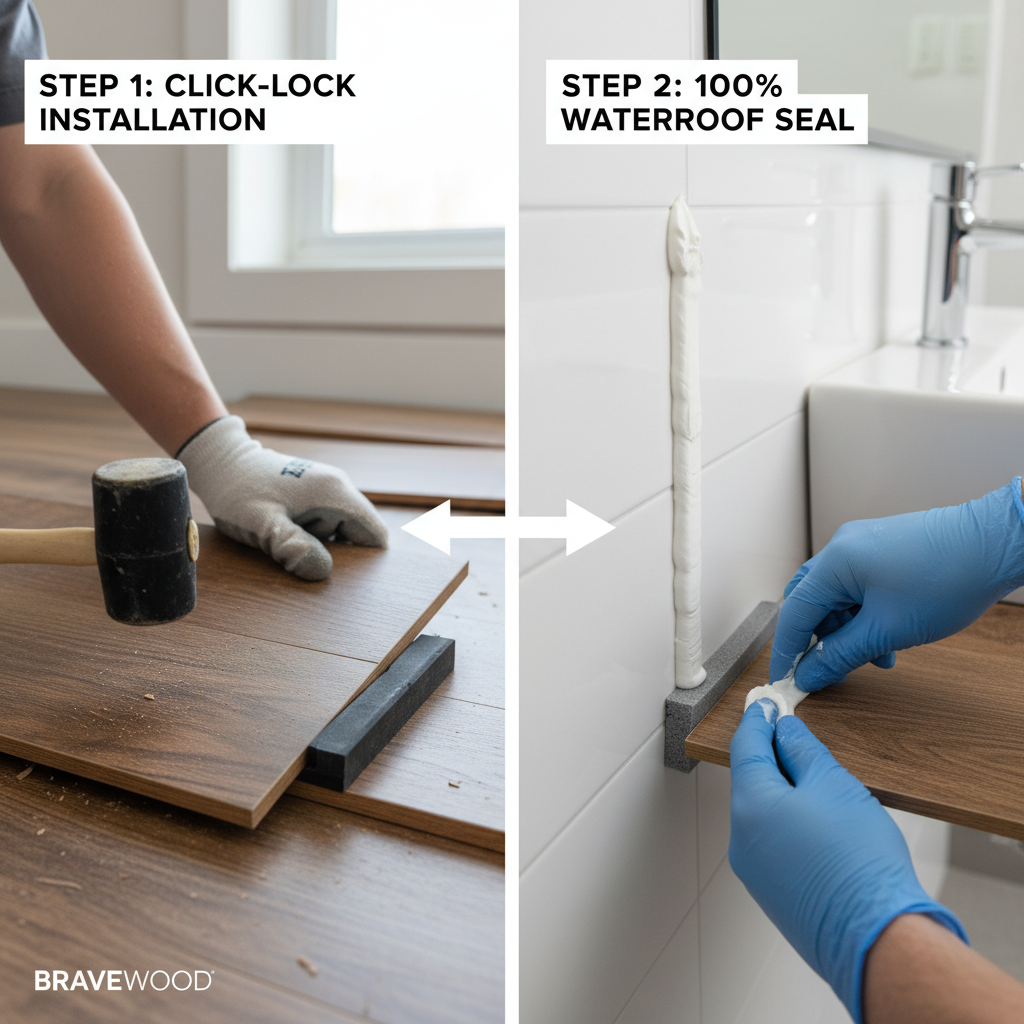
How do you seal the edges of waterproof hybrid flooring in wet zones? Industry best practices dictate a specific protocol for kitchens, bathrooms, and laundry rooms [17].
- Leave your 1/4 inch expansion gap.
- Insert a compressible PE (polyethylene) foam backer rod into the gap.
- What type of silicone is safe for hybrid wood expansion gaps? Fill the remaining space over the backer rod with 100% silicone sealant. Do not use acrylic caulk, as it will crack when the floor moves. The silicone bonds to the floor and the wall, creating a flexible, watertight gasket that still allows the floor to expand.
Long-Term Care and The 48-Hour Water Damage Triage
Can you use a steam mop on waterproof hybrid wood? No. The intense heat can force moisture vapor through the locking joints and delaminate the real wood veneer. Use a damp microfiber mop with a pH-neutral hardwood floor cleaner.
Even with waterproof flooring, plumbing disasters happen. What happens if water gets under waterproof hardwood? If a pipe bursts and floods the room, the water will find its way under the baseboards and beneath the floor.
Wood begins to cup and warp within 48 hours of significant moisture exposure [18]. This is your critical triage window.
How do you dry out hardwood floors after a leak? According to water damage restoration protocols [19], you must act immediately:
- Stop the source of the water.
- Extract standing water using a wet/dry vacuum.
- Remove the baseboards to expose the expansion gap.
- Set up commercial-grade dehumidifiers and high-velocity air movers directed at the floor and the exposed gaps to force dry air under the planks.
Can cupped hardwood floors be flattened without replacing them? If you catch it within the 48-hour window and aggressively dry the environment, hybrid wood can sometimes lay flat again once the moisture content returns to normal. However, if the subfloor is saturated, you may have to carefully unclick the floor, dry the subfloor completely, and reinstall the planks.
What are the signs of mold under water-damaged hardwood? Musty odors, unexplained allergy symptoms, or dark staining seeping up through the joints indicate subfloor mold. At this stage, the floor must be removed.
Does homeowners insurance cover hardwood water damage? Generally, yes, if the damage is sudden and accidental (like a burst pipe). It rarely covers gradual damage (like a slow, hidden refrigerator leak). Always document the damage with photos before beginning triage, and reference flood recovery guidelines for residential building materials when dealing with adjusters [20].
By understanding the mechanics of your materials, respecting the science of subfloor moisture, and taking your time with the click-lock installation, you can successfully lay Bravewood waterproof hybrid hardwood yourself. You will not only save thousands of dollars but also gain the immense satisfaction of transforming your home with your own two hands.
Download our free, pro-grade “Pre-Installation & Tool Checklist” to ensure you have everything you need before starting your Bravewood hybrid hardwood project, and share your completed room transformations in the comments below!
Disclaimer: This guide is for informational purposes. Always consult the specific manufacturer’s installation instructions to ensure warranty compliance. Working with power tools carries inherent risks; always use proper safety gear.
References
- Angi / HomeGuide. (N.D.). Average Costs of Professional Flooring Installation.
- Angi / HomeGuide. (N.D.). Labor Cost Estimates for Hardwood Flooring.
- Bona. (N.D.). Installation Methods: Glue-Down vs. Floating Floors.
- Floor Covering Weekly. (N.D.). Defining the Hybrid Flooring Category.
- Consumer Reports. (N.D.). Waterproof Flooring Durability and Standing Water Tests.
- Coretec. (N.D.). SPC Core Technology and Moisture Vapor Transmission.
- Family Handyman. (N.D.). Common DIY Flooring Failures and Subfloor Preparation.
- ASTM International. (N.D.). Standards for Moisture Testing in Concrete Substrates.
- NWFA (National Wood Flooring Association). (N.D.). Installation Guidelines: Concrete Subfloor Moisture Limits.
- NWFA (National Wood Flooring Association). (N.D.). Installation Guidelines for Wood Flooring.
- This Old House. (N.D.). DIY Floating Floor Installation Time Estimates.
- OSHA. (N.D.). Safety Guidelines for Using Chop Saws, Table Saws, and Pneumatic Tools.
- Unilin / Valinge. (N.D.). Engineering Baseline of Click-Lock Technology.
- JLC (Journal of Light Construction). (N.D.). Speed and Efficiency of Click-Lock Flooring Installation.
- ProTradeCraft. (N.D.). Precise Carpentry Standards: Undercutting Door Jambs and Room Transitions.
- Bravewood Manufacturer Guidelines. (N.D.). Technical Specifications and Expansion Gap Requirements.
- World Floor Covering Association (WFCA). (N.D.). Industry Best Practices for Hybrid Installations in Wet Zones.
- IICRC. (N.D.). Moisture Exposure and Wood Cupping Timelines.
- IICRC (Institute of Inspection, Cleaning and Restoration Certification). (N.D.). Water Damage Restoration Protocols.
- FEMA. (N.D.). Flood Recovery Guidelines for Residential Building Materials.
