
We live in an era of disposable decor, where the allure of immediate gratification often masks the reality of impending mechanical failure. For discerning homeowners and interior design enthusiasts, the “fast furniture” epidemic has become a source of profound frustration. The financial drain of constantly replacing sagging bookshelves, wobbly dining chairs, and peeling veneer tables is a cycle born from a fundamental disconnect between surface-level aesthetics and true structural integrity.
This article serves as an autopsy of failing mass-produced furniture and a definitive masterclass in the structural physics of master craftsmanship. By unmasking the hidden flaws of commercial manufacturing and revealing the meticulous techniques behind Bravewood craftsmanship, we will equip you with a proprietary “Buyer’s Grading Rubric.” This framework will empower you to identify true quality wood furniture, understand the science of durability, and ensure your next investment lasts a lifetime.
- The ‘Fast Furniture’ Epidemic: An Autopsy of Mass-Produced Problems
- The Anatomy of Structural Integrity: The Bravewood Craftsmanship Difference
- Material Science of Durability: Sourcing and Protecting Wood
- The Room-by-Room Durability Audit for the Home
- The Consumer Defense Framework: Your Quality Wood Furniture Grading Rubric
- Symptom-to-Cure: Diagnosing and Reinforcing Flimsy Furniture
- Conclusion
- References & Authoritative Sources
The ‘Fast Furniture’ Epidemic: An Autopsy of Mass-Produced Problems
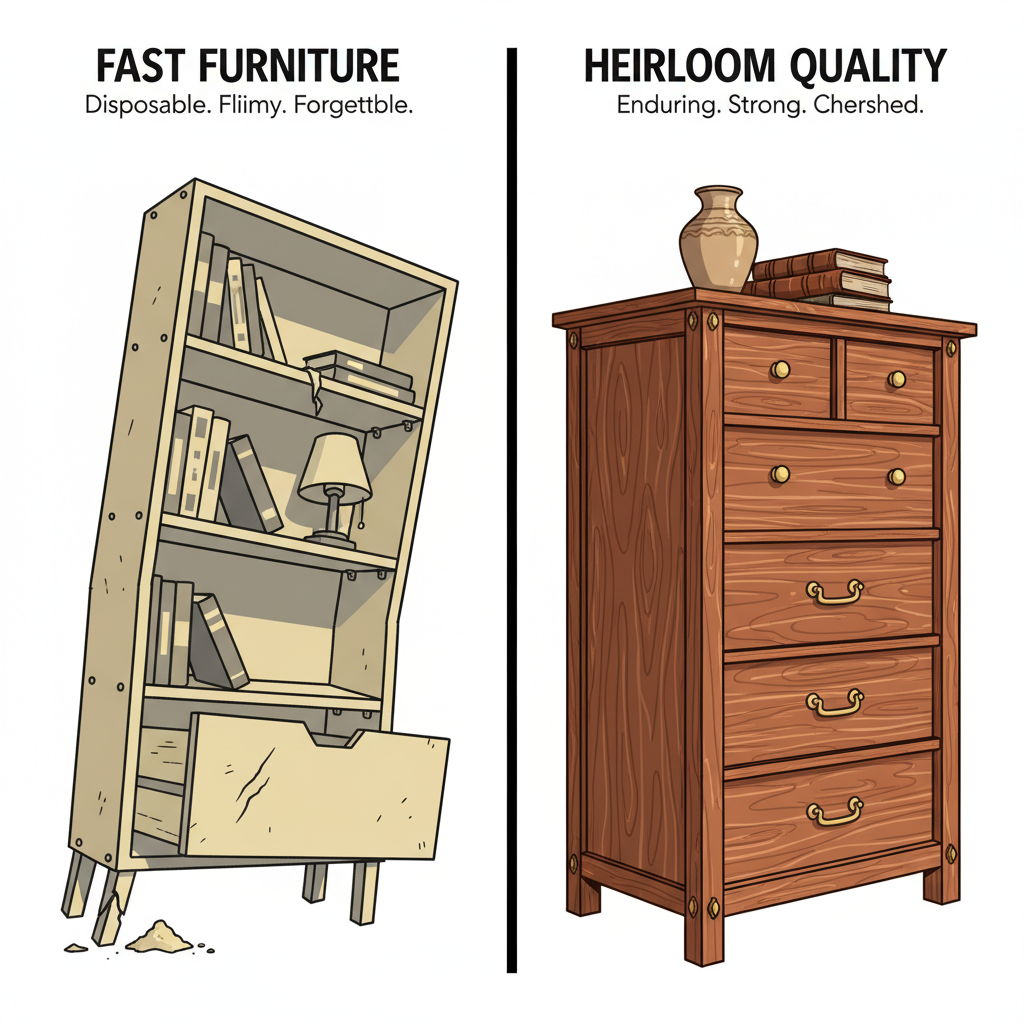
To appreciate exceptional craftsmanship, one must first diagnose the root causes of why modern, cheap furniture fails so predictably. The shift from heritage woodworking to rapid, assembly-line manufacturing has replaced structural physics with chemical adhesives and compressed wood dust.
The environmental and financial toll of this shift is staggering. According to data from the Environmental Protection Agency (EPA), Americans throw out over 12 million tons of furniture annually, with non-repairable particleboard pieces comprising over 80% of this waste [1]. Furthermore, mass-produced composite woods often rely on adhesives that emit volatile organic compounds (VOCs). The California Air Resources Board (CARB) has established strict guidelines to mitigate these emissions, yet the presence of formaldehyde in cheap furniture remains a significant indoor air quality concern [2]. When evaluating commercial durability standards, organizations like the Business and Institutional Furniture Manufacturers Association (BIFMA) highlight the stark contrast between pieces built for temporary utility and those engineered for longevity [3].
The Hidden Cost of Cheap Furniture: A 15-Year ROI Analysis
The initial price tag of fast furniture is deceptive. When we conduct a 15-year Return on Investment (ROI) analysis, the financial argument for heirloom quality becomes undeniable. Consumer data indicates that furniture that lacks durability—primarily utilizing low-density fiberboard and stapled joints—requires replacement three to four times more frequently than solid wood equivalents [4].
Consider the purchase of a mass-produced sofa frame versus a high-durability, bench-made alternative. Over 15 years, replacing a failing, $600 sofa four times results in a $2,400 expenditure, not including the time, delivery fees, and landfill impact. A single, $2,000 investment in a solid hardwood frame utilizing traditional joinery yields a lower total cost of ownership, zero replacement hassle, and an asset that can be passed down to the next generation. Quality is not a luxury expense; it is a calculated economic investment.
Mechanical Failures: Why MDF and Cam-Locks Can’t Last
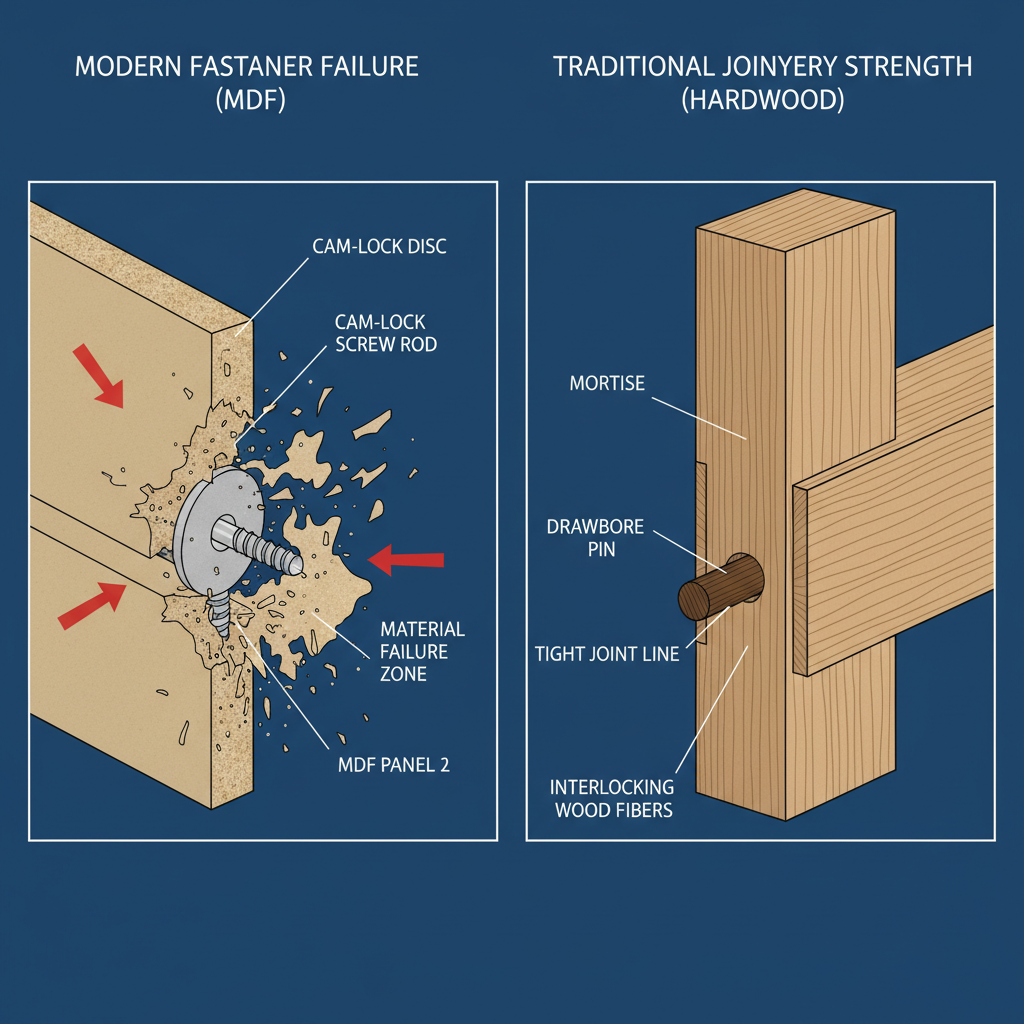
The most common mass produced furniture problems stem from a fundamental misunderstanding of material stress. Medium-Density Fiberboard (MDF) and particleboard lack the continuous longitudinal grain that gives natural wood its tensile strength. When manufacturers use cam-lock fasteners to join two pieces of MDF, they are relying on a small piece of metal gripping into compressed dust.
Under the stress of daily use—such as someone leaning back in a chair or a bookshelf bearing the weight of hardcovers—these joints experience shear force. Because MDF has no internal grain structure to distribute this stress, the cam-lock simply tears out, leaving a jagged, unrepairable hole. The American Society of Furniture Designers (ASFD) frequently points to these specific design flaws as the primary culprits that compromise durability in the modern market [5].
The Anatomy of Structural Integrity: The Bravewood Craftsmanship Difference
Contrasting the inevitable failure of fast furniture is the “invisible integrity” of heritage woodworking. Why integrity in building matters is not just a philosophical question; it is an engineering reality. Exceptional quality furniture building relies on techniques that actively work with the natural properties of wood, rather than fighting against them.
The Structural Engineering Institute (SEI) outlines core principles of load-bearing and stress distribution that apply directly to furniture construction [6]. True craftsmanship distributes weight seamlessly through interlocking wood fibers, eliminating the need for metal fasteners that act as stress concentrators. Fine Woodworking Magazine, a premier authority on advanced woodworking techniques, consistently highlights that the hallmark of a master build is what happens inside the joint over decades of use [7].
This is the essence of Bravewood craftsmanship. As a master craftsman at Bravewood notes, “Our goal is to build pieces where the joinery itself is stronger than the wood surrounding it. We aren’t just assembling parts; we are engineering a unified structure designed to absorb and distribute the forces of daily life for a century or more” [8].
Engineering Longevity: High Integrity Craftsmanship Techniques
At the heart of this durability are high integrity craftsmanship techniques. Consider the drawbored mortise and tenon. Instead of relying solely on glue, a craftsman cuts a mortise (a hole) and a tenon (a projecting pin), but drills the peg hole slightly off-center between the two pieces. When a hardwood peg is driven through, it mechanically pulls the joint perfectly tight, creating a permanent, mechanical lock that resists tensile stress indefinitely.
Similarly, half-blind dovetails used in drawer construction utilize a trapezoidal shape that makes it physically impossible for the drawer front to pull away from the sides, regardless of how much weight is inside. Seminal texts, such as Tage Frid Teaches Woodworking, emphasize that these foundational, high-integrity joinery methods are non-negotiable for heirloom longevity [9]. If one were to examine these joints under macro-photography, they would see the meticulous orientation of the wood grain, ensuring that seasonal expansion and contraction never compromise the structural lock.
The Masterclass Approach: Wood Acclimatization and Precision Milling
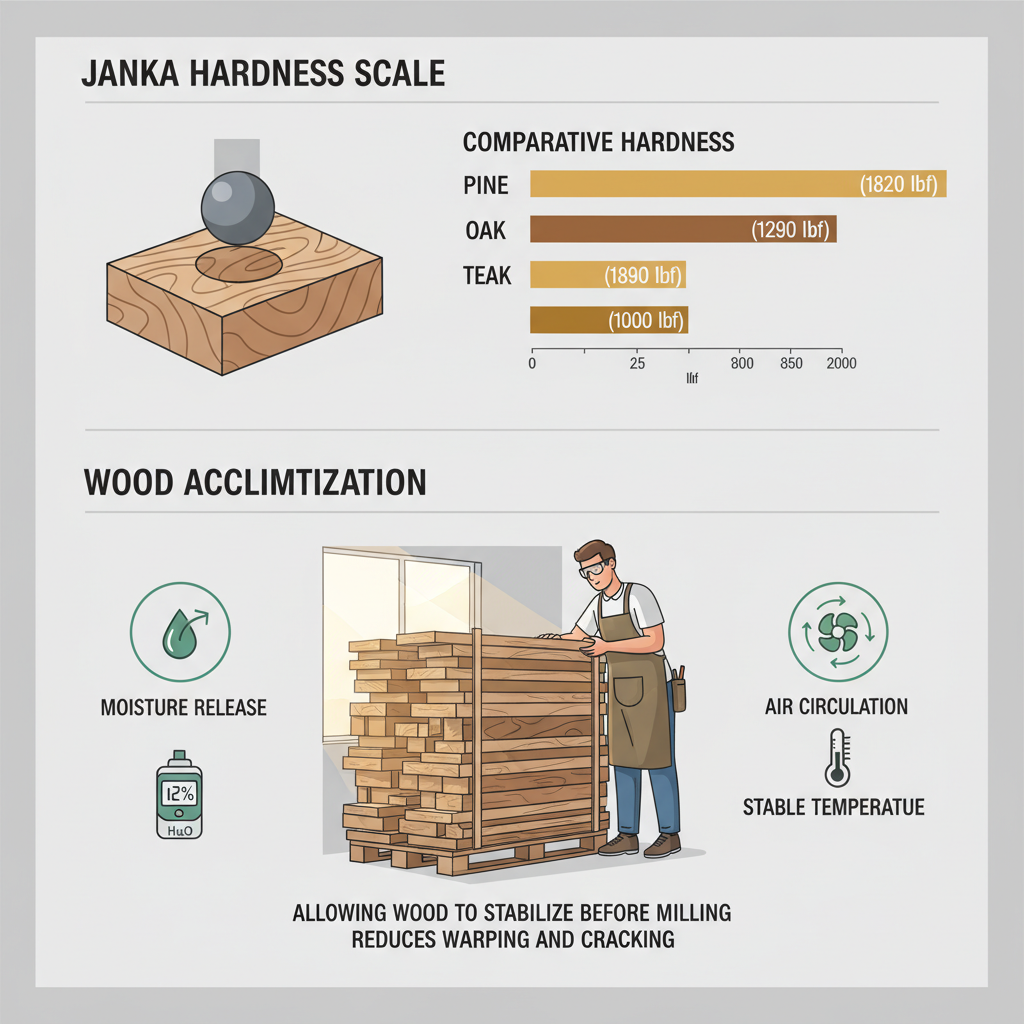
Exceptional quality furniture building begins long before a saw touches the wood. A critical, often-overlooked step is the acclimatization and precision milling of the lumber. The North Bennet Street School, a premier institution for traditional furniture making education, teaches that wood is a hygroscopic material—it constantly absorbs and releases moisture [10].
If wood is milled to its final dimensions immediately, the release of internal tension will cause it to warp, cup, or twist. Master builders rough-mill the lumber and let it rest, allowing the wood cell structure to stabilize. The Center for Wood Anatomy Research confirms that understanding how wood cell structure dictates building integrity is essential; ignoring this science guarantees a compromised build, no matter how beautiful the finish [11].
Material Science of Durability: Sourcing and Protecting Wood
Understanding the raw materials and chemical finishes that make wood products truly durable bridges the gap between natural botanical properties and modern protective solutions. The USDA Forest Service Wood Handbook serves as the definitive scientific authority on wood properties, detailing how different species react to environmental stressors [12].
Ethical sourcing is also a pillar of lasting quality. The Forest Stewardship Council (FSC) provides certifications ensuring that sustainable and durable forestry products are harvested in ways that protect old-growth forests while providing craftsmen with superior, slow-grown lumber [13].
Decoding the Janka Hardness Scale for Furniture
When selecting durable wood products, the Janka hardness scale is an indispensable tool. This scale measures the resistance of a sample of wood to denting and wear, specifically by measuring the force required to embed a steel ball halfway into the wood.
Data from the Journal of Wood Science on wood mechanics and durability indicates that hardwoods like Teak and White Oak (with high Janka ratings) show a 40% higher resistance to environmental degradation over a 20-year period compared to treated softwoods [14]. For a dining table that will see decades of cutlery, homework, and heavy use, selecting a wood with a high Janka rating is the first line of defense against premature aging.
Advanced Protective Finishes: Beyond Traditional Waxes
While the wood itself provides the structural foundation, the finish dictates the surface lifespan. Traditional waxes and oils offer a beautiful, natural luster, but they require constant maintenance and offer minimal protection against heat, water, and scratching.
For true durable wood furniture solutions, modern chemistry offers incredible advancements. The Forest Products Laboratory (FPL), which conducts definitive scientific research on wood preservation, highlights the efficacy of cross-linking finishes [15]. According to Flexner on Finishing, the authoritative source on applying durable wood finishes, applying a catalyzed conversion varnish or a high-grade polyurethane can increase the surface durability and scratch resistance of wood furniture by up to 300% compared to traditional waxes [16]. These advanced finishes create a microscopic plasticized shell that moves with the wood while repelling daily hazards.
The Room-by-Room Durability Audit for the Home
To maximize the lifespan of your investments, you must pair the right material with the right micro-environment. This “Material and Method Matrix” is essential for selecting durable wood products for the home.
High-Traffic Zones: Kitchens and Living Rooms
Kitchens and living rooms are the proving grounds for furniture. The National Wood Flooring Association (NWFA), an authority on durable wood applications in high-traffic environments, notes that using hardwoods with a Janka rating above 1300 (such as Hickory or White Oak) reduces the incidence of visible denting from daily wear by up to 60% [17].
For a kitchen island or a living room coffee table, you need a high-Janka wood paired with a catalyzed conversion varnish to resist spills, pet claws, and the impact of dropped items. Consumer Reports, a trusted source for unbiased durability testing of home products, consistently finds that solid hardwoods treated with modern, high-performance finishes vastly outlast veneered alternatives in these high-traffic zones [18].
The Consumer Defense Framework: Your Quality Wood Furniture Grading Rubric
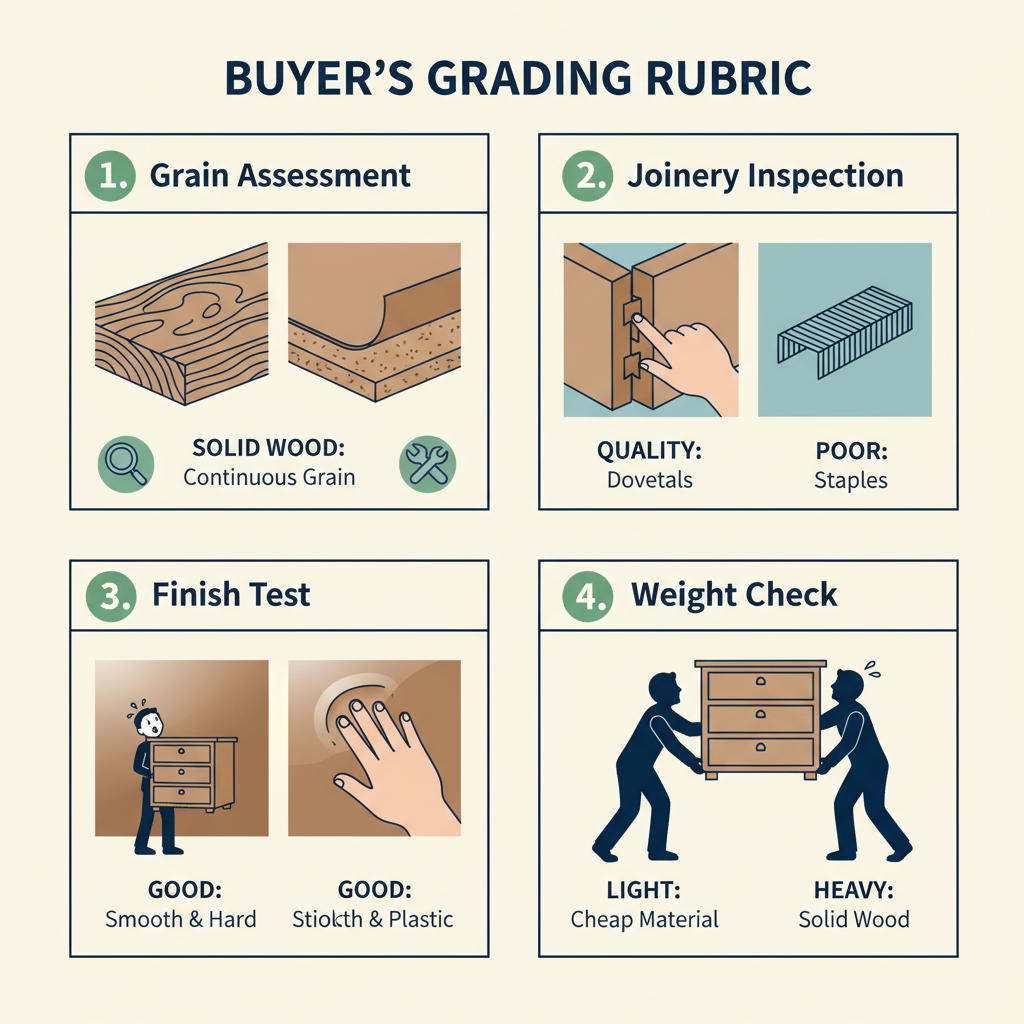
Armed with the science of craftsmanship, you can now navigate showrooms with confidence. Use this proprietary grading rubric to evaluate quality wood furniture:
- The Grain Assessment: Look at the edges of the table or dresser. Does the grain wrap continuously around the edge, or is there a visible seam indicating a thin veneer glued over MDF? Solid wood is paramount.
- The Joinery Inspection: Pull out a drawer. Do you see interlocking dovetails, or are the sides stapled and glued together? Look underneath tables for wooden corner blocks rather than metal brackets.
- The Finish Test: The finish should feel smooth and hard, not sticky or overly plastic. It should enhance the depth of the grain, not obscure it.
- The Weight Check: Solid hardwood is dense and heavy. If a large dresser feels suspiciously light, it is likely hollow-core or low-density particleboard. Architectural Digest frequently cites these tangible benchmarks—weight, joinery, and material density—as the true indicators of high-end market value and longevity [19].
Vetting Exceptional Quality Wood Furniture Builders
If you are commissioning a bespoke piece, vetting exceptional quality wood furniture builders requires looking beyond their Instagram portfolio. Ask about their milling process, their preferred joinery for load-bearing joints, and their warranty on craftsmanship. Authoritative bodies like the American Craft Council [20] and the Guild of Master Craftsmen [21] are excellent resources for finding artisans who adhere to exceptional, vetted building standards.
Symptom-to-Cure: Diagnosing and Reinforcing Flimsy Furniture
For readers currently battling flimsy wood furniture issues, understanding the mechanics of failure can help you execute permanent structural fixes.
- The Wobble (Racking): If a chair or table sways side-to-side, it is suffering from “racking.” This means the shear strength of the joints has failed. Temporary fixes like tightening screws won’t last. According to resources like Family Handyman [22] and Woodworker’s Journal [23], the permanent cure is to install glued-and-screwed wooden corner blocks at a 45-degree angle inside the frame to brace the legs against the apron, restoring shear strength.
- The Sag: A bookshelf bowing in the middle lacks tensile support. The cure is to attach a solid wood cleat along the back edge of the shelf or to replace the flimsy cardboard backing of the bookcase with a structural piece of 1/4-inch plywood, glued and nailed into the frame to prevent the entire unit from shifting.
Conclusion
True quality in wood furniture is not merely a matter of visible aesthetics; it is defined by invisible structural integrity. The “fast furniture” epidemic thrives on the illusion of quality, masking particleboard and cam-locks behind thin veneers. By applying the “Buyer’s Grading Rubric” and understanding the rigorous, physics-based techniques that define Bravewood craftsmanship—from wood acclimatization to drawbored joinery and advanced finishes—you can protect yourself from the financial drain of disposable decor. We encourage you to apply this diagnostic framework to your next furniture purchase and explore Bravewood’s portfolio to witness high-integrity, heirloom craftsmanship in action.
Disclaimer: The ‘Symptom-to-Cure’ repair section is for informational purposes. Please use caution and proper safety equipment when attempting structural furniture reinforcements or DIY repairs.
References & Authoritative Sources
- Environmental Protection Agency (EPA). (N.D.). Furniture and Furnishings: Material-Specific Data. Retrieved from EPA data on furniture waste and landfill impact.
- California Air Resources Board (CARB). (N.D.). Composite Wood Products ATCM. Retrieved from CARB guidelines on formaldehyde and VOC emissions.
- Business and Institutional Furniture Manufacturers Association (BIFMA). (N.D.). Commercial Durability Standards and Testing.
- Consumer Data / Industry Analytics. (N.D.). Lifecycle Analysis of Mass-Produced vs. Solid Wood Furniture.
- American Society of Furniture Designers (ASFD). (N.D.). Insights into Design Flaws and Compromised Durability.
- Structural Engineering Institute (SEI). (N.D.). Baseline Principles for Structural Integrity and Load-Bearing.
- Fine Woodworking Magazine. (N.D.). Authority on Advanced Woodworking Techniques and Craftsmanship Standards.
- Bravewood Craftsmanship. (N.D.). Behind the Bench: Master Craftsman Interview.
- Frid, Tage. (N.D.). Tage Frid Teaches Woodworking. Taunton Press.
- North Bennet Street School. (N.D.). Curriculum Standards for Traditional Furniture Making Education.
- The Center for Wood Anatomy Research. (N.D.). Wood Cell Structure and Building Integrity.
- USDA Forest Service. (N.D.). Wood Handbook: Wood as an Engineering Material.
- Forest Stewardship Council (FSC). (N.D.). Standards for Sustainable and Durable Forestry Products.
- Journal of Wood Science. (N.D.). Peer-reviewed data on wood mechanics, durability, and environmental degradation resistance.
- Forest Products Laboratory (FPL). (N.D.). Scientific Research on Wood Preservation and Durable Solutions.
- Flexner, Bob. (N.D.). Understanding Wood Finishes: How to Select and Apply the Right Finish.
- National Wood Flooring Association (NWFA). (N.D.). Durable Wood Applications and Janka Hardness in High-Traffic Environments.
- Consumer Reports. (N.D.). Unbiased Durability Testing of Home Products and Furniture.
- Architectural Digest. (N.D.). High-End Market Trends and Furniture Quality Benchmarks.
- American Craft Council. (N.D.). Recognizing Exceptional Artisans and Builders.
- Guild of Master Craftsmen. (N.D.). International Authority on Vetting Exceptional Building Standards.
- Family Handyman. (N.D.). Expert DIY Repairs and Structural Fixes Around the Home.
- Woodworker’s Journal. (N.D.). Joint Failure and Structural Reinforcement Techniques.
