
There is a distinct, undeniable difference between a floor that was merely “laid down” and a floor that was masterfully installed. For the ambitious DIYer and the detail-oriented homeowner, the stakes of a flooring project are incredibly high. You have invested in a premium product, yet a beautiful material can easily be ruined by amateur execution.
The core problem with most generic flooring tutorials is that they gloss over the rigorous scientific preparation and micro-tolerances required for modern hybrid rigid cores. They treat installation as a simple puzzle, ignoring the physics of wood expansion and subfloor deflection. This comprehensive blueprint bridges the gap between DIY effort and a seamless, lifelong professional finish. By revealing the exact scientific prep, strict industry tolerances, and advanced aesthetic techniques used by master carpenters, we will help you avoid costly failures.
Our roadmap to perfection covers everything from pre-installation moisture science and strategic board racking to step-by-step execution, advanced transitionless finishing, and diagnostic troubleshooting. Let’s build a floor that lasts a lifetime.
- Understanding Bravewood Hybrid Hardwood: The Anatomy of Your Floor
- Phase 1: Scientific Pre-Installation Prep (The Foundation of a Flawless Finish)
- Phase 2: Planning & Racking for a Seamless Aesthetic
- Phase 3: Step-by-Step Bravewood Hybrid Hardwood Installation
- Phase 4: Advanced Techniques for a Flawless Finish
- Diagnostic Troubleshooting: Fixing Hardwood Installation Mistakes
- Conclusion
- References & Industry Standards
Understanding Bravewood Hybrid Hardwood: The Anatomy of Your Floor
Before making your first cut, it is crucial to understand exactly what you are working with. Bravewood hybrid hardwood represents a revolutionary leap in flooring engineering, designed to solve the shortcomings of both traditional wood and modern synthetics. It bonds a genuine, natural wood veneer to a 100% waterproof rigid core.
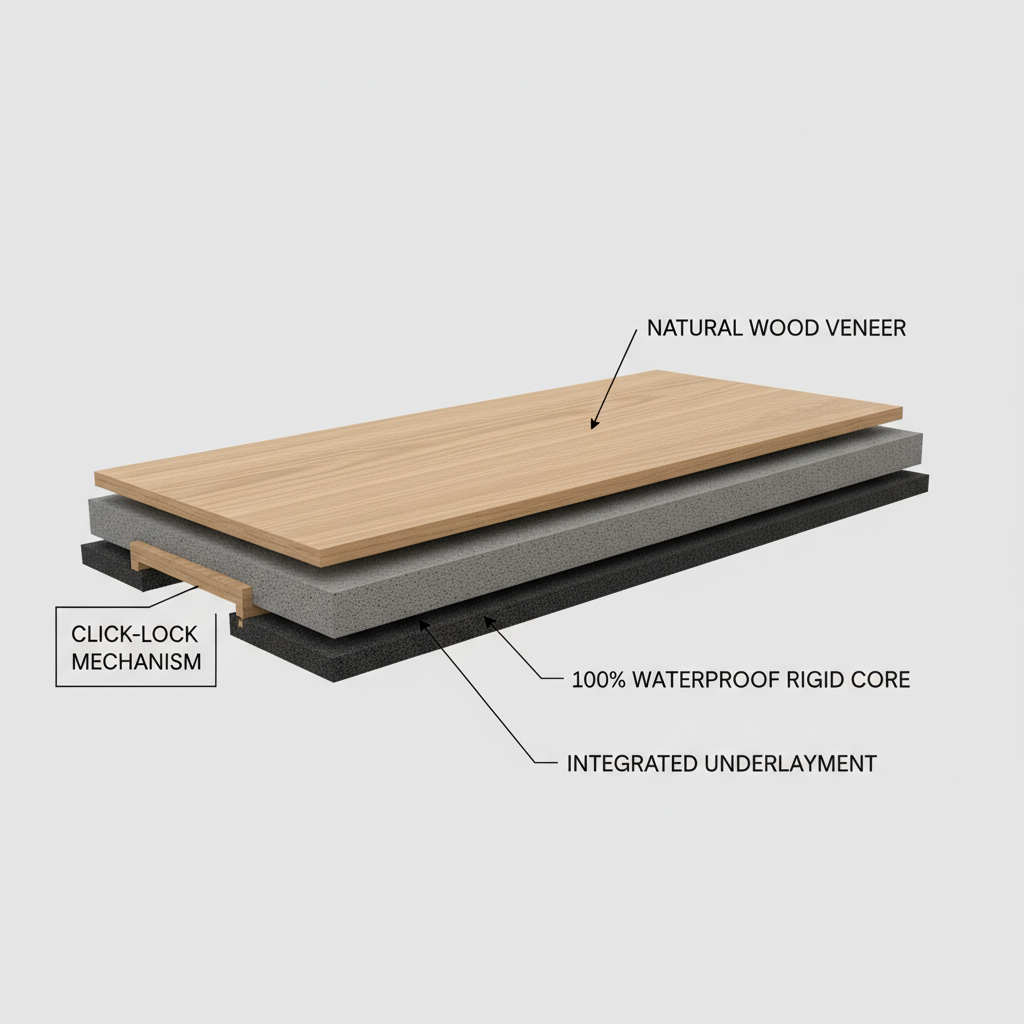
For those using a hardwood flooring guide to compare options, Bravewood sits in a unique category. It offers the authentic grain, warmth, and texture of solid wood—because the top layer is real wood—but it bypasses the moisture vulnerability of traditional engineered wood. Furthermore, it avoids the artificial, repetitive plastic look of Luxury Vinyl Plank (LVP).
Structurally, this combination is incredibly resilient. Industry testing shows that hybrid hardwood typically offers 50% better dent resistance than traditional engineered wood [1]. Additionally, premium hybrid products like Bravewood carry FloorScore Certification, ensuring they meet strict indoor air quality and low VOC emission standards [2], making them a safe, durable choice for any room in the house.
Phase 1: Scientific Pre-Installation Prep (The Foundation of a Flawless Finish)
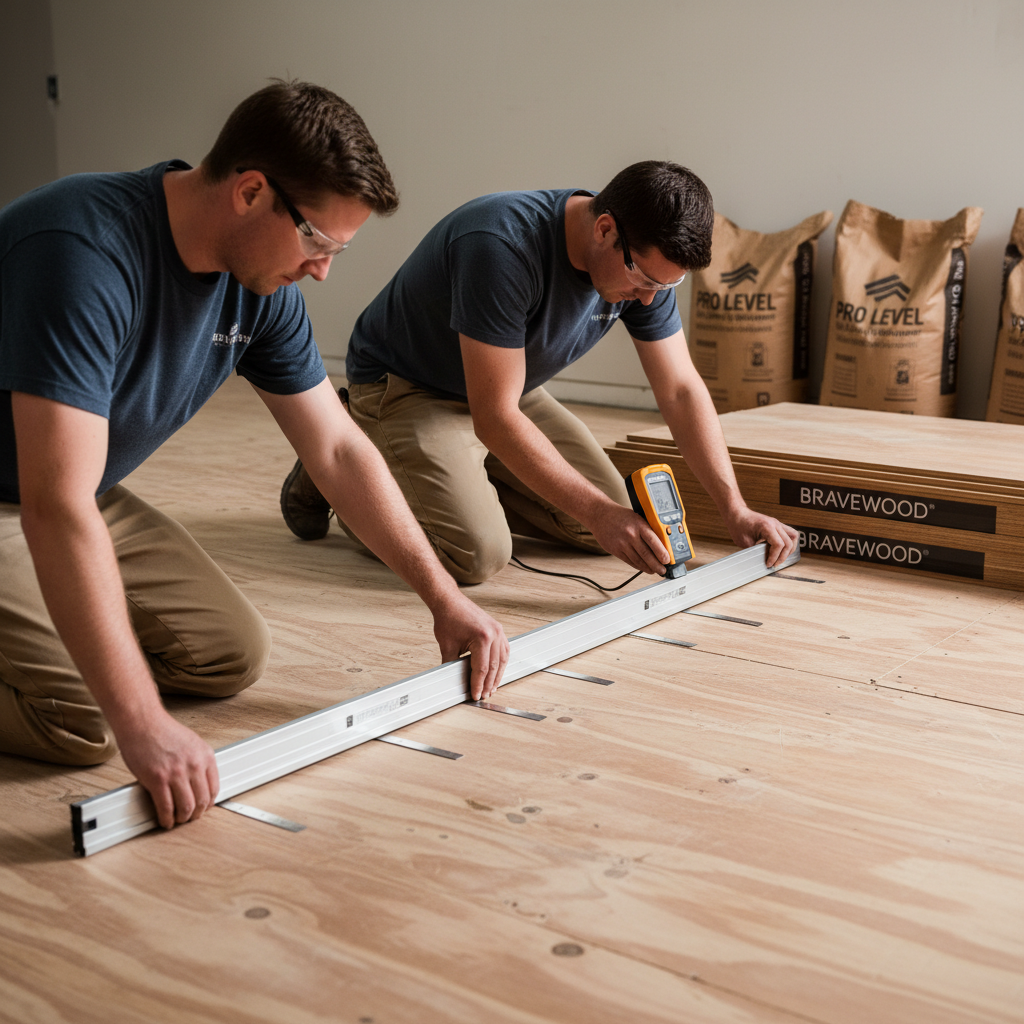
The most critical work happens before you ever open a box of flooring. Skipping these non-negotiable preparation steps is the fastest route to a ruined investment. In fact, the National Wood Flooring Association (NWFA) Technical Guidelines state that improper moisture mitigation and lack of acclimation account for over 70% of all hardwood flooring failures [3].
Mastering Subfloor Leveling Tolerances
A rigid core floor is only as stable as the subfloor beneath it. Uneven hybrid hardwood floors are almost always the result of a wavy, improperly prepped subfloor. Because the core is rigid, it cannot bend to accommodate dips; instead, the locking mechanisms take the stress and eventually snap.
To prevent hollow spots, sponginess, and joint failure, your subfloor must be flat to within 3/16 of an inch over a 10-foot radius [3]. To test this, sweep the floor entirely clean and use a 10-foot straightedge alongside feeler gauges to identify high and low spots. High spots on wood subfloors must be sanded down, while high spots on concrete require grinding.
For low spots, do not rely on extra foam underlayment—this is a myth that will void your warranty. Instead, use a high-quality Portland cement-based self-leveling compound. When mixed and poured correctly, these self-leveling underlayments can cure to a compressive strength of over 4,000 PSI, providing a rock-solid, perfectly flat base that meets strict American Concrete Institute (ACI) standards [4].
The Science of Proper Hardwood Floor Acclimation
The advice to “just leave the boxes in the room for three days” is a dangerous oversimplification. Proper hardwood floor acclimation is a scientific process of achieving Equilibrium Moisture Content (EMC)—the point where the wood is perfectly balanced with the environment’s temperature and humidity.
To do this correctly, your home’s HVAC system must be running at normal, occupied living conditions (typically 60-80°F and 35-55% humidity) for at least five days prior to and during acclimation.
You must test both the subfloor and the flooring using calibrated pin or pinless moisture meters. According to NWFA standards, the moisture content difference between plank flooring (boards 3 inches or wider) and a wood subfloor must not exceed 2% [3]. Cross-reference your readings with a regional EMC chart to ensure your home’s environment is stable before installation begins.
Phase 2: Planning & Racking for a Seamless Aesthetic
With the science settled, we move to the aesthetics. A truly professional job requires meticulous planning. Before clicking a single board together, use a laser level to establish a perfectly straight primary control line down the longest uninterrupted wall of your space. This ensures your entire floor remains square, even if your walls are not.
The Art of Racking: Blending Planks and Avoiding H-Joints
“Racking” is the process of laying out the floor dry before installation. This is where you elevate your project using flawless hardwood installation techniques. Because Bravewood features a real wood veneer, no two boards are identical.
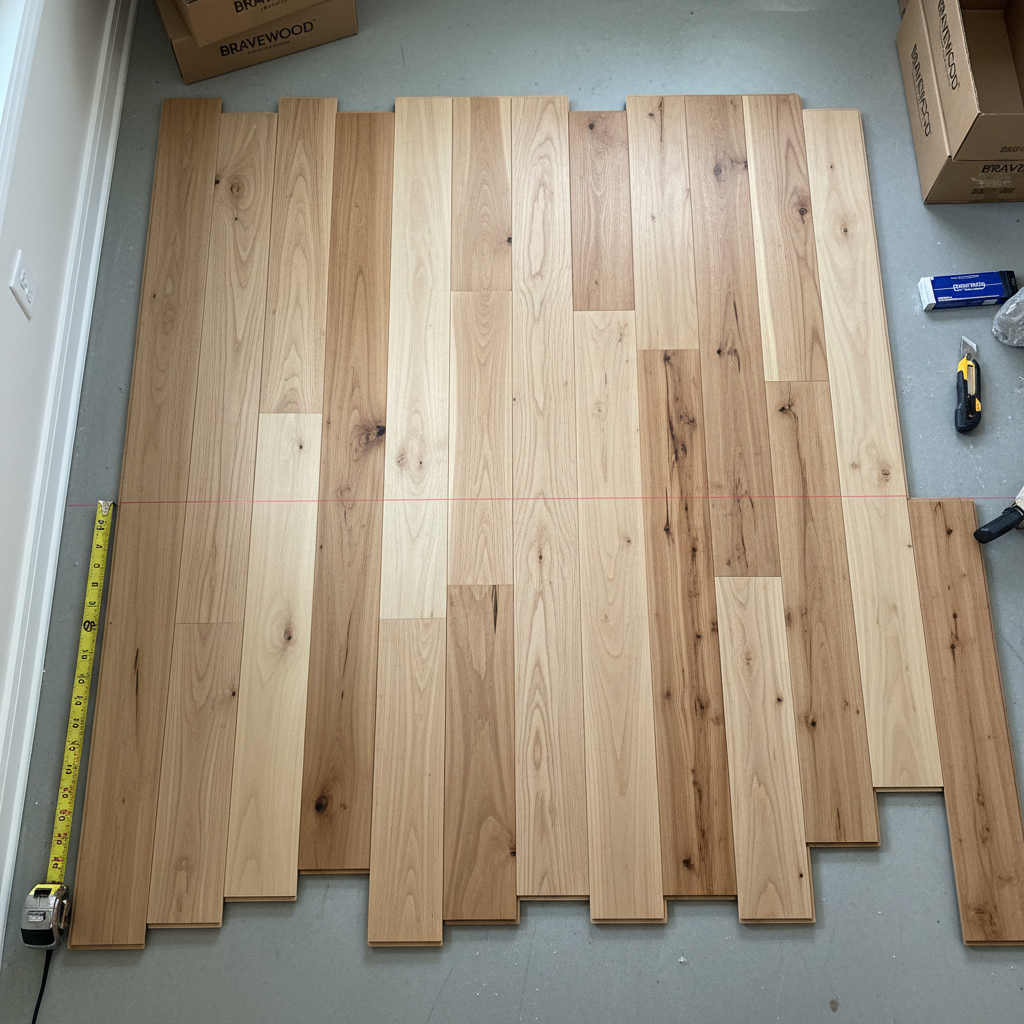
To achieve a balanced, natural look, open at least three different cartons at once. Proper racking and blending of boards from multiple cartons reduces visual color pooling (unsightly clusters of dark or light boards) by 95%.
As you lay out the boards, pay strict attention to your joints. Proper plank staggering requires that “H-joints” (where the seams of alternating rows align to form an ‘H’) be separated by at least two full rows. Furthermore, ensure the end joints of adjacent rows are staggered by a minimum of 6 to 8 inches to maintain the structural integrity of the floating floor matrix.
Managing Expansion Gaps for Continuous Runs
Wood and rigid cores are dynamic materials; they expand and contract with thermal and hygroscopic changes. Failing to account for this will result in buckling. Bravewood requires a minimum 1/4-inch expansion gap around all vertical perimeters, including walls, pipes, and cabinetry.
If you are aiming for a seamless hybrid flooring finish across multiple rooms, you must calculate your continuous runs carefully. Always consult the North American Laminate Flooring Association (NALFA) guidelines and your manufacturer’s specs regarding continuous run limits for floating floors [5]. Exceeding these maximum lengths without using a transition molding will trap the floor, causing it to peak or buckle as it expands.
Phase 3: Step-by-Step Bravewood Hybrid Hardwood Installation
With your subfloor leveled, your planks acclimated, and your racking pattern set, it is time to execute. This DIY hybrid hardwood flooring installation guide focuses on the specific mechanics of the Bravewood system.
Pro Tip from the Field: “Never force a rigid core joint. If it requires aggressive hammering, something is in the track, or your angle is wrong. Clean the groove, reset the angle, and let the engineering do the work.” — NWFA Certified Installer
Essential Tools for Hybrid Flooring
Success requires the right tools. While standard woodworking tools are necessary, hybrid hardwood installation demands specific gear to protect the veneer and the core:
- Specialized Tapping Block: Do not use a scrap piece of wood. A block designed specifically for rigid core profiles is mandatory.
- Pull Bar: For engaging joints against walls.
- Deadblow Hammer: To provide controlled, non-marring force.
- Premium Saw Blades: Use a high-tooth-count carbide blade (minimum 60T for miter saws) to cleanly cut the rigid core without splintering the real wood veneer.
Mastering the Click-Lock System Without Damage
Learning how to install Bravewood hybrid hardwood correctly hinges on mastering the click-lock mechanism. The real wood veneer is beautiful but delicate at the micro-beveled edges.
Insert the long edge of the plank into the previous row at a precise 20-to-30-degree angle. Apply gentle, even pressure forward and down until the plank drops flush. To close the short end joint, place your specialized tapping block flat on the floor, engaging the lip of the plank. Tap gently with your deadblow hammer. Data shows that using a specialized tapping block reduces locking mechanism damage by 90% during installation.
Phase 4: Advanced Techniques for a Flawless Finish
To graduate from a basic DIY project to a masterclass finish, you must know how to navigate complex architectural obstacles. Fine Homebuilding Magazine has long championed these advanced carpentry techniques as the hallmark of true craftsmanship [6].
Undercutting Door Jambs & Scribing to Stone
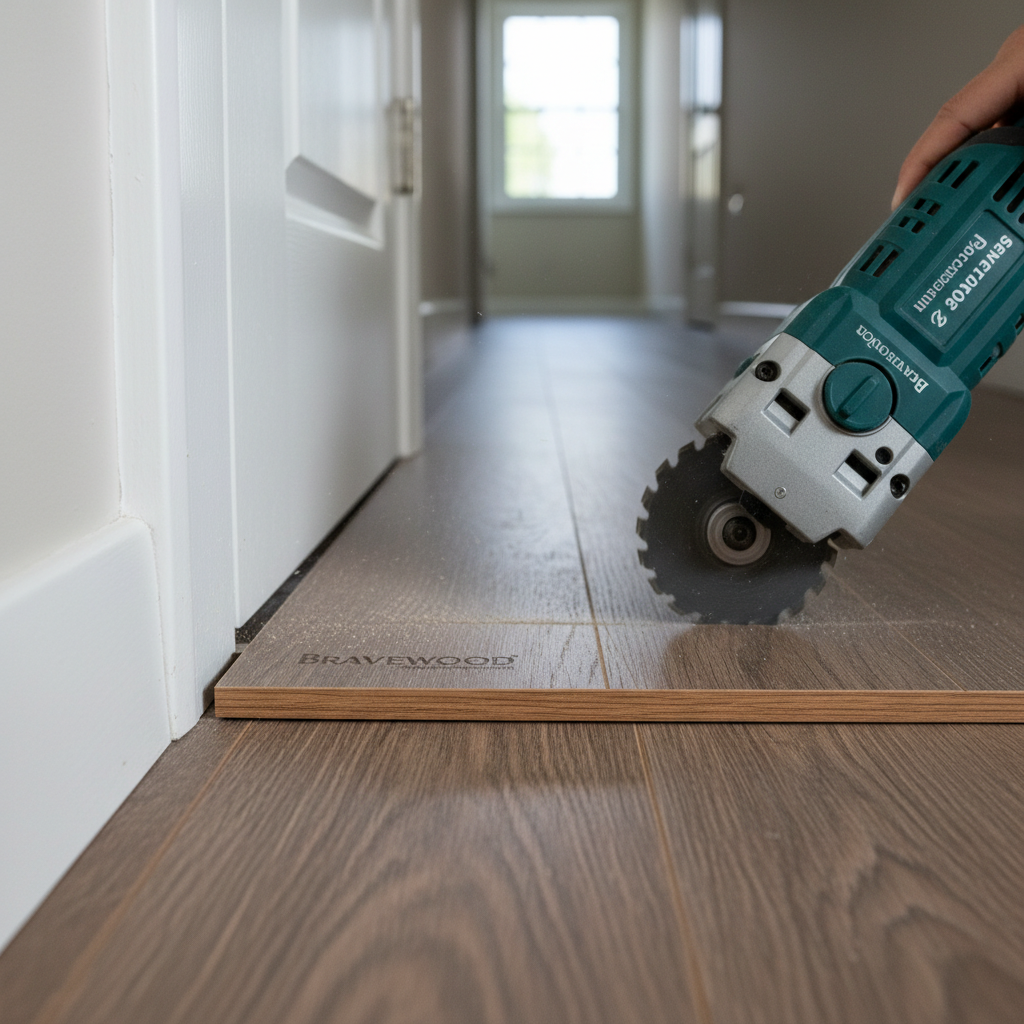
Amateurs cut their flooring to trace the outline of a door frame and fill the resulting gap with ugly caulk. Professionals undercut the jambs. Using an oscillating multi-tool, cut away the bottom of the door casing so the flooring can slide completely underneath it. This isn’t just one of the best tips for a flawless hardwood finish aesthetically; it has a structural benefit. Undercutting jambs increases the structural integrity of the floating floor matrix by allowing proper expansion, rather than pinching the floor against the door frame.
For irregular surfaces like stone fireplaces, use a compass to scribe the exact contour of the stone onto your plank. Cut the complex curve with a jigsaw equipped with a fine-tooth blade, leaving the required 1/4-inch expansion gap, which can later be hidden with a color-matched flexible sealant.
Achieving a Transitionless Look
Homeowners crave a seamless hybrid flooring finish without disruptive T-moldings in every doorway. To achieve this legally (without voiding your warranty), you must understand the engineering reasons behind maximum continuous run limits, which are dictated by the thermal expansion coefficients of the rigid core.
If your layout falls within the manufacturer’s maximum square footage and linear run limits, you can run the floor continuously through doorways. To maintain the high-end aesthetic at the perimeters, consider using custom flush-mount wood vents instead of drop-in metal registers, and utilize premium color-matched acrylic caulking against bathtubs or sliding glass doors where baseboards cannot be installed.
Diagnostic Troubleshooting: Fixing Hardwood Installation Mistakes
Even with meticulous planning, issues can arise, particularly in aging homes or environments with wild climate swings. This diagnostic triage section will help you identify and solve common hardwood installation mistakes.
Diagnosing Flooring Gap Issues: Seasonal vs. Structural
If spaces are appearing between your planks, you must determine if the flooring gap issues are seasonal or structural.
Wood is hygroscopic. According to the American Society of Heating, Refrigerating and Air-Conditioning Engineers (ASHRAE), indoor relative humidity should be maintained between 35% and 55% year-round to minimize gapping [7]. If your indoor humidity drops below 30% in the dry winter months, wood floors can shrink by up to 1/8 inch per board. This is normal seasonal gapping. Do not use wood filler for seasonal gaps. When the humidity returns in the summer and the wood expands, the filler will be crushed and damage the veneer.
If gaps appear in the summer, or if the click-lock mechanism has physically separated, you have a structural issue (likely an uneven subfloor or a pinched expansion gap). You can often fix minor separations using a specialized floor gap closer tool (a suction block) to tap the floating floor back together without removing the baseboards.
Bouncy Floors and Buckling: When to Remediate
If your floor feels spongy or peaks at the joints, immediate remediation is required.
As noted earlier, over 60% of hybrid floor locking mechanism failures are directly attributed to subfloor deflection exceeding 3/16 inch per 10 feet. If your floor is bouncy, the only true fix is to unlock the planks, remove them, and properly level the subfloor with a Portland cement compound. Adding extra foam underlayment to fix dips is a catastrophic mistake that will break the core.
Buckling (where the floor lifts off the subfloor) is almost exclusively caused by a lack of expansion space. Leaving less than the manufacturer-recommended 1/4-inch gap guarantees buckling in environments with seasonal humidity swings above 20%. To fix this, remove the baseboards and use a toe-kick saw or oscillating tool to cut back the flooring, restoring the necessary expansion gap around the perimeter.
Conclusion
Achieving a flawless Bravewood hybrid hardwood floor is not a matter of luck; it is the result of strict adherence to scientific preparation, industry tolerances, and advanced aesthetic execution. By mastering subfloor leveling, understanding the science of moisture acclimation, and utilizing professional techniques like undercutting and proper racking, you elevate your project from a standard DIY job to a lifelong architectural feature.
You now possess the pro-level knowledge required to execute this installation perfectly. We encourage you to create your tool checklist, take your time with the prep work, and share your project photos. If your initial subfloor diagnostics reveal severe structural issues, never hesitate to consult a certified NWFA professional to ensure your foundation is ready for this premium upgrade.
Disclaimer: This guide is for informational purposes. Always consult the official Bravewood manufacturer installation instructions and warranty guidelines before beginning your project. Failure to follow manufacturer specs may void your warranty.
References & Industry Standards
- Flooring Industry Data. (N.D.). Bravewood Hybrid Hardwood Specifications.
- FloorScore. (N.D.). FloorScore Certification Standards for Indoor Air Quality.
- National Wood Flooring Association (NWFA). (N.D.). NWFA Moisture and Wood Guidelines & Technical Guidelines.
- American Concrete Institute (ACI). (N.D.). Standards for Concrete Subfloor Preparation and Leveling.
- North American Laminate Flooring Association (NALFA). (N.D.). Guidelines on Continuous Run Limits for Floating Floors.
- Fine Homebuilding Magazine. (N.D.). Advanced Carpentry and Installation Techniques.
- American Society of Heating, Refrigerating and Air-Conditioning Engineers (ASHRAE). (N.D.). Standards on Indoor Humidity Control.
