
For decades, homeowners have faced a frustrating dilemma: the timeless, warm beauty of hardwood flooring versus the cold, hard reality of water. The dream of seamless wood floors flowing through a home would often come to a screeching halt at the kitchen, bathroom, or basement door. Fear of spills, humidity, leaks, and the resulting warped wood floors meant settling for tile or vinyl in these moisture-prone rooms. But what if you didn’t have to compromise?
Welcome to the Floor Doctor’s Definitive Guide. The game has changed. Thanks to revolutionary advancements in flooring technology, the age-old conflict between wood and water is over. We’re here to demystify confusing terms like “hybrid hardwood” and “waterproof hardwood,” cutting through the marketing jargon to give you the clear, science-backed information you need. This guide will equip you to make a confident, long-term investment in your home’s beauty and value.
From understanding the layered science that makes these floors possible to a room-by-room playbook for choosing the perfect product, and even an emergency guide for when disaster strikes, this is the only resource you need to master the relationship between wood flooring and water.
- Decoding the Tech: What Exactly Is Hybrid & Waterproof Hardwood?
- The Room-by-Room Playbook: Choosing the Best Wood Floor for Your Space
- Hybrid Hardwood vs. The Alternatives: A Head-to-Head Comparison
- The Floor Doctor’s Guide to Prevention & Repair
- Conclusion: The Best of Both Worlds Is Here
- References & Authoritative Sources
Decoding the Tech: What Exactly Is Hybrid & Waterproof Hardwood?
To truly appreciate how you can now have real wood floors in your kitchen or bathroom, you first need to understand the incredible technology that makes it possible. Modern moisture-resistant wood flooring isn’t magic; it’s a marvel of material science. Let’s break down what “hybrid” and “waterproof hardwood” really mean.
The Anatomy of a Hybrid Hardwood Plank
At its heart, hybrid hardwood is an engineered product designed for maximum stability and durability. Unlike a solid piece of wood, each plank is a layered composite, with every layer serving a specific function.
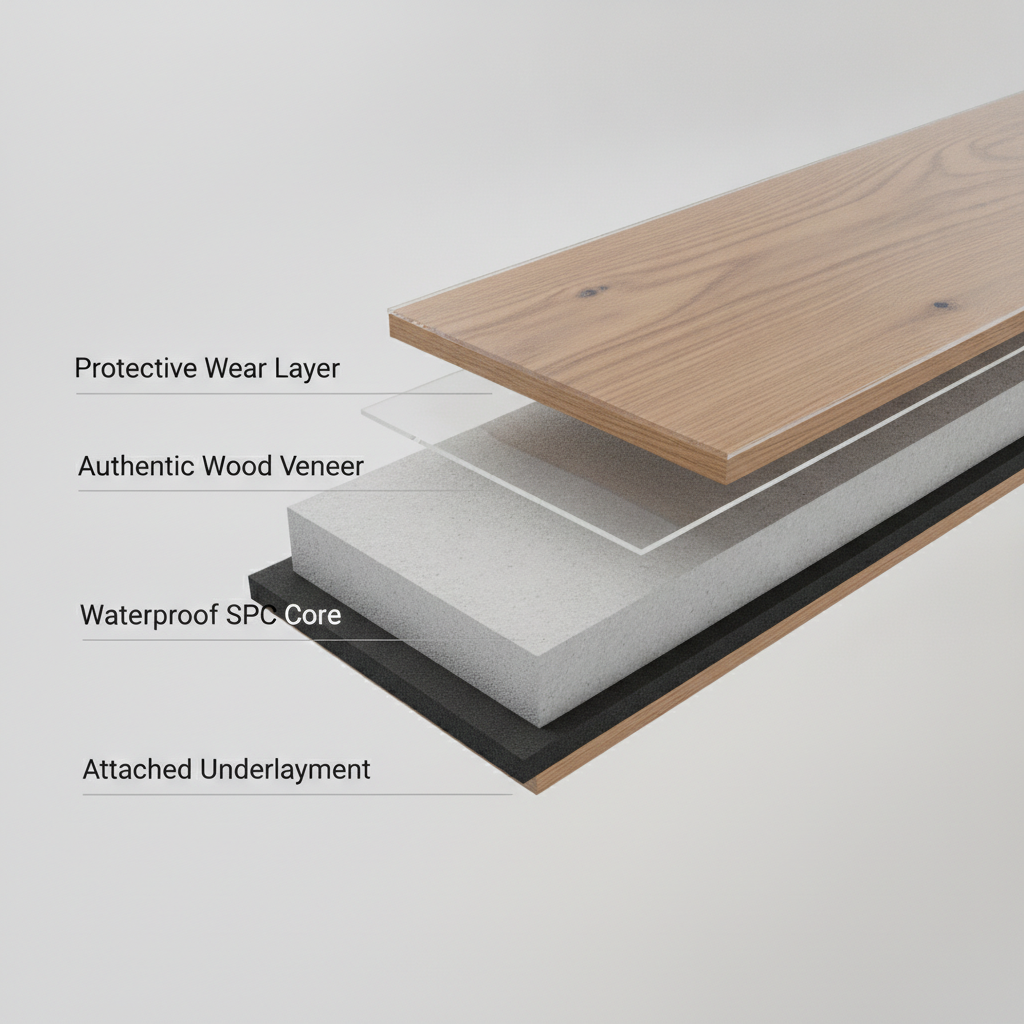
- Protective Wear Layer: The top surface is a highly durable, transparent coating, often infused with aluminum oxide, that resists scratches, stains, and UV fading.
- Authentic Wood Veneer: This is the magic. Unlike laminate or vinyl, this is a layer of real hardwood—species like oak, hickory, or maple—that gives the floor its genuine beauty, grain, and texture. The thickness of this veneer, typically ranging from 1mm to 4mm, affects the floor’s overall durability and its potential to be refinished in the future.
- Waterproof Composite Core: This is the engine of the plank. Instead of wood-based materials that can swell, the core is usually a Stone Polymer Composite (SPC). This blend of limestone and plastic stabilizers creates an incredibly dense and rigid foundation that is 100% waterproof. In fact, SPC cores can provide up to 70% more density and stability than traditional wood floors, preventing warping and buckling from topical water or humidity changes. Many of these products are also tested for indoor air quality safety, earning certifications like FloorScore.
- Attached Underlayment: Most hybrid planks come with a pre-attached pad that provides sound absorption, insulation, and cushioning underfoot, simplifying the installation process.
Is It Truly Waterproof? Unpacking the Claims
This is the most common and important question: can a floor with real wood on it truly be waterproof? The answer is yes, but it’s crucial to understand how. The “waterproof” guarantee comes from a complete, sealed system, not from the wood veneer itself.
The protection relies on three key elements working together:
- A hydrophobic topcoat that causes water to bead up on the surface.
- A 100% waterproof core that will not swell or degrade when exposed to moisture.
- Tight-locking joints that prevent water from seeping between the planks to the subfloor below.
Leading manufacturers like Shaw Floors and Armstrong Flooring have developed product lines that are warrantied against topical moisture, but it’s essential to read the fine print. These products are rigorously tested using scientific standards from organizations like ASTM International to validate their water resistance claims.
Warranty Watch: Reading the Fine Print
When a floor is marketed as “waterproof,” the manufacturer’s warranty is your guide to its true capabilities. Look for specifics:
- Time Limit: Many warranties specify a time limit for topical water, such as “guaranteed waterproof for up to 72 hours.” This means a spill left longer than that could still cause damage.
- Type of Water: Warranties cover topical spills from everyday life. They do not cover flooding from hydrostatic pressure (water coming up from the subfloor), major appliance failures, or structural leaks.
- Installation: The warranty is almost always contingent on following the manufacturer’s installation instructions to the letter, including proper subfloor prep and perimeter sealing in wet areas.
Hybrid vs. Traditional Engineered Hardwood: What’s the Difference?
You might be thinking, “This sounds a lot like engineered hardwood.” You’re right—they are related, but hybrid hardwood is the next evolution. While both are layered products, the key difference lies in the core material.
- Traditional Engineered Hardwood: Uses a core made of crisscrossing layers of plywood or high-density fiberboard (HDF). This construction makes it significantly more stable against humidity changes than solid wood—up to 50% more dimensionally stable—but the wood-based core is only moisture-resistant, not waterproof. It can still be damaged by significant spills or prolonged exposure to water.
- Hybrid (Waterproof) Hardwood: Uses a completely inorganic, waterproof core like SPC. This core is impervious to water, making it suitable for installation in full bathrooms and basements where traditional engineered hardwood would be a risky choice.
The Hardwood Plywood and Veneer Association (HPVA) helps set quality standards for traditional engineered products. Hybrid flooring takes that concept and enhances it with a modern, waterproof foundation.
| Feature | Hybrid (Waterproof) Hardwood | Traditional Engineered Hardwood |
|---|---|---|
| Core Material | Stone Polymer Composite (SPC) | Plywood or HDF |
| Water Resistance | 100% Waterproof (Topical) | Moisture-Resistant |
| Best Use Case | Any room, including bathrooms & basements | Any room except full bathrooms |
The Room-by-Room Playbook: Choosing the Best Wood Floor for Your Space
Now that you understand the technology, let’s apply it. Choosing the right flooring is about matching the product’s performance to the unique challenges of each room.
For the Kitchen: Durability Meets Design
The kitchen is the heart of the home, but it’s also a battlefield for floors. It faces high traffic, dropped utensils, dragged chairs, and spills from the sink, dishwasher, or refrigerator. This is where hybrid hardwood truly shines.
Its multi-layer construction is ideal for this environment. The veneer on high-quality products often uses hard, durable wood species like Hickory or White Oak, which have high ratings on the Janka Hardness Scale. This provides natural dent resistance. More importantly, the commercial-grade wear layer, often a factory-applied aluminum oxide finish recommended by experts like Bona, provides superior protection against scratches and scuffs. Unlike traditional hardwood that would be damaged by a leaky dishwasher, a properly installed waterproof hardwood floor can handle kitchen accidents with ease.
Pro Tip: Even with a durable floor, place high-quality floor mats in front of the sink and stove. They’ll catch the majority of splashes and drips, making cleanup easier and adding an extra layer of protection.
For the Bathroom: The Final Word on Wood Floors in Wet Rooms
Can you install real hardwood in a bathroom? For solid hardwood, the answer is an emphatic no. Industry authorities like the National Wood Flooring Association (NWFA) explicitly state in their installation guidelines that solid hardwood should not be installed in full bathrooms. The constant humidity, steam from showers, and inevitable splashes cause the wood to expand, contract, and absorb moisture, leading to disastrous results like cupping, buckling, and mold growth.
This is where modern technology provides the perfect solution. Waterproof hardwood offers the authentic wood aesthetic you desire without the catastrophic risk. Because its core is inert to water and the surface is sealed, it can be safely installed in a full bathroom, giving you the warm, spa-like feel that cold tile can’t match. High-quality Luxury Vinyl Plank (LVP) is another excellent wood-look option for bathrooms.
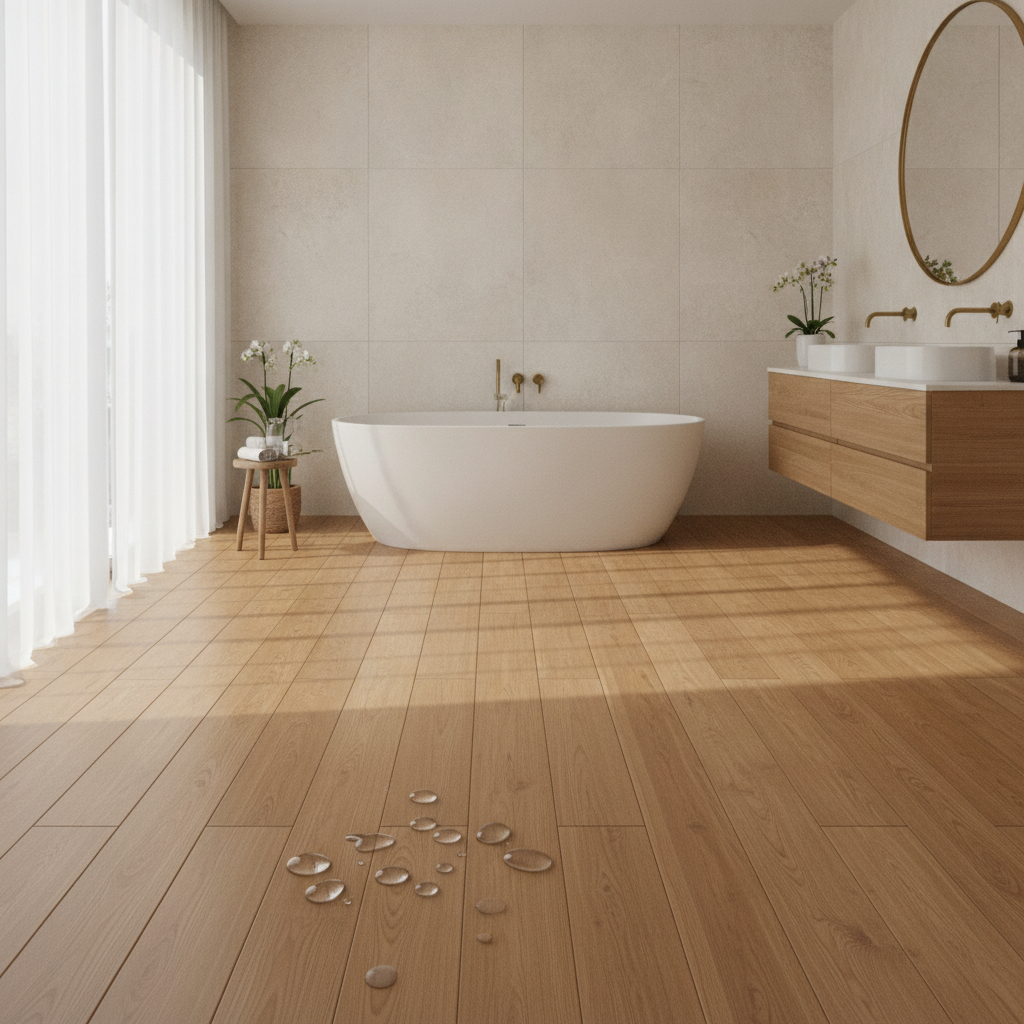
As a water damage restoration expert certified by the Institute of Inspection, Cleaning and Restoration Certification (IICRC) would advise, the key danger in bathrooms is trapped moisture. A waterproof floor system, properly sealed at the perimeter with silicone caulk during installation, creates a surface that keeps water out of the subfloor, preventing hidden mold and rot. For more on industry best practices, the NWFA’s consumer website is a valuable resource.
For the Basement: Conquering Below-Grade Challenges
Basements present a unique set of flooring challenges: they are “below-grade,” meaning they are surrounded by soil, which can transmit moisture through the concrete slab. They are also prone to higher ambient humidity and, in the worst-case scenario, flooding.
Solid hardwood is never an option for basements. While traditional engineered wood can often be used, waterproof hardwood is a far superior and safer choice. Its SPC core is unaffected by the ambient humidity that can cause HDF or plywood cores to swell over time.
For basements, a “floating floor” installation is almost always recommended. This means the planks are clicked together but not glued or nailed to the subfloor. This method allows the floor to move as a single unit and makes installation over concrete much simpler. However, proper subfloor preparation is non-negotiable. According to building science principles, a vapor barrier should always be used over a concrete subfloor to block moisture transmission. You can learn more about the technical details of moisture management from the experts at the Building Science Corporation.
Checklist: Basement Subfloor Prep Essentials
- Clean & Level: The concrete must be clean, dry, and flat to within the manufacturer’s specifications (usually 3/16″ over a 10-foot span).
- Moisture Test: Perform a calcium chloride or in-situ probe test to ensure the concrete’s moisture level is within acceptable limits.
- Vapor Barrier: Lay down a 6-mil polyethylene sheet as a vapor retarder to block moisture from the slab.
- Acclimation: Allow the flooring to acclimate in the basement for at least 48-72 hours before installation so it can adjust to the room’s temperature and humidity.
Hybrid Hardwood vs. The Alternatives: A Head-to-Head Comparison
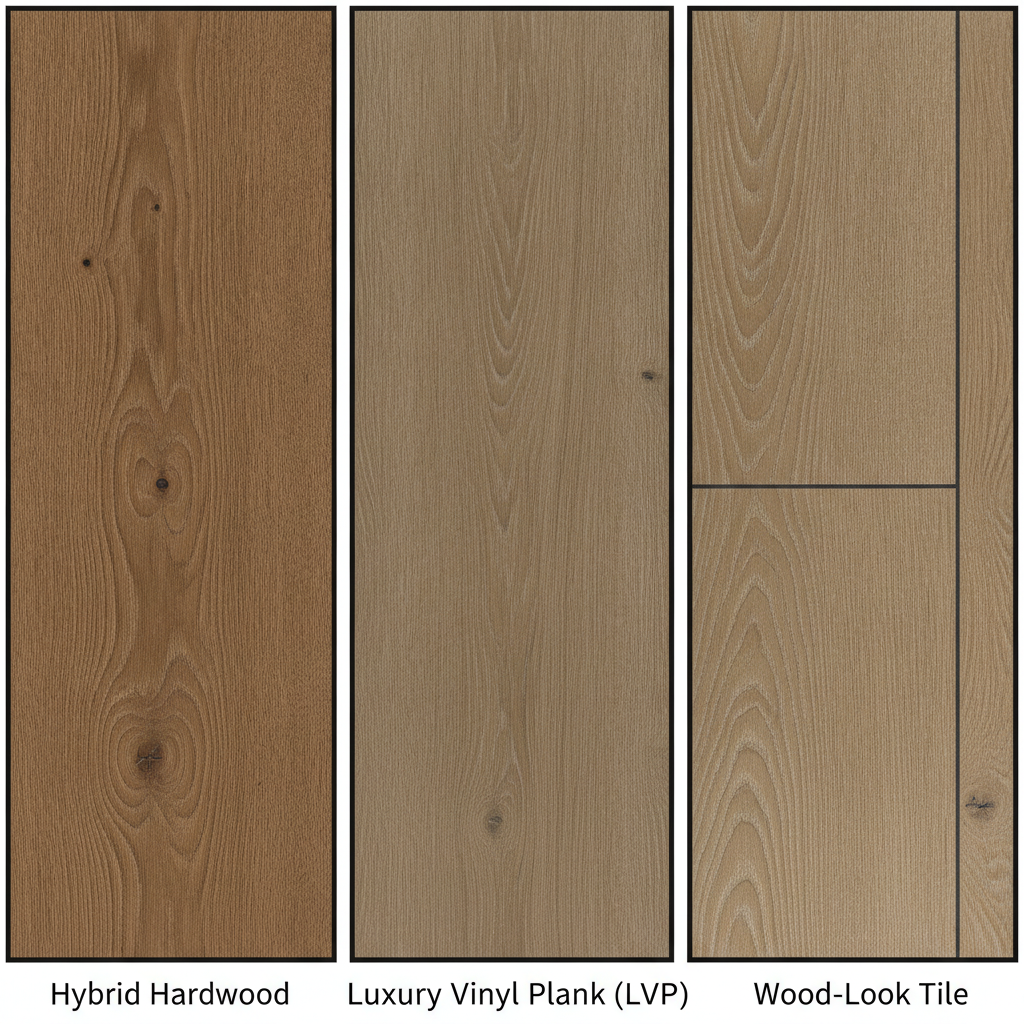
To make the best decision, you need to see the whole picture. Hybrid hardwood competes directly with two other popular “wood-look” options for moisture-prone areas: Luxury Vinyl Plank (LVP) and Wood-Look Tile. Here’s how they stack up.
| Metric | Hybrid (Waterproof) Hardwood | Luxury Vinyl Plank (LVP) | Wood-Look Tile |
|---|---|---|---|
| Authenticity | Excellent: Real wood veneer offers genuine look, feel, and value. | Good: High-definition printing is realistic, but it feels like plastic. | Fair: Looks like wood from a distance, but is cold, hard, and has grout lines. |
| Durability | Very Good: Waterproof core, scratch-resistant wear layer. | Excellent: 100% waterproof, highly durable, and resilient. | Excellent: 100% waterproof, extremely hard to scratch. Can chip or crack. |
| Cost (Material) | $$$ (Premium) | $$ (Mid-Range) | $$ (Mid-Range) |
| DIY-Friendliness | Good: Click-lock systems are manageable for skilled DIYers. | Excellent: Easiest to install with click-lock or loose-lay options. | Poor: Requires specialized tools, mortar, and grout. Best left to pros. |
| Repairability | Fair: Damaged planks can be replaced, but it can be difficult. | Fair: Plank replacement is possible but can be challenging. | Poor: Replacing a single cracked tile is a difficult and messy job. |
vs. Luxury Vinyl Plank (LVP): The Battle of Authenticity and Cost
LVP has seen explosive growth, with sales increasing over 25% year-over-year in recent periods, largely due to its affordability and 100% waterproof PVC construction. It is an outstandingly practical flooring. However, its biggest weakness is authenticity. No matter how good the printed image is, it is still a photograph of wood on a plastic core.
Hybrid hardwood’s unique value proposition is its genuine wood veneer. It offers the same waterproof peace of mind as LVP but with the unmatched look, feel, and perceived value of real wood. For homeowners who refuse to compromise on authenticity, hybrid hardwood is the clear winner. The Resilient Floor Covering Institute (RFCI) provides detailed technical information on vinyl products.
vs. Wood-Look Tile: The Ultimate in Water Protection
When it comes to being waterproof, porcelain tile is king. With a water absorption rate of 0.5% or less, as defined by the Tile Council of North America (TCNA), it is virtually impervious to water. This makes it a popular choice for bathrooms and mudrooms.
However, tile’s strengths come with significant trade-offs. It is cold and hard underfoot, unforgiving when dishes or glasses are dropped, and the grout lines require regular sealing and cleaning to prevent staining. Installation is also far more labor-intensive and expensive. Hybrid hardwood offers a much warmer, softer, and more comfortable surface that is also simpler and more affordable to install, making it a more inviting option for living spaces like kitchens and basements. For those considering tile in wet areas, it’s crucial to look for a high DCOF (Dynamic Coefficient of Friction) rating to ensure adequate slip resistance. You can find authoritative information on tile standards at the TCNA website.
The Floor Doctor’s Guide to Prevention & Repair
Even with the best flooring, problems can happen. This section shifts from proactive selection to reactive solutions, providing expert advice on how to handle common water-related issues. Our guidance is based on professional benchmarks like the IICRC S500 Standard for water damage restoration. For major events, always consult official resources like FEMA’s public guide on flood cleanup.
Diagnosing Warped Floors: Cupping, Crowning, and Buckling Explained
When a traditional wood floor warps, it’s a symptom of a moisture imbalance. Understanding the type of warping helps diagnose the root cause.
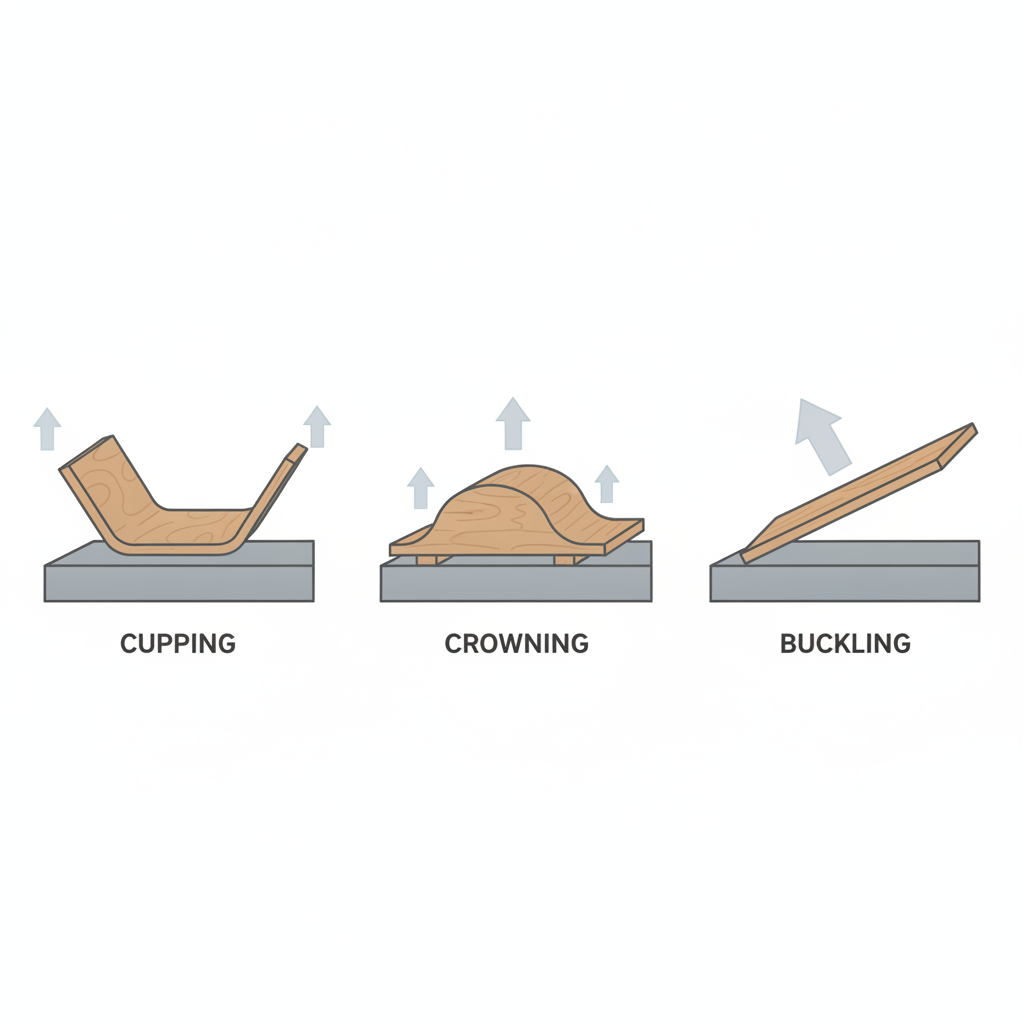
- Cupping: The edges of the board are higher than the center. This is the most common type of warping and is caused by a moisture imbalance where the bottom of the board is wetter than the top (e.g., from a damp subfloor or basement).
- Crowning: The center of the board is higher than the edges. This is the opposite of cupping and often happens when a cupped floor is sanded flat before the underlying moisture issue is resolved and the boards have fully dried out.
- Buckling: The floor lifts up dramatically from the subfloor, sometimes by several inches. This is a severe reaction, usually caused by a major flood or a complete lack of expansion space around the perimeter of the room.
The definitive industry guide on these issues is the NWFA’s ‘Problems, Causes, and Cures’ publication. Professionals diagnose these issues using a moisture meter to get an objective reading of the wood’s moisture content.
Expert Tip: Never sand a cupped floor flat. You must solve the moisture problem first and allow the floor to dry out completely. In many cases, the boards will return to their normal shape on their own once the moisture is balanced. Sanding prematurely will almost guarantee the floor will crown later.
Emergency Action Plan for Water Damaged Hardwood
If you’re facing a leak or flood on a traditional wood floor, time is of the essence. In many cases, floors can be saved if water is removed within 24-48 hours. Follow these steps immediately:
- Stop the Water Source: Find the shut-off valve or source of the leak and stop it immediately.
- Remove Standing Water: Use a wet-dry vacuum, mops, and towels to remove all surface water.
- Promote Drying: Open windows and use fans and dehumidifiers to circulate air and pull moisture from the boards and the room.
- Assess the Damage: Once the floor is dry, check for staining, warping, or signs of mold.
- Know When to Call a Pro: For significant floods, sewage backups (black water), or if the water has been standing for more than 48 hours, do not attempt to handle it yourself. Call a professional restoration company certified by the IICRC. They have the specialized equipment and safety protocols to dry the structure properly and prevent mold growth. You can find certified professionals on the IICRC consumer resources page.
Insurance Claim Checklist
- Photograph and video everything before you move or clean it.
- Keep a log of all communication with your insurance company.
- Save receipts for any expenses incurred (e.g., renting equipment, professional services).
- Do not throw away damaged materials until your insurance adjuster has seen them.
Conclusion: The Best of Both Worlds Is Here
The age-old compromise between the beauty of wood and the reality of water is finally over. Modern technology in the form of hybrid and waterproof hardwood has bridged the gap, allowing the warmth and character of real wood to flow seamlessly into every room of the house—including the kitchen, bathroom, and basement.
By understanding the science behind these innovative floors, making informed choices based on the specific needs of your space, and knowing how to care for your investment, you can eliminate the fear of water damage. You no longer have to choose between the floor you need and the floor you love. You can, at last, have both.
Ready to bring the timeless beauty of real wood to your kitchen or bathroom? Explore our curated selection of hybrid and waterproof hardwood flooring to find the perfect style for your home.
This article provides general guidance. Always consult with a certified flooring professional and follow manufacturer-specific installation instructions for your chosen product. Product performance can vary based on installation quality and environmental conditions.
References & Authoritative Sources
- Shaw Floors. (n.d.). Product Specifications for Floorté Hardwood Series. Shaw Industries Group, Inc.
- SCS Global Services. (n.d.). FloorScore. Retrieved from https://www.scsglobalservices.com/services/floorscore
- ASTM International. (n.d.). ASTM D1735 – Standard Practice for Testing Water Resistance of Coatings Using Water Fog Apparatus. ASTM International.
- Hardwood Plywood and Veneer Association (HPVA). (n.d.). Engineered Hardwood Flooring Standards. HPVA.
- U.S. Forest Products Laboratory. (n.d.). Janka Hardness. U.S. Forest Products Laboratory.
- Bona. (n.d.). Technical Data Sheets for High-Traffic Residential Finishes. Bona US.
- National Wood Flooring Association (NWFA). (n.d.). Installation Guidelines and Technical Publications. Retrieved from https://hardwoodfloors.org/
- Institute of Inspection, Cleaning and Restoration Certification (IICRC). (n.d.). IICRC S500 Standard and Reference Guide for Professional Water Damage Restoration. Retrieved from https://iicrc.org/
- Building Science Corporation. (n.d.). Research & Publications on Moisture Management. Retrieved from https://www.buildingscience.com/
- Resilient Floor Covering Institute (RFCI). (n.d.). Technical Resources for Resilient Flooring. RFCI.
- Tile Council of North America (TCNA). (n.d.). ANSI Standards for Ceramic Tile. Retrieved from https://www.tcnatile.com/
- Wagner Meters. (n.d.). Educational Resources on Wood Moisture Measurement. Wagner Meters.
- Federal Emergency Management Agency (FEMA). (n.d.). Floods | Ready.gov. Retrieved from https://www.ready.gov/floods
