
Choosing the right flooring feels like a high-stakes decision. You want the timeless beauty of hardwood, but the anxieties of modern life—spills from kids, scratches from pets, and the constant threat of water damage—can make the choice overwhelming. You’ve likely heard the terms “hybrid hardwood” and “engineered wood,” but the marketing jargon can create more confusion than clarity. Are they the same? Which one is truly waterproof? Which is a better investment for your home?
You need more than just a sales pitch; you need a decision engine. This guide is designed to be exactly that. We will cut through the hype to give you a data-driven, side-by-side comparison of hybrid hardwood and traditional engineered wood. We’ll dissect their construction, test their claims of durability, and put them through a real-world “Lifestyle Litmus Test” to see which one comes out on top for your specific needs. By the end of this article, you will have the confidence to choose the perfect floor that delivers the beauty you want with the real-world resilience you actually need.
- Decoding the Contenders: What Are Hybrid and Engineered Hardwood?
- Head-to-Head Comparison: Hybrid Hardwood vs. Engineered Wood
- The Lifestyle Litmus Test: Which Floor is Right for You?
- Flooring First Aid: Prevention and Repair Guide
- Frequently Asked Questions (FAQ)
- The Final Verdict: Your Lifestyle is the Tiebreaker
- References & Authoritative Sources
Decoding the Contenders: What Are Hybrid and Engineered Hardwood?
Before we can compare these two flooring giants, it’s crucial to understand what they are at their core. While both use real wood, their internal construction is fundamentally different, leading to dramatic variations in performance, especially when it comes to water.
What is Hybrid Hardwood Flooring? (e.g., Bravewood)
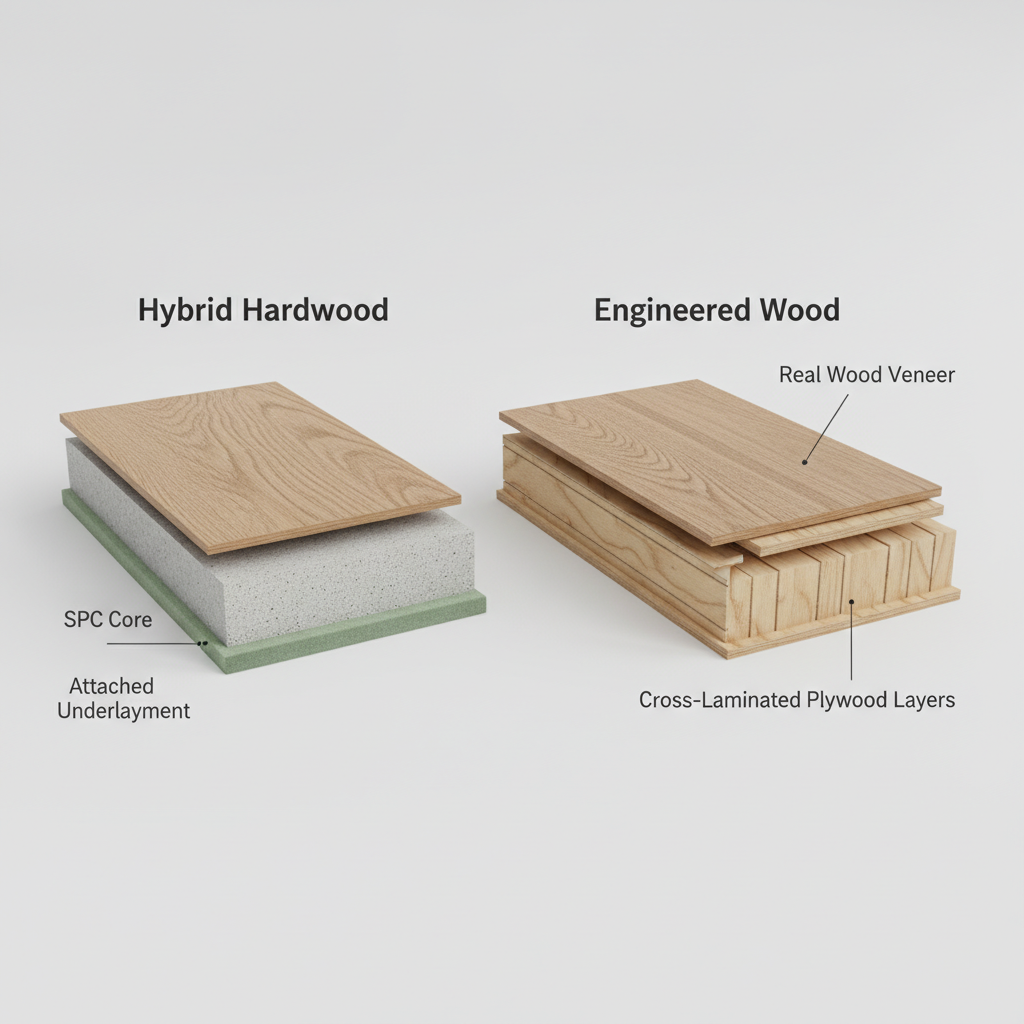
Hybrid hardwood is the new challenger in the flooring world, representing a fusion of technologies. Think of it as the best of both worlds: it pairs an authentic, beautiful slice of real hardwood veneer on top with a high-tech, 100% waterproof composite core below.
This core is the key differentiator. It’s typically made from a Stone Plastic Composite (SPC) or Wood Plastic Composite (WPC), the same ultra-durable foundations found in luxury vinyl flooring. This construction makes the plank itself inert to water. A spill can sit on the surface for hours or even days without causing the core to swell, warp, or buckle. This innovative structure aims to solve the age-old problem of wood’s vulnerability to moisture, allowing you to have real wood in places it was once forbidden, like basements and full bathrooms. According to the Resilient Floor Covering Institute (RFCI), these composite cores are engineered for dimensional stability, which is their ability to resist changes in shape when exposed to environmental shifts like moisture and temperature1.
What is Engineered Wood Flooring? The Classic Alternative
Engineered wood flooring has been a popular and trusted alternative to solid hardwood for decades. As defined by the National Wood Flooring Association (NWFA), it is a layered product made of a real hardwood veneer bonded to a core of high-quality plywood or High-Density Fiberboard (HDF)2. This cross-layered construction makes engineered wood more dimensionally stable than solid hardwood, meaning it expands and contracts less with changes in humidity.
This stability allows engineered wood to be installed in areas where solid hardwood is not recommended, such as over concrete slabs or in basements. However, it’s critical to understand that its core is still made of wood products. While it is more resistant to moisture than solid hardwood, it is by no means waterproof. Prolonged exposure to water will cause the plywood or HDF core to absorb moisture, swell, and delaminate, leading to permanent damage. Experts at the Building Science Corporation emphasize that any wood-based material, regardless of its construction, will have a problematic relationship with bulk water if not managed properly3.
Head-to-Head Comparison: Hybrid Hardwood vs. Engineered Wood
Now that we understand the fundamental makeup of each product, let’s put them in the ring for a direct comparison across the factors that matter most to homeowners.
| Feature | Hybrid Hardwood | Engineered Wood |
|---|---|---|
| Core Material | Stone Plastic Composite (SPC) or Wood Plastic Composite (WPC) | Multi-ply Plywood or High-Density Fiberboard (HDF) |
| Water Resistance | 100% Waterproof. The core is inert to water. | Water-Resistant. The wood-based core will swell and damage with prolonged water exposure. |
| Durability | High dent resistance due to dense core. Scratch resistance depends on the top finish. | Dent resistance varies by core type. Scratch resistance depends on the top finish. |
| Refinishing | No. The wood veneer is typically too thin to be sanded and refinished. | Maybe. Can be refinished 1-3 times if the veneer is 2mm or thicker. |
| Cost (Installed) | $7 – $15 per sq. ft. | $6 – $20+ per sq. ft. (wider range based on veneer thickness and species) |
| Best Use Cases | Kitchens, bathrooms, basements, homes with pets/kids, any area prone to spills. | Living rooms, bedrooms, dining rooms, areas with controlled humidity. |
Construction & Core: The Foundation of Performance
The core is the engine of your floor. A hybrid hardwood’s SPC core is a dense, rigid mixture of limestone powder and stabilizers. This density gives it exceptional resistance to dents from dropped objects or heavy furniture. An engineered wood floor with a plywood core offers good stability, while an HDF core is denser and more dent-resistant than plywood, but can be more susceptible to swelling from moisture at the edges. The testing standards developed by ASTM International are used to evaluate these materials for critical properties like density, stability, and impact resistance, ensuring they meet performance claims4. The rigid composite core of hybrid hardwood often provides a superior rating in impact and indentation tests compared to softer plywood cores.
Waterproof vs. Water-Resistant: The Critical Difference
This is the most important distinction between the two.
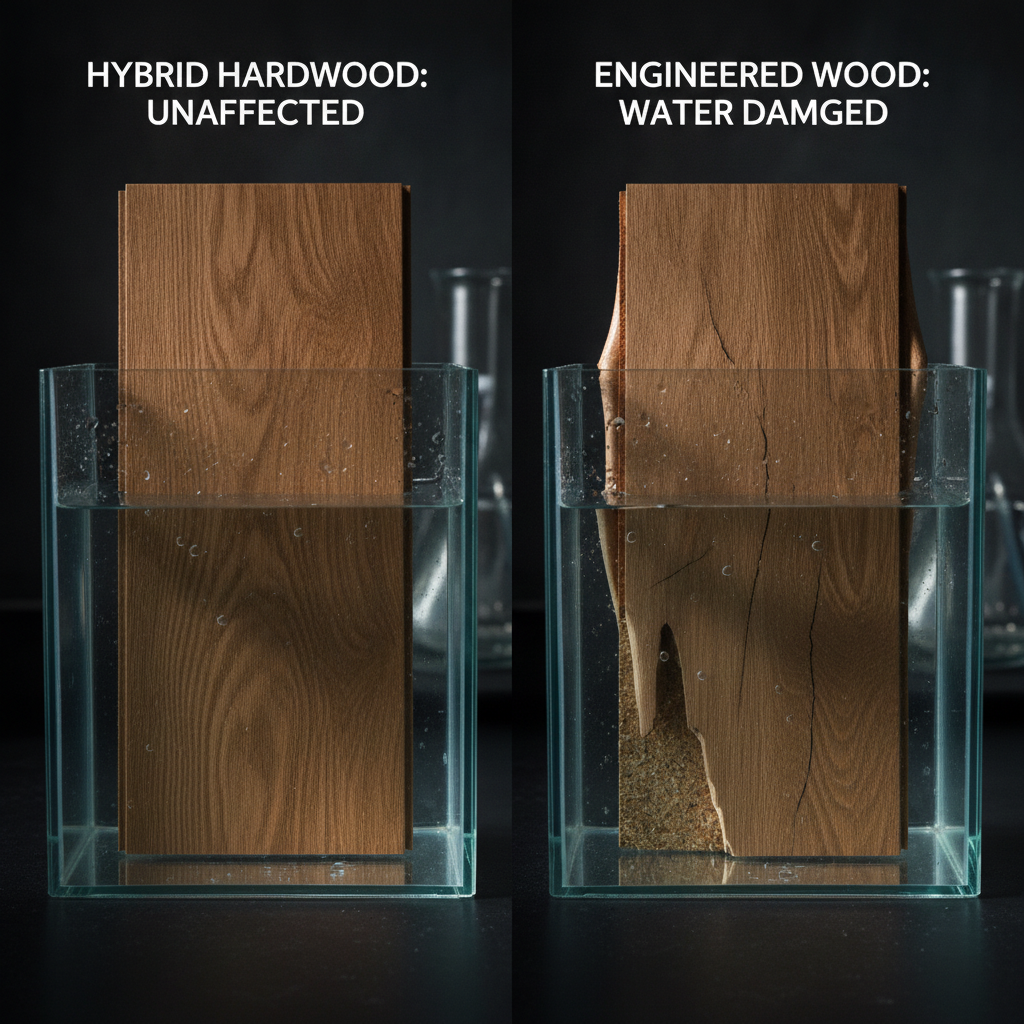
- Hybrid Hardwood is Waterproof: The core material does not absorb water. If you were to submerge a hybrid plank in a bucket of water for a week, it would come out unchanged. This means it protects your subfloor from top-down spills and can be installed in any room of the house without fear.
- Engineered Wood is Water-Resistant: The wood-based core can handle minor spills if they are wiped up quickly. However, if water is left to sit or seeps between the planks, it will be absorbed by the core. The NWFA installation guidelines stress the importance of moisture testing and vapor barriers for engineered wood precisely because of its susceptibility to moisture from the subfloor or ambient humidity2. A leaking dishwasher or pet accident that goes unnoticed can lead to irreversible cupping, buckling, and delamination.
Durability: Scratch, Dent, and Wear Resistance
For both flooring types, the resistance to surface scratches comes from the factory-applied finish, which is typically an aluminum oxide urethane coating. This finish is extremely tough and protects the real wood veneer underneath.
The primary difference in durability comes down to dent resistance. The ultra-dense SPC core of most hybrid hardwoods makes them exceptionally resistant to dents. A high-quality engineered wood with an HDF core will also perform well, while one with a softer plywood core may be more susceptible to denting. While the Janka Hardness Scale is often mentioned, it measures the hardness of the wood species itself. For these products, the core’s ability to resist impact is often more important for preventing dents than the hardness of the thin wood veneer on top.
Refinishing Potential & Lifespan: A Question of Value
Here, traditional engineered wood has a distinct advantage. The ability to sand and refinish a floor removes years of scratches and wear, essentially making it new again. This is only possible if the real wood veneer is thick enough.
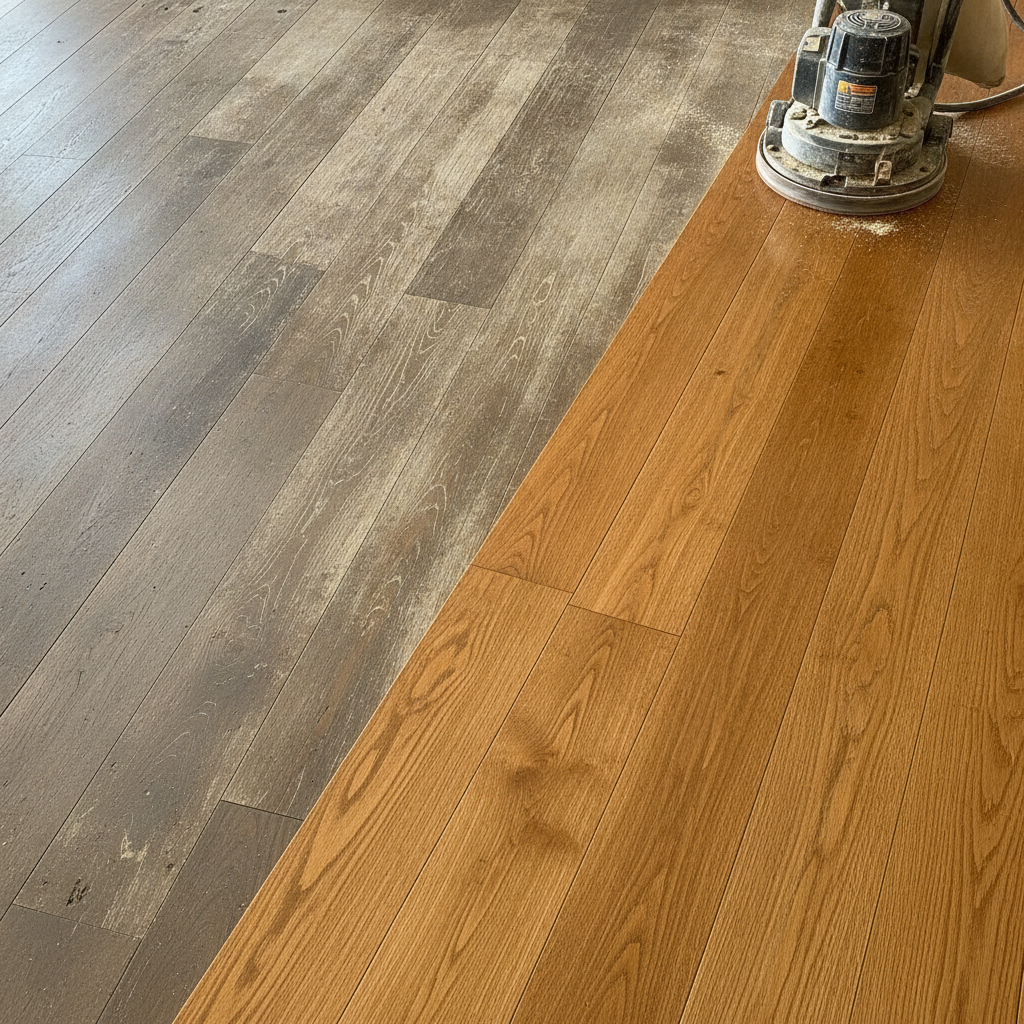
- Veneer < 2mm: Cannot be safely refinished.
- Veneer 2mm – 3mm: Can likely be refinished 1-2 times.
- Veneer > 4mm: Can likely be refinished 3 or more times, similar to solid hardwood.
Most hybrid hardwoods have a very thin veneer (often 1.2mm or less) to keep costs down and maintain flexibility, meaning they cannot be refinished. When their surface is deeply scratched or worn out, the plank must be replaced. This makes high-quality engineered wood a potentially better long-term investment if you value the ability to restore your floors decades down the line.
Cost Comparison: Upfront Investment vs. Lifetime Value
On average, the initial cost for materials and installation is fairly similar, though it can vary widely.
- Hybrid Hardwood: Typically falls in the $7 to $15 per square foot range, installed.
- Engineered Wood: Has a broader range of $6 to $20+ per square foot, installed. The price is heavily influenced by the thickness of the wood veneer and the species of wood used.
While the upfront costs can be comparable, the conversation shifts when considering lifetime value. An engineered floor that can be refinished two times could have a lifespan of 40-60 years or more. A hybrid floor’s lifespan is tied to its wear layer and finish, which might be 15-25 years.
The Lifestyle Litmus Test: Which Floor is Right for You?
Technical specs are useful, but the best floor is the one that fits your life. Let’s see which product wins in common household scenarios.
Winner for Kitchens, Bathrooms & Basements
Clear Winner: Hybrid Hardwood
There is no contest here. The 100% waterproof core of hybrid hardwood makes it the ideal choice for any area prone to moisture. The National Kitchen & Bath Association (NKBA) notes a rising trend in using wood-look flooring in kitchens, but moisture remains a top concern for designers and homeowners5. Hybrid hardwood directly solves this problem. Conversely, the NWFA explicitly advises against installing most wood-based flooring, including engineered wood, in full bathrooms and cautions about its use in below-grade basements without extensive subfloor moisture mitigation2. For peace of mind against plumbing leaks, appliance failures, and everyday spills, hybrid hardwood is the superior choice.
Winner for Homes with Pets and Kids
Clear Winner: Hybrid Hardwood
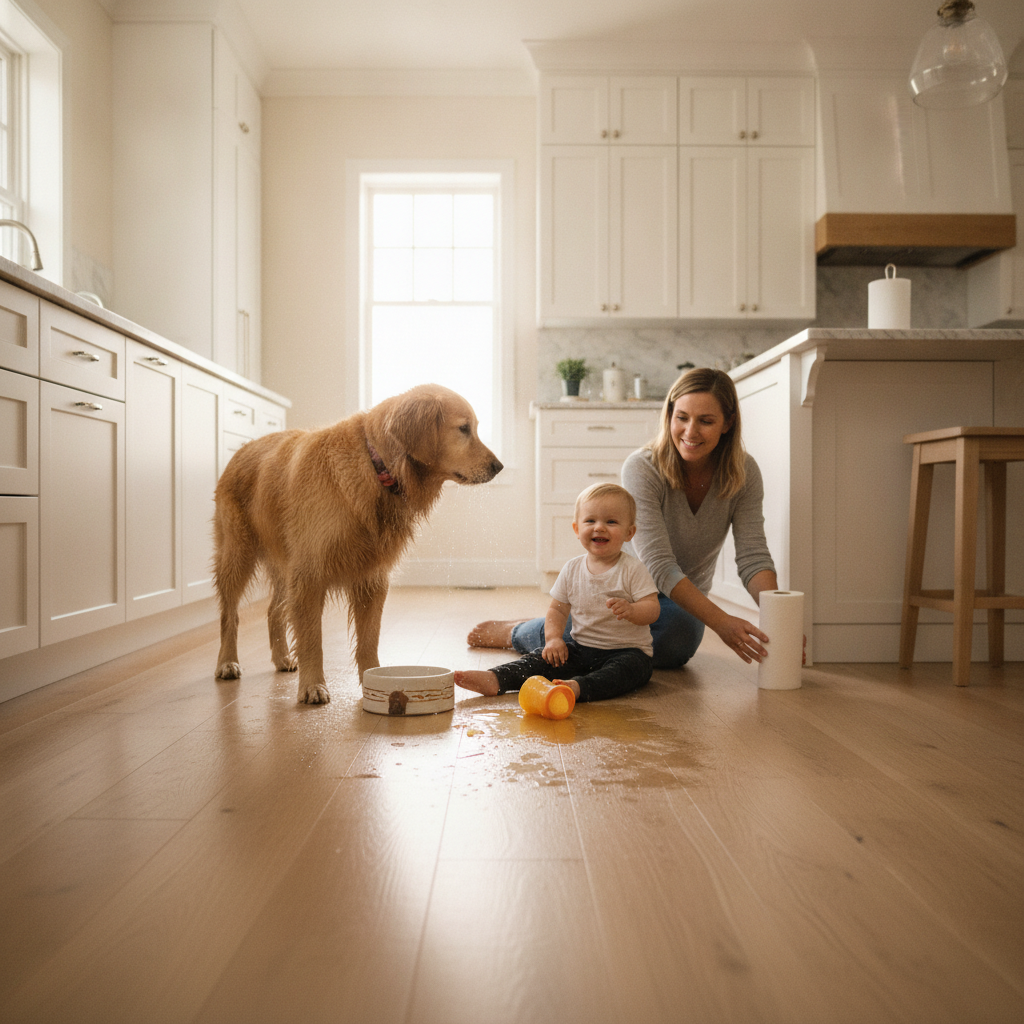
Life with pets and children is a trifecta of flooring challenges: scratches from claws and toys, stains from accidents, and spills of every imaginable liquid. Hybrid hardwood is better equipped to handle all three.
- Scratches: Both have similar scratch-resistant topcoats, making this a tie. However, choosing a lighter color or a wire-brushed texture can help hide minor scratches on either product.
- Stains & Accidents: This is where hybrid’s waterproof nature shines. A pet accident that seeps between the planks of an engineered floor can cause staining and lingering odors in the subfloor. On a hybrid floor, the liquid is contained on the surface, making cleanup easier and more complete. The American Kennel Club (AKC) recommends waterproof, easy-to-clean surfaces for homes with pets, a description that perfectly fits hybrid hardwood6.
Winner for Long-Term Resale Value
Conditional Winner: Engineered Wood
This category is more nuanced. From a buyer’s perspective, the term “hardwood” carries significant weight. A high-quality engineered wood floor with a thick veneer that can be refinished is often seen as a permanent fixture of the home, adding lasting value. According to real estate professionals, the ability to advertise “refinishable hardwood floors” can be a significant selling point. Hybrid hardwood, while incredibly practical, is a newer category and may be perceived by some buyers as less prestigious than a traditional wood floor. However, a pristine, waterproof floor in a finished basement or kitchen could also be seen as a major value-add. The winner here depends on the specific quality of the product and the buyer’s priorities.
Flooring First Aid: Prevention and Repair Guide
No floor is indestructible. Knowing how to care for your choice and handle common problems is key to its longevity.
The Scratch Repair Matrix: From Minor Scuffs to Deep Gouges
Scratches are inevitable, but most can be fixed. The approach depends on the severity.
- Level 1: Minor Surface Scuffs (in the finish): These often look like white lines. They can usually be buffed out with a microfiber cloth and a manufacturer-approved cleaning solution. For slightly more stubborn scuffs, a product like a floor polish or restorer, such as those recommended by experts at Bona, can fill in the micro-scratches and restore the sheen7.
- Level 2: Scratches into the Wood Veneer: If a scratch has breached the finish and removed color from the wood, use a stain-filled repair marker or wax pencil that matches your floor’s color. Carefully fill in the scratch, wipe away the excess, and let it dry.
- Level 3: Deep Gouges: For deep gouges that have removed wood, you’ll need a wood filler putty. Choose a color that matches your floor, overfill the gouge slightly, and scrape it level with a putty knife. Once dry, you can touch it up with a stain marker. For severe damage, the best solution is often to replace the entire plank, which is easier with modern click-lock flooring.
Water Damage Triage: What to Do When a Spill Happens
How you react to water depends entirely on your flooring type.
- On Hybrid Hardwood: Relax. Wipe up the spill when you get a chance. The floor itself is safe. Your only concern is ensuring water doesn’t get under the baseboards and affect the drywall or subfloor on a major leak.
- On Engineered Wood: Act fast. Immediately soak up all surface liquid with towels. Use a fan to circulate air over the area to promote drying. Watch the planks closely for the next 24-48 hours for signs of damage like:
- Cupping: The edges of the plank are higher than the center.
- Crowning: The center of the plank is higher than the edges.
- Buckling: The floor lifts completely off the subfloor.
If you see any of these signs, the damage may be permanent. For large-scale water events like a flood or major pipe burst, it is crucial to call a professional restoration service. Look for technicians certified by the Institute of Inspection, Cleaning and Restoration Certification (IICRC), as they follow industry standards for water damage remediation and mold prevention8.
Frequently Asked Questions (FAQ)
Does hybrid hardwood flooring look fake?
Not at all. This is one of its biggest advantages over laminate or vinyl. Because it uses a genuine slice of real hardwood as its top layer, it has the authentic grain, texture, and natural variation that can’t be replicated by a photographic image. It looks and feels exactly like real wood because it is real wood on the surface.
How do you clean and maintain hybrid and engineered wood?
The cleaning process is nearly identical for both. The NWFA recommends a simple routine: sweep or vacuum regularly to remove abrasive grit, and clean with a pH-neutral cleaner designed for hardwood floors2. Use a microfiber mop and lightly mist the floor or the mop head—never pour liquid directly onto the floor. Avoid using steam mops, oil soaps, or excessive water, especially on engineered wood.
What is the most durable waterproof flooring overall?
While hybrid hardwood is the most durable real wood waterproof option, porcelain and ceramic tile are still the kings of overall durability. With a high PEI rating (a measure of hardness and durability), tile is nearly impervious to scratches, water, and stains. The Tile Council of North America (TCNA) sets the standards for this incredibly resilient material9. High-end Luxury Vinyl Plank (LVP) with a thick wear layer (20mil or more) and an SPC core also offers exceptional scratch and water resistance, though it lacks the authentic wood top layer of hybrid flooring.
The Final Verdict: Your Lifestyle is the Tiebreaker
So, which floor should you choose? The decision comes down to a simple trade-off: peace of mind vs. long-term refinishing value.
Choose Hybrid Hardwood if:
- You need 100% waterproof performance for a kitchen, basement, or bathroom.
- You have pets or young children and your top priority is resilience against spills and accidents.
- You want the authentic look of wood without the constant worry about water damage.
Choose Engineered Wood if:
- You prioritize long-term investment and want the ability to sand and refinish your floors in the future.
- The flooring will be in a controlled environment like a living room or bedroom where moisture is not a primary concern.
- You desire a specific wood species or extra-wide plank that is only available in a high-quality engineered product with a thick veneer.
Ultimately, there is no single “best” floor—only the best floor for your home and your life. By understanding the core differences in construction and performance, you can move past the marketing noise and make a confident choice that you’ll be happy with for years to come.
Disclaimer: This article may contain affiliate links. All recommendations are based on our expert research. For specific installation or repair advice, please consult a certified flooring professional.
References & Authoritative Sources
- Resilient Floor Covering Institute (RFCI). (N.D.). General Information about Resilient Flooring.
- National Wood Flooring Association (NWFA). (N.D.). Installation Guidelines and Specifications.
- Building Science Corporation. (N.D.). Research and Publications on Moisture Management.
- ASTM International. (N.D.). Standards for Wood and Flooring Products.
- National Kitchen & Bath Association (NKBA). (N.D.). Kitchen and Bath Design Trends Reports.
- American Kennel Club (AKC). (N.D.). Articles on Pet-Friendly Home Design.
- Bona. (N.D.). Hardwood Floor Care Guides and Recommendations.
- Institute of Inspection, Cleaning and Restoration Certification (IICRC). (N.D.). IICRC Standard for Water Damage Restoration (S500).
- Tile Council of North America (TCNA). (N.D.). TCNA Handbook for Ceramic, Glass, and Stone Tile Installation.