
Do you love the timeless, elegant look of hardwood floors but live in constant fear of the next spill, pet accident, or muddy footprint? You’re not alone. For decades, homeowners have faced a difficult choice: embrace the unmatched beauty of real wood and accept its vulnerability, or settle for a more durable alternative that lacks its authentic charm. But what if you didn’t have to compromise?
Enter waterproof hybrid hardwood flooring, the modern solution engineered for real life. This revolutionary category combines a genuine layer of beautiful hardwood with a resilient, 100% waterproof core, creating a floor that stands up to the chaos of active households with children and pets.
This guide is designed to be your ultimate decision-making tool. We will decode the marketing jargon, explain the technology, and provide a reality-based framework to help you navigate the options. By the end, you’ll have the confidence to choose the perfect, worry-free floor that brings both beauty and peace of mind to your home.
- Why Traditional Hardwood Floors Cause Modern-Day Headaches
- The Solution Arrives: What is Waterproof Hybrid Hardwood?
- Hybrid Hardwood vs. The Alternatives: A Head-to-Head Comparison
- Decoding Durability: A Guide to Wear Layers, Ratings, and Finishes
- How to Choose Hybrid Hardwood Styles Like a Designer
- The Lifestyle Test: Is Hybrid Hardwood the Best Choice for You?
- FAQs: Your Hybrid Hardwood Questions Answered
- Conclusion
- References
Why Traditional Hardwood Floors Cause Modern-Day Headaches
Before we explore the solution, it’s important to validate the very real concerns you have about traditional wood flooring. Your anxiety about scratches and spills isn’t unfounded; it’s based on the inherent nature of solid wood.
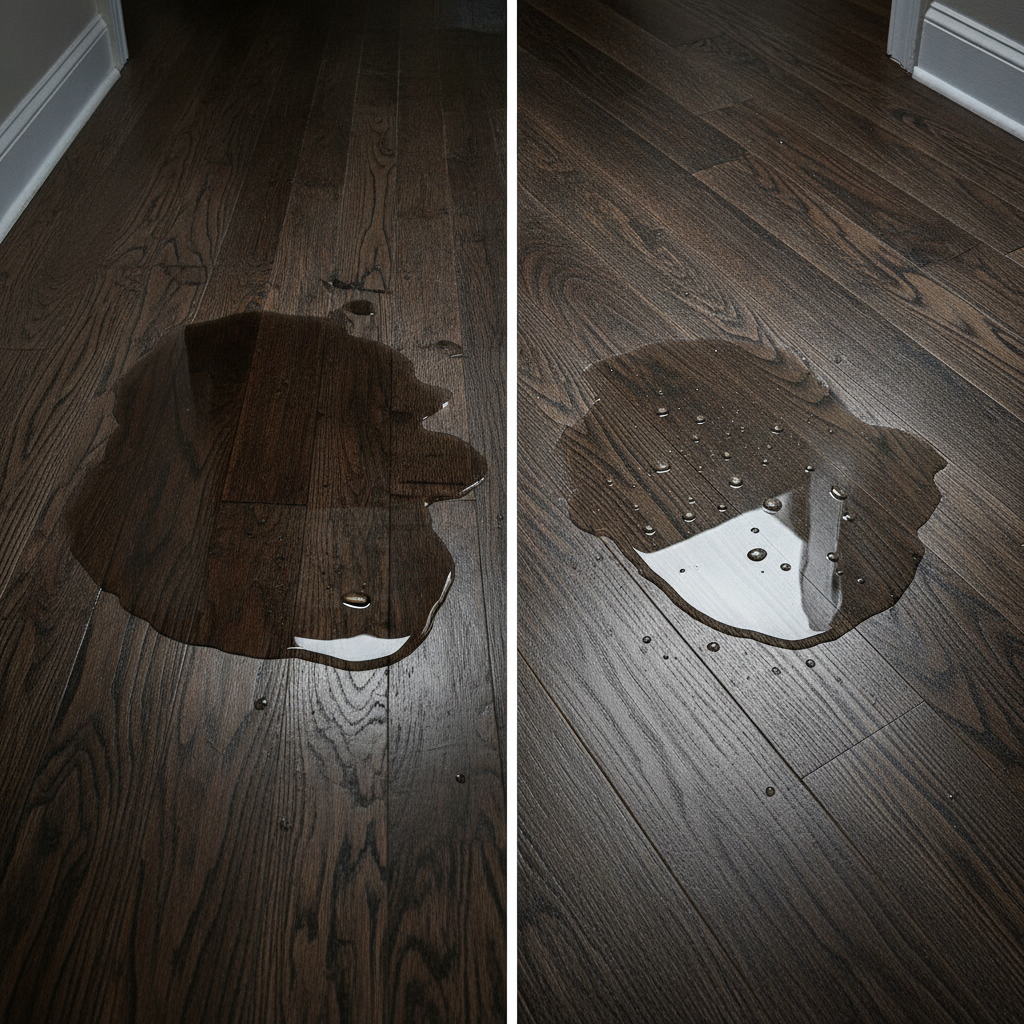
When wood absorbs water from a leak or a large spill, its cellular structure swells. This leads to visible and often permanent damage:[1]
- Cupping: The edges of the planks rise higher than the center, creating a concave shape.
- Crowning: The center of the plank swells and rises higher than the edges, creating a convex dome.
- Buckling: In severe cases, the flooring can lift entirely off the subfloor, creating large waves.
Beyond water, other common household challenges can permanently mar a traditional wood floor. Pet accidents are a primary culprit. The uric acid and ammonia present in pet urine don’t just cause a surface stain; they create a chemical reaction that can burn the wood fibers and react with the wood’s natural tannins, resulting in deep, black discoloration that is often impossible to remove without replacing the boards.
Furthermore, not all woods are created equal when it comes to durability. A wood’s resistance to dents and scratches is measured on the Janka hardness scale. A softer wood like American Cherry (Janka rating of 950) will show wear and tear far more easily than a harder species like Hickory (1820) or Brazilian Walnut (3684).[2] This explains why some homeowners find their “durable” hardwood flooring scratches easily under the pressure of pet claws, dragged furniture, or even dropped toys.
The Solution Arrives: What is Waterproof Hybrid Hardwood?
Waterproof hybrid hardwood is the next generation of flooring, engineered to solve the core problems of its traditional predecessor. So, what exactly is it?
At its heart, hybrid hardwood is a multi-layered plank designed for maximum performance. A key question homeowners ask is, “Is it real wood?” The answer is yes. The top layer is a veneer of genuine hardwood—species like oak, hickory, or maple—that gives the floor its authentic beauty, grain, and character.
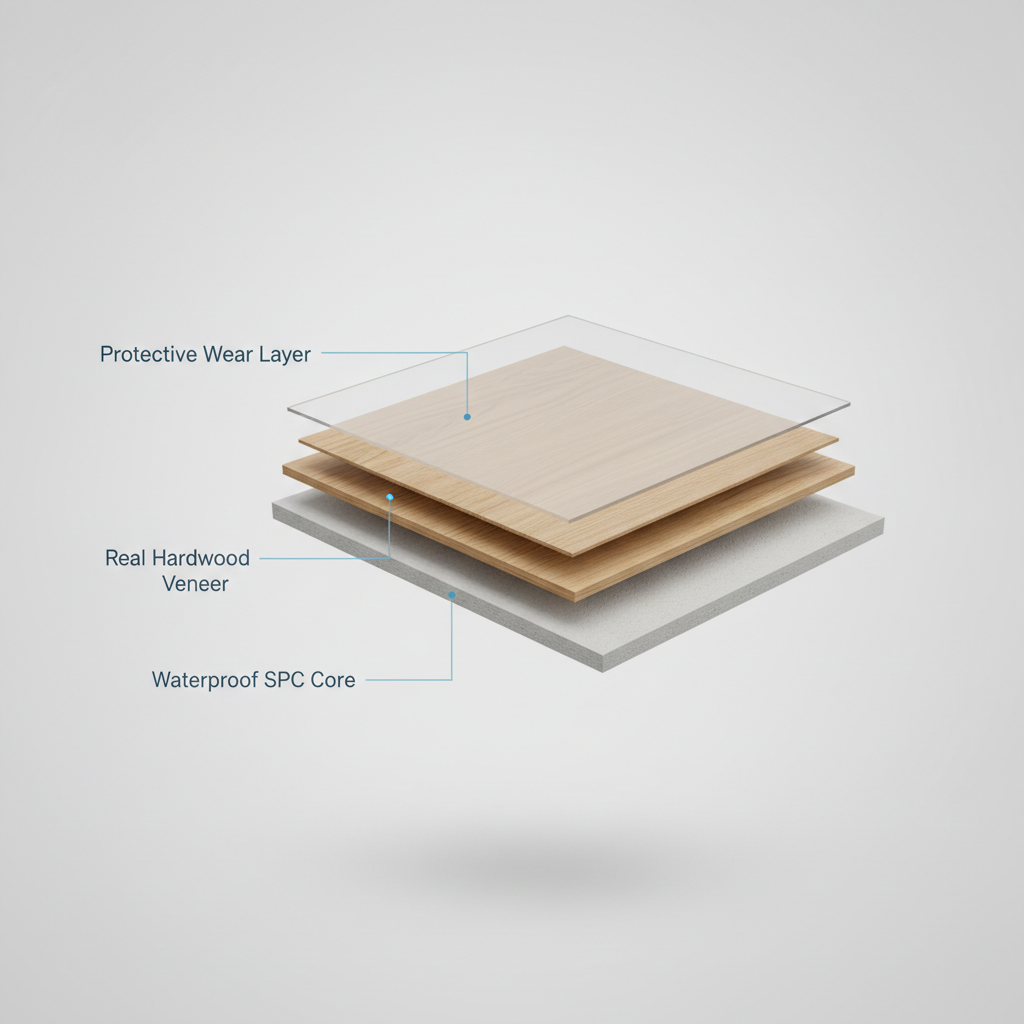
The magic, however, lies beneath this wood veneer. Instead of being bonded to a wood-based core that swells with moisture, the veneer is attached to a 100% waterproof composite core. This core is the floor’s secret weapon, preventing water from being absorbed and protecting the plank’s structural integrity.
This construction creates a critical distinction you must understand:
- Waterproof (Hybrid): The core material itself is impervious to water. A hybrid plank can be fully submerged without swelling or delaminating. This protection is built into the product’s structure.
- Water-Resistant (Topically Sealed Wood): This refers to traditional or engineered wood that has a robust surface finish designed to repel water for a certain period, often between 24 to 96 hours. While helpful for minor spills, prolonged exposure or leaks that reach the seams can still cause significant damage to the underlying wood core.
Essentially, hybrid hardwood gives you the aesthetic you want with the protection you need.
The Core of the Matter: SPC vs. WPC Cores Explained
The waterproof core is the engine of hybrid hardwood, and it typically comes in two forms: SPC or WPC. Understanding the difference will help you read product specifications like a pro.
SPC (Stone Plastic Composite): This core is made from a mixture of natural limestone powder, polyvinyl chloride, and stabilizers. It is known for being extremely dense, rigid, and durable.
WPC (Wood Plastic Composite): This core is made from a combination of recycled wood pulp and plastic composites. It is lighter and less dense than SPC, which gives it a slightly softer, more comfortable feel underfoot.
Here’s a simple breakdown to help you compare:
| Feature | SPC (Stone Plastic Composite) | WPC (Wood Plastic Composite) |
|---|---|---|
| Dent Resistance | Higher (due to density) | Good (but softer than SPC) |
| Feel Underfoot | Very firm and sturdy | Softer and more resilient |
| Thermal Stability | Excellent (less expansion/contraction) | Good (more sensitive to temperature) |
| Best For | High-traffic areas, basements, sunrooms | Living areas where comfort is a priority |
Many leading flooring manufacturers utilize SPC cores for their hybrid hardwood lines due to their superior stability and dent resistance, making them a robust choice for any room in the house.[3]
Hybrid Hardwood vs. The Alternatives: A Head-to-Head Comparison
With so many wood-look flooring options on the market, it can be overwhelming to figure out which is best. Here’s how waterproof hybrid hardwood stacks up against the other leading contenders.
| Flooring Type | Realism | Waterproofing | Scratch Resistance | Avg. Material Cost | DIY-Friendliness |
|---|---|---|---|---|---|
| Hybrid Hardwood | ★★★★★ | ★★★★★ | ★★★★☆ | $$$ | ★★★★☆ |
| Luxury Vinyl (LVP) | ★★★★☆ | ★★★★★ | ★★★★☆ | $$ | ★★★★★ |
| Modern Laminate | ★★★★☆ | ★★★☆☆ | ★★★★★ | $$ | ★★★★☆ |
| Engineered Hardwood | ★★★★★ | ★★☆☆☆ | ★★★☆☆ | $$$$ | ★★★☆☆ |
Hybrid Hardwood: Offers the highest level of realism because the top layer is real wood. Combined with a truly waterproof core, it provides the best of both worlds.
Luxury Vinyl Plank (LVP): A fully synthetic product that uses a high-definition printed image of wood. Modern LVP is incredibly realistic, 100% waterproof, and very durable, but it lacks the unique grain variation of real wood.
Modern Laminate: Known for its exceptional scratch resistance. While traditionally vulnerable to water, newer “water-resistant” laminates can handle spills well, but their fiberboard core is still susceptible to damage from major leaks.
Engineered Hardwood: Like hybrid, this has a real wood veneer. However, its core is typically made of plywood or high-density fiberboard. According to the National Wood Flooring Association (NWFA), this construction makes it more stable than solid wood but still vulnerable to moisture damage.[4]
Decoding Durability: A Guide to Wear Layers, Ratings, and Finishes
A floor’s ability to resist scratches, scuffs, and fading comes down to its top protective layers. Understanding these technical specifications will empower you to see past marketing claims and choose a truly durable wood style floor.
The primary defense for hybrid hardwood, LVP, and laminate is the wear layer. This is a clear, tough topcoat that protects the wood veneer or printed design layer from daily abuse. The secret ingredient in most high-quality wear layers is aluminum oxide, a microscopic crystalline material that dramatically increases abrasion resistance without clouding the floor’s appearance.
When comparing products, look for these key metrics, which are often based on testing standards set by organizations like ASTM International:[5]
- Wear Layer Thickness (for Hybrid & LVP): Measured in mils (one-thousandth of an inch).
- 6-12 mil: Good for light residential use (e.g., bedrooms).
- 20+ mil: Excellent for active homes with kids and pets; considered commercial-grade.
- AC Rating (Abrasion Class, for Laminate): This rates a floor’s resistance to abrasion, impact, stains, and burns.
- AC3: Suitable for general residential use.
- AC4: Recommended for heavy residential use, including homes with large dogs.
- AC5: Heavy commercial grade; the highest level of durability.
For a floor that will look great for years to come in a busy household, aim for a wear layer of 20 mil or an AC4 rating.
How to Choose Hybrid Hardwood Styles Like a Designer
Once you’ve settled on hybrid hardwood for its performance, the fun part begins: choosing a style that elevates your home’s design. Instead of feeling overwhelmed by options, use this simple 3-step framework to make a confident choice.
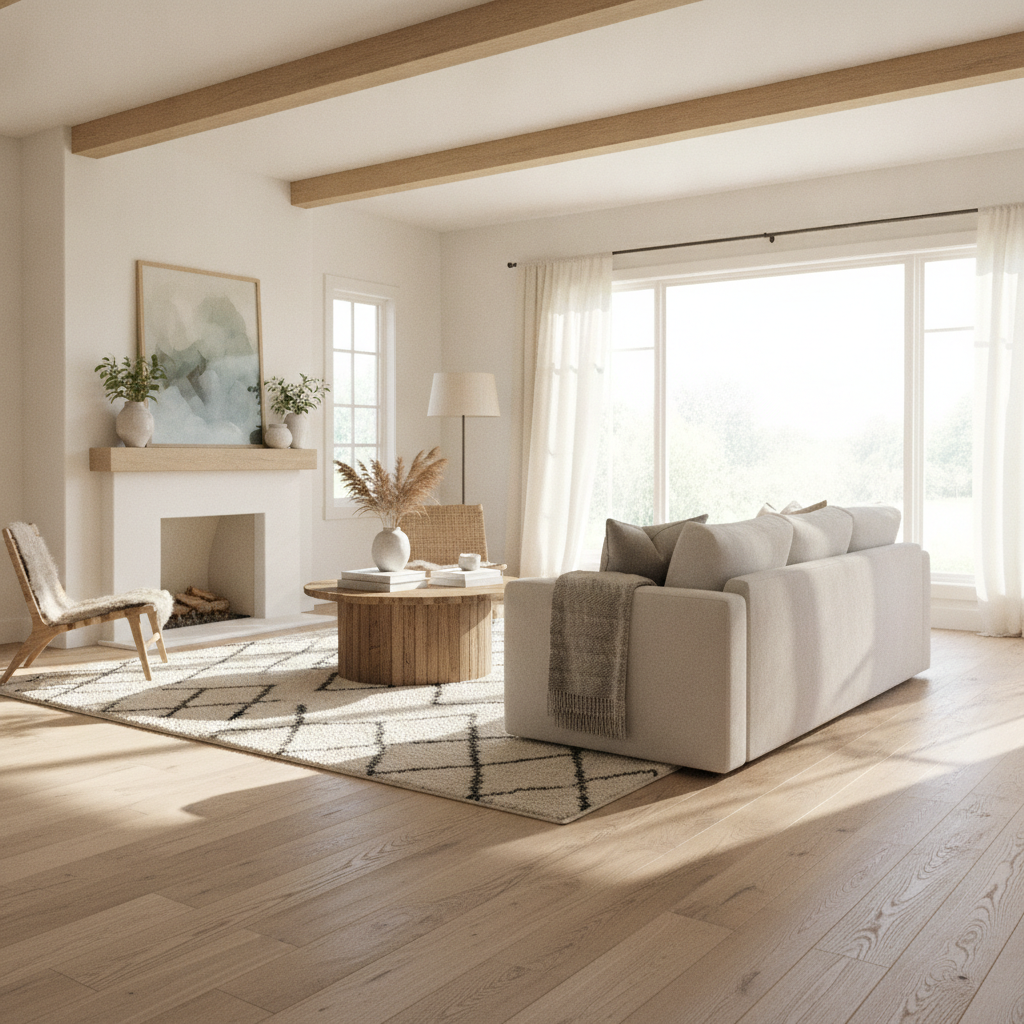
Step 1: Match Your Home’s Architecture
Consider your home’s overall aesthetic. A rustic, wire-brushed oak might look perfect in a modern farmhouse, while a smooth, light-toned maple could be ideal for a minimalist or Scandinavian-inspired space. The floor sets the foundation for your entire design.
Step 2: Consider Lighting & Room Size
As interior design principles suggest, the color and scale of your flooring can dramatically alter the perception of a room.
- Light Colors: Make a small or poorly lit space feel larger, brighter, and more open.
- Dark Colors: Create a cozy, dramatic, and luxurious feel, best suited for larger rooms with ample natural light.
Step 3: Coordinate with Your Color Palette
Look at your “fixed finishes”—the elements that aren’t easily changed, like kitchen cabinets, countertops, and stone fireplaces. Your floor should complement these tones. If your cabinets have warm, honey-colored undertones, a floor with similar warm tones will create a cohesive look. If you have cool gray walls, a floor with cool or neutral tones will feel more harmonious.
Plank Width and Color: Making Your Space Feel Bigger and Brighter
Two of the most impactful style choices are plank width and color. Wider planks, typically 7 inches or more, have fewer seams and can make a room feel more expansive and modern. Lighter-colored floors reflect more light, which is a powerful tool for brightening up north-facing rooms or basements.
It’s also crucial to see how flooring samples look in your home’s unique lighting. The same floor can appear dramatically different under the warm, yellow glow of incandescent bulbs versus the cool, blue-white light of some LEDs. Always view samples in the actual room at different times of day before making a final decision.
The Lifestyle Test: Is Hybrid Hardwood the Best Choice for You?
The final check is to ensure this flooring meets the specific demands of your household. For most, this comes down to three key areas: kitchens, pets, and kids.
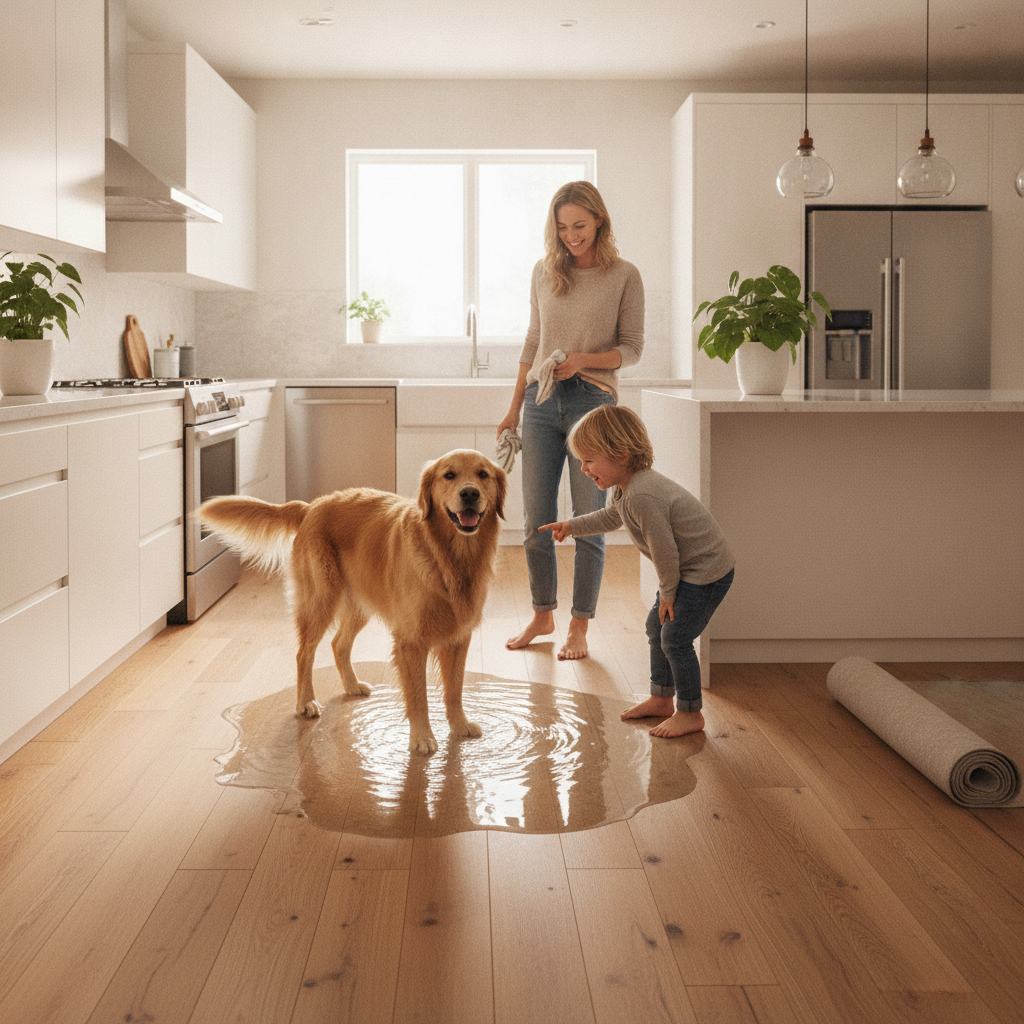
A “Pet-Friendly Flooring Scorecard” for hybrid hardwood would look like this:
- Scratches: Very Good. The strong wear layer provides excellent protection against claws.
- Stains/Accidents: Excellent. The non-porous surface and waterproof core prevent liquids from soaking in.
- Slips: Good to Very Good. Opting for a style with a textured or wire-brushed finish can provide better traction for paws.
- Traction for Paws: Good. The textured surface is generally better than smooth, glossy finishes for pet joint health.
For homes with children, durability is key, but so is indoor air quality. Volatile Organic Compounds (VOCs) are chemicals that can be emitted from building materials. To ensure a healthy environment, look for floors with third-party certifications like FloorScore® or GREENGUARD Gold. These certifications indicate that the product has been tested and meets strict low-VOC emissions standards.[6]
In the kitchen, safety is paramount. Slip resistance is measured by a DCOF (Dynamic Coefficient of Friction) rating. A DCOF of >0.42 is the standard for commercial floors and a great benchmark for residential kitchens, as recommended by standards referenced in the Americans with Disabilities Act (ADA).[7] Many textured hybrid hardwood products meet this threshold.
For Kitchens and Bathrooms: The Ultimate Waterproof Test
Hybrid hardwood is an excellent choice for moisture-prone areas like kitchens, laundry rooms, and even bathrooms. The “100% waterproof” claim means that everyday spills and splashes are no cause for concern.
However, it’s important to understand the limits. While the planks themselves are waterproof, a major event like a dishwasher leak or overflowing tub could still allow water to get underneath the flooring and trap moisture against the subfloor. In these cases, the flooring may need to be uninstalled to allow the subfloor to dry properly and prevent mold growth. A certified flooring installer can advise on best practices, as installation mistakes like not leaving an adequate expansion gap can sometimes void a waterproof warranty.
For Homes with Pets: Surviving Claws, Accidents, and Zoomies
Hybrid hardwood is a game-changer for pet owners. The durable wear layer stands up to the daily “zoomies” and protects against scratches from claws. Unlike traditional wood, the waterproof surface means you don’t have to panic over accidents; they can be cleaned up easily without seeping into the core or causing stains.
A veterinarian or animal expert might advise that for older dogs or those with joint issues, a floor with some texture is preferable to a very smooth, glossy surface to provide better traction and prevent slipping.[8] Additionally, a hidden benefit is the acoustics. The dense composite core and attached underlayment of many hybrid products can help muffle the sound of clicking claws, creating a quieter home environment compared to traditional hardwood or laminate.
FAQs: Your Hybrid Hardwood Questions Answered
Here are quick answers to some of the most common questions about this innovative flooring.
What is the average cost of hybrid hardwood flooring?
The material cost for waterproof hybrid hardwood typically ranges from $4 to $12 per square foot. The final price depends on the thickness of the wood veneer, the species of wood, the brand, and the core type (SPC vs. WPC). Remember to factor in the additional costs of installation, underlayment (if not attached), and removal of your old flooring.
Can you refinish hybrid hardwood flooring?
This is a critical point: No, you cannot sand and refinish hybrid hardwood flooring. The top layer is a thin veneer of real wood. Attempting to sand it would go right through the veneer and destroy the plank. This is a key trade-off for its waterproof durability. For deep scratches or gouges, the repair method is to replace the individual damaged plank, which is why it’s always wise to purchase an extra box of material.
How do you clean and maintain waterproof hardwood?
Maintenance is simple and designed for a busy lifestyle. Following manufacturer guidelines is always the best practice.
Do’s:
- Sweep, dust mop, or vacuum regularly (use a hard floor setting without a beater bar).
- Clean up spills promptly.
- Use a pH-neutral flooring cleaner recommended for urethane finishes.
- Lightly damp-mop when needed.
Don’ts:
- Never use a steam mop, which can damage the finish.
- Avoid harsh chemicals, wax, oil soaps, or abrasive cleaners.
- Do not flood the floor with water when mopping.
Conclusion
Waterproof hybrid hardwood flooring represents a true evolution in home design, finally closing the gap between the timeless beauty of real wood and the demands of modern life. It offers the authentic grain and character you love without the constant worry of water damage, pet mishaps, or the wear and tear from an active family.
By understanding the technology behind its waterproof core, decoding durability ratings, and applying simple design principles, you are now empowered to step past the confusing marketing claims. You have the knowledge to select a floor not just for how it looks today, but for how it will perform for years to come. You can confidently invest in a beautiful, durable, and worry-free foundation for your home.
Ready to find the perfect worry-free floor for your home? Explore our collection of waterproof hybrid hardwood styles or contact our flooring experts today for a personalized consultation.
This article may contain affiliate links. We recommend consulting with a professional flooring installer for specific project advice and installation.
References
- National Wood Flooring Association (NWFA). (n.d.). Water and Wood. Technical Publication No. C200.
- The Wood Database. (n.d.). Janka Hardness. Retrieved from https://www.wood-database.com/wood-articles/janka-hardness/
- Flooring Manufacturer Specifications. (n.d.). Product data sheets from leading manufacturers like Shaw Floors, Flooret, and Mohawk consistently detail the construction of hybrid flooring with genuine wood veneers over SPC or WPC waterproof cores.
- National Wood Flooring Association (NWFA). (n.d.). Engineered Wood Flooring. Technical Publication.
- ASTM International. (n.d.). ASTM F3261 – 21 – Standard Specification for Resilient Flooring in Modular Format with Rigid Polymeric Core. Retrieved from https://www.astm.org/f3261-21.html
- UL (Underwriters Laboratories). (n.d.). GREENGUARD Certification. Retrieved from https://www.ul.com/services/greenguard-certification
- United States Access Board. (n.d.). ADA Accessibility Standards for Buildings and Facilities. Chapter 3: Floor and Ground Surfaces.
- American Kennel Club (AKC). (n.d.). The Best Flooring for Dogs. Retrieved from https://www.akc.org/expert-advice/home-living/the-best-flooring-for-dogs/
