
There is an undeniable allure to upgrading your home with Bravewood hybrid hardwood. Offering the authentic, rich aesthetic of a real wood veneer paired with a highly durable, waterproof core, it represents the pinnacle of modern flooring engineering. However, the journey from purchasing those pristine cartons to enjoying a flawless floor is fraught with high stakes. A single misstep in subfloor preparation or a misunderstood locking mechanism can lead to catastrophic buckling, creaking joints, and instantly voided warranties.
If you are weighing the financial savings of a DIY installation against the peace of mind of hiring a professional, you need more than a basic tutorial. You need a comprehensive strategy. This guide is your “No-Fail Blueprint.” We are moving beyond generic advice to provide you with a True Cost Break-Even Analysis, a DIY Readiness Score, and a masterclass in the Angle/Angle click-lock system to guarantee a flawless, warranty-compliant Bravewood installation.
- What is Bravewood Hybrid Hardwood? (Anatomy of a Waterproof Floor)
- The Great Debate: DIY vs. Professional Hybrid Flooring Installation
- Pre-Installation Non-Negotiables: Avoiding Catastrophic Mistakes
- Step-by-Step Bravewood Hybrid Hardwood Installation Guide
- Troubleshooting: Symptom-to-Solution Diagnostic Table
- Conclusion
- References
What is Bravewood Hybrid Hardwood? (Anatomy of a Waterproof Floor)
To understand how to successfully install Bravewood hybrid hardwood, you must first understand its unique physical construction. Bravewood, manufactured by TAS Flooring, is not your traditional solid hardwood, nor is it a standard laminate. It is a highly engineered, 12mm thick topical waterproof hybrid flooring solution designed to offer the best of both worlds.
At its surface, Bravewood features a 0.6mm real wood veneer—available in stunning Birch or White Oak—giving it an authentic grain and texture that synthetic floors simply cannot replicate. This veneer is protected by an AC4 Rated Antimicrobial surface, ensuring commercial-grade resistance to scratches, dents, and daily wear [1].
Beneath the wood veneer lies a rigid, waterproof core that provides structural stability, preventing the extreme expansion and contraction typically seen in solid wood when exposed to moisture. Finally, the base layer consists of a crucial 1.5mm attached IXPE (cross-linked polyethylene) pad [1]. This integrated underlayment provides acoustic insulation and underfoot comfort.
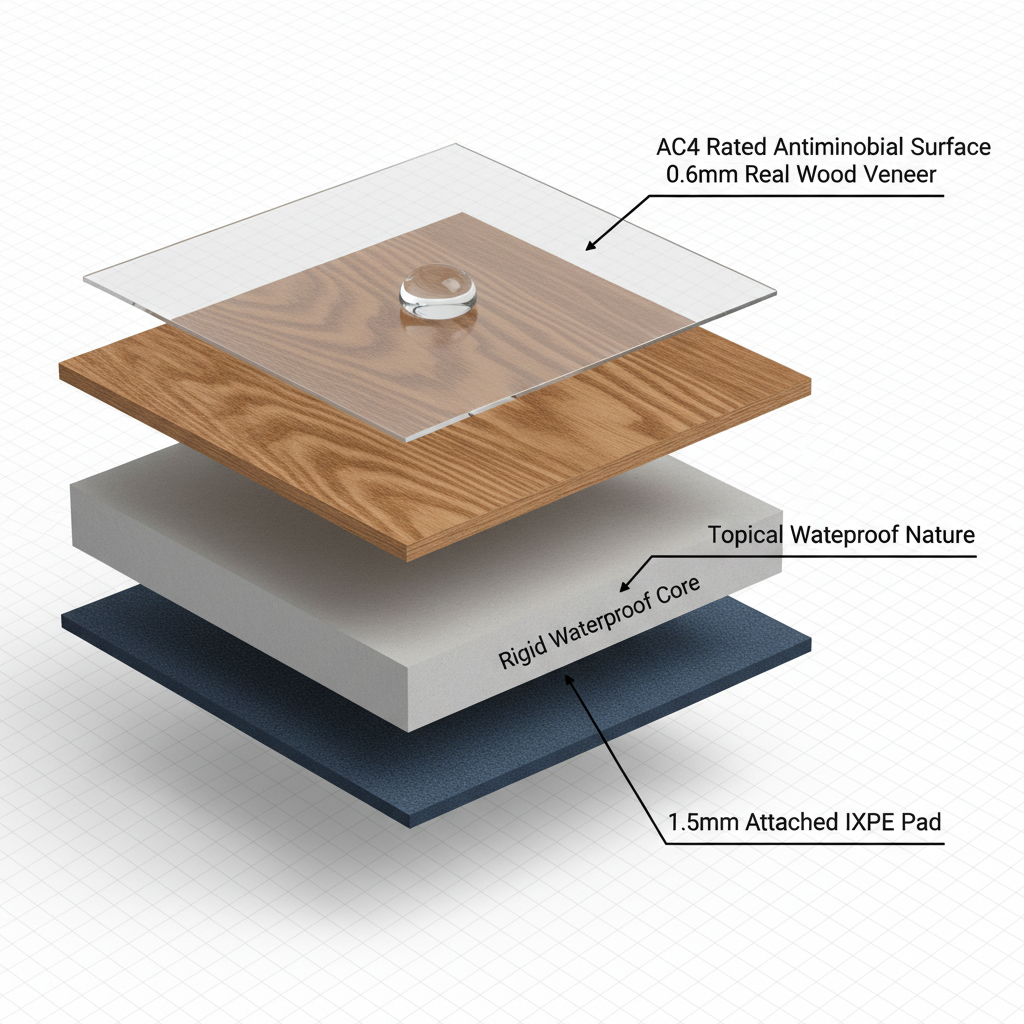
Because of its rigorous manufacturing standards, Bravewood flooring boasts both FloorScore® and GreenGuard Gold certifications, assuring homeowners that the product meets strict indoor air quality and low VOC (Volatile Organic Compound) emission standards [2]. So, is Bravewood flooring completely waterproof? Yes, topically. Its core and surface are designed to repel spills, making it suitable for kitchens and living spaces where traditional hardwood might fail.
The Great Debate: DIY vs. Professional Hybrid Flooring Installation
The most pressing question for cost-conscious homeowners is: Is it cheaper to install hybrid flooring yourself? The short answer is yes, but the true financial picture is far more nuanced. While DIY hardwood flooring appeals to our desire to save money, it requires a realistic assessment of your skills, time, and the hidden costs of the project.
According to industry cost data from Homewyse, professional hardwood installation services typically run between $6 to $25 per square foot for both materials and labor. The labor portion alone accounts for roughly $3.00 to $9.50 per square foot, depending on your region and the complexity of the job [3]. For a standard 50-square-meter (approx. 538 sq. ft.) room, a DIY approach could theoretically save you between $1,250 and $2,000 in labor costs. But before you pick up a saw, let’s look at the true cost.
The ‘True Cost’ Break-Even Analysis
The anticipated savings of a DIY vs professional hybrid flooring installation can quickly evaporate when you factor in hidden expenses. To objectively evaluate both options, consider this comparative matrix:
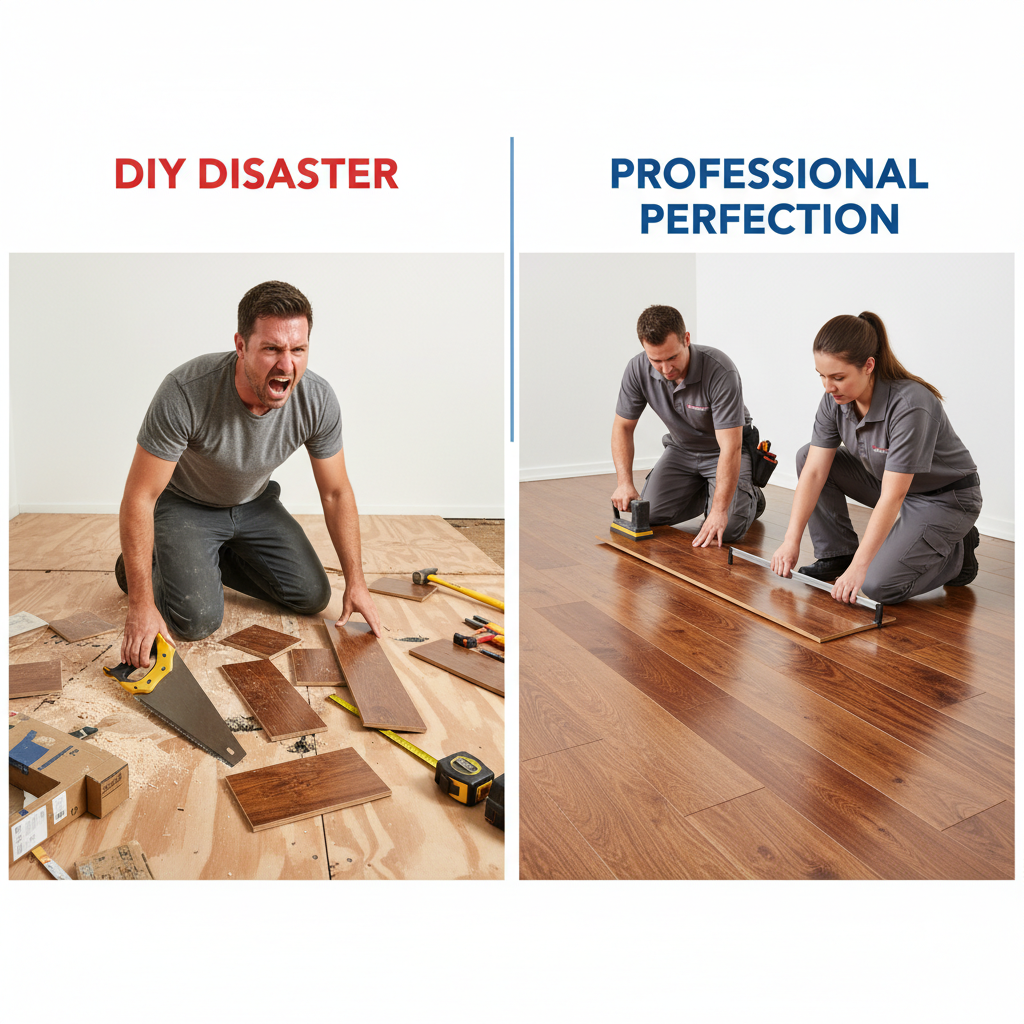
- Cost: DIY saves on labor ($3-$9.50/sq. ft.), but you must subtract the cost of specialized tool rentals or purchases (e.g., jamb saws, pinless moisture meters, specialized tapping blocks) which can easily exceed $200-$400. You must also account for a higher waste factor; professionals typically waste 5-7% of material, whereas beginners may waste 10-15% due to miscuts.
- Time: A professional crew can finish a standard room in 1 to 2 days. For a DIYer, easy DIY flooring solutions still require a significant time investment, often spanning 1 to 2 full weekends.
- Skill: Hybrid click-lock systems are DIY-friendly, but navigating complex cuts around masonry or floor vents requires advanced carpentry skills.
- Warranty: Professional installers guarantee their labor. If a DIYer makes a mistake—such as failing to level the subfloor—the manufacturer’s warranty is entirely voided.
Take the ‘DIY Readiness Score’ Quiz
Is it hard to install hardwood floors yourself? That depends entirely on your starting point. Assess your readiness with these three factors:
- Subfloor Condition: Is your subfloor perfectly flat, or does it have noticeable dips and squeaks? (Leveling a concrete subfloor is significantly harder than laying planks on a pristine surface).
- Room Complexity: Is the room a perfect square, or does it feature multiple angles, closets, a kitchen island, and radiator pipes?
- Tool Access: Do you own or have access to a table saw, miter saw, and an undercut saw?
As many professional installers will warn:
“The most common DIY mistake we are hired to fix isn’t the locking mechanism; it’s a floor that was laid over a wavy, unprepared subfloor, causing the entire system to bounce and break.”
If your subfloor requires extensive leveling, your DIY readiness score drops significantly.
When to Hire Flooring Professionals
There are specific scenarios where you should abandon the DIY route and hire a professional. If your project involves complex staircases, expect to pay a professional $150 to $300 per step—but it is worth every penny, as stairs require precise custom nosing and strict safety adherence.
Furthermore, if your subfloor suffers from severe moisture issues or rot, professional mitigation is mandatory. Hiring licensed, bonded, and insured contractors provides legal and financial protections. If their installation fails, their insurance covers the replacement. If your DIY installation fails, you bear the entire cost of the ruined materials.
Pre-Installation Non-Negotiables: Avoiding Catastrophic Mistakes
If you decide to proceed with a DIY installation, you must understand that 90% of hardwood installation mistakes happen before a single plank is laid. Skipping pre-installation prep is the fastest route to hybrid flooring installation problems like cupping, crowning, and buckling.
What happens if you don’t acclimate hardwood floors? Even with a waterproof core, the 0.6mm real wood veneer on Bravewood planks is hygroscopic—meaning it absorbs and releases moisture from the air. The National Wood Flooring Association (NWFA) strictly mandates that wood flooring must acclimate to the home’s normal living conditions (temperature and humidity) before installation to prevent post-installation expansion or contraction [4].
Subfloor Prep and Leveling Tolerances
The click-lock mechanism of a hybrid floor is incredibly strong, but it has zero tolerance for vertical movement. The subfloor must be flat and level within 3/16 of an inch over a 10-foot span (or 3mm over a 2-meter span) [4].
If your subfloor dips beyond this tolerance, you must use a Portland cement-based self-leveling compound to fill the low spots, or sand down the high spots. Manufacturer warranty clauses explicitly state that installing over an uneven subfloor voids all claims [1]. If you ignore this, the floor will bounce underfoot, and the locking joints will eventually snap under the stress.
CRITICAL WARNING: The Double Underlayment Myth
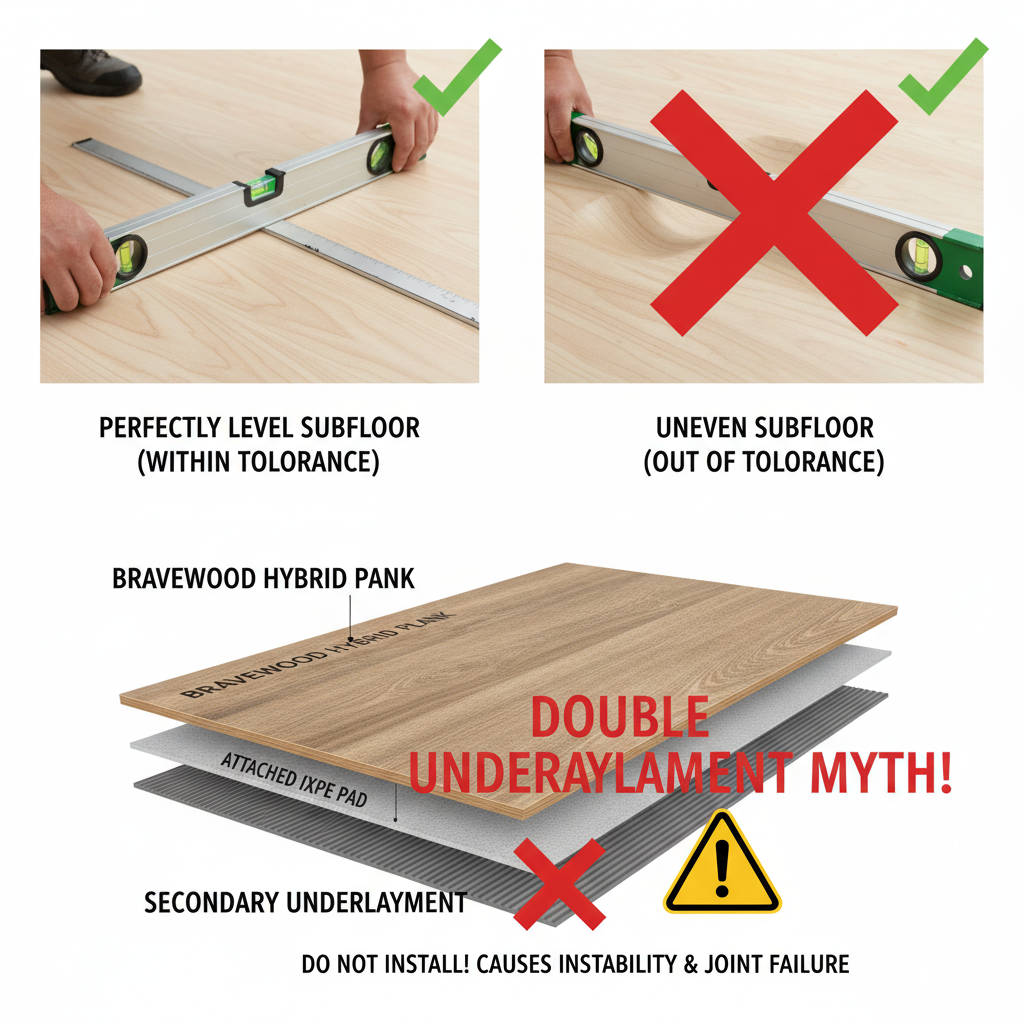
Do you need underlayment for hybrid hardwood? Absolutely not.
Because Bravewood features a 1.5mm attached IXPE pad, adding a secondary underlayment is a catastrophic error. Many DIYers fall for the “double underlayment myth,” believing that adding a foam or cork roll beneath the planks will increase soundproofing or make the floor softer.
TAS Flooring’s official stance is clear: adding extra underlayment creates excessive deflection (sponginess) [1]. When you step on the floor, the planks will sink too deeply into the double padding, forcing the rigid click-lock joints to bend and break. Doing this will immediately void your warranty and ruin the structural integrity of the floor.
Step-by-Step Bravewood Hybrid Hardwood Installation Guide
Bravewood is a floating floor. This means the planks lock together to form a single, continuous sheet that rests on top of the subfloor. Under no circumstances should Bravewood hybrid hardwood be nailed, stapled, or glued down. Confusing this hybrid product with traditional solid nail-down hardwood is a costly error.
For complete warranty compliance, always refer to the official TAS Flooring Installation & Maintenance Sheet [1]. Here is how to execute a flawless installation.
Essential Tools for the Job
Having the right tools is one of the most vital hybrid hardwood installation tips. You will need:
- A specialized, professional-grade tapping block (to prevent crushing the plank edges)
- A heavy-duty pull bar (for tight spaces near walls)
- Wedge spacers (to maintain expansion gaps)
- A jamb saw or oscillating multi-tool (for undercutting door frames)
- A pinless moisture meter (to verify subfloor moisture levels)
Using a scrap piece of flooring as a tapping block is a common amateur mistake that often shatters the locking profile. Invest in the proper tools.
Mastering the Angle/Angle Click-Lock System
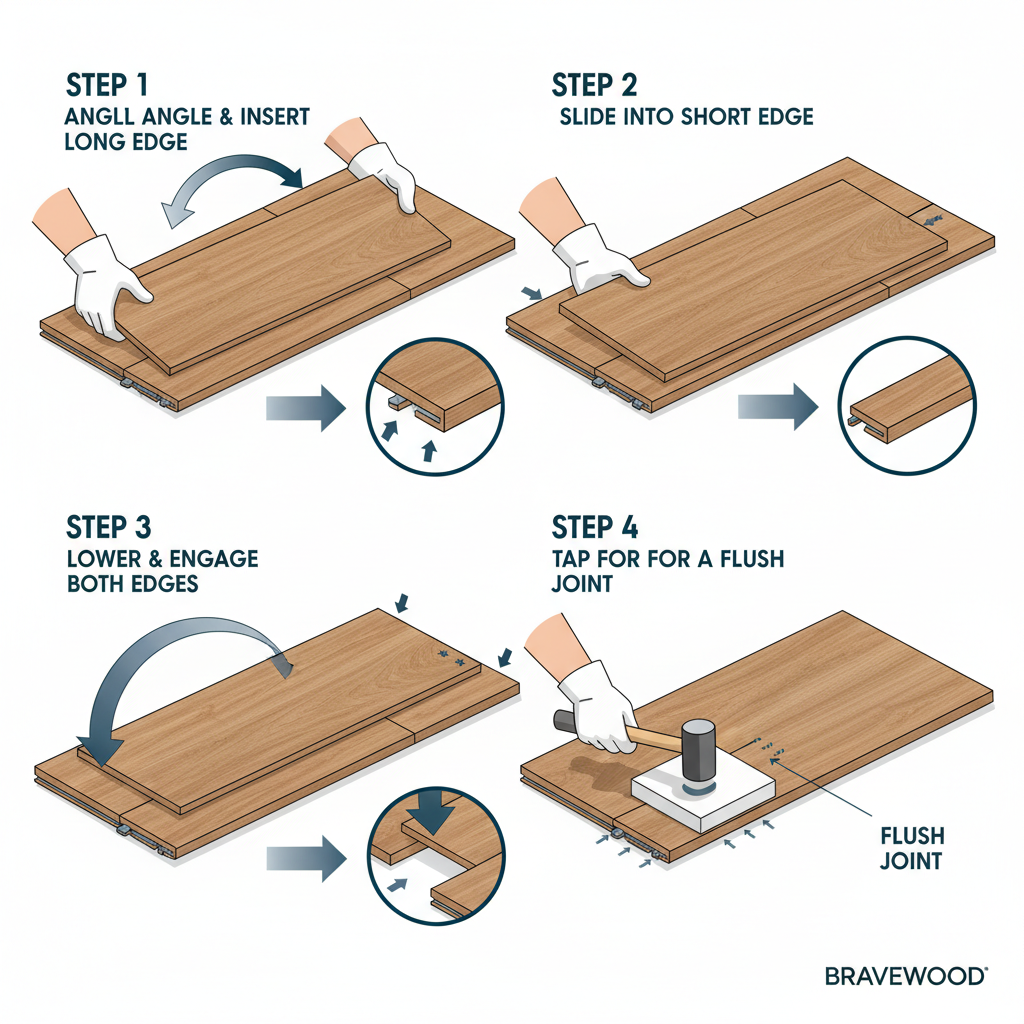
Bravewood utilizes an “Angle/Angle” locking mechanism. This is different from a “drop-lock” or “tap-down” system.
To install Bravewood hybrid hardwood correctly:
- The Long Side: Insert the long edge of the new plank into the groove of the previously installed row at a 20 to 30-degree angle.
- The Short Side: Slide the plank down to meet the short end of the adjacent plank in the same row.
- The Engagement: While maintaining the slight angle, gently push the plank forward into the long groove, then lower it flat to the subfloor. The short ends must also be engaged at an angle.
- The Tap: Use your specialized tapping block and a mallet to gently tap the long edge, ensuring the joint is 100% flush. Never hit the plank directly with a hammer.
First Row / Last Row Masterclass & Expansion Gaps
A professional layout requires mathematical planning to avoid ending up with a tiny, unstable sliver of wood against your final wall.
Measure the total width of your room in inches and divide it by the width of a single Bravewood plank. If the remainder is less than 2 inches, you must rip (cut lengthwise) your first row of planks to ensure both the first and last rows are wide, stable pieces.
Furthermore, you must maintain a strict 6-10mm (1/4 to 1/2 inch) expansion gap around the entire perimeter of the room, including around pipes and cabinetry. Because the real wood veneer is hygroscopic, the entire floating floor will expand and contract as a single unit. If the floor is pinched against a wall, it has nowhere to go but up, resulting in severe buckling.
Troubleshooting: Symptom-to-Solution Diagnostic Table
Even with careful planning, you may encounter issues. Use this diagnostic table to troubleshoot common hybrid flooring installation problems based on expert failure analysis from authorities like Wagner Meters [5].
| Symptom | Primary Cause | The Solution |
|---|---|---|
| Bouncing or Creaking Underfoot | Subfloor dip exceeding 3/16″ over 10 feet. | Lift the affected planks, apply a self-leveling compound to the subfloor, allow it to cure, and reinstall the planks. |
| Floor is Buckling or Tenting | Lack of a 6-10mm perimeter expansion gap, OR heavy fixtures (like kitchen islands) are pinning the floor down. | Remove baseboards to check gaps. Use an oscillating saw to undercut planks that are touching the drywall. Never install heavy cabinetry directly on top of a floating floor; it traps the mechanics. |
| Locking Joints are Breaking/Separating | The “Double Underlayment Myth” (using secondary padding under the attached IXPE pad). | The installation must be dismantled. Remove the secondary underlayment and replace any planks with broken locking profiles. |
| Cupping (Edges higher than center) | Excessive moisture rising from the subfloor. | Conduct a moisture test. If concrete moisture exceeds NWFA limits, a proper moisture barrier must be installed before laying the floor. |
Conclusion
Bravewood hybrid hardwood offers an incredible blend of authentic wood beauty and modern, waterproof durability—provided you respect its highly engineered design. By understanding its floating, click-lock nature, you can achieve a stunning transformation in your home.
Whether you choose the DIY route or hire a professional, remember that meticulous subfloor preparation and strict adherence to expansion gaps are the difference between a pristine, lifelong floor and a costly disaster.
Calculate your DIY Readiness Score using our criteria above. If you are confident in your skills and subfloor, download the official TAS Flooring installation sheet and gather your specialized tools. If you are hesitant, use our True Cost Break-Even Analysis to confidently request itemized bids from local, licensed flooring professionals today.
Disclaimer: This guide is for informational purposes. Always refer to the manufacturer’s official installation instructions to ensure warranty compliance. Improper DIY installation can void product warranties and cause structural damage.
References
- TAS Flooring. (N.D.). Official Manufacturer Specifications, Warranties, and Installation Guidelines for Bravewood Hybrid Hardwood. Retrieved from TAS Flooring official documentation.
- SCS Global Services. (N.D.). FloorScore and GreenGuard Gold Certification Standards. Retrieved from SCS Global Services.
- Homewyse. (2026). Labor and Material Cost Data for Hardwood Flooring Installation. Retrieved from Homewyse.
- National Wood Flooring Association (NWFA). (N.D.). Subfloor and Moisture Standards for Wood Flooring Installation. Retrieved from NWFA.
- Wagner Meters. (N.D.). Moisture Testing and Flooring Failure Analysis. Retrieved from Wagner Meters.
