
You love the timeless, elegant look of hardwood floors, but the reality of your busy life gives you pause. Spills from the kids, scratches from the dog’s nails, the constant worry about a dishwasher leak—these are the fears that make traditional wood flooring a high-stress, high-maintenance choice for modern homes. What if you could have the authentic beauty of wood without the vulnerability?
Welcome to the world of waterproof hybrid flooring, the revolutionary solution designed for real life. This isn’t just another flooring option; it’s a category engineered to solve the biggest problems homeowners face.
But stepping into a showroom can be overwhelming. You’re hit with a barrage of confusing acronyms like SPC and WPC, technical terms like “wear layer” and “AC rating,” and a sea of samples that all start to look the same. How do you choose?
This guide is your definitive answer. We’re going beyond a simple product list to give you a powerful decision-making framework. Our ‘Lifestyle-First’ approach will translate the confusing technical jargon into a clear, confident choice for your specific family, pets, and home. By the end of this article, you’ll know exactly how to select the perfect waterproof hybrid floor that you’ll love for years to come.
- The Problem: Why Traditional Hardwood Fails in Modern, Busy Homes
- The Solution: What Exactly Is Waterproof Hybrid Flooring?
- The 7-Step Framework for Choosing Your Perfect Hybrid Floor
- Step 1: Decode the Core – SPC vs. WPC
- Step 2: Understand the Wear Layer (Your Floor’s Shield)
- Step 3: Judge the Realism (The Tech Behind the Look)
- Step 4: Match Durability to Your Lifestyle (AC Ratings Explained)
- Step 5: Evaluate the Locking System & Installation
- Step 6: Verify Health & Safety (VOCs and Certifications)
- Putting It All Together: Room-Specific & Lifestyle Recommendations
- Maintaining Your Low-Maintenance Floor
- Frequently Asked Questions (FAQ)
- Your Confident Choice for a Beautiful, Worry-Free Home
- Authoritative Sources & References
The Problem: Why Traditional Hardwood Fails in Modern, Busy Homes
To appreciate the innovation of hybrid flooring, it’s essential to understand why its predecessor often struggles. Traditional solid hardwood is a beautiful, natural product, but its organic nature is also its greatest weakness in an active household.
The primary enemy is moisture. Wood is porous, meaning it absorbs and releases moisture from the air and subfloor. According to the National Wood Flooring Association (NWFA), most hardwood performs best when a home’s relative humidity is maintained between 35% and 55%1. When that balance is disrupted by a plumbing leak, a big spill, or high basement humidity, the wood planks react. Too much moisture from below causes the edges of the plank to swell and rise, a condition known as “cupping.” Conversely, moisture on the surface can cause the center of the board to bulge, known as “crowning.” In severe cases, this leads to permanent buckling and damage.
Furthermore, this moisture creates a dangerous secondary problem: mold. The Environmental Protection Agency (EPA) warns that mold can begin to grow on damp surfaces within just 24-48 hours of a water event2.
Beyond water, there’s the issue of durability. While some wood species are harder than others, most are susceptible to scratches from pet claws, dents from dropped objects, and scuffs from furniture. This requires constant vigilance and a demanding maintenance routine of specific cleaners and eventual costly refinishing, making it a challenging choice for those seeking pet-friendly flooring or a low-maintenance lifestyle.
The Solution: What Exactly Is Waterproof Hybrid Flooring?
Waterproof hybrid flooring is a marvel of modern engineering, designed specifically to provide a waterproof hardwood alternative without the compromises. It’s a type of rigid core flooring, a category defined by industry authorities like the Resilient Floor Covering Institute (RFCI) as a multi-layered plank with a solid, unbending core3.
This multi-layer construction is the secret to its performance. While designs vary by manufacturer, a typical hybrid plank consists of four key layers:
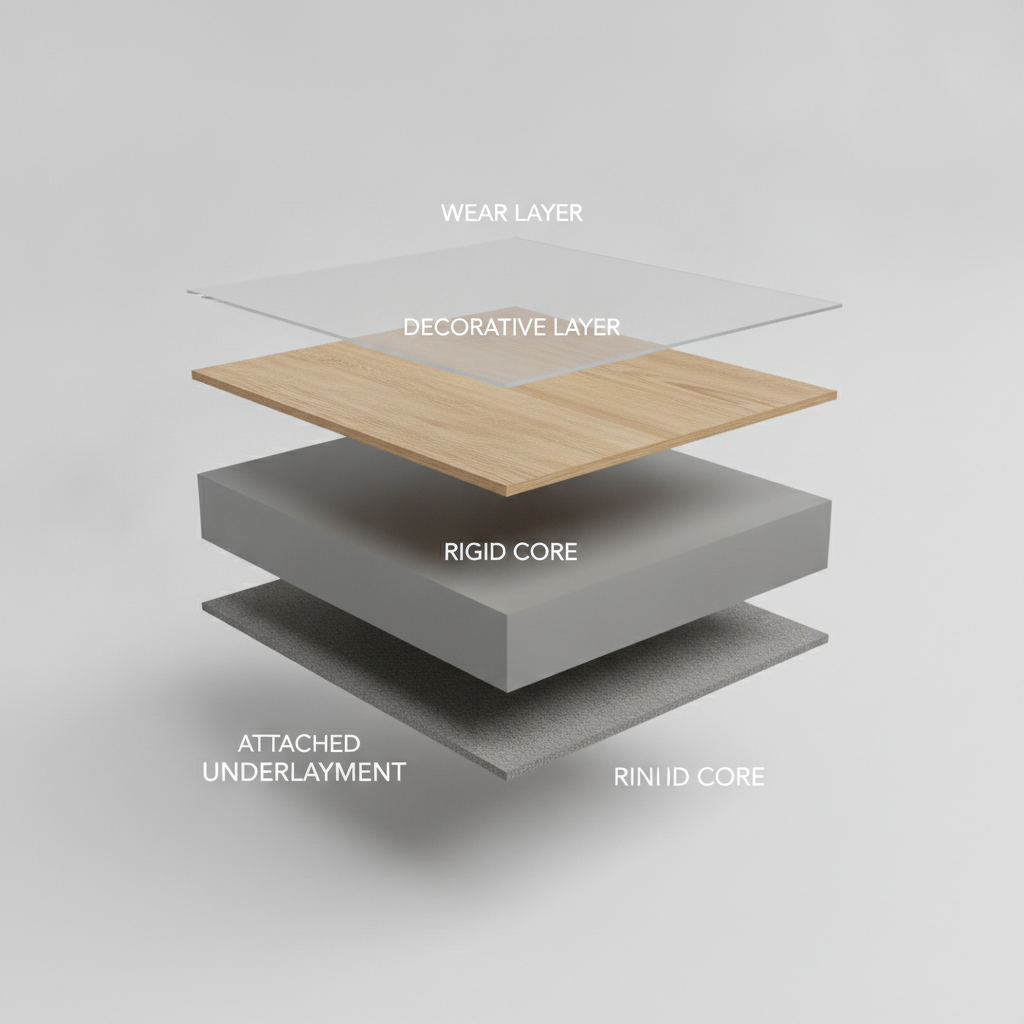
- Wear Layer: This is the transparent top coat that provides the primary defense against scratches, scuffs, and stains. Its thickness and quality are paramount to the floor’s long-term durability.
- Decorative Layer: A high-resolution printed film that gives the plank its stunningly realistic wood look. Advanced printing technology allows for a huge variety of species, colors, and grain patterns.
- Rigid Core: The heart of the plank. Made from a composite material that is 100% waterproof, it provides dimensional stability and prevents the plank from expanding, contracting, or buckling when exposed to moisture. This core is what makes hybrid flooring a perfect choice for any room, including basements and bathrooms.
- Attached Underlayment: Most hybrid floors come with a pre-attached pad made of cork or foam. This layer provides sound insulation, adds comfort underfoot, and can smooth over minor subfloor imperfections, often simplifying installation.
This composite structure creates a floor that is inert to water, highly durable, and incredibly easy to care for, delivering the aesthetic of hardwood with the performance demanded by modern life.
The 7-Step Framework for Choosing Your Perfect Hybrid Floor
Now that you understand the “what” and “why,” it’s time for the “how.” Don’t just look at color and price. Use this 7-step framework to analyze any hybrid flooring sample like a pro and make an informed decision. To make it even easier, we recommend using this guide to create a simple “Flooring Shopping Checklist” to take with you to the store.
Step 1: Decode the Core – SPC vs. WPC
The rigid core is the foundation of your floor, and it primarily comes in two types: SPC and WPC. Understanding the difference is key to matching the floor to your room’s needs.
- SPC (Stone Plastic Composite): This core is composed of approximately 70-80% limestone powder, PVC, and stabilizers. This dense, stone-based composition makes SPC cores incredibly rigid and highly resistant to dents from heavy furniture or dropped objects.
- WPC (Wood Plastic Composite): This core incorporates wood flour or pulp, PVC, and a foaming agent. The foaming agent makes the core lighter and less dense than SPC, giving it more cushioning and warmth underfoot. It also provides better sound insulation.
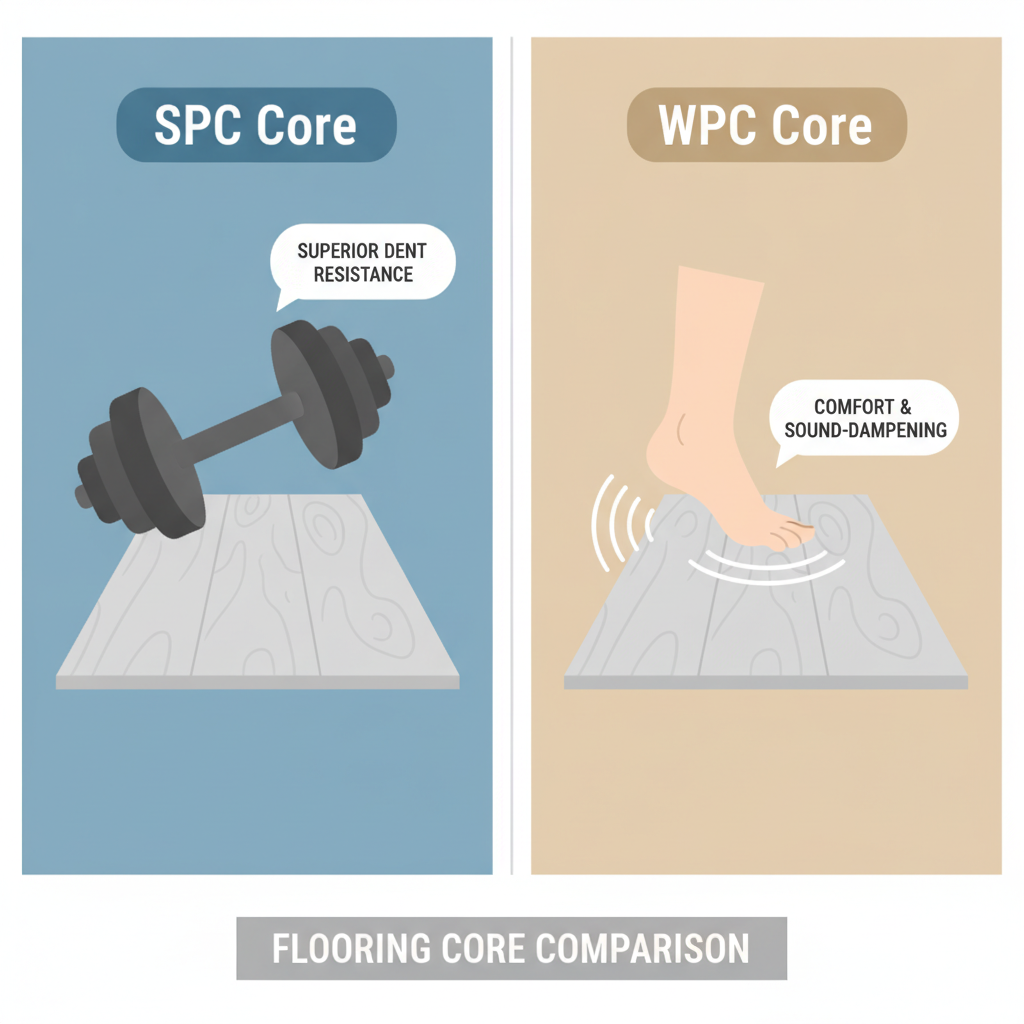
The Trade-Off:
- Dent Resistance: SPC is the clear winner. Its stone composition provides superior resistance to impact and heavy static loads.
- Comfort & Sound: WPC is the champion. The foaming agent makes it feel softer and warmer underfoot and helps dampen sound, making it a quieter floor to walk on.
Best For:
- Choose SPC for high-impact areas, kitchens with heavy appliances, home gyms, or any room where you anticipate heavy furniture.
- Choose WPC for living rooms, bedrooms, and family rooms where comfort underfoot and noise reduction are top priorities.
Step 2: Understand the Wear Layer (Your Floor’s Shield)
The wear layer is your floor’s invisible force field. It’s a clear, urethane-based coating that protects the beautiful decorative layer from everyday life. Its thickness is measured in “mils” (not to be confused with millimeters; 1 mil = 1/1000th of an inch).
This measurement is one of the most critical indicators of a floor’s durability.
- 6-12 mil: Suitable for light residential use, such as bedrooms or closets.
- 20 mil or higher: The gold standard for busy homes. If you have pets, active children, or plan to install the floor in a high-traffic area like an entryway or kitchen, a 20 mil wear layer is a must.
As one certified flooring installer puts it, “The difference between a 12 mil and a 20 mil wear layer is the difference between worrying about every little scrape and having true peace of mind. For a family with a golden retriever, that thicker layer is non-negotiable.”
Also, look for products that boast enhanced coatings with additives like aluminum oxide or ceramic beads. These are microscopic, ultra-hard minerals suspended in the finish that dramatically increase the floor’s resistance to scratches and scuffs, making it a truly scratch-resistant flooring solution.
Step 3: Judge the Realism (The Tech Behind the Look)
What makes the best waterproof flooring look just like wood? It’s all in the details. Go beyond the basic color and look for these key technologies:
- High-Definition Printing: The decorative layer should have crisp, clear graining without a blurry or pixelated appearance.
- Plank-to-Plank Variation: A quality product will have multiple unique plank patterns. Cheaper floors may repeat the same pattern every few planks, which is a dead giveaway that it isn’t real wood.
- Embossed in Register (EIR) Technology: This is the game-changer for realism. EIR means the texture you can feel on the surface of the plank perfectly matches the visual wood grain underneath. You can feel the knots and grain lines exactly where you see them, creating a hyper-realistic look and feel that is indistinguishable from real wood for most people.
To truly judge realism, create a “Realism Score” in your mind. Ask for a few sample planks, lay them on the floor, and look at them from different angles and under different lighting. Does it have EIR? Are the edges beveled to look like individual planks? How often does the pattern repeat? A high score here means a more convincing final look.
Step 4: Match Durability to Your Lifestyle (AC Ratings Explained)
Originally developed for laminate flooring, the Abrasion Class (AC) rating is now used for some high-end hybrid floors as well. This rating, standardized by the North American Laminate Flooring Association (NALFA), is a measure of a floor’s resistance to abrasion, impact, stains, and burns4. It’s a fantastic, data-driven way to gauge overall toughness.
- AC3 (Heavy Residential): Built to handle all areas of a typical home.
- AC4 (Heavy Residential / Moderate Commercial): A significant step up in durability. This is an excellent choice for a busy entryway, a home with large dogs, or even light commercial applications like a small boutique.
- AC5 (Heavy Commercial): The toughest rating available, designed for high-traffic commercial spaces like department stores or public buildings.
For most homes, an AC3 rating is sufficient. However, if you’re looking for maximum durability and peace of mind, choosing a floor with an AC4 rating is a smart investment.
Step 5: Evaluate the Locking System & Installation
The planks of a hybrid floor connect via a “click-lock” or “floating” system. The quality of this locking mechanism is crucial for two reasons: ease of installation and creating a tight, waterproof seal.
When you have a sample, click two pieces together. They should lock into place with a satisfying click and minimal effort. Once connected, try to pull them apart. A strong system will hold firm. The seam between the planks should be nearly invisible and perfectly flush. A poor locking system can lead to gaps over time, which can compromise the floor’s waterproof integrity.
While many hybrid floors are DIY-friendly, professional installation is often recommended to ensure the subfloor is properly prepared and the installation adheres to manufacturer warranty requirements. As one certified installer notes, “The most common DIY mistake is not leaving the proper expansion gap around the perimeter. This can cause the entire floor to buckle when temperatures change, and it almost always voids the warranty.” Adhering to professional best practices, like those outlined in the NWFA installation standards, is the best way to guarantee a long-lasting, beautiful result1.
Step 6: Verify Health & Safety (VOCs and Certifications)
Your floor is one of the largest surfaces in your home, and it can impact your indoor air quality. Volatile Organic Compounds (VOCs) are chemicals that can be released into the air from various building materials. To ensure you’re choosing a safe product, look for third-party certifications.
The most important one to look for is FloorScore® Certification5. Developed by the Resilient Floor Covering Institute (RFCI) and Scientific Certification Systems (SCS), this certification confirms that the flooring product meets strict indoor air quality standards for low VOC emissions. The EPA has extensively documented the health effects of poor indoor air quality, making this a critical consideration for a healthy home2. Always look for the FloorScore® logo on the product’s packaging or technical data sheet.
Putting It All Together: Room-Specific & Lifestyle Recommendations
Now let’s apply the 7-step framework to common real-world scenarios. To help visualize the best choice, you can use a simple “Durability Scorecard” to rate options on a 1-10 scale for features like Dent Resistance, Scratch Resistance, and Comfort, or a “Pet-Proof Flooring Matrix” that plots Scratch Resistance against Pet Comfort/Traction.
Best Hybrid Flooring for Homes with Pets and Kids
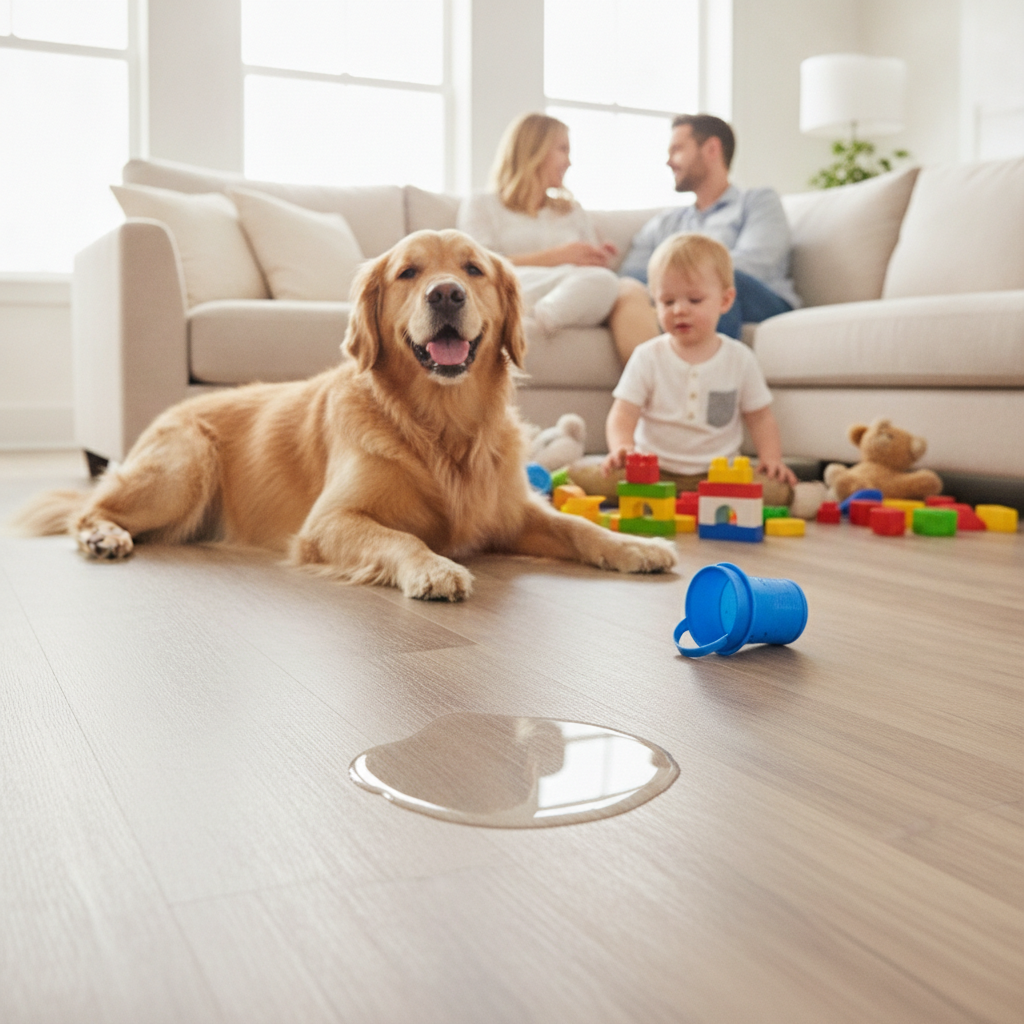
For a home bustling with the joyful chaos of children and pets, durability is the top priority. Your checklist should include:
- Wear Layer: A minimum of 20 mil is essential to stand up to claws, toys, and constant foot traffic.
- Core: An SPC core is highly recommended for its superior resistance to dents from dropped toys or heavy play.
- Durability Rating: Look for an AC4 rating for maximum scratch and abrasion resistance.
- Traction: Consider a floor with an Embossed in Register (EIR) texture. Beyond realism, the texture provides better traction for pets. The American Kennel Club (AKC) notes that good traction is important for a dog’s joint health, especially for older dogs or breeds prone to hip issues6.
Top Choices for High-Traffic & Commercial Use
For entryways, mudrooms, home offices with rolling chairs, or even light commercial spaces, you need a floor that can withstand concentrated wear and heavy loads.
- Core: SPC is the only choice here. Its high density provides excellent static load resistance, meaning it won’t dent under heavy furniture, shelving units, or rolling office chairs.
- Durability: An AC4 or AC5 rating is ideal.
- Warranty: Ensure the product comes with a commercial warranty, which guarantees its performance under more demanding conditions.
A great example is a home’s main entryway, which sees heavy foot traffic and abrasive grit tracked in from outside. An SPC core floor with a 20+ mil wear layer and an AC4 rating will look brand new for years, while a lesser floor would quickly show wear patterns.
Best Waterproof Options for Basements, Bathrooms, and Kitchens
This is where waterproof hybrid flooring truly shines. Because the SPC and WPC cores are 100% waterproof, they are the perfect wood-look solution for these moisture-prone areas.
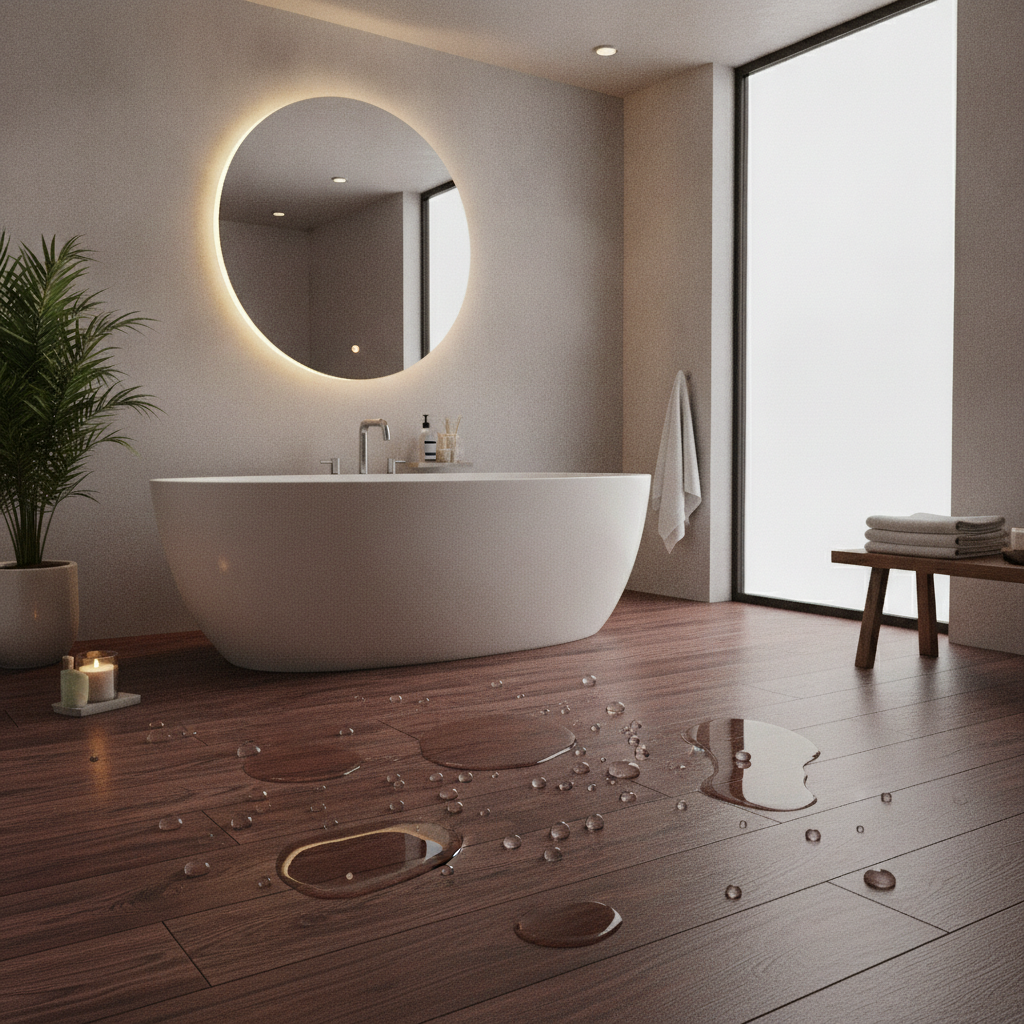
- Core: Either SPC or WPC will provide the necessary waterproof protection.
- Installation: This is critical. The floor itself is waterproof, but the system is only as good as the installation. A professional installer will ensure the subfloor is properly prepared and sealed.
As one IICRC-certified restoration professional states, “In a basement, you’re not just worried about spills; you’re worried about hydrostatic pressure and ambient moisture. A truly waterproof floor like rigid core is your best defense, but only if it’s installed as a complete system.”7
Maintaining Your Low-Maintenance Floor
One of the best features of hybrid flooring is how easy it is to maintain. Forget waxing, polishing, or refinishing. Simple, regular care is all that’s needed.
- Daily/Weekly: Sweep, dust mop, or vacuum (using a hard floor setting without a beater bar) to remove grit and dirt that can act like sandpaper over time.
- As Needed: For deeper cleaning, use a damp mop with a pH-neutral flooring cleaner. Industry leaders like Bona8 and the NWFA1 strongly advise against using steam mops, as the high heat and pressure can damage the wear layer and potentially void your warranty. Avoid harsh chemicals, vinegar, or “mop and shine” products that can leave a dulling film.
For common spills, a simple damp cloth is usually sufficient. A quick-wipe approach prevents any potential staining and keeps your floors looking their best.
Frequently Asked Questions (FAQ)
How much does waterproof hybrid flooring cost?
The cost can vary widely based on brand, quality, and features. Generally, you can expect to pay between $3 to $8 per square foot, including professional installation. Thicker wear layers, more realistic EIR textures, and premium brand names will be at the higher end of that range.
Is hybrid flooring better than luxury vinyl plank (LVP)?
This can be confusing because the terms are often used interchangeably. “Hybrid flooring” typically refers to the newer generation of rigid core LVP, which includes SPC and WPC. Older LVP was often a more flexible product. In general, a rigid core hybrid floor is considered a superior product due to its greater dimensional stability, dent resistance, and ability to hide subfloor imperfections. For official definitions, you can refer to the Resilient Floor Covering Institute (RFCI)3.
Can you use a steam mop on waterproof hybrid flooring?
No. This is one of the most common and damaging maintenance mistakes. Even though the core is waterproof, the intense heat and pressurized steam from a steam mop can damage the wear layer, weaken the adhesives holding the layers together, and force moisture into the seams. Nearly all manufacturer warranties and NWFA cleaning guidelines explicitly state not to use steam mops and doing so will void your warranty1.
Your Confident Choice for a Beautiful, Worry-Free Home
Choosing a new floor is a major investment, and it’s easy to feel lost in a world of technical specifications. But you are now equipped with a powerful 7-step framework to see past the marketing and understand what truly matters. You can walk into any flooring store, pick up a sample, and know exactly what to look for: the core type, the wear layer thickness, the realism of the texture, and the safety certifications.
You are now empowered to choose the perfect waterproof hybrid floor that not only matches your design vision but is also perfectly suited to your unique lifestyle. You can finally have the stunning look of hardwood in any room of your home, with the peace of mind that comes from knowing it can handle whatever your busy life throws at it.
Ready to find your perfect floor? Use the knowledge you’ve gained to make your final decision with confidence.
Disclaimer: This article contains general advice. Always consult manufacturer specifications and a professional flooring installer for your specific project needs and warranty requirements.
Authoritative Sources & References
- National Wood Flooring Association (NWFA). (n.d.). Maintenance & Recoating. NWFA. Retrieved from https://www.nwfa.org/maintenance/
- Environmental Protection Agency (EPA). (n.d.). A Brief Guide to Mold, Moisture, and Your Home. EPA.gov. Retrieved from https://www.epa.gov/mold/brief-guide-mold-moisture-and-your-home
- Resilient Floor Covering Institute (RFCI). (n.d.). Rigid Core LVT. RFCI. Retrieved from https://rfci.com/
- North American Laminate Flooring Association (NALFA). (n.d.). AC Rating. NALFA. Retrieved from https://nalfa.com/ac-rating/
- SCS Global Services. (n.d.). FloorScore®. Retrieved from https://www.scsglobalservices.com/services/floorscore
- American Kennel Club (AKC). (n.d.). The Best Flooring for Dogs. AKC.org. Retrieved from https://www.akc.org/expert-advice/home-living/the-best-flooring-for-dogs/
- Institute of Inspection, Cleaning and Restoration Certification (IICRC). (n.d.). IICRC Global Resource Center. Retrieved from https://iicrc.org/
- Bona. (n.d.). Hard-Surface Floor Cleaners. Bona US. Retrieved from https://us.bona.com/home.html
