
It’s the timeless dilemma for homeowners and designers alike: the desire for the warm, authentic beauty of hardwood floors in every corner of the home, met with the cold, hard reality of water. For years, installing wood in kitchens, bathrooms, or basements was a gamble against splashes, spills, and humidity—a recipe for warped planks and costly repairs. This forced a compromise, sacrificing the seamless flow of wood for the practicality of tile or vinyl in the very rooms where we live our lives most. But what if that compromise was no longer necessary?
Enter Bravewood Waterproof Hybrid Hardwood, an innovative flooring solution designed to shatter the old rules. This isn’t just another wood-look alternative; it’s a revolutionary product that combines a genuine hardwood veneer with a 100% waterproof core, finally allowing the elegance of wood to exist in the most demanding, moisture-prone areas of your home. This guide is your complete lifecycle resource for Bravewood—we’ll take you from understanding the science behind its durability and selecting the perfect style to mastering installation and ensuring a lifetime of worry-free beauty.
- The End of an Era: Why Traditional Hardwood Fails in Wet Areas
- What is Bravewood? Deconstructing Waterproof Hybrid Hardwood
- Design Without Compromise: Bravewood Style Solutions for Your Home
- Bravewood vs. The Alternatives: A Head-to-Head Comparison
- Bulletproof Your Investment: Installation and Care for Bravewood Floors
- Frequently Asked Questions about Bravewood Hybrid Hardwood
- Conclusion
- References
The End of an Era: Why Traditional Hardwood Fails in Wet Areas
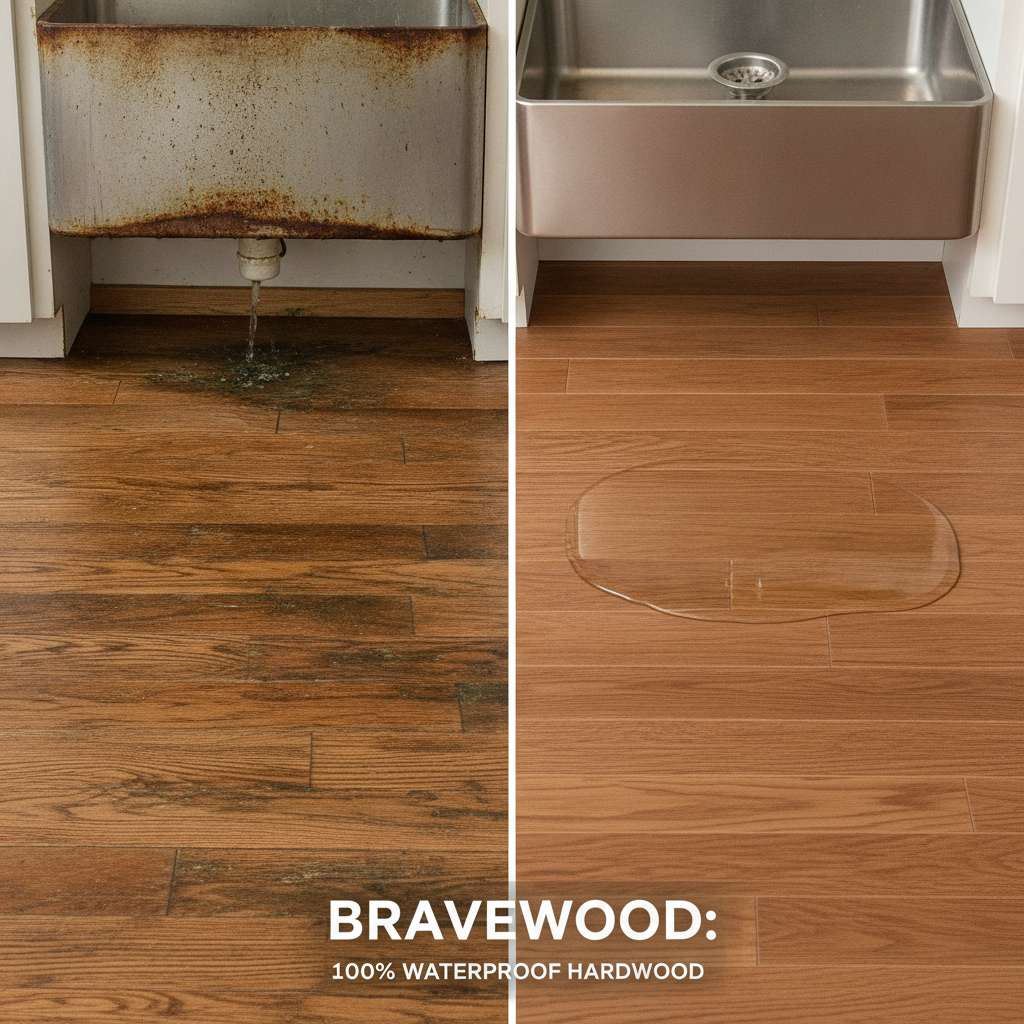
To appreciate the innovation of hybrid hardwood, we must first understand why its traditional counterpart is so vulnerable to moisture. Solid hardwood is a natural, porous material. Like a sponge, its wood cells absorb and release moisture from the environment. This is manageable in stable conditions, but in a kitchen or bathroom, it leads to disaster. According to the National Wood Flooring Association (NWFA), maintaining a stable environment and managing moisture exposure are the most critical factors for the longevity of any wood floor [1]. When these principles are violated, the damage is predictable and often severe.
This is where homeowners encounter problems like water damaged hardwood and flooring warping in the bathroom. The Institute of Inspection, Cleaning and Restoration Certification (IICRC), which sets the professional standard for water damage restoration, classifies these issues based on their severity, but for a homeowner, they manifest in a few distinct ways [2]:
- Cupping: When the edges of a plank are higher than its center, creating a concave shape. This happens when the bottom of the board absorbs more moisture than the top, causing the underside to expand. You’ll see this often after a slow leak or in a high-humidity environment.
- Crowning: The opposite of cupping, where the center of the plank is higher than its edges. This typically occurs when the surface of the floor has been exposed to a significant amount of water, like a spill left too long, causing the top layer to swell.
- Buckling: This is the most extreme form of water damage, where the flooring lifts entirely off the subfloor. Buckling is a clear sign of a major water event, such as a kitchen floor water damage incident from a burst pipe or appliance flood, and indicates that the flooring has expanded so much it has nowhere else to go but up.
These issues aren’t just cosmetic; they can signal deeper problems like subfloor rot or mold growth. This inherent vulnerability is precisely the problem that Bravewood was engineered to solve forever.
What is Bravewood? Deconstructing Waterproof Hybrid Hardwood
Bravewood isn’t just a surface treatment or a clever marketing term; it’s a fundamental re-engineering of wood flooring. It belongs to a category called hybrid hardwood, a product that delivers the best of both worlds: an authentic wood surface and a technologically advanced, waterproof core.
To understand what makes Bravewood so revolutionary, let’s look at its construction, layer by layer:
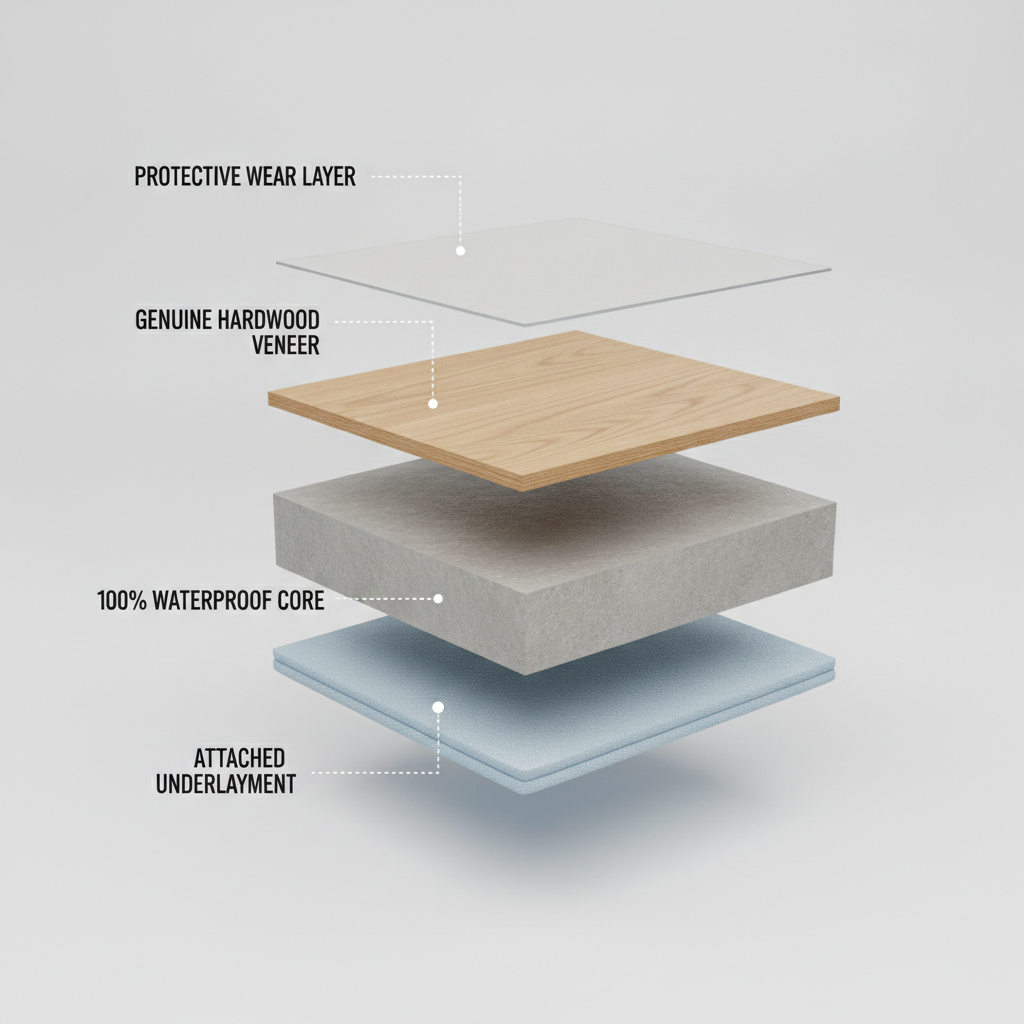
- Protective Wear Layer: The top surface is coated with a high-durability finish, often containing aluminum oxide, which resists scratches, scuffs, and stains from daily life.
- Genuine Hardwood Veneer: This is the magic. Unlike laminate or vinyl which feature a printed image of wood, Bravewood has a top layer of real, sliced hardwood. This provides the unique grain patterns, texture, and natural variation that can only come from authentic wood.
- 100% Waterproof Core: This is the engine of the product. Instead of a wood-based core that would swell on contact with water (like in traditional engineered hardwood), Bravewood uses a composite core made of stone-polymer composite (SPC) or a similar inert, rigid material. This core is completely impervious to water, meaning it will not swell, warp, or buckle, no matter how wet it gets. This construction is validated by rigorous performance testing based on standards from organizations like ASTM International, which sets benchmarks for water resistance in building materials [3].
- Attached Underlayment: Most Bravewood planks come with a pre-attached pad that provides acoustic insulation, reduces noise, and adds comfort underfoot, simplifying the installation process.
The key difference between hybrid hardwood and traditional engineered hardwood lies in that core. While both use a real wood veneer, engineered hardwood’s core is typically made of plywood or fiberboard—materials that will absorb water and fail in a wet environment. Bravewood’s waterproof core eliminates this fatal flaw, making it a true waterproof wood look flooring solution.
Design Without Compromise: Bravewood Style Solutions for Your Home
For too long, choosing a floor for a wet area meant a design compromise. Bravewood eliminates this, offering stylish flooring options for wet areas that integrate seamlessly with any aesthetic. Because you’re getting a real wood veneer, you get the authentic character that elevates a room’s design in a way that printed replicas cannot. As leading design authorities like the National Kitchen & Bath Association (NKBA) often note, using natural materials is key to creating warm, inviting, and high-value spaces [4].
Imagine Bravewood’s versatility in popular design styles:
- Modern Farmhouse: The subtle grain of a light, wide-plank oak Bravewood floor provides the perfect rustic-yet-refined foundation for a kitchen with white shaker cabinets and soapstone countertops.
- Coastal: A bleached or whitewashed Bravewood style can evoke the breezy feel of a seaside cottage in a bathroom, pairing beautifully with navy vanities and brass fixtures.
- Minimalist: The clean lines and consistent tones of a maple or walnut Bravewood floor can create a warm, organic base in a sleek, modern bathroom without the coldness of tile.
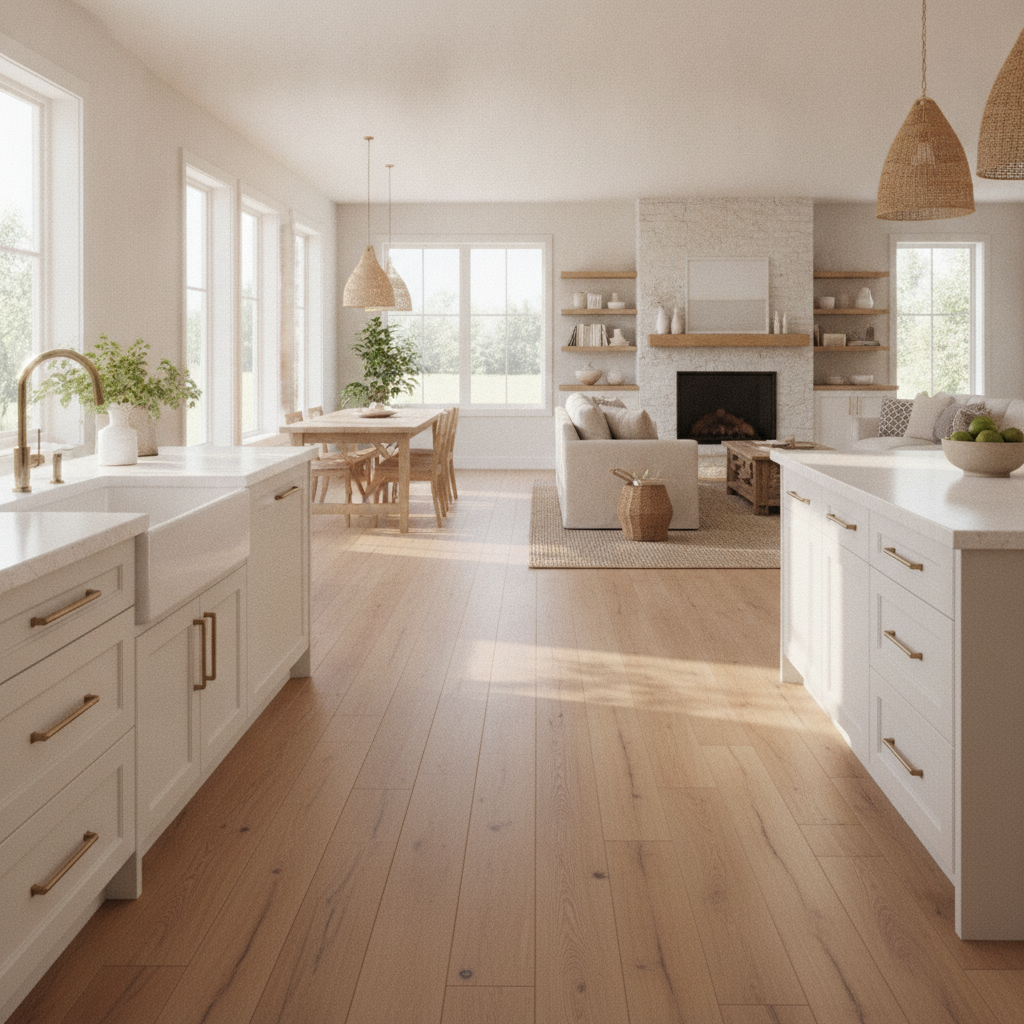
The ability to carry a single, continuous wood floor from the living room directly into the kitchen without interruption is a game-changer for open-concept design. It creates a sense of flow and luxury that was previously impossible without risking water damage.
For the Heart of the Home: Why Bravewood is the Best Waterproof Flooring for Kitchens
The kitchen is the ultimate proving ground for any floor. It faces a daily assault of spills, dropped utensils, heavy appliances, and relentless foot traffic. Bravewood is engineered to handle it all, making it arguably the best waterproof flooring for kitchens. Its durability comes from two key features: the waterproof core that protects against leaks from the sink, dishwasher, or refrigerator, and a robust wear layer that defends against physical damage. This commercial-grade urethane and aluminum oxide coating provides superior resistance to scratches and dents, ensuring the floor remains beautiful for years.
To truly protect your investment, however, flooring is only half the battle. From an appliance technician’s perspective, preventative maintenance is key.
Kitchen Appliance Leak Prevention Checklist:
- Dishwasher: Annually inspect the water supply line for cracks or brittleness. Ensure the door seal is clean and free of debris.
- Refrigerator: If you have an ice maker or water dispenser, check the plastic or copper water line behind the fridge every six months for kinks or leaks. Empty and clean the drain pan regularly.
- Sink: Routinely check under the sink for drips from the faucet supply lines, P-trap, or garbage disposal connections.
For the Personal Oasis: Using Bravewood Hybrid Hardwood in Bathrooms
Using a wood floor in a full bathroom has long been considered taboo, and for good reason. The combination of direct splashes from tubs and showers with constant high humidity can quickly destroy traditional wood or even water-resistant laminate. This is where Bravewood’s waterproof hybrid hardwood for bathrooms truly shines, but it’s also where skepticism is highest.
Myth vs. Reality: Bravewood in a Full Bathroom
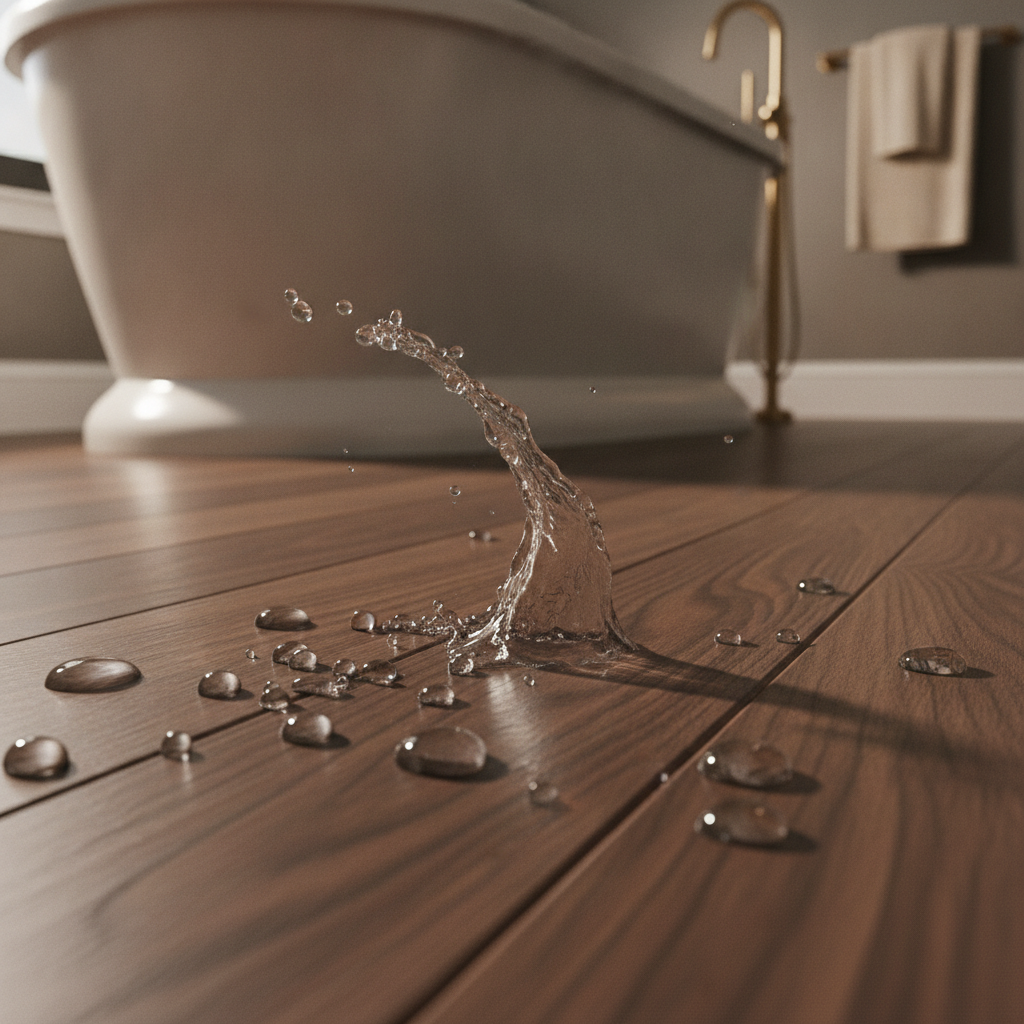
- Myth: Any wood product will eventually be damaged by bathroom humidity.
- Reality: Bravewood’s waterproof core is completely unaffected by moisture or humidity. It will not swell, cup, or warp. The key is proper installation—ensuring a tight fit between planks and using a 100% silicone sealant around the perimeter of the room and fixtures (toilets, tubs) to prevent water from getting under the floor, which is crucial for any floating floor installation.
It’s also vital to understand the warranty. Most manufacturers will warranty Bravewood for use in a full bathroom, provided their specific installation instructions are followed to the letter. This typically includes guidelines on subfloor preparation and perimeter sealing.
Before installing any new floor, however, it’s critical to ensure there are no existing leaks.
A new floor is just a beautiful cover-up for a bigger problem. Before you lay a single plank, check the toilet’s wax ring, the tub and shower seals, and the vanity supply lines. A small, hidden leak can lead to subfloor rot and mold, which no flooring can fix.
Bravewood vs. The Alternatives: A Head-to-Head Comparison
How does Bravewood stack up against other popular waterproof flooring options? Here’s a breakdown to help you make the most informed decision.
| Feature | Bravewood Hybrid Hardwood | Luxury Vinyl Plank (LVP) | Wood-Look Porcelain Tile | Waterproof Laminate |
|---|---|---|---|---|
| Visual Realism | 5/5 (Real wood veneer) | 4/5 (High-def image) | 3/5 (Realistic but grout lines) | 4/5 (High-def image) |
| Feel Underfoot | 5/5 (Warm, authentic) | 3/5 (Softer, less rigid) | 2/5 (Hard, cold) | 3/5 (Can feel hollow) |
| Durability (Scratch/Dent) | 4/5 (Strong wear layer) | 4/5 (Resilient to dents) | 5/5 (Very scratch resistant) | 3/5 (Prone to chipping) |
| Waterproofing Method | 100% Waterproof Core | 100% Waterproof Core | 100% Waterproof Material | Water-resistant top/core |
| Average Cost (Installed) | $$$$ | $$ | $$$ | $$ |
The Visual Realism Showdown:
While LVP and waterproof laminate have made incredible strides with high-definition printing and “embossed in register” textures that align the visual grain with the physical texture, they are still repeating patterns. Bravewood, with its real wood veneer, offers the natural, non-repeating grain and character that is unique to each plank. Tile is incredibly durable, often carrying a high PEI rating for abrasion resistance [5], but the necessary grout lines can break the illusion of a continuous wood floor. For the homeowner who wants the undeniable authenticity of wood, Bravewood is in a class of its own.
Bulletproof Your Investment: Installation and Care for Bravewood Floors
A waterproof floor is only as good as its installation. The most common failures in wet areas are not due to the product itself, but to improper preparation and installation that allows water to get trapped underneath the flooring. Following manufacturer guidelines and best practices from organizations like the Resilient Floor Covering Institute (RFCI) is non-negotiable [6].
Critical Subfloor Preparation Steps:
- Level and Flat: The subfloor must be perfectly flat. Any high or low spots can cause the locking mechanisms between planks to fail, creating gaps where water can penetrate.
- Clean and Dry: The subfloor must be thoroughly cleaned of all debris and be completely dry before installation begins.
- Address Existing Issues: Any existing damage, leaks, or moisture problems in the subfloor must be professionally remediated before proceeding.
Long-Term Care and Maintenance:
Maintaining your Bravewood floor is simple. Regular sweeping or vacuuming (using a hard floor setting) and occasional cleaning with a pH-neutral cleaner designed for hardwood floors is all that’s needed. Never use a steam mop, wax, or oil-based soaps, as these can damage the finish. For spills, simply wipe them up with a damp cloth. This simple routine will keep your floors looking new for decades.
Frequently Asked Questions about Bravewood Hybrid Hardwood
Q: Does hybrid hardwood feel like real wood underfoot?
A: Yes. Because the top layer is genuine hardwood and it’s installed over a rigid core, it feels much more solid and authentic underfoot compared to the slightly softer feel of LVP or the hollow sound of some laminates.
Q: What is the average cost to install waterproof flooring in a kitchen?
A: Costs vary widely by region and product quality, but generally, Bravewood hybrid hardwood is a premium product, often costing more than LVP and waterproof laminate but comparable to or slightly less than professionally installed porcelain tile. Always get multiple quotes for your specific project.
Q: How do I maintain and clean waterproof kitchen floors?
A: The best method is the simplest: sweep or vacuum regularly to remove abrasive grit. For cleaning, use a microfiber mop lightly dampened with a manufacturer-approved or pH-neutral hard surface cleaner. The key is to avoid flooding the floor with water or using harsh chemicals.
Conclusion
Bravewood Waterproof Hybrid Hardwood represents a true paradigm shift in home design. It resolves the age-old conflict between the timeless beauty of wood and the practical demands of modern life. With its innovative construction, you can finally have the uninterrupted, elegant flow of authentic hardwood in your kitchen, bathroom, and every room in between, without the constant fear of water damage. This guide has empowered you with the knowledge to not only choose this revolutionary flooring with confidence but also to ensure its performance and beauty for a lifetime.
Ready to bring the timeless beauty of hardwood into every room of your home, worry-free? Explore the full Bravewood collection and find a certified dealer near you today.
Disclaimer: This article provides general guidance. Always consult with a professional flooring installer for your specific project and follow manufacturer installation instructions to the letter to ensure warranty compliance.
References
- National Wood Flooring Association (NWFA). (n.d.). Technical Guidelines on Wood Flooring and Moisture. Retrieved from the official NWFA website.
- Institute of Inspection, Cleaning and Restoration Certification (IICRC). (n.d.). S500 Standard for Professional Water Damage Restoration. Retrieved from the official IICRC website.
- ASTM International. (n.d.). Standard Test Methods for Water Resistance and Performance of Building Materials. Retrieved from the official ASTM International website.
- National Kitchen & Bath Association (NKBA). (n.d.). Kitchen and Bathroom Planning Guidelines. Retrieved from the official NKBA website.
- Porcelain Enamel Institute (PEI). (n.d.). PEI Rating System for Abrasion Resistance of Glazed Tile. Retrieved from industry resources on tile standards.
- Resilient Floor Covering Institute (RFCI). (n.d.). Recommended Work Practices for the Installation of Resilient Flooring. Retrieved from the official RFCI website.
