
There is an ultimate design dilemma that plagues nearly every homeowner and DIY remodeler: the deep desire for the warm, authentic aesthetic of hardwood in a bathroom, pitted against the sheer terror of water damage, warping, and subfloor rot. For decades, the industry consensus has been clear—traditional solid wood fails spectacularly in high-humidity zones. But what if you no longer had to choose between elegance and endurance?
Welcome to a science-backed masterclass on navigating waterproof flooring options. In this definitive guide, we will bridge the gap between stunning aesthetics and commercial-grade durability by introducing Bravewood Hybrid Hardwood. We will provide a clear roadmap to diagnosing traditional wood failures, decoding deceptive “waterproof” industry jargon, conducting a deep-dive review of Bravewood’s capabilities, and executing expert installation and prevention protocols to protect your home for decades to come.
- The Reality of Hardwood in Bathrooms: Why Traditional Wood Fails
- Decoding ‘Waterproof’ Flooring Terminology
- Enter Bravewood Hybrid Hardwood: A Technical Deep Dive
- Is Bravewood Hybrid Hardwood Good for Bathrooms? Weighing Pros and Cons
- Preventing and Triage: Bathroom Floor Water Damage & Rot
- Installation Masterclass: Moisture Resistant Hardwood
- Conclusion
- References & Authoritative Sources
The Reality of Hardwood in Bathrooms: Why Traditional Wood Fails
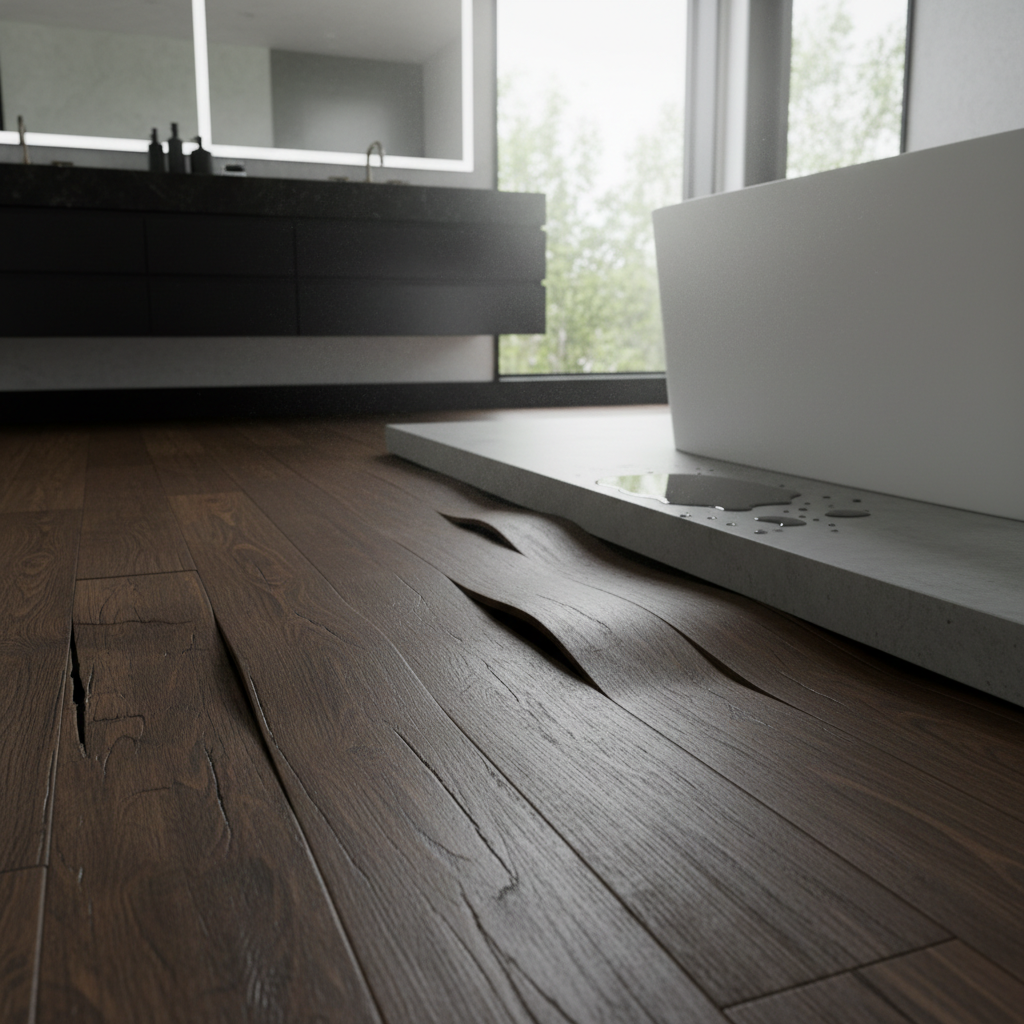
To understand why bathroom hardwood flooring is traditionally a risky endeavor, we must look at the fundamental science of the material. Solid hardwood acts much like a rigid sponge; it is highly susceptible to the ambient environment. The National Wood Flooring Association (NWFA) strictly outlines how moisture and humidity swings dictate wood expansion and contraction [1].
This process is governed by the physics of wood hygroscopy—the ability of wood fibers to absorb and release moisture from the surrounding air. In a bathroom, where hot showers create daily spikes in humidity and splashed water frequently hits the floor, wood absorbs this moisture unevenly. As the fibers swell, the dimensional stability of the plank is compromised, leading to inevitable structural failures.
Diagnosing Warped Hardwood: Cupping vs. Buckling
When moisture infiltrates a wood floor, it rarely does so uniformly. Understanding what happens to hardwood floors in a bathroom requires diagnosing the specific type of warped hardwood in the bathroom.
Cupping occurs when the bottom of the wood plank absorbs more moisture than the top, causing the edges of the board to rise higher than its center. This is almost always indicative of a subfloor leak or trapped moisture beneath the planks. Conversely, crowning happens when the surface of the floor is wetter than the bottom, often caused by ambient humidity or standing surface water.
Professional restoration experts note that the mechanics of cupping are a direct result of this moisture imbalance [2]. If you are dealing with cupped floors, it is critical to advise against sanding them before they are fully dry. Sanding a cupped floor prematurely will flatten it temporarily, but once the wood finally dries and shrinks, the edges will sit lower than the center, resulting in permanent “crowning.”
Decoding ‘Waterproof’ Flooring Terminology
The flooring industry is rife with marketing jargon that can cause decision paralysis. To find durable waterproof bathroom flooring, you must clearly differentiate between “water-resistant” and “100% waterproof.”
Water-resistant flooring (like many engineered hardwoods or standard laminates) provides temporary protection; it can withstand a spill for a few hours, but prolonged exposure will eventually cause the core to swell. True waterproof hardwood means the material itself will not absorb water, even if submerged. However, it is vital to differentiate technically between “waterproof” (the material itself) and “water-tight” (the installation). A floor can be made of 100% waterproof planks, but if the seams are not water-tight, moisture can still penetrate and ruin your subfloor. Independent durability testing methodologies, such as those rigorously conducted by Consumer Reports, consistently verify these claims, separating marketing hype from actual performance [3].
Luxury Vinyl Plank (LVP) vs. Engineered Hardwood vs. Hybrid
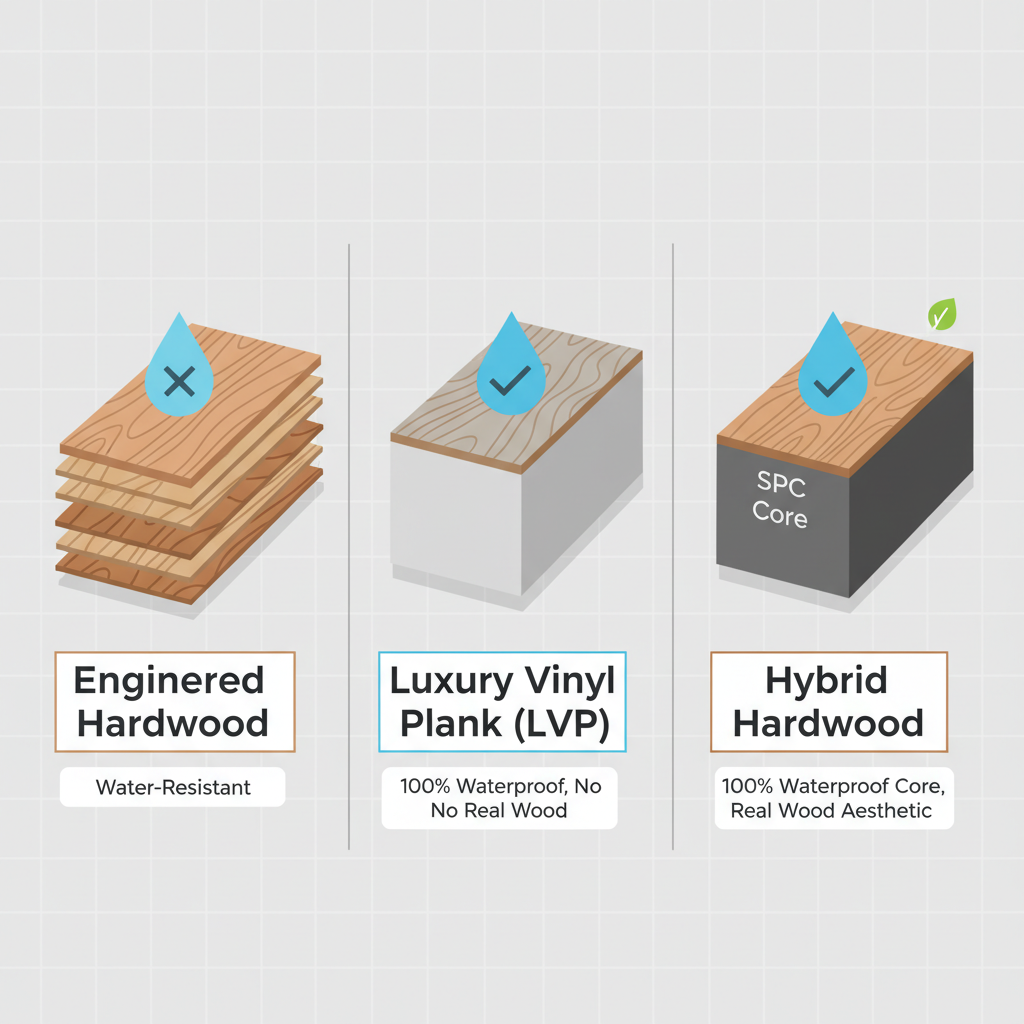
- Engineered Hardwood: Features a real wood veneer over a plywood core. While more dimensionally stable than solid wood, it is generally only water-resistant, making it a risky choice for heavy splash zones.
- Luxury Vinyl Plank (LVP): Made entirely of PVC and synthetic materials, LVP is 100% waterproof and highly durable, but it lacks the authentic texture and warmth of real timber.
- Hybrid Hardwood: The ultimate compromise. It bonds a micro-veneer of real wood to a 100% waterproof rigid core.
When selecting a hybrid or vinyl product, the core type matters. For a bathroom’s expected heavy moisture load, a Stone Plastic Composite (SPC) core is highly recommended over a Wood Plastic Composite (WPC) core, as SPC is denser, more impact-resistant, and entirely impervious to water.
Enter Bravewood Hybrid Hardwood: A Technical Deep Dive
Bravewood hybrid hardwood represents the premier solution for wet environments, offering the genuine aesthetic of timber without the vulnerability. To understand its efficacy, we must look at its specific anatomy.
According to exact manufacturer specifications from TAS Flooring, Bravewood features a robust 12mm overall thickness [4]. A cross-sectional breakdown of its layers reveals exactly how it achieves its waterproof status:
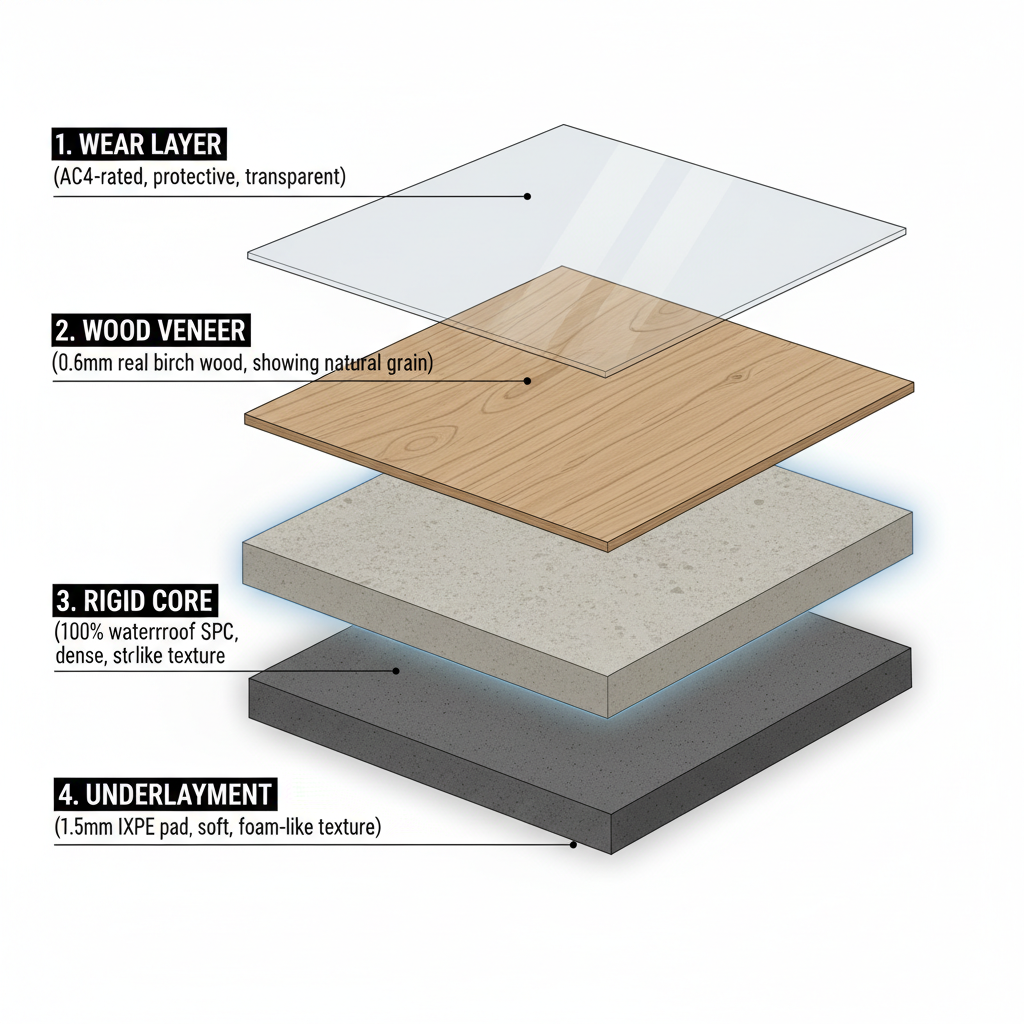
- Wear Layer: A high-performance, AC4-rated protective topcoat.
- Wood Veneer: A 0.6mm real birch wood veneer, providing an authentic, embossed-in-register texture.
- Rigid Core: A 100% waterproof SPC core that provides structural stability and prevents swelling.
- Underlayment: An attached 1.5mm IXPE pad for acoustic and moisture defense.
The Power of the AC4 Antimicrobial Finish
What does the AC4 rating on Bravewood flooring mean for a residential space? The AC (Abrasion Class) scale measures durability. An AC4 rating indicates commercial-grade durability, meaning it is highly resistant to scratches, dents, and heavy foot traffic.
More importantly for wet zones, this finish is antimicrobial. Bathrooms are warm, damp, and frequently traversed barefoot, making them breeding grounds for bacteria. The AC4 antimicrobial surface finish actively resists mold and bacteria growth, ensuring a hygienic environment that traditional wood simply cannot offer.
Integrated IXPE Pad: Acoustic and Moisture Defense
Beneath the rigid core lies an attached 1.5mm IXPE (Irradiated Cross-Linked Polyethylene) pad. This underlayment plays a dual role. First, it provides excellent acoustic insulation, dampening the hollow “clicking” sound often associated with floating floors. Second, and most critically for bathrooms, it acts as a built-in moisture barrier. The IXPE pad prevents trapped subfloor moisture from rising into the flooring planks, significantly reducing the risk of hidden mold growth.
Is Bravewood Hybrid Hardwood Good for Bathrooms? Weighing Pros and Cons
Before committing to a long-term investment, it is essential to weigh the pros and cons of hybrid hardwood in bathrooms. Is Bravewood hybrid hardwood good for bathrooms? Yes, but an objective review requires looking at both its strengths and its technical limitations.
The Advantages for Wet Zones
The primary advantage is absolute peace of mind. TAS Flooring confirms the 100% waterproof capabilities of the Bravewood collection [4]. You achieve the authentic visual warmth of a real birch veneer, but with a core that can theoretically be submerged in water without swelling. Combined with the antimicrobial finish and the acoustic benefits of the pre-adhered underlayment, it is tailor-made for high-moisture residential spaces.
Potential Drawbacks and Considerations
However, there are trade-offs. Hybrid hardwood is generally more expensive than standard luxury vinyl plank. Additionally, in brightly sunlit bathrooms, there is a potential for UV discoloration over time, a common trait of natural wood veneers.
Furthermore, transparency is required regarding maintenance: due to the ultra-thin 0.6mm real wood veneer, you cannot deeply sand or refinish this floor if it gets severely gouged. Finally, hybrid floors have strict subfloor flatness requirements. Because the SPC core is rigid, installing it over an uneven subfloor can cause the locking mechanisms to break. You must also account for thermal expansion; leaving proper expansion gaps around the perimeter of the bathroom is an absolute necessity to prevent the floor from buckling as temperatures fluctuate.
Preventing and Triage: Bathroom Floor Water Damage & Rot
Even with 100% waterproof flooring, your bathroom is not invincible. If plumbing fails, water can seep past the baseboards and into the subfloor. Addressing bathroom floor water damage promptly is the only way to prevent catastrophic structural issues.
Emergency Triage: How to Fix a Water Damaged Bathroom Floor
If you discover trapped water, immediate action is required. Does a wet subfloor always need to be replaced? Not if you act fast. According to guidelines from FEMA and institutional environmental health and safety boards, water sitting for longer than 48 hours significantly increases the likelihood of toxic mold development [5].
Your triage timeline should be:
- Stop the source: Shut off the water supply immediately.
- Extract and dry: Remove surface water and set up commercial dehumidifiers and air movers. The goal is to dry the area completely within the critical 48-hour window.
- Assess: Once dry, evaluate the subfloor.
It is important to state clearly that if the water damage covers more than 10 square feet, or involves contaminated “black water” from a toilet backup, it typically requires professional restoration services.
Proactive Subfloor Protection Against Dry Rot
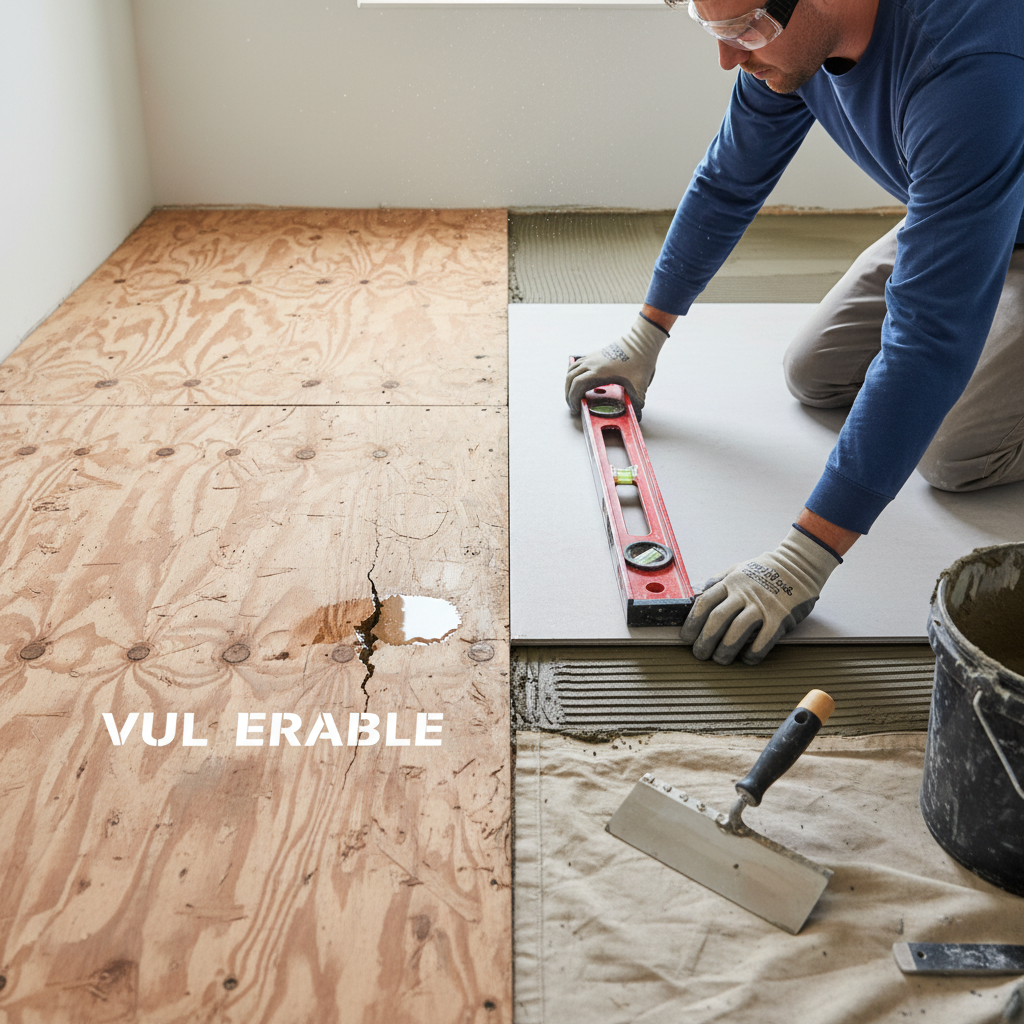
Preventing bathroom floor rot requires moving beyond surface aesthetics to structural integrity. Early signs of a rotting subfloor include soft, spongy spots underfoot, cracked grout, or a persistent musty odor.
If you are replacing a floor, proactive subfloor protection is paramount. Standard plywood is highly vulnerable to moisture. Industry best practices recommend using specific structural materials like marine-grade plywood or cement backer board for bathroom subfloors. Furthermore, installing a waterproofing uncoupling membrane (such as Schluter-Ditra) beneath your tile or flooring provides an impenetrable barrier, ensuring that even if surface water bypasses your flooring, it will never reach the vulnerable wood joists below.
Installation Masterclass: Moisture Resistant Hardwood
Achieving a long lasting bathroom floor replacement hinges entirely on the quality of the installation. A premium waterproof product will still fail if the installation allows water to reach the subfloor.
Acclimation and Moisture Testing
Proper moisture resistant hardwood installation begins before a single plank is laid. You must directly follow the NWFA Installation Guidelines [1]. First, the flooring must acclimate to the room’s environment. The ideal interior environment for hardwood and wood-hybrids is 30-50% relative humidity and a temperature between 60-80°F.
Next, you must test the subfloor moisture. It is crucial to understand the technical difference between moisture meters: use a pinless (dielectric) meter for scanning large areas without damaging the surface, and a pin (electrical resistance) meter to get exact depth readings of the wood’s moisture content.
Finally, you must calculate expansion gaps. Wood expands mathematically based on moisture. For example, traditional red oak has a specific change coefficient of .00369, which installers use to calculate exactly how much of an expansion gap is needed at the walls to prevent buckling. While hybrid floors are more stable, they still require calculated perimeter gaps to accommodate thermal expansion.
Can Bravewood Be Installed Over Existing Tile?
A common question for remodelers is whether Bravewood can be installed over existing bathroom tile. The short answer is yes, as it is a floating floor. However, there is a major caveat: the subfloor must be perfectly flat.
If your existing tile has deep grout lines or uneven, “lippy” tiles, you must apply a self-leveling compound first. We reiterate the importance of a flat subfloor to prevent the rigid click-lock joints from flexing and breaking under daily foot traffic. Additionally, you will need to plan for proper transition strips at the bathroom doorway, as installing over tile will raise the overall height of the floor.
Conclusion
The verdict is clear: traditional solid hardwood and wet bathrooms are a disastrous combination. However, as of 2026, homeowners no longer have to sacrifice their design aspirations for the sake of durability. Bravewood Hybrid Hardwood offers a scientifically sound, 100% waterproof solution. By combining the unyielding strength of an SPC core, the acoustic and moisture-blocking properties of an IXPE pad, and a hygienic AC4 antimicrobial finish, it serves as the ultimate bridge between elegance and endurance. Remember, though, that a floor is only as good as what lies beneath it—proper subfloor preparation and rigorous moisture testing remain just as critical as the flooring material as the flooring material itself.
We encourage you to order a sample of Bravewood Hybrid Hardwood to test its authentic texture and water resistance yourself, or consult with a certified NWFA flooring professional to assess your bathroom’s subfloor before beginning your next remodel.
Standard DIY and Installation Disclaimer: Flooring installation and water damage remediation can involve structural risks. Always consult manufacturer guidelines and consider professional assistance for subfloor rot or extensive water damage.
References & Authoritative Sources
- National Wood Flooring Association (NWFA). (N.D.). Installation Guidelines and Moisture Mitigation Standards. Retrieved from authoritative industry standards.
- Anderson Restore. (N.D.). Mechanics of Wood Flooring Moisture Imbalance, Cupping, and Buckling. Retrieved from professional restoration insights.
- Consumer Reports. (N.D.). Flooring Durability, Scratching, and Waterproof Claims Independent Testing. Retrieved from independent consumer testing data.
- TAS Flooring. (N.D.). Bravewood Collection Official Product Specifications. Retrieved from manufacturer technical data.
- Federal Emergency Management Agency (FEMA) / University of Michigan EHS. (N.D.). Guidelines on Flood Cleanup, Structural Drying, and Mold Prevention. Retrieved from institutional health and safety protocols.
