
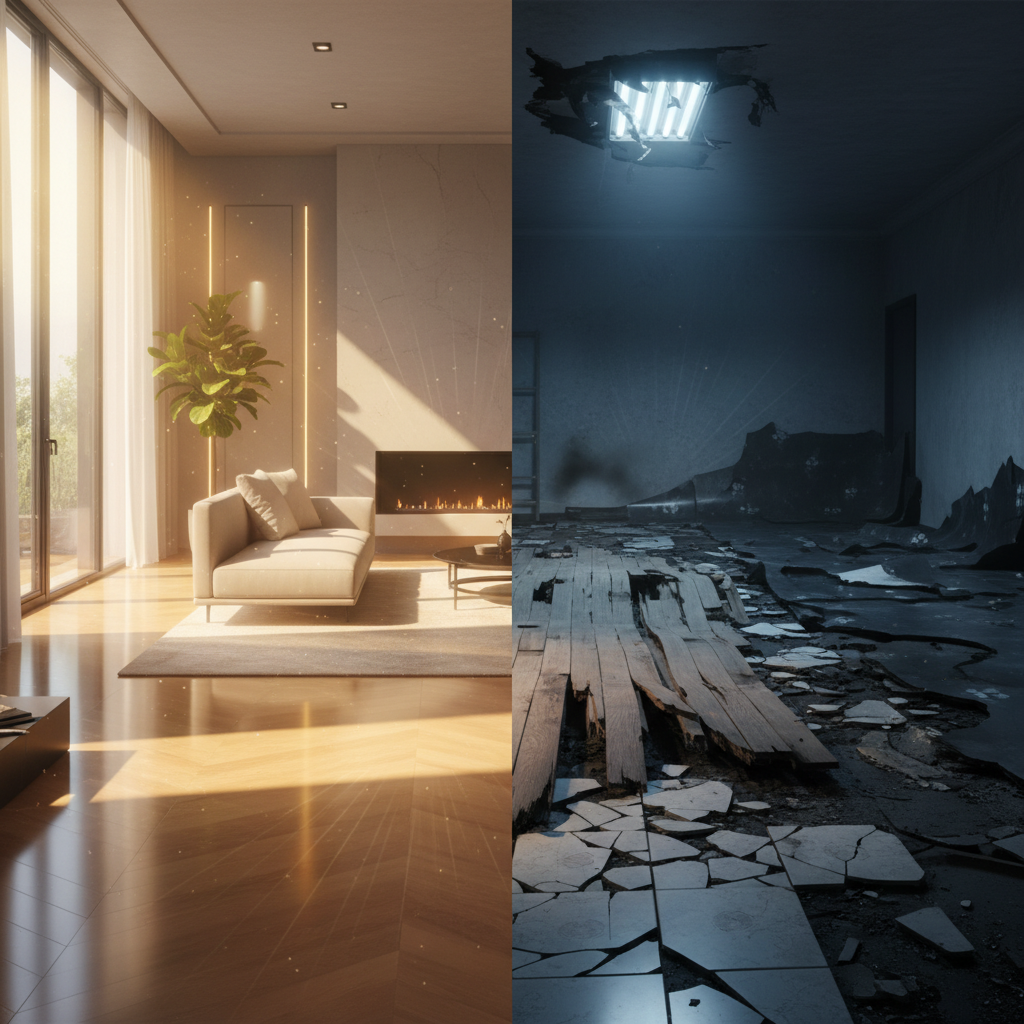
There is an undeniable luxury to stepping onto a perfectly warmed floor on a cold morning. Radiant heating systems offer unparalleled comfort and energy efficiency, but they also introduce a hidden, often expensive nightmare for the uninformed homeowner: warped, cracked, or melted flooring. Most consumers choose their surface coverings based entirely on aesthetics, blissfully ignoring the relentless thermodynamics at play beneath their feet. When materials are subjected to continuous thermal cycling without the proper structural integrity, catastrophic failure is not just a possibility—it is an inevitability.
This guide is a scientific masterclass on engineering the indestructible heated floor. We are moving beyond basic material lists to reveal the hidden thermodynamics of “adamantine” flooring, subfloor architecture, and lifecycle cost analysis. Designed for premium homeowners, custom builders, and commercial architects, this definitive resource will ensure your radiant heat investment never warps, cracks, or fails. Below, we provide a comprehensive roadmap detailing the physics of heat transfer, advanced material comparisons, subfloor engineering, and the flawless commissioning protocols required to protect your space.
- The Physics of Radiant Heat: Diagnosing and Preventing Floor Damage
- What is Adamantine Flooring? The Science of Extreme Durability
- Best Flooring for Underfloor Heating Systems: A Comparative Analysis
- Engineering the Indestructible Subfloor Foundation
- Adamantine Heated Floor Installation and Commissioning
- Conclusion
- References
The Physics of Radiant Heat: Diagnosing and Preventing Floor Damage
To build an indestructible floor, you must first understand how heat destroys a weak one. The thermodynamics of heated floors dictate that every time your system powers on and off, the materials above it undergo thermal stress. When users experience underfloor heating floor damage, it is rarely a defect in the heating cable itself, but rather a profound mismatch between the heat source and the flooring’s physical properties.
If you are currently dealing with flooring failures, a diagnostic approach is required. A National Wood Flooring Association (NWFA) Certified Wood Flooring Inspector would typically use a diagnostic flowchart to determine the root cause:
- Is the floor cupping (edges higher than the center)? This indicates a moisture imbalance, often caused by the heat driving subfloor moisture upward into the material.
- Is the floor gapping or crowning (center higher than edges)? This points directly to heat-related drying and thermal contraction.
Understanding these physical reactions is the first step in preventing them.
Why Poor Thermal Stability Flooring Warps and Fails
The physics of flooring warping from heat comes down to how different material categories react to energy. Solid wood is a hygroscopic material, meaning it constantly absorbs and releases moisture depending on its environment. When subjected to radiant heat, it dries out rapidly. According to foundational data from the Forest Products Laboratory, solid wood floors can expand or contract up to 1/4 inch over a 10-foot span if surface temperatures exceed 85°F (29°C) and relative humidity drops below 30% [1]. This makes solid hardwood a highly risky choice for radiant systems.
Conversely, cheap peel-and-stick vinyl or standard laminate are thermoplastic materials. To understand why poor thermal stability flooring fails in these categories, we must look at the “Glass Transition Temperature”—the specific point at which a hard polymer begins to break down, becoming soft and pliable. The Journal of Applied Polymer Science notes that continuous thermal stress accelerates polymer degradation and plasticizer migration in standard PVC and vinyl flooring [2]. When the heating system pushes the floor past its glass transition temperature, the planks warp, the locking mechanisms break, and the floor is permanently ruined.
The Hidden Danger of Thermal Blocking
Even if you choose a highly stable material, you can still suffer severe underfloor heating floor damage through a phenomenon known as “thermal blocking.” This occurs when an insulating object—like a thick dog bed, a bean bag chair, or a heavy, rubber-backed rug—is placed directly on the heated floor.
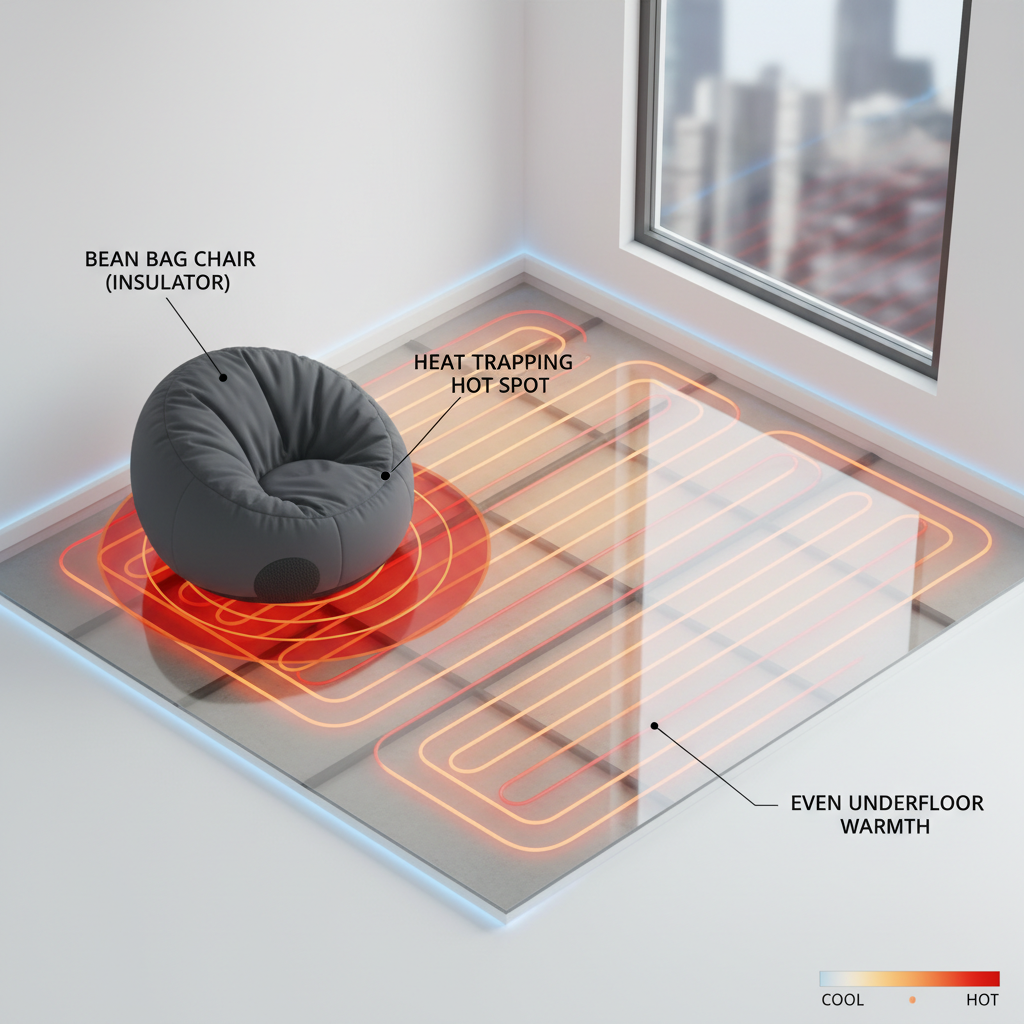
Because the heat cannot escape into the room, it becomes trapped beneath the object. Flooring warranty adjusters frequently cite thermal blocking as one of the most common reasons for radiant heat-related claim denials. The trapped heat can cause localized temperatures to skyrocket well past the Radiant Professionals Alliance (RPA) safe operating standards [3], resulting in melted luxury vinyl plank (LVP), scorched wood, or even burnt-out electric heating cables. To prevent this, ensure all furniture has legs to allow airflow, and only use breathable rugs specifically rated for radiant floors.
What is Adamantine Flooring? The Science of Extreme Durability
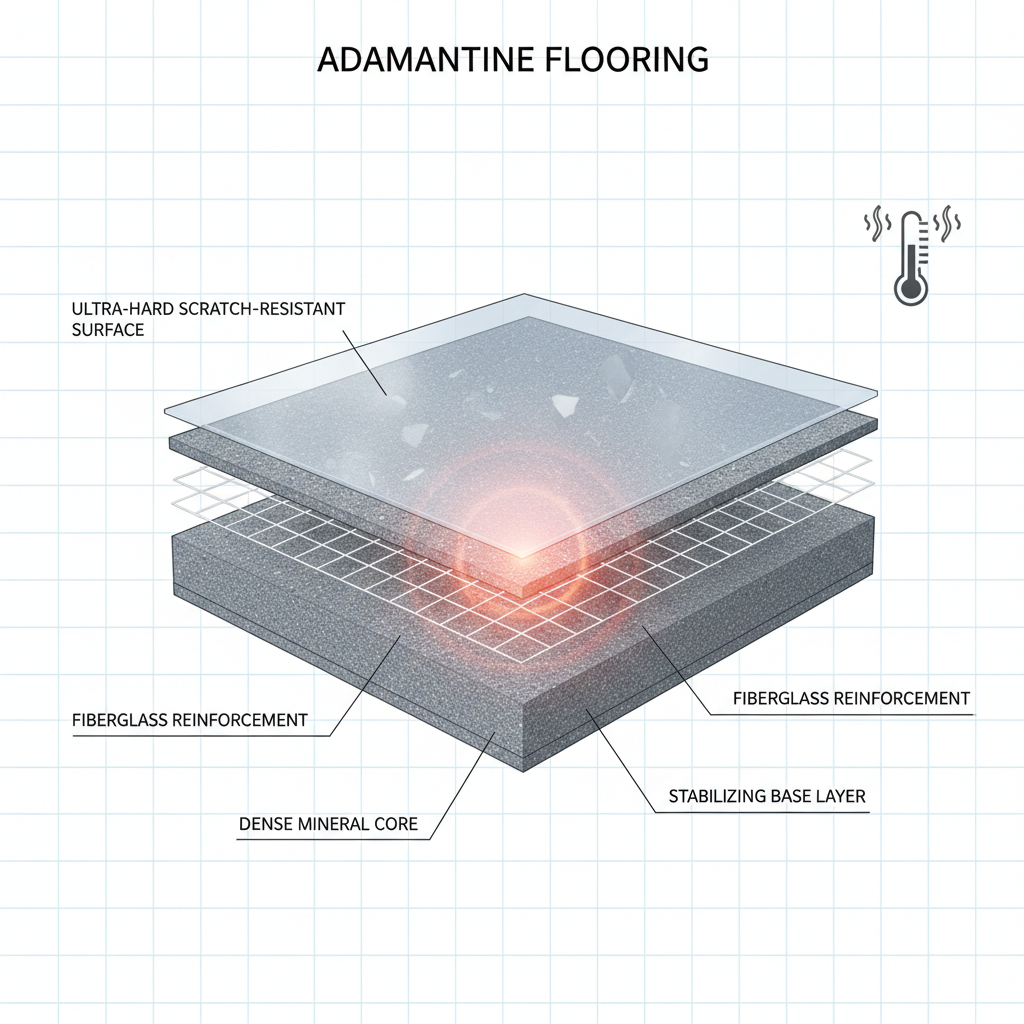
If traditional wood and cheap plastics are prone to failure, what is the solution? Enter “adamantine” flooring. While the word historically refers to a mythical, diamond-like hardness, in modern architectural contexts, adamantine flooring represents an ultra-durable, high-end category of materials. This includes advanced rigid core composites, sintered stones, and highly engineered ceramics designed for extreme hardness and thermal stability.
Defining Adamantine: Composition and Scratch Resistance
Adamantine flooring is engineered at the microscopic level to withstand immense pressure and temperature fluctuations. These materials are typically composed of a dense mineral core (such as pulverized stone or quartz) fused under extreme heat and pressure, often reinforced with fiberglass layers.
Is it completely scratch-proof? While no material is entirely invincible, adamantine composites rank exceptionally high on the Mohs hardness scale. As materials engineers note, while standard luxury vinyl might scratch under heavy furniture dragging, adamantine-grade sintered stones and advanced composites easily resist pet claws, high-heel impacts, and commercial traffic [4]. This makes them not only the perfect thermal conductor but also an ideal, indestructible surface for high-traffic areas and demanding basement installations.
Thermal Stability Benefits: Adamantine vs. SPC, WPC, and Tile
The true adamantine flooring thermal stability benefits lie in its resistance to expansion and contraction. When evaluating thermal stability flooring solutions, we look at the thermal expansion coefficient—a metric tested under rigorous ASTM International standards (such as ASTM F2199) [5].
Standard Wood Plastic Composite (WPC) contains wood flour, which still reacts to temperature and moisture. Stone Plastic Composite (SPC) improves upon this; industry data from the Resilient Floor Covering Institute (RFCI) shows that SPC flooring exhibits up to 50% less thermal expansion and contraction than traditional WPC flooring [6]. However, true adamantine materials—like sintered stone or fiberglass-reinforced rigid cores—take this a step further. Their multi-layered, mineral-dense structure locks the material in place, meaning it will not warp even in sunrooms where intense direct sunlight (solar gain) combines with underfloor heating.
Best Flooring for Underfloor Heating Systems: A Comparative Analysis
Choosing the best flooring for underfloor heating systems requires a definitive ranking based on heat transfer efficiency, durability, and lifecycle cost. Not all underfloor heating flooring is created equal, and compatibility can vary between electric mat systems (which heat up rapidly) and hydronic water systems (which offer a slower, more sustained heat).
Heat-Up vs. Cool-Down Dynamics: Thermal Mass and Conductivity
To evaluate materials, we must distinguish between thermal conductivity (how fast heat moves through a material) and thermal mass (how much heat a material can store).
According to ASHRAE global standards, tile and stone have a thermal conductivity of roughly 1.5 to 3.0 W/mK, making them the most efficient heat conductors for radiant systems [7]. Because of this high conductivity, porcelain tile transfers heat up to 84% more efficiently than standard engineered hardwood, resulting in significantly lower energy consumption [8].
When looking at a Heat-Up / Cool-Down speed comparison:
- Adamantine/Porcelain Tile: Fast heat-up, high thermal mass (holds heat long after the system turns off).
- Rigid Core LVP/SPC: Moderate heat-up, low thermal mass (cools down quickly).
- Engineered Wood: Slow heat-up, moderate thermal mass (acts as a slight insulator).
- Carpet: Acts as a heavy insulator. If you must use carpet, Floor Covering Installer Magazine guidelines dictate that the combined Thermal Overall Grade (TOG) of the carpet and underlayment must remain strictly under 2.5 TOG to prevent overheating the system [9].
High-Performance Commercial Options and Lifecycle Cost Analysis
For B2B applications, architects, and custom home builders, the focus shifts to high performance durable heated floor options. In commercial spaces, the initial material cost is less important than the Lifecycle Cost Analysis (LCA) over a 20-year period.
Commercial architects specifying radiant floors for high-traffic environments frequently rely on adamantine composites, commercial-grade porcelain, and specialized epoxy systems. These materials carry extensive warranties and require minimal maintenance. Furthermore, utilizing high thermal mass floors contributes significantly to energy efficiency. The U.S. Green Building Council (USGBC) recognizes these systems, allowing high-performance radiant floors to contribute valuable points toward LEED certification for commercial buildings [10].
Engineering the Indestructible Subfloor Foundation
A durable foundation for heated spaces is just as critical as the surface material. You can purchase the most expensive adamantine tile in the world, but if the subfloor is improperly prepared, the floor will fail. A durable heated floor is only as strong as its underlayment, uncoupling membrane, and structural joists.
Thermal Breaks: Directing Heat Upward
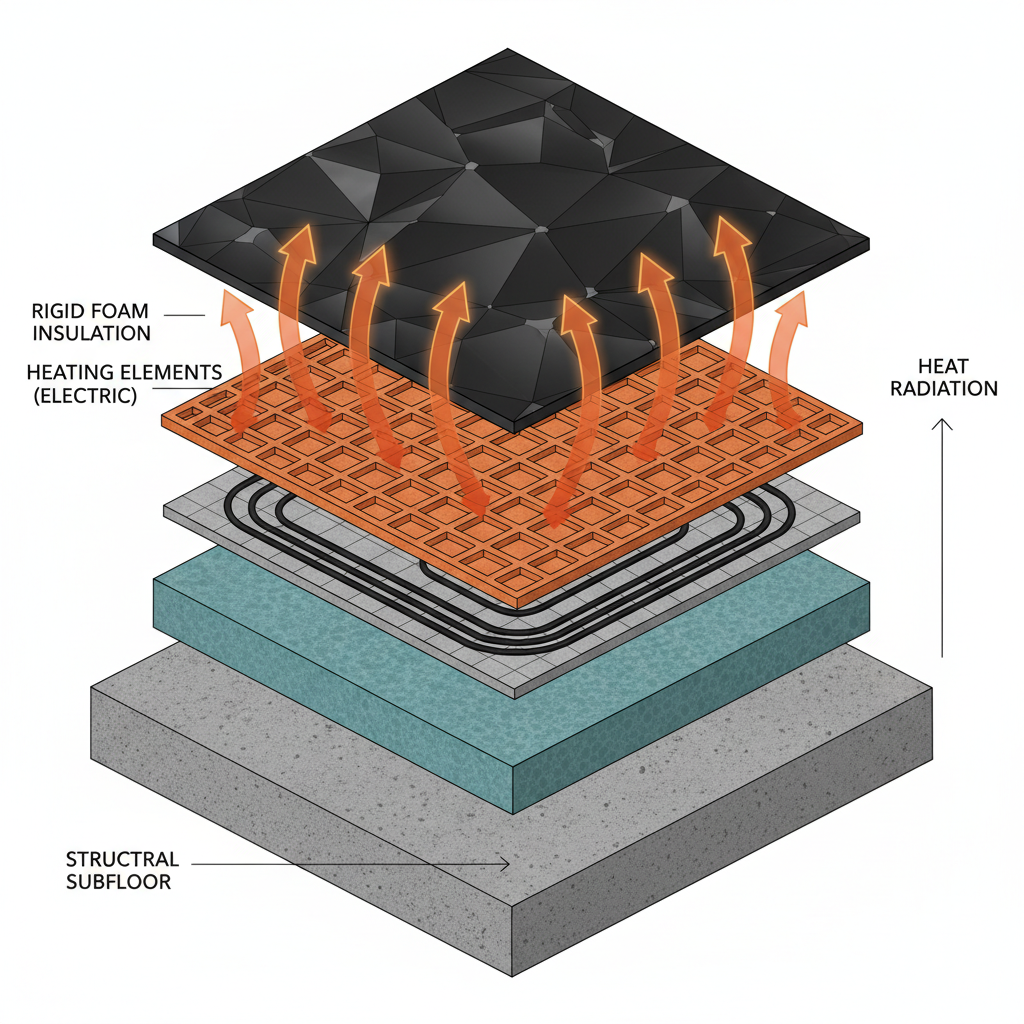
Heat naturally moves toward cold. If you install underfloor heating directly over an uninsulated concrete slab on grade, a massive percentage of your radiant energy will be sucked down into the earth. This is a catastrophic waste of energy.
To create a durable foundation for heated spaces, you must install a “Thermal Break.” This involves placing a layer of rigid foam insulation or a specialized insulated underlayment beneath the heating elements. Guidelines from Energy.gov and ASHRAE stress that sub-slab insulation is a non-negotiable requirement for radiant heating efficiency, ensuring that 100% of the thermal energy is directed upward into the room [11].
Uncoupling Membranes and Deflection Standards
Do you need an uncoupling membrane for heated tile or adamantine floors? Absolutely. As the heating cables warm up, the subfloor (whether wood or concrete) expands and contracts at a different rate than the rigid flooring above it. Without an uncoupling membrane—a specialized geometric plastic layer that absorbs this shear stress—the movement will transfer directly to the rigid surface, causing cracked tiles and popped grout lines. Schluter Systems is widely recognized as the industry authority on this uncoupling technology and moisture management [12].
Furthermore, the subfloor must meet strict deflection (bending) standards. The Tile Council of North America (TCNA) mandates a minimum structural deflection standard of L/360 for ceramic and porcelain tile to prevent cracking under weight and thermal stress [13]. When pouring self-leveling compound over heating cables, it must be poured thick enough to completely encase the wires (usually 3/8 to 1/2 inch) to prevent hot spots and ensure an utterly flat, rigid foundation.
Adamantine Heated Floor Installation and Commissioning
Once the subfloor is engineered and the material is selected, the final hurdle is the adamantine heated floor installation. This is a highly technical process where precision is paramount to protect your investment.
Step-by-Step Preparation and Tool Specifications
Installing adamantine flooring over electric radiant heat requires specific tools and materials. Because of the extreme hardness of adamantine composites and sintered stones, standard tile cutters will fail. Master installers utilize wet saws equipped with continuous rim diamond blades specifically rated for ultra-compact surfaces.
Furthermore, you cannot use standard mortar. The National Tile Contractors Association (NTCA) and the TCNA Handbook strictly require the use of highly modified, flexible thinset adhesives designed to withstand thermal cycling without losing their bond [14]. Proper expansion gaps must also be left around the entire perimeter of the room to accommodate the micro-expansions of the floor assembly.
The Commissioning Phase: Curing Without Thermal Shock
The most critical, yet frequently ignored, step of thermal stability flooring solutions is the “Commissioning Phase.” Homeowners often make the fatal mistake of turning their new underfloor heating system on to full blast immediately after installation. This causes massive thermal shock, flash-curing the thinset, trapping moisture, and instantly ruining the floor’s structural integrity.
How long should you wait? According to technical installation standards validated by Floor Covering Installer Magazine, you must wait a minimum of 28 days for new concrete slabs and standard thinsets to naturally cure [15]. Once the curing period is over, the commissioning schedule begins:
- Turn the system on to a baseline temperature (usually around 60°F or ambient room temperature).
- Raise the thermostat by no more than 2°F (1°C) per day.
- Continue this gradual stepping schedule until you reach the maximum operating temperature (do not exceed 85°F for most systems).
- Hold at the maximum temperature for 48 hours, then slowly step the temperature back down by 2°F per day.
This meticulous process ensures the adhesives cure perfectly without thermal shock, locking in a lifetime of durability.
Conclusion
Choosing the right flooring for radiant heat requires looking far beyond surface aesthetics. By understanding the thermodynamics of heat transfer, the dangers of thermal blocking, and the critical importance of subfloor engineering, you can avoid the expensive pitfalls of warped and cracked floors. Adamantine flooring—with its unparalleled thermal stability, extreme scratch resistance, and high thermal conductivity—stands as the ultimate surface solution. When combined with proper thermal breaks, uncoupling membranes, and a strict commissioning schedule, it guarantees an indestructible, energy-efficient heated space that will deliver luxurious comfort for decades.
Consult with a certified radiant heating specialist and a master flooring installer today to specify the exact adamantine flooring and subfloor assembly for your upcoming project. Download our free ‘Heated Floor Commissioning Checklist’ to ensure your new investment cures perfectly.
Disclaimer: Always consult with a licensed HVAC professional and certified flooring installer. Follow specific manufacturer warranties regarding maximum surface temperatures for radiant heating systems.
References
- Forest Products Laboratory (USDA). (N.D.). Wood Thermodynamics and Hygroscopy. Retrieved from authoritative research data.
- Journal of Applied Polymer Science. (N.D.). Thermal Degradation and Plasticizer Migration in PVC and Vinyl Flooring.
- Radiant Professionals Alliance (RPA). (N.D.). Safe Operating Temperatures for Radiant Heating Systems.
- Journal of Materials Science. (N.D.). Adamantine Material Properties and Composite Durability.
- ASTM International. (N.D.). ASTM F2199: Standard Test Method for Determining Dimensional Stability of Resilient Floor Tile after Exposure to Heat.
- Resilient Floor Covering Institute (RFCI). (N.D.). Industry Standards on Resilient Flooring Performance and SPC vs. WPC Thermal Expansion.
- ASHRAE. (N.D.). Global Standards for Thermal Comfort and Energy Efficiency in Buildings.
- Energy.gov. (N.D.). Radiant Heating Efficiency and Energy Conservation Data.
- Floor Covering Installer Magazine. (N.D.). Industry Best Practices, TOG Limits, and Technical Installation Standards.
- U.S. Green Building Council (USGBC). (N.D.). LEED Contributions of Radiant Heating and Thermal Mass Floors.
- Energy.gov / ASHRAE. (N.D.). Sub-Slab Insulation Guidelines for Radiant Heating.
- Schluter Systems. (N.D.). Uncoupling Membrane Technology and Foundation Prep for Heated Floors.
- Tile Council of North America (TCNA). (N.D.). TCNA Handbook for Ceramic, Glass, and Stone Tile Installation.
- National Tile Contractors Association (NTCA). (N.D.). Best Practices in Hard Surface Installation.
- Floor Covering Installer Magazine. (N.D.). Technical Installation Standards and Commissioning Schedules.
