
Choosing a new floor for your kitchen or bathroom can feel like navigating a minefield. It’s the heart of a renovation, a decision that sets the tone for the entire space, but it’s fraught with anxiety. You’re bombarded with marketing terms like “waterproof,” “hybrid,” and “pet-proof,” yet a nagging fear remains: what if I make the wrong choice? A single leak from a dishwasher, a child’s forgotten spill, or the constant steam from a hot shower could lead to disaster—warped planks, peeling seams, or worse, hidden mold that compromises your home and health.
The core problem is that most advice focuses on the product, not the system. A waterproof plank is only one piece of the puzzle. This guide is different. We’re taking a building-science approach to help you create a truly worry-free floor. We will teach you to think beyond the sample board and understand the entire waterproof system—from the subfloor up to the baseboards. By the end of this article, you won’t just be choosing a floor; you’ll be engineering a bulletproof solution for your home’s toughest rooms, armed with the knowledge to see past the hype and invest with total confidence.
- Why Your Kitchen & Bathroom Floor Is a High-Stakes Decision
- Waterproof Hardwood Unmasked: The Technology Behind the Trend
- In-Depth Review: Is Bravewood the Right Choice for Your Project?
- The Pro’s Playbook: Building a Truly Waterproof System
- The Durability Gauntlet: Choosing a Floor That Survives Real Life
- FAQ: Your Top Questions About Kitchen & Bathroom Flooring
- Conclusion: Choose Your System, Not Just Your Floor
- References & Authoritative Sources
Why Your Kitchen & Bathroom Floor Is a High-Stakes Decision
Kitchens and bathrooms are fundamentally different from any other room in your house. They are high-traffic, high-impact, and most importantly, high-moisture zones. This unique combination of challenges makes your flooring choice one of the most critical decisions in any remodel, where a mistake can lead to costly and disruptive repairs.
The constant threat of water is the primary concern. As one IICRC-certified water damage restoration professional notes, “In our experience, the most insidious damage doesn’t come from a big flood, but from the small, repeated exposures. A slow-leaking refrigerator ice maker line or a poorly caulked bathtub can saturate a subfloor for months before the homeowner ever notices the floor starting to cup or a musty smell.”[2]. This slow, steady assault is what separates a floor that merely looks good from one that is truly built to last.
The Enemies Within: Constant Moisture, Steam, and Leaks
The daily life of a kitchen or bathroom floor is a battle against moisture. In the bathroom, shower steam saturates the air, leading to condensation that settles on every surface. In the kitchen, you have everything from dishwasher overflows and sink splashes to dropped pots of water and melting ice cubes. This isn’t a theoretical risk; it’s a daily reality.
Proper moisture management is so critical that it’s addressed in building codes. The International Code Council (ICC), which sets the standard for residential construction, mandates mechanical ventilation in bathrooms precisely to manage this moisture load and prevent the conditions that lead to material degradation and mold growth[3]. Without a floor designed to handle this environment, you are fighting a losing battle against the laws of physics.
Anatomy of a Failure: Identifying Warping, Mold, and Other Disasters
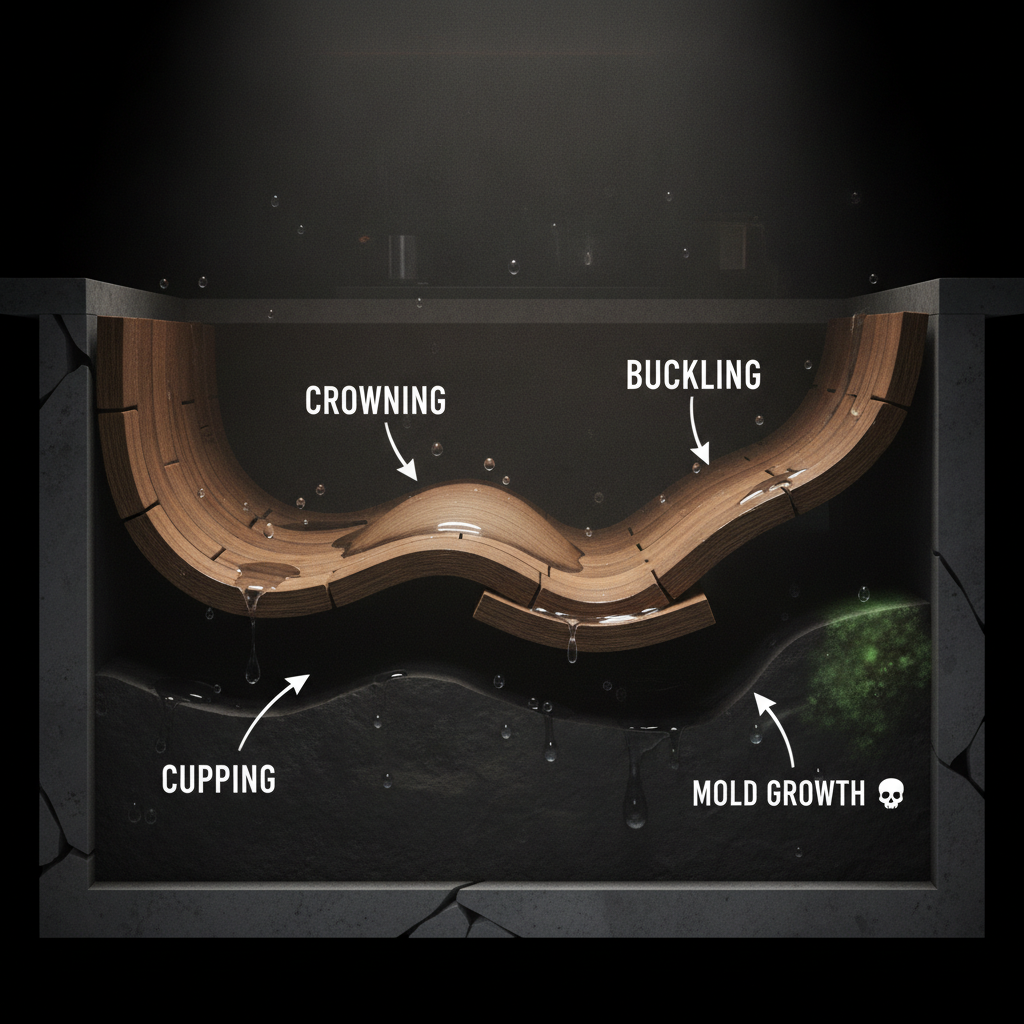
When a non-waterproof floor fails, the signs are unmistakable and distressing. Understanding these symptoms can help you diagnose a problem early or, better yet, choose a material that prevents them entirely.
According to the technical manuals from the National Wood Flooring Association (NWFA), the authority on wood floor performance, moisture-related failures typically appear in three ways[1]:
- Cupping: The edges of a plank are higher than its center, creating a concave, washboard-like surface. This happens when the bottom of the board absorbs more moisture than the top, causing it to expand.
- Crowning: The opposite of cupping, where the center of the plank is higher than its edges. This often occurs after a floor that was cupping has been sanded flat before it was fully dried.
- Buckling: The most dramatic failure, where the flooring lifts completely off the subfloor. This is usually the result of a significant water event, like a flood or major appliance leak.
Beyond warping, there is the health risk of mold. The Environmental Protection Agency (EPA) clearly states in its guide, “A Brief Guide to Mold, Moisture, and Your Home,” that mold requires moisture and an organic food source to grow[4]. Many traditional flooring materials, like solid hardwood or the paper backing on some products, provide the perfect food. Once mold takes hold under a floor, remediation can be a complex and expensive process.
Waterproof Hardwood Unmasked: The Technology Behind the Trend
For decades, the idea of putting real wood flooring in a kitchen or bathroom was unthinkable. The beauty of natural hardwood came with a crippling vulnerability to water. The recent trend of “waterproof hardwood” seems to defy this logic, leaving many homeowners asking: is it too good to be true? The answer lies in its innovative hybrid construction.
Waterproof hardwood is not solid wood. It is an engineered product that combines the best of both worlds: a top layer of genuine hardwood veneer over a completely waterproof core. This construction provides the authentic look and feel of real wood while eliminating the risk of moisture damage that plagues traditional hardwood floors. The quality of the wood veneer is critical to its appearance, and reputable manufacturers often adhere to standards set by organizations like the Hardwood Plywood & Veneer Association (HPVA) to ensure the wood is sourced and milled for optimal beauty and stability[5].
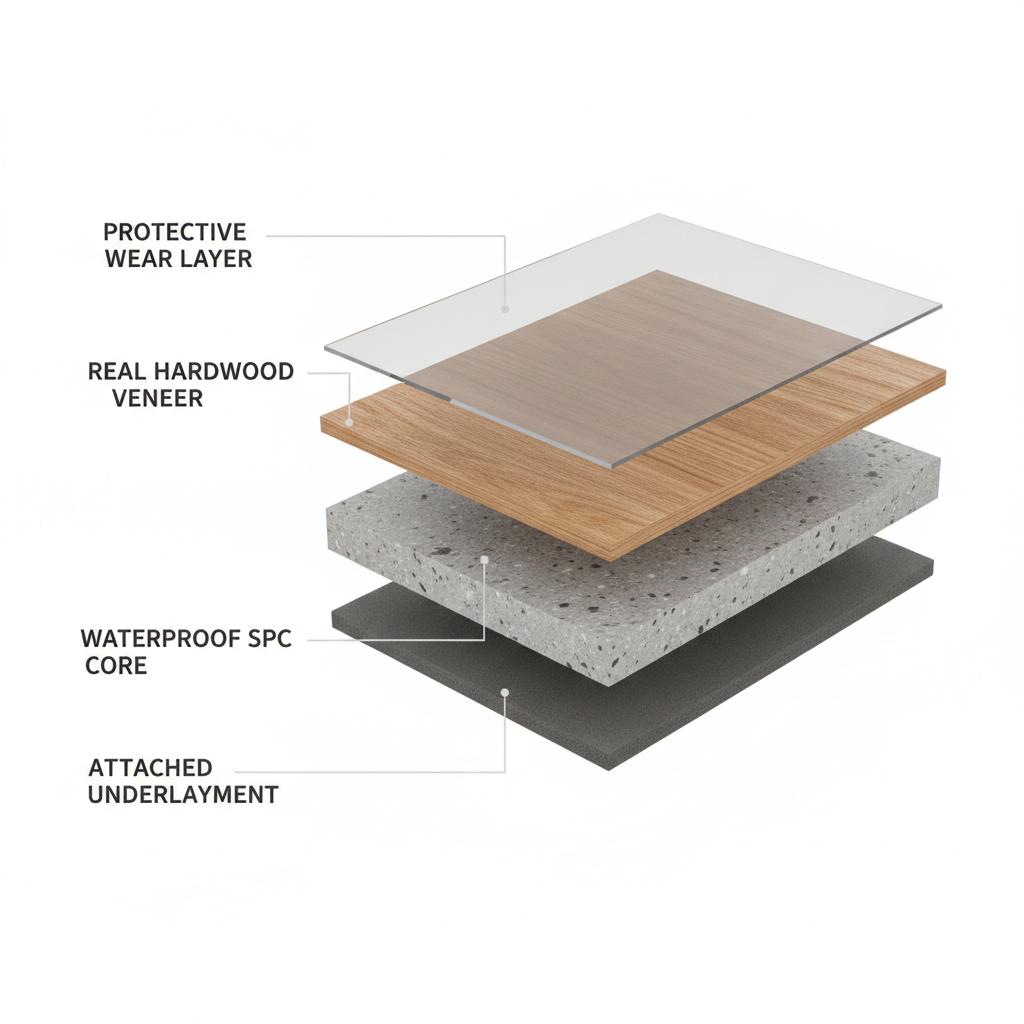
(Image: A detailed cross-section diagram of a hybrid hardwood plank, showing the top hardwood veneer layer, the middle waterproof SPC core, and the bottom attached underlayment.)
How Can Wood Be Waterproof? A Look at Hybrid Core Construction
The secret to waterproof hardwood is that the wood itself isn’t what’s waterproof—the core is. The vast majority of these products are built on a Stone Polymer Composite (SPC) core. SPC is a high-density, rigid material made from a mixture of limestone powder, polyvinyl chloride (PVC), and stabilizers.
According to the Resilient Floor Covering Institute (RFCI), which represents the industry, SPC cores are prized for two key properties: they are 100% waterproof and dimensionally stable[6]. This means that unlike wood-based materials, an SPC core will not swell, warp, or degrade when exposed to water. The real wood veneer is bonded to the top of this inert core, and the entire plank is finished with a highly durable, water-repellent wear layer. Water that sits on the surface simply can’t penetrate to the core or the subfloor below.
Waterproof vs. Water-Resistant: A Critical Distinction You Can’t Ignore
The flooring industry uses “waterproof” and “water-resistant” interchangeably, but they mean very different things for your home. This distinction is crucial.
- Water-Resistant: This typically refers to a product that can withstand topical moisture for a limited time. Traditional engineered hardwood or some high-quality laminate floors might be water-resistant. They can handle a quick spill if wiped up immediately, but prolonged exposure or leaks at the seams will cause damage.
- Waterproof: This means the flooring plank itself is impervious to water. The core material, like SPC, will not be damaged by water, even if fully submerged.
As one certified flooring installer puts it, “The plank might be waterproof, but the installation is what makes the floor waterproof. If water gets under a waterproof floor through the gaps at the wall, it’s trapped. The planks won’t be ruined, but your subfloor will rot. That’s why the distinction matters—a truly waterproof floor requires a waterproof plank and a watertight installation.”[7].
The Showdown: Waterproof Hardwood vs. Luxury Vinyl Plank (LVP)
The closest competitor to waterproof hardwood is Luxury Vinyl Plank (LVP), which is also typically built on a waterproof SPC core. The primary difference is the top layer: real wood veneer vs. a printed image layer.
Here’s how they stack up:
| Feature | Waterproof Hybrid Hardwood | Luxury Vinyl Plank (LVP) |
|---|---|---|
| Appearance & Feel | 5/5 – Authentic wood grain, texture, and warmth. Each plank is unique. | 4/5 – High-definition printing is very realistic, but can feel less authentic underfoot. Patterns repeat. |
| Durability (Scratches) | 3/5 – The protective finish is strong, but the real wood veneer underneath can be dented or deeply scratched, and it cannot be refinished. | 5/5 – The commercial-grade wear layer is extremely resistant to scratches and scuffs. |
| Waterproof Core | 5/5 – Typically a high-density SPC core that is 100% waterproof. | 5/5 – Also uses a 100% waterproof SPC or WPC core. |
| Repairability | 2/5 – Deep scratches or gouges in the wood veneer are very difficult to repair seamlessly. Plank replacement is often the only option. | 3/5 – Scratches are rare, but if they occur, plank replacement is also the primary solution. |
| Cost | $$$$ – Premium price due to the real wood veneer. | $$-$$$ – More budget-friendly, with a wide range of price points. |
The Verdict: Choose waterproof hardwood if the authentic look and feel of real wood is your top priority and you’re willing to pay a premium. Choose LVP if you need maximum scratch resistance for a busy household with pets and kids, or if you’re working with a tighter budget.
In-Depth Review: Is Bravewood the Right Choice for Your Project?
Bravewood has emerged as a popular brand in the waterproof hybrid hardwood category, often highlighted for its balance of aesthetics and performance. But to determine if it’s the right fit for your kitchen or bathroom, it’s essential to look past the marketing and into the product’s construction, real-world performance, and warranty details.
A close examination of a Bravewood plank reveals its multi-layer construction, designed to provide both beauty and resilience. The top layer is a genuine hardwood veneer, which gives it the unique character that only real wood can provide. This is bonded to a rigid, waterproof core, and the plank is typically finished with an attached underlayment for sound dampening and comfort. A crucial factor for any installation in a kitchen or bathroom is the manufacturer’s warranty. Bravewood’s warranty documents explicitly state whether the product is approved for use in these high-moisture areas and outline the specific installation requirements—such as perimeter sealing—that must be followed to maintain coverage.
What is Bravewood Flooring Made Of?
Bravewood flooring is a type of waterproof hybrid hardwood. Its construction consists of three key components:
- Real Hardwood Veneer: The top layer is a slice of genuine hardwood (species vary by collection, such as oak or hickory). This is what you see and feel.
- Waterproof Composite Core: The core of the plank is a high-density, 100% waterproof material, typically an SPC core. This provides the plank’s rigidity and protects it from water damage.
- Attached Pad: Most Bravewood products come with a pre-attached underlayment that provides acoustic insulation and makes for a softer feel underfoot.
The brand often markets its proprietary finishing technology, which is designed to enhance scratch and stain resistance on the real wood surface.
Pros and Cons of Bravewood Flooring
Based on an analysis of product specifications and aggregated customer reviews from major retailers, a balanced picture of Bravewood emerges:
Pros:
- Authentic Wood Beauty: Its greatest strength is that it looks and feels like real hardwood, as each plank has a unique grain pattern.
- 100% Waterproof Core: The SPC core provides peace of mind against spills, leaks, and moisture, making it suitable for kitchens and bathrooms.
- DIY-Friendly Installation: The click-lock system is designed for floating installation, which is accessible to experienced DIYers.
Cons:
- Veneer Durability: While the finish is tough, the real wood veneer is softer than the wear layer of a high-quality LVP. It can be dented by heavy dropped objects or deeply scratched by large pets or dragged furniture.
- Higher Price Point: As a hybrid product with real wood, it is generally more expensive than LVP and other waterproof alternatives.
- Not Refinishable: Unlike solid hardwood, the thin veneer cannot be sanded and refinished to remove deep scratches.
Bravewood vs. The Titans: A Head-to-Head with Coretec and Shaw
To understand its place in the market, it’s helpful to compare Bravewood to established leaders in the waterproof flooring space like Coretec and Shaw’s Floorté line.
| Feature | Bravewood | Coretec | Shaw Floorté |
|---|---|---|---|
| Product Type | Waterproof Hybrid Hardwood | LVP & Waterproof Hardwood | LVP & Waterproof Hardwood |
| Core Technology | Waterproof Composite (SPC) | Patented WPC & SPC Cores | SPC & Mineral Cores |
| Key Differentiator | Focus on real wood veneer aesthetics at a competitive price point. | Pioneer in the category, known for WPC’s comfort and sound-dampening qualities. | Strong brand recognition with a very wide range of styles and technologies. |
| Price Point | Mid-to-High | High | Mid-to-High |
| Warranty | Typically robust, but requires strict adherence to installation guidelines. | Often considered a benchmark for comprehensive coverage. | Strong, well-established warranty support. |
This comparison shows that Bravewood competes directly with the premium waterproof hardwood offerings from major brands, often positioning itself as a strong value proposition for homeowners who want the real wood look without the absolute highest price tag.
The Pro’s Playbook: Building a Truly Waterproof System
Here is the most important takeaway of this guide: a waterproof floor is not a product you buy, it’s a system you build. Even the best waterproof planks will fail if the subfloor is unprepared, the installation is sloppy, and the room’s moisture isn’t managed.
“I can’t tell you how many ‘waterproof’ floor failures I’ve seen that had nothing to do with the planks themselves,” says a member of the International Certified Flooring Installers Association (CFI). “It’s almost always a failure at the perimeter—no sealant around the toilet flange, a gap under the baseboards by the tub. Water is relentless; it will find a way in. A professional installation isn’t just about making it look good; it’s about making it watertight.”[8].
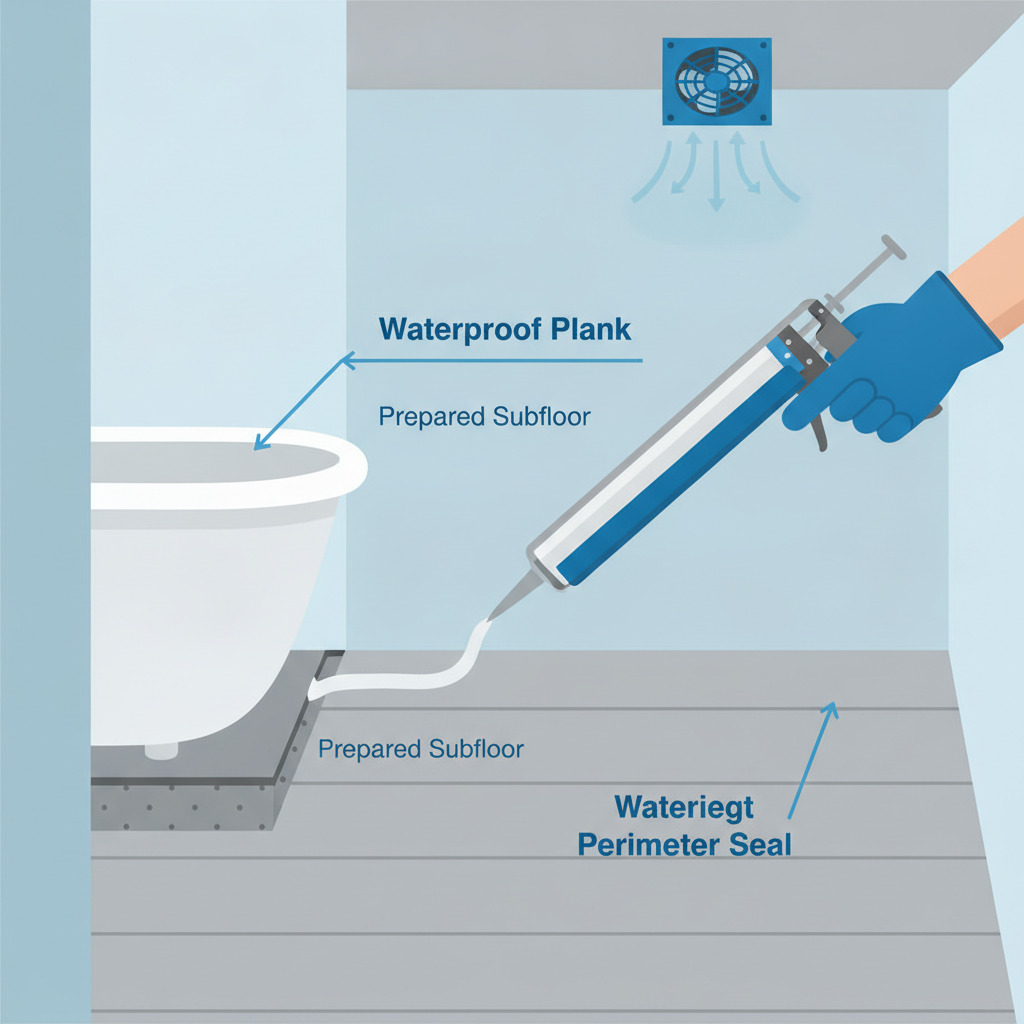
It Starts Below: Subfloor Prep in High-Moisture Areas
A successful installation begins with the subfloor. According to NWFA guidelines, a subfloor must be clean, flat, and, most importantly, dry before any flooring is installed[1]. In a kitchen or bathroom, this is non-negotiable. Any existing moisture trapped in the subfloor will create a breeding ground for mold and can compromise the integrity of the structure over time. Before installation, a professional will use a moisture meter to ensure the subfloor (whether wood or concrete) is within the acceptable moisture content range specified by the flooring manufacturer.
Installation Is Everything: Why Sealing Perimeters Matters
Imagine your waterproof floor as a shallow bowl. The planks form the bottom of the bowl, but the edges must be sealed to keep water contained. This is why manufacturer installation guides for bathroom installations are so strict. They almost universally require a 100% silicone sealant in the expansion gap around the entire perimeter of the room—at the walls, against the bathtub or shower, and around the toilet flange. Failure to do this not only creates a path for water to get underneath the floor but also typically voids the product’s warranty.
Don’t Suffocate Your Bathroom: The Critical Role of Ventilation
The final piece of the system is managing the ambient moisture in the room. A powerful, properly-sized bathroom exhaust fan is not a luxury; it’s a necessity. The National Kitchen & Bath Association (NKBA) provides guidelines for ventilation, recommending a fan that can effectively clear steam and reduce humidity[9]. The power of a fan is measured in Cubic Feet per Minute (CFM). A common rule of thumb is that you need at least 1 CFM per square foot of floor space. Running your fan during and for at least 20-30 minutes after a shower prevents condensation from saturating your walls, ceiling, and floor, protecting your entire investment.
The Durability Gauntlet: Choosing a Floor That Survives Real Life
Beyond being waterproof, your kitchen and bathroom floor needs to be durable enough to handle the chaos of daily life. From dropped pans and dragged chairs to the constant traffic of kids and pets, durability is paramount. True durability isn’t a marketing claim; it’s a measurable set of technical specifications that you can learn to evaluate. Industry standards from organizations like ASTM International provide objective tests for everything from wear and scratch resistance to slip resistance, giving you a scientific basis for comparing products[10].
How to Read a Spec Sheet Like a Pro
When comparing waterproof flooring options like LVP or hybrid hardwood, don’t just look at the pictures. Learn to read the spec sheet. Here are the key terms to know:
- Wear Layer Thickness: This is arguably the most important spec for LVP durability. The wear layer is a clear top coat that protects the printed image layer from scratches and scuffs. It’s measured in mils (not millimeters). For a busy residential kitchen, look for a wear layer of at least 12 mil, with 20 mil or higher being ideal for maximum durability.
- Core Construction (SPC vs. WPC): Both are waterproof. SPC (Stone Polymer Composite) is denser and more rigid, making it more resistant to dents. WPC (Wood Polymer Composite) contains a foaming agent, making it slightly softer, warmer, and quieter underfoot.
- AC Rating (for Laminate): If you’re considering a water-resistant laminate, look for its AC (Abrasion Class) rating. The North American Laminate Flooring Association (NALFA) uses this scale from AC1 (light residential use) to AC5 (heavy commercial use)[11]. For a kitchen, an AC3 or AC4 rating is recommended.
The ‘Pawsitivity’ Test: Finding the Best Flooring for Dogs
Pets, especially dogs, present a unique set of challenges. Their claws scratch, their water bowls splash, and accidents happen. A truly pet-proof floor must excel in several areas.
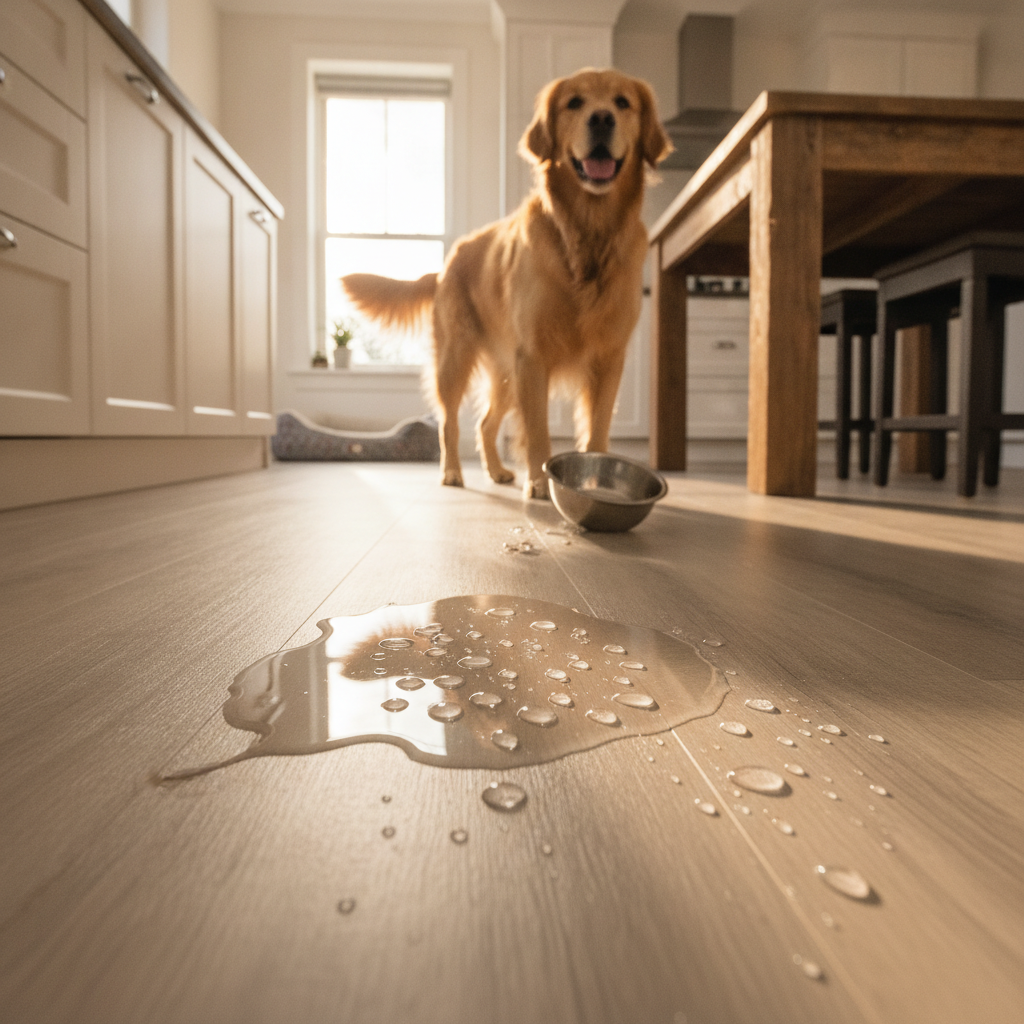
- Scratch Resistance: This is where a high-quality LVP with a thick (20 mil+) wear layer shines. While waterproof hardwood finishes are strong, sharp claws can still scratch the real wood veneer.
- Traction: Smooth, glossy floors can be hazardous for dogs, potentially leading to slips and joint problems. Look for flooring with an embossed or textured surface that provides better grip. The American Kennel Club (AKC) often advises that good traction is essential for a dog’s long-term joint health, especially for senior dogs or breeds prone to hip dysplasia[12].
- Stain & Odor Resistance: A non-porous surface like vinyl or tile is essential for preventing pet urine accidents from soaking in and causing permanent damage or lingering odors.
- Health & Safety: Ensure the flooring is safe for your pets. Look for third-party certifications like FloorScore®[13], which guarantees the product meets strict indoor air quality standards for low volatile organic compound (VOC) emissions.
FAQ: Your Top Questions About Kitchen & Bathroom Flooring
Is hybrid hardwood really suitable for a full bathroom with a shower?
Yes, but with critical conditions. The specific hybrid hardwood product you choose must be explicitly warrantied by the manufacturer for a full bathroom installation. Furthermore, you must follow the “waterproof system” approach: the subfloor must be perfectly prepared, and all perimeters (at the tub, toilet, and walls) must be sealed with 100% silicone sealant as per the installation instructions. Without these steps, the installation will likely fail and will not be covered by the warranty.
What is the single most durable and waterproof flooring option?
From a purely technical standpoint, porcelain tile installed over a modern waterproofing membrane (like a sheet or liquid-applied membrane) and finished with an epoxy or high-performance cementitious grout is the most durable and impervious flooring system available. As outlined in the TCNA Handbook, the industry standard for tile installation, this creates a completely sealed, monolithic surface[14]. However, this durability comes with tradeoffs: tile is cold and hard underfoot, installation is more complex and expensive, and grout lines require maintenance.
How do I prevent mold from growing under my new floor?
You can prevent mold by creating an environment where it cannot survive. This involves a three-part strategy based on the core principle from the EPA: mold needs moisture and organic material to grow[4].
- Eliminate Moisture: Ensure the subfloor is completely dry before installation. Control room humidity with proper ventilation, and immediately clean up any spills.
- Remove the Food Source: Choose inorganic flooring materials like LVP, tile, or a hybrid with a waterproof composite core. These materials do not provide food for mold.
- Seal the System: A professional, watertight installation that seals all perimeters prevents moisture from getting trapped between the floor and the subfloor, which is the most common cause of hidden mold growth.
Conclusion: Choose Your System, Not Just Your Floor
The journey to finding the perfect floor for your kitchen or bathroom ends with a shift in perspective. The goal is not to find a magic, indestructible product, but to build an indestructible system. By now, you understand that the beautiful planks you choose are only as good as the preparation, installation, and environment that support them.
To ensure your investment lasts a lifetime, remember the three pillars of a truly waterproof floor:
- The Right Product: Start with a flooring material that has a 100% waterproof core, whether it’s a hybrid hardwood like Bravewood, a luxury vinyl plank, or porcelain tile.
- A Watertight Installation: Insist on meticulous subfloor preparation and the sealing of all perimeters. This is the single most critical step in protecting your home from water intrusion.
- Total Moisture Management: Control the ambient humidity in your room with proper ventilation to prevent long-term damage from condensation and steam.
You are no longer just a homeowner overwhelmed by choices. You are now an informed decision-maker, equipped with the building-science knowledge to ask the right questions, demand the right process, and choose a floor with the ultimate confidence.
This article provides informational guidance. Flooring installation can be complex and has significant financial implications. Always consult with a certified flooring professional and follow manufacturer-specific installation guidelines to ensure warranty compliance and proper performance.
References & Authoritative Sources
- National Wood Flooring Association (NWFA). (N.D.). Technical Publications. Retrieved from nwfa.org.
- Based on expert opinion from IICRC-certified water damage restoration professionals. The Institute of Inspection, Cleaning and Restoration Certification (IICRC) sets standards for the restoration industry.
- International Code Council (ICC). (N.D.). International Residential Code (IRC). Retrieved from iccsafe.org.
- United States Environmental Protection Agency (EPA). (N.D.). A Brief Guide to Mold, Moisture, and Your Home. Retrieved from epa.gov/mold.
- Hardwood Plywood & Veneer Association (HPVA). (N.D.). Voluntary Standards for the Industry. Retrieved from hpva.org.
- Resilient Floor Covering Institute (RFCI). (N.D.). Industry Resources and Definitions. Retrieved from rfci.com.
- Based on expert opinion from certified flooring installation professionals.
- International Certified Flooring Installers Association (CFI). (N.D.). Installation Standards. Retrieved from cfiinstallers.org.
- National Kitchen & Bath Association (NKBA). (N.D.). Planning Guidelines. Retrieved from nkba.org.
- ASTM International. (N.D.). Flooring Standards. Retrieved from astm.org.
- North American Laminate Flooring Association (NALFA). (N.D.). AC Rating Standards. Retrieved from nalfa.com.
- Based on publicly available guidance from the American Kennel Club (AKC) regarding home safety and health for dogs.
- SCS Global Services. (N.D.). FloorScore® Certification. Retrieved from scsglobalservices.com.
- Tile Council of North America (TCNA). (N.D.). TCNA Handbook for Ceramic, Glass, and Stone Tile Installation. Retrieved from tcnatile.com.
