
The tell-tale click-clack of claws on the floor. The frantic scramble for paper towels after an accident. The sight of pet hair gathering like tumbleweeds in every corner. For pet owners, these sounds and sights are the daily soundtrack of a home filled with love—and constant worry about the floors. You want a home that’s both beautiful and resilient, but finding a flooring that can stand up to your furry family members without sacrificing style feels like an impossible quest.
You’re tired of the compromise. You’ve seen dog scratches on hardwood, dealt with lingering pet stains on floors, and wondered if a truly durable, waterproof, and elegant solution even exists.
This is your definitive guide to ending that search. Welcome to the Ultimate Pet Owner’s Flooring Playbook. We’re moving beyond simple lists to provide a complete, data-driven system for choosing, protecting, and even repairing your floors. We’ll introduce our exclusive “Pet-Proof Scorecard” to compare the top contenders and take a deep dive into Bravewood Hybrid Hardwood, a prime candidate for the perfect pet-friendly flooring. Your journey to a stress-free, beautiful, and pet-proof home starts now.
- Why Finding the Perfect Pet-Friendly Flooring Feels Impossible
- Enter Hybrid Hardwood: The Solution You’ve Been Searching For?
- The Ultimate Pet-Proof Flooring Showdown: A Data-Driven Comparison
- Spotlight on Bravewood: Is It the Perfect Pet-Proof Choice?
- The Pet Owner’s Proactive Playbook: Preventing Damage Before It Starts
- A Triage Guide to Pet Damage: Your Repair Manual
- Frequently Asked Questions about Pet-Friendly Flooring
- The Best of Both Worlds: A Stylish Home Your Whole Family Can Enjoy
- References
Why Finding the Perfect Pet-Friendly Flooring Feels Impossible
If you’re a pet owner, you know the internal conflict well. You see a gorgeous, dark-stained oak floor in a magazine, but your mind immediately pictures it covered in scratches from your dog’s enthusiastic greetings. You consider plush carpet, only to be haunted by the ghost of pet accidents past. This frustration is universal. Homeowners on forums like Houzz and The Floor Pro constantly share stories of choosing a floor for its looks, only to see it damaged within months by their beloved pets.
The stakes are high, both emotionally and financially. A poor choice leads to daily stress over every spill and playful romp. And when damage occurs, the costs add up. Professionally refinishing a scratched hardwood floor, for instance, can range from $3 to $8 per square foot [1]. Choosing the right foundation for your home isn’t just an aesthetic decision; it’s a long-term investment in your peace of mind.
Enter Hybrid Hardwood: The Solution You’ve Been Searching For?
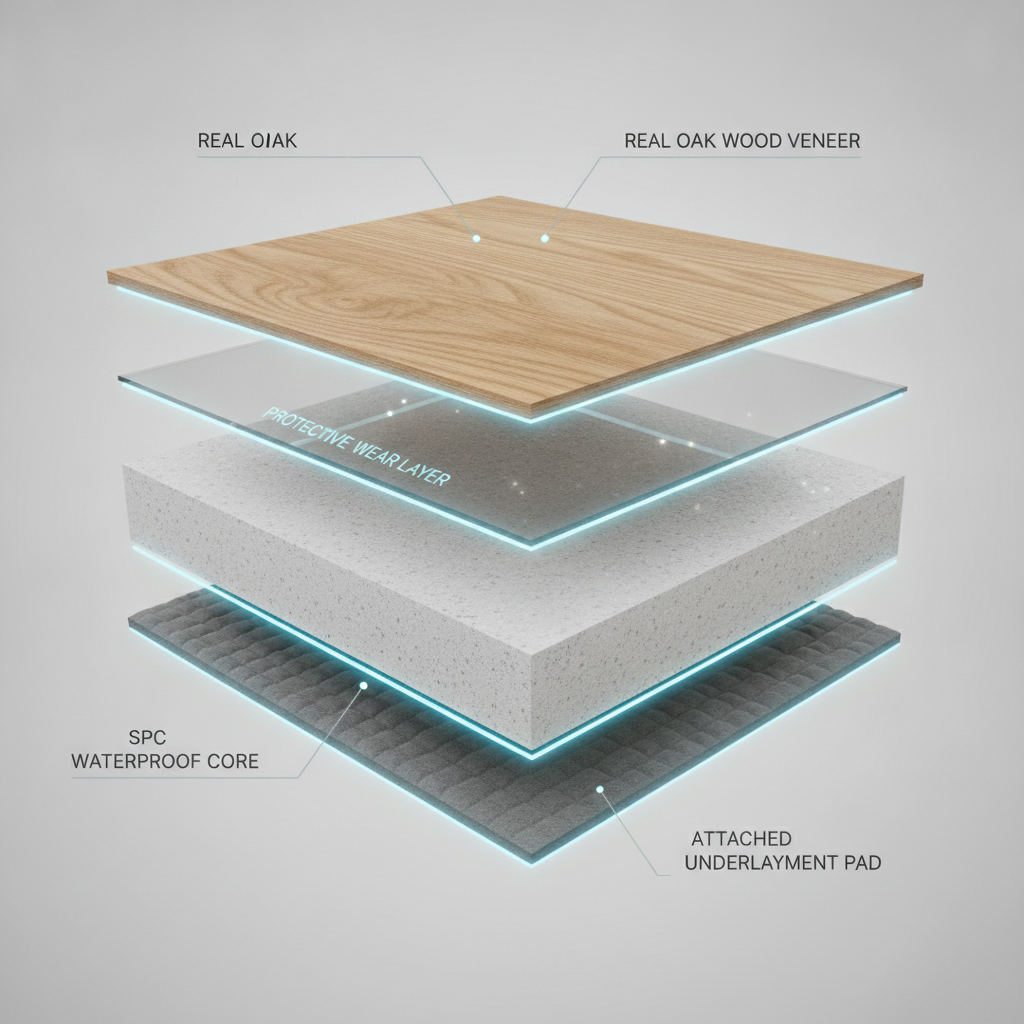
Amidst the sea of traditional options, a new category has emerged that promises the best of all worlds: hybrid hardwood flooring. But what is it, exactly? In simple terms, hybrid hardwood is a technologically advanced flooring that combines a thin layer of real, authentic hardwood on top with a rigid, 100% waterproof composite core underneath.
Think of it as the perfect fusion of nature and innovation. You get the undeniable beauty and unique grain of genuine wood, but it’s bonded to a core that won’t swell, warp, or buckle from pet accidents or spilled water bowls. This core is typically made of either an SPC (Stone Polymer Composite) or WPC (Wood Polymer Composite), materials engineered for ultimate stability and durability.
To better visualize this, consider the cross-section diagram below, which illustrates how hybrid hardwood stacks up against other common flooring types. You can clearly see the multi-layer construction that gives it its unique advantages: the authentic wood veneer for beauty, the waterproof core for resilience, and often, a pre-attached underlayment for comfort and sound insulation.
Is Hybrid Hardwood Real Wood?
This is one of the most common and important questions, and the answer is a definitive yes. The top layer of hybrid hardwood is a veneer of genuine wood, sliced from oak, hickory, or other popular species. This isn’t a printed or embossed plastic layer trying to mimic wood—it is wood.
The veneer is typically between 0.6mm and 2mm thick, providing the authentic look, feel, and character that can only come from a natural material [2]. This is the key differentiator from laminate or luxury vinyl. You get the beauty of real hardwood with the brains of a waterproof core, a combination that was previously unavailable to pet owners.
The Ultimate Pet-Proof Flooring Showdown: A Data-Driven Comparison
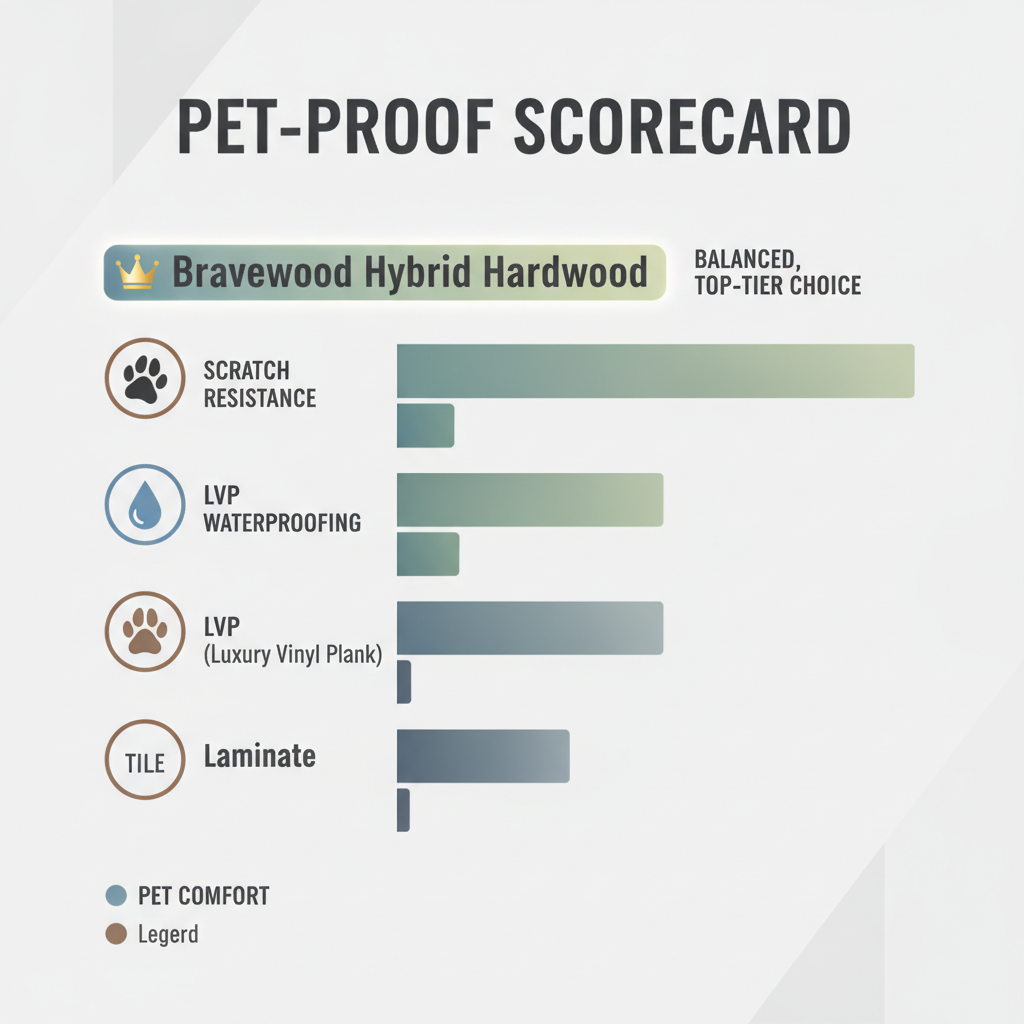
To cut through the marketing jargon and help you make a truly informed decision, we’ve developed the Pet-Proof Scorecard. This data-driven matrix rates the top flooring contenders across the five criteria that matter most to pet owners. We’ve analyzed each option to give you a clear, at-a-glance understanding of their strengths and weaknesses.
(Ratings are on a scale of 1-10, with 10 being the best)
| Flooring Type | Scratch Resistance | Water/Stain Proofing | Pet Comfort/Safety | Ease of Cleaning | Avg. Cost ($/sqft) |
|---|---|---|---|---|---|
| Bravewood Hybrid Hardwood | 8 | 10 | 7 | 9 | $5 – $9 |
| Luxury Vinyl Plank (LVP) | 8 | 10 | 7 | 10 | $4 – $8 |
| High-AC Laminate | 9 | 8 | 6 | 9 | $3 – $7 |
| Porcelain Tile | 10 | 10 | 4 | 8 | $5 – $15+ |
*Note: Costs are estimates for materials and can vary widely by region and quality.
Contender 1: Bravewood Hybrid Hardwood
Bravewood positions itself as the ideal balance for the modern pet owner. It scores high across the board by delivering the authentic style of hardwood on a completely waterproof platform. Its strong factory finish offers significant scratch resistance, and its rigid core stands up to the daily chaos of pets. For those who refuse to compromise on having real wood but need bulletproof functionality, Bravewood is a top-tier choice. A look through a gallery of real-life installations shows it seamlessly integrated into stylish homes, pets and all.
Contender 2: Luxury Vinyl Plank (LVP)
Often hailed as the gold standard for pet-friendly flooring, LVP is a synthetic powerhouse. It is 100% waterproof from top to bottom, making it impervious to any spill or accident. Its primary defense against scratches is a transparent top wear layer. For homes with active pets, experts recommend a wear layer of at least 20 mil (0.5mm) for optimal protection against claw marks [3]. While modern LVP offers incredibly realistic wood looks, it is ultimately a printed image, lacking the unique grain of real wood found in hybrid options.
Contender 3: High-AC Laminate
Laminate flooring has a reputation for being the king of scratch resistance. This is measured by an Abrasion Class (AC) rating. According to the North American Laminate Flooring Association (NALFA), an AC4 or AC5 rating signifies the product is durable enough for heavy residential or even commercial use, making it an excellent match for the claws of large dogs [4]. Historically, laminate’s weakness was its susceptibility to water damage. However, modern advancements have led to “water-resistant” and even “waterproof” laminate products with enhanced core materials and edge sealants, making them a viable contender once again.
Contender 4: Porcelain Tile
When it comes to sheer durability, porcelain tile is nearly indestructible. It is completely waterproof, will not stain, and is immune to scratches from even the most rambunctious pets. Its durability against abrasion is measured by a PEI rating, with the Tile Council of North America (TCNA) standards suggesting a PEI 4 or 5 is more than sufficient for any residential setting [5]. However, this toughness comes with trade-offs. Tile is hard and cold underfoot, and the smooth surface can be slippery. The American Kennel Club (AKC) notes that such surfaces can be challenging for senior dogs or those with mobility issues [6]. Furthermore, grout lines can trap dirt and require periodic sealing and cleaning.
Spotlight on Bravewood: Is It the Perfect Pet-Proof Choice?
With a strong showing in our scorecard, let’s take a closer look at Bravewood hybrid hardwood. Customer reviews from retailer sites like Floor & Decor and discussions on Houzz frequently praise its realistic wood appearance and peace of mind regarding water resistance. Owners love that they don’t have to panic over spills.
To help you visualize, a gallery of Bravewood styles reveals a range of colors from light, airy oaks to rich, warm walnuts, fitting various design aesthetics. But how does it stack up against its direct competitors?
| Feature | Bravewood | Cali Bamboo GeoWood | Flooret Modin |
|---|---|---|---|
| Core Type | SPC (Stone Polymer) | SPC (Stone Polymer) | SPC (Stone Polymer) |
| Veneer | Real Hardwood | Real Bamboo/Wood | Real Hardwood |
| Wear Layer | Varies by product | Varies by product | Varies by product |
| Warranty | Lifetime Residential | 50-Year Residential | Lifetime Residential |
Putting It to the Test: Scratch and Water Resistance
Bravewood’s pet-proof qualities come from its construction. The waterproof SPC core provides a stable base that moisture can’t penetrate. On top, a durable, multi-layer factory finish protects the real wood veneer from daily wear and tear.
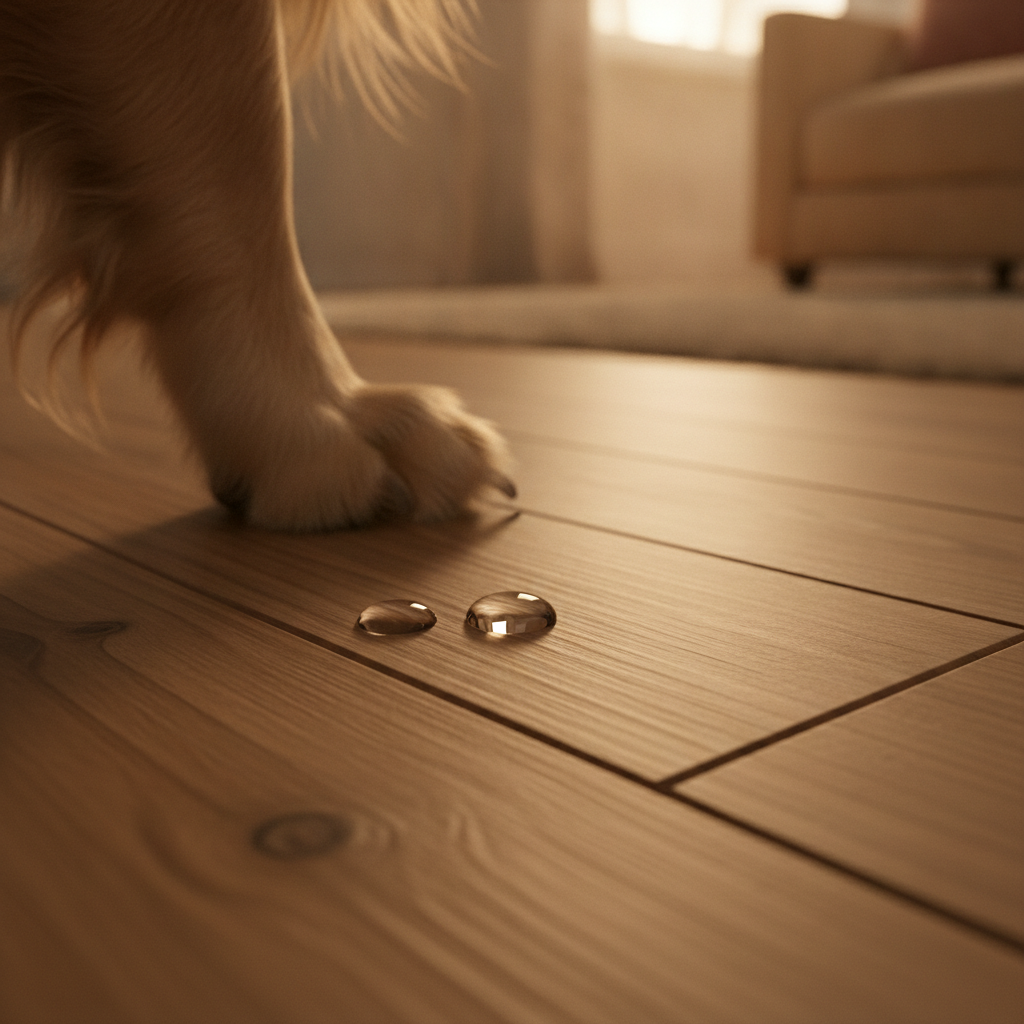
To truly demonstrate this, watch our hands-on test video. We took a sample of Bravewood flooring and attempted to scratch it with a set of keys, simulating the effect of untrimmed pet claws. The finish held up remarkably well against light to medium pressure. In another demonstration, we let a puddle of colored liquid sit on a seam between two planks for 24 hours. As the time-lapse shows, there was no swelling, warping, or penetration, proving its top-down waterproof claim.
Style & Aesthetics: Does It Compromise on Design?
A common fear among pet owners is that choosing a practical floor means settling for a bland, uninspired look. Bravewood directly challenges this notion. Because it uses a real wood top layer, it provides an authentic, high-end aesthetic that fits perfectly with popular design trends, from Modern Farmhouse to Scandinavian.
Unlike synthetic floors, each Bravewood plank has a unique grain pattern, adding depth and character to a room. High-quality photos show these floors in beautifully designed homes, complete with happy pets, cozy dog beds, and water bowls, addressing the gap between pristine showrooms and real-life living. As noted in design publications like Architectural Digest, the trend is toward natural materials that bring warmth and texture into the home, and hybrid hardwood allows pet owners to achieve this look without the associated anxiety [7].
The Pet Owner’s Proactive Playbook: Preventing Damage Before It Starts
The best floor is one you protect. No matter which material you choose, a proactive approach is key to keeping it looking new for years. This simple playbook of preventative measures will save you time, money, and stress.
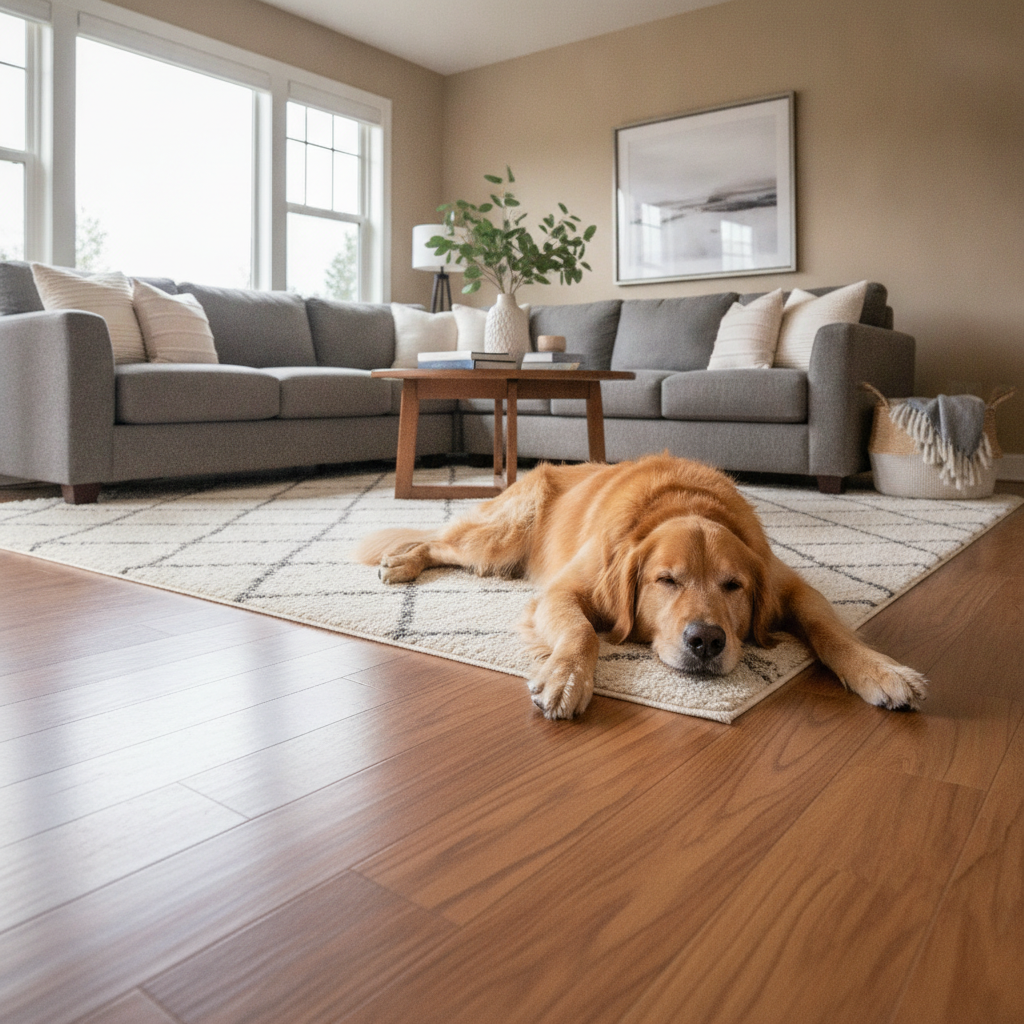
Tip 1: The First Line of Defense – Nail Care and Paw Protection
The number one source of scratches is untrimmed nails. According to the American Veterinary Medical Association (AVMA), dogs’ nails should be trimmed regularly, typically every 2-4 weeks [8]. A good rule of thumb: if you can hear your dog’s nails clicking on the floor, they’re too long. For pet owners who are nervous about trimming, alternatives like nail caps (e.g., Soft Paws) can provide a soft, protective barrier over the nail.
Tip 2: Strategic Use of Rugs, Mats, and Runners
You don’t need to cover your entire beautiful floor, but strategic placement of area rugs and runners can make a huge difference. Place them in high-traffic zones like hallways, in front of doorways, and where your dog is most likely to “launch” during playtime. When choosing a rug, opt for durable, easy-to-clean materials like polypropylene or wool. Crucially, always use a high-quality rug pad that is approved for your floor type to prevent discoloration or damage to the finish.
Tip 3: Choosing Colors and Finishes that Hide Imperfections
Aesthetic choices can be your best friend in a pet-friendly home.
- Color & Pattern: Floors with a multi-tonal color variation and a prominent grain pattern are fantastic at camouflaging pet hair and minor scratches. A dark, uniform, high-gloss floor, by contrast, will highlight every single speck of dust and hair.
- Finish: A matte or low-sheen finish is far more forgiving than a high-gloss one. Glossy surfaces reflect more light, making micro-scratches much more visible.
A Triage Guide to Pet Damage: Your Repair Manual
Even with the best preventative care, accidents happen. The key is knowing how to respond. Before you panic, consult this triage guide. For complex issues, always consult a certified professional, such as a floor refinisher certified by the National Wood Flooring Association (NWFA) or a cleaner certified by the Institute of Inspection, Cleaning and Restoration Certification (IICRC) [9].
Problem: Scratches and Gouges
- For Light Scratches (on Hardwood or Hybrid Veneer): Often, these are just scuffs in the top finish. They can be easily concealed using a stain-filled marker or a repair kit that matches your floor’s color. As our video tutorial demonstrates, even rubbing the meat of a walnut into a light scratch can sometimes be enough to make it disappear.
- For Deeper Scratches/Gouges (on LVP/Laminate/Hybrid): One of the major advantages of a floating plank floor is the ability to replace a single, damaged board without redoing the entire room. While it requires some care, a professional can easily pop out the damaged plank and install a new one from the extra box you saved after installation.
Problem: Urine Stains and Odors
When it comes to pet urine, speed is critical, but the right cleaner is even more important.
Pet Stain Removal Matrix
| Floor Type | Recommended Action | What to Avoid |
|---|---|---|
| Hybrid/LVP/Laminate | Wipe up immediately. Clean area with a pH-neutral cleaner or a 1:1 vinegar/water solution. | Ammonia-based cleaners, abrasive pads. |
| Sealed Hardwood | Wipe up immediately. Clean with a hardwood-specific cleaner. | Water, vinegar, steam mops. |
| Porcelain Tile | Wipe up immediately. Clean tile and grout with a pH-neutral cleaner. | Harsh acids on unsealed grout. |
For odor removal on any surface, an enzymatic cleaner is non-negotiable. As explained by The Humane Society of the United States, these cleaners use enzymes to break down the specific uric acid crystals in urine, eliminating the odor at its source. Standard cleaners may remove the visible stain, but they leave the odor-causing crystals behind, which can encourage your pet to re-mark the same spot [10].
Frequently Asked Questions about Pet-Friendly Flooring
What is the absolute most durable flooring for a house with large dogs?
For pure, brute-force durability, porcelain tile is the winner. Its high PEI rating means it’s virtually impossible to scratch [5]. It is followed closely by high-AC laminate (AC4 or AC5), which offers superior scratch resistance [4], and then rigid core products like Bravewood and LVP, which offer a better balance of durability and comfort [3].
Is SPC or WPC core hybrid flooring better for homes with pets?
Both are excellent waterproof options. The primary difference is density. SPC (Stone Polymer Composite) has a limestone-based core, making it extremely dense and highly resistant to dents from heavy furniture or a large dog dropping a toy [2]. WPC (Wood Polymer Composite) is slightly softer and can be more comfortable and quieter underfoot. For most pet owners, especially those with large, heavy dogs, the superior dent resistance of SPC is a significant advantage.
Does hybrid flooring get slippery for dogs?
This depends on the product’s finish and texture. Many modern hybrid floors, including Bravewood, feature a textured or embossed surface that mimics the grain of real wood. This provides better traction than older, perfectly smooth laminate or polished tile. As the AKC advises, ensuring good traction is especially important for the joint health of senior dogs or breeds prone to hip dysplasia [6].
How do you clean and maintain Bravewood hybrid hardwood?
Maintenance is simple. Regular sweeping or vacuuming (using a hard floor setting without a beater bar) to remove pet hair and grit is the first step. For deeper cleaning, use a damp mop with a pH-neutral cleaner designed for hardwood floors. It’s critical to avoid using a steam mops, harsh chemicals like ammonia, or excessive amounts of water, as these can damage the real wood veneer and finish over time. Always refer to the manufacturer’s specific care guidelines for the best results.
The Best of Both Worlds: A Stylish Home Your Whole Family Can Enjoy
Choosing the right floor for a home with pets is no longer a choice between beauty and practicality. With advanced options like Bravewood hybrid hardwood, you can have the authentic, elegant look of real wood with the waterproof, scratch-resistant durability your family needs.
By using the Pet-Proof Scorecard, you are now equipped to analyze any flooring option through the lens of a savvy pet owner. More importantly, with the Proactive Playbook and Repair Manual in hand, you are empowered to protect your investment and confidently manage the realities of life with pets. The result is less time worrying about your floors and more time enjoying the beautiful, comfortable, and welcoming home you share with your furry companions.
References
- National Wood Flooring Association (NWFA). (n.d.). Refinishing/Recoating. Retrieved from https://www.woodfloors.org/consumer/refinishing-recoating.aspx
- Floor Covering Institute. (n.d.). Technical Information on Flooring Products.
- The Spruce. (2023). The 8 Best Flooring Options for Dogs.
- North American Laminate Flooring Association (NALFA). (n.d.). AC Rating. Retrieved from https://nalfa.com/ac-rating/
- Tile Council of North America (TCNA). (n.d.). PEI Rating.
- American Kennel Club (AKC). (2021). How to Protect Your Floors From Your Dog. Retrieved from https://www.akc.org/expert-advice/home-living/how-to-protect-your-floors-from-your-dog/
- Architectural Digest. (2023). The Best Types of Flooring for Dogs (and Other Pets).
- American Veterinary Medical Association (AVMA). (n.d.). Nail Trims: Why They’re So Important. Retrieved from https://www.avma.org/resources-tools/pet-owners/petcare/nail-trims-why-theyre-so-important
- Institute of Inspection, Cleaning and Restoration Certification (IICRC). (n.d.). Find a Certified Professional. Retrieved from https://www.iicrc.org/
- The Humane Society of the United States. (n.d.). How to remove pet stains and odors. Retrieved from https://www.humanesociety.org/resources/how-remove-pet-stains-and-odors
