
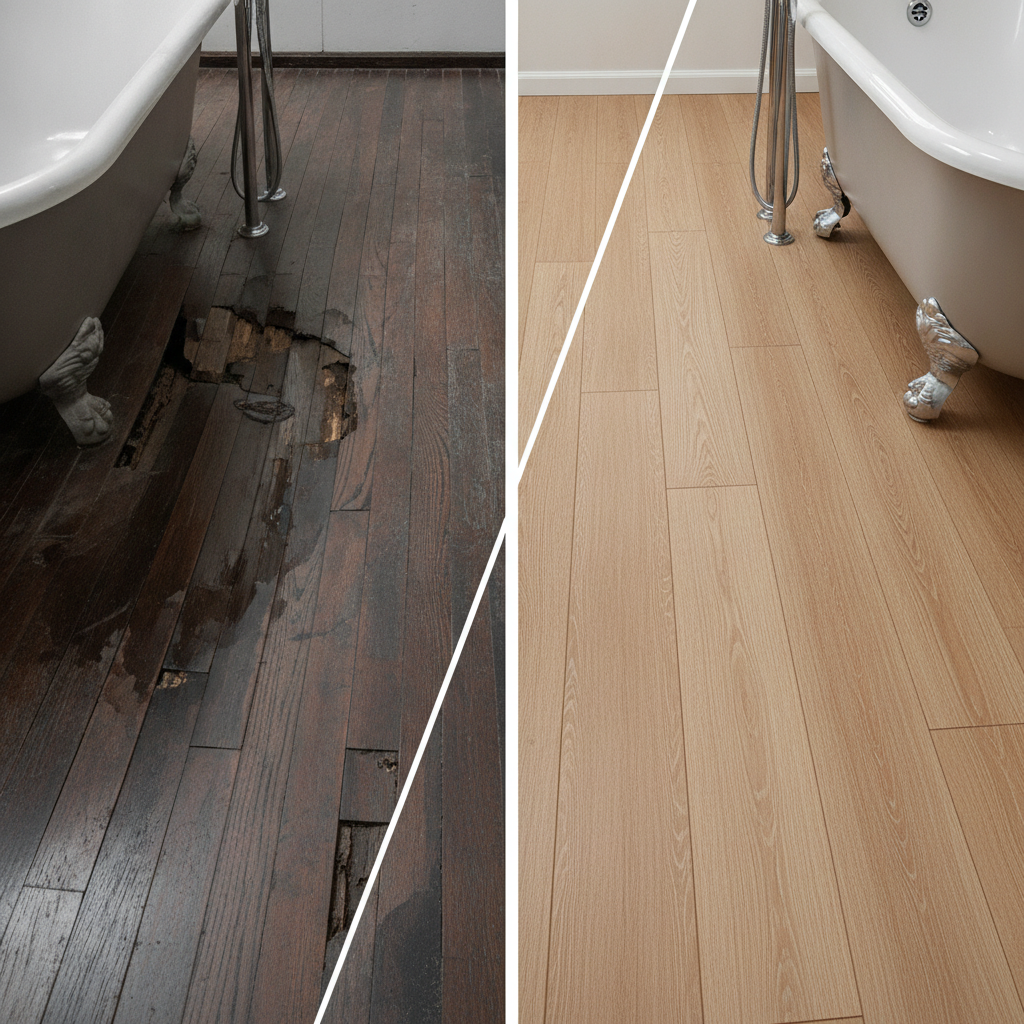
The dream of a bathroom that feels like a warm, inviting sanctuary often includes the timeless beauty of hardwood floors. But reality quickly sets in: the daily steam from showers, inevitable splashes from the tub, and constant high humidity create a hostile environment for traditional wood. For years, homeowners have faced a frustrating choice between the aesthetic they love and the durability they need. Warped planks, water stains, and the threat of mold have made solid hardwood a high-risk, low-reward option for the one room that needs moisture protection the most.
But what if you didn’t have to choose? What if you could have the authentic, luxurious look of real wood with a 100% waterproof guarantee?
This is where the modern marvel of waterproof hybrid hardwood flooring enters the picture. This guide is your ultimate bathroom flooring playbook, designed to cut through the confusion and arm you with the knowledge to make a confident, regret-proof decision. We’ll move beyond simple lists and dive deep into the science of moisture damage, demystify the technology behind today’s best flooring, and introduce data-driven tools—like our unique Durability Scorecard—to help you compare your options like a pro. Prepare to master moisture and discover why hybrid flooring, like the innovative options from Bravewood, is the definitive solution for your bathroom.
- The Bathroom Flooring Dilemma: Can You Put Real Hardwood in a Bathroom?
- The Modern Solution: What is Waterproof Hybrid Hardwood?
- The Ultimate Bathroom Flooring Showdown: Our Durability Scorecard
- Bravewood Hybrid Hardwood: A Comprehensive Review
- Beyond Flooring: A Complete Guide to Bathroom Moisture Control
- Frequently Asked Questions (FAQ)
- Conclusion: The Best of Both Worlds is Finally Here
- References & Authoritative Sources
The Bathroom Flooring Dilemma: Can You Put Real Hardwood in a Bathroom?
Let’s address the big question head-on: can you install traditional, solid hardwood flooring in a full bathroom? While technically possible with extreme, often cost-prohibitive measures, the overwhelming consensus from industry experts is a resounding no.
The National Wood Flooring Association (NWFA), the leading authority on wood flooring standards, consistently advises against installing solid hardwood in high-moisture environments like full bathrooms.1 Wood is a natural, porous material. It acts like a sponge, absorbing and releasing moisture from the air around it. In a bathroom, where humidity levels can spike from 50% to 90% in minutes, this natural process becomes a recipe for disaster.
As one certified flooring installer puts it, “I’ll always advise a client against solid wood in a bathroom. It’s not a matter of if it will fail, but when. No surface sealer can fully protect the seams between boards or the wood itself from the constant ambient humidity. You’re fighting a losing battle against nature.”
The Science of Wood vs. Water: Cupping, Crowning, and Rot Explained
When wood absorbs excess moisture, it physically expands. This movement leads to visible and often irreversible damage. Understanding these failure modes is key to appreciating why waterproof alternatives are essential. According to standards recognized by restoration professionals like the Institute of Inspection, Cleaning and Restoration Certification (IICRC), water damage can manifest in several ways.2
- Cupping: This occurs when the edges of a floorboard are higher than its center, creating a concave, “cupped” shape. It’s a classic sign that the wood has absorbed moisture from the bottom—for instance, from a damp subfloor or water wicking up between the planks.
- Crowning: The opposite of cupping, crowning is when the center of the board is higher than its edges. This typically happens when the surface of the floor has been exposed to more moisture than the bottom, such as from a spill that was left to sit for too long.
- Buckling: This is the most severe form of water damage, where the flooring lifts entirely off the subfloor. Buckling is caused by major expansion as the wood planks push against each other with immense force, having nowhere else to go but up.
Warped Floor Diagnostic Flowchart: What’s Happening to Your Floor?
- Is your floor lifting completely off the subfloor in one or more areas?
- Yes: You have Buckling. This indicates a significant water event or moisture problem that must be addressed immediately. The affected flooring will almost certainly need to be replaced.
- Are the edges of individual planks higher than the center?
- Yes: You have Cupping. This suggests the moisture source is coming from below or between the planks. Check for subfloor dampness or leaks.
- Is the center of individual planks higher than the edges?
- Yes: You have Crowning. This points to a surface moisture issue, such as repeated spills or the after-effects of a floor being sanded while still containing excess moisture.
What About Marine-Grade Finishes? A Reality Check
A common misconception is that applying multiple coats of a marine-grade varnish or polyurethane can make a wood floor waterproof. While these top-tier sealants provide excellent surface protection against occasional splashes, they are not a foolproof solution for a bathroom.
The problem lies in the very nature of wood flooring. It’s a system of individual planks with tiny seams between them. Water will inevitably find its way into these seams. Furthermore, wood’s porosity means it will continue to absorb ambient humidity from the air, causing it to expand and contract regardless of the surface finish. A sealant can slow this process, but it cannot stop it in an environment with the daily steam and humidity cycles of a bathroom. This makes any “waterproofed” solid wood installation an expensive and high-risk gamble.
The Modern Solution: What is Waterproof Hybrid Hardwood?
To solve the age-old conflict between wood’s beauty and water’s destructive power, the flooring industry developed a revolutionary new category: waterproof hybrid hardwood. This innovative product delivers the best of both worlds by a genuine layer of real hardwood with a completely inert, 100% waterproof core.
The magic is in its multi-layered construction. Unlike a solid piece of oak or maple that is vulnerable through and through, a hybrid plank is an engineered product where each layer serves a specific purpose. The star of the show is the core, which is typically made from a Stone Polymer Composite (SPC). SPC is a dense, rigid material made from a mixture of natural limestone powder, polyvinyl chloride, and stabilizers. Because its primary component is stone, it is dimensionally stable and completely impervious to water. It will not swell, warp, or peel when exposed to moisture, giving the entire plank its waterproof foundation.
Cross-Section of a Hybrid Hardwood Plank
- Top Layer (Protective Finish): A durable, commercial-grade urethane finish with aluminum oxide to resist scratches and wear.
- Second Layer (Real Wood Veneer): A thin, authentic layer of real hardwood (e.g., Oak, Hickory, Maple) that provides the genuine look, grain, and texture you can’t get from a printed pattern.
- Third Layer (Waterproof Core): The ultra-dense SPC core that provides structural integrity and makes the plank 100% waterproof.
- Bottom Layer (Attached Underlayment): Often includes a pre-attached pad for sound absorption and added comfort underfoot.
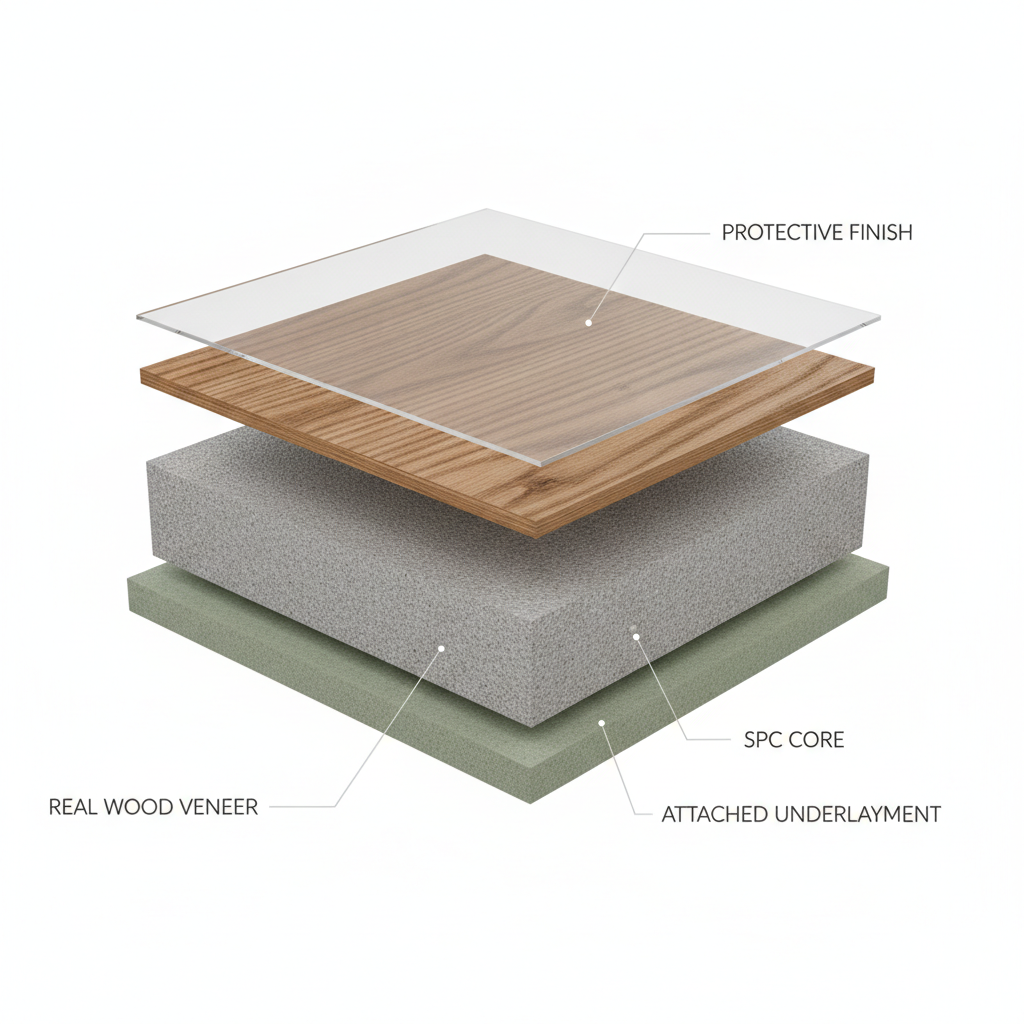
Anatomy of a Hybrid Plank: Real Wood Veneer + Waterproof SPC Core
Let’s break down the two key components that make hybrid flooring the ideal bathroom solution.
First, the real wood veneer. This is what you see and feel. Unlike laminate or vinyl flooring which use a photographic print to mimic wood, hybrid hardwood uses an actual slice of wood. According to the Floor Covering Institute, this construction provides unmatched authenticity.3 Veneer thickness for hybrid products typically ranges from 0.6mm to 2mm. While this layer provides the beauty, it’s the core that does the heavy lifting.
Second, the waterproof SPC core. This is the engineered heart of the plank. Its high density not only makes it waterproof but also extremely resistant to dents and impacts. This structural stability means the planks won’t expand or contract with changes in humidity, eliminating the risk of cupping, crowning, or buckling that plagues solid hardwood.
Product Spotlight: The Bravewood Advantage
Bravewood stands as a prime example of this advanced flooring category, engineering its products specifically to thrive in challenging environments like bathrooms. By fusing a premium hardwood veneer to a rugged SPC core, Bravewood delivers authentic wood aesthetics without any of the traditional moisture-related anxieties. Their product lines offer a range of popular wood species, ensuring a perfect match for any design vision.
Sample Spec Sheet: Bravewood Oak Series
| Specification | Details |
|---|---|
| Construction | Hybrid Hardwood (Real Wood Veneer + SPC Core) |
| Wood Species | European Oak |
| Veneer Thickness | 1.2 mm |
| Core Material | Stone Polymer Composite (SPC) |
| Total Thickness | 7.5 mm |
| Waterproof | Yes, 100% Waterproof Core |
| Installation | Click-Lock Floating System |
| Warranty | Lifetime Residential / 15-Year Light Commercial |
The Ultimate Bathroom Flooring Showdown: Our Durability Scorecard
To help you make the best choice for your home, we’ve developed the Bathroom Flooring Durability Scorecard. This tool provides an at-a-glance comparison of the top three waterproof flooring contenders, rating them on the factors that matter most in a high-moisture space.
Callout Box: Waterproof vs. Water-Resistant
It’s crucial to understand the difference between these two terms:
- Water-Resistant: The material can withstand topical moisture and spills for a limited time before damage occurs. Many laminates and engineered hardwoods fall into this category. They are not suitable for bathrooms.
- Waterproof: The material itself is impervious to water and will not swell, crack, or warp even with prolonged exposure. This is the standard you need for a bathroom.
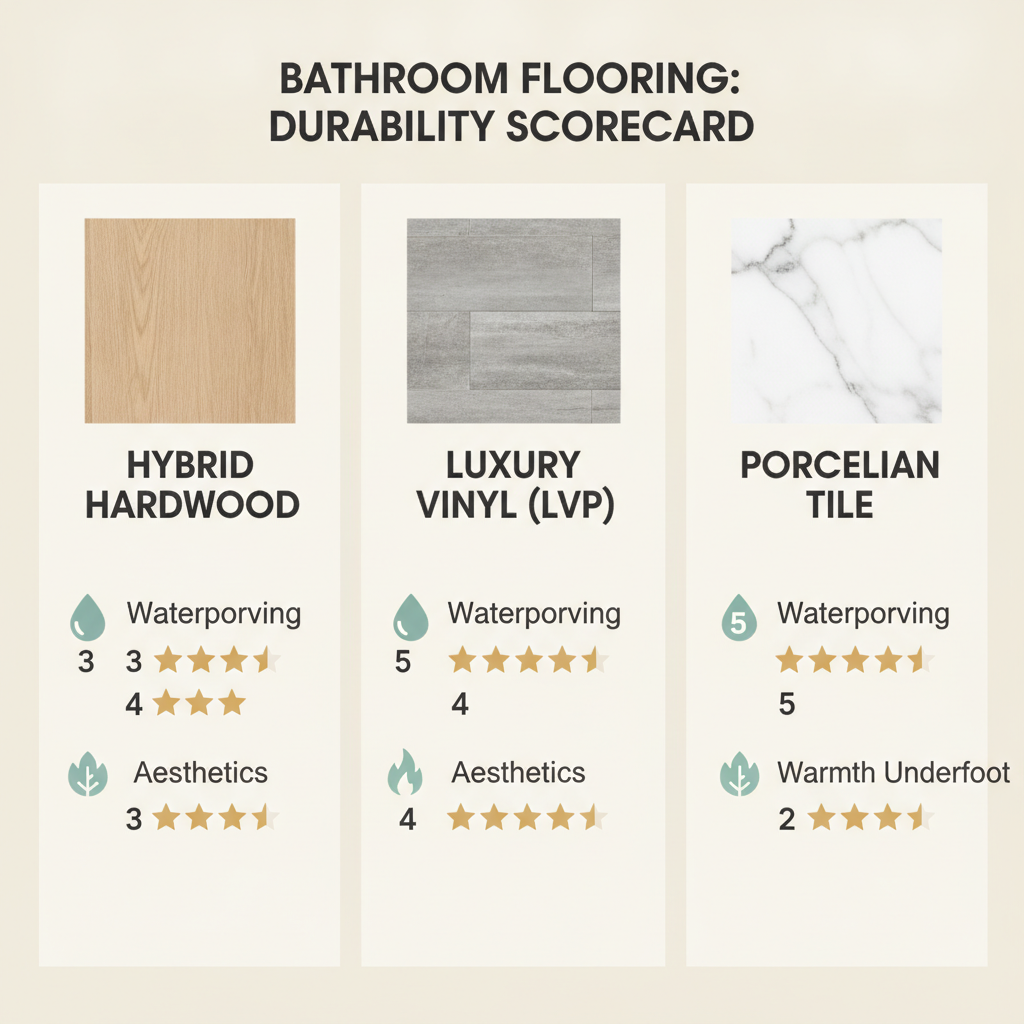
Bathroom Flooring Durability Scorecard
| Feature | Waterproof Hybrid Hardwood (Bravewood) | Luxury Vinyl Tile (LVT/LVP) | Porcelain Tile |
|---|---|---|---|
| Waterproofing | ★★★★★ (100% Waterproof Core) | ★★★★★ (100% Waterproof) | ★★★★★ (Inherently Waterproof) |
| Scratch Resistance | ★★★★☆ (Strong Finish) | ★★★★☆ (Depends on Wear Layer) | ★★★★★ (Extremely High) |
| Aesthetics | ★★★★★ (Authentic Real Wood) | ★★★★☆ (Realistic Photo Layer) | ★★★★☆ (Versatile Looks) |
| Warmth/Feel | ★★★★☆ (Warmer than Tile) | ★★★☆☆ (Softer Underfoot) | ★★☆☆☆ (Cold and Hard) |
| Average Cost (Materials) | $$$$ | $$$ | $$ |
Contender 1: Waterproof Hybrid Hardwood (e.g., Bravewood)
Hybrid hardwood scores highest on aesthetics, offering the undeniable beauty of real wood because it is real wood on the surface. Its waterproof SPC core provides total peace of mind against spills and humidity. While the protective finish is very durable, it’s important to note a key difference from thicker engineered hardwood: the thin veneer on hybrid products generally cannot be sanded and refinished. This means that while it’s highly scratch-resistant, a very deep gouge that penetrates the veneer cannot be repaired in the same way as a solid or thick-veneer engineered floor.
Contender 2: Luxury Vinyl Tile/Plank (LVT/LVP)
LVT is a champion of durability and value. It’s 100% waterproof, budget-friendly, and highly realistic thanks to modern high-definition printing. The key to its longevity is the wear layer—a clear top coating that protects the printed design from scratches and scuffs. The Resilient Floor Covering Institute (RFCI) provides standards for these products.4 For bathrooms, a wear layer of 12-mil is good, but a 20-mil layer is recommended for maximum durability, especially in high-traffic family bathrooms.
Contender 3: Porcelain & Ceramic Tile
Tile is the traditional, time-tested king of bathroom floors for a reason: it’s virtually indestructible and completely waterproof. Its durability is measured by a PEI rating, a scale established by the Porcelain Enamel Institute (PEI) that grades a tile’s resistance to abrasion and wear.5
- PEI 1: Walls only.
- PEI 2: Light residential traffic (e.g., master bathroom).
- PEI 3: All residential traffic. Look for a PEI rating of 3 or higher for residential bathroom floor tiles.
- PEI 4: Residential and light commercial traffic.
- PEI 5: All residential and heavy commercial traffic.
The primary downsides of tile are that it is cold and hard underfoot, and the grout lines require regular cleaning and sealing to prevent staining and mildew. For maximum durability, consider using an epoxy grout, which is non-porous and highly resistant to stains and water compared to traditional cement-based grout.
Bravewood Hybrid Hardwood: A Comprehensive Review
For homeowners unwilling to compromise on the authentic look of wood, Bravewood offers a compelling, modern solution. This section provides a deeper look at what sets this brand apart. While specific details are sourced from manufacturer data, the analysis is framed to give you a clear, unbiased understanding of the product.
Bravewood vs. The Competition
| Feature | Bravewood Hybrid Hardwood | Flooret (SPC Vinyl Plank) | Cali Bamboo (Engineered Hardwood) |
|---|---|---|---|
| Surface Material | Real Wood Veneer | High-Definition Vinyl Print | Real Wood Veneer |
| Core Material | 100% Waterproof SPC | 100% Waterproof SPC | Plywood or HDF (Water-Resistant) |
| Waterproof? | Yes | Yes | No (Water-Resistant) |
| Refinishable? | No | No | Yes (1-2 times) |
| Key Advantage | Authentic wood on a waterproof core | Extreme durability, thick wear layer | Thicker wood veneer |
Installation Guide: What to Expect
Bravewood hybrid hardwood is designed for straightforward installation, typically using a click-lock floating system. This means the planks lock together without the need for glue or nails. While this makes it a potential DIY project for an experienced homeowner, a bathroom installation has unique challenges. Ensuring a perfectly level subfloor and properly sealing the perimeter with 100% silicone caulk are critical steps to maintain the waterproof integrity of the system. For most homeowners, hiring a professional installer is the best way to guarantee a perfect, long-lasting result.
Buyer’s Checklist: Questions for Your Installer
- Are you experienced with installing SPC-core hybrid flooring?
- How will you ensure the subfloor is perfectly flat and dry?
- What is your process for sealing the perimeter and around the toilet and vanity?
- Does your installation warranty cover any moisture-related issues?
Warranty Deep Dive: What’s Really Covered?
Bravewood, like most premium flooring brands, offers a robust lifetime residential warranty. This typically covers manufacturing defects that could cause the floor to fail, such as delamination of the layers. However, it’s crucial to understand what a “waterproof” warranty truly means. It guarantees that the plank itself will not be damaged by topical water. It does not cover damage from major flooding, leaks from plumbing, or problems arising from improper installation (like unsealed expansion gaps). Always read the full warranty document before purchasing to understand the specific terms and conditions.
Beyond Flooring: A Complete Guide to Bathroom Moisture Control
The best waterproof floor in the world can still fail if the bathroom has a chronic moisture problem. A truly protected space requires a holistic approach to controlling humidity. Following guidelines similar to those from the Environmental Protection Agency (EPA) for mold prevention can safeguard your entire bathroom, not just the floor.6
The most critical tool for moisture control is your exhaust fan. Its power is measured in CFM (Cubic Feet per Minute). To be effective, a fan must be sized correctly for the room. A common rule of thumb is to have at least 1 CFM for every square foot of floor space. For bathrooms over 100 square feet, a more precise calculation is needed: add the CFM requirement for the tub (50 CFM), shower (50 CFM), and toilet (50 CFM) together.
Immediate Fixes: Daily Habits for a Drier Bathroom
- Run the Fan: Always run your exhaust fan during a shower or bath and for at least 20-30 minutes afterward to vent humid air outside.
- Wipe Up Water: Don’t let water sit on the floor. Wipe up splashes and drips from the tub or sink immediately.
- Use a Squeegee: Wiping down shower walls and doors with a squeegee after each use removes a significant amount of water that would otherwise evaporate into the air.
DIY Bathroom Moisture Audit Checklist
- [ ] Does my exhaust fan audibly pull air (test with a tissue held up to the vent)?
- [ ] Is the caulk around my tub, shower, and sink free of cracks and gaps?
- [ ] Are there any signs of water staining on the ceiling or walls?
- [ ] Do I see any visible mold or mildew growth, particularly in corners or on grout lines?
- [ ] Does the area under the sink feel dry and free of musty odors?
Weekend Projects: Sealing and Painting for Protection
For a more robust defense, consider these simple DIY projects. First, inspect and replace any old, cracked, or missing caulk around your tub, shower, and sink with a high-quality, mold-resistant 100% silicone caulk. This is one of the most common entry points for water to get behind walls and under floors.
Second, when it’s time to paint, choose the right product. Modern bathroom paints are specifically formulated with mildewcides and have a tighter surface structure to repel moisture. Look for products labeled “for kitchens and baths” or those with a durable satin or semi-gloss finish, which are easier to clean and more resistant to moisture penetration than flat or matte finishes.
Frequently Asked Questions (FAQ)
What is the most durable and low-maintenance flooring for a kids’ bathroom?
For a high-traffic kids’ bathroom, both LVT/LVP and porcelain tile are top-tier choices. LVT offers superior resilience—it’s softer underfoot and less likely to be damaged if something heavy is dropped. Porcelain tile is nearly scratch-proof and indestructible but is harder and colder. The choice often comes down to a preference for the softer feel of vinyl versus the absolute toughness of tile.
How much does it cost to install waterproof flooring in a small bathroom?
Material costs vary widely. As of 2026, you can generally expect to pay:
- Porcelain Tile: $2 – $10 per square foot
- Luxury Vinyl Plank (LVP): $3 – $7 per square foot
- Waterproof Hybrid Hardwood: $5 – $12 per square foot
Installation costs can range from $3 to $10+ per square foot depending on your location, the complexity of the job, and the condition of your subfloor. Always get at least three quotes from qualified installers.
Can water-damaged hardwood floors be saved?
It depends entirely on the severity. Minor cupping caused by temporary humidity might relax on its own once the moisture source is controlled. More significant cupping can sometimes be corrected by sanding and refinishing the floor after it has completely dried out. However, severe crowning, buckling, or any floor with signs of rot or mold will need to be replaced. For any significant water damage, it is critical to consult a professional restoration service certified by the IICRC to assess the damage and prevent further issues like mold growth.2
Conclusion: The Best of Both Worlds is Finally Here
For decades, the warmth and elegance of hardwood in the bathroom remained a risky fantasy. The relentless assault of moisture meant that warping, staining, and permanent damage were all but inevitable. But technology has finally caught up to our design aspirations.
Waterproof hybrid hardwood, exemplified by brands like Bravewood, has fundamentally changed the rules. By fusing an authentic real wood surface to an unyielding, 100% waterproof SPC core, it delivers the aesthetic you desire with the performance you demand. You no longer have to sacrifice beauty for peace of mind.
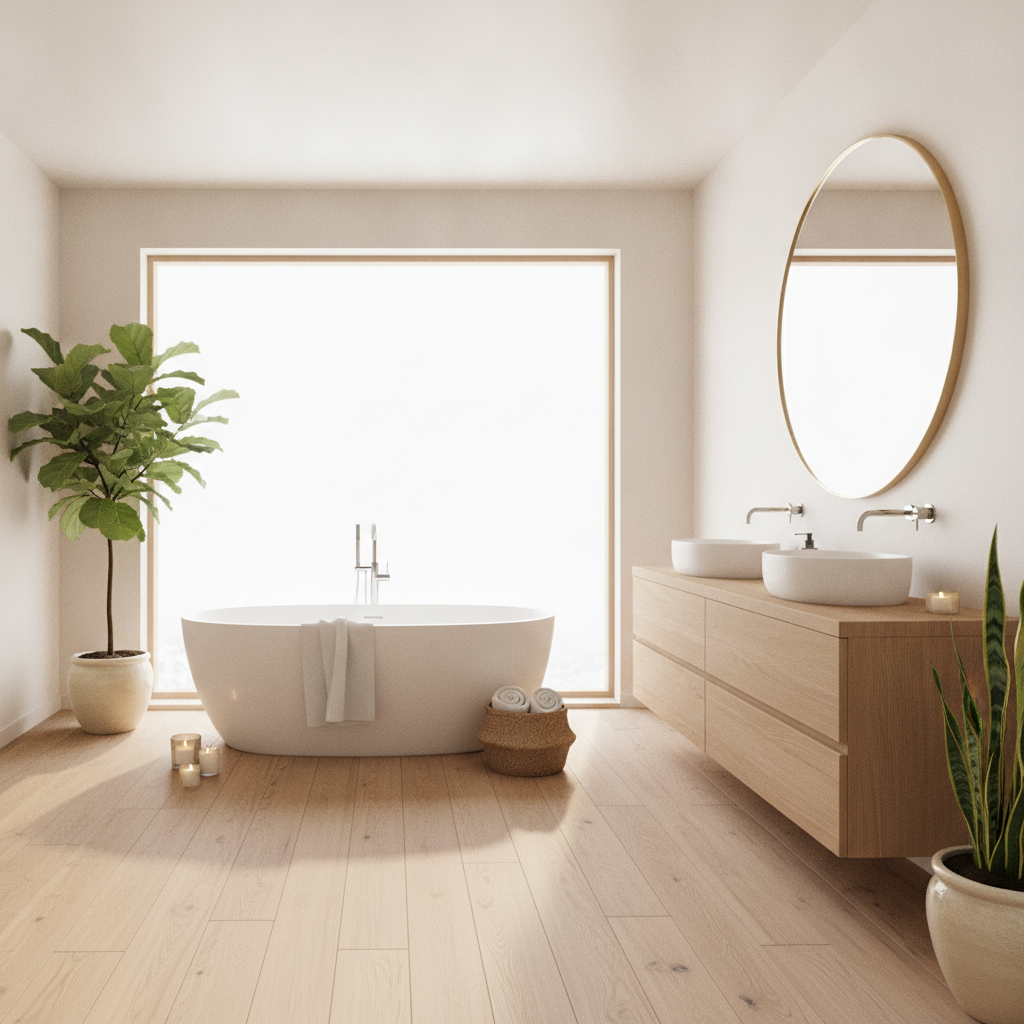
By understanding the critical differences between materials, decoding technical terms like PEI ratings and wear layers, and using our Durability Scorecard, you are now fully equipped to make an expert-level decision for your home. You can step out of the shower each morning onto a floor that is not only beautiful and warm but also engineered to master moisture for a lifetime.
Feeling confident? Explore Bravewood’s latest collection of waterproof hybrid hardwood to find the perfect style for your bathroom, or use our downloadable Moisture Audit Checklist to start protecting your home today.
This article may contain affiliate links. All installation and repair advice should be considered informational; always consult with a certified professional for your specific project.
References & Authoritative Sources
- National Wood Flooring Association (NWFA). (N.D.). Installation Guidelines and Specifications. The NWFA provides the definitive industry standards for the proper installation of wood flooring, including guidelines on moisture testing and environmental requirements.
- Institute of Inspection, Cleaning and Restoration Certification (IICRC). (N.D.). IICRC S500 Standard for Professional Water Damage Restoration. This standard is the authoritative guide for the water damage restoration industry, defining procedures and best practices for assessing and repairing water-damaged structures.
- Floor Covering Institute. (N.D.). Technical Resources. The Floor Covering Institute offers educational materials and technical explanations on the construction and properties of various flooring types, including hybrid and composite flooring.
- Resilient Floor Covering Institute (RFCI). (N.D.). Product Standards. The RFCI represents the vinyl flooring industry and provides reliable information and standards on product specifications, including wear layer thickness and performance criteria.
- Porcelain Enamel Institute (PEI). (N.D.). PEI Rating System for Ceramic Tile. The PEI developed and maintains the standard industry scale for rating the abrasion resistance and durability of ceramic and porcelain tiles.
- Environmental Protection Agency (EPA). (N.D.). A Brief Guide to Mold, Moisture, and Your Home. The EPA provides authoritative public health information and guidelines for preventing and remediating mold in residential buildings.
