
For years, homeowners have faced a frustrating design dilemma: the desire for the timeless warmth and beauty of wood flooring in the bathroom clashes with the fear of inevitable water damage. Splashes from the tub, high humidity, and unexpected leaks have traditionally made wood a non-starter for these wet areas, leading to warped planks and costly repairs. But what if you could have the authentic aesthetic of hardwood without the risk?
Enter waterproof hybrid hardwood, an innovative flooring solution engineered to solve this very conflict. This is not your grandmother’s laminate or a simple picture of wood on a vinyl plank. It’s the real deal—genuine wood on a technologically advanced, 100% waterproof core.
This is your definitive, science-backed guide to achieving the perfect wood-look floor in any wet area. We move beyond simple lists to provide a complete decision-making framework, empowering you to choose with confidence. We’ll explore the technology behind hybrid hardwood, compare it to the best alternatives, detail the critical installation steps that guarantee a worry-free result, and answer your most pressing questions.
- The Core Conflict: Why Traditional Hardwood and Bathrooms Don’t Mix
- The Solution Unveiled: What Is Waterproof Hybrid Hardwood?
- The Ultimate Showdown: Best Waterproof Flooring Options for Bathrooms
- Installation is Everything: How to Guarantee a Waterproof Result
- Beyond Function: Stylish Flooring for Every Wet Area
- FAQ: Your Top Questions About Waterproof Bathroom Flooring Answered
- The Confidence to Choose
- References & Authoritative Sources
The Core Conflict: Why Traditional Hardwood and Bathrooms Don’t Mix
Before we can appreciate the solution, we must first understand the problem. The reason traditional solid wood flooring is a poor choice for a full bathroom lies in its very nature. Wood is a hygroscopic material, meaning it naturally absorbs and releases moisture from the air to balance with its environment.
In a room with fluctuating humidity like a bathroom, this creates a constant cycle of expansion and contraction. This movement leads to common problems like:
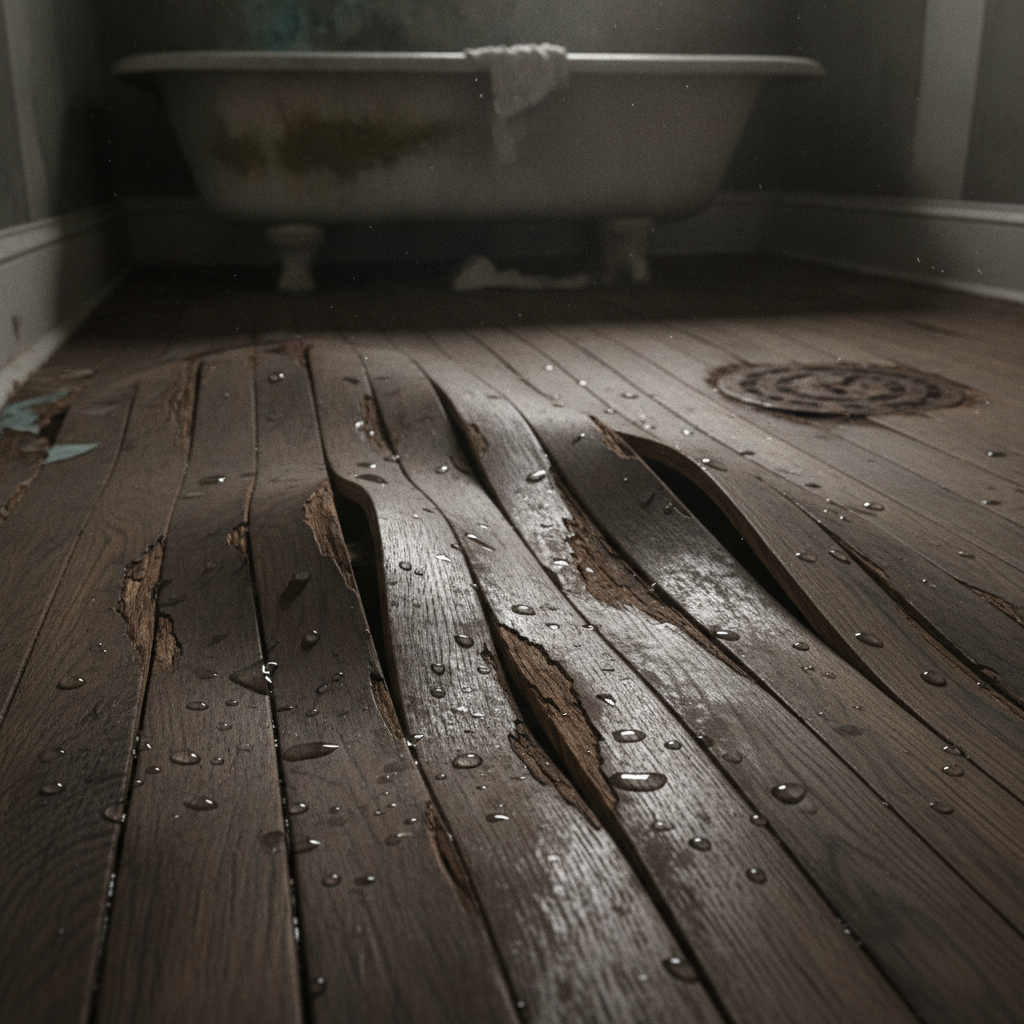
- Cupping: The edges of the plank become higher than the center, creating a concave shape. This happens when the bottom of the board absorbs more moisture than the top.
- Crowning: The center of the plank swells and becomes higher than the edges, creating a convex shape. This is often due to topical moisture, like a water spill left too long.
- Buckling: A severe reaction where the flooring lifts off the subfloor entirely.
The National Wood Flooring Association (NWFA) generally advises against installing solid hardwood in full bathrooms for these reasons[1]. To maintain stability, hardwood floors require a consistent indoor relative humidity, ideally between 35% and 55%—a range rarely found in a room with a steamy shower[1]. This fundamental conflict between wood’s natural properties and a bathroom’s environment is the core problem that modern waterproof flooring was engineered to solve.
The Solution Unveiled: What Is Waterproof Hybrid Hardwood?
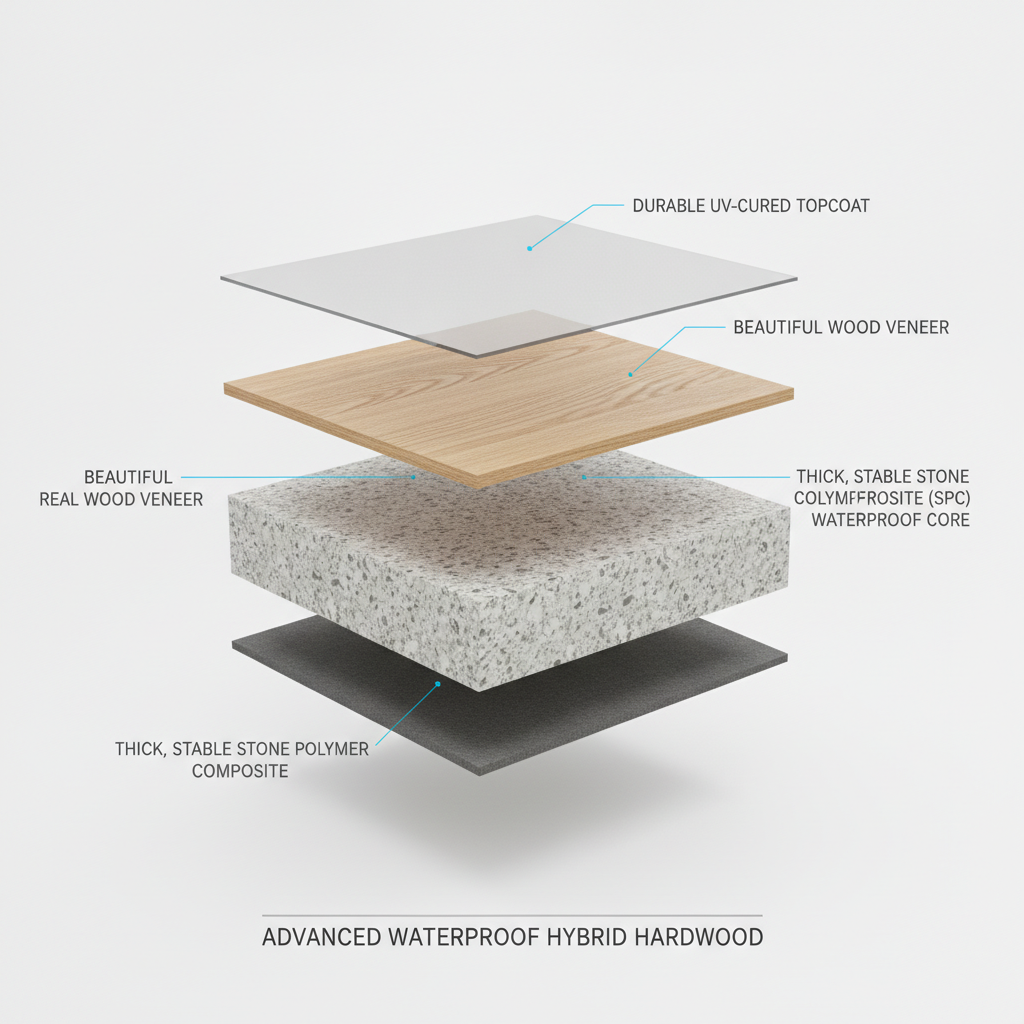
Waterproof hybrid hardwood is a marvel of modern flooring engineering, designed to deliver the authentic beauty of wood without its vulnerability to moisture. It is a multi-layered plank that combines the best of both natural and synthetic materials.
At its core, hybrid hardwood is not wood at all. The main structure of the plank is a rigid, 100% waterproof composite core, typically made of either Stone Polymer Composite (SPC) or Wood Polymer Composite (WPC)[2]. This core is what gives the flooring its dimensional stability and complete immunity to water damage from spills or humidity. Bonded to the top of this waterproof core is a thin layer of genuine hardwood veneer, often between 0.6mm and 2mm thick. This is real wood—oak, hickory, maple—that you can see and feel. The plank is then finished with multiple layers of a durable, UV-cured topcoat for protection against scratches and wear.
As one flooring expert from our Pro Panel puts it, “Hybrid hardwood is the ultimate compromise. You get the unique graining, knots, and character of real wood that photo-based products can’t perfectly replicate, but with the peace of mind of a completely waterproof foundation. It’s the best of both worlds.”
Hybrid Hardwood vs. Engineered Hardwood vs. LVP: What’s the Difference?
The flooring market can be confusing. Here’s a clear breakdown of how waterproof hybrid hardwood stacks up against its closest relatives.
| Feature | Waterproof Hybrid Hardwood | Traditional Engineered Hardwood | Luxury Vinyl Plank (LVP) |
|---|---|---|---|
| Water Resistance | 100% Waterproof Core | Water-Resistant (Plywood core can swell/delaminate) | 100% Waterproof |
| Authenticity | Real Wood Veneer Surface | Real Wood Veneer Surface | Photographic Image of Wood |
| Refinishing | Generally No (Veneer too thin) | Yes, 1-3 times (Depending on veneer thickness) | No |
| Dent Resistance | High (Rigid composite core) | Varies (Softer plywood core) | High (Rigid composite core) |
The most critical distinction is the core material. Traditional engineered hardwood uses a plywood-like core, which, while more stable than solid wood, can still absorb water, swell, and delaminate over time. Hybrid hardwood’s composite core is completely inert to water. Furthermore, while both have real wood on top, the thinner veneer on hybrid hardwood means it cannot be sanded and refinished—a crucial detail many homeowners overlook.
Pros and Cons of Hybrid Hardwood in a Bathroom
To make a balanced decision, consider the clear advantages and potential drawbacks.
Pros:
- Authentic Wood Beauty: It features a genuine hardwood surface, offering unmatched natural beauty and texture.
- Completely Waterproof: The SPC or WPC core will not swell, warp, or degrade when exposed to water, making it ideal for bathrooms.
- Exceptional Durability: The rigid core provides excellent resistance to dents and impacts.
- Strong Warranties: Many products come with residential warranties ranging from 25 years to a lifetime, specifically covering water damage.
Cons:
- No Refinishing: The thin wood veneer cannot be sanded down to remove deep scratches or change the finish later on.
- Higher Cost: It is often more expensive than LVP and waterproof laminate options.
- Installation is Key: While waterproof, the system is only as good as its installation. Improper sealing can still allow water to reach the subfloor.
An interior designer on our Pro Panel notes, “The aesthetic benefit is undeniable. Using materials with authentic texture, like the real wood veneer on a hybrid floor, adds a layer of warmth and luxury to a bathroom design that can elevate the entire space from purely functional to a spa-like retreat.”
The Ultimate Showdown: Best Waterproof Flooring Options for Bathrooms
While hybrid hardwood is an excellent choice, it’s one of several fantastic options for achieving a durable, wood-look floor in your bathroom. Here’s how the top contenders compare.
Our interior design expert advises, “The best material often depends on the overall style. For a seamless, modern look with minimal lines, large-format porcelain tile is unbeatable. For a cozy, modern farmhouse feel, the warmth and texture of a wide-plank LVP or hybrid hardwood is perfect.”
Option 1: Luxury Vinyl Plank (LVP/SPC)
Luxury vinyl plank is a dominant force in waterproof flooring for good reason. It is 100% synthetic and therefore 100% waterproof. Modern LVP uses high-definition 3D printing technology to create incredibly realistic wood visuals and textures. The best products are built on a rigid SPC core, similar to hybrid hardwood, making them highly durable.
When shopping for LVP, the most important specification to check is the wear layer—a clear top coating that protects the printed design. For a high-traffic area like a bathroom, a wear layer of 20 mil (0.5mm) or greater is recommended for long-term durability. Additionally, look for products with FloorScore® Certification, which ensures they have low VOC emissions for healthier indoor air quality[3].
Option 2: Wood-Look Porcelain Tile
For ultimate durability and water protection, nothing beats porcelain tile. By definition, porcelain has a water absorption rate of less than 0.5%, making it completely impervious to water[4]. High-definition printing allows for an astonishing range of realistic wood looks, from rustic and reclaimed to sleek and modern.
To gauge tile durability, look for the Porcelain Enamel Institute (PEI) rating, which measures resistance to abrasion. A PEI rating of 3 is suitable for residential bathrooms, while a rating of 4 or 5 indicates suitability for even heavy commercial traffic[5]. While tile is unmatched in durability, its downsides include a hard, cold feel underfoot and the need for grout lines, which require maintenance. To combat this, consider using epoxy grout, which is far more resistant to stains and water penetration than traditional cement-based grout.
Option 3: Modern Waterproof Laminate
Laminate flooring has evolved significantly. While older versions were notoriously susceptible to water damage, a new generation of waterproof laminate is now available. These products feature water-repellent surfaces, advanced locking systems that prevent water from seeping between planks for up to 72 hours, and water-resistant fiberboard cores.
To ensure you’re getting a durable product, check the Abrasion Class (AC) rating. An AC3 rating is good for general residential use, but for a bathroom, an AC4 rating is recommended for its superior resistance to wear, scratches, and impact[6]. While highly water-resistant, it’s critical to differentiate these products from older, non-waterproof laminate.
Installation is Everything: How to Guarantee a Waterproof Result
Choosing a waterproof material is only half the battle. A flawless installation is what creates a truly waterproof system that protects your subfloor and home.
According to a certified flooring installer on our Pro Panel, “The number one mistake homeowners and even some contractors make is failing to properly seal the perimeter. They choose a 100% waterproof plank but leave a tiny gap around the tub where water can get underneath. That completely defeats the purpose.”
Step 1: Subfloor Preparation – The Unseen Foundation
Your new floor is only as good as the foundation it rests on. The subfloor must be perfectly clean, flat, and dry before you begin. Most floor failures can be traced back to poor subfloor preparation. According to standards from the Institute of Inspection, Cleaning and Restoration Certification (IICRC), moisture levels in the subfloor should be checked with a meter to ensure they are within acceptable limits before installation[7].
Pro Tip: Do not skip this step. Use a long, straight edge to check for high or low spots. Use a self-leveling compound to fix any imperfections greater than 3/16 of an inch over a 10-foot span.
Step 2: The Critical Perimeter Seal
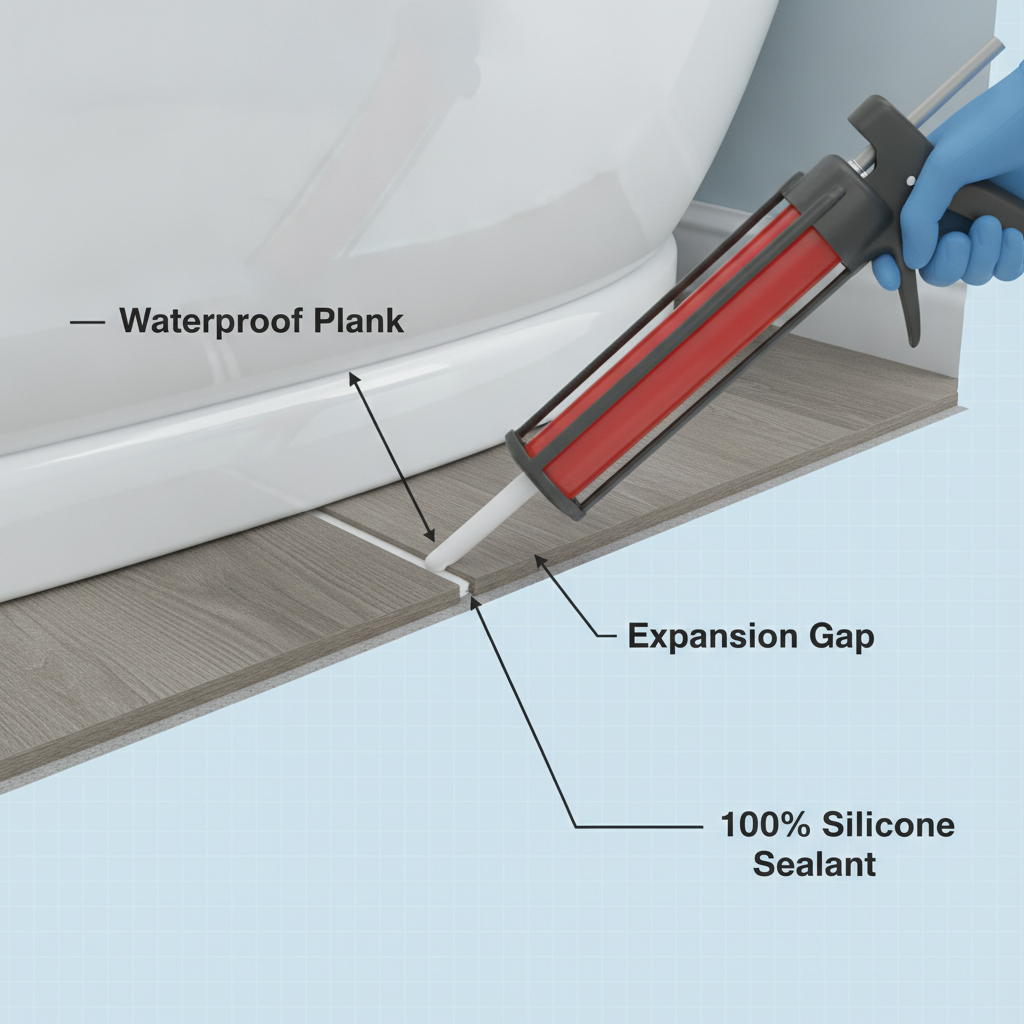
Floating floors like hybrid hardwood and LVP require a small gap around the perimeter of the room (typically 1/4 inch) to allow for slight seasonal movement. In a dry room, this gap is simply covered by baseboards. In a bathroom, this gap is a potential freeway for water.
It is a non-negotiable requirement from virtually all manufacturers to fill this expansion gap with 100% silicone sealant in any wet area[8]. This applies to the entire perimeter of the room, especially around bathtubs, showers, and toilets. This flexible, waterproof seal prevents water from getting under the floor and reaching the subfloor, creating a “bathtub effect” that contains spills on the surface. Do not use acrylic caulk, as it can crack over time and is not as waterproof as pure silicone.
Beyond Function: Stylish Flooring for Every Wet Area
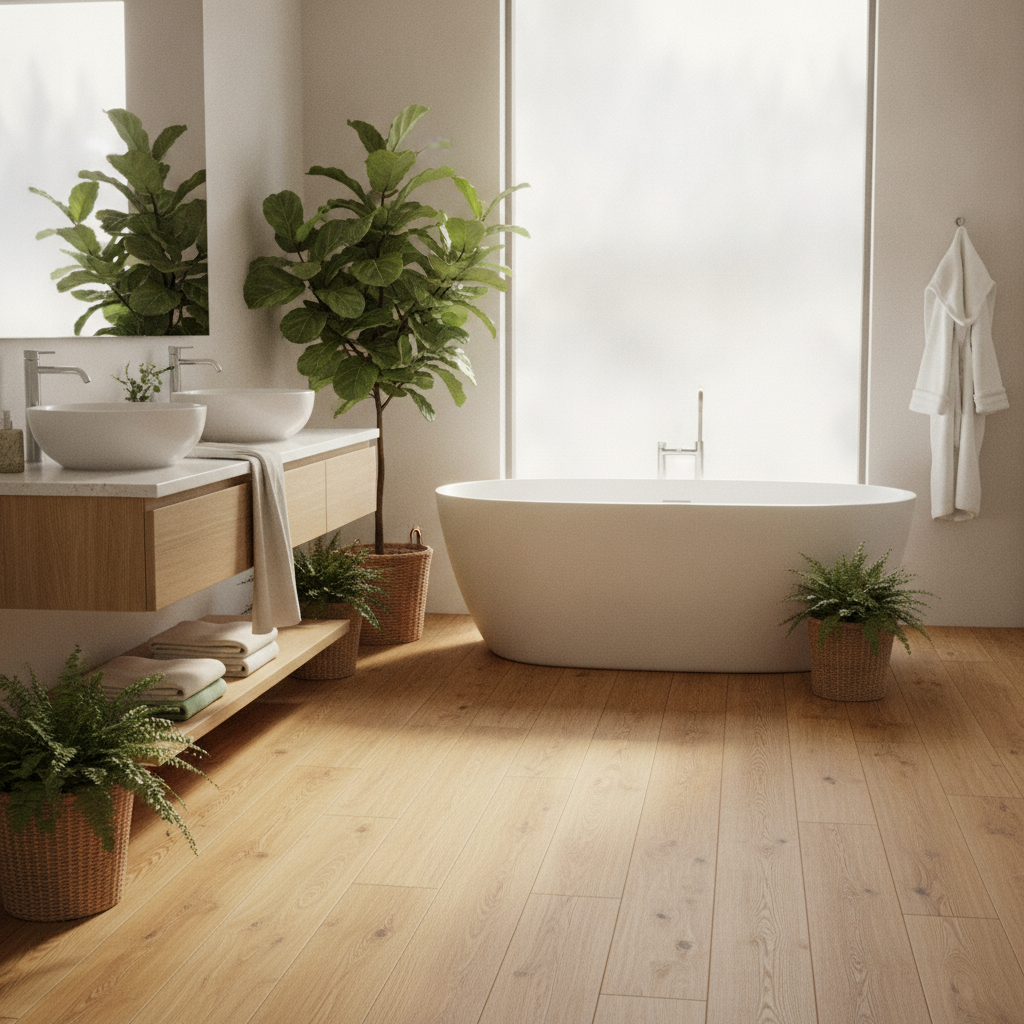
Your bathroom floor is a major design element. With today’s waterproof options, you don’t have to sacrifice style for function. You can achieve virtually any aesthetic you desire.
Recent data shows that wood-look porcelain remains a top choice for designers and homeowners, capturing over 15% of the tile market, thanks to its blend of durability and design versatility[9].
Our interior design expert adds, “We’re seeing a big trend towards large-format tiles and wider, longer planks. They create fewer grout lines or seams, which makes a small bathroom feel more spacious and serene. It’s a cleaner, more modern look.”
FAQ: Your Top Questions About Waterproof Bathroom Flooring Answered
Can you refinish waterproof hybrid hardwood?
Generally, no. The real wood veneer on waterproof hybrid hardwood is typically too thin (0.6mm to 2mm) to withstand the sanding process required for traditional refinishing. This is a key difference compared to solid hardwood or thicker engineered hardwood floors.
Will steam from a shower damage hybrid hardwood?
No, provided the floor is installed correctly according to manufacturer guidelines. The waterproof core is unaffected by ambient humidity, and the critical perimeter seal of 100% silicone prevents moisture from getting underneath the floor. However, proper bathroom ventilation with a correctly sized exhaust fan is always essential for managing moisture and preventing mold growth on other surfaces[10].
What is the most durable waterproof flooring?
For sheer, brute-force durability and being completely impervious to water, porcelain tile is the undisputed champion[5]. Its hardness is measured on the PEI scale, and it is exceptionally resistant to scratches and wear. However, for an outstanding combination of durability, comfort underfoot, and ease of installation, a high-quality SPC vinyl plank with a thick (20+ mil) wear layer is an excellent and often more practical choice for many homeowners.
The Confidence to Choose
The age-old conflict between wood’s beauty and water’s destructive power is officially over. Modern flooring technology, led by innovations like waterproof hybrid hardwood, has given homeowners the freedom to design the bathrooms of their dreams without compromise.
By understanding the unique construction of hybrid hardwood, comparing it to other excellent options like LVP and porcelain tile, and committing to the critical installation steps—especially the perimeter seal—you can confidently achieve a beautiful, durable, and worry-free wood-look floor. You are now empowered with the knowledge to build a foundation for your bathroom that is as practical as it is stunning.
Feeling inspired? Explore our gallery of bathroom flooring styles to find the perfect look for your renovation project.
This article provides general guidance. Always consult with a certified flooring professional and follow the specific manufacturer’s installation instructions and warranty requirements for any product you choose.
References & Authoritative Sources
- National Wood Flooring Association (NWFA). (n.d.). Installation Guidelines. The NWFA provides industry-standard technical information and guidelines for wood flooring installation and maintenance.
- Resilient Floor Covering Institute (RFCI). (n.d.). Technical Information. The RFCI is an industry trade association that provides authoritative information on the composition and performance of resilient flooring materials like SPC and WPC.
- FloorScore®. (n.d.). SCS Global Services. FloorScore is a third-party certification program that tests for volatile organic compound (VOC) emissions in flooring products.
- Tile Council of North America (TCNA). (n.d.). ANSI Standards for Ceramic Tile. The TCNA sets the American National Standards Institute (ANSI) standards for tile, including the <0.5% water absorption rate for porcelain.
- Porcelain Enamel Institute (PEI). (n.d.). PEI Rating System. The PEI developed and maintains the industry-standard rating system for measuring the abrasion resistance and durability of ceramic and porcelain tiles.
- Association of European Producers of Laminate Flooring (EPLF). (n.d.). Technical Bulletins. The EPLF develops and standardizes the Abrasion Class (AC) rating system used to classify the durability of laminate flooring.
- Institute of Inspection, Cleaning and Restoration Certification (IICRC). (n.d.). IICRC S500 Standard for Professional Water Damage Restoration. The IICRC is a standards-setting body for the inspection and restoration industry, providing guidelines on moisture levels in building materials.
- Flooring Manufacturer Installation Guidelines. (n.d.). Major flooring manufacturers (e.g., Shaw, Mohawk, COREtec) universally require the use of 100% silicone sealant for perimeter expansion gaps in full bathroom installations in their official product manuals.
- Tile Market Research Reports. (n.d.). Industry analysis reports from sources like Floor Covering Weekly or Market Research Future consistently show wood-look tile as a significant and popular segment of the overall tile market.
- U.S. Environmental Protection Agency (EPA). (n.d.). Moisture Control. The EPA provides authoritative guidance for homeowners on managing moisture, improving ventilation, and preventing mold growth in homes.
