
We love our pets, but we also love our homes. It’s a constant balancing act. You cherish the joyful chaos of a dog skidding into the room or a cat pouncing on a toy, but you cringe at the sound of nails on the floor and hold your breath every time a water bowl tips over. The battle between a beautiful home and a happy pet often feels like it’s fought on the very floors beneath your feet. If you’re tired of worrying about scratches, stains, and the endless cleanup, you’ve come to the right place.
This isn’t just another list of “good” flooring options. This is the definitive pet owner’s flooring playbook. We’re moving beyond vague marketing claims to give you a data-driven framework, complete with a ‘Durability Index’ and a ‘Pet-Friendliness Scorecard,’ to empower your decision. We’ll dive deep into the top flooring contenders, give a special focus to the game-changing category of waterproof hybrid hardwood, and even provide a repair guide to fix existing damage. By the end of this guide, you’ll have the clarity and confidence to choose the perfect floor for your furry family—a floor that you and your pets can love for years to come.
- Understanding the Challenge: What Pets Do to Floors
- Our Data-Driven Framework: How We Rate Pet-Friendly Flooring
- In-Depth Review: The Top 4 Contenders for Pet-Friendly Flooring
- Special Focus: Is Waterproof Hybrid Hardwood the Perfect Pet-Friendly Floor?
- The Pet Owner’s Repair Guide: Fixing and Preventing Floor Damage
- Frequently Asked Questions (FAQ)
- Your Home, Your Pet, Your Perfect Floor
- References & Authoritative Sources
Understanding the Challenge: What Pets Do to Floors
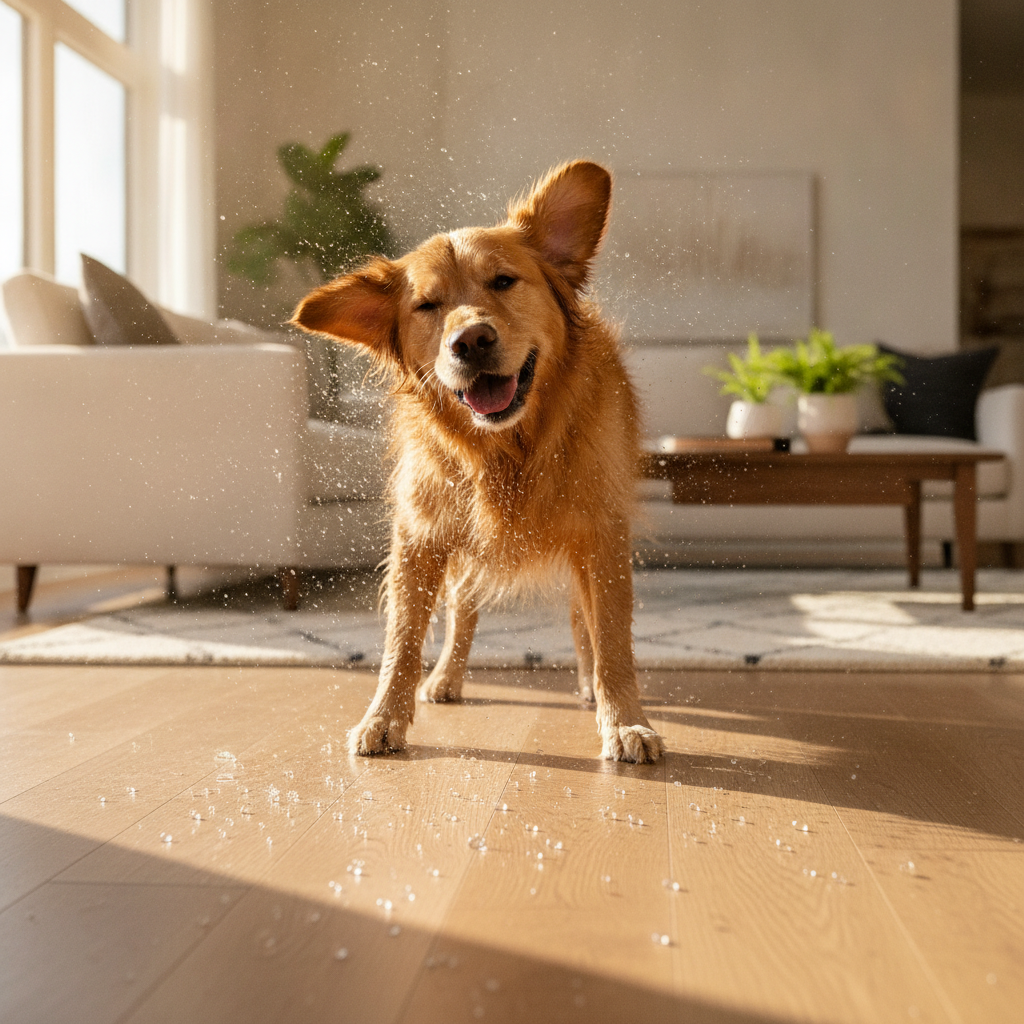
Before finding the solution, it’s critical to understand the problem. The daily life of a pet introduces a unique set of challenges that can quickly degrade and destroy flooring. For homeowners, this makes choosing the right material a high-stakes decision. The damage isn’t just cosmetic; in many cases, it can be permanent and costly.
The primary culprits of flooring damage from pets include:
- Scratches and Scuffs: This is the most common complaint, especially from owners of large or active dogs. A dog’s nails, even when trimmed, can inflict a range of damage, from light surface scuffs on a finish to deep gouges that penetrate the material itself.
- Stains and Odors from Accidents: Pet urine is uniquely destructive. It has a pH that can range from 6.0 to 8.0, and the ammonia it contains can react with the tannins in wood flooring, causing deep, dark stains that are nearly impossible to remove. The real problem lies in the uric acid crystals, which are not water-soluble and can linger deep within porous materials, creating a persistent odor that returns with humidity.
- Water Damage: Beyond accidents, there are the daily spills from drool and overturned water bowls. On floors that aren’t waterproof, this constant exposure to moisture can cause planks to swell, warp, or peel at the edges, leading to irreversible damage.
- Chewing and Digging: Puppies and anxious dogs may chew on floorboards, carpet edges, or transition strips, causing significant structural damage that often requires professional replacement.
According to the Institute of Inspection, Cleaning and Restoration Certification (IICRC), some of the most common and irreversible damage they see involves deep urine saturation in hardwood and carpet, where the damage penetrates not just the floor covering but the subfloor itself, requiring extensive restoration[1]. Understanding these risks underscores why a preventative approach—choosing the right pet-friendly flooring from the start—is the most effective strategy.
Our Data-Driven Framework: How We Rate Pet-Friendly Flooring
To cut through the confusion of marketing terms like “durable” and “tough,” we’ve developed a clear, data-driven framework to evaluate flooring. This system relies on industry-standard metrics and pet-specific criteria to give you a true picture of how a floor will perform in a home with animals.
First, we use the Durability Index, which measures a floor’s resistance to physical wear and tear using quantifiable data:
- AC (Abrasion Class) Rating: Used for laminate flooring, this rating from the North American Laminate Flooring Association (NALFA) grades a product’s durability on a scale from AC1 (light residential use) to AC5 (heavy commercial use)[3]. For homes with pets, especially large dogs, an AC3 rating or higher is essential.
- PEI (Porcelain Enamel Institute) Rating: This scale measures the hardness and durability of the glaze on ceramic and porcelain tile, indicating its resistance to scratches and chipping. A PEI rating of 4 or 5 is suitable for heavy residential and even commercial traffic, making it virtually scratch-proof against pet nails[4].
- Wear Layer Thickness: For luxury vinyl flooring (LVT), the top transparent layer that protects the design is called the wear layer. Its thickness is measured in mils (1/1000th of an inch). A 12 mil layer is acceptable for residential use, but for homes with pets, a 20 mil or thicker wear layer offers commercial-grade protection.
Second, we rate each flooring type using our Pet-Friendliness Scorecard. This tool evaluates materials across five key criteria that matter most to pet owners:
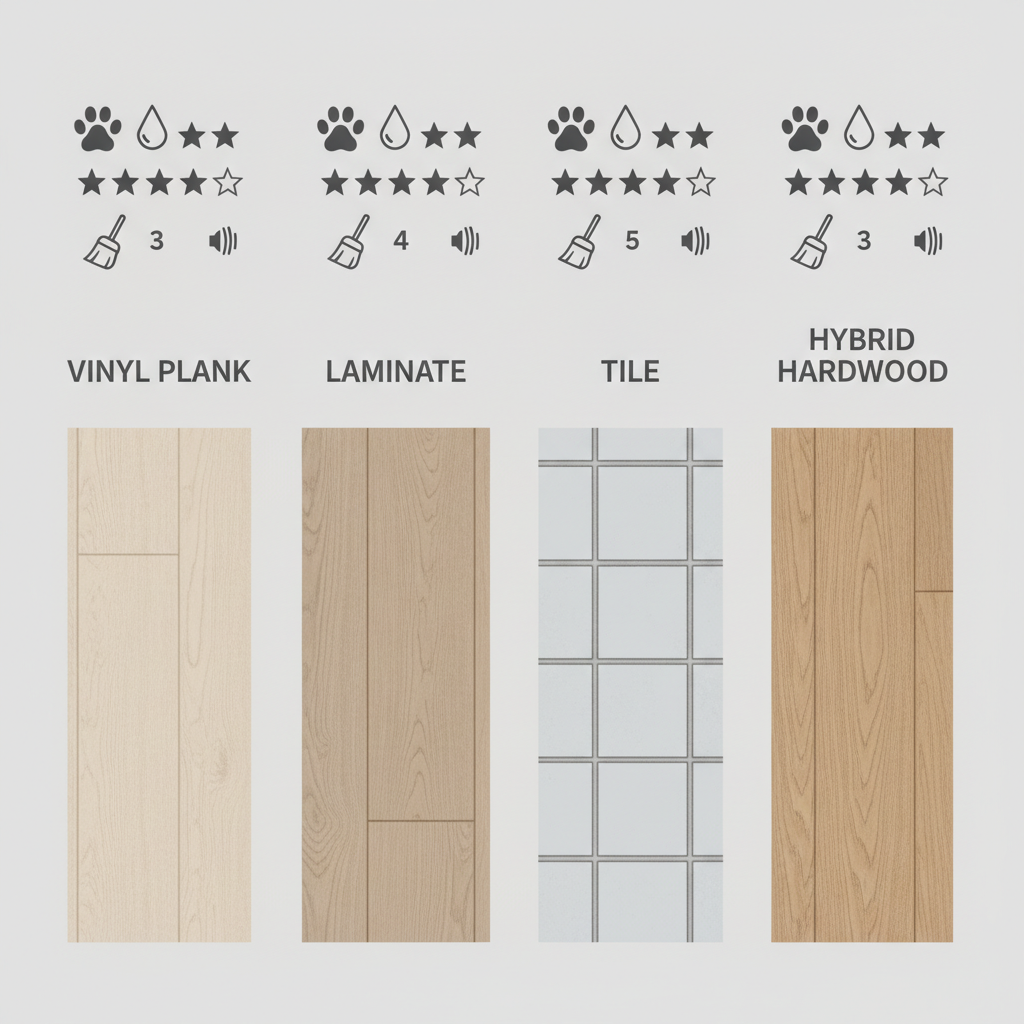
- Durability (Scratch & Dent Resistance): How well does it stand up to claws and chaos?
- Water Resistance: Can it survive accidents and spills without damage?
- Ease of Cleaning: How simple is it to remove pet hair, dander, and messes?
- Pet Comfort & Traction: Is the surface comfortable for pets to walk and rest on? Does it provide enough grip to prevent slipping?
- Noise Dampening: How well does it absorb the sound of clicking claws?
This last point is crucial. The American Kennel Club (AKC) notes that good traction is vital for a dog’s joint health, as slippery surfaces can lead to injuries, especially in senior dogs or breeds prone to hip dysplasia[2]. Our scorecard considers all these factors to give you a holistic view.
In-Depth Review: The Top 4 Contenders for Pet-Friendly Flooring
Using our framework, let’s analyze the leading options for pet-friendly flooring. Each has its own unique strengths and weaknesses, making one a better fit for your specific pet, home, and lifestyle than another.
1. Luxury Vinyl Tile/Plank (LVT/LVP): The All-Around Champion
Luxury vinyl has exploded in popularity for good reason—it’s a nearly perfect solution for pet owners. LVT is a multi-layered product built around a rigid, stable core. Modern, high-quality LVT features an SPC (Stone Plastic Composite) core, which is a dense and incredibly durable blend of limestone and plastic stabilizers.
This construction is what makes LVT the top all-around choice. Its key benefits are rooted in its layers. The SPC core makes the planks 100% waterproof, not just water-resistant. This means that spills and accidents won’t cause the planks to swell, warp, or degrade, even if they aren’t wiped up immediately.
So, will a large dog’s nails scratch luxury vinyl plank? The answer depends entirely on the wear layer. As mentioned, for maximum durability, look for a product with a wear layer of 20 mil or thicker. This commercial-grade coating provides exceptional resistance to scratches and scuffs, keeping the beautiful design layer beneath it safe. While a very sharp nail or a heavy object being dragged could potentially cause a deep gouge, for everyday pet life, high-quality LVT is exceptionally resilient.
Pet-Friendliness Scorecard: LVT/LVP
- Durability: ★★★★★
- Water Resistance: ★★★★★
- Ease of Cleaning: ★★★★★
- Pet Comfort & Traction: ★★★★☆
- Noise Dampening: ★★★★☆
2. Modern Waterproof Laminate: Style Meets Durability
Laminate flooring has a reputation for being susceptible to water damage, but modern technology has changed the game. While older laminate would swell at the slightest hint of moisture, today’s waterproof laminate is a formidable contender for pet-friendly flooring.
Its durability against scratches is legendary. Thanks to its tough, factory-applied finish, laminate flooring earns an AC rating for abrasion resistance. For homes with large, active dogs, a product with an AC4 or AC5 rating is highly recommended, as these are designed to withstand light to heavy commercial traffic[3].
But what about water? Waterproof laminate achieves its protection through a combination of a moisture-resistant core and an advanced locking system that creates a tight seal between planks. This prevents topical spills and pet accidents from seeping through to the subfloor for a specified period, often between 24 and 72 hours.
Myth vs. Fact: Laminate Water Resistance
- Myth: All laminate flooring is easily ruined by water.
- Fact: Modern waterproof laminate systems are designed to resist topical moisture for extended periods, making them suitable for pet accidents. However, they are not typically recommended for areas with constant moisture like full bathrooms. It’s crucial to check the manufacturer’s warranty to understand the exact coverage.
When asking, “Is luxury vinyl tile or laminate better for dogs?” it’s a close call. LVT is truly waterproof from the core out, while waterproof laminate offers superior scratch resistance at a given price point. The choice often comes down to budget and the level of water protection needed.
Pet-Friendliness Scorecard: Waterproof Laminate
- Durability: ★★★★★
- Water Resistance: ★★★★☆
- Ease of Cleaning: ★★★★★
- Pet Comfort & Traction: ★★★☆☆
- Noise Dampening: ★★★☆☆
3. Porcelain & Ceramic Tile: The Indestructible Option
When it comes to sheer, brute-force durability, nothing beats tile. Porcelain tile, in particular, is incredibly dense and has a water absorption rate of less than 0.5%, making it completely impervious to pet accidents and water spills. Its hardness is graded on the PEI scale, and a rating of PEI 4 or 5 makes it one of the most scratch-proof flooring surfaces you can buy[4]. A German Shepherd could try to dig to China on a porcelain tile floor and would likely fail.
However, this indestructibility comes with trade-offs for pet owners. The hard, cold surface can be uncomfortable for pets to lounge on and can be tough on the joints of older animals. The surface can also be slippery, especially when wet. The biggest challenge, though, is the grout. Traditional cement-based grout is porous and will readily absorb moisture and odors from pet urine.
Grout Sealing 101: A Pet Owner’s Must-Do
To make tile truly pet-proof, the grout must be sealed. For the best protection, consider using an epoxy-based grout from the start. According to the Tile Council of North America (TCNA), epoxy grout is non-porous and highly resistant to stains and chemicals, making it a far superior choice for homes with pets[5]. If you have existing cement grout, it must be cleaned and sealed regularly with a high-quality penetrating sealer.
Pet-Friendliness Scorecard: Porcelain & Ceramic Tile
- Durability: ★★★★★
- Water Resistance: ★★★★★
- Ease of Cleaning: ★★★☆☆ (Grout requires maintenance)
- Pet Comfort & Traction: ★★☆☆☆
- Noise Dampening: ★☆☆☆☆
Special Focus: Is Waterproof Hybrid Hardwood the Perfect Pet-Friendly Floor?
A new category of flooring has emerged that aims to offer the best of both worlds: the timeless beauty of real hardwood and the worry-free performance of a waterproof core. Known as waterproof hybrid hardwood, this innovative product is an engineered floor built for the realities of modern life, including pets.
To understand its potential, imagine a cutaway of a single plank. You would see several distinct layers working together:
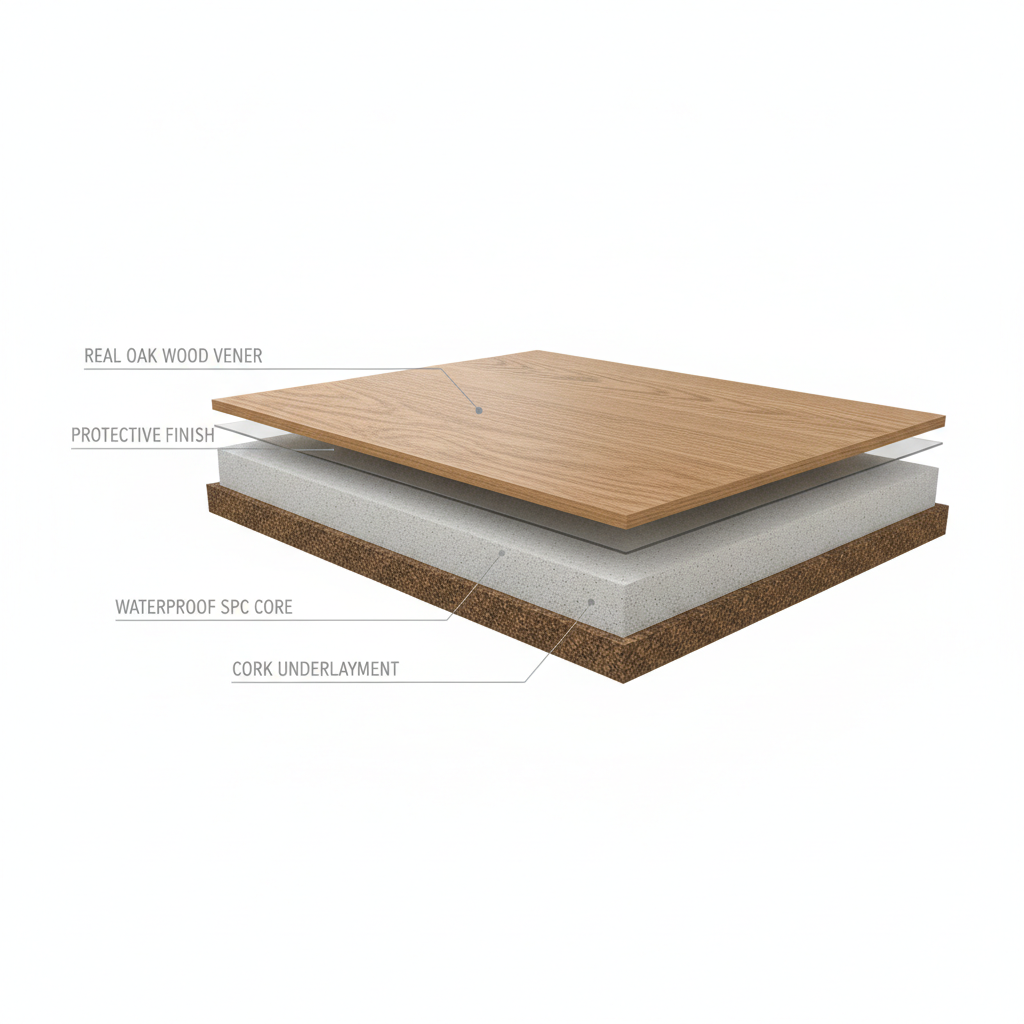
- The Top Layer (Veneer): This is a thin slice of genuine hardwood (like oak, hickory, or maple). This is what you see and feel, giving the floor its authentic character and beauty.
- The Protective Finish: A factory-applied, multi-layer urethane finish, often infused with aluminum oxide, protects the wood veneer from scratches and wear.
- The Waterproof Core: This is the heart of the plank. It’s an SPC or WPC (Wood Plastic Composite) core, identical to the ones found in luxury vinyl. This core is 100% waterproof and provides extreme dimensional stability.
- The Backing Layer: An attached underlayment, often made of cork or foam, provides sound dampening and cushioning underfoot.
This construction, which builds upon the principles of traditional engineered flooring outlined by organizations like the National Wood Flooring Association (NWFA), creates a product that solves the biggest problem of having hardwood with pets: water damage[6].
The Pros: The Beauty of Wood Without the Water Worries
For pet owners who have always dreamed of hardwood floors but feared the consequences, the advantages of hybrid hardwood are immense.
The primary benefit is its 100% waterproof core. The SPC core is completely inert to moisture, meaning that pet accidents, water bowl spills, or wet paws won’t cause the planks to swell, cup, or buckle. This provides peace of mind that traditional solid and most engineered hardwoods simply can’t offer. You get the authentic grain, texture, and warmth of real wood without the constant fear of water damage. This makes it an incredibly popular choice for pet owners who refuse to compromise on style.
The Cons: Understanding the Limitations of the Veneer
The main drawback of waterproof hybrid hardwood lies in its greatest strength: the real wood veneer. While the core is waterproof, the top layer is still wood, and it has limitations.
The most significant issue is scratch resistance. Does hybrid hardwood scratch easily? The answer is: it scratches just like any real wood floor. The durability depends on the hardness of the wood species (its Janka rating) and the quality of the factory finish. While a high-quality aluminum oxide finish offers good protection, it is not as scratch-proof as the wear layer on premium LVT or the surface of an AC5-rated laminate. A large dog’s nails can and likely will cause fine scratches over time.
Furthermore, the veneer is typically very thin, often ranging from 0.6mm to 2mm. This means that waterproof hybrid hardwood generally cannot be sanded and refinished like solid hardwood. Once a scratch is deep enough to penetrate the finish and the wood veneer, it cannot be sanded out without exposing the core below. This makes cosmetic repairs the only option. It’s crucial to read the warranty carefully to understand what is covered under “wear and tear” versus what is covered by the waterproof guarantee.
The Verdict: Who Should Choose Hybrid Hardwood?
Waterproof hybrid hardwood is an excellent choice for a specific type of pet owner: one who places the highest value on the authentic aesthetic of real wood but requires robust protection against moisture and accidents.
Is Hybrid Hardwood Right for Your Pet?
- Choose it if: You have a small-to-medium-sized pet, or an older, calmer large dog.
- Choose it if: Your primary concern is water bowl spills and occasional accidents, not heavy scratching.
- Choose it if: You are diligent about keeping your pet’s nails trimmed and using protective measures like area rugs.
- Reconsider if: You have multiple large, high-energy dogs or a puppy known for scratching and digging.
- Reconsider if: You expect the same level of scratch immunity as high-end laminate or tile.
For the right household, it represents the perfect compromise, delivering unparalleled beauty with practical, pet-friendly functionality.
The Pet Owner’s Repair Guide: Fixing and Preventing Floor Damage
Even with the best flooring, accidents happen. This guide provides actionable solutions for the most common pet-related damage. For a quick overview, consider a Damage Repair Matrix: for scratches on hardwood, use a stain marker; for LVT, try a vinyl repair kit. For urine stains on hardwood, use an enzymatic cleaner; on sealed tile, clean the grout.
How to Fix Scratches from Dog Nails
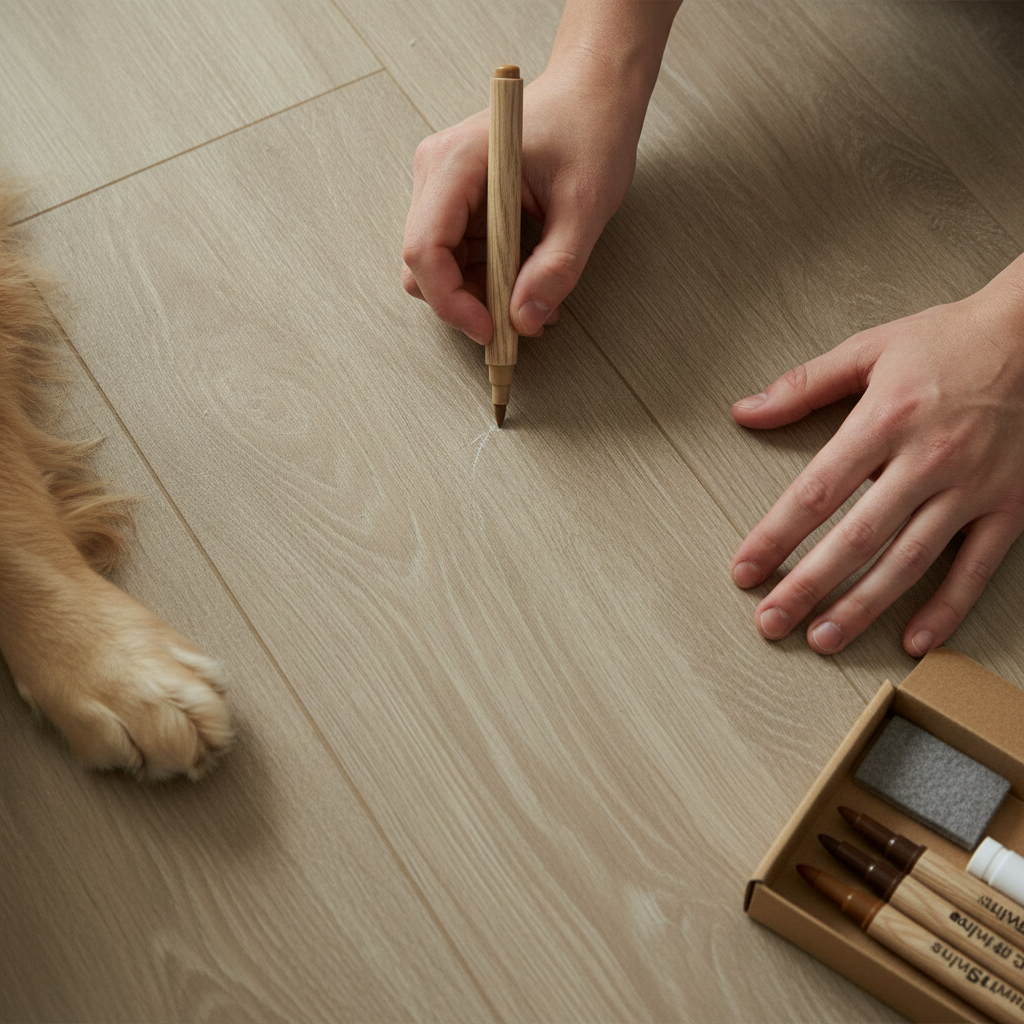
The method for repairing scratches depends entirely on the flooring material and the severity of the damage.
- For Hardwood & Hybrid Hardwood: For light surface scuffs in the polyurethane finish, you can often buff them out with a very fine grit sandpaper (0000 steel wool) and reapply a coat of finish. For deeper scratches that have removed the color, a stain-filled marker or a wax repair stick in a matching color can effectively conceal the damage.
- For Laminate: Since laminate cannot be refinished, repairs are purely cosmetic. Use a laminate floor repair kit, which typically includes a color-matched putty or wax filler that you apply to the scratch and wipe away the excess.
- For LVT: Similar to laminate, deep scratches can be filled with a vinyl floor repair kit. For lighter scuffs, sometimes simply cleaning the area and applying a floor polish can hide the mark.
Prevention is Key: A professional dog groomer will tell you that the best defense is a good offense. Keep your dog’s nails trimmed short and smooth. Regular walks on pavement can help naturally file them down. For extra protection, consider using stylish area rugs in high-traffic zones.
Removing Pet Urine Stains and Odors for Good
Tackling pet urine requires a two-pronged attack: cleaning the stain and neutralizing the odor-causing acid.
Immediate Action (Fresh Stains):
- Blot up as much liquid as possible with a clean, dry cloth. Do not rub.
- Spray the area liberally with an enzymatic cleaner. This is the most critical step. According to The Cleaning Institute, these cleaners contain enzymes that biologically break down the uric acid crystals, which are the source of the lingering smell[7].
- Let the cleaner sit for the time recommended on the product label, then blot dry.
Treating Old, Set-In Stains on Hardwood:
This is much more challenging. You can try making a paste of hydrogen peroxide and a clean cloth, letting it sit on the dark stain for a few hours. However, this can discolor the wood, so test in an inconspicuous area first.
Damage Assessment: DIY vs. Professional Help
- DIY Fix: A light surface stain or a fresh accident can usually be treated at home.
- Call a Pro: If the wood has turned black, if the floorboards are cupping or warping, or if the odor persists after multiple cleanings, the urine has likely saturated the wood and possibly the subfloor. At this point, according to NWFA guidelines, the only effective solution is to have a professional sand and refinish the floor, which may include replacing the damaged boards[6].
What NOT to Do: Never use an ammonia-based cleaner on pet urine stains. Urine already contains ammonia, and using more can actually amplify the smell, encouraging your pet to mark the spot again.
Frequently Asked Questions (FAQ)
What is the easiest flooring to clean pet hair from?
Hard, smooth surfaces are by far the easiest for cleaning pet hair. Sheet vinyl, luxury vinyl plank (LVT), and tile are top choices because hair and dander have nowhere to hide. Matte finishes tend to show smudges and paw prints less than high-gloss finishes. For tools, microfiber mops and robotic vacuums designed for pet hair are game-changers. The Good Housekeeping Institute often tests and recommends specific models that excel at this task[8].
Are there any good pet-friendly carpet options?
Yes, though it requires careful selection. Look for carpets made from nylon or triexta fibers, as they are highly durable and resilient. Many modern carpets come with built-in, lifetime stain and soil protection. Choose a low-pile construction, as deep piles can trap allergens and are harder to clean. For the ultimate practical solution, consider carpet tiles. If a section becomes permanently stained or damaged, you can simply replace the single tile instead of the entire room.
What about acoustics and claw noise?
This is an often-overlooked aspect of pet-friendly flooring. The “click-clack” sound of a dog’s nails can be a significant annoyance. Tile and, to a lesser extent, laminate are the most acoustically reflective and will be the loudest. LVT and waterproof hybrid hardwood, especially those with an attached cork or foam underlayment, are much better at dampening sound. For any hard surface floor, using area rugs in hallways and living spaces is the most effective way to reduce noise.
Is traditional hardwood a bad idea if I have a dog?
It’s not a bad idea, but it is a high-maintenance choice. If your heart is set on solid hardwood, you must be strategic. Choose a very hard wood species, like Brazilian Cherry or Hickory, which have high Janka hardness ratings and are more resistant to dents and scratches. You can reference the Janka Hardness Scale Chart, often provided by sources like the USDA’s Forest Products Laboratory, to compare species[9]. Opt for a durable, modern polyurethane finish and be prepared to refinish it every decade or so. Ultimately, waterproof alternatives like hybrid hardwood or LVT offer a much lower-stress experience for most pet owners.
Your Home, Your Pet, Your Perfect Floor
Choosing the right floor for a home with pets is about finding the perfect intersection of durability, style, and peace of mind. By moving beyond simple appearances and using a data-driven approach—understanding metrics like wear layer thickness, AC ratings, and PEI scores—you can confidently select a floor that will stand up to your furry family members for years to come.
Luxury vinyl remains the all-around champion for its balanced performance, while modern laminate and porcelain tile offer unrivaled durability in their respective categories. And for those who refuse to compromise on the authentic beauty of wood, waterproof hybrid hardwood presents a revolutionary solution that beautifully merges aesthetics with practicality.
With this guide, you are now equipped to make a smart, regret-free decision that honors both your love for your pets and your investment in your home.
We’d love to hear from you! Share your own experiences with pet-friendly flooring in the comments below.
References & Authoritative Sources
- Institute of Inspection, Cleaning and Restoration Certification (IICRC). (N.D.). IICRC Standards. Retrieved from iicrc.org.
- American Kennel Club (AKC). (N.D.). Expert advice on dog health and care. Retrieved from akc.org.
- North American Laminate Flooring Association (NALFA). (N.D.). Laminate Flooring Standards and Certifications. Retrieved from nalfa.com.
- Porcelain Enamel Institute (PEI). (N.D.). PEI Rating System for Ceramic Tile. (Industry standard, often cited by tile manufacturers and retailers).
- Tile Council of North America (TCNA). (N.D.). Consumer Resources & Tile Standards. Retrieved from tcnatile.com.
- National Wood Flooring Association (NWFA). (N.D.). Consumer Guides to Hardwood Flooring. Retrieved from hardwoodfloors.org.
- The Cleaning Institute. (N.D.). Cleaning Facts and Tips. Retrieved from cleaninginstitute.org.
- Good Housekeeping Institute. (N.D.). Product Reviews and Testing. Retrieved from goodhousekeeping.com.
- USDA Forest Products Laboratory. (N.D.). Janka Hardness. (Publicly available data on wood properties).