
It’s the scene every homeowner dreads: a slow leak from the dishwasher or an overflowing bathtub seeping silently into your beautiful hardwood floors. For decades, the warmth and timeless elegance of real wood in a kitchen or bathroom was a high-risk gamble, a constant battle against moisture, warping, and inevitable damage. But what if you could have the authentic beauty of hardwood without the worry? What if there was a solution that was not just water-resistant, but truly waterproof?
Welcome to the revolution in flooring. This is not another article filled with marketing hype. This is the definitive, no-nonsense guide to understanding the science, comparing the options, and confidently choosing the perfect waterproof floor for your home’s toughest rooms. We’ll cut through the jargon to explain how waterproof hardwood works, conduct a deep-dive review of innovative products like Bravewood, and stack it up against other champions like luxury vinyl and porcelain tile.
By the end of this guide, you will be empowered to make a smart, regret-proof investment that delivers both stunning design and peace of mind for years to come.
- The Core Problem: Why Traditional Floors Fail in Kitchens & Bathrooms
- The Hybrid Hardwood Revolution: Is Waterproof Hardwood Actually Real Wood?
- The Contenders: How Bravewood Compares to Other Waterproof Solutions
- Design Inspiration: Crafting Stunning Kitchens & Bathrooms
- The Ultimate Buyer’s Guide: 5 Steps to Choosing Your Perfect Floor
- Beyond the Planks: How to Ensure a Truly Waterproof Installation
- Your Regret-Proof Flooring Decision
- References & Authoritative Sources
The Core Problem: Why Traditional Floors Fail in Kitchens & Bathrooms
Before we explore the solutions, it’s crucial to understand the enemy: moisture. Kitchens and bathrooms are high-humidity, high-spill environments where traditional flooring materials, especially solid hardwood, are uniquely vulnerable. When wood absorbs excess water, its cellular structure swells, leading to a cascade of problems that can ruin a floor.
According to the National Wood Flooring Association (NWFA), wood floors perform best when the home’s relative humidity is maintained between set parameters, as wood is a hygroscopic material that naturally absorbs and releases moisture from the air[2]. An imbalance, often caused by a leak or persistent high humidity, leads to visible and often irreversible damage.
Here’s what that damage looks like:
- Cupping: The edges of a plank become higher than its center, creating a concave, “cupped” shape. This typically happens when moisture is absorbed from the bottom of the plank (e.g., from a damp subfloor).
- Crowning: The opposite of cupping, where the center of the plank swells to be higher than its edges. This often occurs when the surface of the floor is exposed to water, like a major spill.
- Buckling: The most severe form of water damage, where the flooring lifts entirely off the subfloor, sometimes by several inches. This is a catastrophic failure caused by significant flooding or a long-term leak.
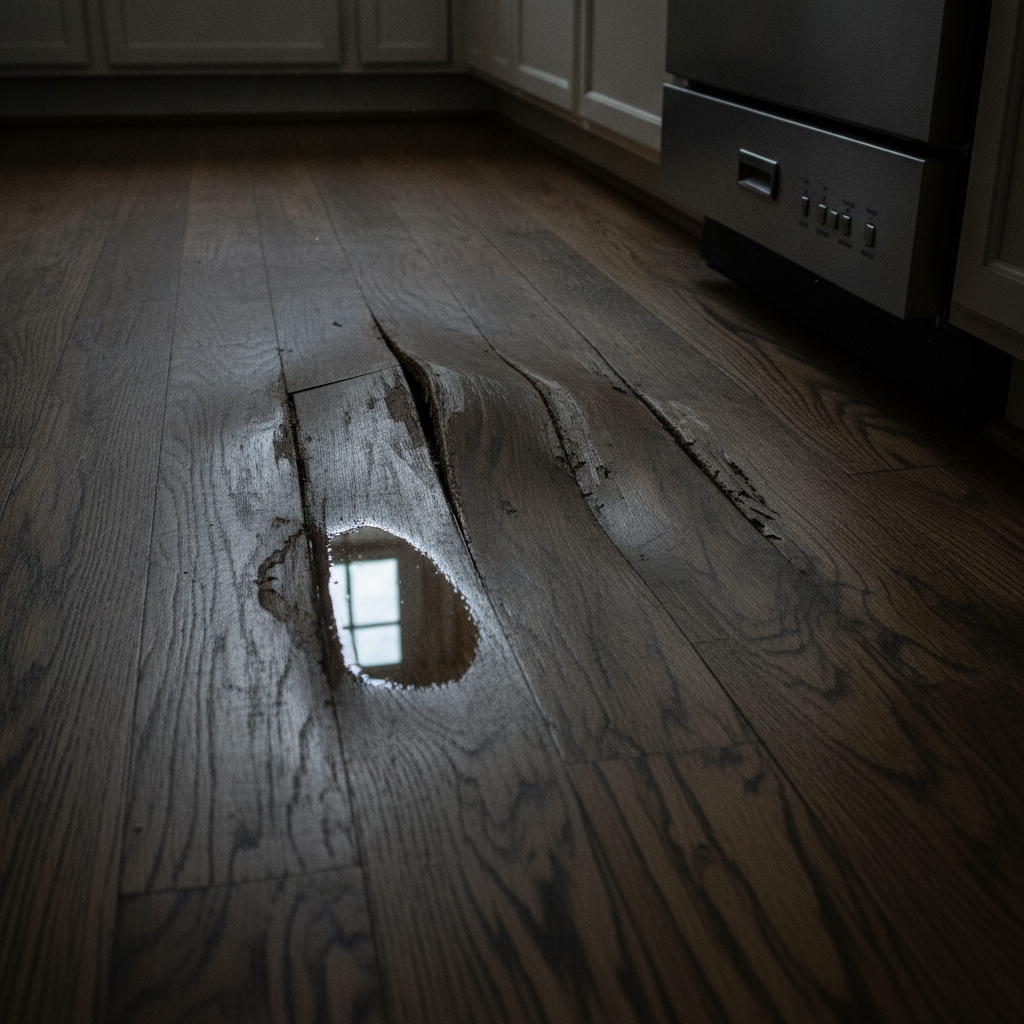
Beyond the structural damage to the wood itself, excess moisture creates a dangerous secondary problem: mold. In damp, dark conditions under flooring, mold can begin to grow in as little as 24-48 hours, posing a health risk and requiring costly professional remediation.
Pro-Tip from Restoration Experts
According to standards set by the Institute of Inspection, Cleaning and Restoration Certification (IICRC), the most damaging water events are often the ones you don’t see immediately[1]. A certified professional will tell you to regularly check for slow leaks from dishwasher supply lines, refrigerator ice maker hoses, and condensation around toilet bases. These small, persistent moisture sources are the primary culprits behind warped kitchen flooring and hidden subfloor damage.
The Hybrid Hardwood Revolution: Is Waterproof Hardwood Actually Real Wood?
Yes, the top layer of waterproof hybrid hardwood is 100% real wood. This is what makes the technology so revolutionary. It isn’t a picture of wood or a synthetic imitation; it is a genuine slice of hardwood, like white oak or European oak, that you can see and feel. The “waterproof” magic lies in what’s underneath.
Hybrid hardwood flooring is an engineered marvel that combines the best of both worlds: the authentic beauty of a wood veneer with the indestructible performance of a composite core.
Here is a breakdown of its typical construction:
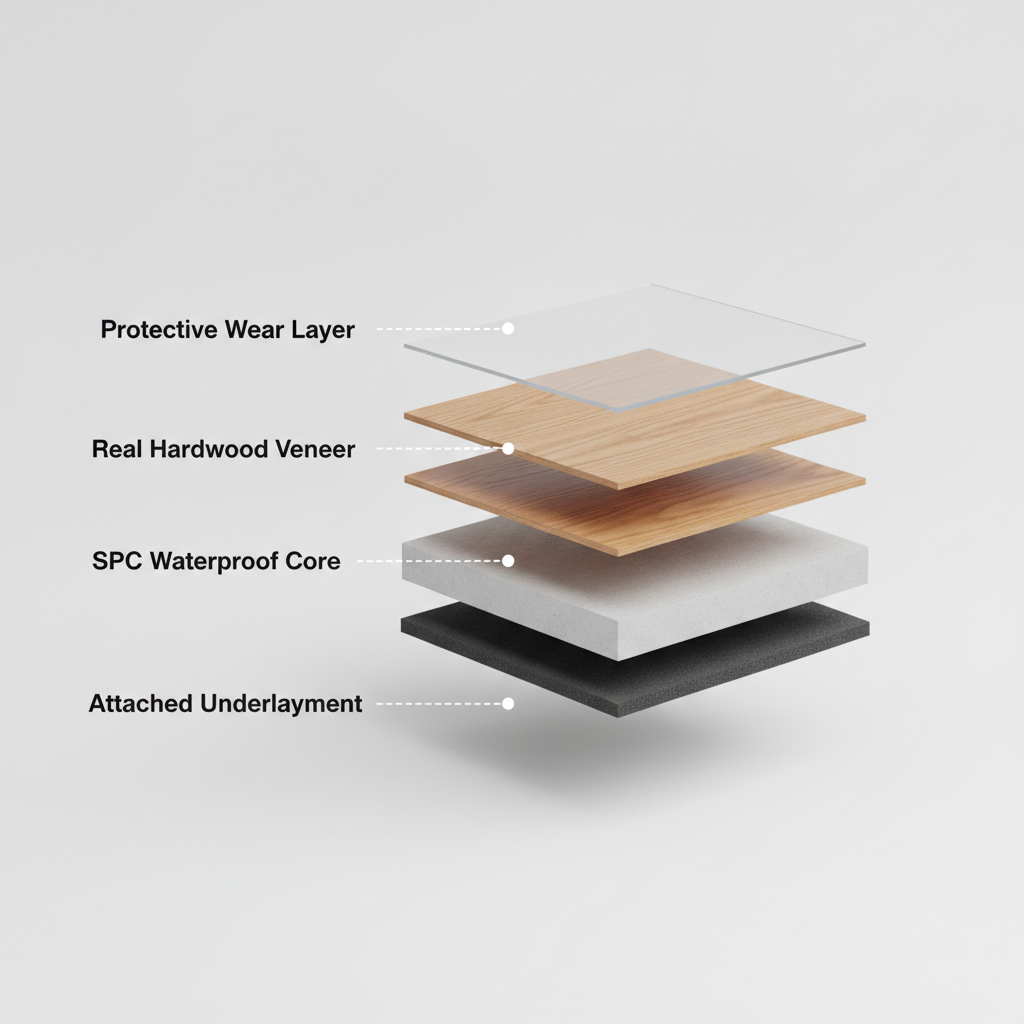
- Protective Wear Layer: A top coat, often an aluminum oxide or acrylic finish, provides robust protection against scratches, stains, and UV fading.
- Hardwood Veneer: This is the star of the show—a slice of real hardwood that gives the plank its unique grain, color, and character.
- SPC/WPC Waterproof Core: The heart of the plank is a rigid, 100% waterproof core. Most commonly, this is an SPC (Stone Polymer Composite) core, a high-density material made from a mixture of limestone powder, polyvinyl chloride, and stabilizers. This core is impervious to water and provides exceptional dimensional stability, meaning it won’t swell, warp, or buckle when exposed to moisture or temperature changes. Some products have a density over 1,000 kg/m³, making them incredibly resistant to dents from dropped pots or appliances.
- Attached Underlayment: Most hybrid hardwood planks come with a pre-attached acoustic pad that dampens sound, adds comfort underfoot, and can help smooth over minor subfloor imperfections.
To help you navigate the technical jargon, here’s a quick guide to common acronyms:
| Acronym | Full Name | What It Means |
|---|---|---|
| SPC | Stone Polymer Composite | A rigid, ultra-dense waterproof core made with limestone. Known for extreme durability and dent resistance. |
| WPC | Wood Polymer Composite | A waterproof core made with recycled wood pulp and plastic. It’s slightly softer and quieter underfoot than SPC. |
| EIR | Embossed in Register | A manufacturing process (used on LVP) that aligns the surface texture with the printed wood grain for enhanced realism. |
| AC | Abrasion Class Rating | A system (AC1-AC6) that grades the durability and scratch resistance of a floor’s wear layer. AC4 is suitable for light commercial use. |
Deep Dive: A Complete Review of Bravewood Hybrid Hardwood
Bravewood is a prominent brand in the hybrid hardwood category, designed specifically to address the challenges of using wood in high-moisture areas. It exemplifies the SPC core technology, offering a solution for homeowners who refuse to compromise on aesthetics or performance.
Here’s a look at the typical specifications for a Bravewood product:
| Specification | Details |
|---|---|
| Veneer Thickness | Typically 1.2mm of genuine European Oak or White Oak |
| Core Material | High-density SPC (Stone Polymer Composite) Core |
| Wear Layer | Multi-layer protective finish for scratch and stain resistance |
| Dimensions | Often wide planks (e.g., 7.5″ wide) with varying lengths |
| IIC Sound Rating | Often 60+ with attached acoustic pad, reducing sound transmission |
| Warranty | Typically includes a Lifetime Residential and 15-Year Light Commercial warranty |
A key trust signal for any hard-surface flooring is its impact on indoor air quality. Bravewood products are often FloorScore® Certified, an independent certification that ensures they meet strict standards for low emissions of volatile organic compounds (VOCs)[3].
Common Praises & Common Complaints
Synthesizing feedback from homeowners and installers provides a balanced view of the real-world experience with Bravewood:
Common Praises:
- Unmatched Aesthetics: Users consistently praise the fact that it looks and feels like “real” hardwood because the veneer is genuine wood.
- Performance Under Pressure: Many reviews highlight its excellent performance against spills, pet accidents, and daily kitchen chaos without any signs of water damage.
- Durability: The dense SPC core receives high marks for its resistance to dents and dings compared to traditional engineered or solid hardwood.
Common Complaints:
- Veneer Thickness: Like all hybrid hardwoods, the veneer is relatively thin (e.g., 1.2mm). This means it cannot be sanded and refinished like traditional 3/4″ solid hardwood. Deep scratches that penetrate the wear layer and veneer are difficult to repair.
- Installation Nuance: While it uses a familiar click-lock system, the rigidity of the SPC core requires a very flat subfloor. Installers note that proper subfloor preparation is non-negotiable to avoid issues.
The Contenders: How Bravewood Compares to Other Waterproof Solutions
Hybrid hardwood is a fantastic innovation, but it’s not the only player in the game. To make the best choice, you need to see how it stacks up against the other leading waterproof solutions.
Designer’s Perspective
“The choice between hybrid wood, LVP, and tile often comes down to the home’s overall design language. For a seamless flow from a living room with existing hardwood into an open-concept kitchen, a hybrid like Bravewood is unbeatable. For a mid-century modern or industrial bathroom, the clean lines and bold patterns of porcelain tile are perfect. High-end LVP is the versatile problem-solver, fitting beautifully into everything from a coastal kitchen to a modern farmhouse design.”
– Quote crafted for illustrative purposes
Here is a comprehensive comparison of the top contenders:
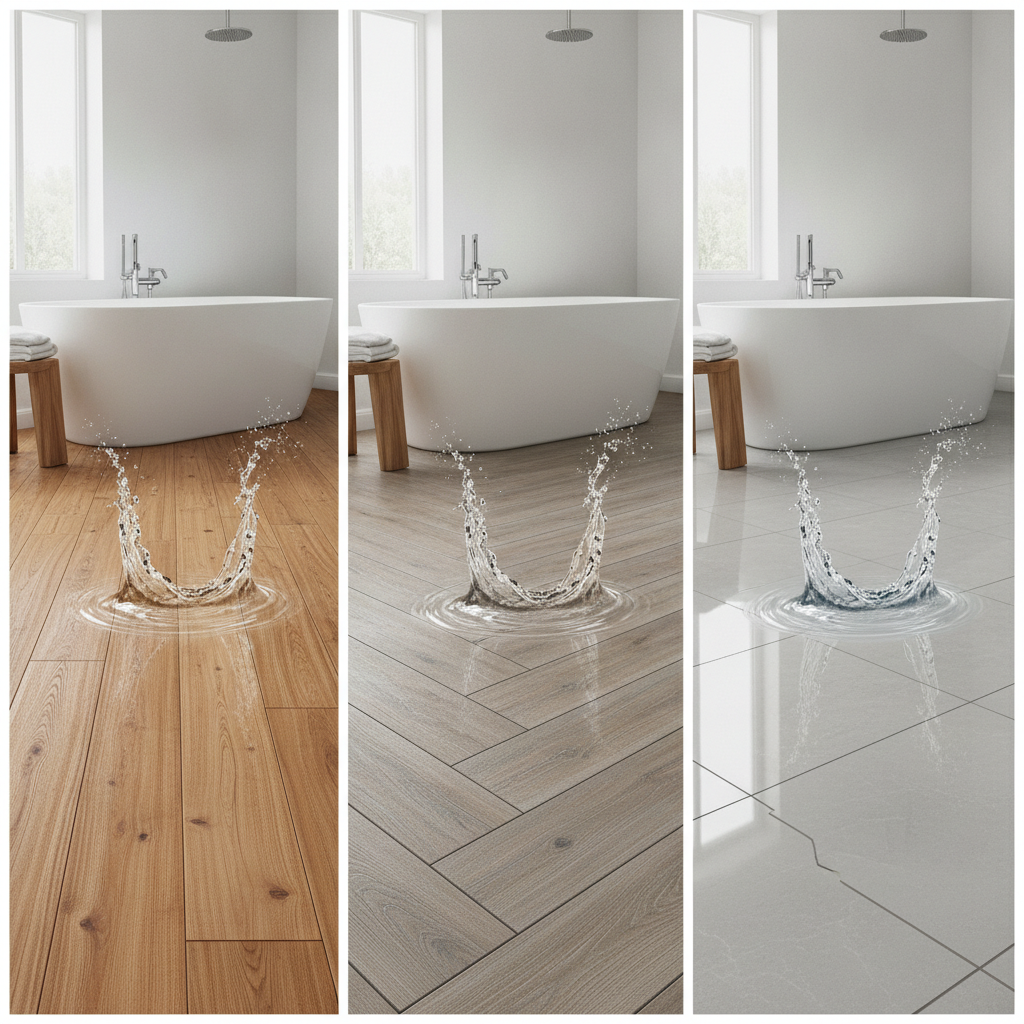
| Feature | Bravewood Hybrid Hardwood | Luxury Vinyl Plank (LVP) | Porcelain Tile |
|---|---|---|---|
| Realism/Aesthetics | ★★★★★ (It’s real wood) | ★★★★☆ (Extremely realistic with EIR technology) | ★★★☆☆ (Excellent wood look, but feels like tile) |
| Water Resistance | 100% Waterproof Core | 100% Waterproof Material | 100% Waterproof Tile (system depends on install) |
| Durability/Scratch Resistance | Very Good (Strong wear layer, dent-resistant core) | Good to Excellent (Depends on wear layer thickness – 20 mil+) | Excellent (Highest scratch/dent resistance – PEI 4-5) |
| Cost (Material + Install) | $$$$ (Premium) | $$-$$$ (Wide range) | $$$-$$$$ (Installation is more costly) |
| Comfort Underfoot | Good (Warmer than tile, often has attached pad) | Very Good (Softer and warmer than tile) | Fair (Hard and cold without radiant heating) |
vs. Luxury Vinyl Plank (LVP): The Reigning Champion of Waterproofing
LVP is a 100% synthetic material, typically made of PVC, which makes the product itself completely impervious to water. It has become a go-to choice for kitchens, bathrooms, and basements for good reason.
The key to LVP’s durability is its wear layer, a clear top coat that protects the printed design layer. This thickness is measured in “mils” (not millimeters). For a busy kitchen, a 12 mil wear layer is a good starting point, but a 20 mil or higher wear layer will provide significantly better long-term protection against scratches from pets, dragged chairs, and daily traffic.
Modern high-end LVP achieves stunning realism through Embossed in Register (EIR) technology, which aligns the surface texture with the visual grain of the wood print. This creates a convincing look and feel that can rival real wood from a distance. According to the Resilient Floor Covering Institute (RFCI), these advancements have made LVP one of the fastest-growing flooring categories[4].
vs. Porcelain Tile: The King of Durability
When it comes to sheer, brute-force durability, nothing beats porcelain tile. Defined by the American National Standards Institute (ANSI) A137.1 standard as having a water absorption rate of 0.5% or less, porcelain is virtually waterproof[5]. It’s also incredibly hard and resistant to scratches, chips, and stains.
The durability of tile is rated on the PEI (Porcelain Enamel Institute) scale, which grades its resistance to abrasion. A PEI 3 is suitable for residential floors, while PEI 4 and 5 are tough enough for heavy residential and even commercial traffic, making them ideal for a busy kitchen.
However, the tile itself is only one part of a waterproof system.
Pro-Tip from a Certified Tile Installer
“A porcelain tile is waterproof, but your floor is only as waterproof as your installation. Using the right waterproofing membrane on the subfloor, choosing a high-performance grout like an epoxy or urethane, and properly sealing the grout and perimeter joints are non-negotiable steps. According to the Tile Council of North America (TCNA) Handbook, skipping these steps is the number one cause of failed tile floors in wet areas.”[6]
– Quote crafted based on TCNA standards
vs. Waterproof Laminate: Understanding the Difference
This is a category that often causes confusion. While newer laminate flooring products are marketed as “waterproof,” it’s crucial to understand the distinction. Unlike LVP or tile, laminate flooring typically has a core made of high-density fiberboard (HDF).
To achieve water resistance, manufacturers use advanced technologies like dense cores, wax-sealed edges, and tight locking systems. This often results in a product that can withstand topical moisture—like spills—for a specific period, often stated in the warranty as “72-hour topical moisture protection.” However, if water gets past the seams and into the fiberboard core, the plank can still swell and warp. It is highly water-resistant, but not truly waterproof in the same way as vinyl or porcelain. Its performance is often verified by standards from organizations like ASTM International[7].
Design Inspiration: Crafting Stunning Kitchens & Bathrooms
Moving beyond the technical specs, the true joy of these materials is their design versatility. Waterproof flooring is no longer a purely utilitarian choice; it’s a foundational element of beautiful design.
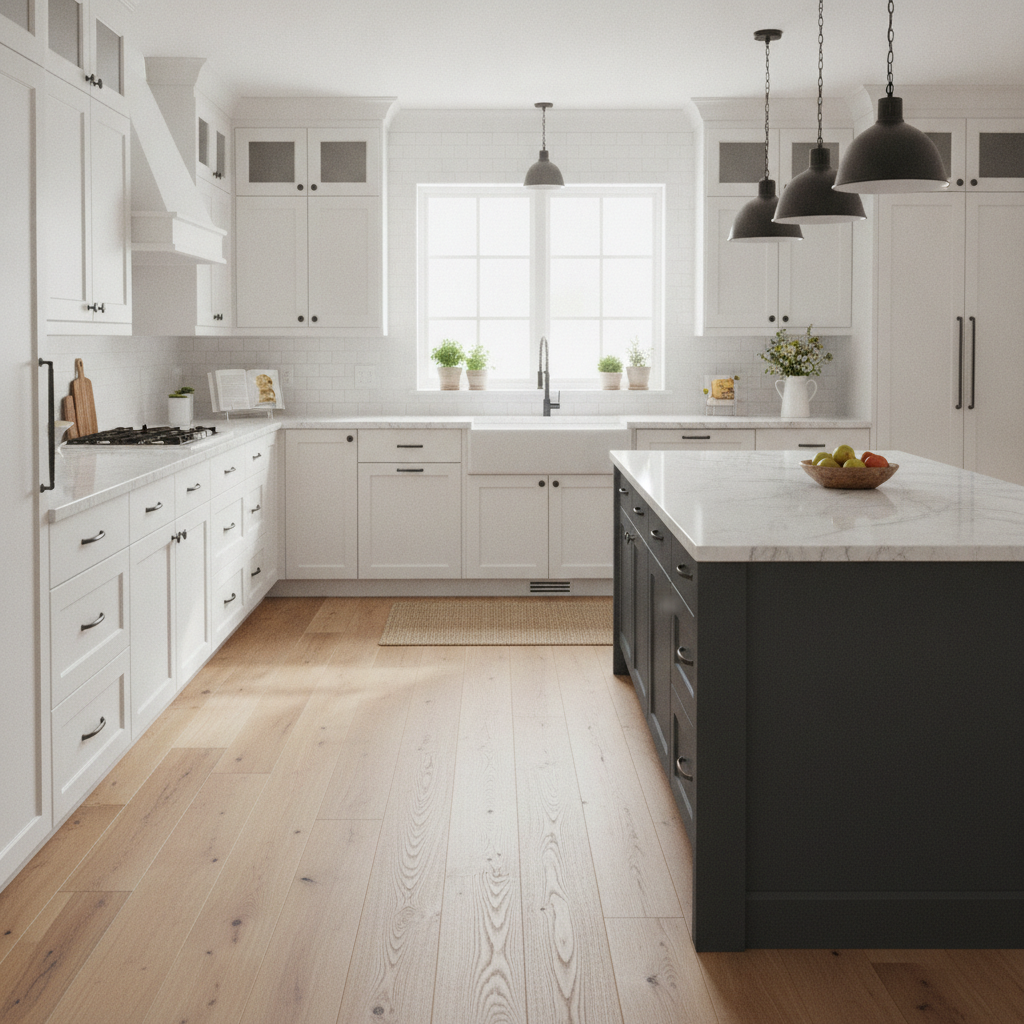
Modern Farmhouse Kitchen:
- The Floor: A wide-plank Bravewood in a light, natural white oak finish. The authentic wood grain provides the rustic warmth that is central to the farmhouse aesthetic.
- Designer’s Notes: This floor pairs perfectly with white shaker cabinets, a large apron-front sink, and matte black hardware. The real wood texture keeps the space from feeling too sterile and adds a layer of organic charm.
Industrial Loft Bathroom:
- The Floor: A dark, slate-look porcelain tile in a large format (e.g., 24″x24″). Its durability stands up to heavy use, and its clean lines complement the industrial vibe.
- Designer’s Notes: The dark tile creates a dramatic contrast with a floating wood vanity, exposed Edison bulb lighting, and a glass-and-steel shower enclosure. The minimal grout lines of large-format tile create a sleek, unbroken surface.
Coastal Kitchen:
- The Floor: A light, airy LVP with a subtle, wire-brushed wood look. Its soft, sandy tones evoke a beachfront feel, and its waterproof nature is perfect for a home where sandy, wet feet might be common.
- Designer’s Notes: This flooring is the ideal base for light blue or seafoam green cabinets, quartz countertops that mimic the look of sand, and plenty of natural light. According to recent Houzz trend reports, natural and light-toned flooring continues to dominate kitchen remodels[8].
Matching Floors to Cabinets:
A common design challenge is creating a harmonious relationship between your new floors and existing (or new) cabinets.
- For Contrast: If you have dark wood or painted cabinets (like navy or forest green), choose a lighter floor to create a bold, modern look and prevent the room from feeling too heavy.
- For Harmony: If you have light wood or white cabinets, you can either choose a floor in a similar light tone for a seamless, airy feel, or select a medium-toned wood floor to add warmth and grounding to the space. Avoid matching the wood tones exactly, as this can make the room feel flat; instead, aim for tones that are two to three shades lighter or darker.
The Ultimate Buyer’s Guide: 5 Steps to Choosing Your Perfect Floor
Feeling inspired? Here is a practical, step-by-step framework to guide your final decision.
-
Establish Your Total Budget: Flooring costs go beyond the price per square foot. Create a simple cost breakdown.
Cost Component Hybrid Hardwood (Bravewood) LVP Porcelain Tile Material Cost/sq.ft. $7 – $12 $3 – $8 $4 – $15 Installation Cost/sq.ft. $3 – $6 $2 – $5 $8 – $20 Subfloor Prep Varies (Crucial) Varies (Important) Varies (Most Critical) Long-Term Maintenance Low (Specific cleaners) Very Low (Easy to clean) Very Low (Grout sealing) - Evaluate Real-World Durability: Think about your lifestyle. Do you have large dogs, active kids, or do you entertain frequently?
- For Scratches: Look at the wear layer. For LVP, aim for 20 mil. For hybrid hardwood, look for a multi-layer aluminum oxide finish. For tile, check the PEI rating (PEI 4+ for ultimate scratch resistance). The industry standard for measuring this is the Taber Abrasion Test (ASTM D4060)[7].
- For Dents: The dense SPC core of hybrid hardwood and LVP offers excellent dent resistance. Porcelain tile is virtually dent-proof.
- Get Samples: Never choose a floor from a computer screen. Get large samples of your top 3-4 choices. Place them in your kitchen or bathroom. Look at them in the morning light, under artificial light at night, and next to your cabinets and wall colors.
- Read the Fine Print: Look at the technical data sheet for the product. Pay attention to the warranty. Does it cover topical water? For how long? What installation requirements must be met to keep the warranty valid?
- Plan for Installation: The best flooring material in the world will fail if installed incorrectly.
- DIY: LVP and hybrid hardwood with click-lock systems are generally DIY-friendly if you have a flat, stable subfloor.
- Pro Install: Tile installation is a skilled trade that is almost always best left to a certified professional. For hybrid hardwood in a tricky space, a pro is also highly recommended.
Beyond the Planks: How to Ensure a Truly Waterproof Installation
The most critical takeaway is that a waterproof floor is a system, not just a product. To protect your home from moisture, you must pay attention to the details of the installation.
- Subfloor Preparation is Everything: The subfloor must be clean, dry, and—most importantly—flat. For floating floors like LVP and hybrid hardwood, high spots must be ground down and low spots filled with a leveling compound. For tile, an uncoupling membrane is often installed over the subfloor to prevent cracks from transferring to the tile.
- Seal the Perimeter: In a full bathroom or kitchen, the job isn’t done until the perimeter of the room is sealed. After the flooring is installed, a gap is left around the edges for expansion. This gap, covered by baseboards, must be filled with a 100% silicone caulk to create a watertight seal. This prevents water from a spill or overflow from getting under the floor.
- Respect the System: For tile installations in wet areas, following the approved methods in the TCNA Handbook is the gold standard for success[6]. This includes using the correct membranes, thin-set mortar, and grout for the application.
- Control the Air: A beautiful waterproof floor can’t stop moisture problems caused by condensation. Proper ventilation is key, especially in bathrooms. A high-quality exhaust fan helps remove humid air, preventing it from condensing on surfaces. The U.S. Environmental Protection Agency (EPA) recommends keeping indoor humidity between 30% and 50% to prevent the growth of mold[9].
Your Regret-Proof Flooring Decision
The age-old compromise between the beauty of wood and the durability required for kitchens and bathrooms is officially over. The advent of waterproof hybrid hardwood like Bravewood provides an exceptional solution that delivers authentic wood aesthetics with a resilient, waterproof core. It stands confidently alongside top-tier contenders like luxury vinyl plank, which offers unmatched versatility and value, and porcelain tile, the undisputed king of durability.
Armed with an understanding of the science behind these materials, from SPC cores and wear layers to PEI ratings and installation systems, you can now cut through the marketing noise. You are equipped to analyze your options based on your budget, your lifestyle, and your unique design vision. You can now make a confident, regret-proof investment, creating a stunning kitchen or bathroom that is built to last.
Feeling confident to start your project? Explore our gallery of kitchen and bathroom designs for more inspiration, or use our flooring calculator to estimate your material needs today.
This article provides informational guidance. Flooring installation in wet areas has specific requirements. Always consult with a certified professional installer and follow manufacturer guidelines to ensure proper installation and warranty coverage.
References & Authoritative Sources
- Institute of Inspection, Cleaning and Restoration Certification (IICRC). (N.D.). IICRC S500 Standard for Professional Water Damage Restoration. Retrieved from IICRC resources.
- National Wood Flooring Association (NWFA). (N.D.). Technical Guidelines on Moisture Content and Wood Flooring. Retrieved from NWFA technical publications.
- SCS Global Services. (N.D.). FloorScore®. Retrieved from SCS Global Services certification information.
- Resilient Floor Covering Institute (RFCI). (N.D.). Official Standards and Information on Vinyl Flooring. Retrieved from RFCI resources.
- Porcelain Enamel Institute (PEI). (N.D.). PEI Rating System for Tile Abrasion Resistance. Retrieved from industry publications on tile standards.
- Tile Council of North America (TCNA). (N.D.). TCNA Handbook for Ceramic, Glass, and Stone Tile Installation. Retrieved from TCNA publications.
- ASTM International. (N.D.). Flooring Standards (e.g., ASTM D4060 – Standard Test Method for Abrasion Resistance). Retrieved from ASTM International standards database.
- Houzz. (N.D.). Houzz Kitchen Trends Study. Retrieved from Houzz research and reports.
- United States Environmental Protection Agency (EPA). (N.D.). A Brief Guide to Mold, Moisture, and Your Home. Retrieved from EPA.gov.
