
Are you standing in a flooring showroom, paralyzed by a sea of options and confusing acronyms? You want the timeless beauty of wood, but you live in fear of the inevitable spill, pet accident, or leaky dishwasher. You’ve heard the terms “waterproof hybrid,” “SPC,” and “WPC,” but you’re left wondering what they actually mean for your home and your investment. You’re not just buying a floor; you’re trying to buy peace of mind.
This is where the confusion ends. We’re going to move beyond the marketing buzzwords and give you a simple, powerful framework for making a confident choice: The Durability Trinity. This guide will teach you to evaluate any hybrid floor based on the three pillars that truly matter for long-term performance: its Core, its Wear Layer, and its Locking System.
By the time you finish reading, you will understand the material science behind indestructible flooring. You’ll know exactly what to look for on a spec sheet, how to choose the perfect floor for your lifestyle, and how to make a lasting investment that can withstand real life.
- What is Waterproof Hybrid Flooring? (And Is It Truly 100% Waterproof?)
- The Durability Trinity: Deconstructing What Makes a Hybrid Floor Last
- Pillar 1: The Core Technology (SPC vs. WPC)
- Pillar 2: The Wear Layer and Scratch Resistance
- Pillar 3: The Locking System (The Unsung Hero of Durability)
- Decoding ‘Waterproof Hybrid Hardwood’: Is It Real Wood?
- Your Ultimate Buyer’s Checklist: 7 Factors to Evaluate
- Special Consideration: The Best Waterproof Hybrid Flooring for Pets
- Frequently Asked Questions (FAQ)
- Conclusion
- References
What is Waterproof Hybrid Flooring? (And Is It Truly 100% Waterproof?)
Waterproof hybrid flooring is a marvel of modern engineering, designed to offer the best of all worlds: the stunning appearance of natural materials like wood or stone combined with uncompromising performance. It’s a multi-layered plank constructed with a rigid, waterproof core that will not swell, buckle, or degrade when exposed to water.
Here is a breakdown of its typical construction, often referred to as the anatomy of a hybrid plank:
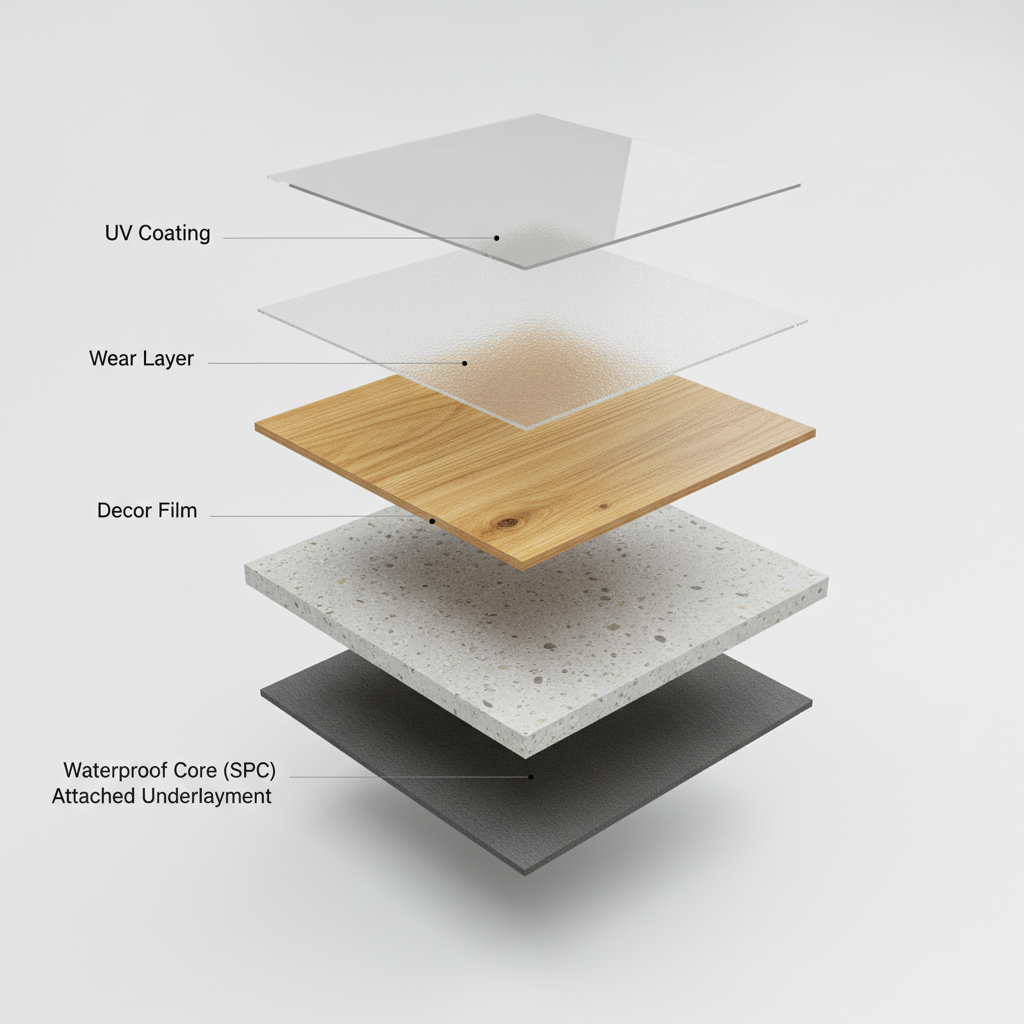
- UV Coating: The topmost layer provides a finish (e.g., matte, satin) and offers the first line of defense against fading from sunlight.
- Wear Layer: This is the transparent, high-traffic coating that provides the crucial resistance against scratches, scuffs, and stains. Its thickness is a primary indicator of durability.
- Decor Film: A high-resolution printed layer that gives the plank its realistic wood or stone appearance.
- Waterproof Core: This is the heart of the plank. It’s typically made from a Stone Plastic Composite (SPC) or Wood Plastic Composite (WPC), making the plank itself impervious to water.
- Attached Underlayment: Most hybrid floors come with a pre-attached pad (usually foam or cork) that provides sound insulation, cushioning underfoot, and can correct for minor subfloor imperfections.
So, is it truly 100% waterproof? The planks themselves are. You could submerge a hybrid plank in water indefinitely, and it would not be damaged. However, a “waterproof floor system” depends on the installation. The claim’s integrity relies on the locking mechanism between planks and proper installation techniques to prevent water from seeping through the seams to the subfloor below.
As one certified flooring installer puts it, “The planks are waterproof, but your subfloor isn’t. A high-quality locking system is what creates a tight seal at the seams, forming a barrier that keeps topical spills on the surface. That’s the difference between a truly protected floor and a potential disaster.”
This is why professional installation and adherence to manufacturer guidelines, which align with industry benchmarks like ASTM F3261-20 for resilient flooring, are paramount.[1]
Hybrid Flooring vs. Luxury Vinyl Plank (LVP) vs. Laminate: Key Differences
These terms are often used interchangeably, causing massive confusion for buyers. The primary difference lies in the core material, which dictates their performance.
| Feature | Waterproof Hybrid Flooring | Luxury Vinyl Plank (LVP) | Traditional Laminate |
|---|---|---|---|
| Core Material | Rigid Core: SPC (Stone Plastic Composite) or WPC (Wood Plastic Composite) | Flexible or Rigid Core: PVC (Polyvinyl Chloride) | HDF (High-Density Fiberboard) made of wood byproducts |
| Water Resistance | 100% Waterproof Core. Impervious to water. | 100% Waterproof Core. Impervious to water. | Water-Resistant Surface. Core is highly susceptible to swelling and permanent damage from moisture. |
| Dent Resistance | Excellent, especially SPC cores which are extremely dense and rigid. | Good, but flexible LVP is more prone to denting from heavy furniture. | Fair. The HDF core can be dented by sharp impacts. |
| Feel Underfoot | Solid and substantial. WPC offers more warmth and cushioning. | Can feel softer and more flexible, especially thinner “glue-down” versions. | Can feel hard and produce a hollow sound if no underlayment is used. |
According to the Resilient Floor Covering Institute (RFCI), which helps set industry standards, the rigid core is the key innovation that gives hybrid flooring its superior dimensional stability and dent resistance compared to more flexible LVP products.[2] The difference is most stark when compared to laminate; while a spill on hybrid flooring will bead on the surface, the same spill on laminate can quickly find a seam and cause the fiberboard core to swell and peel.
The Durability Trinity: Deconstructing What Makes a Hybrid Floor Last
A floor’s longevity isn’t determined by a single feature. True waterproof flooring durability comes from the synergy of three critical components working together. We call this The Durability Trinity:

- The Core: The waterproof foundation that provides dent resistance and stability.
- The Wear Layer: The transparent shield that fights off scratches and stains.
- The Locking System: The interlocking mechanism that ensures structural integrity and a watertight seal.
A failure in any one of these pillars compromises the entire floor. A thick wear layer is useless if the core dents easily, and a waterproof core can’t protect your subfloor if the locking system allows water to seep through. By understanding and evaluating all three, you can look at a product’s technical data sheet and know precisely how it will perform in your home.
Pillar 1: The Core Technology (SPC vs. WPC)
The core is the engine of your hybrid floor. It dictates how the plank resists impacts, handles temperature changes, and feels underfoot. The two dominant technologies are SPC and WPC.
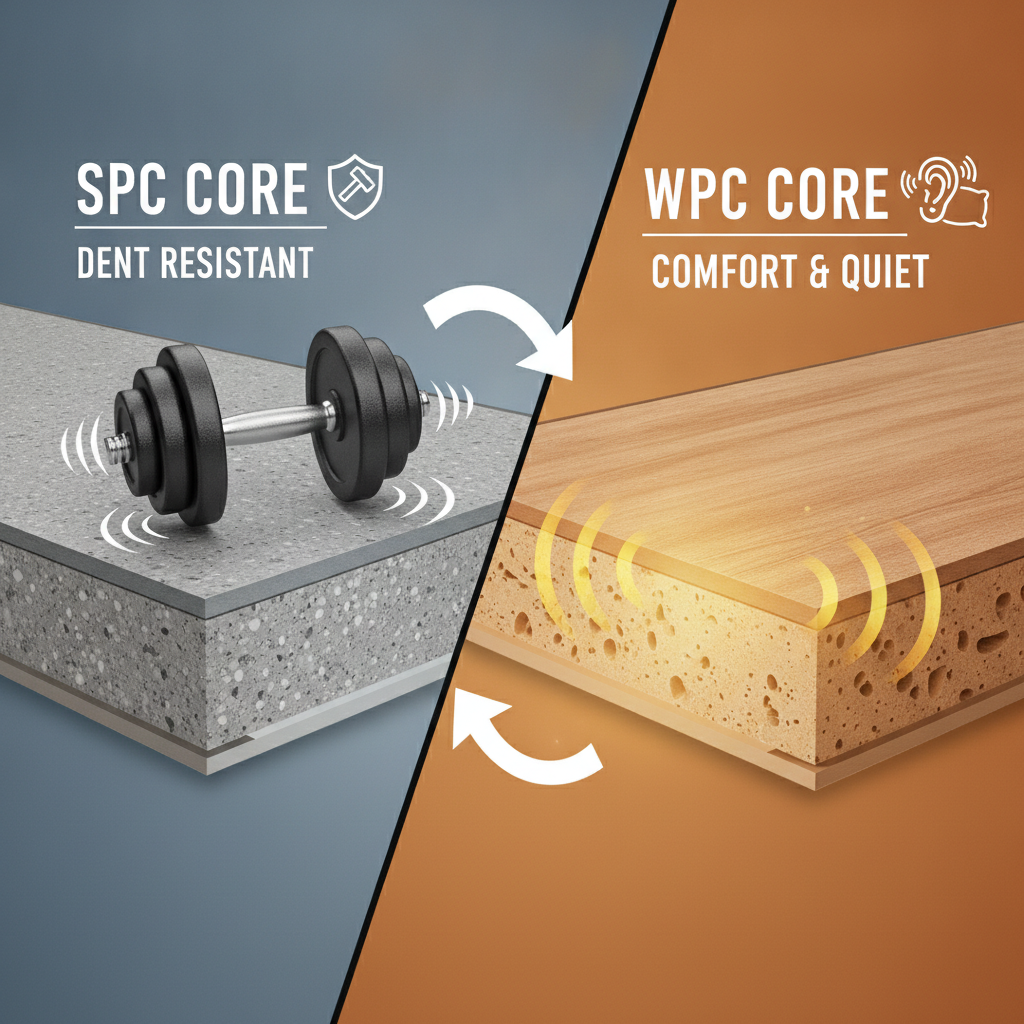
- SPC (Stone Plastic Composite): This core is comprised of approximately 60% calcium carbonate (limestone), blended with PVC and stabilizers. This composition gives it incredible density (around 2000 kg/m³) and rigidity.
- WPC (Wood Plastic Composite): This core combines recycled wood pulp or wood-like materials, PVC, and a foaming agent. The foaming agent creates air pockets within the core, making it less dense (around 950 kg/m³), lighter, and slightly softer underfoot.
Here’s how they stack up in key performance areas:
| Feature | SPC (Stone Plastic Composite) | WPC (Wood Plastic Composite) |
|---|---|---|
| Dent Resistance | Superior. The dense, rigid limestone core is extremely resistant to dents from dropped objects and heavy furniture. | Good. Softer and less dense, making it more susceptible to denting from heavy point loads. |
| Feel/Comfort | Firm & Sturdy. Feels very solid underfoot, similar to tile. Can feel colder to the touch. | Softer & Warmer. The foaming agent provides more cushioning and better thermal insulation. |
| Sound Insulation | Fair. The high density can reflect sound, though a quality underlayment mitigates this. | Excellent. The air pockets in the core provide superior sound absorption, making it quieter to walk on. |
| Cost | Generally more affordable due to the lower cost of its raw materials. | Typically more expensive due to a more complex manufacturing process. |
| Thermal Stability | Excellent. Very stable in the face of temperature fluctuations, making it a great choice for areas with direct sunlight. | Good. Less stable than SPC. It can be more prone to expansion and contraction with extreme temperature swings. |
A common content gap is the effect of sunlight and temperature. Because of its dense stone composition, an SPC core is significantly more stable and less likely to expand or contract when exposed to direct sunlight from a large window. This makes it a safer choice for sunrooms or rooms with floor-to-ceiling glass.
Which Core is Right for You?
The choice between SPC and WPC should be based on the room’s function.
- Choose SPC for: Kitchens, entryways, laundry rooms, and any high-traffic area. Its superior dent resistance makes it the champion for busy households with kids, pets, and heavy furniture. It’s also the best choice for commercial applications.
- Choose WPC for: Bedrooms, family rooms, and basements. Its added warmth, comfort, and superior sound dampening create a cozier and quieter environment where dent resistance is less of a critical factor.
As one interior designer notes, “I specify SPC for the ‘workhorse’ areas of a home where durability is non-negotiable. For a client’s master bedroom or a basement media room, WPC provides that extra touch of comfort and quiet that enhances the living experience.”
Pillar 2: The Wear Layer and Scratch Resistance
This is where the battle against scratches from pet claws, dragged furniture, and daily grit is won or lost. Many consumers mistakenly believe a thicker plank is more scratch-resistant, but this is false. Scratch resistance comes exclusively from the wear layer, the transparent topcoat.
This layer’s thickness is measured in mils (one-thousandth of an inch). For residential use, wear layers typically range from 12 mil to 22 mil. For a home with pets or children, a wear layer of 20 mil or greater is highly recommended.
Beyond thickness, look for two key indicators of quality:
- Enhanced Coatings: Premium wear layers are infused with microscopic particles of extremely hard minerals like aluminum oxide or ceramic beads. Aluminum oxide is one of the hardest substances in existence, ranking just below diamond on the Mohs scale of mineral hardness,[4] giving the floor exceptional abrasion resistance.
- AC (Abrasion Class) Rating: This is an internationally recognized standard developed by the Association of European Producers of Laminate Flooring (EPLF).[3] It rates a floor’s durability for specific traffic levels.
- AC1: Light residential (e.g., bedrooms)
- AC2: Moderate residential (e.g., living rooms)
- AC3: Heavy residential / Light commercial
- AC4: General commercial (e.g., small offices, cafes)
- AC5: Heavy commercial (e.g., public buildings, department stores)
For a busy home, look for a floor with an AC3 or AC4 rating to ensure it can handle high traffic without showing wear patterns. It’s crucial to differentiate this from dent resistance; a floor can have a high AC rating for scratch resistance but still dent if it has a soft WPC core.
Pillar 3: The Locking System (The Unsung Hero of Durability)
The locking system is the most overlooked—and often the first to fail—component of a floating floor. A robust locking profile is what holds the planks together tightly, preventing gapping, peaking, and squeaking over time. More importantly, it is essential for maintaining the floor’s waterproof seal.
A weak or poorly designed locking mechanism can allow the planks to separate slightly under the stress of foot traffic or shifting subfloors. This not only creates unsightly gaps but also breaks the watertight barrier, allowing spills to reach and damage the subfloor.
When inspecting a sample, look for a thick and complex locking profile. Systems like “angle-tap” or “click-lock” with multiple points of contact are generally more robust than simple tongue-and-groove designs.
A veteran flooring installer explains, “The number one reason I get called to fix a failing floating floor is gapping caused by a cheap locking system. The homeowner saved a few cents per square foot, but now they have a floor that’s slowly pulling itself apart. A quality lock is worth every penny.”
Equally important is subfloor preparation. No locking system can perform correctly on an uneven subfloor. Always follow the manufacturer’s installation guidelines for subfloor flatness to ensure the long-term integrity of your floor.
Decoding ‘Waterproof Hybrid Hardwood’: Is It Real Wood?
Yes, it is real wood. The term “waterproof hybrid hardwood” or “hybrid hardwood” refers to a product that combines the best of both worlds: a top layer of genuine hardwood veneer bonded to a 100% waterproof SPC core.
This construction solves the greatest weakness of traditional wood flooring: its vulnerability to water. The National Wood Flooring Association (NWFA) provides clear definitions that help distinguish these products.[5]
| Feature | Solid Hardwood | Engineered Hardwood | Waterproof Hybrid Hardwood |
|---|---|---|---|
| Construction | Single piece of solid wood. | Plywood or HDF core with a real wood veneer on top. | SPC core with a real wood veneer on top. |
| Water Resistance | Poor. Highly susceptible to cupping, crowning, and permanent damage from water. | Fair. More stable than solid, but the wood-based core will still be damaged by significant moisture. | Excellent. The SPC core is 100% waterproof, and the veneer is protected by a water-resistant finish. |
| Durability | Varies by wood species (Janka hardness). Prone to dents and scratches. | Similar to solid hardwood in terms of veneer durability. | Superior. The ultra-dense SPC core provides extreme dent resistance, protecting the wood veneer from impacts. |
| Refinishing | Can be sanded and refinished multiple times. | Can be refinished 1-3 times, depending on veneer thickness. | Typically cannot be refinished. The veneer is usually too thin. |
The result is a floor that offers the authentic beauty and unique grain of real oak, hickory, or maple, but can be installed in kitchens, bathrooms, and basements without fear.
What to Look For: Veneer Thickness and Refinishing
This is the critical trade-off with most hybrid hardwood products. To keep them affordable and stable, the real wood veneer is often quite thin, typically ranging from 0.6mm to 2mm. This is a key content gap many guides miss.
A wood flooring specialist advises, “For a traditional sand and refinish, you need a bare minimum of 2mm of veneer, but ideally 3mm or more. Most hybrid hardwood products have veneers thinner than this, so you should consider their finish to be permanent.”
Therefore, while hybrid hardwood offers incredible durability against dents and water, it doesn’t offer the same multi-generational lifespan as solid hardwood that can be refinished repeatedly. It’s a cost-benefit analysis: you gain immense protection against daily life’s biggest threats (water and dents) in exchange for the ability to refinish the floor decades down the line.
Your Ultimate Buyer’s Checklist: 7 Factors to Evaluate
When you’re ready to shop, use this checklist to cut through the noise and compare products like a pro.
1. Core Type (SPC vs. WPC)
What to Look For: Choose SPC for high-traffic areas, kitchens, and homes with pets for maximum dent resistance. Choose WPC for bedrooms and living areas where extra comfort and sound dampening are priorities.
2. Wear Layer Thickness (Mils & AC Rating)
What to Look For: For light traffic (bedrooms), 12 mil is acceptable. For moderate to heavy traffic and homes with kids or pets, insist on 20 mil or higher, or an AC3 or AC4 rating.
3. Overall Plank Thickness (mm)
What to Look For: Look for planks in the 5mm to 8mm range. Thicker planks are not necessarily more durable, but they can feel more substantial underfoot and are more forgiving of minor subfloor imperfections.
4. Attached Underlayment
What to Look For: A quality pre-attached pad of at least 1mm to 1.5mm is essential for sound absorption and comfort. It also simplifies the installation process.
5. Texture and Visuals (EIR)
What to Look For: For the most realistic wood look, choose a product with Embossed-in-Register (EIR) texture. This process aligns the surface texture with the grain pattern on the visual layer, creating an incredibly authentic look and feel. It also provides better traction.
6. Certifications (FloorScore®)
What to Look For: Your floor has a major impact on your home’s indoor air quality. Look for the FloorScore® logo. This is an independent certification by SCS Global Services that ensures the flooring meets strict standards for low emissions of Volatile Organic Compounds (VOCs).[6]
7. Warranty Details
What to Look For: Don’t just look at the length (e.g., “Lifetime Residential”). Read the fine print. A good warranty will clearly cover topical water spills. Look for specific language like “100% waterproof” and check for exclusions related to flooding, improper installation, or moisture from the subfloor.
Special Consideration: The Best Waterproof Hybrid Flooring for Pets
For pet owners, a floor needs to be more than just durable; it needs to be “pet-proof.” This means it excels in four key areas.
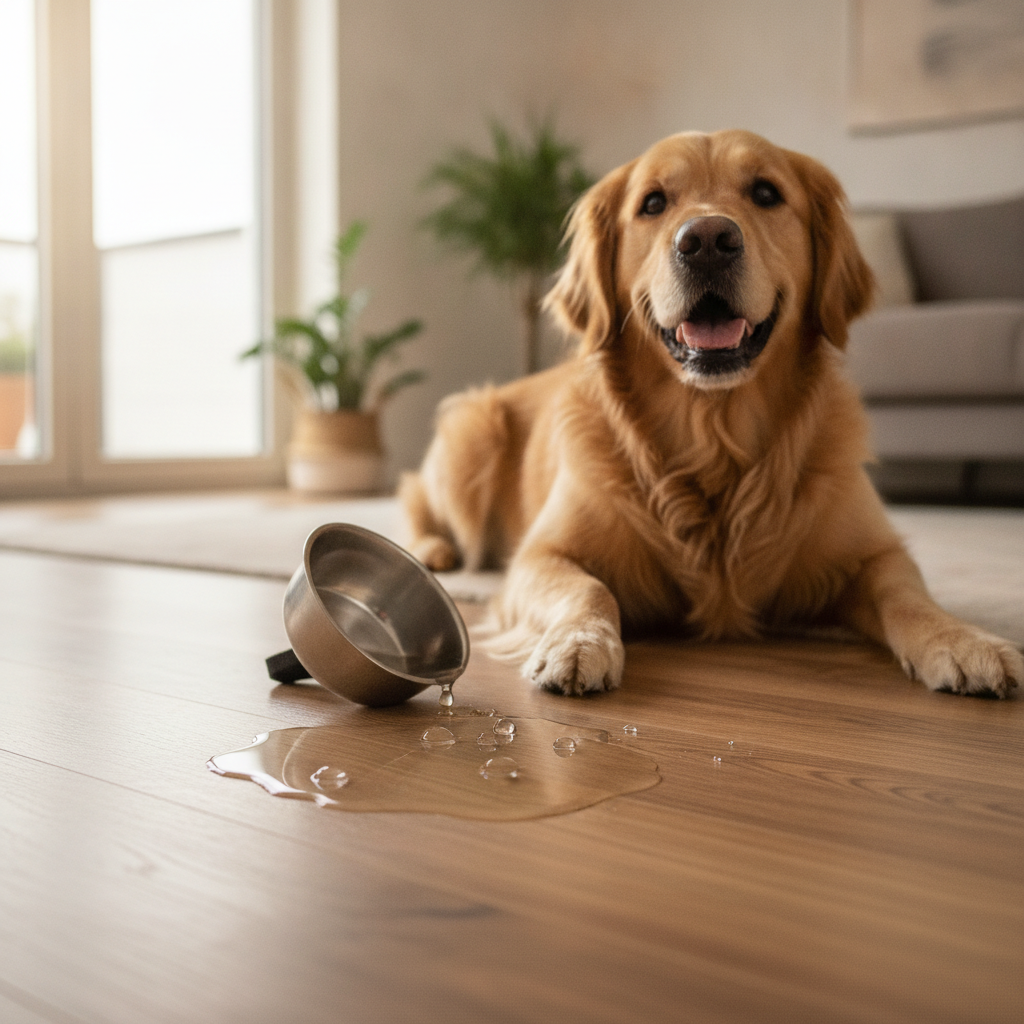
The Pet-Proof Flooring Scorecard:
- Scratch Resistance (Grade: A+): This is paramount. A wear layer of 20 mil or greater with an aluminum oxide coating is non-negotiable to defend against claws.
- Waterproofing (Grade: A+): An SPC core provides a 100% waterproof barrier against accidents, spilled water bowls, and muddy paws.
- Traction (Grade: B+): Slippery floors can be dangerous for pets, especially older dogs or breeds prone to hip dysplasia. The American Kennel Club (AKC) advises that non-slip surfaces are important for a dog’s joint health and safety.[7] Look for flooring with an embossed or textured surface (like EIR) to provide better grip for paws.
- Stain Resistance (Grade: A): The UV coating and wear layer should be non-porous and easy to clean, preventing pet accidents from staining the floor.
When cleaning up pet accidents, use a pH-neutral cleaner recommended by the flooring manufacturer. Avoid harsh chemicals like ammonia or bleach, which can damage the wear layer over time and void your warranty.
Frequently Asked Questions (FAQ)
Can you install waterproof hybrid flooring in bathrooms and basements?
Yes, absolutely. Its waterproof core makes it an ideal choice for moisture-prone areas where traditional hardwood or laminate would be destroyed. However, for installation over a concrete subfloor (like in a basement), it is critical to perform a moisture test and use a vapor barrier as recommended by the manufacturer.
What is the average cost of waterproof hybrid flooring?
The cost can vary widely based on quality. You can generally expect to pay between $3.00 to $7.00 per square foot for materials. Products with thicker wear layers, WPC cores, or real wood veneers will be at the higher end of that range. Professional installation typically adds $2.00 to $4.00 per square foot.
How long does waterproof hybrid flooring last?
High-quality waterproof hybrid flooring is built to last. Most reputable products come with residential warranties ranging from 25 years to a lifetime. However, the actual lifespan depends on the quality of its “Durability Trinity”—a floor with a 20 mil wear layer and a robust locking system will far outlast a budget option with a 12 mil wear layer, even if both have a “lifetime” warranty.
Conclusion
Choosing a new floor no longer has to be an exercise in guesswork and anxiety. By arming yourself with the “Durability Trinity” framework, you can confidently walk into any showroom and see past the marketing claims. You now know to investigate the Core for dent resistance, the Wear Layer for scratch protection, and the Locking System for long-term integrity.
You understand the real-world differences between SPC and WPC, the critical importance of a 20-mil wear layer for a busy home, and what “waterproof hybrid hardwood” truly means. You are now equipped to choose the perfect waterproof hybrid floor. Use the Buyer’s Checklist in this guide to confidently compare your options and make an investment in your home that you won’t regret.
This article provides general guidance. Always consult with a professional flooring installer and refer to manufacturer specifications before making a purchase or beginning an installation. Product features and warranties may vary by brand.
References
- ASTM International. (n.d.). ASTM F3261-20 Standard Specification for Resilient Flooring in Modular Format with Rigid Polymeric Core. Retrieved from ASTM.org.
- Resilient Floor Covering Institute. (n.d.). Industry Information and Standards. Retrieved from RFCI.com.
- Association of European Producers of Laminate Flooring (EPLF). (n.d.). Technical Information: Abrasion Resistance. Retrieved from EPLF.com.
- National Park Service. (n.d.). Mohs Hardness Scale. Retrieved from NPS.gov.
- National Wood Flooring Association (NWFA). (n.d.). Wood Flooring Types. Retrieved from NWFA.org.
- SCS Global Services. (n.d.). FloorScore®. Retrieved from SCSGlobalServices.com.
- American Kennel Club (AKC). (n.d.). Canine Hip Dysplasia. Retrieved from AKC.org.
