
The pitter-patter of paws is the soundtrack to a happy home. We love our pets like family, but that love often comes with a side of frustration when we look at our floors. The tell-tale click-clack of nails on hardwood, the frantic scramble that leaves a web of scratches, or the sinking feeling of discovering an accident—these are the moments that test the bond between pet owner and floor. The anxiety of choosing a new floor is real. You’re caught between wanting the beautiful, warm look of wood and needing something that can stand up to the daily chaos of pet life. How do you find a floor that is durable, beautiful, and safe for your furry companions without breaking the bank?
Welcome to the Pet Owner’s Definitive Flooring Playbook. This is more than just a list of products; it’s a complete guide to making the smartest, most confident decision for your home. We will equip you with a framework for evaluating what “pet-proof” truly means, and we’ll dive deep into the top flooring contenders. Then, for those of you currently battling the evidence of your pet’s past adventures, we’ll provide a first-aid guide to repairing common pet-related damage. By the end, you’ll understand not only how to choose the perfect new floor but also how to manage and fix the one you already have.
- What Truly Makes a Floor ‘Pet-Proof’? A Multi-Factor Scorecard
- The Contenders: Comparing the Best Pet-Friendly Flooring Materials
- Deep Dive: Why Hybrid Hardwood is the ‘No-Compromise’ Solution
- First Aid for Floors: How to Fix Existing Pet Damage
- Your Playbook for a Pet-Friendly Home
- References & Authoritative Sources
What Truly Makes a Floor ‘Pet-Proof’? A Multi-Factor Scorecard
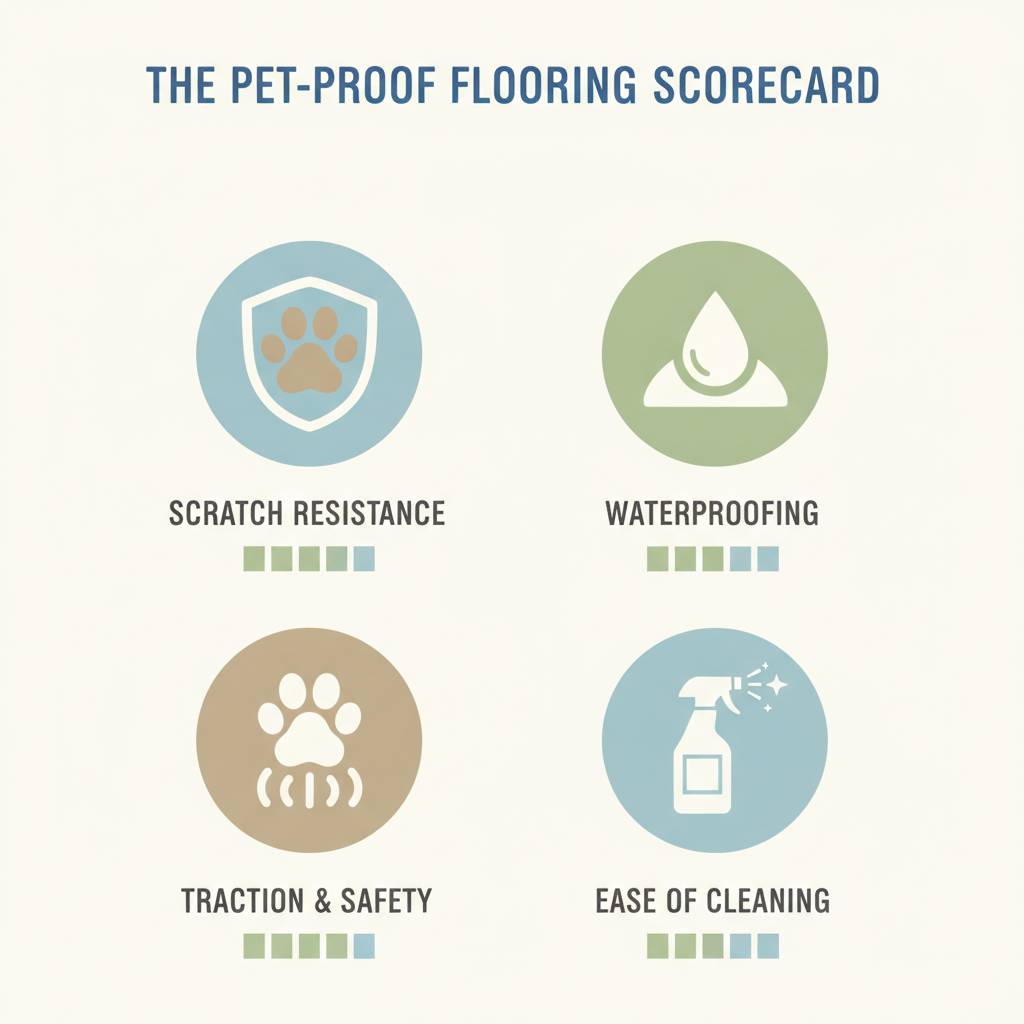
The term “pet-proof” is used so often in marketing that it’s almost lost its meaning. True durability for a pet-filled home isn’t about a single feature; it’s a holistic combination of factors that work together to give you peace of mind. To cut through the noise, we’ve developed the Pet-Friendliness Scorecard, which evaluates flooring based on four critical performance indicators.
- Scratch Resistance: This is the frontline defense against your pet’s nails. It’s determined by the hardness of the material and, more importantly, the quality of its protective top layer or finish. A floor that resists scratches will look newer for longer and save you from the constant worry of everyday activity.
- Waterproofing: From spilled water bowls to house-training accidents, moisture is a constant threat. A truly waterproof floor has a core that won’t swell, warp, or degrade when exposed to liquid. This is different from “water-resistant,” which can only handle topical moisture for a limited time. For pet owners, 100% waterproof is the gold standard.
- Traction & Safety: Your pet’s health is paramount. Floors that are too slick can cause pets to slip, potentially leading to anxiety or serious joint injuries, especially in older dogs or breeds prone to hip dysplasia. The American Kennel Club (AKC) emphasizes that good traction is crucial for a dog’s stability and long-term joint health [1]. A floor with a bit of texture provides the grip they need to move confidently and safely.
- Ease of Cleaning & Maintenance: Life with pets is messy. The ideal floor should be non-porous and easy to clean, allowing you to wipe up mud, fur, and accidents without fear of staining or lingering odors. Furthermore, the flooring materials should contribute to a healthy home environment. Look for products with low volatile organic compounds (VOCs), often verified by certifications like FloorScore®, to ensure better indoor air quality for both your family and your pets [2].
The Contenders: Comparing the Best Pet-Friendly Flooring Materials
Now that we have our criteria, let’s see how the top pet-friendly flooring options stack up. Each material offers a unique blend of benefits and drawbacks, and the right choice depends on your specific needs, budget, and aesthetic preferences.
Pet-Friendliness Scorecard: At a Glance
| Flooring Type | Scratch Resistance | Waterproofing | Traction/Safety | Ease of Cleaning |
|---|---|---|---|---|
| Luxury Vinyl (LVP) | 4/5 | 5/5 | 4/5 | 5/5 |
| Waterproof Laminate | 5/5 | 4/5 | 3/5 | 4/5 |
| Porcelain/Ceramic Tile | 5/5 | 5/5 | 2/5 | 4/5 |
| Hybrid Hardwood | 5/5 | 5/5 | 4/5 | 5/5 |
Note: Ratings are on a 1-5 scale, where 5 is the highest performance.
As interior design experts often note, the aesthetic challenge is balancing this raw performance with a look that feels warm and integrated into your home’s style. While tile offers unmatched durability, it can feel cold and clinical. LVP and laminate have made incredible leaps in realism, but only hybrid hardwood delivers the authentic beauty of real wood with the performance you need.
Luxury Vinyl Plank/Tile (LVP/LVT): The All-Around Champion
Luxury vinyl is a synthetic flooring made of multiple layers, designed to realistically mimic the look of wood (LVP) or stone (LVT). Its core is typically made from one of two materials: Stone Polymer Composite (SPC), which is rigid, dense, and extremely durable, or Wood Polymer Composite (WPC), which is slightly softer and quieter underfoot.
The key to LVP’s scratch resistance is its transparent wear layer, a protective top coating measured in mils (thousandths of an inch). For homes with pets, a wear layer of 20 mils or more is highly recommended for maximum durability, a specification often detailed by industry bodies like the Resilient Floor Covering Institute (RFCI) [3].
- Top Coat: UV-cured coating for durability and sheen.
- Wear Layer: Clear top layer that provides scratch and stain resistance.
- Vinyl Print Layer: High-resolution image of wood or stone.
- Core: Waterproof SPC or WPC core for stability.
- Backing Layer: Provides sound absorption and stability.
Pet-Friendliness Scorecard: LVP/LVT
- Scratch Resistance: 4/5 – A thick wear layer is very effective, but can be gouged by extremely heavy, sharp objects.
- Waterproofing: 5/5 – With a polymer core, LVP is 100% waterproof from top to bottom.
- Traction/Safety: 4/5 – Many styles feature embossed textures that provide good grip for paws.
- Ease of Cleaning: 5/5 – The non-porous surface is incredibly easy to wipe clean.
Waterproof Laminate: The Scratch-Resistant Powerhouse
Modern laminate flooring has come a long way from the easily damaged versions of the past. Today’s waterproof laminate features a high-density fiberboard core with water-repellent technology and a tightly locking system that prevents moisture from seeping through.
Laminate’s greatest strength is its exceptional scratch resistance. This is measured using the Abrasion Class (AC) rating system, developed by the Association for European Producers of Laminate Flooring (EPLF) [4]. The ratings range from AC1 (light residential use) to AC5 (heavy commercial use). For homes with pets, an AC4 or AC5 rating ensures the surface can withstand significant traffic and claw scratches.
However, a common drawback is acoustics; the hard, dense surface can create a loud “clicking” sound from pet nails. This can be mitigated with a high-quality acoustic underlayment, but it’s an important consideration for noise-sensitive households.
Pet-Friendliness Scorecard: Waterproof Laminate
- Scratch Resistance: 5/5 – An AC4 or AC5 rated laminate is one of the most scratch-resistant surfaces available.
- Waterproofing: 4/5 – While the surface and joints are waterproof, a major flood could still potentially damage the core if water gets to the edges of the installation.
- Traction/Safety: 3/5 – Can be slicker than LVP, though textured options are improving.
- Ease of Cleaning: 4/5 – Easy to clean, but harsh chemical cleaners should be avoided.
Porcelain & Ceramic Tile: The Indestructible Option (with Caveats)
When it comes to pure, raw durability, nothing beats porcelain or ceramic tile. It is virtually scratch-proof, completely waterproof, and will last for decades. For pet owners dealing with frequent, heavy-duty messes, tile is a formidable choice.
However, this durability comes with significant trade-offs for pet comfort and safety. As veterinarians and canine physical therapists often caution, “hard, slick surfaces can be challenging for dogs, especially seniors or those with arthritis, as they require more effort to stand up and move around, potentially straining joints” [5]. The surface is cold, hard, and can be very slippery when wet, increasing the risk of injury. Furthermore, while the tile itself is easy to clean, porous grout lines can absorb stains and odors, requiring regular sealing and deep cleaning. The Tile Council of North America (TCNA) provides standards for slip resistance (measured by DCOF rating) that can help in selecting a safer, more textured tile [6].
Pet-Friendliness Scorecard: Porcelain/Ceramic Tile
- Scratch Resistance: 5/5 – Unmatched resistance to scratches from pet nails.
- Waterproofing: 5/5 – The tile itself is impervious to water.
- Traction/Safety: 2/5 – Generally poor traction unless a highly textured tile is chosen. Hardness is a major concern for pet joints.
- Ease of Cleaning: 4/5 – Tile is easy, but grout maintenance can be a significant chore.
Deep Dive: Why Hybrid Hardwood is the ‘No-Compromise’ Solution
For years, pet owners who loved the look of real hardwood had to compromise. They either accepted the inevitable scratches and water damage or chose a synthetic alternative. Hybrid hardwood flooring eliminates that compromise. It is an innovative product category that fuses the authentic beauty of a real wood veneer with the indestructible, waterproof core of luxury vinyl.
This technology delivers a floor that is not only beautiful but also engineered to withstand the toughest challenges of a pet-filled home. Flooring product developers explain that the magic lies in its construction: “By bonding a thin slice of genuine hardwood to a Stone Polymer Composite (SPC) core, we create a plank that is 100% waterproof and far more dent-resistant than traditional or engineered wood.” This construction adheres to rigorous industry benchmarks, such as ASTM International standards for dimensional stability and wear resistance, ensuring a high-performance product [7].
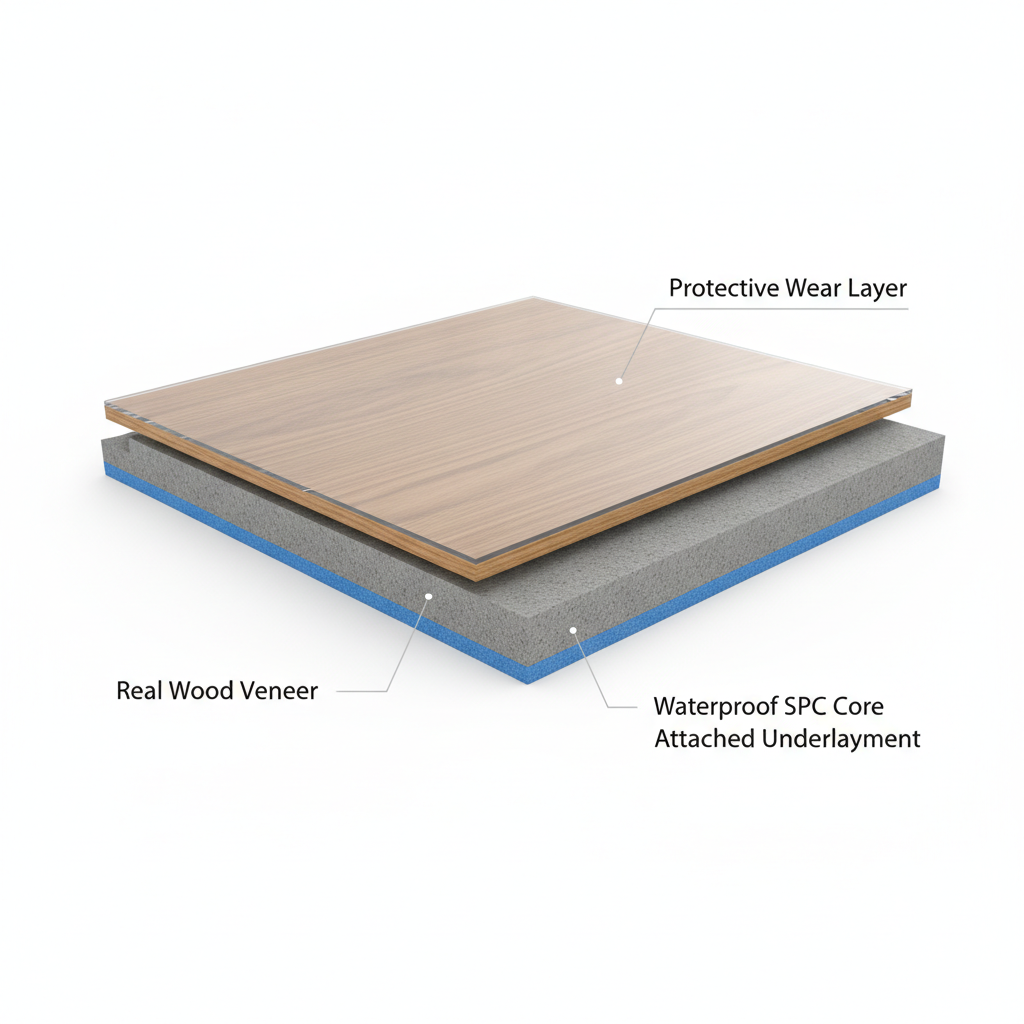
- Protective Wear Layer: Multiple coats of aluminum oxide or ceramic bead finish for extreme scratch resistance.
- Real Wood Veneer: A thin layer of authentic hardwood (e.g., Oak, Hickory) for unmatched beauty.
- Waterproof Core: A high-density SPC core that prevents water damage and adds dent resistance.
- Attached Underlayment: Often includes a pre-attached pad for sound reduction and comfort.
What Exactly is Hybrid Hardwood Flooring?
It’s crucial to understand how hybrid hardwood differs from its predecessors. Unlike solid hardwood, which is a single piece of wood, and engineered hardwood, which has a wood-based core, hybrid hardwood uses a composite SPC core. This is the key to its waterproof guarantee. While engineered hardwood is more stable than solid wood, its plywood or HDF core will still swell and delaminate with prolonged exposure to moisture. Hybrid hardwood will not.
Leading manufacturers like Shaw Floors have perfected this technology, offering products that are indistinguishable from high-end engineered wood flooring but with vastly superior performance against water and dents.
Comparison Chart: Wood Flooring Options
| Feature | Solid Hardwood | Engineered Hardwood | Hybrid Hardwood |
|---|---|---|---|
| Top Layer | Solid Wood | Real Wood Veneer | Real Wood Veneer |
| Core Material | Solid Wood | Plywood or HDF | Waterproof SPC |
| Waterproof? | No | No | Yes |
| Can Refinish? | Yes (multiple times) | Yes (1-2 times) | No |
| Dent Resistance | Varies by species | Moderate | High |
| Pet-Friendliness | Low | Low-Moderate | Very High |
The Scratch Test: How Does Hybrid Hardwood Stand Up to Pet Nails?
The number one concern for any wood floor owner is scratches. Hybrid hardwood addresses this head-on with a commercial-grade wear layer. This factory-applied finish, typically infused with aluminum oxide or ceramic beads, creates an incredibly tough barrier that is far more durable than standard polyurethane finishes applied to solid or engineered wood.
In a “Scratch Test Showdown,” a hybrid hardwood plank consistently outperforms traditional hardwood. While a dog’s nails might leave surface scuffs on a standard oak floor, they will glide over the hardened wear layer of a hybrid plank with little to no effect. As one veteran flooring installer noted, “I’ve put hybrid hardwood in homes with 100-pound dogs, and a year later, the floors still look brand new. The finish is just that tough.”
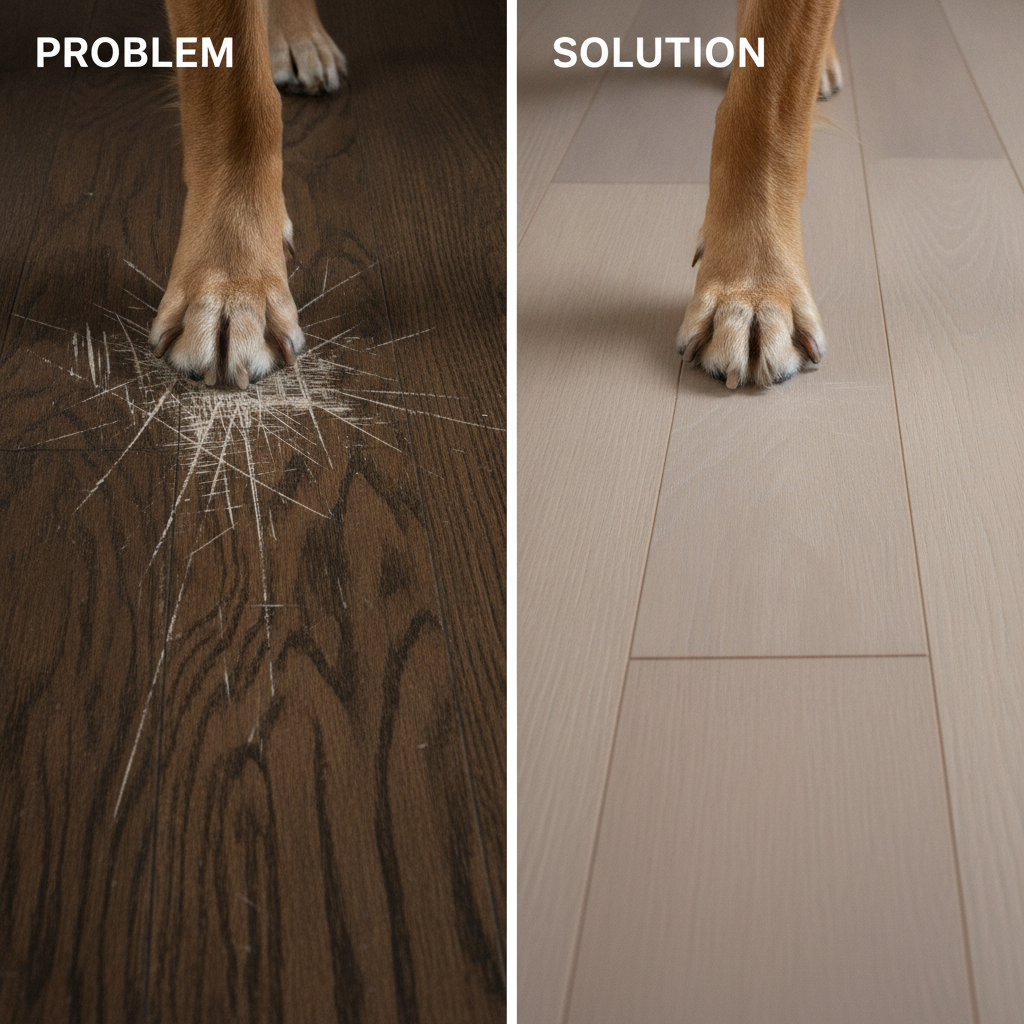
Furthermore, the choice of finish can make a big difference. A low-sheen, matte, or wire-brushed finish is excellent at hiding the minor micro-scratches that can accumulate over time, whereas a high-gloss finish will highlight every small imperfection.
Cost, Installation, and Maintenance: Is Hybrid Hardwood Worth It?
Hybrid hardwood typically costs more than LVP and laminate but is often priced competitively with mid-to-high-end engineered hardwood. While the initial investment may be higher, its long-term value is exceptional.
A common question is about refinishing. Unlike solid wood, the thin veneer of hybrid hardwood cannot be sanded and refinished. However, this addresses a problem you’re unlikely to have. Its superior scratch and dent resistance means you may never need to refinish it in the first place. You are trading the option to repair a floor that damages easily for a floor that is engineered to resist damage from the start.
Installation is similar to other floating floors, but due to its rigid core, subfloor preparation is critical.
Pro Tip from a Certified Installer: The most common failure of any waterproof click-lock floor is an uneven subfloor. Hybrid hardwood’s rigid core is less forgiving than flexible LVP. Ensure your subfloor is perfectly flat according to the manufacturer’s specifications to prevent planks from separating or breaking at the joints over time.
First Aid for Floors: How to Fix Existing Pet Damage
If you’re not ready for a new floor, you can still improve the one you have. Tackling existing pet damage can feel daunting, but with the right techniques, many issues can be fixed. When attempting repairs, always exercise caution. As the Institute of Inspection, Cleaning and Restoration Certification (IICRC) advises, improper cleaning or repair methods can sometimes cause more harm than good [8].
What Not To Do:
- Don’t use steam cleaners on wood floors: The heat and moisture can damage the finish and the wood itself.
- Don’t use vinegar or ammonia-based cleaners on urine stains: They can set the stain and fail to neutralize the odor-causing bacteria.
- Don’t sand a single spot on your floor: This will create an uneven patch in the finish. Repairs need to be blended carefully.
Repairing Scratches from Dog Nails on Wood Floors
The first step is to assess the damage. Are the scratches shallow, affecting only the top finish, or are they deep gouges that have penetrated the wood itself?
For Surface Scratches (in the finish):
- Cleaning: Thoroughly clean the area with a hardwood-safe cleaner.
- Restoration Products: Use a finish restorer like a Rejuvenate or Minwax Hardwood Floor Reviver. These products fill in micro-scratches and restore the sheen.
- Stain Markers: For slightly deeper scratches that have removed some color, a stain-filled marker can help blend the scratch with the surrounding wood.
For Deep Scratches (in the wood):
- Wood Filler: For deep gouges, use a stainable wood filler that matches your floor’s species. Apply it, let it dry, and gently sand it smooth.
- Stain and Seal: Carefully apply a matching stain to the filled area with a small artist’s brush, then seal with a matching polyurethane finish.
According to the National Wood Flooring Association (NWFA), for widespread, severe scratching, the only true solution is to sand and refinish the entire floor professionally [9].
Pro Tip from a Professional Dog Groomer: The best repair is prevention. Keep your dog’s nails trimmed short and smooth. A weekly trim with clippers followed by a grinder to smooth the edges will dramatically reduce the likelihood of scratches.
Eliminating Pet Urine Stains and Odors for Good
Pet urine is particularly damaging to wood floors because of its chemical composition. The uric acid crystals in urine don’t dissolve in water, and as bacteria feed on the urine, they release ammonia gas, creating that persistent, unpleasant odor.
To eliminate both the stain and the smell, you must neutralize the uric acid. Here’s how:
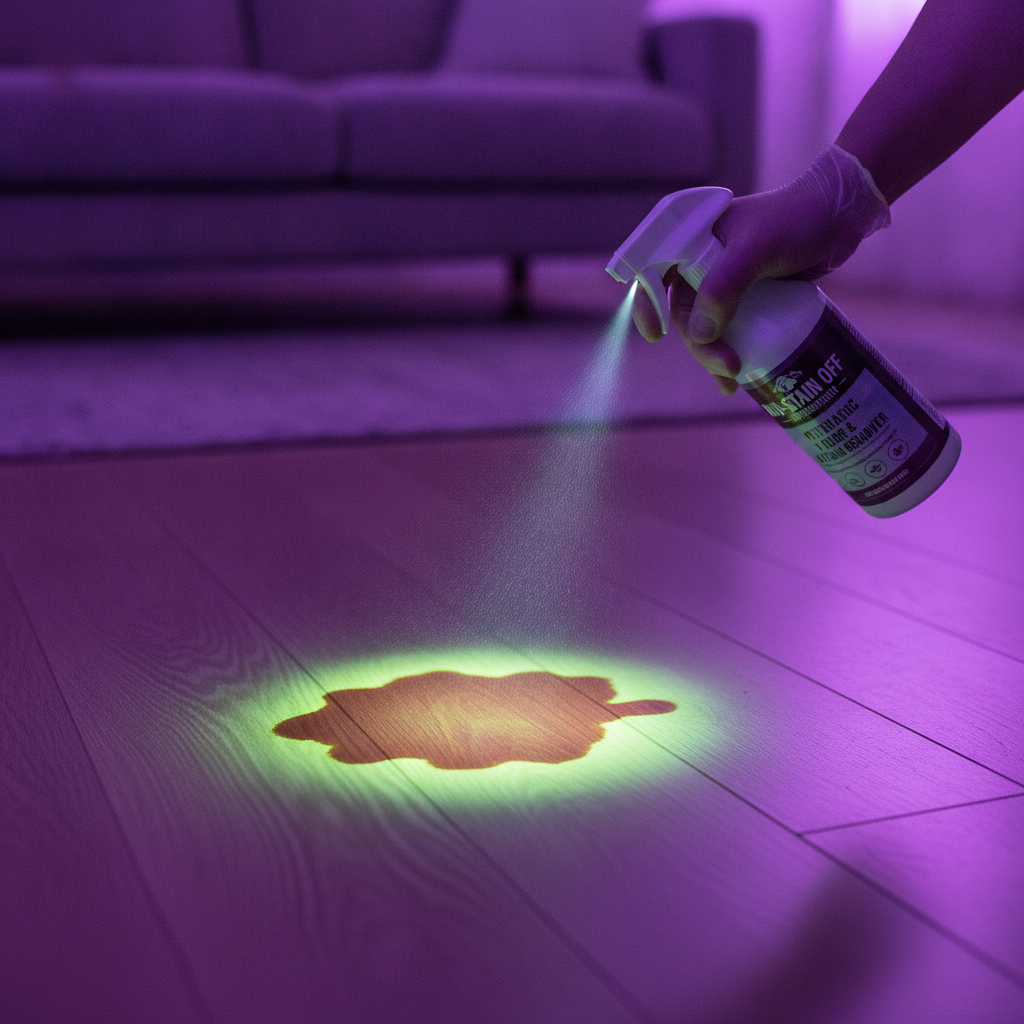
- Find Every Spot: If you suspect old accidents, use a UV blacklight in a dark room. Urine stains will glow, revealing hidden problem areas.
- Use an Enzymatic Cleaner: This is the most critical step. Products like Nature’s Miracle or Rocco & Roxie Supply Co. contain enzymes that break down the uric acid crystals. Regular cleaners will not work.
- Saturate and Wait: Liberally apply the enzymatic cleaner to the stain, extending beyond the visible edge. Allow it to sit and air dry completely. This can take a day or more. The enzymes need time to work. You may need to repeat the process for old, set-in stains.
- Address Deep Stains: If the stain has turned the wood black, it means the tannins in the wood have reacted with the ammonia. After cleaning, you can try lightening the stain with a 3% hydrogen peroxide solution. Apply it to the dark area, let it sit for a few hours, then wipe it clean. This may lighten the wood too much, requiring re-staining.
In severe cases, the urine can penetrate the floorboards and soak into the subfloor. A water damage restoration specialist can assess the damage and will often advise that “once the subfloor is contaminated, the affected sections of both the flooring and subfloor must be removed, sealed, and replaced to permanently eliminate the odor.”
Your Playbook for a Pet-Friendly Home
Choosing a floor for a home with pets no longer has to be a choice between beauty and durability. A truly “pet-proof” floor is a system of features working in harmony: elite scratch resistance, 100% waterproofing, safe traction for your pet’s joints, and effortless maintenance. While options like luxury vinyl and modern laminate offer excellent performance, hybrid hardwood stands alone as the ‘no-compromise’ solution. It delivers the authentic, timeless beauty of real wood with an engineered core built to handle the realities of pet ownership, giving you complete peace of mind.
You are now equipped with a complete playbook—not only to select the perfect, worry-free floor for your family’s future but also to confidently tackle any damage your furry friends have left on your current one.
Ready to find the perfect, worry-free floor for you and your furry family? Explore our collection of waterproof hybrid hardwood flooring and find a style you’ll both love.
This article provides general advice for flooring selection and repair. Always test cleaning and repair solutions on an inconspicuous area first. For severe damage or complex installations, consult a certified flooring professional.
References & Authoritative Sources
- American Kennel Club (AKC). (N.D.). Authoritative source on canine health, including the importance of joint support and safe surfaces.
- FloorScore®. (N.D.). Independent third-party certification program for hard surface flooring, testing for VOC emissions and indoor air quality.
- Resilient Floor Covering Institute (RFCI). (N.D.). Industry trade association representing manufacturers of resilient flooring, providing technical standards for products like LVP.
- Association for European Producers of Laminate Flooring (EPLF). (N.D.). The organization that developed and maintains the AC rating system for laminate floor durability.
- American Veterinary Medical Association (AVMA). (N.D.). Insights from veterinary professionals on pet health and safety, including the impact of flooring on animal well-being.
- Tile Council of North America (TCNA). (N.D.). An industry association that sets standards for ceramic tile, including installation methods and slip resistance (DCOF) ratings.
- ASTM International. (N.D.). An international standards organization that develops and publishes voluntary consensus technical standards for a wide range of materials, products, systems, and services, including flooring.
- Institute of Inspection, Cleaning and Restoration Certification (IICRC). (N.D.). The standard-setting body for the cleaning and restoration industry, providing protocols for water, mold, and odor damage remediation.
- National Wood Flooring Association (NWFA). (N.D.). The leading authority on wood flooring, providing industry standards and guidelines for installation, sanding, finishing, and repair.
