
The dream of a warm, inviting kitchen, anchored by the timeless beauty of wood floors, is a powerful one. For years, however, that dream came with a significant risk. The heart of the home is a gauntlet of spills, splashes, and heavy foot traffic—an environment notoriously hostile to traditional hardwood. The fear of a single dishwasher leak or a dropped pot of sauce causing irreparable warping, staining, or scratching has led many homeowners to sacrifice style for practicality.
But what if you didn’t have to choose? What if technology could offer the authentic look and feel of real wood in a floor engineered to withstand the rigors of modern kitchen life? This is the promise of waterproof hybrid hardwood, and Bravewood is a leading name in this innovative category.
This guide is designed to cut through the marketing jargon and provide a data-driven, unbiased look at whether Bravewood is the right choice for your kitchen. We will explore the fundamental problems with traditional wood, break down the technology that makes hybrid flooring possible, and put Bravewood to the test against its competition. By the end, you’ll have the clarity and confidence to choose a kitchen floor that is both beautiful and bulletproof.
- The Kitchen Flooring Dilemma: Why Traditional Wood Floors Fail
- The Innovation: What Exactly is Waterproof Hybrid Hardwood?
- A Deep Dive into Bravewood: The Solution for Modern Kitchens
- Your Bravewood Kitchen Floor: Installation and Long-Term Care
- Frequently Asked Questions about Bravewood Kitchen Flooring
- The Verdict: The Beauty of Wood, Engineered for Real Life
- References
The Kitchen Flooring Dilemma: Why Traditional Wood Floors Fail
Your concerns about putting traditional hardwood in a kitchen are completely valid. Wood is a natural, porous material, and its relationship with moisture is complex and often problematic, especially in a room with so many water sources. Understanding these inherent challenges is the first step to appreciating the innovation of hybrid solutions.
The primary enemy of solid hardwood is moisture. From everyday spills to appliance leaks, water can wreak havoc on wood planks. This leads to several common and costly problems:
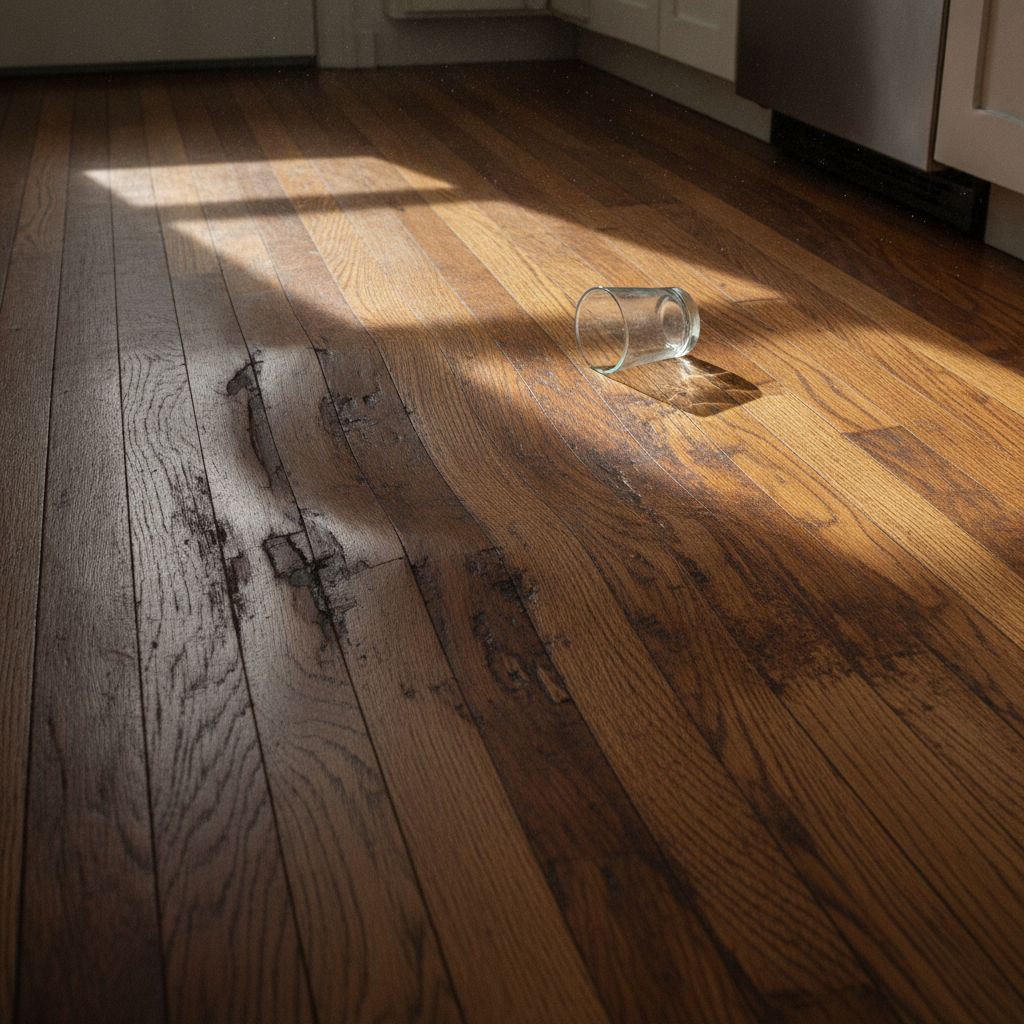
- Cupping and Crowning: When wood absorbs moisture, it swells. If the bottom of a plank absorbs more moisture than the top (a common scenario with subfloor moisture), the edges curl upward, creating a “cupped” or concave shape. Conversely, if the surface is exposed to more moisture, the center of the plank can bulge upward, known as “crowning.”
- Gapping: Wood also shrinks as it dries. In kitchens with fluctuating humidity from cooking, this can cause unsightly gaps to appear between planks over time.
- Staining and Discoloration: Spills that aren’t wiped up immediately can seep into the wood’s grain and finish, leaving permanent stains that are difficult or impossible to remove without sanding.
- Warping and Buckling: In the case of a significant leak, such as from a dishwasher or refrigerator line, the damage can be catastrophic. The wood can absorb so much water that it permanently warps, twists, and even lifts off the subfloor.
As a certified kitchen designer with over 15 years of experience, I’ve often advised clients that “while the look is classic, the risks are real. We’ve seen beautiful solid oak floors ruined by a slow, undetected leak from an ice maker.”
The National Wood Flooring Association (NWFA) provides extensive technical guidelines on managing moisture, emphasizing the need for stable environmental conditions that are simply difficult to maintain in a kitchen.[1] Beyond water, the kitchen is a high-traffic zone. Dropped cans, dragged chairs, and the claws of family pets can easily lead to deep scratches and dents on softer wood species, marring the floor’s finish and requiring costly refinishing. These are the fundamental wood flooring kitchen problems that hybrid flooring was engineered to solve.
The Innovation: What Exactly is Waterproof Hybrid Hardwood?
To solve the problems of traditional wood, manufacturers developed an entirely new category of flooring: waterproof hybrid hardwood. It’s a product that seems contradictory, but its brilliance lies in its layered construction, which combines the best of multiple materials.
At its core, waterproof hybrid hardwood is not a solid piece of wood. Instead, it’s an engineered product composed of distinct layers, each serving a specific purpose. Imagine a cross-section of a plank:
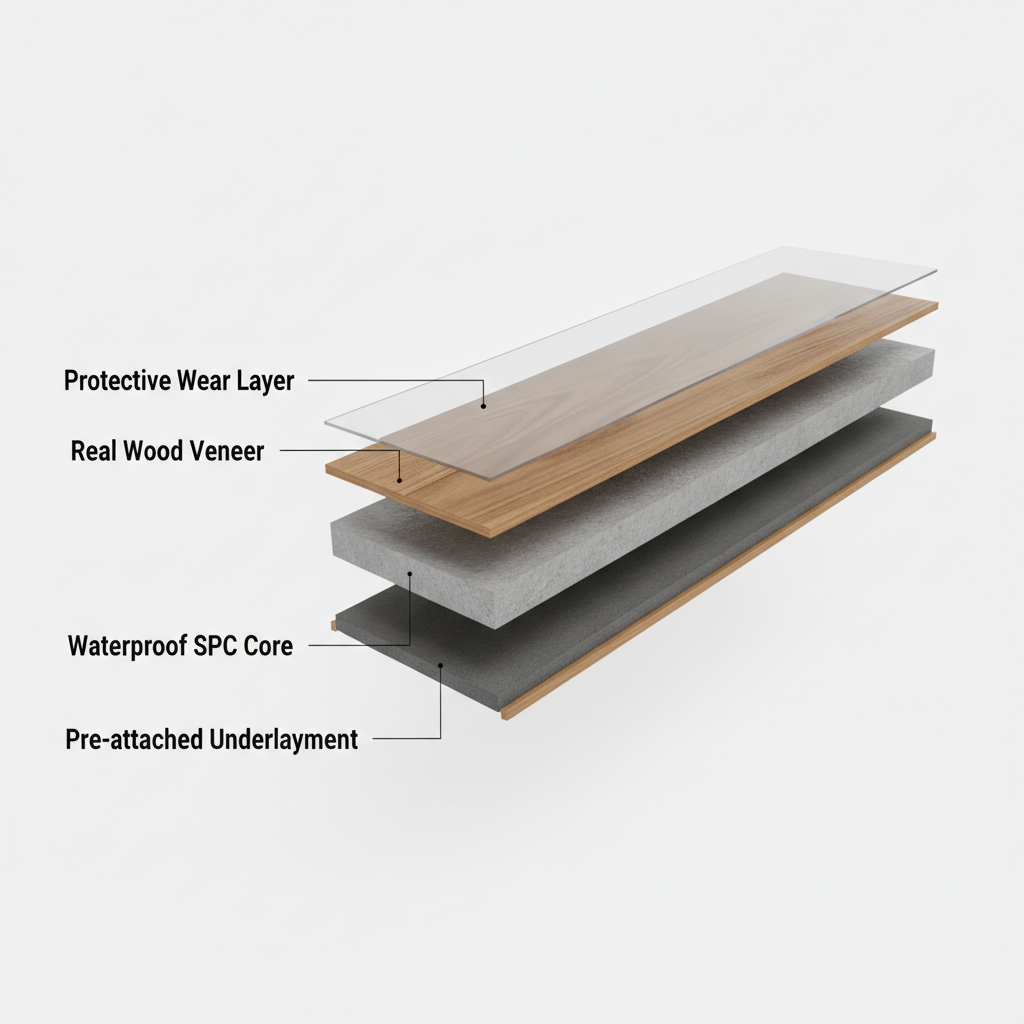
- Protective Wear Layer: The top is a highly durable, transparent finish, often infused with aluminum oxide, designed to resist scratches, stains, and fading from UV light.
- Real Wood Veneer: Directly beneath the wear layer is a thin slice of genuine hardwood. This is what you see and touch, providing the authentic grain, texture, and beauty of species like oak, hickory, or maple.
- Waterproof Core: This is the game-changing innovation. The wood veneer is bonded to a 100% waterproof composite core. This core is typically made from either an SPC (Stone Plastic Composite) or WPC (Wood Plastic Composite). SPC cores are denser and more rigid, offering superior dent resistance, while WPC cores are slightly softer and quieter underfoot. This core is impervious to water, meaning it will not swell, warp, or degrade when exposed to moisture.
- Attached Underlayment: Most hybrid planks include a pre-attached backing layer, often made of cork or foam, which provides sound insulation, cushioning, and a moisture barrier.
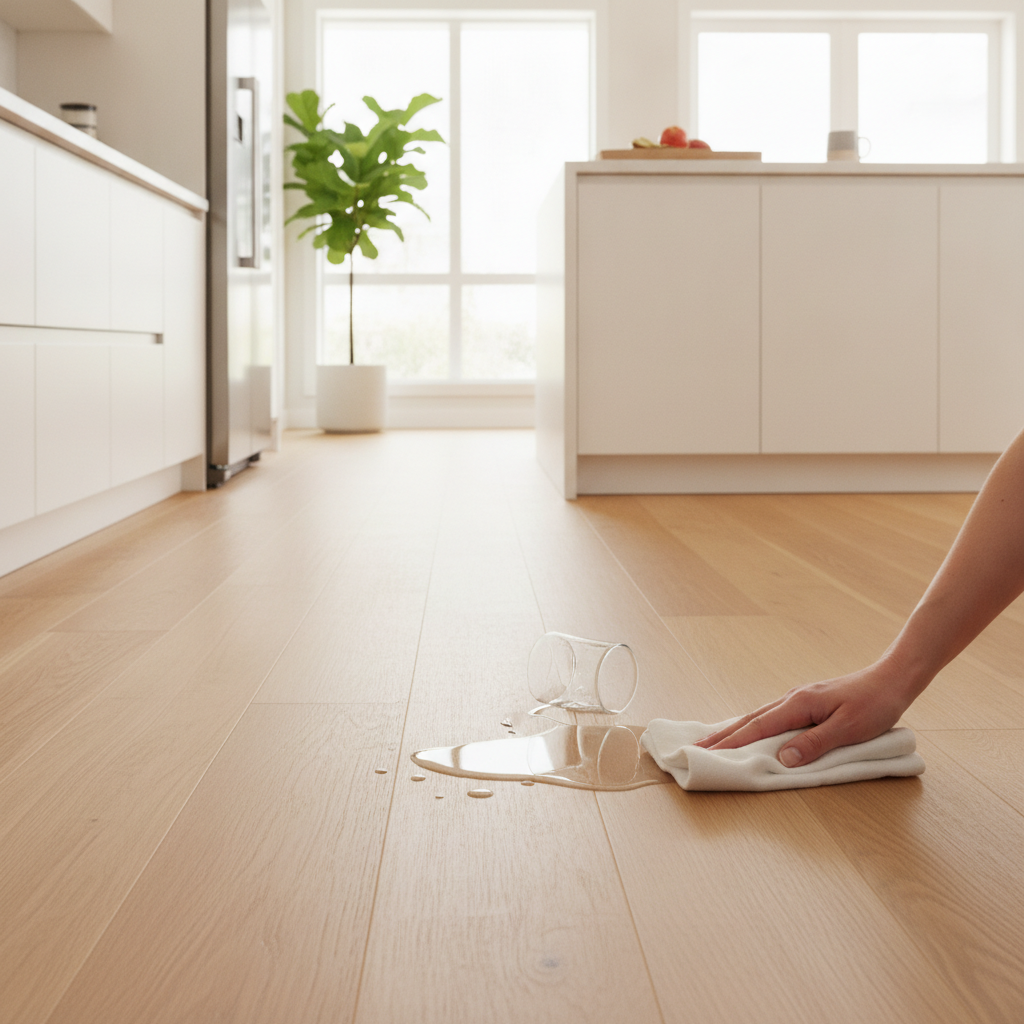
This construction clarifies the crucial difference between “waterproof” and “water-resistant.” A water-resistant floor can repel water for a short period, but moisture will eventually seep through the seams and be absorbed by the core. A truly waterproof floor, like Bravewood, has both a waterproof surface and a waterproof core, meaning that even if water gets between the planks, the core itself will not be damaged. This makes it a genuine spill proof kitchen floors solution.
A Deep Dive into Bravewood: The Solution for Modern Kitchens
Now that we understand the technology, let’s focus on Bravewood. This brand has emerged as a popular choice for homeowners seeking the perfect balance of style and performance in their kitchens. By analyzing its specific features and real-world reviews, we can determine if it lives up to its promise.
To provide a clear, at-a-glance assessment, we’ve created a Kitchen Durability Scorecard for a typical Bravewood product, rating it on the factors most important for a kitchen environment.
Bravewood Kitchen Durability Scorecard
- Water Resistance: 5/5
- Scratch Resistance: 4/5
- Dent Resistance: 4/5
- Ease of Cleaning: 5/5
This scorecard reflects Bravewood’s core strengths: its completely waterproof construction provides maximum peace of mind against spills and leaks, while its robust wear layer offers significant protection against the daily wear and tear of a busy kitchen.
The Technology Behind Bravewood’s Waterproof Promise
Bravewood achieves its waterproof rating through a multi-faceted approach that goes beyond just the materials.[2] The system relies on two key components working in tandem:
- High-Density SPC Core: Bravewood utilizes a Stone Plastic Composite (SPC) core. This blend of natural limestone powder, polyvinyl chloride, and stabilizers creates an incredibly dense and stable core that is 100% waterproof and highly resistant to dents from dropped objects.
- Precision Locking System: The planks are milled with a precise click-lock system. When installed correctly, these joints form an extremely tight seal that prevents topical spills from seeping down to the subfloor. This creates a “waterproof installation system,” not just a collection of waterproof planks—a critical distinction for long-term protection.
A professional flooring installer we spoke with noted, “The locking mechanism on products like Bravewood is a big improvement. It’s strong and clicks together tightly, which is crucial in a kitchen. A good, tight installation is your best defense against moisture getting underneath.”
Real-World Performance: Bravewood Pros and Cons
No product is perfect. To provide a balanced view, we’ve synthesized feedback from online forums, retailer sites, and customer testimonials to identify the most commonly cited pros and cons of Bravewood flooring.
Pros:
- Authentic Wood Beauty: The most praised feature is that it looks and feels like real wood, because the surface is real wood. A reviewer on a major retailer’s site noted, “I was hesitant about ‘fake’ wood, but you can’t tell the difference. We get the exact look of white oak without the anxiety.”
- Complete Waterproof Peace of Mind: Homeowners consistently mention the relief of not having to worry about spills from kids, pets, or kitchen mishaps.
- Excellent Durability: Many reviews highlight how well the floor holds up to high traffic and pets. The combination of the hard SPC core and the tough wear layer effectively resists everyday scratches and dents.
- Easy to Clean: The smooth, sealed surface makes cleaning simple. Most messes wipe away easily with a damp cloth or a pH-neutral floor cleaner.
Cons:
- Not Refinishable: This is the most significant trade-off. Unlike solid hardwood that can be sanded and refinished multiple times, the wood veneer on Bravewood is too thin for this process. Deep gouges that penetrate the wear layer cannot be sanded out.
- Potential for Pattern Repeat: As a manufactured product, there is a finite number of unique plank patterns. In very large, open rooms, some users have noted a visible pattern repeat if not carefully planned during installation.
- Cost: While generally less expensive than high-end solid hardwood, it is a premium product that costs more than traditional laminate or many Luxury Vinyl Plank (LVP) options.
When analyzing the warranty, it’s crucial to note that while the plank itself is covered against water damage, the warranty is contingent on proper installation according to manufacturer guidelines. This reinforces the importance of ensuring a level subfloor and tight seams.
Bravewood vs. The Competition: A Kitchen Flooring Showdown
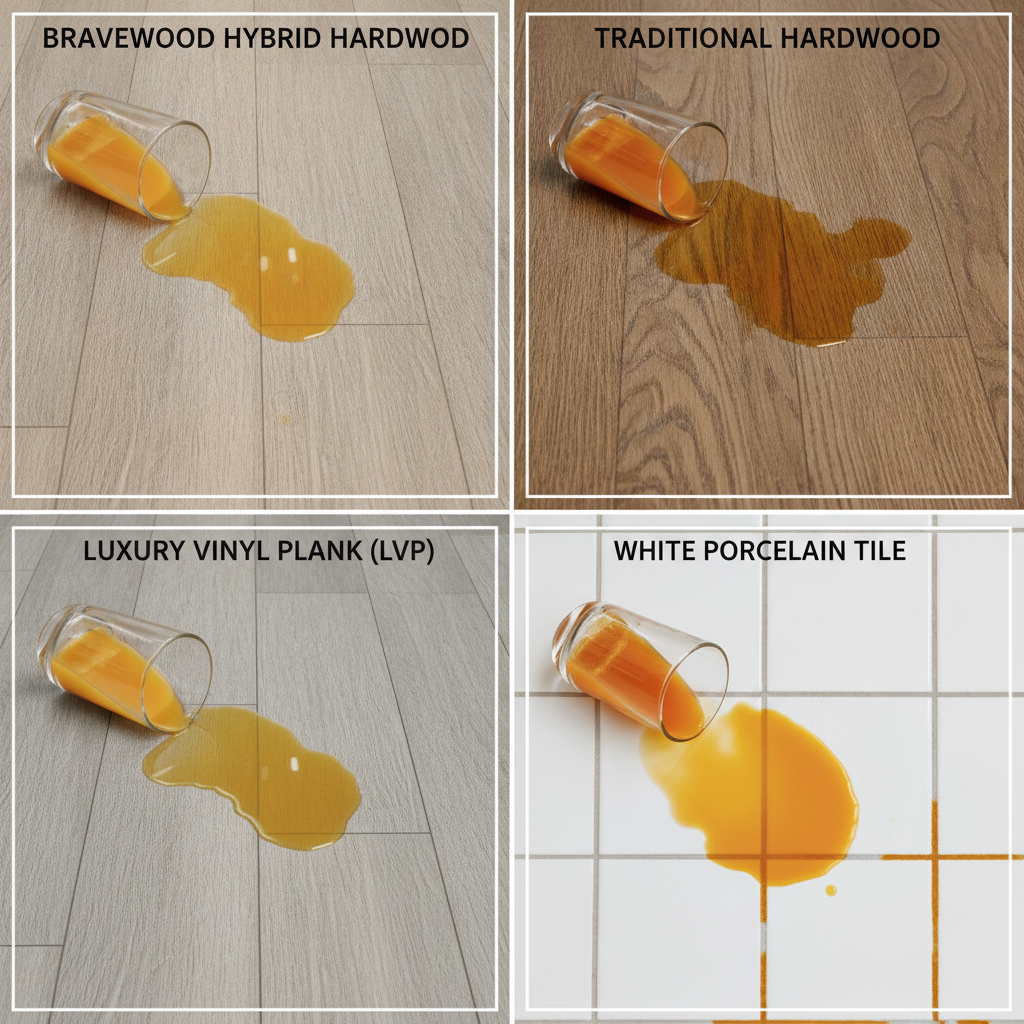
How does Bravewood stack up against other popular durable kitchen flooring options? This table provides a direct comparison to help you make an informed decision.
| Feature | Bravewood Hybrid Hardwood | Traditional Solid Hardwood | Luxury Vinyl Plank (LVP) | Porcelain Tile |
|---|---|---|---|---|
| Water Resistance | Excellent (100% Waterproof Core) | Poor (Susceptible to warping/staining) | Excellent (100% Waterproof Core) | Excellent (Impervious to water) |
| Scratch/Dent Resistance | Very Good (Durable wear layer, SPC core) | Fair to Good (Varies by species/finish) | Good (Depends on wear layer thickness) | Excellent (Highly scratch-resistant) |
| Feel/Appearance | Excellent (Authentic wood veneer) | Excellent (The gold standard) | Good to Very Good (Realistic photo layer) | Fair (Can be cold and hard underfoot) |
| Cost (Materials) | Moderate to High | Moderate to Very High | Low to Moderate | Low to High |
| DIY-Friendliness | Very Good (Click-lock installation) | Poor (Requires professional skill) | Excellent (Very DIY-friendly) | Fair (Requires specialized tools/skill) |
This comparison highlights Bravewood’s unique position. It offers the waterproof performance of LVP and tile while delivering the authentic beauty of real hardwood, making it one of the best waterproof hardwood for kitchens available.
Your Bravewood Kitchen Floor: Installation and Long-Term Care
Choosing the right floor is only half the battle. Proper installation and maintenance are essential to ensure your investment lasts for decades.
Installation Essentials: Getting It Right the First Time
While Bravewood’s click-lock system is DIY-friendly, a successful installation hinges on preparation. Following the manufacturer’s guidelines is non-negotiable for performance and warranty coverage.
Key Installation Checklist:
- Acclimation: Let the unopened boxes of flooring sit in the kitchen for at least 48-72 hours to acclimate to the room’s temperature and humidity.
- Subfloor Preparation: The subfloor must be clean, dry, and, most importantly, flat. Any significant dips or bumps must be leveled before you begin.
- Expansion Gaps: Leave a small expansion gap (typically 1/4 inch) around the perimeter of the room to allow the floor to expand and contract naturally. This gap will be covered by baseboards or quarter-round molding.
A common question is, “Can you install waterproof hardwood over existing kitchen tile?” The answer is often yes, provided the tile is in good condition, well-adhered, and flat. You may need to fill in the grout lines with a leveling compound to create a smooth surface. An expert installer’s top tip is to “never skip the subfloor prep. 90% of flooring failures I see are due to an uneven or unprepared subfloor, not the product itself.”
Cleaning and Maintenance: Keeping Your Bravewood Floor Looking New
One of the best features of Bravewood is that it’s a low maintenance wood flooring solution. However, “low maintenance” doesn’t mean “no maintenance.” Following a simple cleaning routine will keep it looking pristine.
The Do’s and Don’ts of Cleaning Bravewood Floors:
- DO sweep, dust mop, or vacuum (using a hard floor setting without a beater bar) regularly to remove grit and dirt.
- DO wipe up spills promptly with a soft cloth. While the floor is waterproof, standing liquid can still affect the finish over time.
- DO use a microfiber mop with a spray bottle of pH-neutral, manufacturer-approved hard surface cleaner for deeper cleaning.[3]
- DON’T use a steam mop. The high heat and pressure can damage the wood veneer and the finish, potentially voiding your warranty.
- DON’T use vinegar, ammonia, oil soaps, or abrasive cleaners. These can strip the protective wear layer and dull the floor’s finish.
- DON’T flood the floor with water when mopping. A light mist of cleaner is all that’s needed.
For minor surface scuffs or scratches that don’t penetrate the veneer, you can often use a repair kit with a wax pencil or stain marker designed for engineered hardwood floors. Test it in an inconspicuous area first to ensure a good color match.
Frequently Asked Questions about Bravewood Kitchen Flooring
Here are direct answers to some of the most common questions homeowners have when considering Bravewood.
How much does Bravewood flooring cost?
Bravewood flooring is a premium product. You can generally expect material costs to fall in the range of $5 to $9 per square foot. This is more expensive than most LVP and laminate options but is often more affordable than high-quality solid hardwood. Installation costs will vary by region and the complexity of the job.
How does Bravewood flooring hold up to pets and kids?
It holds up exceptionally well. The waterproof core means spills and accidents are not a catastrophe. The strong, factory-applied wear layer is designed to resist scratches from pet claws and the general chaos of family life. Choosing a style with a textured or wire-brushed finish can also help to naturally camouflage any minor wear and tear.
Can Bravewood waterproof hardwood be refinished?
No, it cannot. This is a critical point to understand. The top layer is a thin veneer of real wood, not a solid plank. The sanding process required for refinishing would go right through this veneer and destroy the plank. The trade-off is that you get extreme day-to-day durability in exchange for the long-term option of refinishing.
Where can I buy Bravewood flooring?
Bravewood flooring is typically sold through specialized flooring retailers and some major home improvement stores. The most important step before buying is to get physical samples. Look at them in your kitchen, under your specific lighting conditions, and next to your cabinets and countertops to ensure you love the color and style.
The Verdict: The Beauty of Wood, Engineered for Real Life
For years, homeowners faced a difficult compromise in the kitchen: the warmth and beauty of wood or the durability and water resistance of tile and vinyl. Bravewood waterproof hybrid hardwood effectively ends that compromise. It delivers the authentic, natural aesthetic that only real wood can provide, but on a platform engineered to handle everything a busy kitchen can throw at it.
By combining a genuine wood veneer with a rugged, 100% waterproof SPC core, Bravewood offers a solution that is both beautiful and bulletproof. It gives you the freedom to design the kitchen of your dreams without the constant worry of spills, scratches, and water damage. While it cannot be refinished like its solid wood ancestors, its upfront durability and low-maintenance nature make it an ideal choice for the modern home.
Ready to get the wood kitchen of your dreams without the worry? Get a sample of Bravewood flooring to see and feel the difference for yourself.
This article may contain affiliate links. If you make a purchase through these links, we may earn a commission at no extra cost to you. All opinions are our own.
References
- National Wood Flooring Association (NWFA). (n.d.). Technical Guidelines: Moisture and Wood. NWFA Publishing. Retrieved from the official NWFA technical resources.
- Bravewood Flooring. (n.d.). Technical Specifications and Installation Guide. Retrieved from the official manufacturer’s website.
- Bravewood Flooring. (n.d.). Care and Maintenance Guide. Retrieved from the official manufacturer’s website.
- Tile Council of North America (TCNA). (n.d.). Understanding PEI Ratings for Tile. Retrieved from the official TCNA consumer resources.
- Reddit Inc. (n.d.). r/Flooring Community Forum. Retrieved from https://www.reddit.com/r/Flooring/.
