
The open-concept home is the modern dream: a bright, airy space where kitchen, living, and dining areas flow into one another, creating a hub of family connection and effortless entertaining. But this dream often crashes into a harsh reality—the floor. Finding a single flooring material that can withstand the unique challenges of each zone is a practical nightmare. You need a surface that can handle kitchen spills and dropped pans, endure the constant traffic of a living room, resist scratches from pets and kids’ toys, and, most importantly, unify the entire space with seamless style. The fear of flooring damage from spills, the frustration of scratched hardwood floors, and the visual disruption of awkward floor transitions can turn the dream into a daily source of anxiety.
This is where an engineered solution is needed. Bravewood Waterproof Hybrid Hardwood isn’t just another flooring option; it’s a technological breakthrough designed specifically to solve the open-concept dilemma. It combines the authentic beauty of real hardwood with an indestructible waterproof core, creating a single, continuous surface that eliminates compromise. In this guide, we’ll break down the engineering behind this innovative flooring, score its real-world durability, and show you exactly how it achieves the seamless, worry-free foundation your modern home deserves.
- The Modern Challenge: Why Perfect Open-Concept Flooring is So Hard to Find
- What is Waterproof Hybrid Hardwood? An Engineering Breakdown
- The Durability Scorecard: How Bravewood Stands Up to Real Life
- Achieving the Seamless Dream: Unifying Your Home with Bravewood
- Bravewood Hybrid Hardwood vs. The Alternatives: A Head-to-Head Comparison
- Frequently Asked Questions
- The Uncompromising Solution for Modern Living
- References & Authoritative Sources
The Modern Challenge: Why Perfect Open-Concept Flooring is So Hard to Find
Choosing a floor for an open-concept layout is one of the most significant decisions a homeowner can make, and it’s fraught with challenges. As one interior designer puts it, “The number one challenge my clients face is finding a floor that offers both aesthetic cohesion and zoned durability. They want the warm, inviting look of wood to flow from the living room right into the kitchen, but they’re terrified that a dropped glass or a spill from the sink will lead to an expensive, irreversible mistake.” This struggle is real. Homeowners are forced to choose between the beauty they want and the performance they desperately need.
The High-Traffic Gauntlet: From Kitchen Spills to Living Room Play
An open-concept floor is a battlefield of daily life. The area in front of the kitchen sink is a splash zone, while the space by the island is subject to dropped utensils and food spills. Just a few feet away, the living area must endure the constant scuff of foot traffic, the scraping of furniture, and the unpredictable chaos of children’s toys and pets’ claws. Each zone presents a different threat. According to authorities like the Institute of Inspection, Cleaning and Restoration Certification (IICRC), even common household spills can lead to significant water damage if the flooring and subfloor are not properly protected.[1] This requires a versatile, durable open concept flooring solution that doesn’t just look good, but is engineered to withstand this multi-front assault, making it a truly kid and pet friendly hardwood alternative.
The Aesthetic Problem of Awkward Floor Transitions
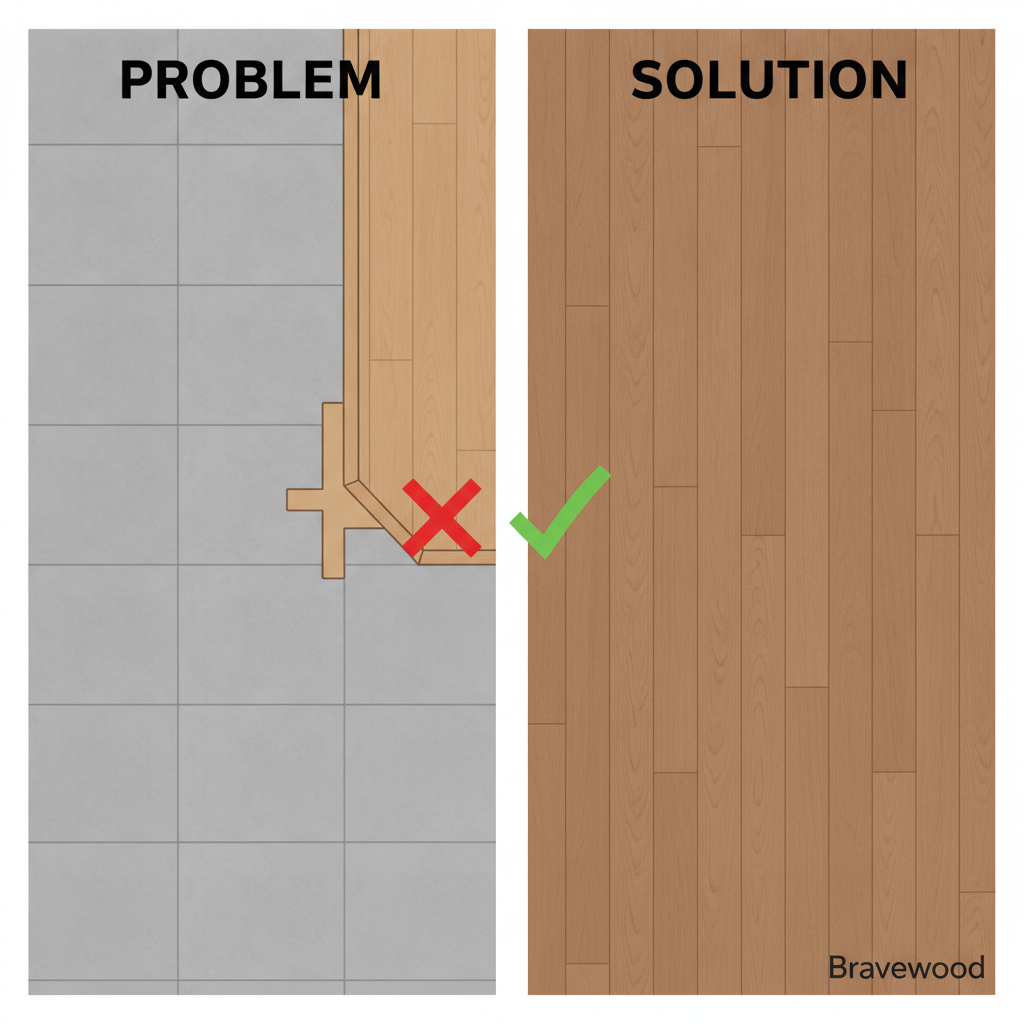
Historically, the solution to the kitchen-living room dilemma was to use two different materials: durable tile in the kitchen and warm hardwood in the living area. The result? An awkward floor transition—typically a raised T-molding—that creates a visual and physical barrier right in the middle of your open space. This jarring line breaks the seamless flow that is the very essence of open-concept design. It chops up the room, making it feel smaller and less cohesive. Getting these transitions right even with professional guidance is complex; industry standards like the Tile Council of North America (TCNA) Handbook dedicate extensive guidelines just to managing the join between different materials.[2] The ideal solution is to eliminate these transitions altogether with a single, beautiful, high-performance floor.
What is Waterproof Hybrid Hardwood? An Engineering Breakdown
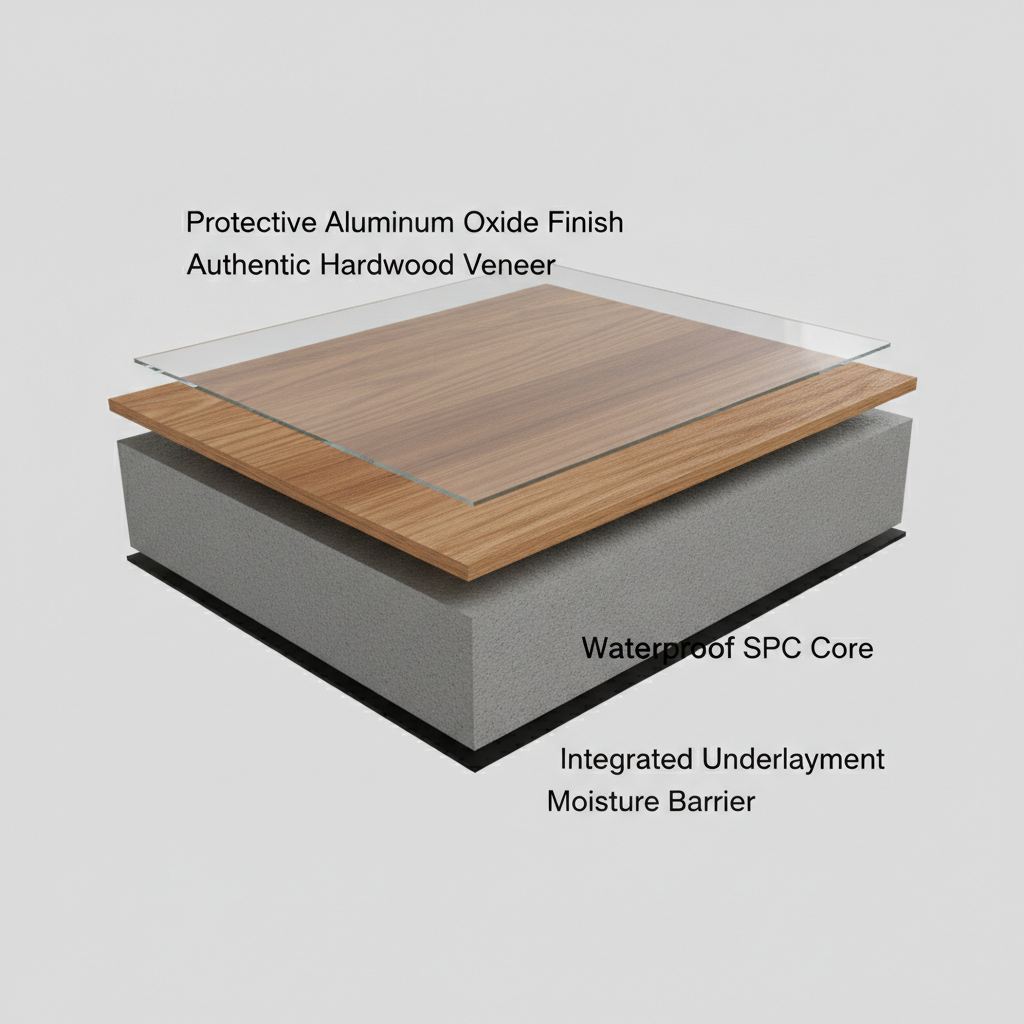
To understand why Bravewood is the answer, you have to look inside the plank. Waterproof hybrid hardwood is not traditional wood flooring; it’s a multi-layered marvel of material science, engineered for performance from the bottom up. Each layer serves a distinct purpose, combining to create a floor that offers the best of all worlds. This construction adheres to rigorous material testing standards, such as those developed by ASTM International, ensuring stability and quality in every plank.[3]
Layer 1: The Protective Aluminum Oxide Finish
The top layer is the floor’s first line of defense. Bravewood features a commercial-grade aluminum oxide finish, one of the hardest and most durable coatings available. This transparent shield provides robust resistance against scratches, stains, and fading from UV light. In the flooring industry, durability is often measured with an Abrasion Class (AC) rating, typically used for laminate. While hybrid hardwood doesn’t use the same scale, the principle is identical: a thicker, higher-quality wear layer provides superior protection against daily wear and tear. The ultimate authority on any product’s specific durability is found in the manufacturer’s technical specification sheets, which detail the finish’s composition and thickness.[4]
Layer 2: The Beauty of Authentic Hardwood Veneer
Beneath the protective finish lies the soul of the product: a layer of genuine hardwood. Unlike LVP, which uses a printed photographic layer, Bravewood features a veneer of real oak, hickory, or other premium wood species. This is why it has the authentic grain, texture, and natural variation that synthetic materials can only imitate. The National Wood Flooring Association (NWFA) sets the standards for wood species grading, ensuring the quality of the wood used.[5] Furthermore, to address concerns about sun exposure in bright, open-concept rooms, these veneers are treated with UV inhibitors in the finish to resist fading and maintain their color over time.
Layer 3: The Waterproof Composite Core (SPC)
The engine of a Bravewood plank is its Stone-Polymer Composite (SPC) core. This core is forged by combining natural limestone powder, polyvinyl chloride, and stabilizers, creating a material that is incredibly dense, stable, and 100% waterproof. Unlike traditional wood or wood-composite cores that can swell and warp when exposed to moisture, an SPC core is impervious to water. According to the Resilient Floor Covering Institute (RFCI), which represents manufacturers of core materials like SPC, this composition provides exceptional dimensional stability, preventing planks from expanding or contracting with changes in temperature and humidity.[6] This core, combined with a precision-milled click-lock system, creates a watertight seal between planks, effectively stopping spills from ever reaching the subfloor.
The Durability Scorecard: How Bravewood Stands Up to Real Life
Talk is cheap, but performance is everything. So, how durable is hybrid hardwood flooring in the real world? We’ve created a Durability Scorecard to rate Bravewood’s performance against the most common household challenges.
| Performance Metric | Rating (1-5) | Description |
|---|---|---|
| Water Resistance | ★★★★★ | 100% waterproof core and locking system prevent surface spills from penetrating to the subfloor. |
| Scratch Resistance | ★★★★☆ | Multi-coat aluminum oxide finish provides excellent protection against pet claws and daily scuffs. |
| Dent Resistance | ★★★★☆ | The dense SPC core provides superior resistance to impacts from dropped objects compared to traditional wood. |
| Stain Resistance | ★★★★★ | The non-porous surface finish prevents spills like wine or juice from setting in, allowing for easy cleanup. |
Waterproof Performance: Beyond ‘Water-Resistant’
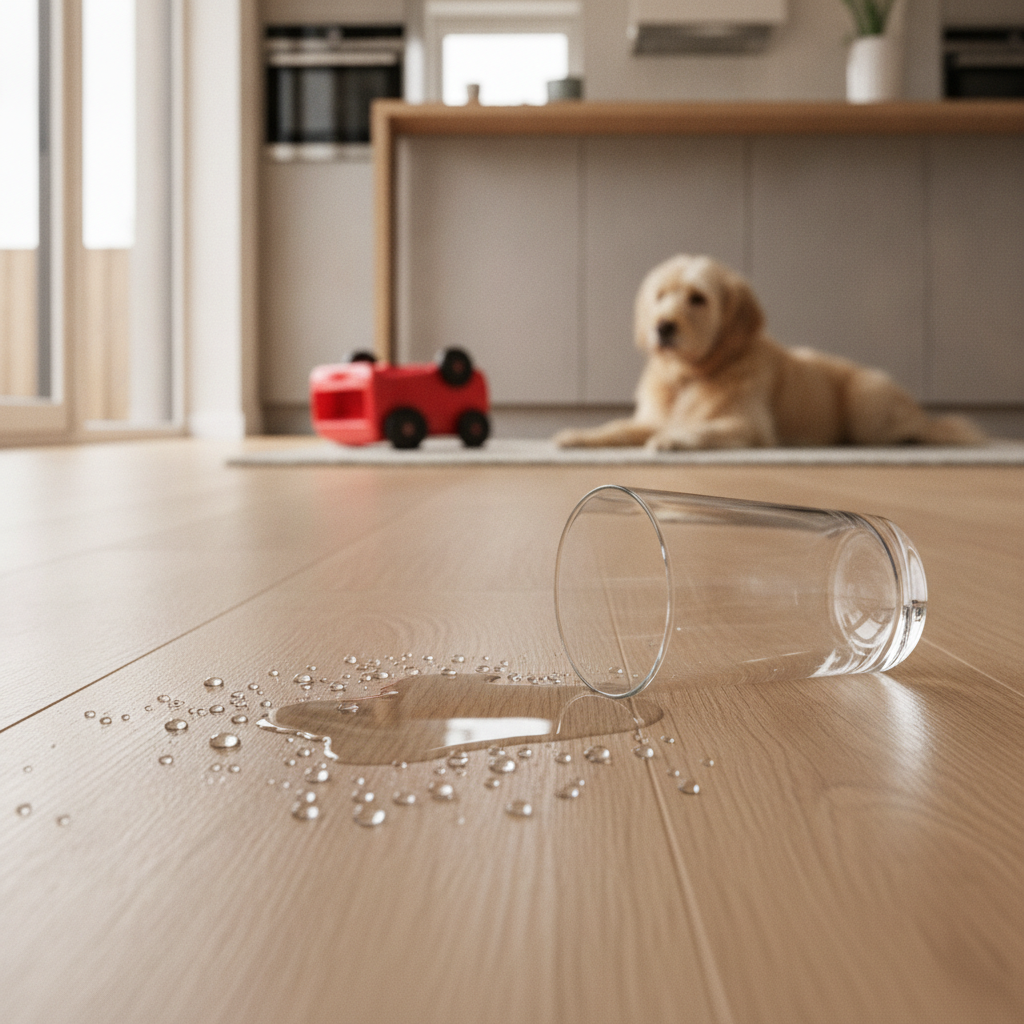
There is a critical difference between “water-resistant” and “waterproof.” Water-resistant floors can handle small spills if they are wiped up quickly. Bravewood is truly waterproof. Thanks to its SPC core, water can pool on the surface for hours or even days without causing the plank to swell, buckle, or delaminate. This is crucial because the real danger of flooring damage from spills isn’t just cosmetic; it’s structural. As outlined in guides from the Federal Emergency Management Agency (FEMA) on household water damage, moisture that reaches the wooden subfloor can lead to mold, mildew, and rot, causing catastrophic damage.[7] Bravewood’s waterproof system, as guaranteed by its manufacturer warranty when installed correctly, provides total peace of mind.
Scratch & Dent Resistance: A Floor for Pets, Kids, and Life
For anyone with pets or children, the fear of scratched hardwood floors is constant. Bravewood’s multi-layer defense system is designed to alleviate that worry. The tough aluminum oxide finish provides the primary scratch resistance. While the real wood veneer beneath is naturally softer, its durability can be understood in the context of the Janka Hardness Scale, the industry standard for measuring a wood’s resistance to denting.[8] However, the true star is the rigid SPC core, which provides foundational support and prevents the plank from denting when something heavy is dropped. User testimonials frequently highlight this resilience: “We have two large dogs and three kids, and after a year, our Bravewood floors still look brand new. We’ve stopped worrying about every little scrape and spill.”
Achieving the Seamless Dream: Unifying Your Home with Bravewood
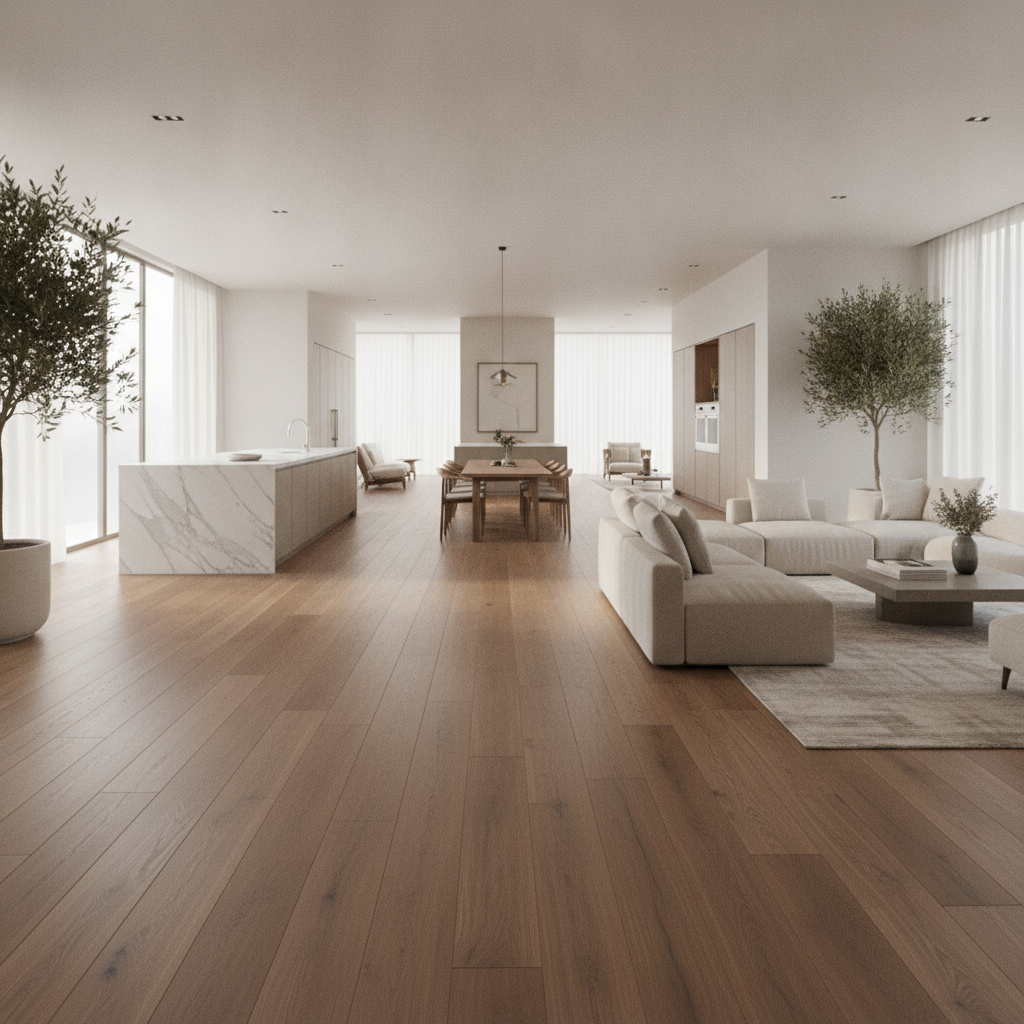
Beyond its raw performance, Bravewood’s greatest strength in an open-concept home is its ability to create a flawless, unified aesthetic. By using a single, continuous flooring material, you eliminate the visual clutter of transitions and allow the eye to travel uninterrupted across the entire space.
How a Single Flooring Unifies Kitchen, Dining, and Living Areas
Laying one type of flooring from your front door through your living room and into your kitchen makes the entire area feel larger, more cohesive, and more intentionally designed. As one designer notes, “Continuous flooring is the single most impactful choice you can make to enhance the sense of space in an open plan. It creates a clean, expansive canvas that allows your furniture and decor to be the stars.” This seamless living room kitchen flooring erases the arbitrary lines that once divided rooms, fulfilling the true promise of open-concept living. A side-by-side comparison is striking: a space with a jarring transition strip feels disjointed, while the same space with continuous flooring feels harmonious and upscale.
Acoustic Considerations in Large, Open Spaces
A common but often overlooked issue in open-concept homes is acoustics. Hard surfaces like tile or traditional hardwood can create an echo chamber, making the space feel loud and cold. This is another area where Bravewood’s engineering provides a solution. Most Bravewood planks come with a pre-attached high-density underlayment. This layer not only adds comfort underfoot but also helps to absorb sound, reducing both ambient echo within the room and noise transmission to the floor below. In technical terms, this improves the floor’s Sound Transmission Class (STC) and Impact Insulation Class (IIC) ratings. While you should always check the manufacturer’s technical specifications for precise acoustic ratings,[4] this integrated feature is a significant advantage for creating a comfortable, serene open-concept environment.
Bravewood Hybrid Hardwood vs. The Alternatives: A Head-to-Head Comparison
To make a confident decision, it’s essential to see how Bravewood stacks up against other popular choices for open-concept flooring. Here’s an objective, head-to-head comparison based on key performance metrics.
| Feature | Bravewood Hybrid Hardwood | Luxury Vinyl Plank (LVP) | Traditional Engineered Hardwood |
|---|---|---|---|
| Surface Material | Real Hardwood Veneer | Printed Vinyl Image Layer | Thicker Real Hardwood Layer |
| Look & Feel | Authentic wood grain & texture | Realistic but synthetic feel | Authentic wood grain & texture |
| Water Resistance | 100% Waterproof SPC Core | 100% Waterproof Vinyl/SPC Core | Water-Resistant (Wood core can swell) |
| Scratch Resistance | Excellent (Aluminum Oxide) | Excellent (Wear Layer) | Good (Varies by finish) |
| Dent Resistance | Excellent (Dense SPC Core) | Good to Excellent (SPC > WPC) | Fair (Dents easily) |
| Repairability | Plank replacement for deep gouges | Plank replacement for deep gouges | Can be sanded & refinished 1-2 times |
| Best For… | Homeowners wanting real wood beauty with total waterproof protection and durability. | Budget-conscious projects needing maximum durability and waterproof performance. | Homeowners prioritizing refinishing ability over top-tier water and dent resistance. |
This comparison, informed by standards from authorities like the NWFA[5] and RFCI,[6] shows that Bravewood occupies a unique space: it delivers the waterproof durability of LVP without sacrificing the authentic beauty of real wood.
Frequently Asked Questions
Can you install Bravewood hybrid hardwood in bathrooms and kitchens?
Absolutely. Due to its 100% waterproof SPC core and tight-locking seams, Bravewood is an ideal flooring solution for high-moisture areas like kitchens, bathrooms, and laundry rooms. Always be sure to follow the official manufacturer installation guides, which are the final authority on approved locations and methods.[10]
How do you repair scratches or damage to the wood veneer?
This is an important distinction from solid hardwood. For light surface scuffs in the top finish, you can often use a manufacturer-recommended repair kit to conceal the mark. However, if a deep gouge penetrates through the finish and the wood veneer, the plank cannot be sanded and refinished. In these cases, the solution is to carefully replace the damaged plank, which is a straightforward process for a qualified installer. This differs from solid hardwood, which can be fully refinished, but also from LVP, where a deep scratch permanently damages the printed image layer. Recommendations from finish experts like Bona can provide guidance on care and minor repairs.[11]
What is the typical warranty and lifespan?
Bravewood hybrid hardwood typically comes with a robust residential warranty, often ranging from 25 years to a limited lifetime warranty. With proper care and maintenance, the expected lifespan is decades. It is crucial to remember that these warranties are always contingent on following the official installation and maintenance guidelines provided in the manufacturer’s technical documents.[4] This protects your investment and ensures the floor performs as designed for its full life.
The Uncompromising Solution for Modern Living
The dream of a beautiful, functional open-concept home no longer requires a compromise on flooring. You don’t have to choose between the timeless elegance of hardwood and the rugged durability needed for a busy, modern life. Bravewood Waterproof Hybrid Hardwood stands as the definitive engineered solution, meticulously designed to solve every core challenge of the open-concept space. It offers a single, seamless surface that is 100% waterproof for the kitchen, tough enough to resist scratches and dents in the living room, and aesthetically stunning enough to unify your entire home with flawless style. It allows you to finally stop worrying about your floors and start enjoying your space to the fullest.
Ready to unify your home with a floor that’s as beautiful as it is tough? Explore the Bravewood collection today or order a sample to see the difference for yourself.
This article discusses the features and benefits of a specific brand, Bravewood. All product specifications should be verified with the manufacturer. This post may contain affiliate links.
References & Authoritative Sources
- Institute of Inspection, Cleaning and Restoration Certification (IICRC). (n.d.). IICRC Standards for Professional Water Damage Restoration. IICRC.
- Tile Council of North America (TCNA). (n.d.). TCNA Handbook for Ceramic, Glass, and Stone Tile Installation. TCNA.
- ASTM International. (n.d.). ASTM Standards for Materials. ASTM International.
- Flooring Manufacturer’s Technical Specification Sheets. (n.d.). Provides authoritative data on a specific product’s wear layer thickness, core material, and warranty details.
- National Wood Flooring Association (NWFA). (n.d.). Official Flooring Industry Guidelines. NWFA.
- Resilient Floor Covering Institute (RFCI). (n.d.). Information and Standards for Resilient Flooring. RFCI.
- Federal Emergency Management Agency (FEMA). (n.d.). Guides on Water Damage in Homes. FEMA.
- Janka Hardness Scale. (n.d.). Industry standard for ranking the dent and wear resistance of wood species.
- Product-specific installation manuals. (n.d.). The ultimate authority on how to install a product to achieve its warranted waterproof status.
- Bona / DuraSeal (Product Manufacturers). (n.d.). Official guides and recommendations for floor finish and care products.
