
Taking on a flooring project yourself is one of the most rewarding home improvement tasks you can tackle, offering potential savings of $2 to $5 per square foot on labor costs alone. However, the path to a beautiful room is often paved with good intentions and costly mistakes. Many ambitious homeowners accidentally void their warranties or end up with amateur-looking results—think bouncing boards, unsightly gaps, and messy transitions—simply due to poor subfloor preparation or a misunderstood locking mechanism.
This is your ultimate, manufacturer-approved roadmap to mastering the Bravewood system. We are going to walk you through how to bulletproof your subfloor, perfectly engage Bravewood’s proprietary locking joints, and execute pro-level finishing techniques. By following this comprehensive guide from prep to installation to the final finishing touches, you will achieve a truly flawless finish that looks like a $5,000 professional job while keeping your warranty firmly intact.
- Phase 1: The Realities of DIY Flooring Installation
- Proper Subfloor Preparation: The Non-Negotiable Foundation
- Acclimation: Preventing Flooring Gaps Before They Start
- How to Install Bravewood Flooring: Step-by-Step
- Avoiding the 7 Most Expensive Flooring Installation Mistakes
- Pro Tips for a Flawless Flooring Finish
- Conclusion
- References
Phase 1: The Realities of DIY Flooring Installation
Before you tear up your old carpet or open a single box of planks, it is crucial to set realistic expectations for your DIY flooring installation. While the financial savings are significant, installing floors is a physically demanding job that takes a toll on your knees, back, and hands.
A realistic time commitment for a solo DIYer installing 1,000 square feet of flooring is typically a full 4-to-5-day weekend, assuming the subfloor requires minimal leveling. When calculating your true cost-benefit analysis, you must include a transparent breakdown of hidden DIY costs. Beyond the flooring itself, budget for specialized tool rentals (like undercut saws or heavy-duty floor scrapers), subfloor prep materials (self-leveling compounds, moisture barriers), and a 10% waste factor for complex cuts.
As Mark T., a licensed contractor with 15 years of residential renovation experience, notes:
“The biggest mistake DIYers make isn’t in the snapping of the boards; it’s underestimating the physical endurance and the hidden costs of proper prep. If you budget your energy and your wallet for the unseen subfloor work, the actual DIY Bravewood floor installation guide becomes a breeze.”
Essential Tools & Materials Checklist
To ensure a smooth Bravewood flooring installation, you need the right tools on hand before you begin. You can download our printable PDF project checklist to take to the hardware store, but here are the non-negotiables:
- Measuring & Layout: Tape measure, chalk line, T-square, and a moisture meter.
- Cutting: Miter saw, table saw (or jigsaw for long rips), and an oscillating multi-tool for door jambs.
- Installation Specifics: A non-marring rubber mallet, pull bar, 1/4-inch to 3/8-inch expansion spacers, and a Bravewood-compatible tapping block (do not use a generic block, as it can crush the proprietary tongue).
- Underlayment: According to the Bravewood Official Manufacturer Guidelines [1], if your specific Bravewood product does not have a pre-attached pad, you must use their approved 2mm or 3mm high-density acoustic underlayment to maintain the warranty.
Proper Subfloor Preparation: The Non-Negotiable Foundation
If there is one section of this guide you memorize, let it be this: proper subfloor preparation is the most critical step of your entire project. Up to 90% of all flooring warranty claims are denied due to improper subfloor preparation or unmitigated moisture issues.
“Homeowners often want to rush to the fun part of laying the planks,” explains a certified structural engineer and flooring inspector. “But if your subfloor has deflection—meaning it bounces or sags—the locking mechanisms of your floating floor will eventually snap under foot traffic. The 90% failure statistic is entirely preventable.” For structural integrity, always adhere to the baseline requirements set by the American Concrete Institute (ACI) [2] for concrete slabs, or APA – The Engineered Wood Association [3] for plywood and OSB subfloors.
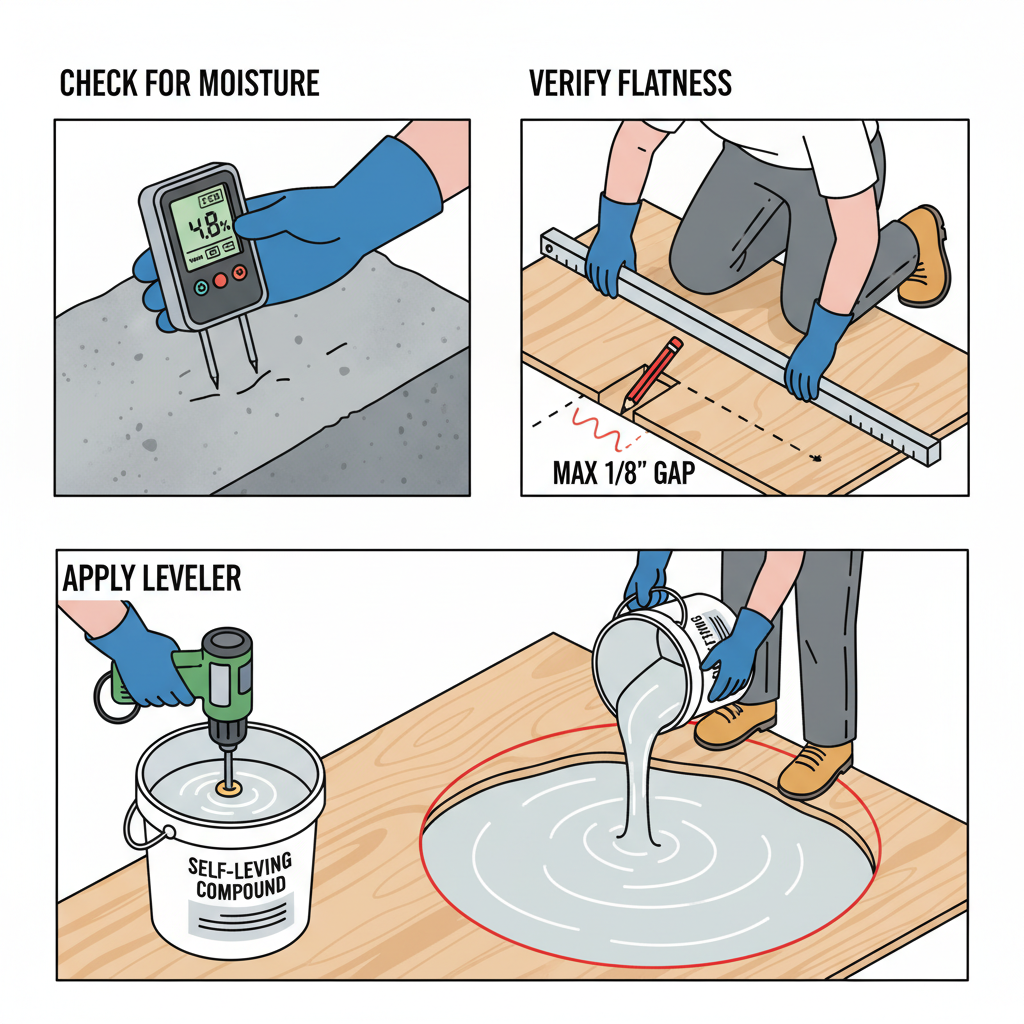
Testing and Mitigating Moisture
Moisture is the silent killer of uneven floorboards and buckling planks. For concrete subfloors, you must perform a calcium chloride moisture test or use relative humidity (RH) in-situ probes. Follow the exact testing protocols from the National Wood Flooring Association (NWFA) [4]: drill the required holes, insert the RH probes, and wait 24 hours for an accurate reading. If the concrete reads above the manufacturer’s threshold (typically 80-85% RH), you must apply a roll-on moisture mitigation barrier.
For wood subfloors over crawlspaces, ensure a 6-mil poly moisture barrier is laid on the ground of the crawlspace itself. Do not put a plastic vapor barrier directly between a wood subfloor and a wood-based floating floor, as this can trap moisture and cause rot.
Fixing Uneven Floorboards and Leveling
How do you know if your subfloor is flat enough? The exact NWFA tolerances for subfloor flatness dictate a maximum variance of 3/16 inch over a 10-foot radius, or 1/8 inch over a 6-foot radius [4].
To diagnose this, take a 10-foot long straight edge (or a perfectly straight piece of lumber) and sweep it across the floor in a semi-circle. As demonstrated in our leveling video guide, look for any gaps under the straight edge where a standard #2 pencil can slide underneath. If the pencil fits, that low spot must be filled.
For low spots on concrete or wood, mix and pour a high-quality Portland cement-based self-leveling compound according to the bag’s exact water ratios. For high spots on wood subfloors, use an edger sander to grind them down. Finally, walk the entire room and screw down any loose OSB or plywood panels into the joists to prevent future squeaks.
Acclimation: Preventing Flooring Gaps Before They Start
You’ve prepped the subfloor, but if you install the flooring the day you bring it home, you are asking for trouble. Proper acclimation—typically leaving the open boxes in the installation room for 48 to 72 hours—reduces post-installation buckling and gapping issues by up to 80%.
The science behind preventing flooring gaps relies on the relationship between relative humidity (RH), temperature, and the materials themselves. Wood and rigid core products expand when they absorb moisture from the air and contract when the air dries out. By letting the planks adjust to your home’s normal living conditions, you prevent them from shrinking drastically in the winter. According to Wood Floor Business Magazine [5], maintaining your indoor RH between 30% and 50% year-round is the golden rule for minimizing seasonal gapping.
How to Install Bravewood Flooring: Step-by-Step
With the prep work complete, you are ready for the actual Bravewood flooring installation. Because Bravewood uses a unique drop-and-lock system, following the chronological steps tailored to their design is paramount.
Planning Your Layout for Seamless Floor Installation
Before laying the first plank, plan your layout to avoid narrow slivers of flooring at the walls. Measure the width of the room and divide by the width of an exposed plank. If the remainder is less than two inches, rip your starting row down to ensure the final row is substantial.
For a natural, professional look, you must stagger your flooring planks correctly. Avoid “H-joints” (where seams line up every other row) and “stair-stepping” (creating a distinct staircase pattern). As shown in our custom layout diagrams, aim for a random stagger, ensuring end joints are separated by at least 8 inches from the joints in adjacent rows.
Additionally, ensure your starting wall is square. Use the 3-4-5 rule (measure 3 feet down one wall, 4 feet down the adjacent wall; the diagonal between those points should be exactly 5 feet). If the room is out of square, you will need to scribe and cut your first row at a slight angle so the rest of the floor runs true.
Mastering the Bravewood Locking Mechanism
The most common pain point when learning how to install Bravewood flooring is breaking the tongue or groove. Bravewood planks feature a proprietary angle-drop locking mechanism.
As seen in our macro-photography series of the joint, you must insert the long edge of the plank at a precise 20-to-30-degree angle into the previous row. Once the long edge is seated, slide the plank down so the short end aligns with the adjacent plank. Do not force it flat. Use your Bravewood-approved tapping block and a rubber mallet to gently tap the long edge to ensure it is fully seated, then tap the top of the short joint to lock it flush.
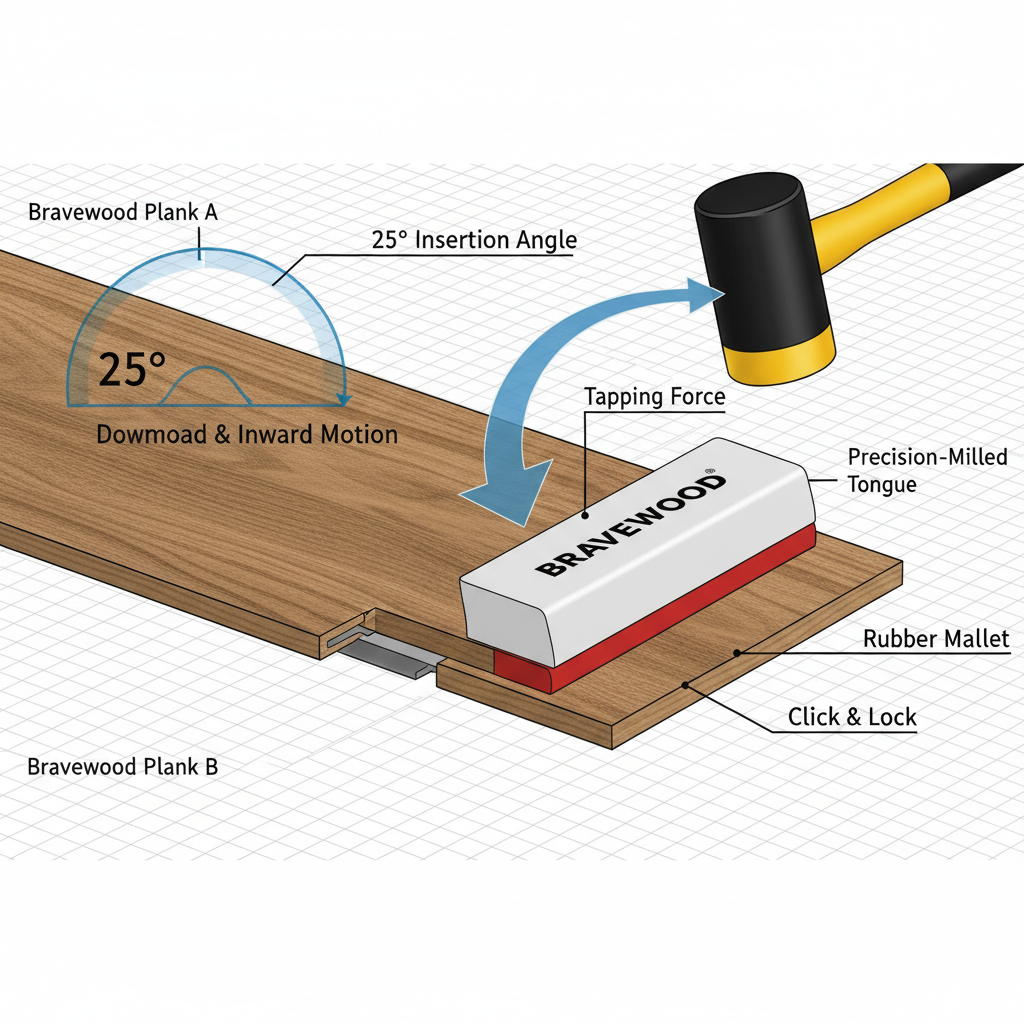
A certified Bravewood installer advises: “Never hit the plank directly with a hammer, and never use a scrap piece of flooring as a tapping block for the short ends. The Bravewood lock is precision-milled; gentle, consistent tapping with the correct block is all it takes to engage it perfectly.” Always refer to the Bravewood Technical Support Documentation [6] which specifies starting your installation in the left corner and working right, with the tongue facing the wall.
Avoiding the 7 Most Expensive Flooring Installation Mistakes
Even with the best intentions, flooring installation mistakes happen. Here is how to avoid the most expensive ones:
- Ignoring Expansion Gaps: If you do not leave a 1/4-inch to 3/8-inch gap around the entire perimeter (including cabinets and pipes), the floor will have nowhere to expand. Floor Covering Installer Magazine (FCI) [7] highlights that the physics of material expansion dictates that a floor bound by walls will inevitably buckle or peak in the center of the room.
- Installing Over an Uneven Subfloor: As discussed, this leads to bouncing and broken joints.
- Sanding Laminate or Vinyl: If you have uneven floorboards after installing laminate or luxury vinyl, you cannot sand them down like solid hardwood. The wear layer will be instantly destroyed. You must pull up the boards and fix the subfloor.
- Trapping the Floor: Nailing baseboards or transition strips directly through the floating floor pins it down, causing it to separate elsewhere.
- Skipping the Moisture Barrier: Resulting in cupping and mold.
- Poor Staggering: Creating weak structural points and an ugly, repetitive aesthetic.
- Using the Wrong Cleaning Products: Ruining the factory finish immediately after installation. (Our Before and After photos show the devastating clouding effect of using steam mops on rigid core floors).
Pro Tips for a Flawless Flooring Finish
The difference between a DIY job and a professional installation lies entirely in the finishing touches. A flawless flooring finish requires patience, trim carpentry skills, and a quality-assurance checklist to ensure every detail is perfect.
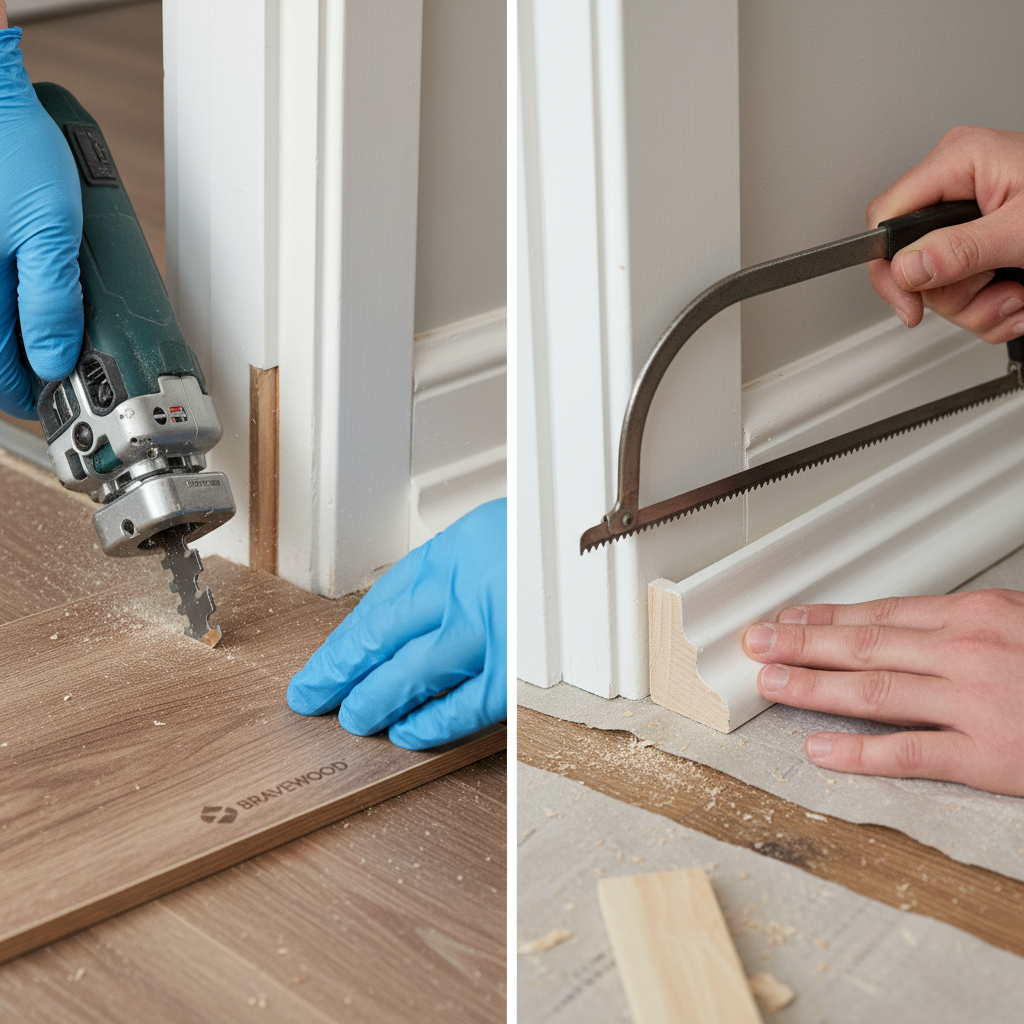
Navigating Complex Cuts and Undercutting Door Jambs
Amateurs try to cut flooring to fit around door jambs, leaving an ugly gap filled with caulk. Professionals undercut the jambs so the flooring slides seamlessly underneath.
In a recent Q&A with a flooring contractor boasting 20+ years of experience, he shared his top tip for seamless floor installation techniques: “Rent an oscillating multi-tool or a dedicated undercut saw. Use a scrap piece of your flooring with the underlayment attached as a depth guide. Rest the saw flat on the scrap, and plunge cut right through the wooden door casing. The new floor will slide under perfectly, hiding all edges.”
Managing Transitions and Continuous Runs
Can you run floating flooring continuously through doorways without transition strips? While seamless floor installation techniques look incredible, you must respect the physics of the material.
Most floating floors, including Bravewood, have a maximum continuous run length—typically 40 feet in any direction. If your open-concept layout exceeds 40 feet, or if you are passing through doorways less than 36 inches wide, Floor Covering Weekly (FCW) [9] industry standards and Bravewood guidelines dictate that you must use a T-molding transition strip to prevent buckling.
Baseboards, Shoe Molding, and Final Detailing
To hide the mandatory expansion gaps around the perimeter, you will install baseboards and, if necessary, shoe molding (quarter round).
For a flawless flooring finish, never miter your inside baseboard corners (cutting two 45-degree angles). Houses shift, and mitered inside corners will inevitably open up. Instead, use a coping saw to cope the inside corners, profiling one piece of trim to fit perfectly over the face of the other. This traditional craftsmanship technique, heavily championed by This Old House [8], ensures a tight joint even if the walls aren’t perfectly square.
When nailing your trim, shoot 18-gauge brad nails into the wall, never down into the floor. To make nail holes invisible, Fine Homebuilding [10] recommends using a color-matched wood putty rather than standard spackle, blending it with a soft cloth. Finally, clean your newly installed floors using only the manufacturer-approved pH-neutral cleaner and a microfiber mop to prevent streaks and haze.
Conclusion
Achieving a stunning, professional-grade floor is entirely within your reach. By committing to uncompromising subfloor preparation, taking the time to master the precise angle of the Bravewood locking joint, and applying pro-level finishing touches like undercutting door jambs and coping baseboards, you elevate your project from a basic DIY task to a masterclass in home improvement. Following these manufacturer-approved steps guarantees a flawless, warranty-compliant floor while saving you thousands of dollars on labor.
We encourage you to download the ‘Essential Tools & Materials Checklist PDF’ to start planning your project today. Once you are finished, share photos of your completed, flawless Bravewood floors in the comments section below or on social media by tagging the brand!
Standard DIY Disclaimer: Flooring installation requires physical labor and specific tools. Always prioritize safety. Manufacturer Warranty Disclaimer: Failure to follow exact manufacturer specifications regarding subfloor prep and acclimation may void your Bravewood warranty.
References
- Bravewood Official Manufacturer Guidelines. (N.D.). Bravewood Installation and Warranty Guidelines. Bravewood Official Documentation.
- American Concrete Institute (ACI). (N.D.). Concrete Subfloor Moisture and Leveling Standards. ACI Guidelines.
- APA – The Engineered Wood Association. (N.D.). Plywood and OSB Subfloor Structural Requirements. APA Standards.
- National Wood Flooring Association (NWFA). (N.D.). NWFA Installation Guidelines: Environmental Controls, Acclimation, and Subfloor Tolerances. NWFA Official Guidelines.
- Wood Floor Business Magazine. (N.D.). Wood Science, Moisture Testing, and Flooring Behavior. Wood Floor Business.
- Bravewood Technical Support Documentation. (N.D.). Product Handling and Installation Specifications. Bravewood Support.
- Floor Covering Installer Magazine (FCI). (N.D.). Professional Installation Issues, Failures, and Solutions. FCI Magazine.
- This Old House. (N.D.). Traditional Craftsmanship, Trim Work, and Finishing Details. This Old House.
- Floor Covering Weekly (FCW). (N.D.). Industry News and Technical Installation Standards. FCW.
- Fine Homebuilding. (N.D.). High-Quality Craftsmanship, Trim Carpentry, and Finishing Details. Fine Homebuilding.
