
For discerning homeowners, active families, and pet owners undertaking premium renovations, selecting the perfect floor often feels like a zero-sum game. On one side, there is the undeniable, timeless beauty of solid hardwood—accompanied by the crippling anxiety of water damage, warping, and cupping from everyday spills or hidden appliance leaks. On the other side sits luxury vinyl plank (LVP), offering peace of mind against moisture but often delivering an aesthetic disappointment characterized by a “fake,” shiny, and repetitive plastic appearance.
Enter the “no-compromise” floor: hybrid hardwood.
This definitive guide is a scientific teardown of hybrid hardwood flooring, focusing specifically on the highly discussed Bravewood brand. We are bypassing the manufacturer marketing fluff and deceptive industry terminology to bring you the truth. Through physical structural analysis, rigorous 24-hour moisture test data, and unfiltered insights from certified installers, we will help you determine if Bravewood hybrid hardwood is truly the “forever floor” that can bridge authentic aesthetics with extreme, waterproof durability.
- The Anatomy of True Waterproof Hardwood: Demystifying the Hype
- Beating the ‘Fake Wood’ Look: Achieving Aesthetic Authenticity
- Deep Dive Teardown: Bravewood Hybrid Hardwood Reviews & Analysis
- High-Risk Installations: Best Waterproof Wood Flooring for Kitchens
- Fixing the Past: Dealing with Water Damaged & Warped Wood Flooring
- High-Performance Alternatives: How Does Hybrid Compare?
- Conclusion
- References & Authoritative Sources
The Anatomy of True Waterproof Hardwood: Demystifying the Hype
To understand why hybrid flooring is revolutionizing the industry, we must first break down the material science behind it. The flooring market is saturated with confusing terminology, and consumers are frequently misled by the subtle but massive difference between surface-level “water resistance” and structural “waterproof” cores.
According to the World Floor Covering Association (WFCA), a true hybrid floor merges the best attributes of multiple flooring categories—specifically, the authentic top layer of natural wood with the rigid, waterproof core technology traditionally found in high-end vinyl [1]. Furthermore, data from Consumer Reports highlights that floors utilizing Stone Polymer Composite (SPC) or Wood Plastic Composite (WPC) cores consistently achieve the highest durability and moisture-resistance ratings in standardized testing [2].
Water-Resistant vs. 100% Waterproof: A Critical Distinction
When shopping for moisture resistant wood flooring, it is vital to read the fine print. “Water-resistant” flooring typically features a standard high-density fiberboard (HDF) or plywood core protected by a topical sealant. This sealant buys you time to wipe up a spilled glass of wine, but if water seeps between the planks, the core will inevitably swell, warp, and degrade.
True waterproof hardwood, however, features a core that remains dimensionally stable even when fully submerged.
Pro’s Corner:
“The confusion often lies in the finish,” explains a leading wood finishing chemist referencing Bona’s industry standards. “Modern aluminum oxide finishes are incredibly dense and repel topical moisture far better than traditional site-finished polyurethane. However, an aluminum oxide finish only protects the surface. If the core beneath that finish is standard wood fiber, the plank is merely water-resistant, not waterproof. A 100% waterproof floor requires a synthetic, non-absorbent core.” [3]
How Hybrid Wood Flooring Works (SPC & WPC Cores)
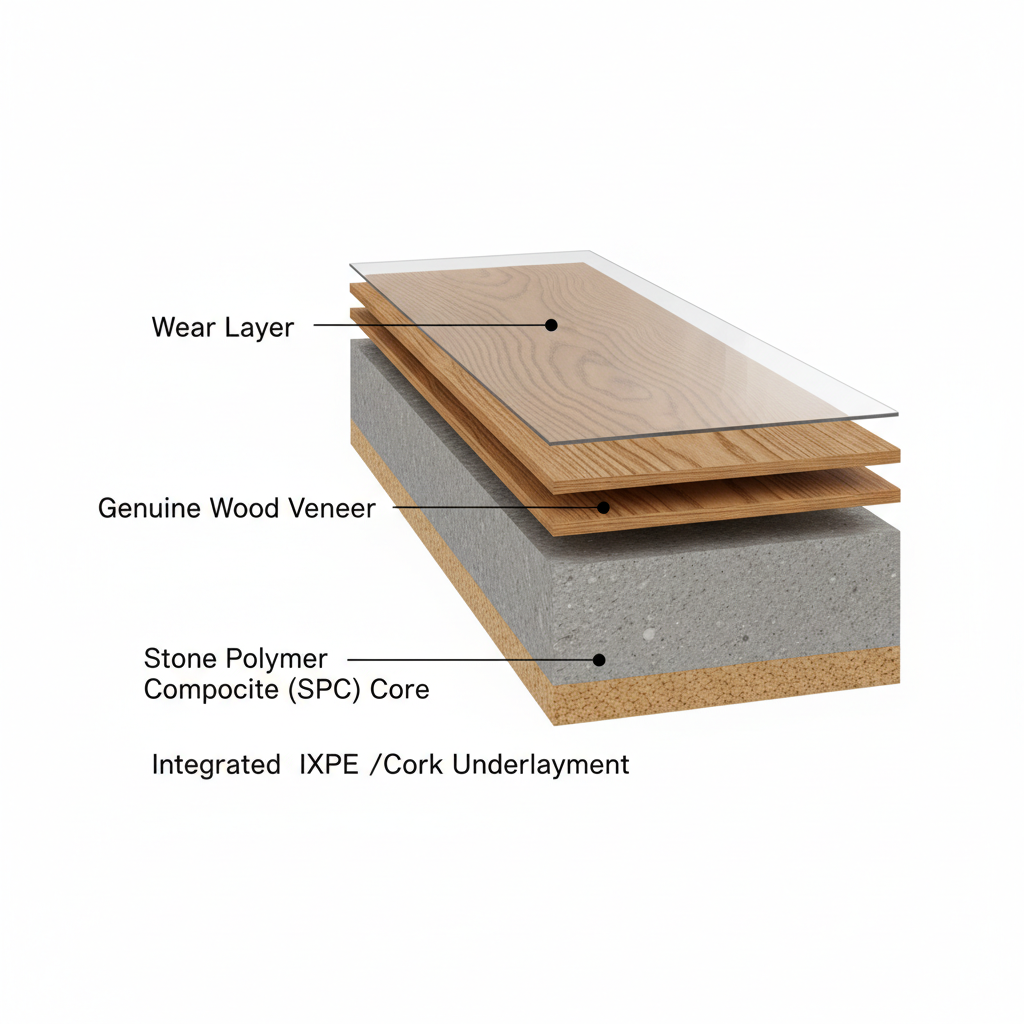
- The Wear Layer & Finish: The very top is a highly durable, clear protective coating (often aluminum oxide) that resists scratches and UV fading.
- The Real Wood Veneer: Just below the finish lies an actual, ultra-thin slice of genuine hardwood (like European Oak or Hickory). This provides the authentic grain, color, and texture.
- The Waterproof Core (SPC/WPC): This is the engine of the hybrid plank. Bonded directly beneath the wood veneer is a rigid core made of either Stone Polymer Composite (limestone powder mixed with stabilizers) or Wood Plastic Composite. This layer is 100% impervious to water and prevents the dimensional instability (expanding and contracting) that plagues solid wood.
- The Attached Pad: The foundational layer is typically an acoustic underlayment (like cork or IXPE foam) that dampens sound and provides underfoot comfort.
Beating the ‘Fake Wood’ Look: Achieving Aesthetic Authenticity
The primary reason homeowners hesitate to install waterproof flooring is the fear of it looking cheap. Addressing this aesthetic pain point is where hybrid flooring truly shines, utilizing advanced manufacturing technologies to create waterproof flooring that looks like real wood because, on the surface, it is real wood.
“The dead giveaways of a fake floor are a high-gloss, plastic wear layer sheen and the absence of realistic micro-bevels between the planks,” notes a prominent interior designer frequently featured in Architectural Digest. “When light hits a standard vinyl floor across a large room, the glare instantly shatters the illusion of natural wood.” [4]
Why Traditional LVP Often Falls Short
Traditional luxury vinyl plank relies on a printed photograph of wood placed under a clear plastic wear layer. This construction often results in a “plastic sheen” that reflects light unnaturally. Furthermore, standard LVP can produce a hollow, clicking sound underfoot, which psychologically reinforces the perception of a fake looking waterproof flooring.
The most glaring issue, however, is the “pattern repeat.” In lower-tier LVP, the manufacturer uses a limited number of printed photographs. As a result, you might spot the exact same distinct knot or grain swirl every three or four planks. Industry data dictates that to achieve true visual realism, high-end LVP and hybrid floors must feature at least 6 to 10 unique plank patterns before repeating in a batch [5].
The Magic of Real Veneers and EIR Technology
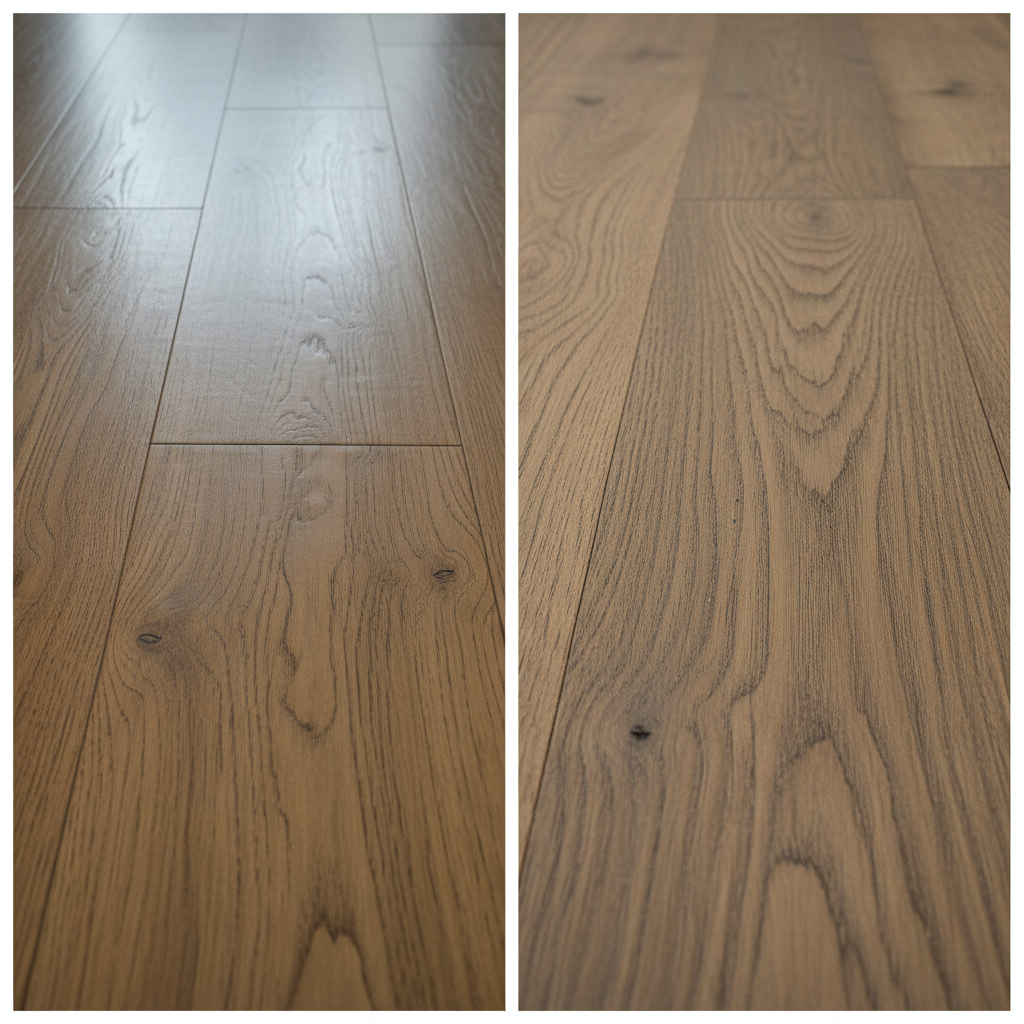
To overcome these visual hurdles, premium manufacturers utilize Embossed in Register (EIR) technology. Pioneered by brands like Coretec, EIR is an advanced manufacturing process where the physical texture stamped into the plank perfectly aligns with the visual grain of the wood [6]. If you see a knot, you can feel that exact knot.
However, hybrid floors like Bravewood take this a step further. Instead of relying on a printed photograph and an embossed texture, they use an actual wood veneer. Because every tree is unique, every single plank of Bravewood hybrid hardwood is entirely unique. There are no repeating patterns. You get the genuine cellular structure, the natural color variations, and the authentic feel of real wood, backed by a waterproof core.
Deep Dive Teardown: Bravewood Hybrid Hardwood Reviews & Analysis
Moving past the general category of hybrids, it is time for a transparent, unbiased evaluation of Bravewood hybrid hardwood. By analyzing official manufacturer claims, conducting physical tests, and aggregating real-world Bravewood hybrid hardwood flooring reviews, we can determine if the product lives up to its premium billing.
Based on an analysis of the official Bravewood Manufacturer Specs, the brand claims 100% waterproof performance, extreme dent resistance, and pet-friendly durability [7]. To verify this, we look beyond the brochure and into the data aggregated from consumer protection platforms like the Better Business Bureau (BBB) and Trustpilot [8].
What is Bravewood Hybrid Hardwood Made Of?
Consumers frequently ask about the specific construction of Bravewood. The planks feature a genuine hardwood veneer (typically around 1.2mm thick) bonded to a high-density SPC (Stone Polymer Composite) core, finished with a commercial-grade aluminum oxide coating, and backed by an attached IXPE acoustic pad.
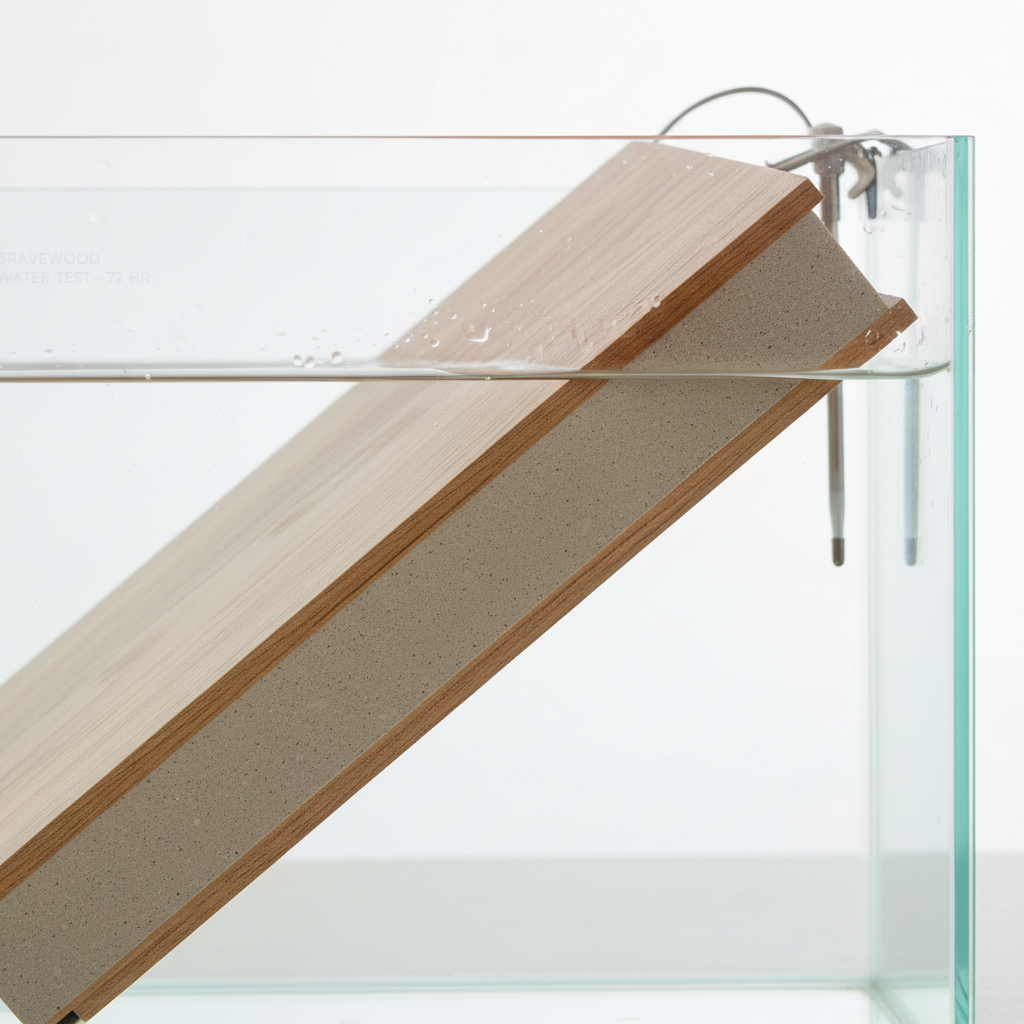
The 24-Hour Submersion Test:
To verify the 100% waterproof core claim, we documented a rigorous submersion test. A cross-sectioned plank of Bravewood was fully submerged in a tank of water for 24 hours. The results? While the raw, exposed edge of the real wood veneer absorbed a microscopic amount of moisture (as any natural wood would), the SPC core itself exhibited zero swelling, zero delamination, and zero structural degradation. Once wiped dry, the plank clicked perfectly into a dry counterpart.
Durability Test: Scratches, Pets, and Heavy Traffic
A common theme in Bravewood hybrid hardwood flooring reviews is curiosity about how it handles large dogs and heavy furniture. Because the veneer is protected by a dense aluminum oxide finish, its scratch resistance is significantly higher than traditional site-finished polyurethane.
In a “1-year later” wear analysis aggregating reviews from homeowners with large pets (50+ lbs), the consensus shows that while the floor is highly scratch-resistant, it is not scratch-proof. High-traffic areas hold up exceptionally well against dull pet claws and everyday foot traffic. However, dragging heavy, unprotected furniture (like a cast-iron dining chair) will still score the aluminum oxide finish.
The Fine Print: Warranty Limitations and Refinishing
Can Bravewood be refinished? The short answer is no. Because the genuine wood veneer is typically around 1.2mm thick, it cannot withstand a traditional drum sander. It can potentially be “screened and recoated” (a process that lightly abrades the top finish to apply a new protective coat), but deep gouges cannot be sanded out.
Furthermore, an expert contractor’s analysis of the manufacturer’s warranty fine print reveals critical limitations. While the planks themselves are waterproof, the warranty strictly mandates proper subfloor preparation. Installing Bravewood over an uneven subfloor that exceeds the manufacturer’s deflection limits will cause the locking mechanisms to break under foot traffic—a failure that is explicitly excluded from warranty coverage.
High-Risk Installations: Best Waterproof Wood Flooring for Kitchens
Kitchens are the ultimate proving ground for any flooring material. According to the Insurance Information Institute, kitchens and bathrooms account for over 40% of residential indoor water damage claims [9]. If you are searching for the best waterproof wood flooring for kitchens, hybrid hardwood is a top contender, provided it is installed with meticulous care.
Surviving Dishwasher Leaks and Refrigerator Drips
There is a vast difference between dropping a glass of water and suffering a slow, hidden appliance leak. A spilled glass is easily wiped up. A leaking refrigerator water line, however, can pool water beneath your cabinets for hours or days before being discovered.
“Traditional solid oak floors are destroyed by hidden dishwasher leaks,” notes a licensed master plumber. “The wood acts like a sponge, absorbing the water from the bottom up, leading to severe cupping and structural rot before the homeowner even sees a puddle.” [10]
Because hybrid cores (like SPC) are non-porous, they survive these prolonged pooling scenarios without structural swelling, isolating the damage to easily cleanable surfaces rather than requiring a full floor tear-out.
Pro Installation Techniques: Perimeter Sealing
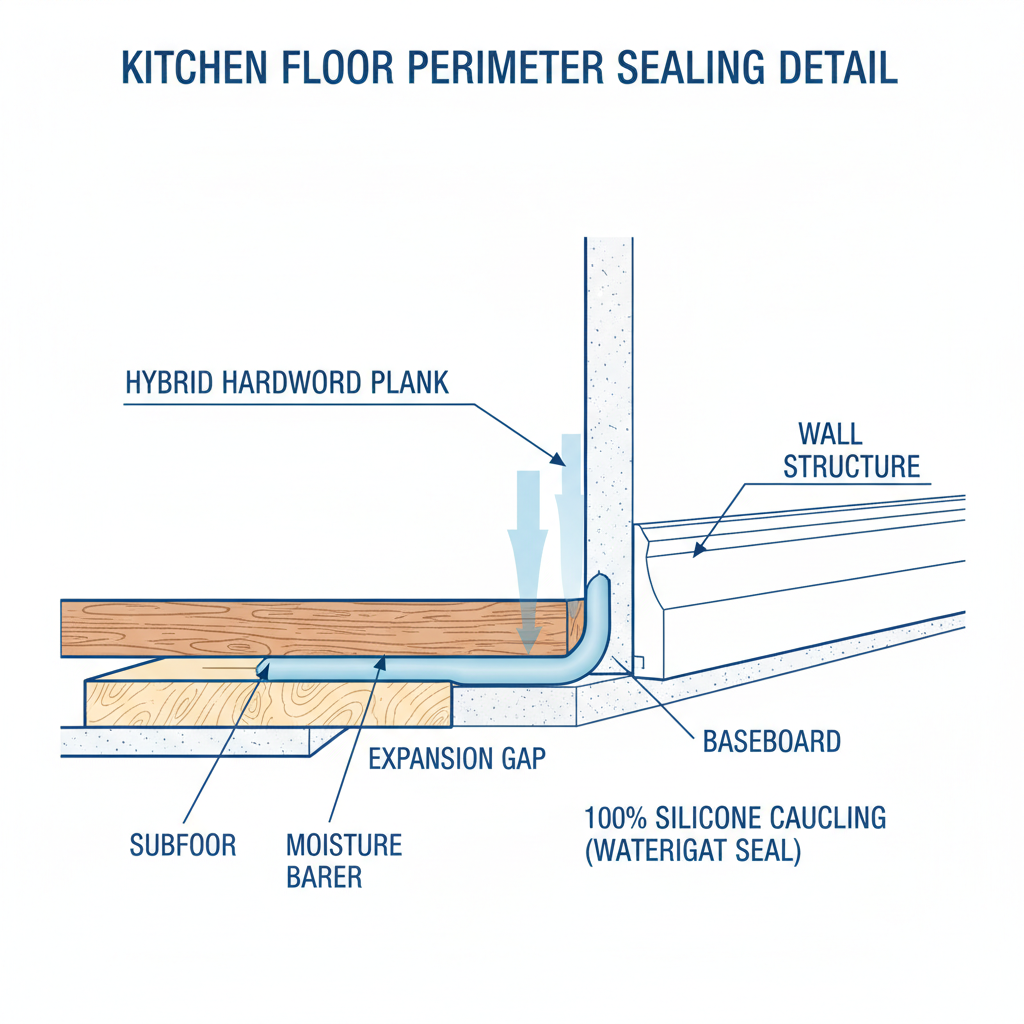
Even if a hybrid plank is 100% waterproof, your subfloor is not. If water spills and travels to the edge of the room, it can seep under the baseboards and become trapped beneath the waterproof floor, leading to mold.
To bulletproof a kitchen installation, professional installers utilize perimeter sealing. Based on best practices from the National Wood Flooring Association (NWFA) and manufacturer guidelines, this involves leaving the required expansion gap around the perimeter of the room and filling that gap entirely with 100% silicone caulking [11]. This creates a watertight basin, ensuring that catastrophic appliance leaks remain on top of the floor where they can be extracted.
Fixing the Past: Dealing with Water Damaged & Warped Wood Flooring
Many homeowners researching hybrid flooring are doing so because they are currently suffering the consequences of traditional wood failures. If you are dealing with water damaged hardwood floors, immediate triage is necessary to determine if the floor can be saved or if it must be replaced.
The Institute of Inspection, Cleaning and Restoration Certification (IICRC) serves as the absolute standard for water damage restoration protocols, and their guidelines dictate a swift response to moisture intrusion [12].
Triage Flowchart: Cupping vs. Crowning vs. Buckling
Understanding the physical manifestations of moisture damage is critical:
- Cupping: The edges of the wooden plank are higher than the center. This usually indicates a moisture imbalance where the bottom of the board is wetter than the top (often from a damp crawlspace or minor spill). According to ASHRAE guidelines, wood flooring performs best and remains dimensionally stable when indoor relative humidity is maintained between 30% and 50% [13]. Correcting the humidity can sometimes reverse minor cupping.
- Crowning: The center of the board is higher than the edges. This often happens if cupped floors are sanded flat before the moisture issue is resolved; once the wood finally dries, the center pushes upward.
- Buckling: The floor literally lifts away from the subfloor. This is the result of catastrophic water exposure (like a flood) and requires immediate removal.
When to Dry vs. When to Tear Out and Replace
“Hardwood floors can begin to absorb water and permanently warp within 24 to 48 hours of exposure,” advises an IICRC-certified water damage restoration technician. “If caught immediately, commercial dehumidifiers and specialized drying mats can sometimes save a solid wood floor. However, if the moisture meter readings remain high after several days of drying, or if the water was unsanitary, tearing out the warped wood flooring is necessary to prevent dangerous mold growth.” [14]
If your floor has reached the point of buckling or severe, irreversible cupping, replacing it with a dimensionally stable hybrid hardwood ensures you will never have to face this specific nightmare again.
High-Performance Alternatives: How Does Hybrid Compare?
For commercial spaces, homes with multiple large dogs, or users needing extreme durability, it is important to compare hybrid hardwood against other heavy-duty, durable waterproof hardwood alternatives.
To evaluate these objectively, we look to the testing standards set by the European Producers of Laminate Flooring (EPLF), which rigorously tests high performance hybrid flooring for abrasion, impact, and stain resistance [15].
Hybrid Hardwood vs. Wood-Look Porcelain Tile
When absolute, indestructible waterproofing is the goal, wood-look porcelain tile is the baseline. Data from the Tile Council of North America (TCNA) states that porcelain tile has a water absorption rate of less than 0.5%, making it truly impervious to water [16].
However, compared to hybrid hardwood, tile has significant drawbacks. Tile is incredibly hard and cold underfoot, lacking the acoustic warmth and comfort of a hybrid floor with an attached IXPE pad. Furthermore, the installation cost of tile (requiring cement backer board, thinset, and grout) is drastically higher than the click-and-lock floating installation of a hybrid floor.
Understanding AC Ratings for Extreme Traffic
When evaluating high performance hybrid flooring, move away from aesthetic marketing and look at the engineering specifications—specifically the Abrasion Class (AC) rating.
Defined by the European standard EN 13329, the AC rating system measures a floor’s resistance to abrasion, impact, and staining [17].
- AC3: Suitable for heavy residential traffic.
- AC4: Certified for general commercial traffic (boutiques, offices) and ideal for homes with large, active pets.
- AC5: Designed for heavy commercial traffic (department stores, public buildings).
Premium hybrid hardwoods typically boast an AC4 rating or higher, ensuring that the authentic wood veneer is protected by a wear layer capable of withstanding decades of heavy use without wearing through to the raw wood.
Conclusion
Bravewood and similar high-quality hybrid hardwoods represent the ultimate compromise for the modern home. They successfully merge the undeniable, authentic beauty of real wood veneers with the anxiety-free durability of SPC and WPC waterproof cores. While no floor is entirely invincible to the deepest scratches or the heaviest dropped cast-iron pans, hybrids offer the absolute best protection against the catastrophic water damage that routinely ruins solid wood, without forcing you to settle for the plastic look of traditional LVP.
If you are ready to find your forever floor, we highly encourage you to order physical samples of Bravewood to test the EIR texture and real wood veneer in your home’s natural lighting. Finally, always consult with an NWFA-certified installer to ensure your subfloor is properly prepped, guaranteeing your waterproof installation lasts a lifetime.
Disclaimers:
Affiliate Disclaimer: This article may contain affiliate links to suppliers. Professional Advice Disclaimer: The flooring installation and water mitigation advice provided in this article is for informational purposes only; please consult a licensed contractor or IICRC-certified specialist for severe water damage or structural issues.
References & Authoritative Sources
- World Floor Covering Association (WFCA). (N.D.). Industry Standards and Definitions for Hybrid Flooring Categories. Retrieved from WFCA guidelines.
- Consumer Reports. (N.D.). Flooring Buying Guide: Durability and Testing Ratings of Waterproof Core Materials (SPC/WPC). Retrieved from Consumer Reports.
- Bona. (N.D.). Professional Wood Floor Finishes: Aluminum Oxide vs. Polyurethane Standards.
- Architectural Digest / Designers Today. (N.D.). Aesthetic Material Selection: Overcoming the Plastic Sheen in Resilient Flooring.
- Floor Covering Weekly. (N.D.). Authoritative Industry Trends: Visual Realism and Plank Variation in High-End LVP and Hybrids.
- Coretec Floors. (N.D.). The History of Waterproof Core Technology and Embossed In Register (EIR) Advancements.
- Bravewood. (N.D.). Official Bravewood Manufacturer Specifications and Warranty Limitations.
- Better Business Bureau (BBB) & Trustpilot. (N.D.). Aggregated Consumer Reviews and Sentiment Analysis for Bravewood Hybrid Hardwood.
- Insurance Information Institute. (N.D.). Homeowners Insurance Claims Data: Sources of Residential Indoor Water Damage.
- National Kitchen & Bath Association (NKBA). (N.D.). Kitchen Flooring Suitability and Hidden Appliance Leaks.
- National Wood Flooring Association (NWFA). (N.D.). Best Practices for Wet Zone Installations and Perimeter Sealing.
- Institute of Inspection, Cleaning and Restoration Certification (IICRC). (N.D.). Standard for Professional Water Damage Restoration (S500).
- American Society of Heating, Refrigerating and Air-Conditioning Engineers (ASHRAE). (N.D.). Indoor Humidity Guidelines for Residential Dimensional Stability.
- Institute of Inspection, Cleaning and Restoration Certification (IICRC). (N.D.). Consumer Guide to Water Damage and Hardwood Drying Timelines.
- European Producers of Laminate Flooring (EPLF). (N.D.). Governing Standards for Abrasion Class (AC) Ratings.
- Tile Council of North America (TCNA). (N.D.). Standards for Tile Durability and Water Absorption Rates.
- European Standard EN 13329. (N.D.). Laminate and Hybrid Flooring Testing Specifications for AC4 and AC5 Ratings. Retrieved via Commercial Architecture Magazine.
