
There is an undeniable prestige that comes with natural hardwood floors. For centuries, they have been the gold standard of residential design, bringing warmth, character, and organic beauty into the home. But for the modern, active household, that prestige often comes at a steep psychological and financial cost. The universal desire for an authentic wood aesthetic is frequently at odds with the daily anxiety of water damage, the inevitability of scratches from pets and children, and the exhausting, high-maintenance upkeep required to keep natural wood looking its best.
Enter the “No-Compromise Flooring Matrix.” You no longer have to choose between a beautiful home and a livable one. This definitive, science-backed guide decodes the exact technical differences between hybrid hardwood, premium luxury vinyl plank (LVP), and waterproof laminate. By understanding the anatomy of these modern materials, you can achieve an authentic wood look flooring without compromise—a floor that survives active daily life, resists moisture, and retains its high-end appeal for decades.
- The Vulnerabilities of Traditional Hardwood: Why Homes Need an Alternative
- Demystifying the ‘Authentic Wood Look’ Revolution
- The Hybrid Hardwood Breakthrough: The Ultimate No-Compromise Solution
- Top Waterproof Hardwood Alternatives Compared
- The Lifestyle Matchmaker: Choosing Your No-Compromise Floor
- Conclusion
- References & Authoritative Sources
The Vulnerabilities of Traditional Hardwood: Why Homes Need an Alternative
To understand why modern flooring technology has evolved so rapidly, we first have to examine the deep pain points of traditional solid wood. While beautiful, natural wood is inherently porous and reactive to its environment. For homeowners dealing with high maintenance hardwood floors, easily scratched wood floors, and the devastating effects of hardwood flooring water damage, the need for a resilient alternative is clear.
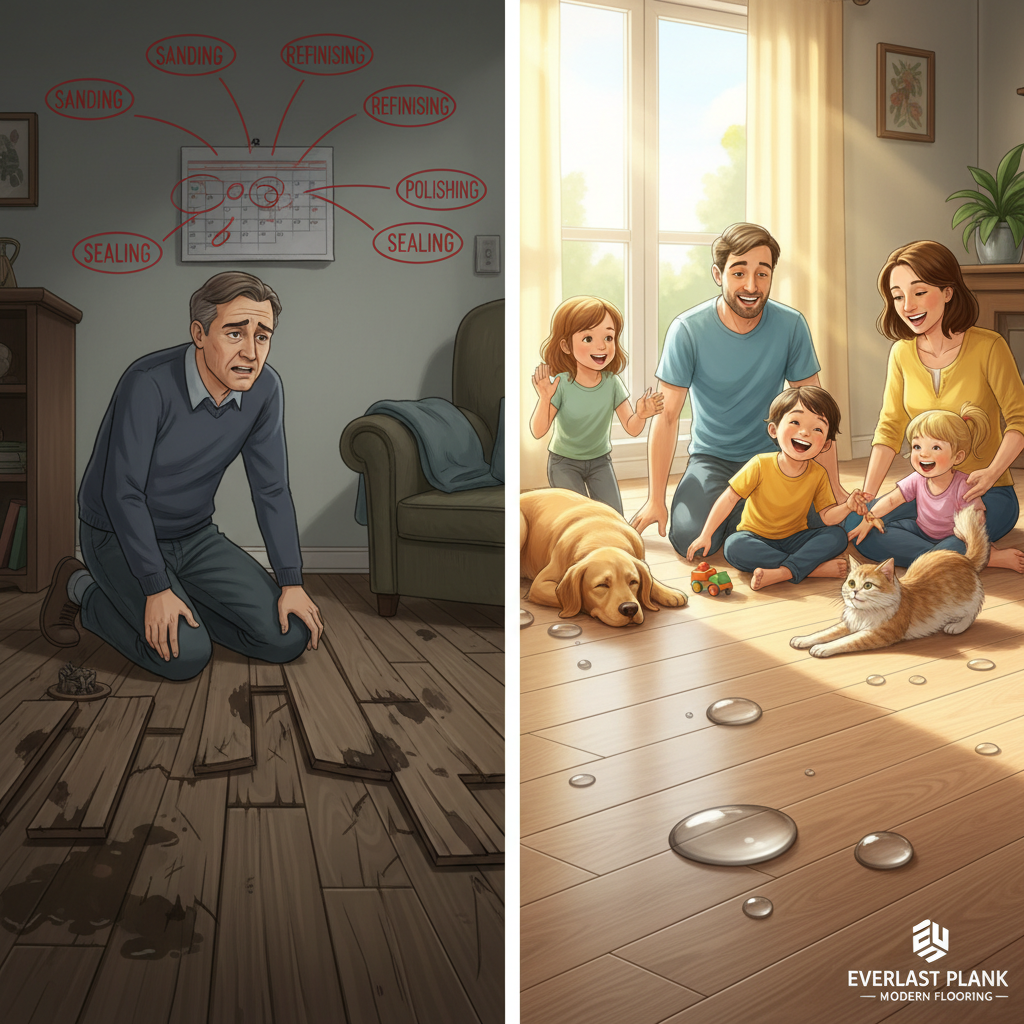
Water Damage Triage: Cupping, Crowning, and Mitigation
Water is the natural enemy of solid hardwood. But how long does it take for water to damage hardwood floors? The reality is that moisture begins absorbing into the wood fibers almost immediately, and visible deformation can occur within 24 to 48 hours. When a leak occurs, the bottom of the floorboard absorbs moisture and expands, causing the edges to push upward—a condition known in the industry as “cupping.”
Can water-damaged wood floors be saved? Yes, but time is of the essence. According to the hardwood restoration experts at Duffy Floors [1], immediate mitigation is critical. If you are dealing with an active leak, your first step is to stop the water source and remove standing water immediately. Professional water damage restoration often requires specialized equipment like high-velocity floor dryers and commercial dehumidifiers.
Furthermore, experts at Phil’s Carpets and Flooring Inc. [2] explicitly warn against a common DIY mistake: sanding wet hardwood floors. If you sand a cupped floor before the moisture content has completely stabilized, the wood will eventually dry and shrink, causing the center of the boards to bulge upward—a permanent, irreversible condition known as “crowning.” Always use a professional moisture meter to ensure the wood’s internal moisture has returned to baseline before attempting any repairs.
The Scratch Repair Clinic and Prevention Playbook
Beyond water, daily wear and tear is a significant source of frustration. Why do hardwood floors scratch so easily? The answer lies in differentiating between the Janka hardness of the actual wood species (like Oak or Hickory) and the durability of the clear polyurethane finish applied on top. Most surface scratches are actually abrasions in the finish, not gouges in the wood itself.
How do you fix easily scratched wood floors? Before attempting any repair, you must identify your finish. The refinishing professionals at SVB Wood Floors [3] note that using the wrong product—such as applying a polyurethane touch-up to a wax-finished floor—can ruin the aesthetic and require a complete strip-down. For minor surface scratches, blending pencils or a professional “recoat” (lightly abrading the top layer and applying a new coat of polyurethane) can work wonders without the expense of a full sanding and refinishing job. Can you use wood filler? Yes, but only for deep gouges that penetrate the wood, and matching the stain perfectly is notoriously difficult.
Prevention is your best playbook. Swap out hard plastic furniture glides for felt pads, and be mindful of your rug pads. Avoid rubber-backed rug pads, which can cause chemical discoloration on polyurethane finishes; instead, opt for breathable felt-and-rubber combination pads.
The Reality of High Maintenance Wood Floors
Are hardwood floors considered high maintenance? Objectively, yes. The National Wood Flooring Association (NWFA) explicitly states that to prevent warping, cupping, and gapping, indoor humidity must be maintained between 30% and 50% year-round [4]. This often requires whole-home humidifiers in the winter and robust air conditioning in the summer.
Furthermore, solid hardwood typically requires sanding and refinishing every 10 to 15 years, depending on traffic—a messy, expensive process that forces you out of your home. Daily cleaning is also fraught with peril. You must explicitly avoid damaging practices like wet mopping or using steam mops, which force moisture into the seams. Many generic, store-bought floor cleaners also contain harsh chemicals or acrylic waxes that degrade polyurethane finishes over time. When you calculate the true cost-benefit analysis of maintaining natural wood over a decade—factoring in specialized cleaners, humidity control, and professional refinishing—the appeal of a low-maintenance hardwood alternative becomes undeniable.
Demystifying the ‘Authentic Wood Look’ Revolution
Fortunately, the flooring industry has responded to these vulnerabilities. Today’s wood look flooring is a marvel of engineering, but navigating the marketing jargon can be overwhelming. To find an authentic wood look flooring without compromise, you must understand the manufacturing technologies that make faux wood indistinguishable from the real thing, and clarify the confusing claims surrounding water resistance.
The Science of Realism: Embossed-in-Register (EIR) Technology
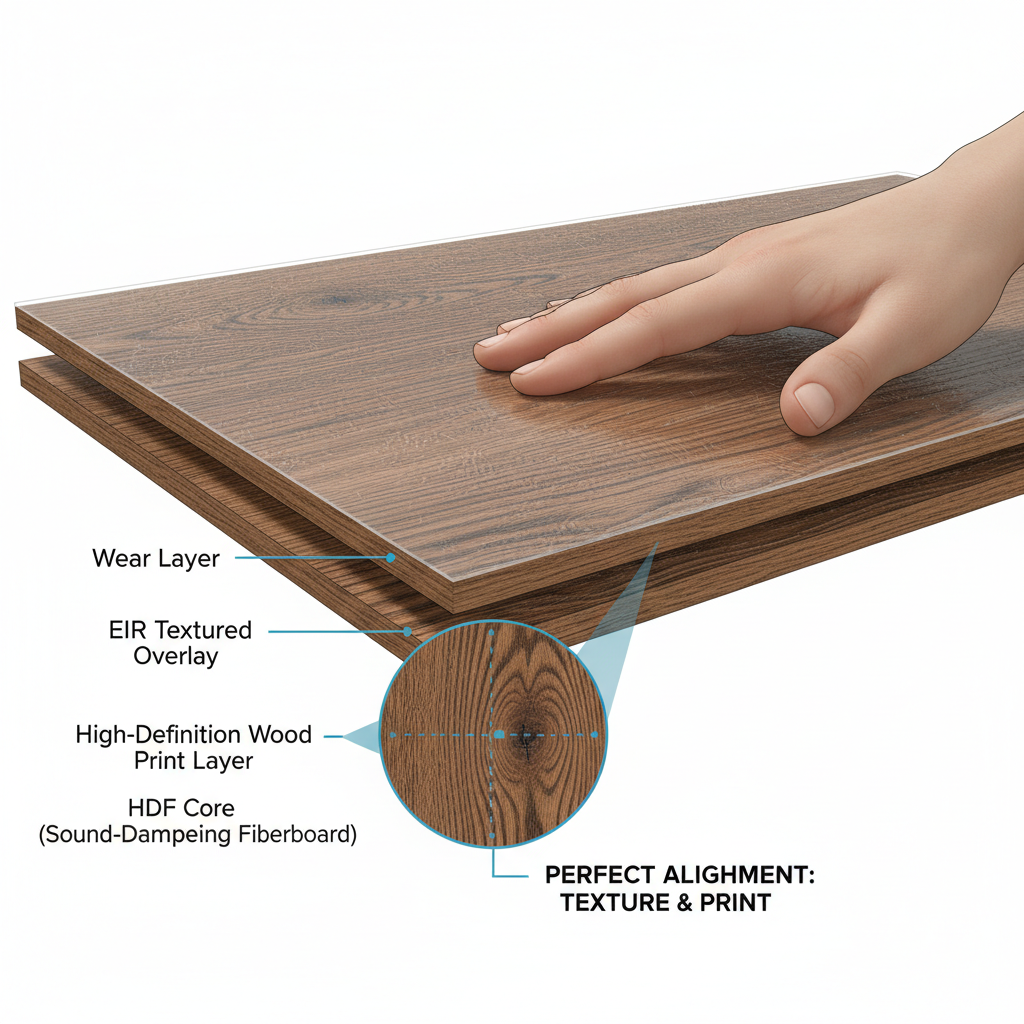
What type of flooring looks most like natural wood? The answer lies in a manufacturing breakthrough called Embossed-in-Register (EIR) technology. In older generations of laminate or vinyl, a wood grain photograph was simply printed onto a flat surface, resulting in a fake, plastic appearance.
EIR technology changes everything. During the manufacturing process, the physical surface texture—the micro-bevels, the knots, the grain lines—is stamped into the wear layer so that it aligns perfectly with the high-definition photographic print beneath it. When you run your hand over an EIR plank, you feel the knot exactly where you see it. Retail authorities at Flooring America [5] note that this technology, combined with current design trends like multi-tonal blonde tones and high-variation planks (where no two boards look exactly alike), has created a new class of synthetic flooring that routinely fools even seasoned interior designers.
Water-Resistant vs. 100% Waterproof: Reading the Fine Print
When shopping for waterproof wood look flooring, the most critical distinction you can make is understanding the difference between “water-resistant” and “100% waterproof.”
Water-resistant flooring (like many modern laminates) relies on tight locking systems and hydrophobic topical coatings to keep water pooled on the surface. It buys you time to wipe up a spill. However, can standing water ruin waterproof flooring? If left long enough, water can eventually seep through the seams of water-resistant floors and swell the core.
Truly waterproof flooring utilizes a core made of Stone Polymer Composite (SPC) or Wood Plastic Composite (WPC). These materials are structurally impervious to water. To establish technical authority, manufacturers often subject these cores to rigorous ASTM (American Society for Testing and Materials) testing standards for water absorption [6], proving they will not swell or degrade even if submerged.
However, you must read the warranty fine print. Even if a plank is 100% waterproof, the subfloor beneath it is not. If a catastrophic flood allows water to breach the perimeter of the room and get under the floor, the waterproof planks will survive, but they will still need to be uninstalled to dry the wooden subfloor and prevent mold.
The Hybrid Hardwood Breakthrough: The Ultimate No-Compromise Solution
If you refuse to settle for a printed photograph of wood, but you cannot risk the water damage associated with solid hardwood, you are the ideal candidate for the industry’s most exciting innovation: hybrid hardwood flooring. This category represents the ultimate “best of both worlds” solution.
What Exactly is Hybrid Hardwood Flooring?
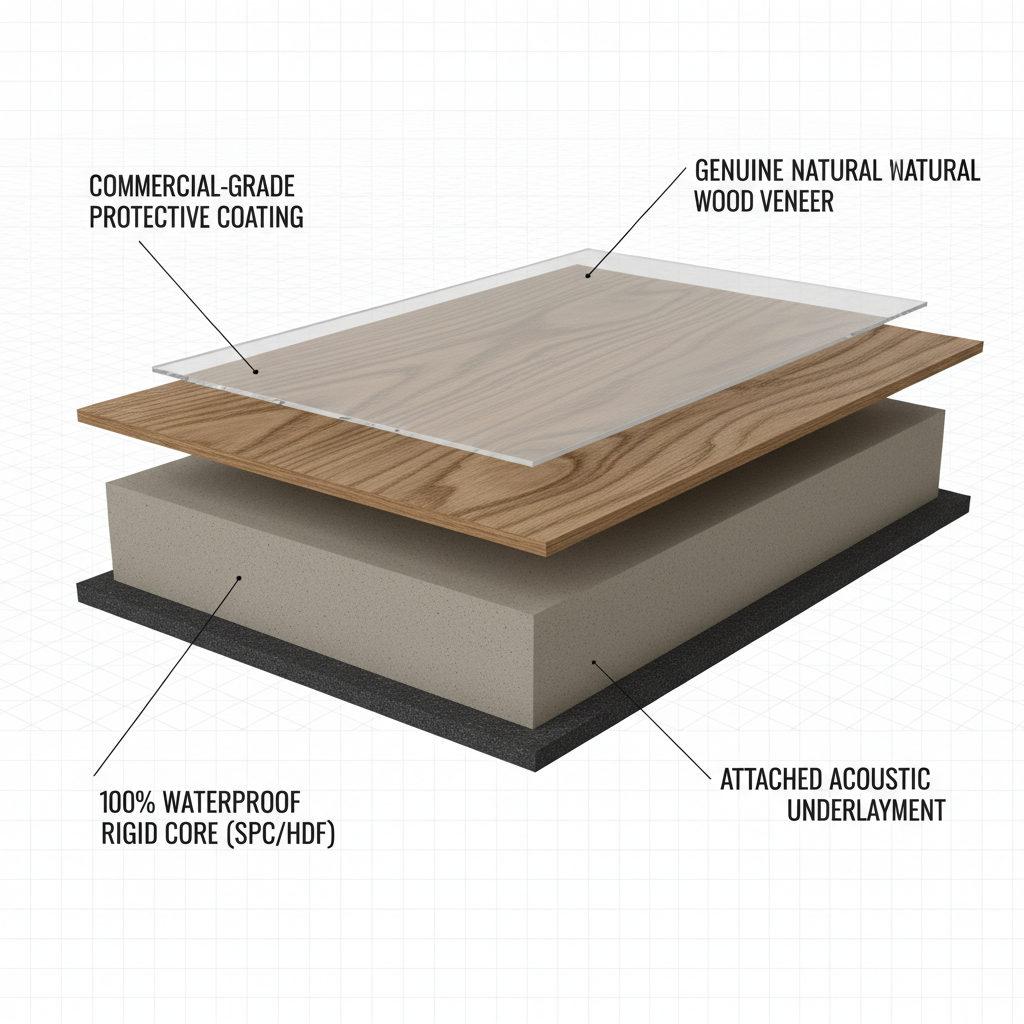
What is hybrid resilient flooring, and is it better than traditional engineered wood? Traditional engineered wood features a real wood veneer glued to a plywood core. While more dimensionally stable than solid wood, plywood is still wood—it will warp and delaminate if exposed to significant moisture.
Hybrid hardwood flooring replaces that plywood core with a 100% waterproof rigid core, typically made of Stone Polymer Composite (SPC) or High-Density Fiberboard (HDF) treated with advanced resins. Imagine a cross-section of this flooring: at the base is an attached acoustic underlayment; above that sits the dense, waterproof SPC core; and bonded to the very top is a slice of genuine, natural wood veneer (usually 1.2mm to 2mm thick), finished with a commercial-grade protective coating.
Because the top layer is real wood, there are no repeating print patterns. It is wood. Certified flooring inspectors routinely praise the dimensional stability of these hybrid cores, noting that the SPC layer prevents the natural wood veneer from expanding and contracting wildly with humidity changes [7]. Furthermore, experts at Unique Wood Floors point out that premium hybrids with a veneer thickness of 2mm or more can actually be lightly sanded and refinished 3 to 4 times over their lifespan, matching the longevity of traditional floors [8].
Comparing Top Brands and Proprietary Technologies
If you are searching for the best waterproof hybrid hardwood flooring, several proprietary technologies lead the market.
- MSI Woodhills: This line utilizes a patent-pending Dryluxe technology. It features a robust 7mm total thickness, including a non-PVC polymer core and a closed-cell attached pad for superior acoustic performance [9].
- Cali GeoWood: Cali Bamboo revolutionized the space by bonding real European Oak and Hickory veneers to a proprietary limestone composite core, offering extreme dent resistance and 100% waterproof core stability [10].
- Bruce Nature of Wood / Techtanium Plus: Bruce Flooring offers hybrid options coated with their Techtanium Plus finish, which claims to offer twice the scratch resistance of standard 22 mil wear layer alternatives, making it ideal for active homes [11].
Cost Analysis: Hybrid Hardwood vs. LVP vs. Engineered Wood
How much does hybrid hardwood flooring cost compared to LVP? Generally, hybrid hardwood sits at a premium price point above standard LVP, but below high-end solid hardwood. However, the long-term ROI and home resale value are exceptional. Because it features a real wood veneer, it appraises as real wood in the eyes of homebuyers, unlike vinyl.
Installation costs are also mitigated. As the installation experts at Six Floors Down explain, hybrid hardwoods utilize a floating click-and-lock system [12]. This mechanics make it incredibly DIY-friendly and eliminates the need for expensive glues or nail-down labor associated with traditional wood. Just remember that because the top layer is natural wood, a mandatory 48-hour acclimation period in the room of installation is required before locking the boards together.
Top Waterproof Hardwood Alternatives Compared
For homeowners who want the aesthetic of wood but prefer 100% synthetic materials for extreme durability, budget constraints, or a desire for a truly low maintenance hardwood alternative, the market offers three dominant categories.
Premium Luxury Vinyl Plank (LVP)
How does LVP compare to waterproof engineered hardwood? While hybrid hardwood uses a real wood veneer, LVP is entirely synthetic. It features a rigid core (usually SPC or WPC) topped with a high-definition photographic print and a clear, protective urethane wear layer.
Coretec, the pioneer of WPC technology, revolutionized this space by proving that multi-layer rigid core vinyl could be both beautiful and structurally sound [13]. The durability of LVP is dictated by its wear layer, measured in “mils” (thousandths of an inch). For active residential use, look for a wear layer between 12 mil and 20+ mil. The greatest advantage of LVP as a waterproof hardwood alternative is its absolute zero-maintenance profile—its factory wear layer eliminates the need for waxing, oiling, or refinishing forever.
Waterproof Laminate (The RevWood Revolution)
What is the difference between waterproof laminate and LVP? While LVP is made of plastics and polymers, laminate is made of highly compressed wood byproducts (HDF). Historically, laminate was notoriously susceptible to water damage.
Today, that has changed. Is RevWood truly waterproof? Mohawk Flooring’s RevWood line has blurred the lines between laminate and vinyl. By utilizing proprietary WetProtect technology—which features incredibly tight, patented locking joints and hydrophobic chemical coatings that repel water—these laminates keep moisture trapped on the surface [14]. Does waterproof laminate actually work in bathrooms? Yes, for topical spills and wet footprints, premium waterproof laminates perform exceptionally well, though LVP or Hybrid SPC remains the safer choice for full bathrooms with heavy shower steam.
Wood-Look Porcelain Tile and Bamboo
For the ultimate durable wood look flooring for homes, wood-look porcelain tile reigns supreme. Is wood look tile better than LVP? In terms of raw durability, yes. It is virtually impervious to water, scratches, and dents. However, experts at The Tile Shop highlight significant drawbacks: porcelain is cold and hard underfoot (often requiring radiant heating), and the subfloor preparation and thin-set mortar installation make it significantly more expensive to install than floating floors [15].
Alternatively, if you seek an eco-friendly, highly durable option, consider strand-woven bamboo. While not waterproof, strand-woven bamboo is created by compressing bamboo fibers under extreme heat and pressure, resulting in a floor that is often significantly harder and more dent-resistant than traditional oak.
The Lifestyle Matchmaker: Choosing Your No-Compromise Floor
Choosing the right floor is not just about aesthetics; it is about matching the material’s engineering to your specific home stress factors. Use this transparent assessment to find your perfect fit.
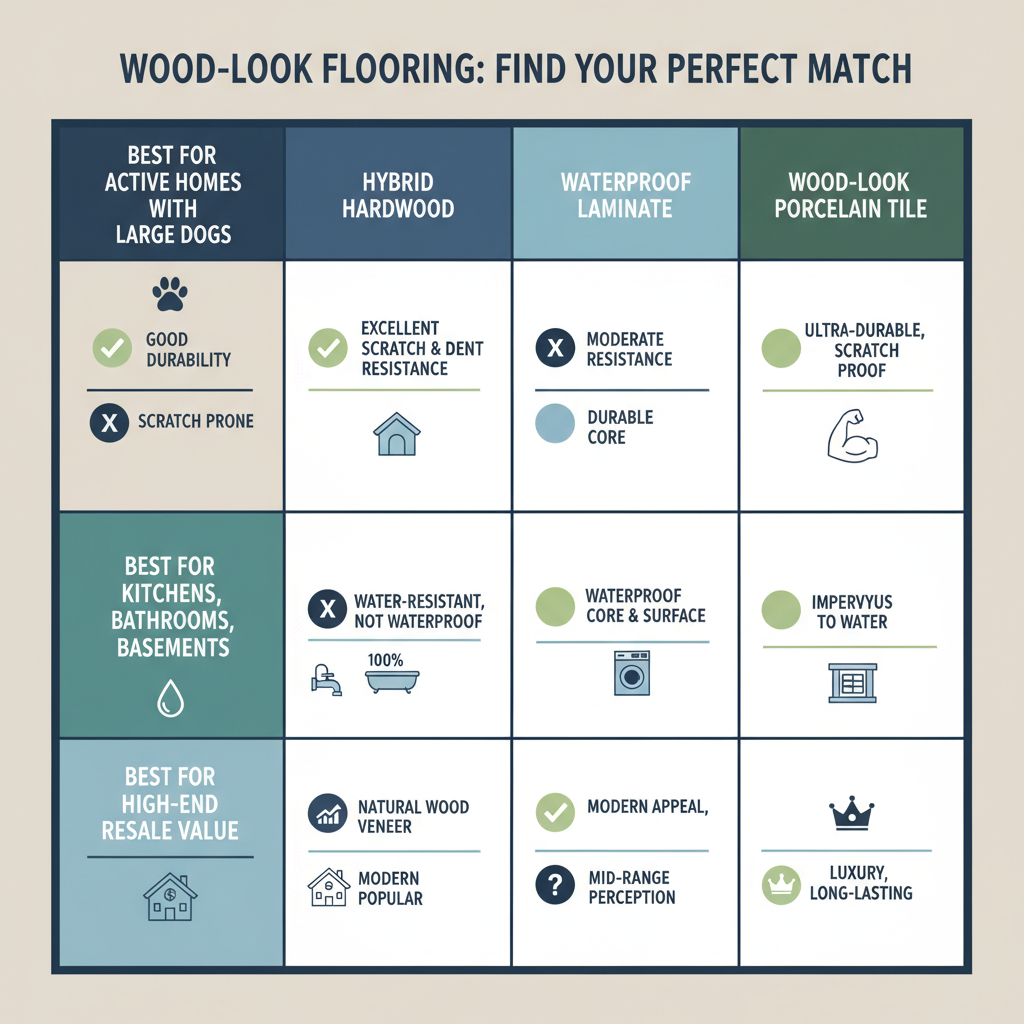
Best for Active Homes with Large Dogs
Which wood look flooring is the most durable for dogs? If you have large dogs with unclipped nails, traditional hardwood will show wear within months. Your best options are wood-look porcelain tile (which is entirely scratch-proof) or a premium LVP with a 20+ mil wear layer, which offers excellent scratch resistance with a softer, warmer underfoot feel. If you demand real wood, look to engineered solutions specifically designed for extreme pet durability, such as Bruce Flooring’s Dogwood Pro, which uses a densified wood technology to resist gouges [16].
Best for Kitchens, Bathrooms, and Basements
What is the most water-resistant wood flooring? Solid wood fails in these environments due to humidity and spill risks. For kitchens and half-baths, Waterproof Laminate or LVP are excellent choices. However, for full bathrooms (with showers) and below-grade basements prone to moisture vapor, you need a 100% waterproof core. SPC-core Hybrid Hardwood or premium LVP are the only reliable choices here, as their stone/polymer cores will not expand or contract with moisture.
Best for High-End Resale Value and Prestige
Do high-end homes use vinyl flooring? While premium LVP has made massive strides, there remains a slight stigma against “vinyl” in the ultra-luxury real estate market. There is a tactile difference—the sound of footsteps and the thermal feel underfoot—between synthetic LVP and real wood. If you want the cheapest installation with the best ROI, LVP wins. But if you are renovating a high-end property and want to bridge the gap between prestige and practicality, Hybrid Hardwood is the ultimate choice. It appraises as real wood because it is real wood on the surface, satisfying luxury buyers while providing the waterproof peace of mind modern homeowners demand.
Conclusion
The era of suffering through the exhausting upkeep of traditional solid wood is over. The flooring industry has evolved, bringing high-tech, resilient solutions into the residential space. Whether you choose the impenetrable durability of wood-look porcelain tile, the zero-maintenance ease of premium LVP, or the revolutionary, best-of-both-worlds engineering of Hybrid Hardwood, you no longer have to compromise.
You can achieve a breathtaking, authentic wood aesthetic that effortlessly survives large dogs, spilled wine, and the chaos of an active family. We encourage you to assess your home’s specific stress factors using the Lifestyle Matchmaker above. Then, take the next step: order physical samples of Hybrid Hardwood and Premium LVP. Run your hands over the EIR texture, test their waterproof claims with a glass of water, and experience the future of no-compromise flooring for yourself.
Disclaimer: Water damage triage advice is for informational purposes. Severe flooding or structural water damage should always be evaluated by a certified water damage restoration professional to prevent mold and structural failure.
References & Authoritative Sources
- Duffy Floors. (N.D.). Expert insights on hardwood cupping, crowning, and water damage timelines. Retrieved from industry research on hardwood water damage mitigation.
- Phil’s Carpets and Flooring Inc. (N.D.). Step-by-step water damage restoration techniques and the dangers of sanding wet wood. Retrieved from industry research on hardwood repair.
- SVB Wood Floors. (N.D.). Professional wood floor refinishing and finish identification for scratch repair. Retrieved from industry research on hardwood maintenance.
- National Wood Flooring Association (NWFA). (N.D.). Wood Flooring Moisture Guidelines and Routine Maintenance Standards. Retrieved from NWFA official guidelines.
- Flooring America. (N.D.). Current flooring trends, Embossed-in-Register (EIR) technology, and consumer preferences. Retrieved from retail industry insights.
- American Society for Testing and Materials (ASTM). (N.D.). Standard Test Methods for Water Absorption in Flooring Materials. Retrieved from ASTM international standards.
- [Certified Flooring Inspector]. (N.D.). Analysis of dimensional stability in SPC vs. HDF hybrid cores. Quoted from industry research on hybrid resilient flooring.
- Unique Wood Floors. (N.D.). Standards for solid hybrid-engineered wood floors and veneer thickness refinishing capabilities. Retrieved from industry research on hybrid hardwood.
- MSI Surfaces. (N.D.). Woodhills Collection and patent-pending Dryluxe waterproof technology specifications. Retrieved from MSI product data.
- Cali Bamboo / Cali Floors. (N.D.). GeoWood limestone composite hybrid flooring innovations. Retrieved from Cali Bamboo product data.
- Bruce Flooring / AHF Products. (N.D.). Techtanium Plus coating and hybrid resilient flooring specifications. Retrieved from Bruce.com.
- Six Floors Down. (N.D.). Professional flooring installation benefits of rigid core construction and click-and-lock systems. Retrieved from industry installation guides.
- Coretec. (N.D.). Pioneering Wood Plastic Composite (WPC) waterproof flooring technology. Retrieved from Coretec product history.
- Mohawk Flooring. (N.D.). RevWood waterproof laminate and WetProtect technology specifications. Retrieved from Mohawk Flooring product data.
- The Tile Shop. (N.D.). Porcelain tile durability, subfloor preparation, and installation requirements. Retrieved from retail industry insights.
- Bruce Flooring. (N.D.). Dogwood Pro densified wood technology for extreme pet durability. Retrieved from Bruce.com product data.
