
Every homeowner knows the classic flooring dilemma: you desperately want the aesthetic prestige, warmth, and resale value of real hardwood, but you live in a reality of muddy paws, spilled sippy cups, and heavy foot traffic. For decades, the flooring industry forced a compromise. You could either baby a fragile solid wood floor, or settle for the synthetic repetition of vinyl and laminate.
Fortunately, flooring technology has evolved. Enter the “zero-compromise” solution: hybrid hardwood. By fusing a genuine wood veneer with a rigid, waterproof core, products like Bravewood Hybrid Hardwood are revolutionizing how we design active living spaces.
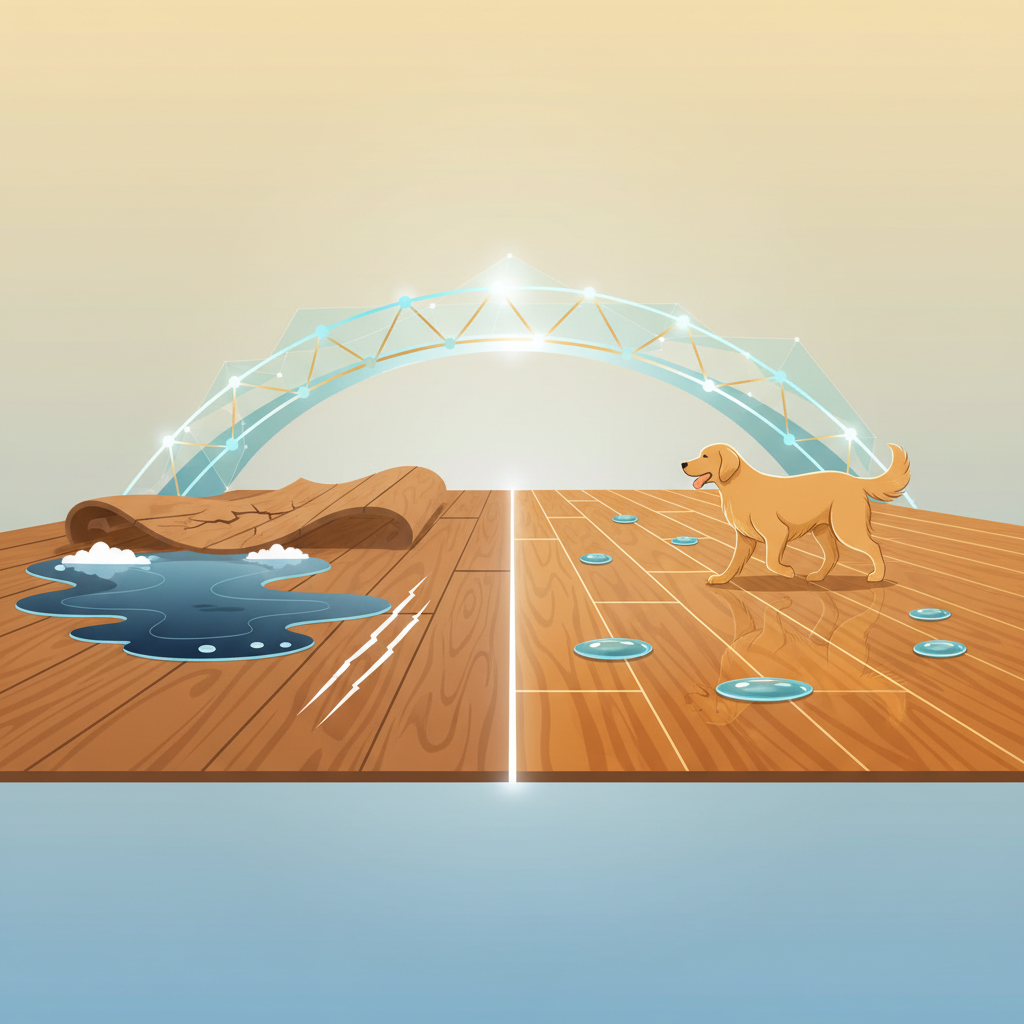
This comprehensive, science-backed guide will move past the marketing jargon to decode wear layers, acoustic dampening, and waterproof cores. Whether you are searching for the ultimate pet-friendly waterproof flooring or trying to salvage an existing floor from water damage, this guide will help you make an informed, ROI-positive investment for your busy home.
- Demystifying the Materials: What is Hybrid Hardwood?
- The ‘Busy Family Stress Test’: Durability and Acoustics
- Pet-Friendly Perfection: Surviving Claws, Paws, and Accidents
- Moisture Management: From Waterproof Cores to Emergency Triage
- Conclusion
- References & Authoritative Sources
Demystifying the Materials: What is Hybrid Hardwood?
To make an informed decision, we first need to clarify what hybrid hardwood actually is. The flooring market is flooded with confusing terminology, often blurring the lines between “water-resistant” and “waterproof.”
According to classifications set by the National Wood Flooring Association (NWFA) [1], it is crucial to distinguish between true waterproof engineered hardwood and wood-look waterproof flooring. Wood-look flooring, such as Luxury Vinyl Plank (LVP) or laminate, uses a high-definition photographic layer to mimic wood grain. Hybrid hardwood floors, on the other hand, feature a top layer of real natural wood veneer bonded to a 100% waterproof Stone Polymer Composite (SPC) or Wood Plastic Composite (WPC) rigid core.
This construction satisfies the core user intent: achieving authentic, unrepeated wood aesthetics without the moisture vulnerability that plagues traditional solid hardwood.
To understand the long-term value, consider this 20-Year Cost-Over-Time ROI Matrix:
- Solid Hardwood: High initial cost. High resale value. Requires careful moisture management. Can be refinished 4-7 times. 20-year cost is high due to maintenance and potential water damage repairs.
- Luxury Vinyl Plank (LVP): Low to medium initial cost. Lower resale value (synthetic). 100% waterproof. Cannot be refinished. 20-year cost is moderate, but may require full replacement if heavily damaged.
- Hybrid Hardwood (e.g., Bravewood): Medium to high initial cost. High resale value (real wood). 100% waterproof core. Cannot be traditionally refinished. 20-year cost is highly efficient due to extreme durability and retained home value.
The Anatomy of Bravewood Hybrid Hardwood
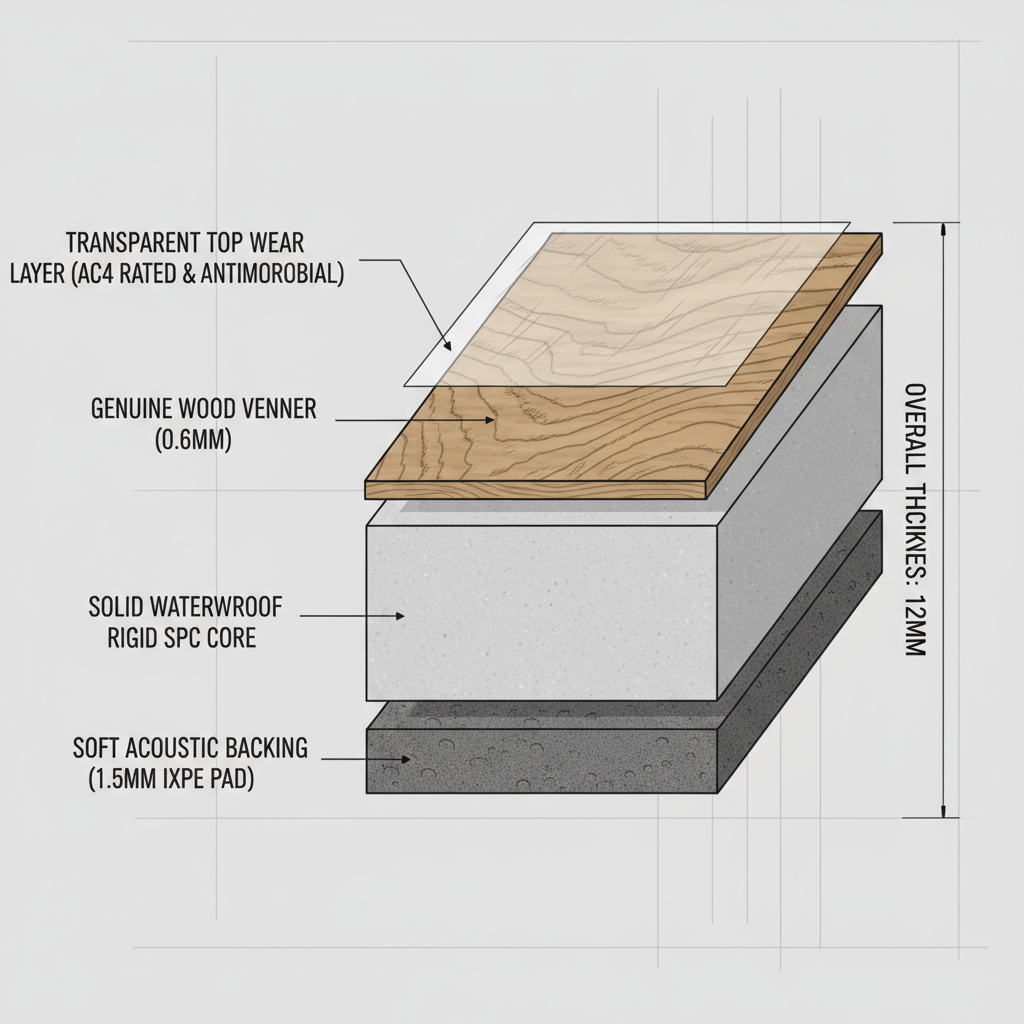
To truly appreciate the benefits of Bravewood hybrid hardwood, you have to look beneath the surface. Based on exact technical specifications from TAS Flooring, the official manufacturer, Bravewood is engineered for maximum stability and performance [2].
If you were to look at a high-resolution cross-section diagram of a Bravewood plank, you would see a highly engineered 12mm overall thickness, broken down into distinct, purposeful layers:
- The Wear Layer & Finish: An AC4 rated antimicrobial surface finish that seals and protects the wood from scratches and bacteria.
- The Real Wood Veneer: A 0.6mm slice of genuine, natural hardwood, providing authentic grain, texture, and color.
- The Waterproof Rigid Core: A dense SPC core that provides structural integrity and prevents the plank from expanding or contracting when exposed to moisture.
- The Acoustic Backing: A 1.5mm IXPE (Irradiated Cross-Linked Polyethylene) attached pad designed for premium sound reduction and underfoot comfort.
Hybrid vs. Solid Wood: The Refinishing Reality Check
While hybrid hardwood floors offer incredible durability, transparency is key when comparing them to solid wood. The most significant limitation of hybrid flooring is that it cannot be sanded and refinished multiple times.
Because the genuine wood veneer on hybrid planks is typically between 0.6mm and 1.2mm thick, taking a heavy drum sander to the surface would quickly burn through to the SPC core below [3]. Solid hardwood, which is wood all the way through, can be sanded down to remove deep gouges every decade or so.
However, real estate appraisers and flooring experts note that while you lose the ability to refinish, hybrid floors still positively impact long-term home valuation compared to LVP [3]. Buyers recognize and value the presence of real wood, and the advanced factory finishes applied to hybrid floors mean they rarely need the refinishing that traditional wood demands anyway.
The ‘Busy Family Stress Test’: Durability and Acoustics
When searching for the best waterproof wood flooring for busy homes, aesthetics alone won’t cut it. The floor must survive the daily abuse of dropped toys, heavy foot traffic, and the chaotic energy of an active household.
Objective data is vital here. In standardized surface-wear abrasion tests conducted by independent organizations like Consumer Reports, prefinished solid wood often receives less-than-satisfactory ratings when subjected to heavy grit and traffic [4]. In contrast, multi-layer SPC and LVT (Luxury Vinyl Tile) products excel in high traffic flooring wear.
The secret lies in the wear layer. In synthetic floors, wear layer thickness (measured in “mils,” or thousandths of an inch) directly correlates to traffic endurance. A 20 mil wear layer is considered commercial-grade and will vastly outperform a standard 12 mil residential layer. In hybrid hardwoods, this durability is achieved through advanced chemical finishes applied directly to the wood veneer.
Decoding Scratch Resistance and AC4 Ratings
What makes a scratch resistant hybrid hardwood so tough? It goes far beyond the natural hardness of the wood species. Modern hybrid floors utilize advanced factory finishes, specifically Aluminum Oxide or Ceramic-bead coatings.
Aluminum sesquioxide surfaces, cured under intense UV light, can offer up to 4X more scratch resistance than traditional polyurethane finishes applied on-site [5]. This microscopic armor prevents dog claws and sliding chairs from penetrating the wood grain.
Furthermore, Bravewood features an AC4 rated antimicrobial surface finish. The AC (Abrasion Class) rating system is a standardized measure of durability. An AC4 rating means the floor is approved for heavy residential use and moderate commercial traffic (like small offices or boutiques). The added antimicrobial properties ensure that the floor actively inhibits the growth of bacteria, a crucial health benefit for homes with crawling toddlers and pets.
Silencing the Echo: Acoustic Dampening in Two-Story Homes
A major complaint regarding hard-surface flooring in busy homes is the acoustics. The loud, hollow “clicking” of dog nails or the echoing thud of footsteps can turn a peaceful two-story home into a noisy echo chamber.
Acoustic performance is measured by IIC (Impact Insulation Class) and STC (Sound Transmission Class) ratings. Higher numbers indicate better sound absorption. Bravewood addresses this directly with its integrated 1.5mm IXPE attached pad. This closed-cell foam layer acts as a shock absorber, neutralizing impact noise and preventing sound from transmitting to the rooms below, making it an ideal choice for second-floor installations and active living spaces.
Pet-Friendly Perfection: Surviving Claws, Paws, and Accidents
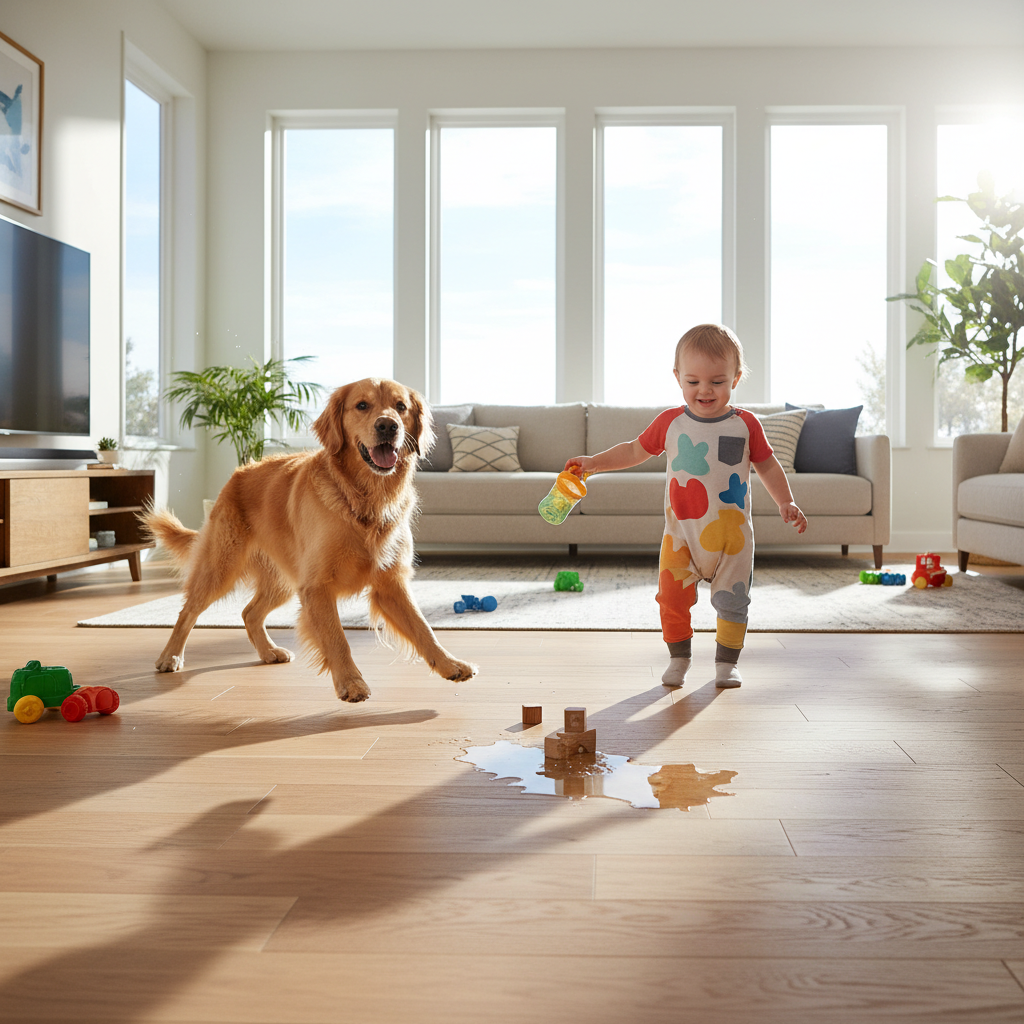
For dog owners, finding durable wood-look flooring for dogs is often the primary driver of a renovation. The ideal pet-friendly waterproof flooring requires a specific “trifecta”: a 100% waterproof core for inevitable accidents, an ultra-scratch-resistant wear layer for frantic claws, and acoustic backing to muffle the sound of pacing paws.
When evaluating natural wood, we use the Janka hardness scale to mathematically gauge resistance to denting and wear. For instance, Hickory boasts a formidable Janka rating of 1820, while Acacia sits around 1700, making them naturally better suited to resist the pressure of a large dog’s claws compared to softer woods [6].
However, pet owners must also consider traction. Ultra-smooth, high-gloss floors can cause older dogs with mobility issues to slip, leading to joint injuries. Hybrid hardwoods with textured finishes offer better grip. Additionally, premium hybrid floors are strictly regulated for low VOC (Volatile Organic Compound) emissions, ensuring the floor your pet sleeps on is non-toxic and safe.
Camouflaging Damage: Wire-Brushed Finishes and Densified Wood
Even the most durable wood-look flooring can suffer minor micro-scratches over a decade of heavy pet use. The strategic move is to choose a floor that actively camouflages wear.
Wire-brushed, hand-scraped, or distressed finishes are incredibly forgiving. Because the texture is already intentionally varied and matte, a minor surface scratch blends seamlessly into the aesthetic, whereas it would glare brightly on a smooth, high-gloss floor.
For those who want the ultimate in dent resistance, Densified Wood technology is a game-changer. Products like Bruce’s Dogwood utilize a process that compresses the wood veneer, increasing its density dramatically. Data shows this technology yields 4x the scratch resistance and 6x the dent resistance of standard, untreated hardwoods [7].
Fixing Pet Scratches and Urine Stains
If you are dealing with scratched flooring from pets on an existing wood floor, a tiered repair approach is necessary.
- Surface Scuffs: Minor scratches in the clear coat can often be buffed out using a specialized wood floor restorer or a walnut (the natural oils hide the scratch).
- Deep Gouges: For scratches that penetrate the finish and expose raw wood, use a color-matching wood putty. Carefully fill the gouge, level it, and apply a dab of polyurethane. Warning: Never attempt to aggressively sand a small spot on an aluminum oxide finished floor, as you will create a cloudy, un-blendable patch [8].
- Pet Urine Stains: If pet urine has penetrated the finish, it reacts with the tannins in the wood, creating a dark black stain. To fix this, you must strip the finish over the spot and apply a two-part wood bleach (hydrogen peroxide and sodium hydroxide) to lift the dark stain before neutralizing, staining, and refinishing the area [8].
Moisture Management: From Waterproof Cores to Emergency Triage
Water is the natural enemy of traditional hardwood. Understanding moisture management is critical, whether you are installing new waterproof wood flooring or trying to save an old floor.
It is vital to differentiate between topical water resistance and structural waterproof cores. A solid oak floor finished with a high-quality polyurethane is water-resistant—it will repel a spilled glass of water if wiped up quickly. However, if water seeps between the planks, the wood will absorb it and warp. Hybrid floors with SPC or WPC cores are structurally waterproof; the core itself is inert and will not expand, swell, or degrade even if fully submerged.
However, a critical content gap in many flooring warranties is the subfloor moisture barrier requirement. Even if your hybrid plank is 100% waterproof, if moisture rises from a concrete subfloor, it can trap mold beneath the planks. Always install a 6-mil poly moisture barrier over concrete subfloors to ensure your waterproof warranty remains valid.
Is Bravewood Completely Waterproof?
Yes, Bravewood Hybrid Hardwood is engineered to be waterproof from the top down and the bottom up. The real wood veneer is protected by advanced hydrophobic sealants and the AC4 finish, preventing topical spills from penetrating the wood grain [2]. Beneath that, the rigid SPC core ensures the plank will not warp or buckle.
Furthermore, Bravewood utilizes Embossed In Register (EIR) design technology. This means the protective surface texture perfectly aligns with the visual grain of the real wood veneer beneath it. You get the authentic tactile feel of natural wood, completely encased in a waterproof, life-proof shield.
Emergency Triage Guide for Water-Damaged Wood Floors
If you currently have traditional solid wood floors and suffer a severe leak or flood, you are dealing with water damaged wood floors. The clock is ticking; the first 24 to 48 hours are critical to prevent permanent mold colonization and structural warping [9].
Follow these emergency mitigation protocols, aligned with IICRC (Institute of Inspection, Cleaning and Restoration Certification) standards [10]:
- Stop the Source and Extract: Immediately stop the water flow. Use wet vacuums to extract standing water. Do not use heat to dry the floors rapidly, as this will shock the wood and cause severe splitting.
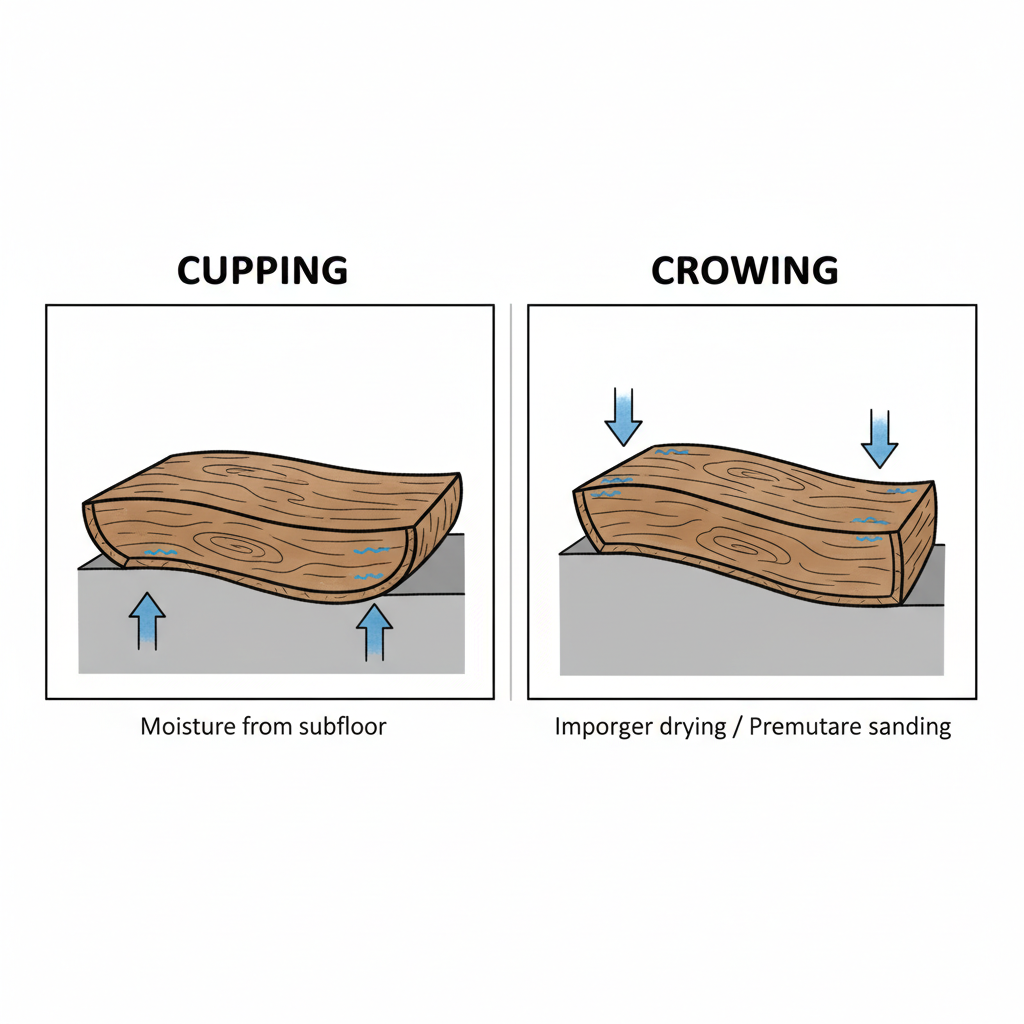
- Assess Cupping vs. Crowning: As wood absorbs moisture from the bottom (subfloor), the edges of the planks swell and rise higher than the center. This is called cupping. If the floor is dried improperly or sanded prematurely while the bottom is still wet, the top will eventually dry and shrink, leaving the center of the plank higher than the edges. This permanent, irreversible damage is called crowning [11].
- Professional Moisture Testing: Call a professional who uses specialized equipment. They will use pinless moisture meters to scan large areas without damaging the wood, and pin meters to get exact moisture content readings deep within the subfloor [11].
- Dehumidification: Industrial dehumidifiers and air movers must be run continuously. The active drying phase typically takes 7 to 10 days.
- Insurance: Document everything with photos immediately and contact your homeowner’s insurance before pulling up any planks, as premature removal can void claims.
Conclusion
The era of choosing between a beautiful home and a lived-in home is over. Bravewood Hybrid Hardwood and similar advanced flooring technologies offer the ultimate compromise for aesthetic purists who demand modern, life-proof durability. By fusing the unmistakable beauty of genuine wood veneers with the indestructible nature of waterproof rigid cores and acoustic dampening pads, homeowners can finally breathe easy. You no longer have to sacrifice the resale value and warmth of real hardwood for a floor that can effortlessly survive dogs, kids, and the inevitable spills of daily life.
If you are ready to upgrade your home, we highly encourage you to order a sample of Bravewood Hybrid Hardwood to test its scratch resistance and acoustic feel in your own space, or consult with a certified local flooring installer to assess your subfloor and begin your renovation journey.
The information provided regarding water damage triage and flooring repair is for educational purposes. Always consult a certified flooring installer or IICRC-certified restoration professional for severe water damage or structural subfloor issues.
References & Authoritative Sources
- National Wood Flooring Association (NWFA). (N.D.). Wood Flooring Classifications and Moisture Standards. Retrieved from NWFA industry guidelines.
- TAS Flooring. (N.D.). Bravewood Hybrid Hardwood Technical Specifications and Warranty Data. Retrieved from tasflooring.com.
- Sensse Floor & Payless United. (N.D.). Hybrid Flooring Lifespans, Refinishing Limitations, and Resale Value. Retrieved from senssefloor.com and paylessunited.com.
- Consumer Reports. (N.D.). Flooring Surface-Wear Abrasion Machine Tests. Retrieved from consumerreports.org.
- Lee Flooring & Wallys Carpet. (N.D.). Aluminum Sesquioxide Coating Technology and Scratch Resistance Multipliers. Retrieved from leeflooring.ca and wallyscarpet.com.
- Hardwood Bargains. (N.D.). Wood Species Durability and Janka Hardness Ratings. Retrieved from hardwoodbargains.com.
- Bruce Flooring. (N.D.). Dogwood Densified Wood Technology: Scratch and Dent Resistance Data. Retrieved from bruce.com.
- Weatherall & McMillan Floors. (N.D.). DIY Repair Techniques for Wood Floor Restoration and Pet Damage. Retrieved from weatherall.com and mcmillanfloors.com.
- Certified Water and Fire. (N.D.). Mold and Cupping Development Timelines in Water Damaged Wood. Retrieved from certifiedwaterandfire.com.
- Institute of Inspection, Cleaning and Restoration Certification (IICRC). (N.D.). Standards for Water Damage Restoration.
- Duffy Floors. (N.D.). The Risks of Premature Sanding: Cupping vs. Crowning. Retrieved from duffyfloors.com.
