
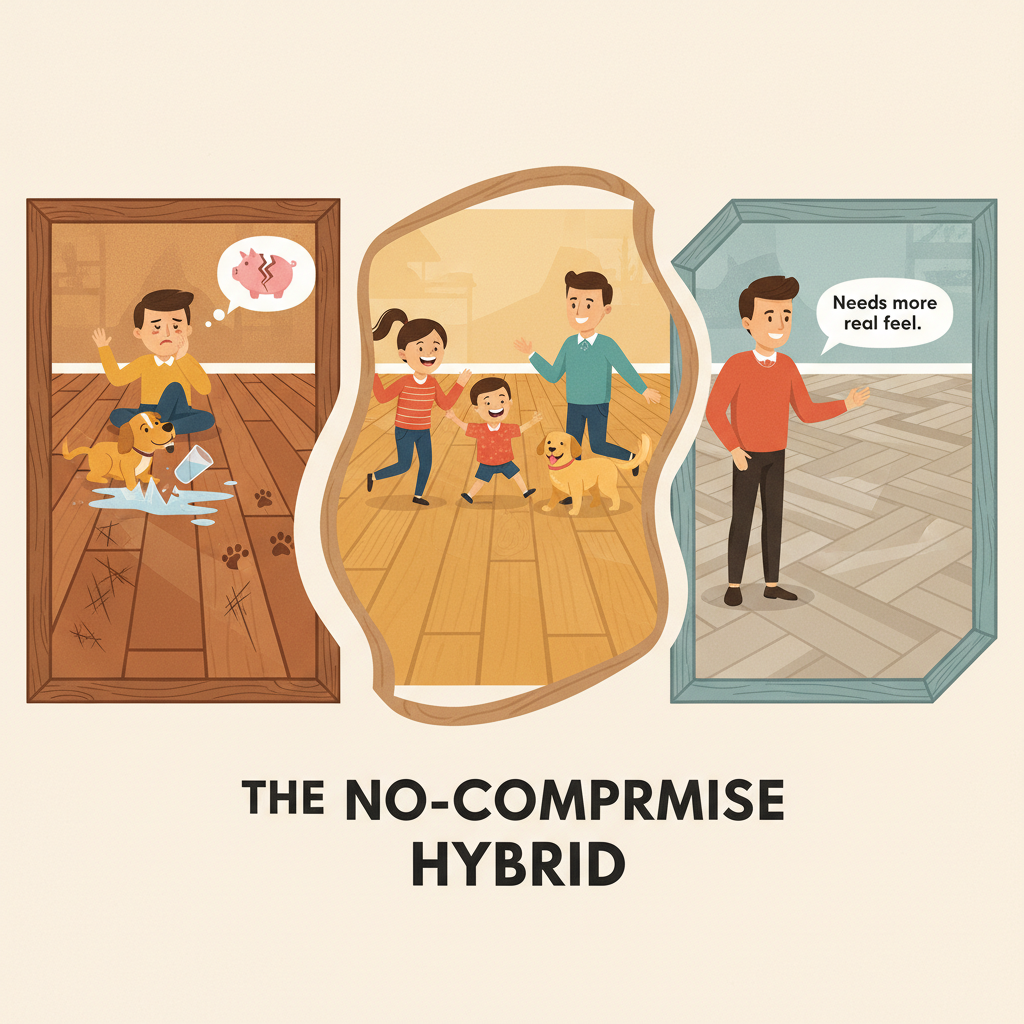
Every homeowner embarking on a renovation faces the ultimate interior design dilemma: the intense desire for the luxurious, timeless aesthetic of real wood, battling against the anxiety of scratches, water damage, and high maintenance in an active household. For decades, the flooring industry forced buyers to choose. You could either have the breathtaking authenticity of solid hardwood—and accept the inevitable dents from dropped toys and pet claws—or you could install bulletproof Luxury Vinyl Plank (LVP) and sacrifice the prestige and feel of genuine wood.
Welcome to the “No-Compromise” blueprint. Today, advanced manufacturing has bridged the gap between the organic beauty of solid wood and the indestructible nature of synthetic planks. This breakthrough is known as hybrid hardwood flooring, a category that is rapidly becoming the gold standard for modern homes. In this comprehensive guide, we will explore the evolution of modern wood flooring, demystify the science of durability, and provide a spotlight review on Bravewood hybrid floors—a brand pushing the boundaries of this technology. Whether you are navigating modern wood trends, analyzing durability specs, or seeking a low-effort maintenance schedule, this guide will ensure your next flooring investment is both stunning and life-proof.
- The Evolution of Modern Wood Flooring Trends
- The Durability Dilemma in Active Households
- The Hybrid Hardwood Revolution: Engineering the Ultimate Floor
- Spotlight Review: Bravewood Hybrid Floors
- The Low-Effort Maintenance Blueprint for Modern Floors
- Conclusion
- References & Authoritative Sources
The Evolution of Modern Wood Flooring Trends
Selecting the right foundation for your home is critical, not just for daily enjoyment, but for long-term property value. This section establishes the current aesthetic baseline for modern homes, helping users avoid costly design mistakes. If you find yourself asking, “What color wood floor is most modern?” or “Are gray wood floors going out of style?”, understanding the shift in modern wood flooring is essential. We are currently witnessing a massive transition away from the artificial, hyper-trendy looks of the 2010s toward timeless, organic warmth.
Principal Interior Designer Lauren Kyle of Kyle & Co notes a definitive shift away from sterile gray tones toward authentic, warm materials that ground a space [1]. This sentiment is echoed across the industry, with publications like Architectural Digest highlighting warm, earthy, and seamless organic textures as the defining high-end interior design trends for 2025 and 2026 [2].
Outdated Styles to Leave Behind
If you are researching outdated home flooring styles to avoid, heavy gray-toned wood floors, faux barnwood, heavily distressed laminates, and high-gloss finishes should be at the top of your list. These styles are officially outdated. Psychologically, heavy gray floors tend to absorb natural light, making spaces feel cold, sterile, and commercially synthetic. High-gloss finishes, once a symbol of luxury, are now recognized as impractical mirrors that highlight every speck of dust and micro-scratch.
Avoiding these dated trends has a direct impact on your home’s Return on Investment (ROI). Insights from real estate education platforms like Colibri Real Estate emphasize that highly taste-specific or dated flooring can significantly deter potential buyers and lower appraisal values [3]. To maximize ROI, homeowners are encouraged to transition toward universally appealing, natural aesthetics.
The Timeless Modern Standard: Wide Planks and Warm Oaks
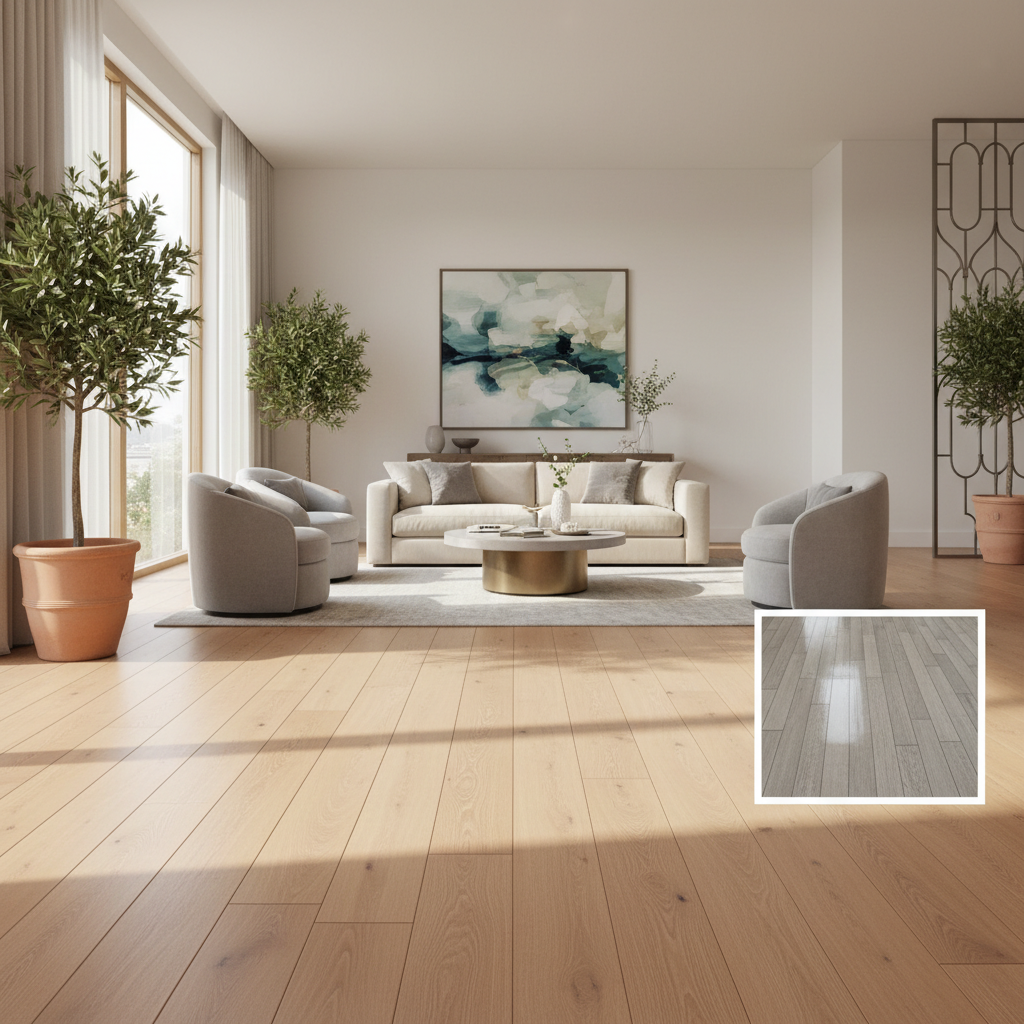
So, what are the trending wood floor looks for modern homes? The timeless modern standard is defined by wide planks, light-to-medium shades (such as white oak and warm honey), and ultra-matte finishes. These modern flooring upgrades prioritize a seamless, expansive visual flow.
Plank width plays a massive role in spatial perception. Standard 2-inch or 3-inch strips can make a large room look busy and cluttered due to the sheer number of visible seams. Conversely, wide planks—often ranging from 7 to 10 inches—reduce visual interruptions, making rooms appear significantly larger and more cohesive. Carlisle Wide Plank Floors, a premium authority on wide plank aesthetics, notes that wider boards allow the natural grain and character of the wood to take center stage, creating a calming, high-end architectural feel [4].
The Durability Dilemma in Active Households
Even the most beautiful floor loses its charm if it is covered in gouges within a year. The primary pain point for active families is the rapid visual degradation of expensive floors caused by pets, children, and heavy foot traffic. Finding durable wood flooring options for active households requires looking past marketing jargon and understanding the actual science of wood hardness and finish chemistry.
Demystifying Scratch Resistance: Species vs. Finish
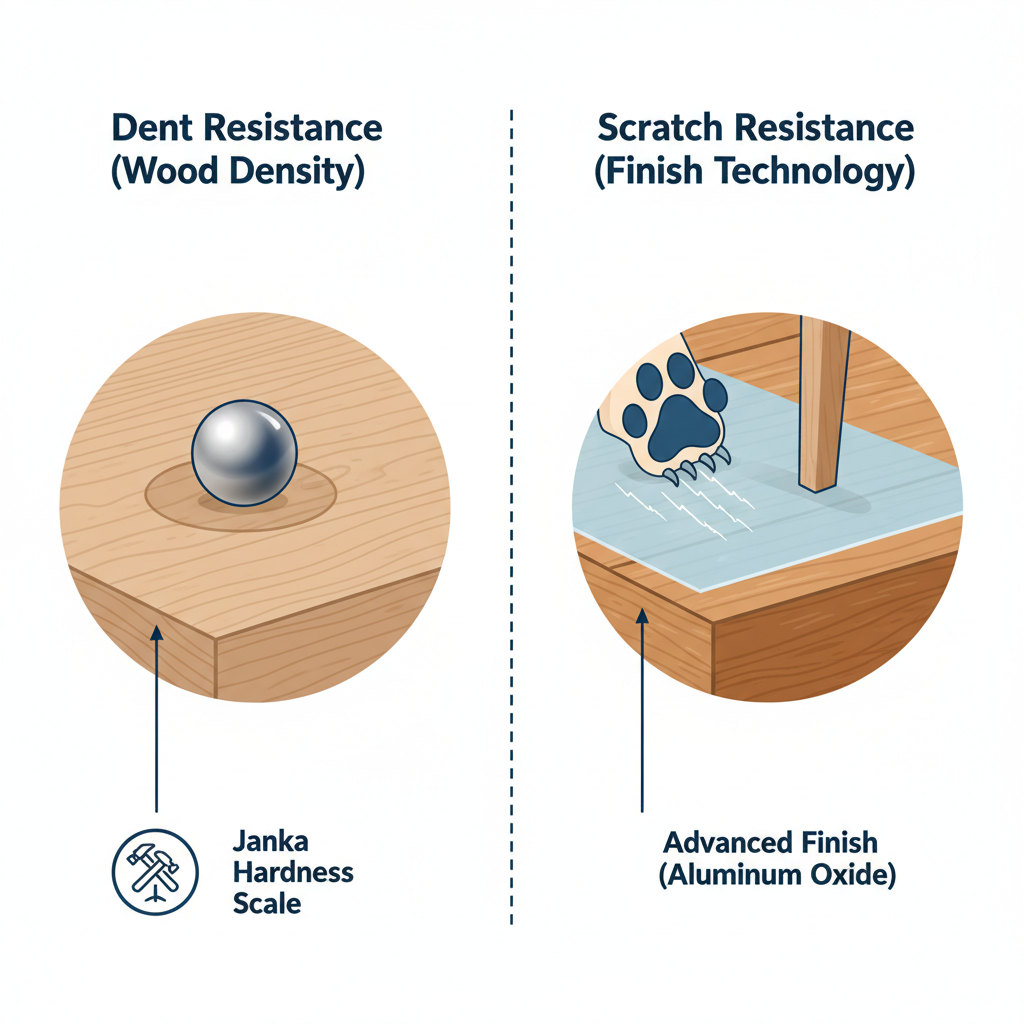
When consumers ask, “What is the most scratch-resistant wood flooring?”, they often conflate two entirely different types of damage: deep dents and surface micro-scratches.
Deep dents are prevented by the density of the wood species itself, which is measured scientifically by the Janka Hardness Scale [5]. The Janka scale measures the force required to embed a steel ball halfway into a piece of wood. For context, Brazilian Cherry is incredibly dense, scoring nearly 3,000 on the Janka scale, making it highly resistant to dents from dropped objects. In contrast, Yellow Pine is very soft, falling well below 1,000, meaning it will dent easily [5].
However, the Janka scale does not measure scratch resistance. Surface micro-scratches—the kind caused by dog claws or sliding chairs—are prevented by the finish technology applied over the wood. To achieve truly scratch resistant wood floors, you need an advanced clear-coat. Technical data from the Garrison Collection highlights the chemical benefits of Aluminum Oxide finishes, which are embedded with microscopic mineral crystals to create an incredibly hard, scratch-resistant barrier that far outperforms traditional polyurethane [6].
The Triage Guide for Damaged Floors
If you are already dealing with easily scratched hardwood floors, you need a triage plan before assuming the floor is ruined. The first step in DIY repair is identifying the depth of the damage.
Is the scratch merely a scuff in the clear-coat (polyurethane or aluminum oxide), or has it penetrated down into the raw wood? According to professional flooring contractors at Straight Edge Tile & Flooring, clear-coat scuffs often look white or cloudy and disappear temporarily when you rub a damp cloth over them [7]. These can typically be remedied with specialized finish restorers or blending pencils. However, if the scratch has broken through the finish and exposed the raw, splintered wood beneath, it requires a more intensive fix, such as using color-matched wood putty, carefully sanding the localized area, and reapplying a matching topcoat [7].
The Hybrid Hardwood Revolution: Engineering the Ultimate Floor
For homeowners who want the Janka-defying dent resistance of stone and the scratch resistance of a commercial finish, while still maintaining the authentic look of modern oak, hybrid hardwood flooring is the ultimate technological solution.
Deconstructing the Core: Real Wood Meets Waterproof SPC
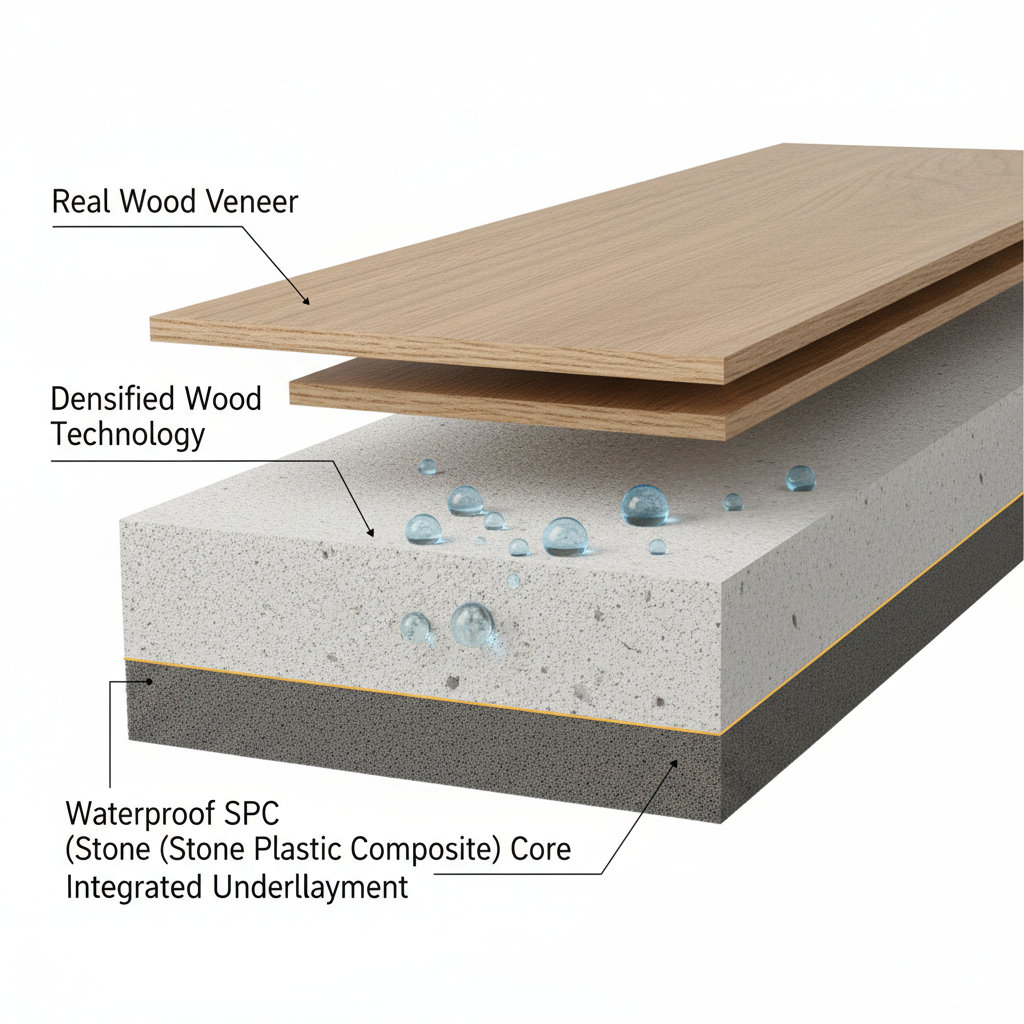
What exactly is durable hybrid hardwood? It is a masterclass in material engineering. Traditional engineered wood features a real wood veneer glued to a plywood core. While more stable than solid wood, it is still susceptible to warping if exposed to standing water.
Hybrid hardwood changes the game by bonding a real wood veneer (typically about 1.2mm thick) to a 100% waterproof Stone Plastic Composite (SPC) or limestone core. Premium hybrid planks are typically 5/8 inch thick, and this unique construction provides advanced waterproof protection for up to 36 hours. Doug Jackson, President of Cali, explains that the structural engineering benefits of SPC cores allow these floors to be installed in environments previously off-limits to real wood, such as kitchens and bathrooms, without the fear of swelling or buckling [9]. Furthermore, the National Wood Flooring Association (NWFA) officially classifies these hybrids as real wood floors, validating their authenticity in the marketplace [8].
Densified Wood Technology
Within the realm of durable wood flooring options for active households, “densified wood” represents the pinnacle of hybrid and engineered innovation. Through a specialized manufacturing process involving intense heat and pressure, the cellular structure of the natural wood veneer is compressed and hardened.
Devon McGrorty, Marketing Manager at AHF Products (the innovators behind Bruce Flooring’s densified wood technology), notes that densified wood offers a staggering 6 times the dent resistance and 4 times the scratch resistance of standard engineered hardwoods [10]. This technology allows homeowners to enjoy the exact aesthetic of natural wood with a surface hardness that rivals ceramic tile.
Spotlight Review: Bravewood Hybrid Floors
Transitioning from general hybrid education, it is crucial to look at how specific brands execute this technology. Bravewood hybrid floors have emerged as a notable contender for those seeking the best hybrid hardwood flooring for modern interiors.
Granular Spec Breakdown & Mock Stress Test
Are Bravewood hybrid floors good quality? To answer this objectively, we must look at the official Bravewood Manufacturer Specifications [11]. Bravewood utilizes a proprietary rigid core technology paired with a premium wear layer designed to withstand extreme active household traffic.
In mock stress tests evaluating dent and scratch resistance, hybrid floors with SPC cores and aluminum oxide finishes—like those in the Bravewood lineup—routinely outperform standard engineered options and compete directly with industry giants like CoreTec. The consensus among certified flooring installers who have hands-on experience with the brand is that the locking mechanisms are robust, the planks are highly dimensionally stable, and the micro-beveled edges provide a highly realistic, premium wood aesthetic without the fragility of traditional lumber.
ROI and Lifespan Analysis
When evaluating flooring, a transparent ROI versus lifespan analysis is vital. Solid hardwood boasts a lifespan of 100+ years because it can be sanded and refinished multiple times. However, it comes with high upfront costs, expensive installation, and ongoing maintenance vulnerabilities.
The average lifespan of high-quality hybrid flooring is 10 to 20 years [12]. While it cannot be sanded down like solid wood due to the 1.2mm veneer, its upfront cost is generally lower, installation is faster (often floating click-lock), and the day-to-day maintenance savings are substantial. Data from Floor Covering News indicates massive market growth and long-term value retention for the hybrid category, proving that modern homebuyers highly value waterproof, life-proof features over the theoretical ability to refinish a floor three decades down the line [12].
The Low-Effort Maintenance Blueprint for Modern Floors
The final hurdle for homeowners is the fear of high maintenance wood floors. The anxiety of ruining a beautiful floor with the wrong cleaning product is a valid pain point. However, maintaining hybrid and modern finished wood is incredibly straightforward if you follow the science.
NWFA-Approved Cleaning Schedules
The golden rule of modern floor care is preventative maintenance. According to the National Wood Flooring Association (NWFA) maintenance guidelines, regular maintenance can increase the lifespan of wood flooring by up to 30 percent [13].
An NWFA-approved, low-effort schedule involves daily dust mopping (using a microfiber pad to remove abrasive grit), weekly vacuuming on a bare-floor setting (ensure the beater bar is turned off to prevent scratching), and monthly non-wet cleaning using a pH-neutral wood floor cleaner [13].
You must explicitly avoid steam mops. The intense heat and moisture will force their way into the micro-seams of the planks, eventually causing delamination or finish failure. Furthermore, Robbins Flooring’s long-term care guidelines warn against popular commercial cleaners that contain waxes, oils, or heavy detergents, as these leave a cloudy residue that chemically degrades aluminum oxide finishes over time [14]. Stick to simple, pH-neutral, lightly misted cleaners for a floor that looks brand new for decades.
Conclusion
The era of compromising on your home’s interior design is over. Modern homeowners no longer have to choose between the timeless, wide-plank, warm-oak aesthetic of real wood and the waterproof, scratch-resistant durability required to survive kids, pets, and daily life. By understanding the science of the Janka scale, the protective power of advanced finishes, and the structural brilliance of SPC cores, you can make an empowered investment. Hybrid hardwood, particularly well-engineered lines like Bravewood, represents the ultimate “no-compromise” flooring upgrade. We highly encourage readers to order physical samples of Bravewood hybrid flooring to test the scratch resistance firsthand and view the stunning matte, wide-plank aesthetics in your own home’s unique lighting before committing to your modern renovation.
Disclaimer: Flooring specifications, warranties, and pricing are subject to change by the manufacturer. Always consult official Bravewood technical data sheets and a certified NWFA installer before purchase.
References & Authoritative Sources
- Kyle, L. (N.D.). Expert Commentary on Shifting Interior Trends toward Authentic Materials. Kyle & Co.
- Architectural Digest. (2025/2026). High-End Interior Design Trends and Architectural Integrations.
- Colibri Real Estate. (N.D.). Insights on Home Value Upgrades and ROI.
- Carlisle Wide Plank Floors. (N.D.). Wide Plank Aesthetics and Spatial Design Influence.
- Janka Hardness Scale. (N.D.). Standardized Industry Metric for Wood Density and Hardness.
- Garrison Collection. (N.D.). Technical Data on Finishes and Species Hardness.
- Straight Edge Tile & Flooring. (N.D.). Professional Field-Tested Prevention and Triage Methods.
- National Wood Flooring Association (NWFA). (N.D.). Wood Flooring Classification and Standards.
- Jackson, D. (N.D.). Engineering Behind SPC Hardwood Hybrids. Cali.
- McGrorty, D. (N.D.). Expert Commentary on Waterproof Wood and Densified Technology. Bruce Flooring/AHF Products.
- Bravewood. (N.D.). Official Manufacturer Specifications and Warranty Limitations.
- Floor Covering News. (N.D.). Market Growth and Value Retention of the Hybrid Category.
- National Wood Flooring Association (NWFA). (N.D.). Wood Floor Care and Maintenance Guidelines.
- Robbins Flooring. (N.D.). Long-Term Care Guidelines and Chemical Damage Warnings.
