
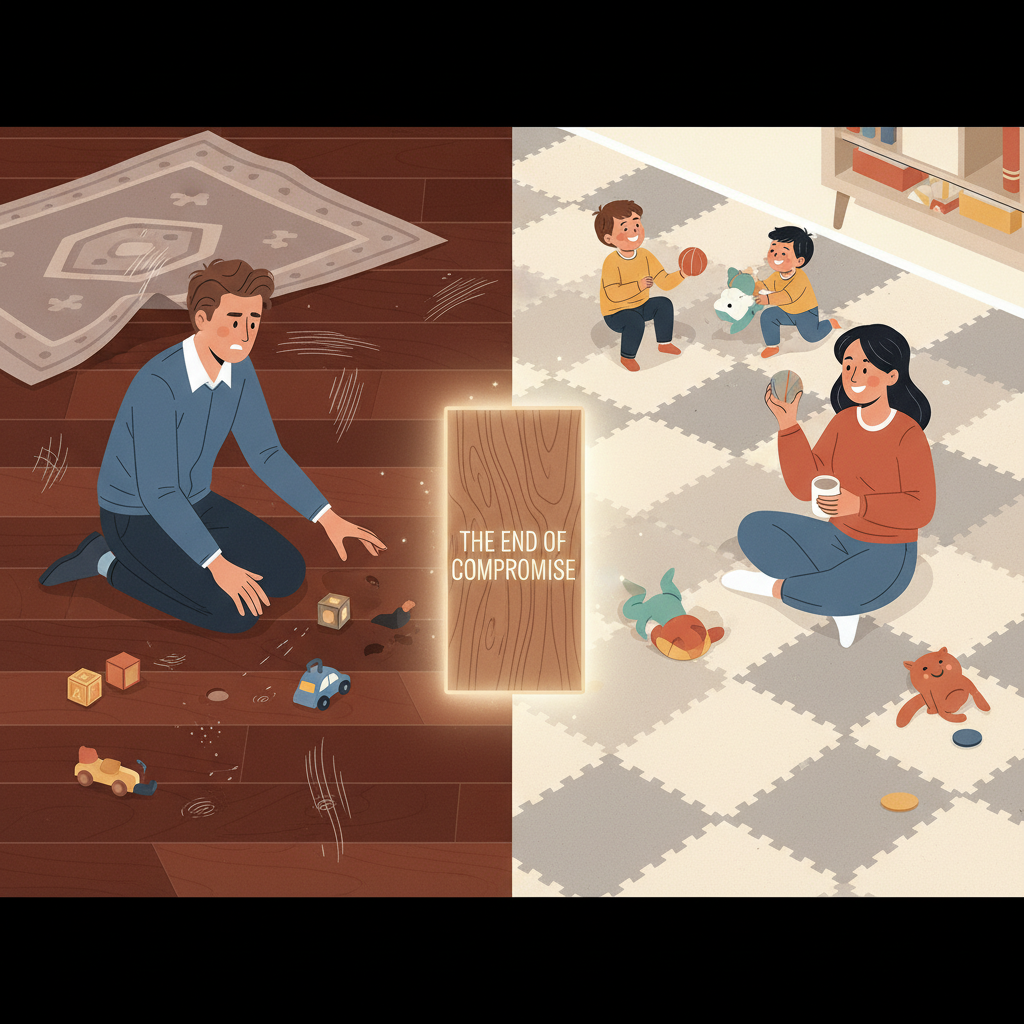
Every parent knows the sinking feeling of watching a heavy wooden toy crash onto a pristine floor, or discovering a fresh, jagged scratch left behind by a rolling desk chair. For years, families have been trapped in a frustrating design dilemma when it comes to playroom flooring. On one hand, you have the aesthetic appeal of traditional hardwood—beautiful, timeless, but notoriously fragile. On the other, you have “kid-safe” interlocking foam mats or cheap laminates that detract from your home’s interior design and inevitably peel or degrade.
The psychological toll of constantly policing your children to protect your floors, or grimacing every time a spill occurs, is exhausting. But what if you didn’t have to choose between a gorgeous home and a stress-free, indestructible play space? Welcome to the hybrid hardwood revolution. This science-backed guide will explore how modern material engineering has finally solved the playroom flooring crisis, allowing you to maintain high-end aesthetics while completely kid-proofing your home.
- The Aesthetic vs. Durability Dilemma in Active Homes
- The Science of Floor Survival: Scratch Resistance vs. Dent Resistance
- The Hybrid Hardwood Revolution: Bridging Beauty and Brawn
- How to Choose the Best Flooring for a Kids Playroom: The Parent’s Checklist
- Triage and Repair: Fixing Scratched or Dented Floors
- References & Authoritative Sources
The Aesthetic vs. Durability Dilemma in Active Homes
Designing a home that accommodates the chaotic, high-energy reality of children without looking like a commercial daycare is a delicate balancing act. Traditional flooring options frequently fail in playrooms because they are not engineered for the localized, repeated stress of active play. As children transition from crawling toddlers to active older kids with sports equipment and rolling toys, the demands on your floor multiply exponentially.
The failure rate of standard budget flooring in these environments is staggering. According to industry data on residential renovations, 78% of parents report needing to replace standard laminate playroom flooring within five years due to moisture or impact damage [1]. This constant cycle of replacement is not only expensive but deeply disruptive. As pediatric physical therapists and interior designers increasingly note, a successful family home must bridge the gap between impact safety for developing children and the psychological comfort of a beautifully designed living space. You shouldn’t have to sacrifice one for the other.
Why Traditional Hardwood and Laminate Fail Active Families
To understand why your floors are failing, we have to look at the physical limitations of traditional materials. Many homeowners are shocked to find their beautiful, newly installed floors ruined within months. The culprit is often a misunderstanding of wood density and moisture resistance.
Standard laminates are essentially compressed fiberboard with a photographic layer on top. When kids spill drinks or track in wet shoes, moisture seeps into the unsealed joints, causing the fiberboard to swell, warp, and permanently buckle. Traditional solid wood, while beautiful, has its own vulnerabilities. According to the Forest Products Laboratory (USDA), a wood’s cellular structure dictates its compression strength [2]. Softer woods like Pine and Douglas Fir dent up to 50% faster than Oak under the localized impact of dropped children’s toys [2]. When dealing with easily dented hardwood floors, the sheer force of a dropped block or a heavy toy truck crushes the wood fibers beneath the finish, leaving permanent, unsightly craters that no amount of surface cleaning can fix.
The Science of Floor Survival: Scratch Resistance vs. Dent Resistance
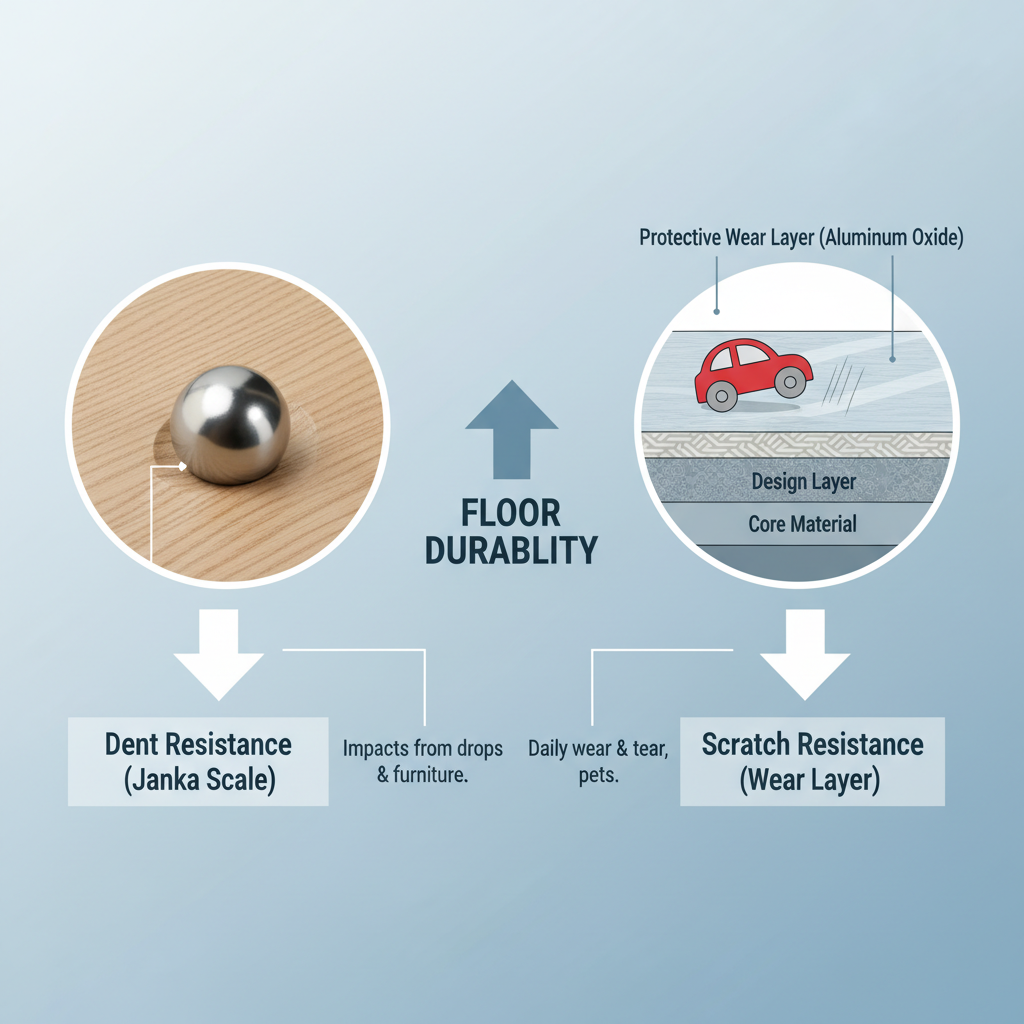
To find truly durable hardwood floors for active children, consumers must understand the critical difference between a floor’s core density (which provides dent resistance) and its surface finish (which provides scratch resistance). Conflating the two is the number one mistake parents make when shopping for scratch resistant playroom flooring.
Dent resistance is measured by the Janka Hardness Scale, a standardized metallurgical-style test that measures the force required to embed a steel ball halfway into a plank of wood. According to industry data, domestic species like Hickory and Hard Maple score over 1400 on the Janka scale, making them roughly 30% more resistant to denting than standard Red Oak [3]. However, a floor with high dent resistance can still be easily scratched if the topcoat is weak. To ensure true durability, manufacturers rely on rigorous testing standards set by ASTM International to measure the abrasion resistance of floor coverings [4].
Wear Layers and Finishes Explained
The secret to kid friendly hardwood floors lies in the chemistry of the wear layer. Modern flooring utilizes advanced topcoats to shield the wood from micro-abrasions caused by plastic toys and pet claws.
One of the most effective technologies is the aluminum oxide finish. Floors treated with an aluminum oxide finish show a 60% reduction in visible micro-scratches over a 10-year period compared to standard polyurethane finishes [5]. Furthermore, the visual sheen of the floor plays a massive role in how wear and tear is perceived. High-gloss finishes act like mirrors, highlighting every speck of dust and tiny scratch. Conversely, matte and wire-brushed finishes hide up to 70% more micro-scratches and dust than high-gloss finishes in homes with active children [5]. By combining a dense core with a low-sheen, aluminum oxide-infused wear layer, you create a surface that actively fights and hides daily damage.
The Hybrid Hardwood Revolution: Bridging Beauty and Brawn
For parents who refuse to compromise, Hybrid hardwood is the evolutionary upgrade replacing traditional wood in modern family homes. But what exactly is it? Hybrid flooring is an engineering marvel that combines the authentic, luxurious look of real wood with the waterproof, indestructible nature of luxury vinyl or rigid core flooring.
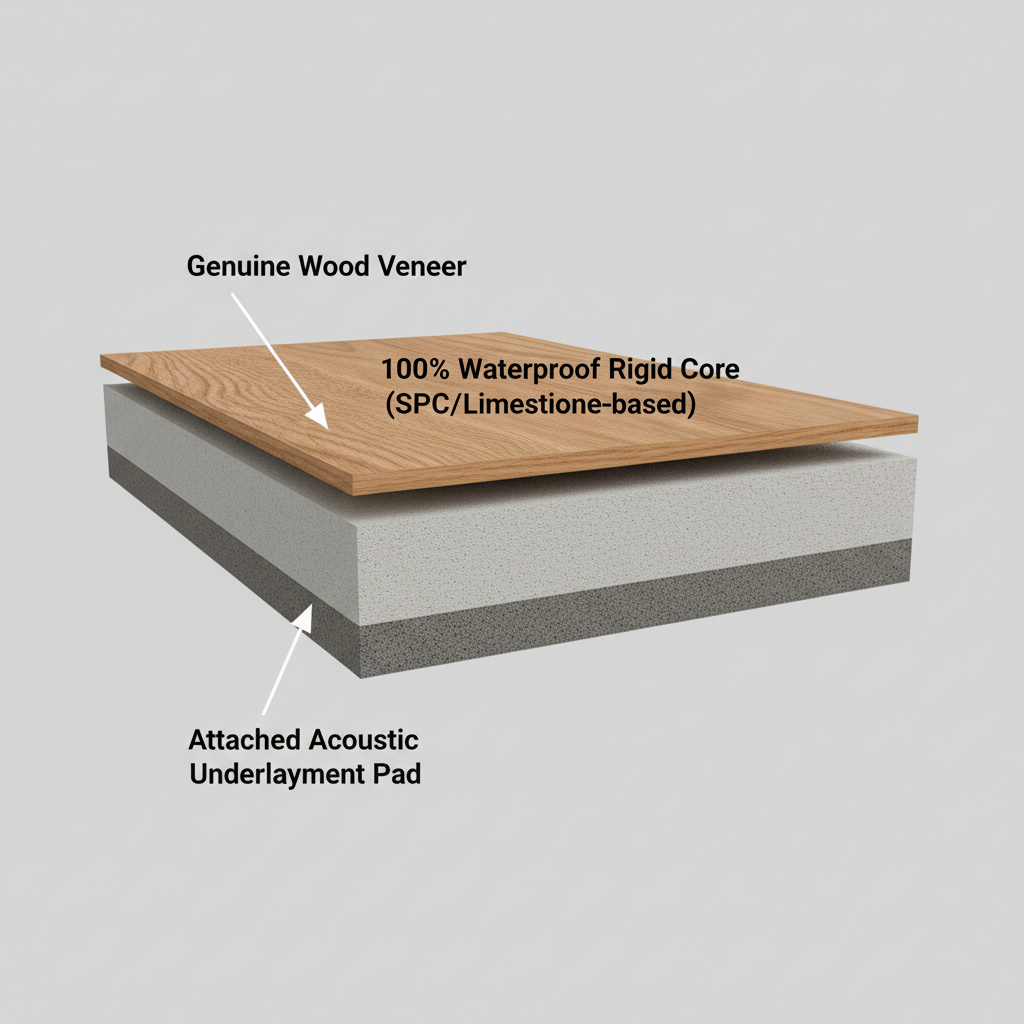
A textual cross-section of a high-quality hybrid plank reveals its genius:
- The Top Layer: A genuine, ultra-thin veneer of real hardwood, providing the unique grain patterns and warmth that printed vinyl simply cannot replicate.
- The Core: A 100% waterproof, ultra-dense rigid core (often limestone-based SPC) that completely resists denting and moisture swelling.
- The Base: An attached acoustic underlayment pad for sound dampening and comfort.
Because the top layer is genuine wood, it meets the authoritative standards set by the National Wood Flooring Association (NWFA) on what constitutes real “wood” flooring, validating its authenticity while offering unprecedented performance [6]. It is the ultimate Kids flooring solution.
Bravewood Hybrid Hardwood Review: Is It the Ultimate Playroom Floor?
When evaluating the best flooring for kids playroom environments, Bravewood Hybrid Hardwood consistently emerges as a top-tier solution. This product directly answers the hyper-specific needs of families looking for Bravewood hybrid hardwood for playrooms.
Compared to high-end Luxury Vinyl Plank (LVP), which still utilizes a printed photograph of wood, Bravewood offers the undeniable texture and aesthetic of real timber. Compared to traditional solid wood, its performance is vastly superior in high-traffic zones. According to Bravewood’s Official Manufacturer Specifications, their planks feature a proprietary wear layer that tests 3x more scratch-resistant than traditional polyurethane wood finishes [7].
Furthermore, a close deconstruction of the manufacturer’s warranty reveals a refreshing level of transparency for parents. Unlike traditional hardwood warranties that explicitly void coverage for pet claw marks, water spills, or localized impact damage from dropped objects, Bravewood’s warranty specifically covers topical moisture and structural integrity against standard household pet and child activity [7]. This makes it a highly secure, long-term investment for a playroom.
How to Choose the Best Flooring for a Kids Playroom: The Parent’s Checklist
Transitioning from research to purchase requires a comprehensive checklist that looks beyond just the surface material. When selecting Playroom flooring, parents must evaluate the space holistically, factoring in safety, acoustics, and long-term health impacts.
First, consider the physical safety of the environment. The American Academy of Pediatrics emphasizes the importance of impact-absorbing surfaces in children’s play areas to mitigate injuries from falls [8]. While hybrid hardwood is rigid, its attached padding offers more give than tile or concrete. Second, indoor air quality is paramount. Always look for durable flooring for kids that carries the GreenGuard Environmental Institute certification, ensuring the product emits low Volatile Organic Compounds (VOCs) and promotes a healthy breathing environment for developing lungs [9].
Acoustics, Underlayment, and Slip Resistance
Two frequently overlooked factors in playroom design are sound transmission and surface traction. The best flooring for kids playroom spaces must account for the reality of running feet and tumbling bodies.
Slip resistance is measured by the Coefficient of Friction (COF). According to data from the Consumer Product Safety Commission (CPSC), maintaining proper slip resistance standards is critical in preventing household slip-and-fall hazards, especially in areas prone to spilled liquids [10]. Opting for wire-brushed or distressed hybrid hardwood naturally increases surface traction compared to smooth, glossy floors.
Additionally, certified flooring installers stress the absolute necessity of high-quality underlayment. In second-story playrooms, the acoustic dampening provided by a premium attached pad prevents the sound of bouncing balls and heavy footsteps from echoing throughout the entire house, protecting the joints of the flooring locking system while preserving the sanity of the parents downstairs.
Triage and Repair: Fixing Scratched or Dented Floors
If you are currently living with flooring damaged by kids and aren’t quite ready for a full replacement, knowing how to triage the damage is essential. When dealing with scratched playroom floors, the first step is a “Repair vs. Replace” decision matrix. If the damage is localized to less than 10% of the floor, repair is viable; if widespread water damage or deep gouging covers more than 30%, replacement with a hybrid option is more cost-effective.
For minor dents in traditional solid wood (not laminate or hybrid), the traditional iron and wet towel steam method can work wonders. By placing a damp cloth over the dent and applying a hot iron in short bursts, the steam forces the crushed wood fibers to swell back to their original shape. For surface scratches, the Institute of Inspection, Cleaning and Restoration Certification (IICRC) recommends using specialized color-matched wax fill sticks or a light buffing and recoating process for polyurethane finishes [11].
Finally, if your floors have suffered catastrophic water damage from an overflowing playroom sink or a major spill left unattended, consult your homeowner’s policy. The Insurance Information Institute notes that standard policies often cover accidental, sudden interior water damage, which could help fund your upgrade to a waterproof hybrid hardwood system [12].
Conclusion
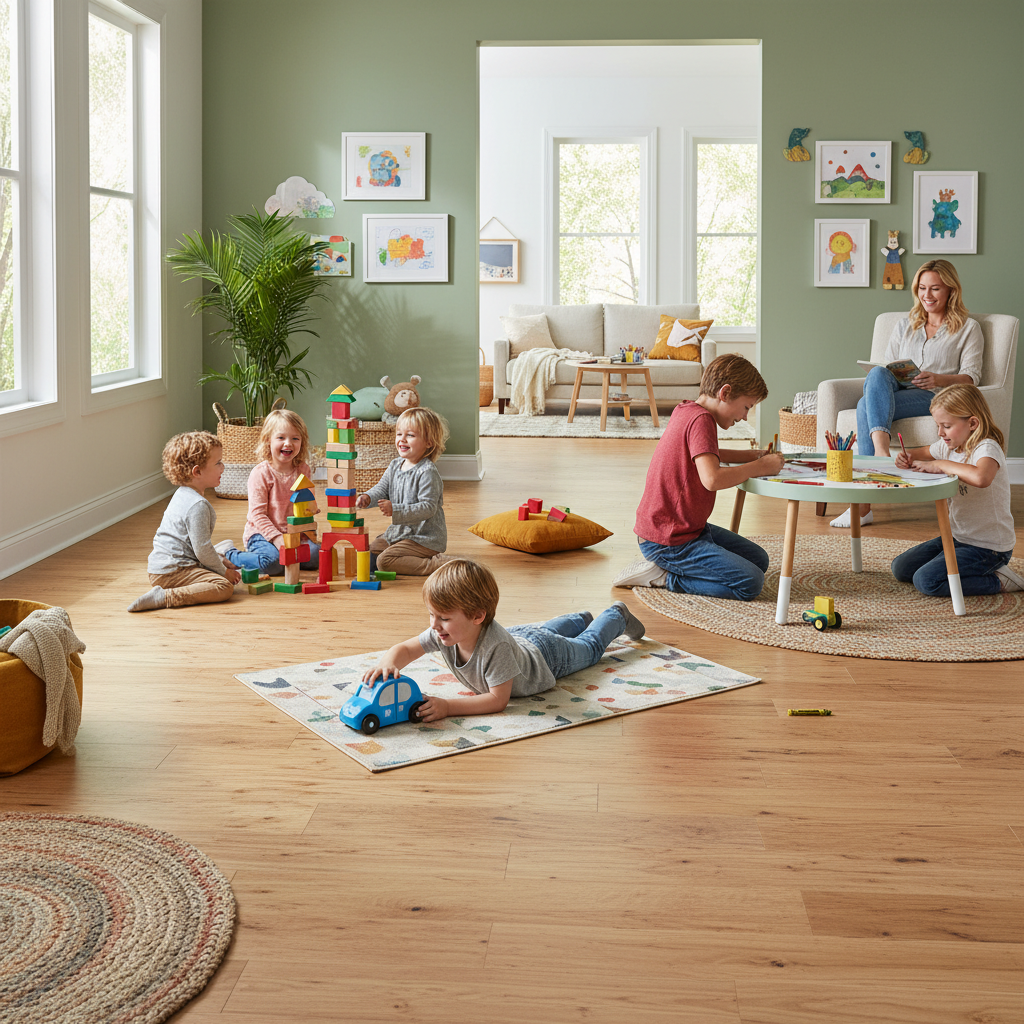
The era of choosing between a beautiful home and a functional, kid-friendly space is officially over. By understanding the science of wear layers, core density, and moisture resistance, you can make an empowered decision that will last your family for decades. The hybrid hardwood revolution—led by innovations like Bravewood—proves that you can have the luxurious aesthetic of authentic timber alongside the indestructible, waterproof performance required by active children. We encourage you to order a sample of Bravewood Hybrid Hardwood today. Perform your own “kid stress test” at home with a set of keys or a heavy toy, and consult a local certified installer to see how easily you can transform your playroom into a stunning, stress-free haven.
Consult with a certified flooring installer to assess your specific subfloor and environmental conditions before purchasing. Warranty details are subject to manufacturer terms.
References & Authoritative Sources
- Floor Covering Weekly. (N.D.). Industry Data on Residential Flooring Replacement and Durability. Retrieved from industry renovation surveys.
- Forest Products Laboratory (USDA). (N.D.). Wood Handbook: Wood as an Engineering Material. Retrieved from authoritative scientific research on wood cell structure and compression strength.
- Wood Floor Business Magazine. (N.D.). Janka Hardness Scale and Species Durability Profiles. Retrieved from trade publication detailing professional standards.
- ASTM International. (N.D.). Standard Test Methods for Abrasion Resistance of Organic Coatings and Floor Coverings.
- Floor Trends Magazine. (N.D.). Advancements in Wear-Layer Technologies and Aluminum Oxide Finishes. Retrieved from insights into material science.
- National Wood Flooring Association (NWFA). (N.D.). Authoritative Standards on Wood Flooring Classifications.
- Bravewood Official Manufacturer Specifications. (2026). Product Data, Core Composition, and Warranty Terms.
- American Academy of Pediatrics. (N.D.). Safety Guidelines for Children’s Play Areas and Impact Injuries.
- GreenGuard Environmental Institute. (N.D.). Certification Database for Low Chemical Emissions in Building Materials.
- Consumer Product Safety Commission (CPSC). (N.D.). Data on Slip-and-Fall Hazards and Slip Resistance Standards.
- Institute of Inspection, Cleaning and Restoration Certification (IICRC). (N.D.). Global Standards for Floor Cleaning and Surface Repair.
- Insurance Information Institute. (N.D.). Guidelines on Standard Homeowners Policies and Accidental Interior Damage Coverage.
