
When it comes to renovating your home, few decisions carry as much weight—both financially and aesthetically—as your choice of flooring. For decades, homeowners have faced a classic dilemma: do you invest in the timeless, generational prestige of traditional solid wood, or do you pivot to the modern, practical durability of engineered alternatives? Today, that decision is more complex than ever.
This is not your generic pros-and-cons list. Instead, consider this your technical teardown and lifestyle matchmaker guide. We are going to cut through the misleading marketing jargon—like the myth of “100% waterproof wood”—and expose the real science behind these materials. By providing a room-by-room blueprint backed by National Wood Flooring Association (NWFA) standards, we will ensure your flooring investment doesn’t just look beautiful on day one, but actually survives the rigorous demands of your real, everyday life.
- Structural Anatomy: Demystifying Hybrid vs. Solid Hardwood
- The Moisture Battle: Waterproof Claims vs. Warping Realities
- Lifestyle Matchmaker: Which Hardwood Flooring is Best for Homes?
- Installation Challenges and Lifecycle Economics
- Final Verdict: Bravewood Hybrid Flooring Benefits
- Conclusion
- References & Authoritative Sources
Structural Anatomy: Demystifying Hybrid vs. Solid Hardwood
To truly understand the differences between hybrid and solid hardwood, we have to look beneath the surface. What exactly are you walking on? When evaluating the baseline standards for wood flooring characteristics, the National Wood Flooring Association (NWFA) provides strict definitions that separate natural timber from composite materials [1].
When we perform a visual teardown of a hybrid plank, the distinction becomes clear. Hybrid wood flooring is not a single piece of timber. Instead, it is a highly engineered sandwich. At the top sits a 1.2mm real wood veneer, providing the authentic grain and texture of nature. This veneer is permanently bonded to a rigid stone polymer composite (SPC) core, creating a floor that looks like traditional wood but behaves entirely differently under stress.
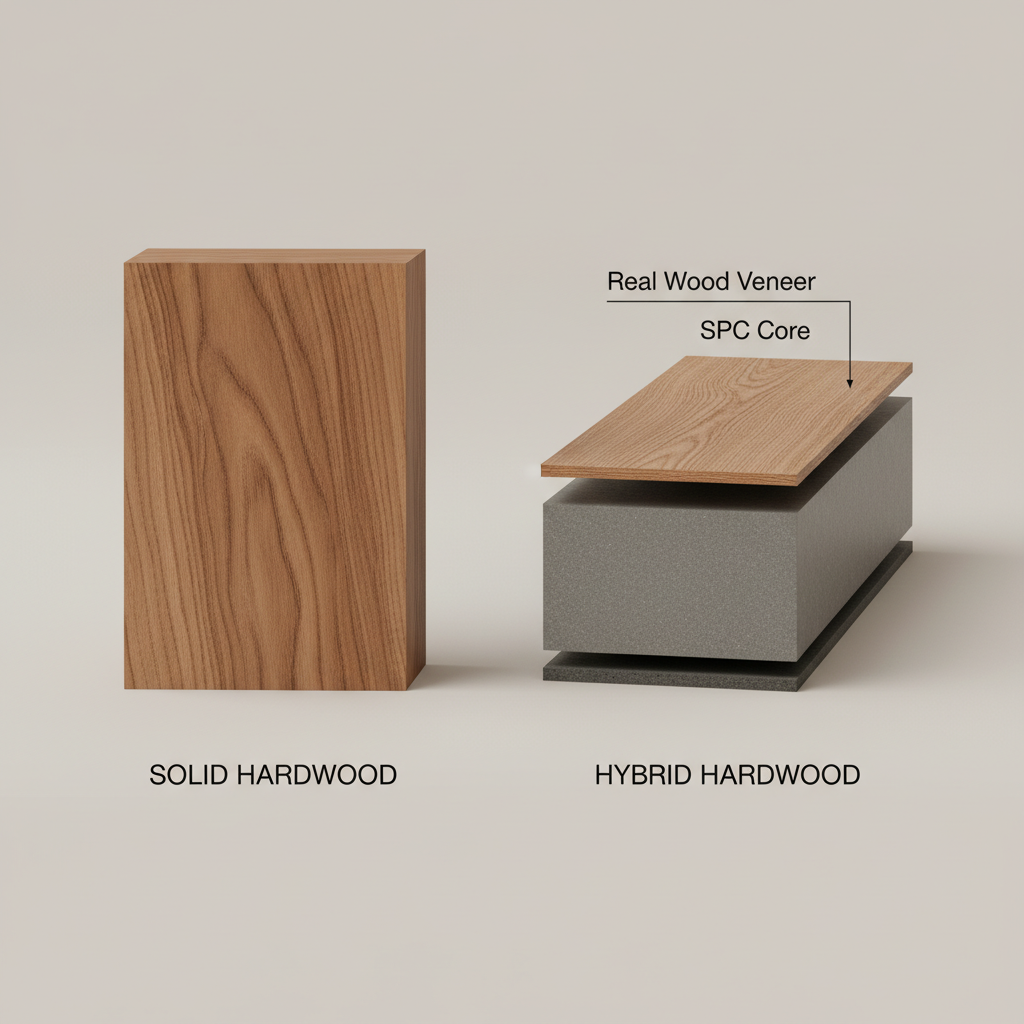
The Traditional Standard: Solid Hardwood Flooring
Solid hardwood flooring is exactly what it sounds like: a single, homogenous piece of timber milled directly from a tree, typically measuring a robust 3/4 inch (19mm) in thickness. Because it is a 100% organic material, it is subject to the laws of nature.
The most critical factor to understand about solid wood is its hygroscopy—its natural tendency to absorb and release moisture from the surrounding air. According to the Forest Products Laboratory, wood is constantly seeking an equilibrium moisture content (EMC) with its environment [2]. When humidity rises, the wood absorbs moisture and expands; when the air dries out in the winter, the wood shrinks. This constant breathing requires careful environmental control to prevent structural damage.
Inside Bravewood Hybrid Hardwood
Bravewood hybrid hardwood represents a technological leap designed to combat the inherent instability of solid timber. A standard Bravewood plank is typically 7mm to 10mm thick and is constructed in distinct performance layers. The surface is protected by a multi-layer aluminum oxide finish, which sits atop the 1.2mm real wood veneer.
The secret to its stability, however, lies beneath the wood. To demystify industry jargon, it is crucial to understand the difference between WPC (wood polymer composite) and SPC (stone polymer composite) cores. While older WPC cores used wood pulp that could still retain some moisture, Bravewood utilizes an SPC core made of limestone powder and stabilizers. This stone-based core is entirely inert, meaning it will not expand or contract with humidity changes, effectively anchoring the thin wood veneer in place.
The Moisture Battle: Waterproof Claims vs. Warping Realities
Water damage is arguably the greatest fear for any homeowner investing in hardwood. When comparing these two materials, we must separate marketing myths from scientific realities.
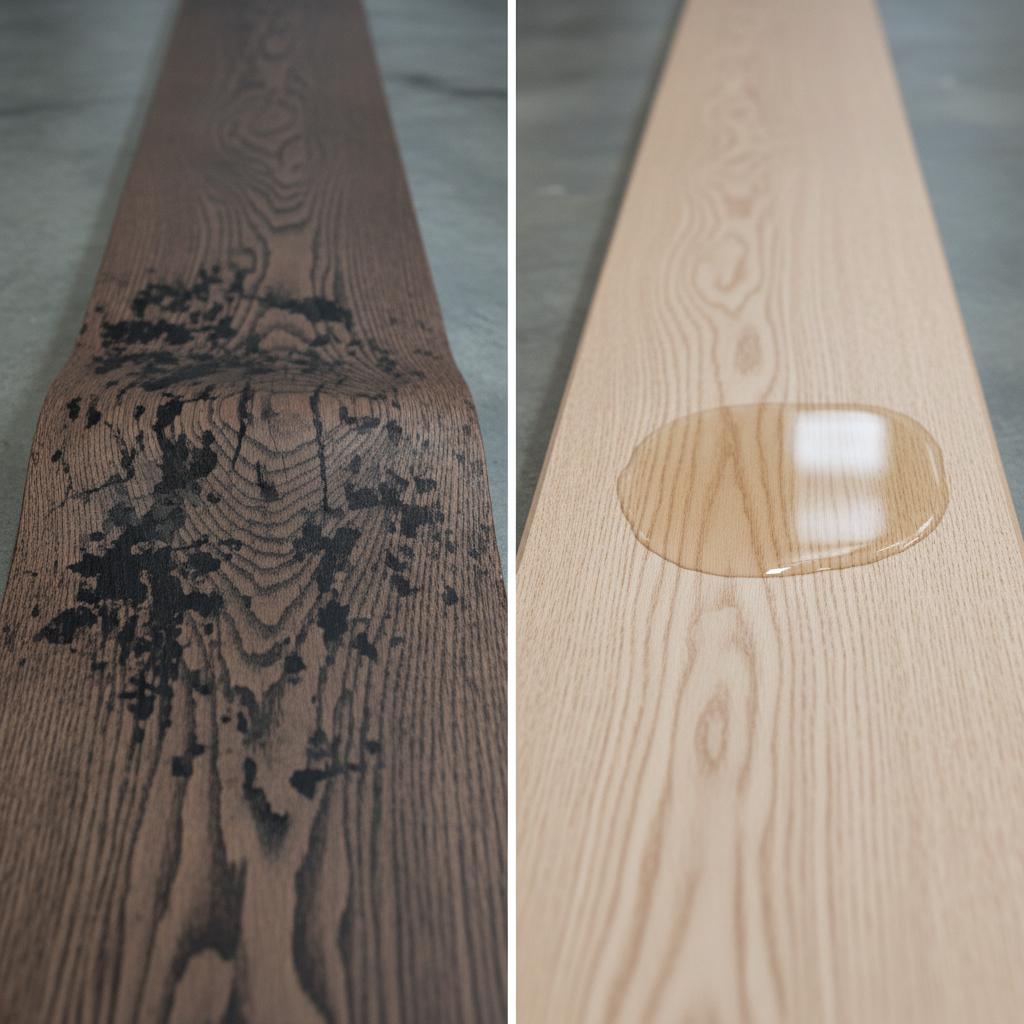
To illustrate how both floors handle moisture, let’s look at a “Spill Test Timeline.”
- After 1 Hour: Both floors perform admirably. A spilled glass of water will sit on the surface finish of both solid wood and hybrid flooring without causing immediate harm.
- After 24 Hours: Solid hardwood will begin to absorb the standing water through its seams and unsealed edges, initiating the swelling process. The hybrid floor’s SPC core remains unaffected, though water may begin to test the seams.
- After 72 Hours: Solid wood will likely show severe, irreversible warping. For the hybrid floor, while the core remains waterproof, the organic wood veneer may begin to swell and delaminate if water has penetrated the locking mechanisms.
Solid Hardwood Warping Issues: Cupping, Crowning, and Buckling
When solid hardwood encounters excess moisture, it acts as a diagnostic indicator of your home’s environmental health. Understanding solid hardwood warping issues is essential for any owner.
The two most common issues are cupping and crowning. Cupping occurs when the edges of a board rise higher than its center, creating a concave shape. According to data from Wagner Meters, wood floors begin to cup when the moisture differential between the top and bottom of the board exceeds just 4% [3]. Crowning is the opposite—the center of the board swells higher than the edges, often caused by moisture left on the surface or by sanding a cupped floor before it has fully dried. In extreme cases, floors will buckle, completely lifting off the subfloor. Furthermore, the Institute of Inspection, Cleaning and Restoration Certification (IICRC) warns that mold can begin to grow under water-logged hardwood within a mere 48 to 72 hours if not properly ventilated and mitigated [4].
Is Bravewood Flooring Completely Waterproof?
The short answer is no, and it is vital to approach water resistant wood flooring with realistic expectations. While the SPC core of Bravewood is 100% waterproof and will never swell or degrade in water, the top layer is still an organic wood veneer.
If a major plumbing leak occurs and water penetrates the seams, that real wood layer is vulnerable to swelling. Standard Product Warranty Documents for hybrid floors explicitly state limitations regarding standing water, usually capping exposure at 24 to 72 hours [5]. To maximize water resistance, especially in spill-prone areas like kitchens or mudrooms, professional installers strongly advise edge-sealing the perimeters of the room with a high-quality silicone sealant to prevent water from migrating beneath the floating planks.
Lifestyle Matchmaker: Which Hardwood Flooring is Best for Homes?
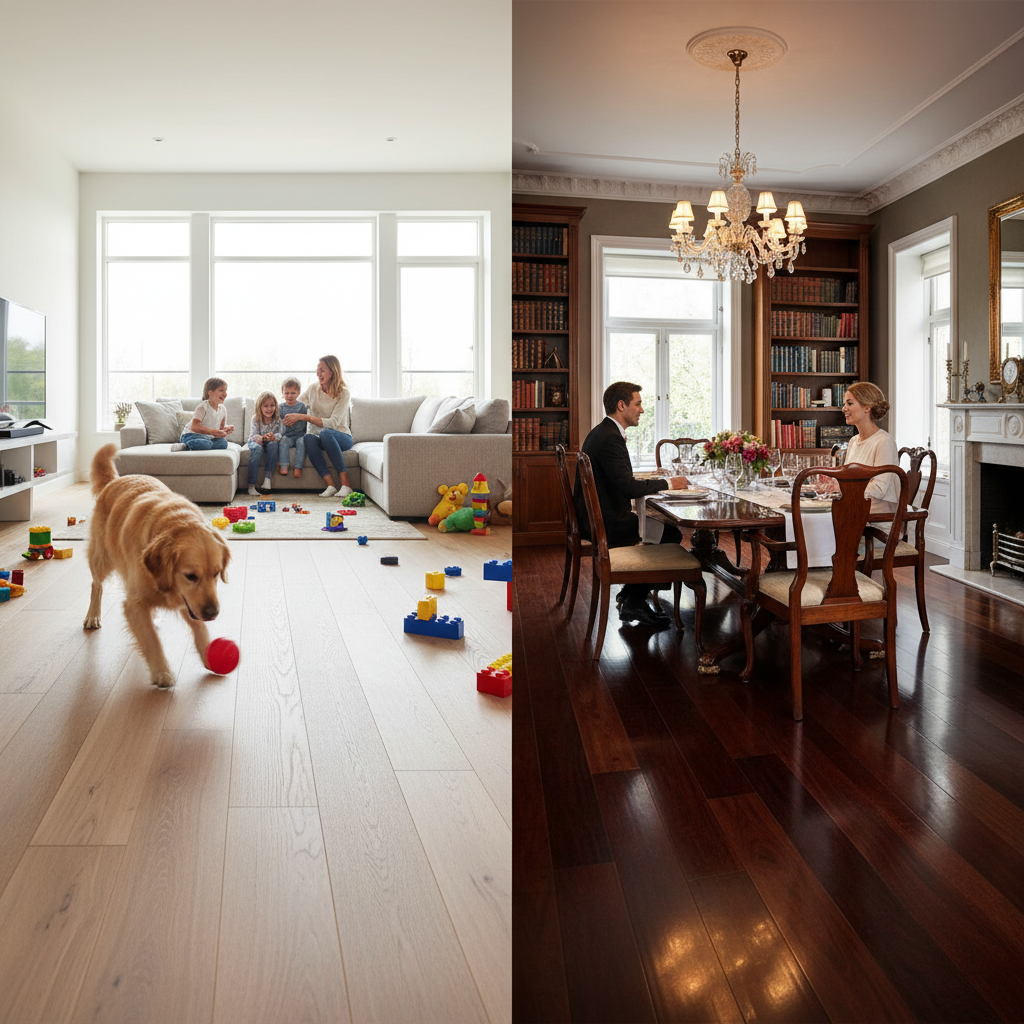
Determining which hardwood flooring is best for homes requires a personalized approach. Think of this as a lifestyle matrix: you must weigh “Pets vs. Prestige” and “Basements vs. Living Rooms.”
If you are installing flooring below-grade (in a basement), solid hardwood is universally unsuited due to concrete moisture emissions; a hybrid floor is mandatory. Conversely, for a formal, above-grade dining room where authenticity is paramount, solid wood is the undisputed champion.
Durable Hybrid Hardwood Flooring for Active Families
For households with large dogs, active children, and high foot traffic, durable hybrid hardwood flooring is often the superior choice. When evaluating durability, it is important to distinguish between dent resistance (impact) and scratch resistance (surface wear).
Because of its dense limestone core, hybrid flooring is highly dent-resistant. For surface protection, look to the European Producers of Laminate Flooring (EPLF) AC rating system. For heavy residential use, an AC4 or AC5 rating is recommended [6]. Top-tier hybrid floors achieve this extreme scratch resistance through a 9-layer aluminum oxide finish, which acts as an invisible shield over the wood veneer, preventing dog claws and dragged toys from gouging the actual wood grain.
The Prestige, Acoustics, and Resale Value of Solid Wood
Despite the technological advancements of hybrids, solid hardwood flooring still wins in several critical categories: authenticity, underfoot feel, and long-term financial return.
There is a distinct acoustic difference between the hollow, clicking sound sometimes associated with floating hybrid floors and the solid, quiet thud of a nail-down hardwood floor. Furthermore, genuine solid wood is a major selling point for real estate. The Appraisal Institute notes that installing solid hardwood can add up to 2.5% to a home’s overall resale value [7]. When selecting solid wood, durability is measured by the Janka Hardness Scale; domestic species like Hickory and White Oak are top choices for balancing beautiful grain patterns with high density and impact resistance [8].
Installation Challenges and Lifecycle Economics
When weighing Bravewood hybrid hardwood vs solid hardwood, you must look beyond the initial retail price per square foot and consider the installation process and the 50-year lifecycle cost.
Generally, solid wood is a premium investment, costing between $8 to $15 per square foot fully installed. In contrast, hybrid options like Bravewood offer a more accessible price point, typically ranging from $5 to $9 per square foot installed, largely due to reduced labor costs.
Avoiding the 50% Failure Rate: Subfloor Prep and Acclimation
Wood flooring installation challenges are notorious for derailing DIY projects and frustrating homeowners. Solid hardwood requires a flawless foundation. According to NWFA Installation Guidelines, subfloors must be flat to within 3/16 of an inch over a 10-foot radius for a successful installation [9].
Even more critical is the acclimation process. Solid wood must sit in the climate-controlled installation environment for days or weeks to reach its EMC. Industry statistics reveal that improper acclimation accounts for over 50% of post-installation failures and voided warranties. Hybrid flooring, thanks to its inert SPC core, requires little to no acclimation and is far more forgiving of minor subfloor imperfections.
The 50-Year ROI: Refinishing vs. Replacing
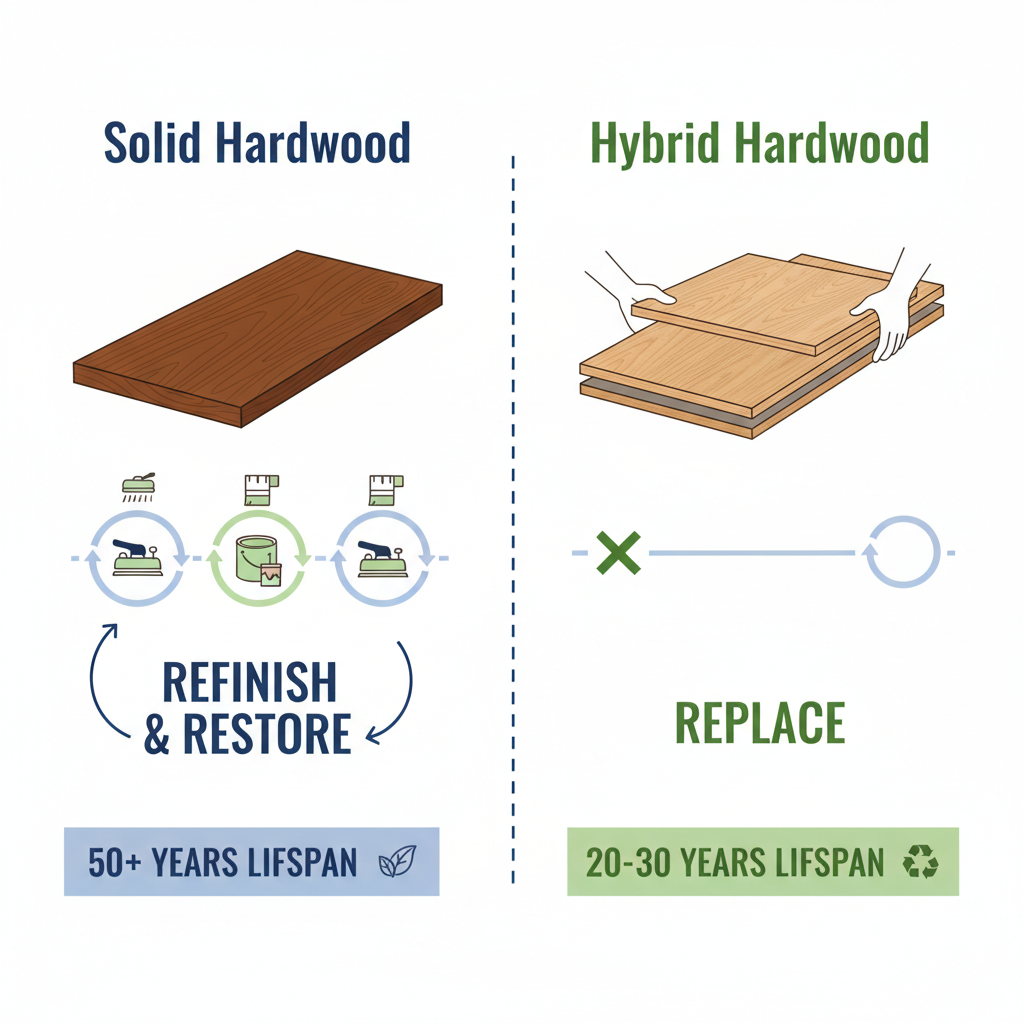
The true differences between hybrid and solid hardwood become apparent when analyzing long-term return on investment. Solid wood is a multi-generational floor. Depending on the exact thickness of the tongue and groove (which dictates how much material can be safely sanded away), a solid hardwood floor can be sanded and refinished 4 to 7 times over its lifespan. This allows you to completely change the stain color decades later or erase years of damage.
Hybrid flooring, however, is a lifetime-limited product. Because the real wood veneer is only 1.2mm thick, it cannot be deeply sanded and refinished. Once the aluminum oxide finish is compromised or the veneer is severely damaged, the floor must be entirely replaced.
Final Verdict: Bravewood Hybrid Flooring Benefits
Ultimately, the Bravewood hybrid flooring benefits present a compelling modern solution that balances the aesthetic beauty of nature with extreme, everyday practicality.
Beyond its durability and moisture resistance, it offers significant environmental advantages. According to the Forest Stewardship Council (FSC), hybrid manufacturing uses up to 80% less raw hardwood per plank compared to solid wood, drastically increasing the yield per tree and promoting sustainable forestry [10]. Additionally, the integrated click-lock system allows Bravewood to be installed up to 30% faster than traditional nail-down hardwood, saving homeowners substantial time and labor costs.
Conclusion
The decision between Bravewood hybrid and solid hardwood does not have a single, universal answer—it requires a matchmaker’s approach. If you are renovating an above-grade space, prioritize architectural prestige, and want a floor that will last for a century and boost your home’s resale value, traditional solid hardwood remains the gold standard. However, if you are tackling a basement, managing a chaotic household full of pets, or simply want the look of real wood without the constant anxiety of moisture damage and warping, Bravewood hybrid hardwood is the definitive choice.
Understanding the science behind the planks is the best way to prevent costly mistakes. We highly encourage you to order physical samples of Bravewood hybrid to test its scratch resistance against your own keys or pet’s claws. Alternatively, consult the NWFA directory to find a certified flooring installer in your area who can professionally assess your home’s specific subfloor and moisture conditions before you make your final investment.
Disclaimer: Pricing, warranty details, and installation costs are estimates and subject to regional variations. Always consult manufacturer guidelines and a certified flooring professional before installation.
References & Authoritative Sources
- National Wood Flooring Association (NWFA). (N.D.). Baseline standards for wood flooring characteristics.
- Forest Products Laboratory. (N.D.). Wood properties and moisture dynamics (Equilibrium Moisture Content).
- Wagner Meters. (N.D.). Moisture differential and wood cupping data.
- Institute of Inspection, Cleaning and Restoration Certification (IICRC). (N.D.). Water damage restoration and mold growth standards.
- Standard Product Warranty Documents. (N.D.). Standing water limitations for hybrid wood flooring.
- European Producers of Laminate Flooring (EPLF). (N.D.). AC rating system for flooring durability.
- Appraisal Institute. (N.D.). Home value additions based on material choices.
- Janka Hardness Scale. (N.D.). Standard industry metric for wood density and durability.
- National Wood Flooring Association (NWFA). (N.D.). Installation Guidelines and Subfloor Tolerances.
- Forest Stewardship Council (FSC). (N.D.). Sustainable forestry practices and raw material yield.
