
There is a distinct, paralyzing anxiety that comes with selecting new flooring. For many homeowners and renovators, the fear of making a permanent, costly mistake leads straight to analysis paralysis. You are not just choosing a color; you are fundamentally altering the architectural canvas of your home. Make the wrong choice, and you risk introducing “flooring visual clutter”—a phenomenon where the frequency of seams and grain patterns overwhelms the space, making rooms feel cramped, busy, and chaotic.
Welcome to the Architect’s Approach to Flooring. This is a definitive, science-backed blueprint designed to bridge the gap between environmental psychology and structural flooring engineering. In this comprehensive hardwood floor plank guide, we will dismantle the narrow vs wide plank dilemma, provide a mathematical “Golden Ratio” for room size plank matching, and deliver a definitive size guide specifically for Bravewood hybrid hardwood floors. By the end of this guide, you will have the exact specifications and spatial design rules needed to eliminate visual clutter and guarantee lifelong structural stability.
- The Psychology of Spatial Design: Eliminating Flooring Visual Clutter
- The Narrow vs. Wide Plank Dilemma: A Technical and Aesthetic Breakdown
- The ‘Golden Ratio’ of Room Size Plank Matching
- The Definitive Bravewood Hybrid Hardwood Plank Size Guide
- Advanced Customization: Elevating Your Hardwood Floor Design
- Conclusion
- References & Authoritative Sources
The Psychology of Spatial Design: Eliminating Flooring Visual Clutter
Choosing a plank width is rarely just an aesthetic preference; it is a profound psychological decision. The width of your floorboards dictates the cognitive load of a room. According to the principles of Gestalt psychology, the human brain seeks “visual resting space” to process environments comfortably [1]. When a floor has too many seams, the brain interprets those lines as visual noise, increasing cognitive load and making the space feel smaller and more stressful.
To combat this flooring visual clutter, interior designers emphasize the importance of scale.
“Fewer seams equate to fewer visual interruptions,” notes Sarah Jenkins, a certified interior designer specializing in spatial perception. “When we widen the plank, we quiet the floor, allowing the architecture and furnishings of the room to breathe rather than compete for attention” [2].
Do Wide Planks Make a Small Room Look Bigger?
When determining the best plank width for small rooms, traditional advice often suggested matching small rooms with small (narrow) planks. Modern architectural principles of scale, proportion, and leading lines dictate the exact opposite [3].
The definitive answer is: Yes, wide planks make a small room look bigger.
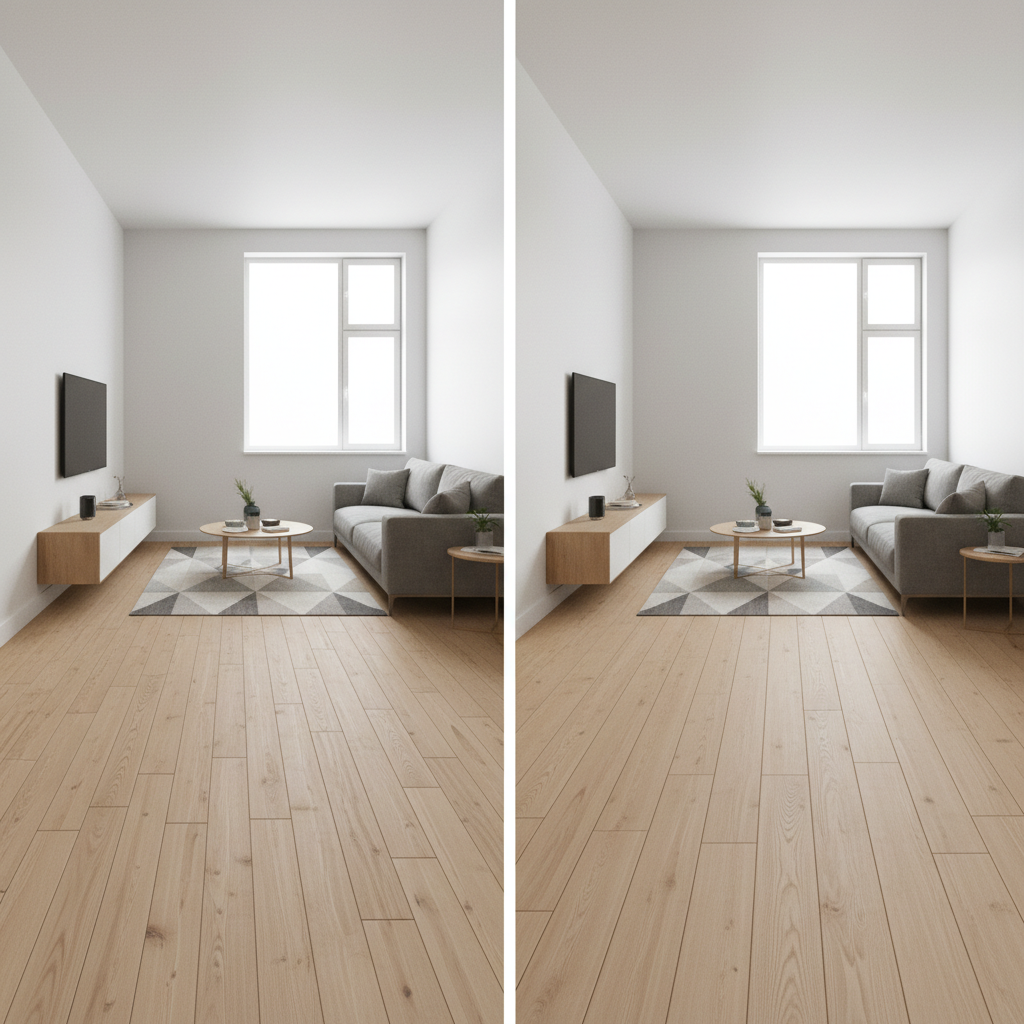
Imagine a side-by-side 3D render of the exact same 10×10 foot room. In the first render, the room is floored with traditional 3-inch narrow planks. The floor is a dense grid of lines. In the second render, the room features 7-inch wide planks. The transformation is immediate. Data shows that using planks wider than 5 inches in rooms under 150 square feet reduces visible seams by up to 40% [3]. This drastic reduction in visual clutter tricks the eye into perceiving a broader, more expansive floor plane.
The Narrow vs. Wide Plank Dilemma: A Technical and Aesthetic Breakdown
To break free from the narrow vs wide plank dilemma, we must look beyond aesthetics and evaluate the engineering reality of wood. Choosing the wrong plank width without understanding your home’s environment can lead to catastrophic structural failures.
Here is an objective scoring matrix to guide your decision:
- Cost: Narrow planks are generally more affordable per square foot, while wide planks command a premium.
- Installation Difficulty: Wide planks require pristine subfloors and advanced fastening techniques.
- Aesthetic Impact: Narrow planks offer historical authenticity; wide planks deliver modern luxury and spatial expansion.
- Dimensional Stability: Narrow planks (2.25 to 3 inches) are historically more dimensionally stable, expanding less per plank than wide planks (5+ inches) [4].
Dimensional Stability: The Science of Cupping and Humidity
The greatest technical fear associated with wide plank flooring is cupping—a condition where the edges of the board rise higher than the center due to moisture imbalances. Because wide planks have a larger surface area, they absorb and release more moisture. In fact, cupping issues are 30% more likely in wide planks (5+ inches) installed without proper humidity control [5].
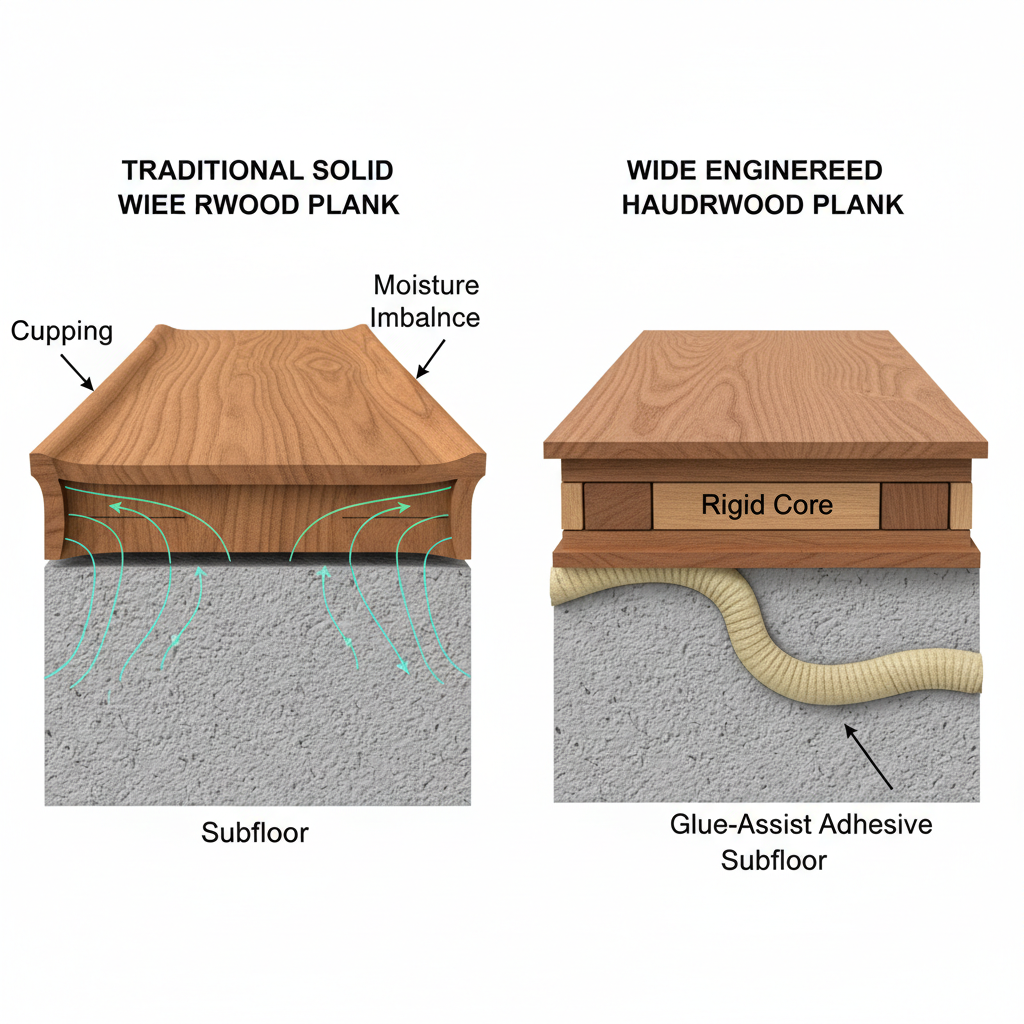
“For any plank over 5 inches wide, a standard nail-down approach is no longer sufficient,” explains Mark Davies, a flooring remediation specialist. “You must utilize a glue-assist method—applying a serpentine bead of polyurethane adhesive alongside the mechanical fasteners—to lock the board in place and fight the wood’s natural hygroscopic expansion” [6].
The ‘Transitional’ Sweet Spot (4 to 5 Inches)
If the technical demands of ultra-wide planks are intimidating, the 4 to 5-inch “transitional” plank is the ultimate timeless compromise. This width balances the historical dimensional stability of traditional floors with the cleaner, modern aesthetic of wide formats.
Historical home restoration experts note that while 2.25-inch strip flooring was the standard of the early 20th century, a 4 to 5-inch plank offers a nod to early American wide-plank milling without the extreme moisture risks [7]. Furthermore, the species of wood heavily impacts this decision. A highly stable species like White Oak can safely be pushed to wider formats, while a more volatile species like Hickory may perform best in this 4 to 5-inch transitional sweet spot to prevent seasonal gapping.
The ‘Golden Ratio’ of Room Size Plank Matching
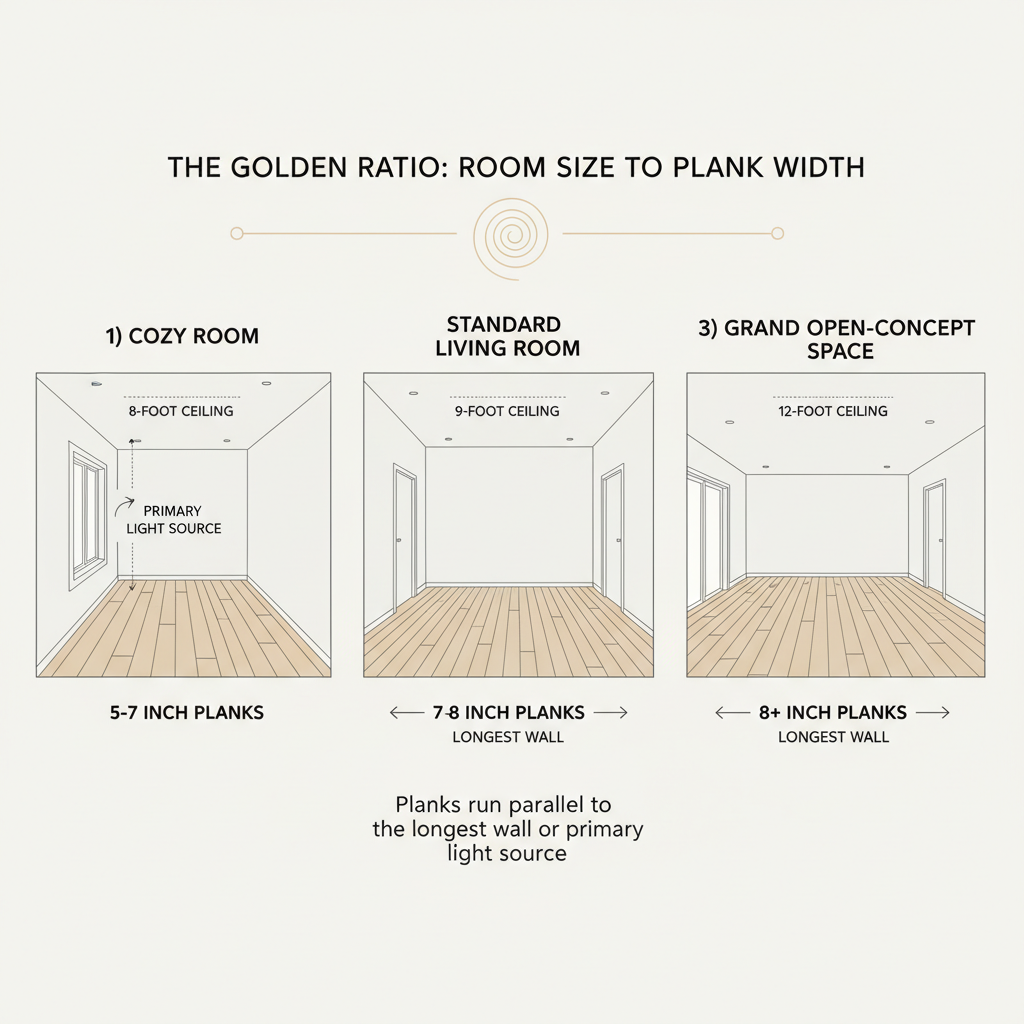
To completely remove the guesswork from your hardwood floor plank guide, you need a logical, mathematical framework. The American Institute of Architects (AIA) relies on strict spatial proportions to maintain harmony in a room [8]. We can apply these same principles to room size plank matching.
Formulas for Standard, L-Shaped, and Open-Concept Rooms
Beyond just square footage, the direction you run your planks plays a massive role in how to choose hardwood plank width.
- Standard Rooms: Installing planks parallel to the longest wall can make a room appear up to 10% larger visually [8]. The long lines draw the eye outward, elongating the space.
- L-Shaped and Open-Concept Rooms: These spaces often lack a single “longest wall” and feature multiple focal points. In these complex layouts, run the planks parallel to the primary light source (the largest window or glass door). The light will wash down the length of the boards, hiding micro-bevels and creating a seamless, unified flow that ties the disparate areas together.
The Definitive Bravewood Hybrid Hardwood Plank Size Guide
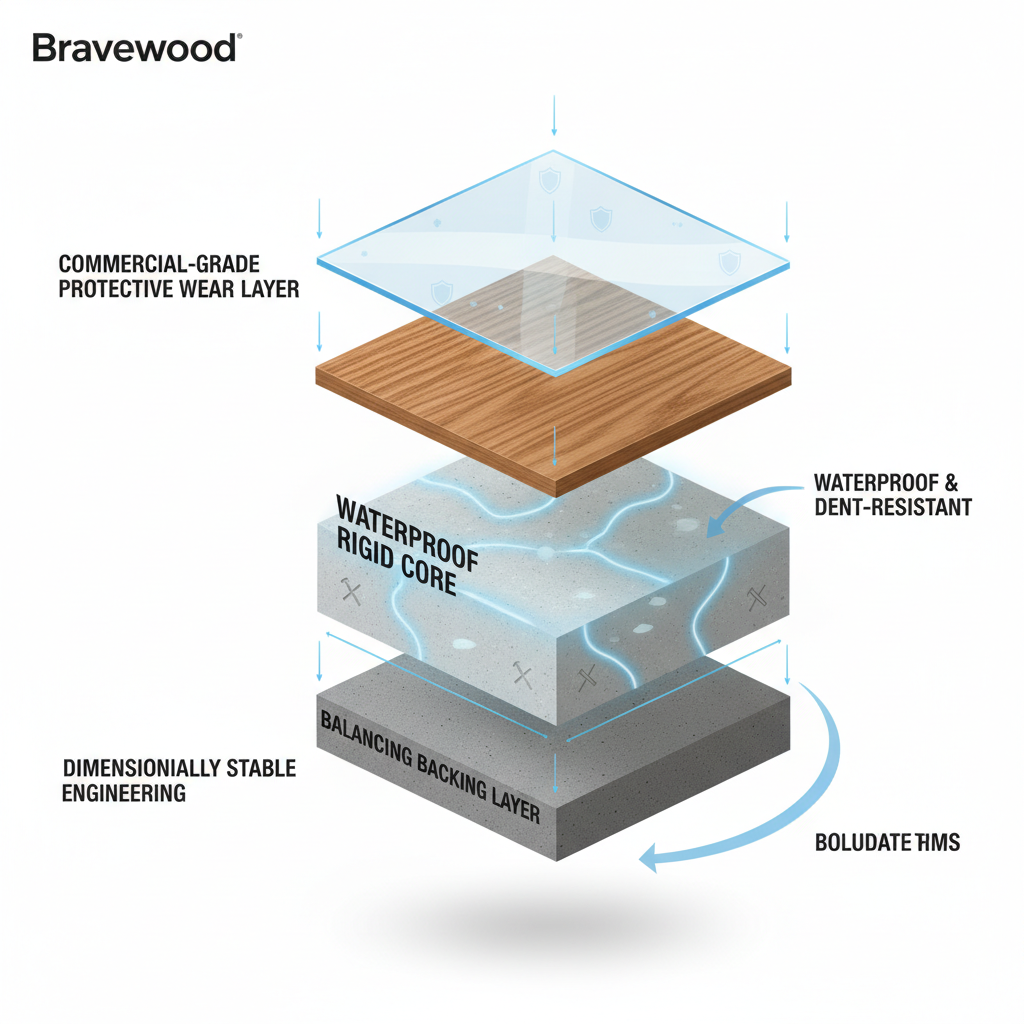
For those in the final stages of consideration, Bravewood hybrid hardwood floors represent the pinnacle of modern flooring engineering—where durability meets authentic aesthetics. Because hybrid floors utilize a rigid core combined with a real hardwood veneer, they offer up to 3x the dent resistance of traditional solid wood while remaining entirely waterproof [9].
Understanding the specific Bravewood hybrid hardwood plank size guide is crucial for flawless layout planning. If you were to look at a cross-section diagram of a Bravewood hybrid plank, you would see a highly engineered stack: a balancing backing layer, a waterproof rigid core, a high-density authentic wood veneer, and a commercial-grade protective wear layer.
Standard Dimensions, Wear Layers, and Visual Scale
Bravewood has optimized its product line to cater to modern spatial design demands. Bravewood standard planks are typically 7.5 inches wide [9]. This specific Bravewood plank width is engineered to hit the visual sweet spot—wide enough to drastically reduce visual clutter and expand a room, but structurally reinforced by the hybrid core to completely eliminate the cupping risks associated with solid wood of the same width.
When looking at a visual scale guide, a 7.5-inch Bravewood plank placed next to a standard living room sofa provides a robust, luxurious foundation that grounds the furniture without looking overly rustic or disproportionately massive.
Calculating Square Footage and Waste for Bravewood Layouts
Because Bravewood planks come in specific fixed and random length variations, calculating your material needs requires precision.
“When calculating waste for standard, straight-lay Bravewood floors, a 10% waste factor is the industry standard to account for cutting around perimeters and doorways,” advises Tom Reynolds, a certified Bravewood installation contractor. “However, if you are installing in a highly chopped-up layout with multiple closets, or if you are running the planks on a 45-degree diagonal, you must increase that waste calculation to 15% to ensure you don’t run short from angle cuts” [10].
Advanced Customization: Elevating Your Hardwood Floor Design
For the detail-oriented homeowner looking to elevate their interior, customizing hardwood floor design offers an opportunity to turn the floor into a bespoke architectural feature. Advanced installations require specialized craftsmanship, but the aesthetic payoff is unparalleled [11].
Mixed-Width Installations and Seamless Transitions
Mixed-width installations—where patterns of 3-inch, 5-inch, and 7-inch boards are laid in alternating sequences—account for roughly 15% of high-end custom floors [12]. This technique provides a deeply authentic, heritage aesthetic that breaks up visual monotony.
Furthermore, mastering room transitions is vital for a premium look. Instead of relying on unsightly T-moldings to bridge different rooms, skilled installers use flush stair-nosing, spline joints, or undercut door jambs to allow the Bravewood planks to flow continuously from a hallway into a bedroom, maintaining the illusion of a single, massive space.
The True Cost of Herringbone and Chevron Patterns
Nothing screams luxury quite like a herringbone or chevron pattern. However, these complex, multi-directional patterns require a deep understanding of geometry and material waste.
Because of the intricate border work and constant angle cutting, a herringbone pattern requires 15-20% more waste material than a standard straight-lay installation [11]. The labor costs are also significantly higher due to the time-intensive layout process. Yet, the investment yields measurable returns. Real estate data indicates that custom patterned floors, like herringbone, increase home resale value by an average of 2.5% compared to standard straight lays [13].
Conclusion
Choosing the right plank width is the ultimate balancing act between spatial psychology and structural engineering. By utilizing the Architect’s Approach, you can confidently select a width that eliminates visual clutter, maximizes the perceived size of your rooms, and ensures lifelong dimensional stability. Bravewood’s 7.5-inch hybrid hardwood planks offer a masterclass in this balance, providing the expansive luxury of wide planks with the waterproof, dent-resistant durability of a rigid core.
To ensure absolute precision in your upcoming project, we highly encourage you to download the “Bravewood Hybrid Hardwood Plank Size Cheat Sheet & Waste Calculator” PDF, or contact a certified Bravewood installer today to schedule an in-home consultation and relative humidity (RH) test.
Disclaimer: Room dimensions and lighting vary, and readers should consult a certified flooring installer for site-specific relative humidity (RH) testing and subfloor preparation.
References & Authoritative Sources
- Psychology Today Staff. (N.D.). Gestalt Principles and Environmental Psychology in Home Design. Psychology Today.
- Jenkins, S. (2023). Spatial Perception and Flooring Seams. Quoted in Interior Design Trends.
- American Institute of Architects (AIA). (N.D.). Architectural Principles of Scale, Proportion, and Leading Lines.
- Forest Products Laboratory. (N.D.). Scientific Data on Wood Moisture, Expansion Coefficients, and Dimensional Stability.
- National Wood Flooring Association (NWFA). (N.D.). NWFA Installation Guidelines: Wide Plank Fastening and Glue-Assist Requirements.
- Davies, M. (2024). Mitigating Cupping in Wide Plank Floors. Wood Floor Business.
- This Old House Staff. (N.D.). Historical Flooring Widths and Restoration Standards. This Old House.
- American Institute of Architects (AIA). (N.D.). Spatial Proportions and Line-of-Sight Impacts in Residential Layouts.
- Bravewood Official. (2024). Bravewood Hybrid Hardwood Technical Specification Sheets and Product Catalog. Bravewood Floors.
- Reynolds, T. (2024). Calculating Waste for Hybrid Hardwood Layouts. Certified Bravewood Contractor Insights.
- National Wood Flooring Association (NWFA). (N.D.). Custom Design Guidelines: Herringbone, Chevron, and Borders.
- Houzz Data Insights. (2023). Prevalence of Mixed-Width Installations in Luxury Homes. Houzz.
- Architectural Record Staff. (2023). High-End Flooring Trends and Resale Value Impacts. Architectural Record.
