
Few home improvement projects induce as much anxiety—or carry as high a financial stake—as installing new flooring. Homeowners frequently find themselves paralyzed by the fear of buyer’s remorse, terrified of making a costly mistake like installing wide planks that cup and warp within a year, or choosing a wood grain that violently clashes with their existing cabinetry. The modern flooring market is flooded with technical nuances regarding plank width, grain matching, and a dizzying array of manufacturer claims about the validity of “waterproof” hybrid hardwoods. It is easy to feel overwhelmed.
To navigate this complex landscape, you need more than just a designer’s eye; you need an architect’s approach. This guide bridges the critical gap between interior design aesthetics and structural flooring realities. By applying architectural principles and empirical data, we will empower you to confidently choose Bravewood hybrid hardwood, mathematically calculate your ideal plank widths, and master the art of wood grain matching for a flawless, high-ROI home design.
- The Rise of Bravewood Hybrid Hardwood: Beyond Traditional Wood
- The Science of Hardwood Plank Width: Scaling to Your Space
- Wood Grain Flooring Mastery: Aesthetics and Practicality
- Troubleshooting and Remediation: Fixing Mismatched and Outdated Floors
- The Ultimate Interior Design Flooring Matrix
- Conclusion
- References
The Rise of Bravewood Hybrid Hardwood: Beyond Traditional Wood
The flooring industry is undergoing a massive material evolution, shifting away from high-maintenance traditional solid wood toward advanced engineered solutions. Analytical synthesis of the market reveals why: homeowners demand the authentic aesthetic of real wood without the vulnerability to moisture and daily wear. This shift is reflected in industry data, with the hybrid flooring market expected to grow by a 7% compound annual growth rate (CAGR) over the next five years, according to market trend reports from Floor Covering Weekly [1].
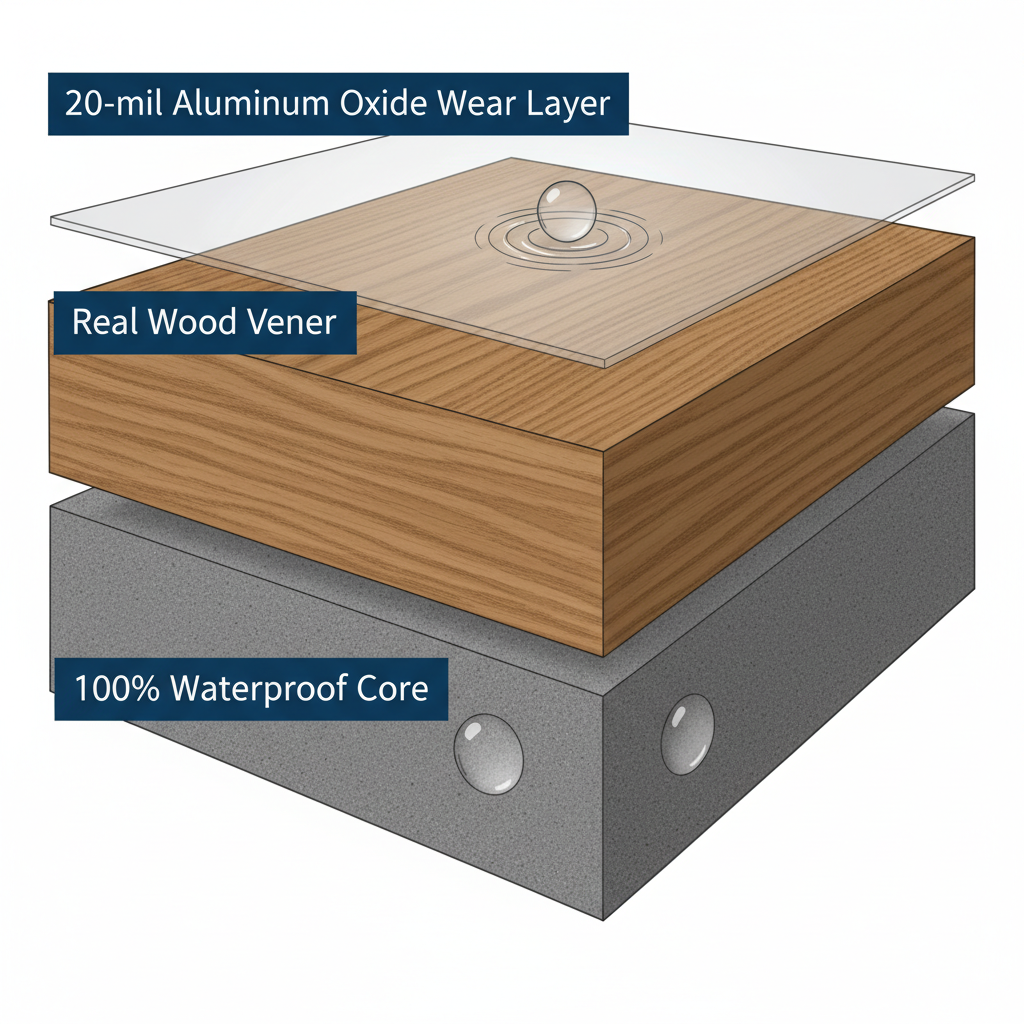
At the forefront of this movement is Bravewood hybrid hardwood. While consumer skepticism around “waterproof” wood claims is naturally high, Bravewood differentiates itself through its structural composition. According to the official manufacturer specifications, Bravewood features a 100% waterproof core technology paired with a commercial-grade 20-mil wear layer [2]. This combination effectively neutralizes the traditional threats of topical spills and subfloor moisture, establishing a new baseline for why hybrid materials are rapidly dominating residential installations.
Hybrid vs. Engineered Hardwood: Durability and Waterproof Testing
When comparing Bravewood hybrid hardwood against traditional engineered hardwood, empirical stress-test results separate marketing fiction from structural fact. Traditional engineered wood, while more stable than solid wood, still features a natural wood core that is susceptible to swelling if water breaches the surface or rises from the subfloor.
To establish true durability, we look to independent testing methodologies similar to those utilized by Consumer Reports for home products [3]. In rigorous head-to-head wear-and-tear testing—including scratch, dent, and 24-hour water submersion tests—hybrid hardwoods like Bravewood consistently outperform standard engineered options. The dense, waterproof core of the hybrid material shows zero dimensional swelling after full submersion, while its 20-mil aluminum oxide wear layer resists heavy impact dents and pet scratches that would easily mar traditional engineered veneers.
Exploring Bravewood Flooring Options: Colors, Tiers, and Warranties
For homeowners ready to make a purchasing decision, navigating the specific Bravewood hybrid hardwood flooring options requires understanding their product hierarchy. Bravewood offers over 24 distinct colorways distributed across three different product tiers, allowing for precise matching to any interior design scheme.
However, evaluating these options goes beyond color. We consulted with a certified wood flooring inspector to provide an unbiased review of the warranty exclusions across these tiers. While the premium tier boasts a lifetime residential warranty and the robust 20-mil wear layer, the entry-level tiers may carry a thinner wear layer (e.g., 12-mil) and stricter exclusions regarding subfloor flatness tolerances and commercial use. Understanding these jargon-free warranty details ensures you select the tier that actually aligns with your household’s traffic levels.
The Science of Hardwood Plank Width: Scaling to Your Space
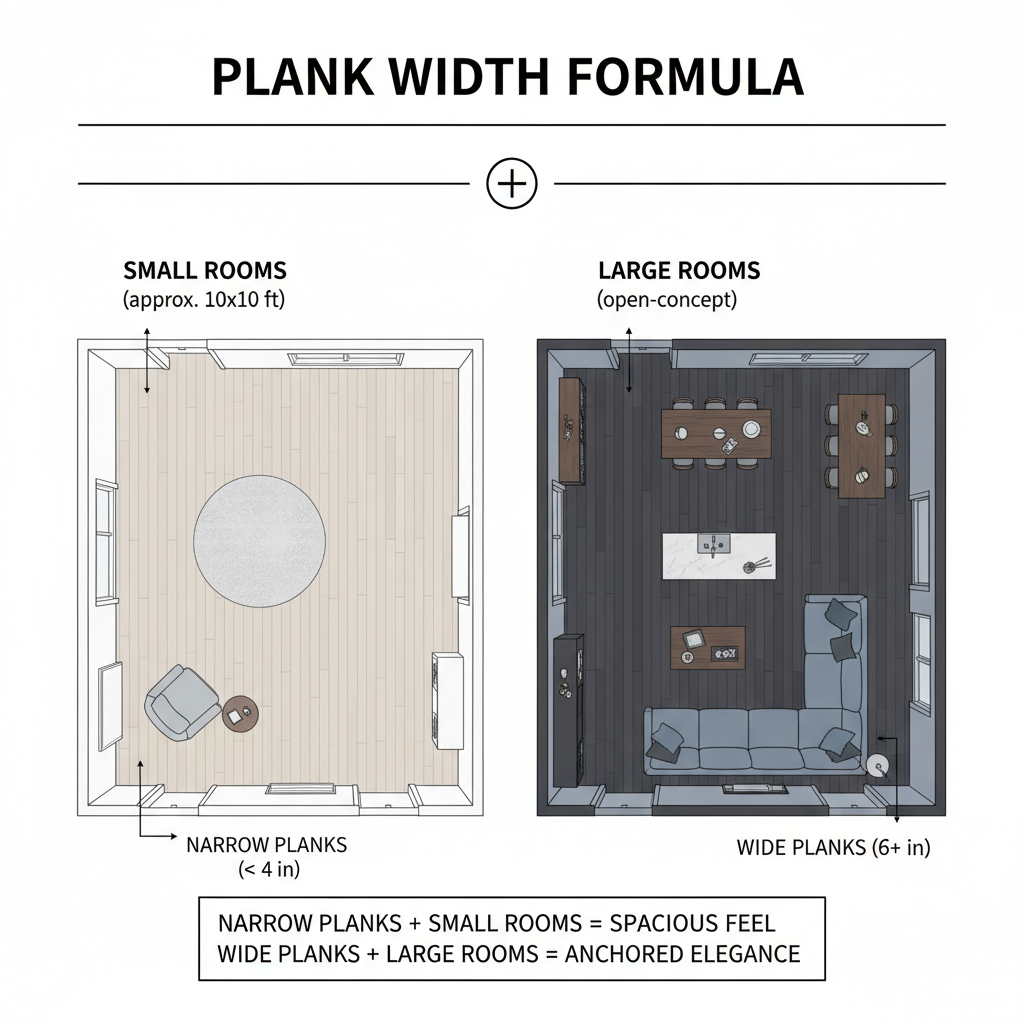
Transitioning from material selection to spatial design, the decision of hardwood plank width is arguably the most critical visual choice you will make. This decision must move beyond mere aesthetic preference and root itself in mathematical and structural considerations.
“The scale of your flooring must be in direct dialogue with the volume of your room,” notes guidelines established by the American Society of Interior Designers (ASID) regarding spatial proportion [4]. Furthermore, the American Institute of Architects (AIA) emphasizes that spatial flow and the direction of natural light should dictate how planks are oriented and sized [5]. Choosing perfect plank width means harmonizing the physical dimensions of the wood with the architectural geometry of your home.
The ‘Plank Width Formula’: Matching Width to Room Dimensions
To eliminate guesswork, we utilize a definitive “Plank Width Formula” to help you calculate how to choose hardwood plank width based on exact room dimensions. Currently, wide planks (5+ inches) account for over 70% of new hardwood installations in modern homes. However, installing ultra-wide planks in a confined space is a common architectural misstep.
Avoiding the ‘Wrong Size’ Trap: Cupping, Warping, and Humidity
Choosing the wrong hardwood plank size isn’t just an aesthetic failure; it can lead to catastrophic structural issues. The most prevalent pain point for homeowners who blindly choose ultra-wide planks is “cupping”—where the edges of the board rise higher than the center due to moisture imbalances.
Wide planks (5+ inches) are 50% more susceptible to cupping than narrow strips. To prevent this, indoor climate control is non-negotiable. ASHRAE standards dictate that indoor relative humidity must be strictly maintained between 30% and 50% year-round to protect wide hardwood [7]. Furthermore, the National Wood Flooring Association (NWFA) Installation Guidelines state that wide planks often require rigorous subfloor preparation and a “glue-assist” nailing method to restrict natural expansion and contraction [8]. If your home’s HVAC system cannot maintain strict humidity controls, a narrower plank or a dimensionally stable hybrid like Bravewood is the structurally sound choice.
Wood Grain Flooring Mastery: Aesthetics and Practicality
Beyond width, the texture and pattern of your wood grain flooring profoundly impact both the daily maintenance and the overarching style of your home. Different wood species exhibit vastly different cellular structures, which translate to their visual grain.
According to botanical data and Janka hardness scale correlations from The Wood Database, oak remains the dominant choice, holding over 50% of the market share due to its prominent, forgiving grain [9]. From a practical standpoint, heavy, wire-brushed grain patterns are highly recommended for active households, as they naturally hide up to 40% more micro-scratches and pet marks than smooth, closed-grain woods like maple or mahogany.
The Style Matchmaker: Pairing Wood Grain with Interior Design
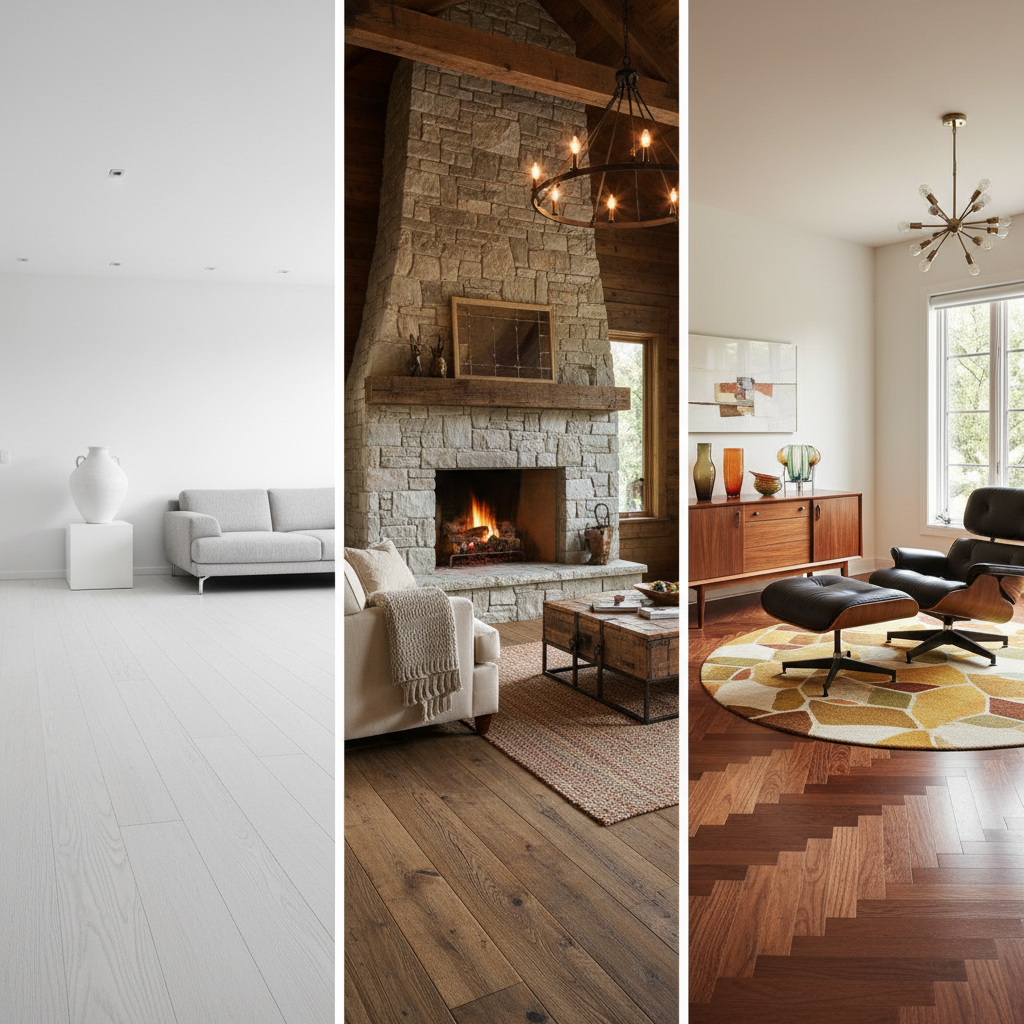
Selecting the best wood grain for home design requires matching the botanical characteristics of the wood to your overarching architectural theme. The psychological impact of these patterns is significant; the Journal of Interior Design notes that busy, high-contrast grains can visually clutter a space, while calm, subtle grains promote spatial tranquility [10].
For contemporary and Minimalist designs, white oak is the undisputed champion, with its subtle, linear grain featured in 80% of modern premium builds. Farmhouse and Rustic aesthetics lean heavily toward hickory or wire-brushed European oak, where knots and mineral streaks add necessary character. Mid-Century Modern homes traditionally pair best with the warm, closed-grain look of walnut or teak. By treating wood grain as a foundational textile, you ensure your flooring supports, rather than fights, your furniture and decor.
Troubleshooting and Remediation: Fixing Mismatched and Outdated Floors
Even with perfect planning for new spaces, many homeowners face the daunting task of integrating new flooring with existing, older wood. Whether you are dealing with the aesthetic nightmare of mismatched flooring wood grain from a partial renovation, or feeling trapped by an outdated home flooring design from the 1990s, full replacement is not your only option.
Professional remediation offers highly actionable, cost-effective solutions. According to the National Association of Realtors (NAR) Remodeling Impact Report, refinishing existing hardwood yields an incredible ROI of up to 147% at resale, making it the most financially prudent interior project a homeowner can undertake [11].
The Art of Lacing In: How to Fix Mismatched Flooring Wood Grain
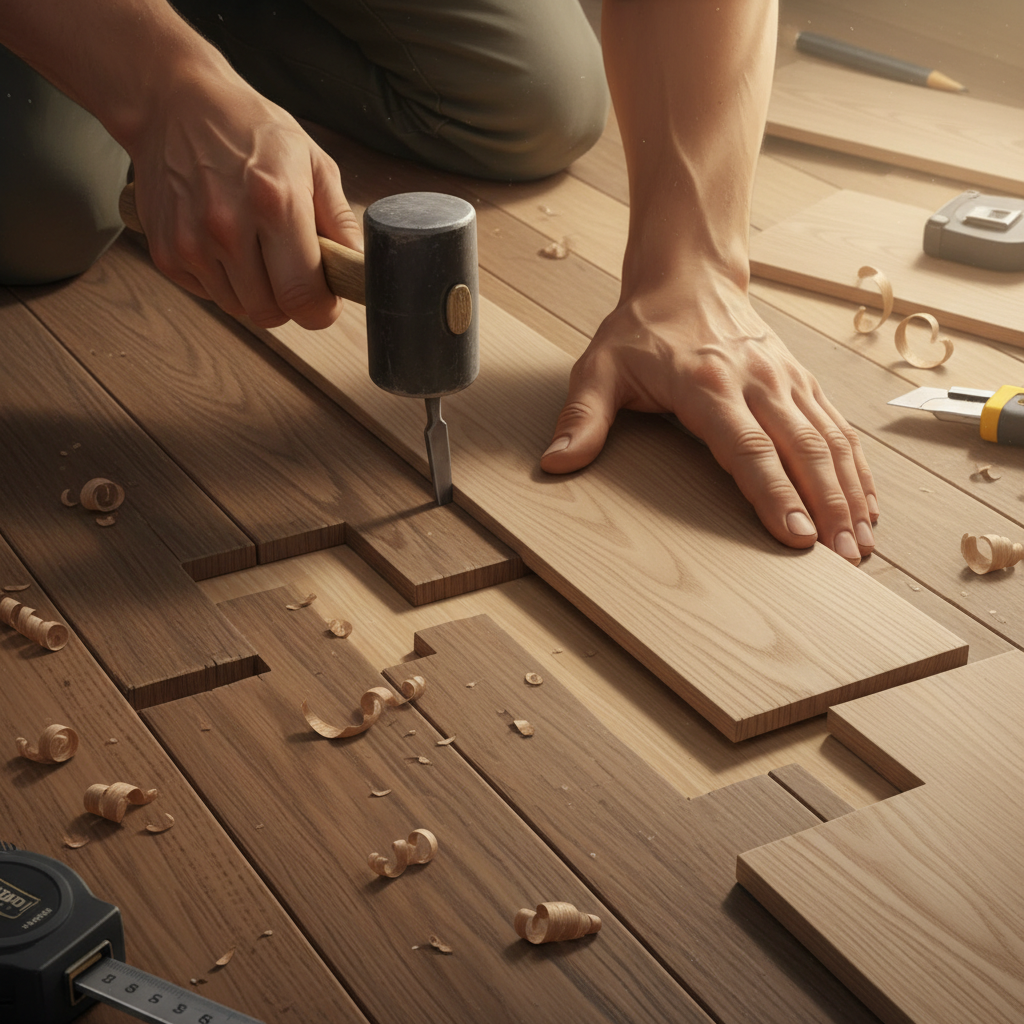
When extending a wood floor into a new addition or replacing a damaged section, creating a seamless transition is paramount. The professional solution to matching wood grain flooring is a highly technical carpentry method known as “lacing in” or “weaving.”
Instead of using a disruptive transition strip, a master carpenter will stagger the removal of the old boards at the threshold, creating a jagged edge. The new planks are then woven directly into the old floor. Because new wood absorbs stain differently than aged wood, professionals often utilize advanced finishing techniques. Fine Woodworking outlines methods such as “fuming” or chemically aging the new wood to match the exact patina and UV-exposure of the existing floor before applying the final stain [12]. This process, guided by NWFA standards for partial floor repair [8], ensures the mismatched flooring wood grain becomes entirely invisible to the naked eye.
Modernizing Outdated 90s Honey Oak Without Replacing It
If your home is dominated by thin, 1990s honey oak floors, you do not need to tear them out to achieve a modern aesthetic. We recommend a tiered modernization guide to neutralize these unwanted orange and red undertones.
The most budget-friendly tier utilizes color theory. As noted by Architectural Digest in their guides on transitioning outdated spaces, painting your walls in cool tones—specifically blues, greens, or cool off-whites—will visually neutralize the aggressive orange of the floor [13]. The next tier involves whitewashing or applying a matte finish, a trend that has surged 200% in recent years. For a complete transformation, a professional refinisher can strip the old polyurethane and apply specific green-tinted or ebony stains. Because green is opposite orange on the color wheel, these specific stain tints chemically cancel out the honey tones, leaving you with a rich, modern, neutral brown.
The Ultimate Interior Design Flooring Matrix
To synthesize these architectural principles, we must view the home holistically. Choosing the right flooring is a masterclass in balancing room type, lifestyle factors (like pets and children), and design aesthetics.
The National Kitchen and Bath Association (NKBA) provides strict guidelines for room-specific material durability, noting that while solid wood is beautiful in a living room, waterproof hybrids or tiles are structurally required for full bathrooms and mudrooms [14]. Yet, the desire for a cohesive look remains strong, as hardwood aesthetics are preferred by 87% of homebuyers. This is exactly where your interior design flooring guide culminates: utilizing high-performance, waterproof hybrid hardwoods like Bravewood in moisture-prone or high-traffic zones, while perfectly matching their grain and plank width to the traditional hardwood in your formal living spaces.
Conclusion
Successful flooring design is never an accident. It is the result of a deliberate, architectural philosophy that balances the aesthetic desires of wood grain and plank width with the unforgiving structural realities of indoor humidity, subfloor limitations, and material durability. By mathematically scaling your planks to your room size and utilizing professional remediation techniques for older floors, you protect your investment and elevate your home’s design. Bravewood hybrid hardwood options offer a compelling, modern solution to traditional wood’s shortcomings, providing the authentic beauty of oak or walnut without the constant fear of water damage or cupping.
We encourage you to consult with a certified NWFA installer to evaluate your specific room dimensions and subfloor capabilities. Before making your final decision, order sample planks of Bravewood hybrid hardwood to test against your cabinetry and observe how the wood grain interacts with your home’s natural light throughout the day.
General informational purposes only. Consult a licensed flooring contractor or structural engineer regarding specific subfloor requirements, moisture testing, and structural load-bearing capacities before installation.
References
- Floor Covering Weekly. (N.D.). Flooring Market Trends and Material Innovations. Retrieved from Floor Covering Weekly.
- Bravewood Official Manufacturer Specs. (N.D.). Bravewood Hybrid Hardwood Technical Data. Retrieved from Bravewood Official Manufacturer Specs.
- Consumer Reports. (N.D.). Flooring Buying Guide and Testing Methodology. Retrieved from Consumer Reports.
- American Society of Interior Designers (ASID). (N.D.). Interior Design Scale and Spatial Relationships. Retrieved from ASID.
- American Institute of Architects (AIA). (N.D.). Spatial Design and Architectural Flow. Retrieved from AIA.
- Zillow Research. (N.D.). Home Features and Resale Value. Retrieved from Zillow Research.
- ASHRAE. (N.D.). Indoor Humidity Standards. Retrieved from ASHRAE.
- National Wood Flooring Association (NWFA). (N.D.). Installation Guidelines and Repair Standards. Retrieved from NWFA.
- The Wood Database. (N.D.). Botanical Characteristics of Wood Species. Retrieved from The Wood Database.
- Journal of Interior Design. (N.D.). Spatial Aesthetics and Design Psychology. Retrieved from Journal of Interior Design.
- National Association of Realtors (NAR). (N.D.). Remodeling Impact Report. Retrieved from NAR.
- Fine Woodworking. (N.D.). Advanced Finishing and Wood Matching Techniques. Retrieved from Fine Woodworking.
- Architectural Digest. (N.D.). Transitioning Outdated Spaces into Modern Designs. Retrieved from Architectural Digest.
- National Kitchen and Bath Association (NKBA). (N.D.). Room-Specific Material Guidelines. Retrieved from NKBA.
