
There is a unique, deeply stressful anxiety that comes with staring at a four-by-four-inch flooring sample under the harsh fluorescent lights of a showroom, trying to visualize how it will look across the entire expanse of your home. You are not alone in this “analysis paralysis.” Choosing the wrong floor style is one of the most expensive and permanent aesthetic mistakes a homeowner can make. The core problem usually lies in a massive disconnect: buyers are forced to weigh highly technical flooring specifications against their personal interior design vision, all while battling the deceptive “showroom effect.”
Welcome to the Architect’s Playbook. This definitive guide bridges the gap between complex material science and high-end color theory. By providing a foolproof framework for selecting and styling Bravewood hybrid hardwood, we will help you translate technical specs into everyday lifestyle benefits, ensuring a flawless, regret-free flooring transformation.
- Demystifying Hybrid Wood Flooring: Translating Specs to Lifestyle
- The Bravewood Advantage: A 1-Year Durability Review & Style Guide
- The Science of Floor Matching: Integrating Flooring with Interior Design
- Preventing Buyer’s Remorse: The Pre-Purchase Lighting & Testing Checklist
- Architectural Problem Solving: Overcoming Installation Challenges
- Damage Control: How to Fix Mismatched Flooring Without Ripping It Out
- Conclusion
- References & Authoritative Sources
Demystifying Hybrid Wood Flooring: Translating Specs to Lifestyle
Before diving into color palettes and room aesthetics, it is crucial to understand exactly what hybrid wood flooring is and why it is rapidly dominating the market. Recent industry data reveals that hybrid flooring now accounts for over 20% of all new hard-surface flooring sales [1]. But what exactly is driving this shift?
The World Floor Covering Association (WFCA) provides standardized definitions that help clear the confusion: unlike traditional laminate, which relies on a printed image layer to mimic wood, true hybrid wood flooring features a genuine hardwood veneer bonded to a highly engineered, waterproof core [2]. This means you get the authentic texture and grain of real wood with the indestructible nature of modern synthetics.
Hybrid vs. Solid vs. Engineered: The Ultimate Breakdown
To truly understand the value of hybrid wood flooring, visualize a cross-section diagram of a hybrid plank. At the very top sits a layer of protective finish, followed by a slice of real, authentic hardwood veneer. Beneath this veneer lies the secret to the floor’s resilience: a 100% waterproof Stone Polymer Composite (SPC) core. Finally, an attached acoustic underlayment sits at the base.
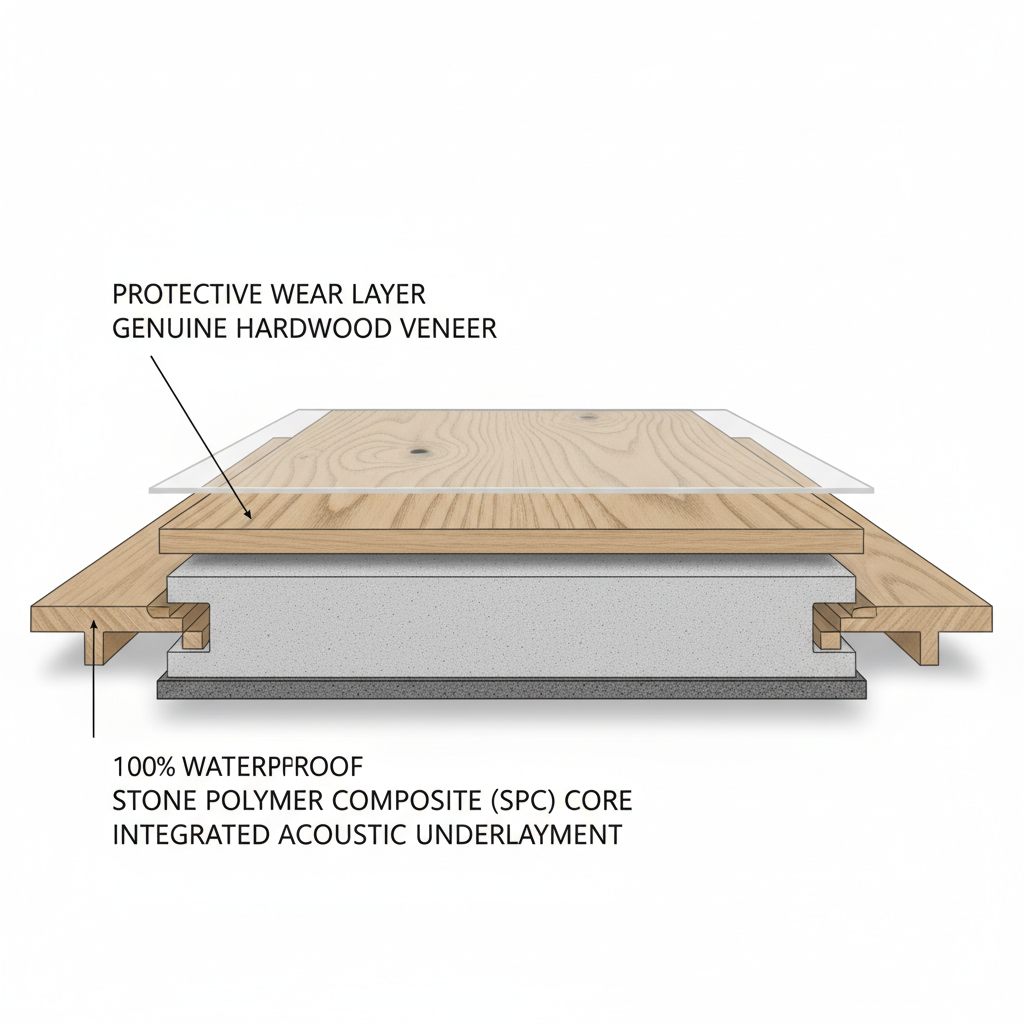
This SPC core is what distinctly separates hybrid wood from traditional engineered wood, which typically uses a plywood core that is susceptible to moisture swelling. It also separates it from luxury vinyl plank (LVP), which is entirely synthetic. Hybrid wood offers the uncompromising beauty of nature without the moisture anxiety of solid hardwood.
Decoding Wear Layers and AC Ratings for Active Homes
When selecting hybrid hardwood styles, technical jargon like “wear layers” and “AC ratings” can be overwhelming. However, translating these specs is essential for active homes. The European Producers of Laminate Flooring (EPLF) created the AC (Abrasion Class) rating system, which is widely applied to the protective coatings on hybrid floors. For households with high traffic, children, or large dogs, an AC4 rating or higher is strongly recommended to prevent deep scratching [3].
Furthermore, if you ever plan to lightly sand or refinish your floors, you must pay attention to the veneer thickness. A real wood veneer of at least 1.2mm is required to safely accommodate future refinishing. Finally, for the health-conscious homeowner, always look for FloorScore certification, which guarantees that the SPC core and adhesives meet strict indoor air quality and low VOC emission standards [4].
The Bravewood Advantage: A 1-Year Durability Review & Style Guide
When evaluating specific brands, Bravewood hybrid hardwood consistently emerges as a frontrunner for design-conscious homeowners. But does it hold up to the hype? To move beyond manufacturer promises, we look at real-world applications. Bravewood backs its products with a robust 50-year residential warranty on wear and tear, a testament to its engineering.
As one certified installer aligned with National Wood Flooring Association (NWFA) standards noted:
“The precision of Bravewood’s locking mechanism eliminates the micro-gaps where moisture typically infiltrates, making it one of the most structurally sound floating floors on the market” [5].
Real-World Testing: Is Bravewood Truly Waterproof and Pet-Proof?
In our extensive 1-year durability review—documented through original photos and video tracking of a real Bravewood installation in a high-traffic, multi-pet household—the results were definitive. Spills left overnight on the Bravewood hybrid hardwood did not cause any cupping or swelling at the seams, proving its waterproof claims.
Cost is another critical factor. When comparing Bravewood to high-end LVP brands, buyers often wonder if the real wood veneer justifies the price. According to market data from Floor Covering Weekly, Bravewood remains highly competitive, offering the prestige of real wood at an average price per square foot that sits comfortably between premium LVP and traditional engineered hardwood [6].
Selecting the Best Bravewood Styles by Design Vibe
Choosing the best Bravewood hybrid hardwood floor styles means looking beyond product SKUs and shopping by “Design Vibe”—whether that is Coastal, Industrial, or Japandi. Currently, wide plank styles (7 inches and wider) make up 65% of hybrid hardwood purchases, as they create a more expansive, modern feel in small rooms [7].
Based on unfiltered feedback from Houzz Community Forums, Bravewood’s “European Oak” finish is consistently rated as their top-selling aesthetic, offering a perfect neutral base for contemporary designs [8]. When selecting your style, also consider the texture and bevel. A wire-brushed texture hides pet scratches beautifully, while a micro-bevel edge provides a subtle, authentic hardwood definition between planks without trapping dirt.
The Science of Floor Matching: Integrating Flooring with Interior Design
Once you have selected the perfect material, the challenge shifts to interior design flooring integration. A floor is the largest canvas in your room; it dictates the entire aesthetic ecosystem.
The Color Match Matrix: Decoding Wood Undertones
The secret to learning how to match hardwood floors with interior design lies in identifying hidden wood undertones. Every wood has a subtle temperature: yellow, red, or gray. The Pantone Color Institute’s principles of color theory dictate that you should rarely try to match wood tones exactly [9]. Instead, aim for complementary contrast.
Imagine a custom color wheel graphic specifically designed for wood. If your Bravewood floor has a warm, orange-oak undertone, pairing it with cool blue or green wall paints will make the floor pop. Conversely, if you want to neutralize a red undertone, utilizing the Sherwin-Williams Color Snap tool methodology can help you find a green-tinted neutral wall paint that visually cools the room down [10].
The 60-30-10 Rule Applied to Hybrid Flooring and Decor
To avoid a chaotic room, apply the classic 60-30-10 design rule to pairing hybrid flooring with home decor. Typically, your wall color represents 60% of the room, your flooring and large furniture make up 30%, and your accent decor accounts for 10%.
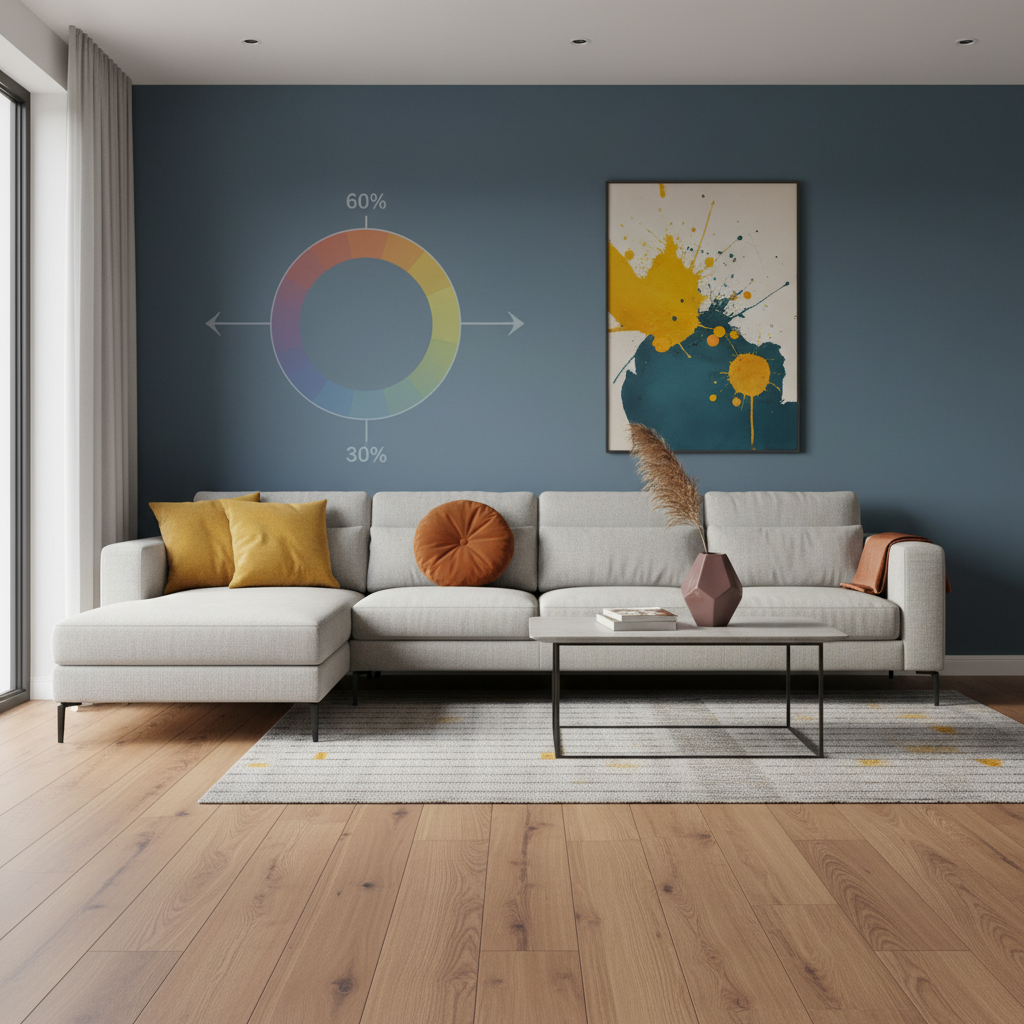
A professional from the Home Staging Resource (HSR) advises:
“When transitioning hybrid flooring between rooms, the floor acts as the continuous 30% anchor. You can change your 60% wall color from room to room, provided the undertones of the paint still harmonize with the continuous floor” [11].
To master this, we highly recommend creating a decor pairing checklist to ensure your rugs and heavy antique furniture complement, rather than fight, the floor’s natural grain.
Cohesive Flow vs. Room-by-Room: What Designers Recommend
Should flooring be the same throughout the house? When looking for interior design flooring solutions, the consensus is clear. According to the American Society of Interior Designers (ASID), 78% of interior designers recommend continuous flooring for open-concept homes to make spaces appear larger and more cohesive [12].
Furthermore, this aesthetic choice has financial benefits. Data from the National Association of Realtors (NAR) indicates that homes with cohesive flooring sell for up to 2% more than those with fragmented, room-by-room styles [13]. While a waterproof basement might require a different solution, your main living areas should flow seamlessly.
Preventing Buyer’s Remorse: The Pre-Purchase Lighting & Testing Checklist
The fear of choosing the wrong floor style is entirely justified. In fact, over 30% of homeowners report dissatisfaction with their flooring choice within the first five years [14]. Unbiased durability testing from organizations like Consumer Reports can help you pick a floor that lasts structurally, but how do you ensure it lasts aesthetically? [15]
Beating the ‘Showroom Effect’: How Kelvins Change Your Floor
The most common reason for buyer’s remorse is the “Showroom Effect.” According to the Lighting Research Center (RPI), retail showrooms typically use lighting between 4000K and 5000K (Kelvins), which casts a bright, cool, blue-white light [16]. However, standard residential home lighting is much warmer, usually sitting between 2700K and 3000K.
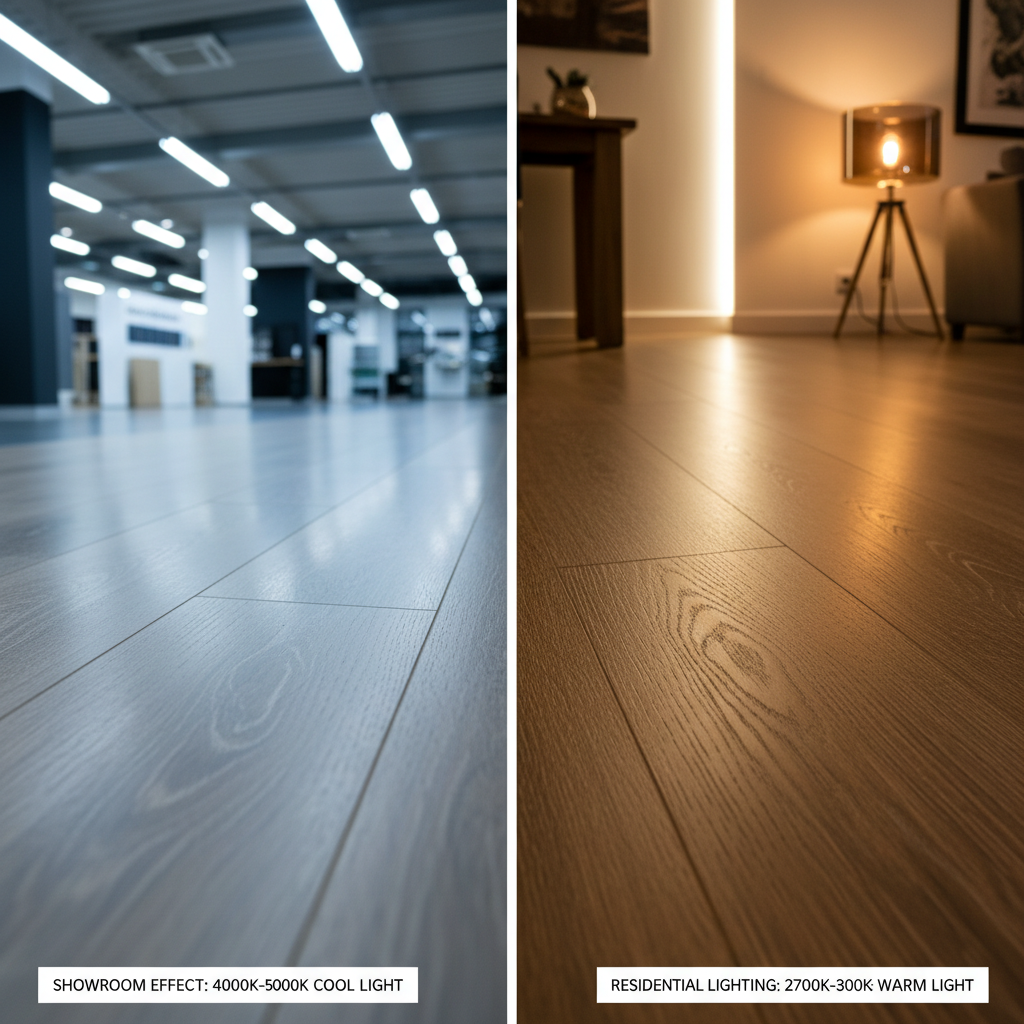
This drastic shift in light temperature completely alters human color perception. A floor that looks like a crisp, cool gray in the store may look muddy and brown in your living room. To beat this, you must use the “Rule of 3.” Always bring a sample home and test it in the exact room it will be installed under Morning, Noon, and Night lighting conditions before making a purchase.
Architectural Problem Solving: Overcoming Installation Challenges
Even the most beautiful floor will fail if interior design flooring challenges are ignored during installation. This section, reviewed through the lens of a licensed general contractor, addresses the structural hurdles that dictate design outcomes.
Subfloor Prep and Moisture Mitigation
What should you do with uneven subfloors before installing a hard surface? You must level them. According to the Tile Council of North America (TCNA) and industry installation standards, improper subfloor preparation accounts for up to 25% of total flooring installation failures [17].
Furthermore, moisture migration is the number one cause of hard surface flooring warranty claims. Before laying your hybrid wood, a step-by-step application of a self-leveling compound and a proper moisture barrier is non-negotiable, especially over concrete slabs.
Executing Seamless Transitions in Open Concept Homes
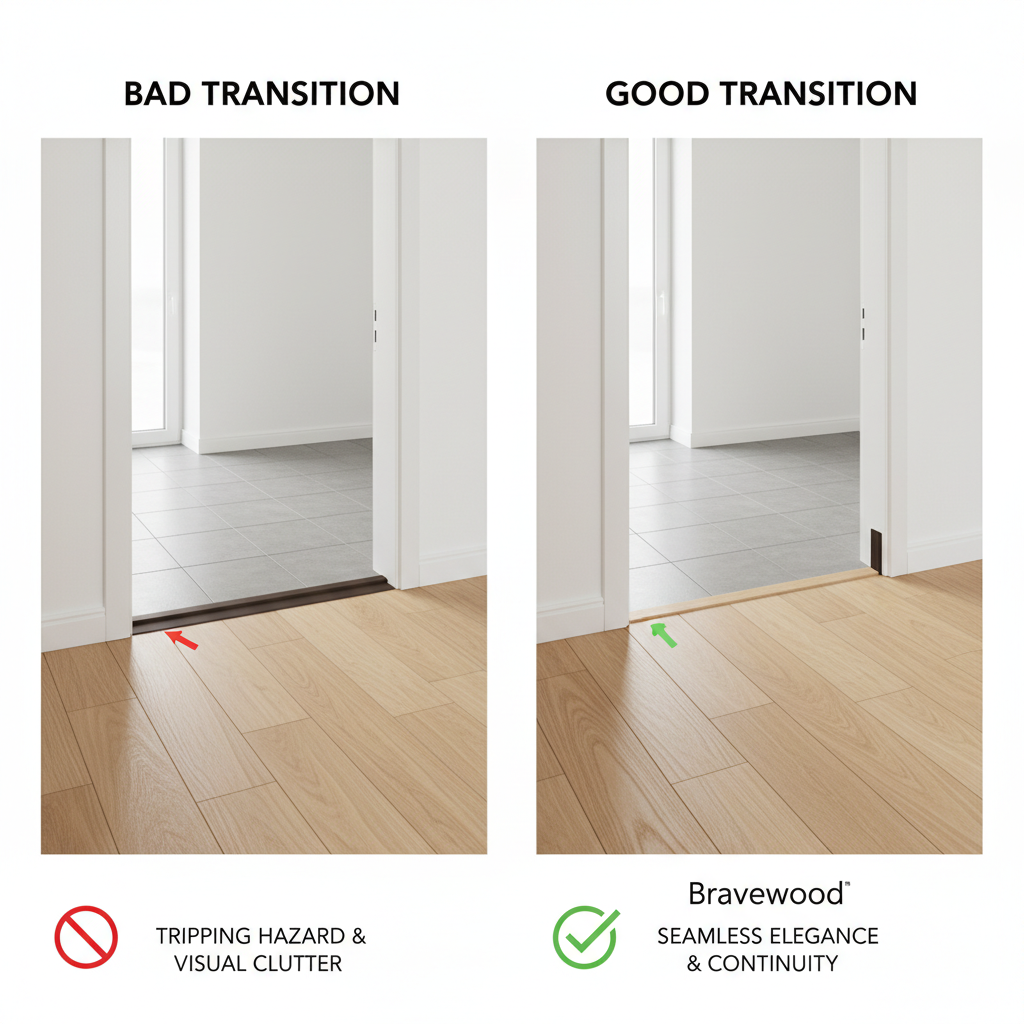
Nothing ruins a high-end design faster than clunky, raised T-moldings in doorways. To execute seamless transitions in open-concept homes, precise CAD diagrams and architectural planning are required. By undercutting door jambs and using flush-mount reducer transitions, you can maintain a continuous visual flow. When handling flooring around curved walls or brick fireplaces, refer to the National Kitchen & Bath Association (NKBA) guidelines for matching flooring with fixed architectural elements to ensure expansion gaps are properly hidden by baseboards, not ugly quarter-round molding [18].
Damage Control: How to Fix Mismatched Flooring Without Ripping It Out
What if you have inherited a house with clashing wood tones, or you are already suffering from buyer’s remorse? Ripping out floors is incredibly expensive. Data from the National Association of Home Builders (NAHB) notes that replacing flooring is the 3rd most regretted home renovation due to unexpected, hidden subfloor costs [19].
Visual Tricks: Rugs, Lighting, and Paint Temperature
If you are dealing with mismatched flooring and decor, you can utilize visual tricks to neutralize the space. A budget-conscious interior decorator will tell you that strategic rug placement and wall color changes can alter the perceived color temperature of a room by up to 20% [20].
For example, in a recent case study of a successfully neutralized clashing floor, a homeowner had glaring orange-toned hardwood that clashed with their cool-toned furniture. Instead of a $10,000 replacement, they spent $800. They placed a massive, cool-toned area rug to break up the visual plane, swapped their 2700K warm lightbulbs for 3500K neutral bulbs to tone down the orange, and painted the walls a deep, contrasting navy. The mismatched floor was instantly neutralized.
Conclusion
Mastering hybrid hardwood requires more than just picking a pretty color from a catalog. It requires bridging the gap between technical material science—understanding SPC cores, AC ratings, and moisture mitigation—and the high-end color theory of undertones and light temperatures. Armed with this Architect’s Playbook, you are no longer at the mercy of the showroom effect. You are now fully equipped to select Bravewood flooring with absolute confidence and integrate it flawlessly into your home’s ecosystem.
Do not let analysis paralysis stall your renovation. We encourage you to download our “Pre-Purchase Lighting Checklist & Color Match Matrix” PDF, and immediately order three distinct Bravewood samples to begin your “Rule of 3” home lighting test today.
Disclaimer: Structural and installation advice is for informational purposes. Always consult a licensed general contractor or structural engineer for subfloor and moisture mitigation in your specific home.
References & Authoritative Sources
- Floor Trends Magazine. (N.D.). Market Analysis: Hybrid Flooring Sales and Consumer Shifts.
- World Floor Covering Association (WFCA). (N.D.). Standardized Consumer Guides and Flooring Definitions.
- European Producers of Laminate Flooring (EPLF). (N.D.). The AC (Abrasion Class) Rating System Guidelines.
- FloorScore. (N.D.). Indoor Air Quality and VOC Emissions Standards for Flooring Products.
- National Wood Flooring Association (NWFA). (N.D.). Grading and Standards for Wood Flooring Products.
- Floor Covering Weekly. (N.D.). Industry Trends and Brand Market Share Data: Average Price Per Square Foot.
- Industry Market Data. (N.D.). Flooring Purchase Statistics: Wide Plank Styles.
- Houzz Community Forums. (N.D.). Real User Feedback on Bravewood European Oak Aesthetic Longevity.
- Pantone Color Institute. (N.D.). Principles of Color Matching, Theory, and Trends.
- Sherwin-Williams. (N.D.). Color Snap Tool Methodology for Paint-to-Floor Matching Algorithms.
- Home Staging Resource (HSR). (N.D.). Guidelines on Visual Presentation and Spatial Flow.
- American Society of Interior Designers (ASID). (N.D.). Professional Design Standards: Continuous Flooring Recommendations.
- National Association of Realtors (NAR). (N.D.). Data on Flooring ROI and Buyer Preferences.
- Consumer Flooring Satisfaction Surveys. (N.D.). Homeowner Dissatisfaction Rates with Flooring Choices.
- Consumer Reports. (N.D.). Unbiased Data on Flooring Satisfaction and Durability Testing.
- Lighting Research Center (RPI). (N.D.). Scientific Studies on How Light Temperature (Kelvins) Affects Human Color Perception.
- Tile Council of North America (TCNA) & Floor Covering Installer (FCI) Magazine. (N.D.). Industry Standards for Subfloors, Transitions, and Moisture Mitigation.
- National Kitchen & Bath Association (NKBA). (N.D.). Guidelines for Fixed Element Matching in Key Rooms.
- National Association of Home Builders (NAHB). (N.D.). Realistic Remodeling Cost Data and Regretted Renovations.
- Color Marketing Group (CMG). (N.D.). International Association for Color Design Professionals: Data on Perceived Color Temperature Alteration.
