
Choosing new flooring is one of the most high-stakes, anxiety-inducing decisions a homeowner can make. Unlike a coat of paint or a piece of furniture, hardwood flooring is a permanent architectural foundation. Make the right choice, and your home feels expansive, cohesive, and luxurious. Make the wrong choice, and you risk inadvertently making your rooms feel cramped, disjointed, or visually disproportionate.
For many meticulous renovators, the core problem lies in the disconnect between modern material science and spatial design. You want the cutting-edge durability of modern flooring, but you also need it to look architecturally flawless. This isn’t just another marketing brochure; this is your definitive Architect’s Guide. We are bridging the gap between the technical, waterproof durability of Bravewood hybrid hardwood and the spatial psychology of hardwood plank width.
In this comprehensive guide, we will provide a clear roadmap to your perfect floor: breaking down the material science of hybrid hardwood, exploring the optical illusions of plank width, providing a room-by-room decision matrix, and offering expert troubleshooting techniques for mismatched floors.
- The Evolution of Flooring: Demystifying Bravewood Hybrid Hardwood
- The Psychology of Space: How Hardwood Plank Width Manipulates Perception
- The Architect’s Decision Matrix: How to Choose Hardwood Plank Width
- Troubleshooting & Transitions: Fixing Mismatched Flooring Proportions
- Conclusion
- References & Authoritative Sources
The Evolution of Flooring: Demystifying Bravewood Hybrid Hardwood
To understand why hybrid hardwood flooring is rapidly replacing traditional options in high-end homes, we must look at the evolution of flooring materials. For decades, homeowners had to choose between the authentic beauty of solid hardwood (which is susceptible to water damage and warping) and Luxury Vinyl Plank or LVP (which is waterproof but often lacks the genuine texture and warmth of real wood). Traditional engineered wood offered a middle ground, but still fell short in truly wet environments like kitchens and mudrooms.
Enter hybrid hardwood. According to industry data published in Floor Covering Weekly, the hybrid flooring market is projected to grow at a compound annual growth rate (CAGR) of 7.5% over the next five years, driven entirely by the demand for waterproof, authentic wood alternatives [1].
But what exactly is it? The National Wood Flooring Association (NWFA) draws a distinct line between traditional engineered wood (which uses a plywood or high-density fiberboard core) and true hybrid floors [2]. A genuine hybrid hardwood features a 100% waterproof rigid core—often made from a stone polymer composite (SPC)—topped with a real, natural wood veneer. If you were to look at a custom-designed diagram showing the layer-by-layer anatomy of Bravewood hybrid hardwood, you would see a high-performance acoustic underlayment, a dent-proof rigid core, a slice of authentic European Oak or Hickory, and a commercial-grade protective wear layer.
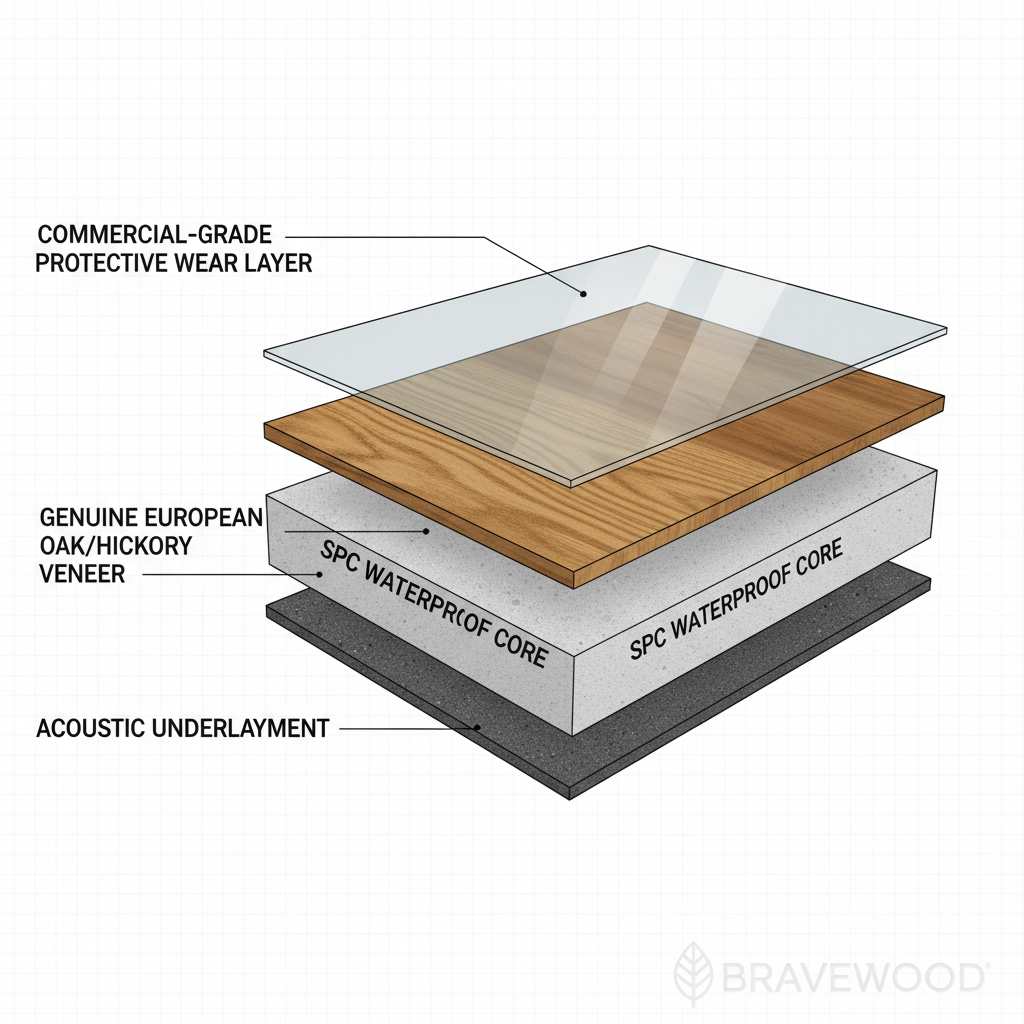
What is Bravewood Hybrid Hardwood Made Of?
Bravewood hybrid hardwood represents the pinnacle of this material science. At its foundation, Bravewood utilizes a proprietary waterproof core that completely resists moisture expansion. This is topped with a genuine wood veneer, meaning no two planks are exactly alike—you get the unique grain patterns and knots of natural wood. Finally, the surface is sealed with an advanced aluminum oxide finish, providing extreme resistance to scratches, dents, and pet wear.
According to Bravewood Official Manufacturer Specifications, the product is 100% waterproof and dimensionally stable, making it suitable for below-grade installations (like basements) where traditional wood would fail [3].
However, users frequently ask: Can hybrid hardwood flooring be refinished? This is where we must look at a 20-year lifespan cost-benefit analysis. Unlike solid hardwood, which can be sanded down and refinished multiple times over a century, the real wood veneer on hybrid flooring is typically too thin for a traditional heavy sanding. The trade-off is upfront durability versus long-term malleability. Over a 20-year period, solid wood will likely require at least one expensive refinishing treatment to maintain its look. Bravewood hybrid hardwood costs significantly less to install and requires zero refinishing over that same two-decade span, though it cannot be restained if you decide you want a different color ten years down the line.
Comparing Bravewood Hybrid Hardwood Flooring Options
When you are deep in the commercial investigation phase, choosing the right product line requires a comprehensive look at Bravewood hybrid hardwood flooring options. While macro-photography of the different textures and finishes reveals a stunning array of choices, understanding the technical differences is key. Here is an unbiased comparison matrix based on their product catalogs [3]:
- The Essential Line: Designed for budget-conscious renovations, this line features a slightly thinner overall core thickness (typically around 5mm to 6mm) and a standard residential wear layer. It offers beautiful, classic colors but is best suited for low-to-medium traffic areas.
- The Architectural Reserve: This is the premium tier. It features an ultra-thick rigid core (up to 8mm) for maximum sound dampening and a commercial-grade aluminum oxide wear layer. The macro-photography of this line highlights deep wire-brushing and hand-scraped textures.
- Warranty Differences: Based on the manufacturer’s catalogs, The Essential Line typically carries a 25-year residential warranty, while The Architectural Reserve boasts a lifetime residential and a 10-year light commercial warranty, reflecting its superior dent and scratch resistance.
The Psychology of Space: How Hardwood Plank Width Manipulates Perception
Once you have settled on the material, you must transition from material science to interior design. Hardwood plank width is not merely an aesthetic preference; it is a powerful architectural tool that fundamentally alters the perceived size, scale, and proportion of a room.
In recent years, the trend has skewed heavily toward wider boards. Industry data indicates that over 70% of new premium hardwood installations in 2023 featured wide planks measuring 5 inches or wider [4]. However, blindly following trends can lead to spatial disaster. The American Society of Interior Designers (ASID) emphasizes that principles of spatial design and proportion must dictate material choices [5]. A massive 9-inch plank in a tiny 10×10 bedroom will look out of scale, visually shrinking the room, while narrow 2.25-inch strip flooring in a sprawling great room can look busy and chaotic.
Optical Illusions: Direction, Color, and Width
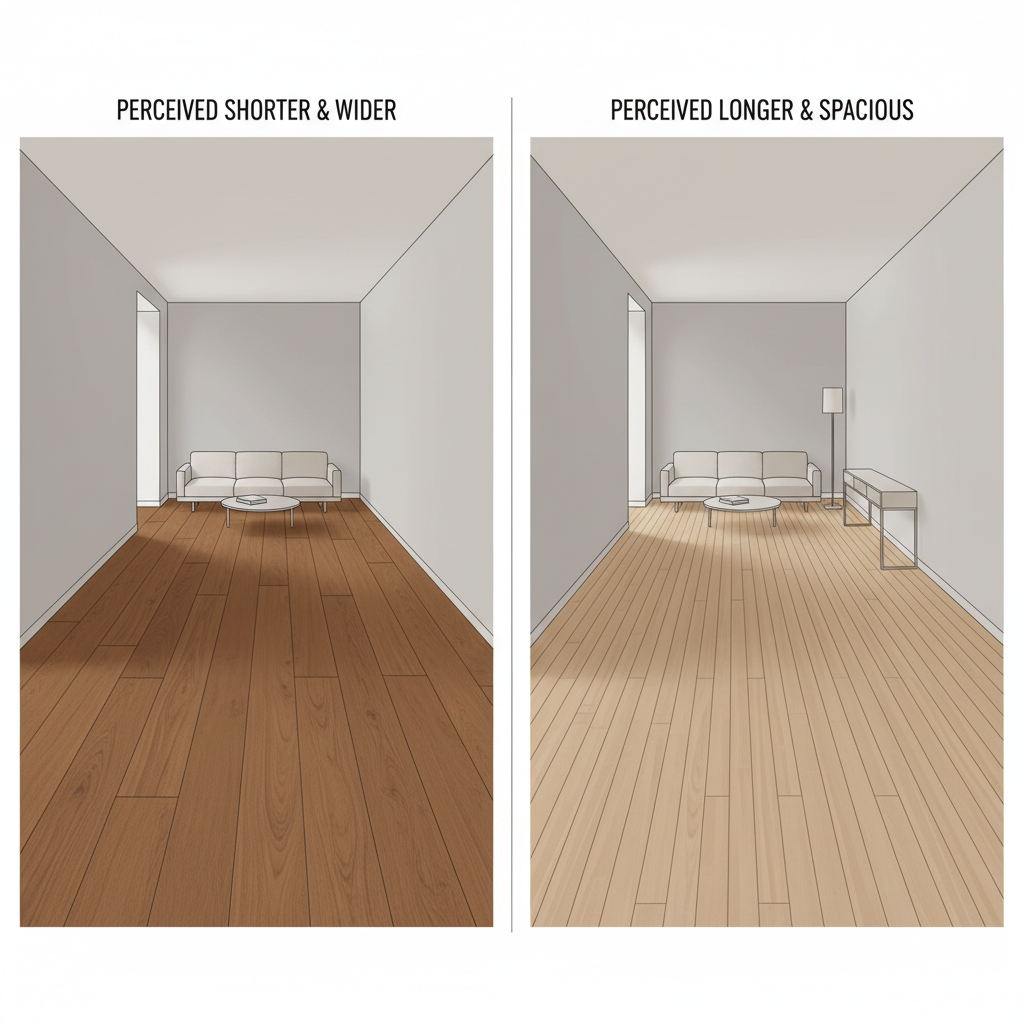
If you are worried about your flooring making a room look small, you need to understand the optical illusions at play. The root causes of a cramped-feeling room often stem from the interplay of plank direction, color, and natural light reflection.
According to studies published in the Journal of Environmental Psychology, the human eye naturally follows lines of perspective [6]. Diagrams illustrating this concept show that installing planks parallel to the longest wall of a room will draw the eye outward, effectively elongating the space. Conversely, running planks horizontally across a narrow room can make it feel wider, though it may also make it feel shorter.
Color and light reflection are equally critical. Dark flooring absorbs light, which can make a room feel smaller and more enclosed. However, this is a content gap many design blogs miss: the finish matters just as much as the color. A dark floor with a satin or semi-gloss finish that reflects abundant natural light will feel much more expansive than a matte dark floor in a poorly lit room. When combining dark colors with wide planks, ample natural light is non-negotiable to prevent the space from feeling heavy.
The Architect’s Decision Matrix: How to Choose Hardwood Plank Width
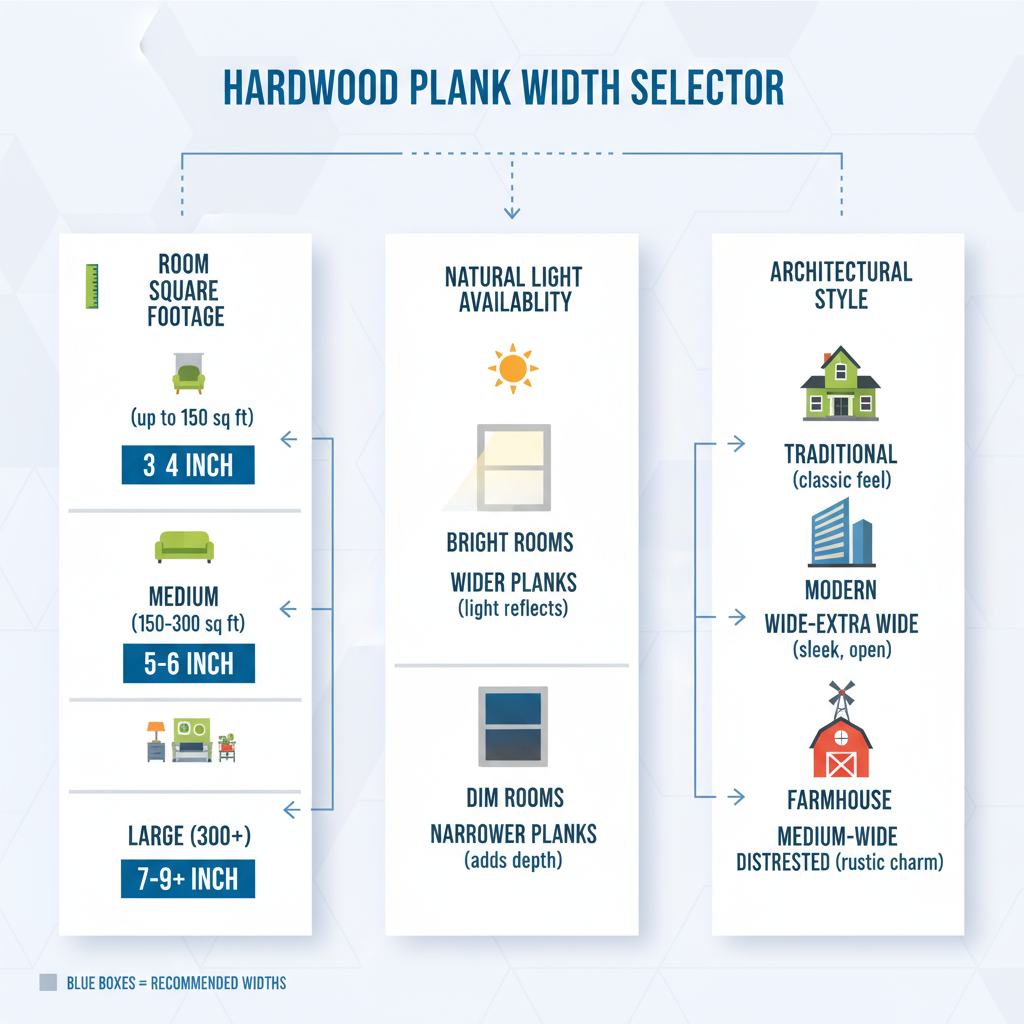
To eliminate the guesswork, we have developed a step-by-step framework for choosing the right plank width. This “Decision Matrix” relies on three pillars: room square footage, natural light availability, and the architectural style of your home. The National Association of Home Builders (NAHB) notes that matching these elements to standard building practices significantly improves buyer satisfaction and home cohesion [7].
The Hardwood Plank Width Guide & Decision Matrix:
- Assess Square Footage: For small rooms (under 150 sq. ft.), stick to traditional widths (3 to 4 inches) to maintain scale. For medium rooms (150-300 sq. ft.), standard wide planks (5 to 6 inches) are ideal. For expansive, open-concept spaces (300+ sq. ft.), ultra-wide planks (7 to 9+ inches) shine.
- Evaluate Natural Light: Wide planks showcase more of the wood’s natural grain and require fewer seams, creating a cleaner look. If a room has massive windows, wide planks will look breathtaking. In dark, cramped hallways, narrower planks can create a sense of movement and texture that distracts from the lack of light.
- Match Architectural Style: Historic or traditional homes often look best with 3-inch to 5-inch planks, honoring period-accurate aesthetics. Modern, contemporary, or farmhouse styles demand the clean, sweeping lines of 7-inch or wider planks.
The Best Hardwood Plank Width for Living Rooms
When determining the best hardwood plank width for living room spaces, the layout dictates the rules. For traditional, closed-off living rooms, a 5-inch plank offers a perfect balance of modern appeal and traditional scale.
However, the rules change for modern layouts. Currently, 7.5-inch planks are the top-selling width for open-concept living room renovations. In an open concept, your living room flooring must seamlessly flow into the kitchen and dining areas. Using a wide plank reduces the number of visible seams across that massive footprint, creating a unified, calming aesthetic. Furthermore, Zillow Research indicates that cohesive, wide-plank flooring in main living areas is a highly sought-after feature that can positively impact a home’s resale value [8].
When placing furniture on wide planks, ensure your area rugs are large enough so that the furniture sits entirely on the rug. This creates a “room within a room” and prevents the wide planks from dwarfing your furniture.
The Hidden Installation Costs of Wide Planks
While wide planks are visually stunning, choosing the right plank width requires understanding the financial and structural implications. What many homeowners don’t realize is that wide planks come with hidden installation costs.
Data from HomeAdvisor / Angi shows that wide plank installation (5 inches and wider) can cost 10% to 20% more in labor compared to standard strip flooring [9]. Why? It comes down to the physics of wood movement. The Forest Products Laboratory explains that wood naturally expands and contracts with changes in ambient moisture and humidity [10]. The wider the plank, the more dimensional movement occurs across its face.
To prevent wide planks from “cupping” (where the edges of the board warp upward), installers cannot simply nail them down. They must use a “glue-assist” installation method, applying a serpentine bead of specialized urethane adhesive to the subfloor alongside the traditional cleats or staples. This requires more materials, more time, and a higher level of expertise, driving up the installation cost. Fortunately, the rigid core of Bravewood hybrid hardwood mitigates much of this dimensional instability, making it a safer bet for wide-plank aesthetics than solid wood.
Troubleshooting & Transitions: Fixing Mismatched Flooring Proportions
Even with the best planning, renovations and additions can lead to design dilemmas. If you are dealing with mismatched flooring proportions where new hardwood meets old, or if you feel you’ve inherited the wrong hardwood plank size from a previous owner, there are expert solutions.
Visual Corrections for the ‘Wrong’ Hardwood Plank Size
If you are experiencing anxiety because your current flooring is making your room look small or disproportionate, you do not necessarily need to tear it up. The International Association of Home Staging Professionals (IAHSP) utilizes several non-destructive visual corrections to fix the look of a room [11].
If your planks are too narrow and make the room look busy, the solution is strategic distraction. Use oversized, lightly colored area rugs to cover the bulk of the floor, leaving only a border of the narrow planks visible. This breaks up the chaotic lines. Furthermore, improving the room’s lighting—both natural and artificial—draws the eye upward to the walls and ceiling, minimizing the floor’s visual dominance. Remember, while architectural “rules” exist, psychological reassurance is key: personal preference and comfortable styling can easily override a mathematically “incorrect” plank width.
The Art of the Transition: Blending Different Plank Widths
When a renovation forces you to blend two different wood floors or transition between different plank widths, the goal is to avoid a jarring visual clash. Fine Homebuilding Magazine highlights several expert carpentry techniques for mastering the art of the transition [12].
According to NWFA Installation Guidelines, you should never try to seamlessly butt two different plank widths together if they run parallel; the mismatched seams will look like a mistake [13]. Instead, use an intentional transition.
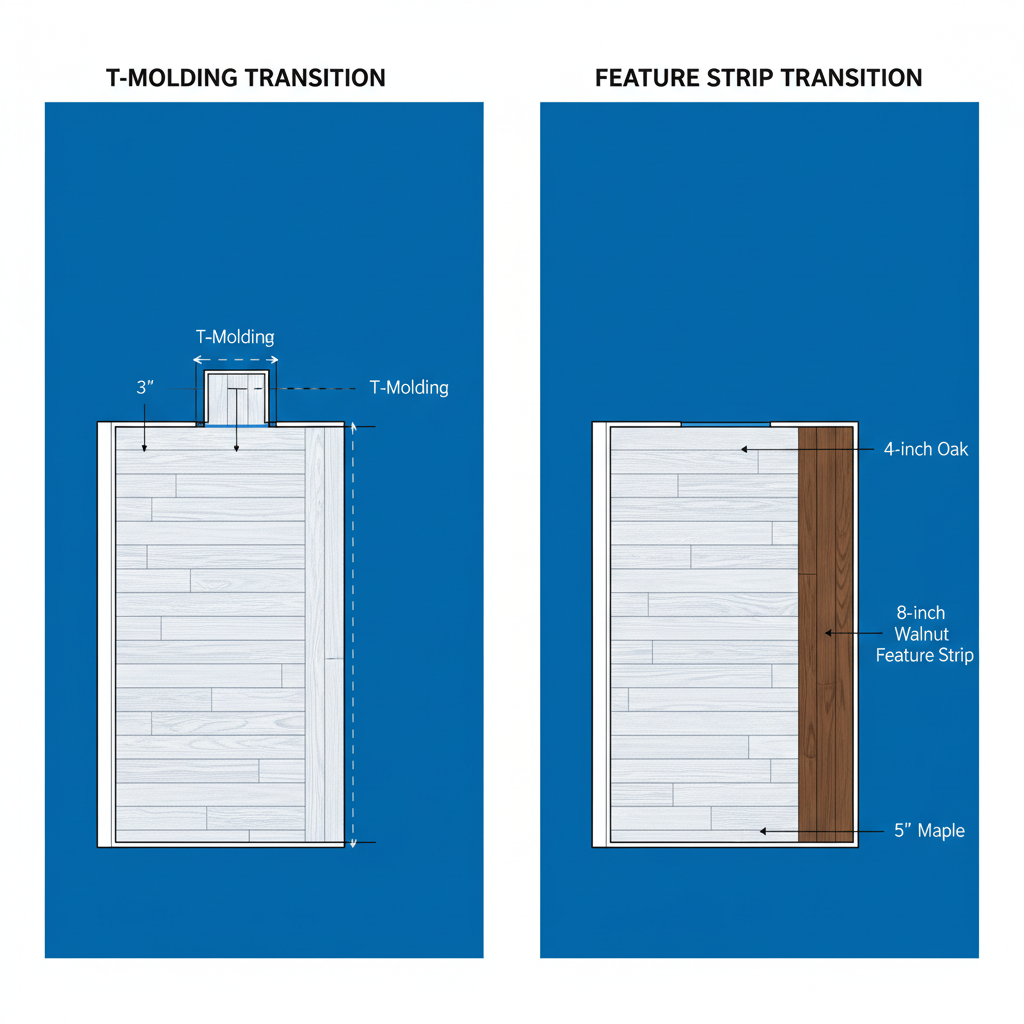
- T-Moldings: Use a custom-stained T-molding in doorways to create a distinct visual break between a room with 3-inch planks and a hallway with 7-inch planks.
- Feature Strips: If transitioning in an open area without a doorway, install a “feature strip”—a board laid perpendicular to the main flooring—to act as a deliberate border between the two mismatched zones.
Custom illustrations of these transition profiles show that by intentionally framing the change in flooring, you turn a mismatch into a bespoke architectural detail.
Conclusion
Mastering your home’s flooring is a delicate balance of cutting-edge material science and spatial psychology. Bravewood hybrid hardwood offers the ultimate solution for durability, utilizing a waterproof rigid core and an authentic wood veneer to outlast traditional engineered options. However, the true success of your renovation hinges on selecting the best plank size for your space. While 7.5-inch wide planks dominate current design trends, the “right” choice will always depend on your specific room dimensions, natural light, and architectural style.
Take control of your space’s proportions. We encourage you to download our Ultimate Visual Guide to Plank Widths checklist, or better yet, contact a local NWFA-certified installer to bring hands-on Bravewood samples directly into your home to see how the width interacts with your unique lighting.
Disclaimer: General informational purposes only. Always consult a certified National Wood Flooring Association (NWFA) installer for specific structural, moisture testing, and installation requirements for your home.
References & Authoritative Sources
- Floor Covering Weekly. (2023). State of the Industry: Hybrid Flooring Market Growth and Projections. Retrieved from authoritative industry market reports.
- National Wood Flooring Association (NWFA). (N.D.). Wood Flooring Types and Definitions: Engineered vs. Hybrid Composites. Retrieved from NWFA official standards.
- Bravewood Official Manufacturer Specifications. (N.D.). Bravewood Hybrid Hardwood Product Catalogs, Warranties, and Dimensional Data.
- Houzz Design Reports / Industry Data. (2023). Annual U.S. Houzz & Home Study: Flooring Trends and Wide Plank Preferences.
- American Society of Interior Designers (ASID). (N.D.). Principles of Spatial Design, Scale, and Proportion in Residential Interiors.
- Journal of Environmental Psychology. (N.D.). The Impact of Lines of Perspective and Color on Spatial Perception in Interior Environments.
- National Association of Home Builders (NAHB). (N.D.). Standard Building Practices and Consumer Preferences in Home Renovations.
- Zillow Research. (N.D.). Home Features that Sell: The ROI of Open-Concept Flooring and Hardwood Upgrades.
- HomeAdvisor / Angi. (N.D.). True Cost Guide: Hardwood Flooring Installation and Wide Plank Labor Premiums.
- Forest Products Laboratory. (N.D.). Wood Handbook: Wood as an Engineering Material (Moisture, Dimensional Stability, and Cupping).
- International Association of Home Staging Professionals (IAHSP). (N.D.). Visual Correction Techniques and Staging Strategies for Disproportionate Spaces.
- Fine Homebuilding Magazine. (N.D.). Master Carpentry: How to Execute Flawless Flooring Transitions.
- National Wood Flooring Association (NWFA). (N.D.). NWFA Wood Flooring Installation Guidelines: Transitions and Glue-Assist Requirements.
