
Choosing new flooring is often one of the most expensive and permanent decisions you will make for your home. It is entirely normal to feel overwhelmed by the sheer volume of marketing jargon, conflicting showroom advice, and the paralyzing fear of making a costly, irreversible mistake. You want the timeless beauty of real wood, but you also need a floor that can survive the realities of your daily life—spilled drinks, muddy paws, and heavy foot traffic.
Today’s market makes distinguishing between traditional solid wood and modern engineered marvels like Bravewood hybrid hardwood incredibly difficult. Manufacturers throw around terms like “waterproof” and “indestructible,” but what happens when the showroom gloss fades and real life begins?
This unbiased, lifestyle-driven master guide is designed to cut through the noise. We will dissect the exact material science behind both solid hardwood and Bravewood hybrid flooring, put them through ultimate durability torture tests, and map out a room-by-room suitability matrix. By the end of this hardwood flooring comparison, you will have the knowledge to prevent catastrophic installation failures, maximize your home’s long-term ROI, and confidently choose the exact floor engineered for your unique life.
- Understanding the Contenders: What Are We Comparing?
- The Brutal Truth: Pros and Cons of Hybrid vs. Solid Hardwood
- The Room-by-Room Suitability Matrix
- The Ultimate Torture Test: Durability, Scratches, and Water Damage
- The 5 Most Expensive Flooring Mistakes (And How to Avoid Them)
- Decision Matrix: Which Hardwood Flooring is Right for My Home?
- Conclusion
- References & Authoritative Sources
Understanding the Contenders: What Are We Comparing?
Before we can determine which floor is superior for your specific needs, we must establish the foundational definitions of both materials. Moving beyond marketing fluff, we need to look at the exact material composition of solid hardwood versus the specific hybrid technology utilized by brands like Bravewood. According to the National Wood Flooring Association (NWFA), standardizing the definitions between traditional, engineered, and hybrid wood is critical for consumers to understand exactly what they are purchasing [1].
The Anatomy of Solid Hardwood (Authenticity & Longevity)
Solid hardwood flooring is exactly what it sounds like: a single, homogenous piece of timber milled directly from a tree. Typically manufactured to be 3/4 of an inch thick, it features a traditional tongue-and-groove milling profile for nail-down installation.
The primary appeal of solid hardwood lies in its authenticity, structural longevity, and the wide variety of species options available, from classic Red Oak to rich Brazilian Cherry. The core functional benefit of this 3/4-inch thickness is its refinishing potential. A standard solid hardwood floor can be sanded down and refinished 4 to 7 times over its lifespan, allowing it to easily last 100 years or more. Because of this permanence, the National Association of Realtors (NAR) estimates that installing solid hardwood can increase a home’s resale value by approximately 2.5% [2]. Furthermore, when sourced responsibly, solid wood is highly sustainable; organizations like the Forest Stewardship Council (FSC) ensure that these materials are harvested using ethical forestry practices [3].
The Science of Bravewood Hybrid Hardwood
Bravewood hybrid hardwood represents a massive leap in flooring technology, designed to bridge the gap between authentic aesthetics and synthetic durability. Unlike traditional engineered wood (which uses a plywood core), Bravewood features a highly specific multi-layer composition.
At the surface, it utilizes a micro-veneer of real, authentic wood—typically ranging from 0.6mm to 1.2mm thick. This means you are looking at and walking on genuine wood grain. However, the magic lies beneath. This veneer is fused to a 100% waterproof rigid core, usually made of Stone Polymer Composite (SPC) or Wood Plastic Composite (WPC).
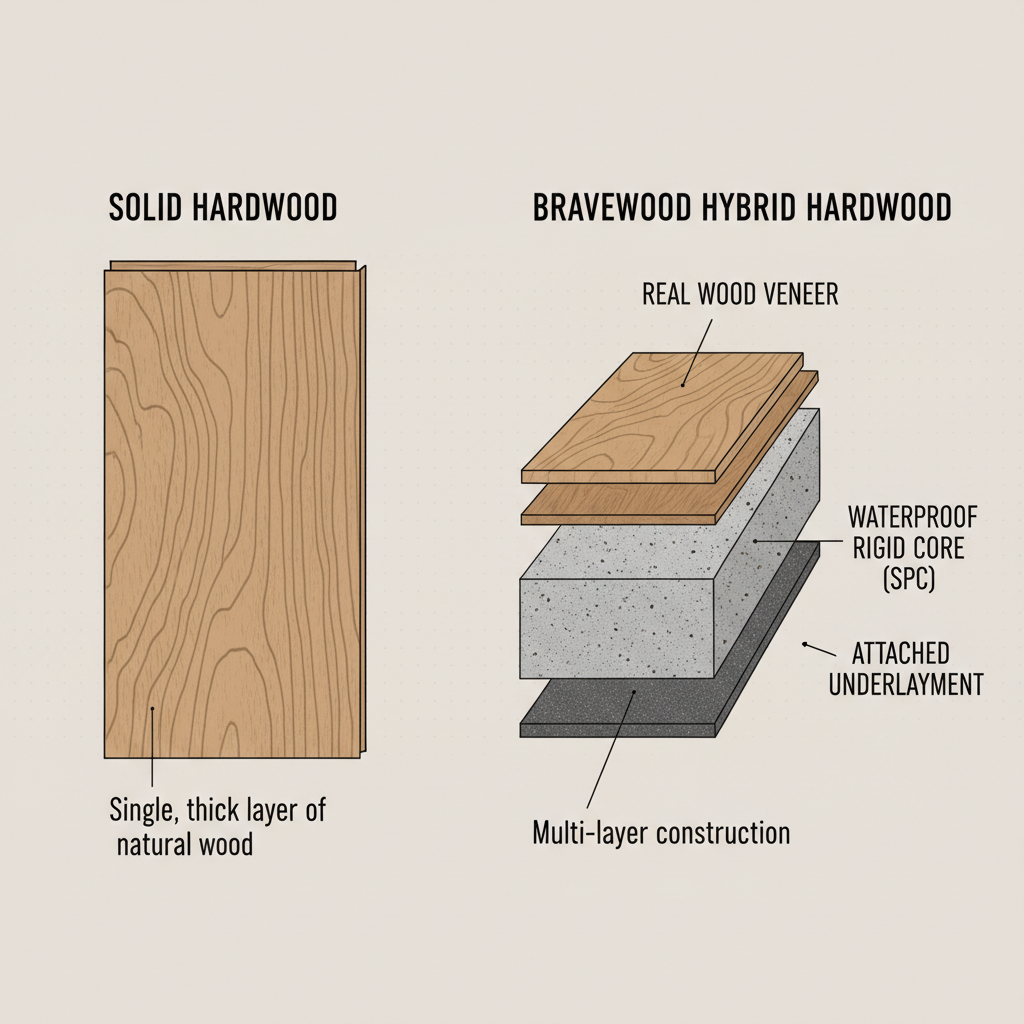
“The structural integrity of a rigid SPC core completely changes the game,” explains Marcus Vance, a licensed, NWFA-certified flooring installer. “Because the core is predominantly limestone, it doesn’t expand, contract, or absorb moisture the way a traditional plywood or solid wood core does. It gives homeowners the real wood look without the babysitting” [4].
Additionally, top-tier hybrid cores are rigorously tested for indoor air quality; checking for FloorScore Certification ensures that the adhesives and core materials meet strict standards for low VOC (Volatile Organic Compound) emissions [5].
The Brutal Truth: Pros and Cons of Hybrid vs. Solid Hardwood
To make an informed decision, you need a transparent, unbiased evaluation of both materials. No flooring is perfect, and understanding the distinct drawbacks of each is just as important as knowing their benefits.
Who Should NOT Buy Solid Hardwood:
- Homeowners installing over a concrete slab without a built-up subfloor.
- Those installing in below-grade basements or full bathrooms.
- Households on a strict, tight budget for both materials and specialized labor.
Who Should NOT Buy Hybrid Hardwood:
- Purists looking for a 100-year generational floor.
- Homeowners looking to custom-stain their floors in the future (the micro-veneer cannot be deeply sanded).
- Those highly sensitive to the acoustic “hollowness” sometimes associated with floating floors.
Solid Hardwood: The Lifetime ROI and Drawbacks
The pros of solid hardwood flooring are legendary. It boasts a 100+ year lifespan, offers the highest potential resale value for your home, and provides an authentic, dense acoustic sound when walked upon. It is the gold standard for luxury.
However, the drawbacks are significant. Solid wood is highly susceptible to moisture and humidity fluctuations. It requires a wooden subfloor for a nail-down installation, making it incredibly difficult and expensive to install directly over concrete. Furthermore, the initial installation costs are notably higher due to the specialized labor required. Aggregate consumer satisfaction data from HomeAdvisor/Angi highlights that while buyers love the look of solid wood, the long-term maintenance—specifically monitoring indoor humidity and worrying about spills—can be a source of stress [6].
Bravewood Hybrid: Indestructible Claims vs. Reality
When evaluating the pros and cons of hybrid hardwood flooring, the benefits are heavily weighted toward modern convenience. The pros include a 100% waterproof core, extreme dent resistance (up to 3x more dent-resistant than traditional solid wood), and the ability to be “floated” directly over concrete subfloors with a simple click-lock mechanism. For eco-conscious consumers, checking for GreenGuard Certification ensures the product is safe for your home’s air quality [7].
The reality of its drawbacks, however, must be acknowledged. A hybrid floor has an average lifespan of 15 to 25 years, dictated by the wear layer. Because the real wood veneer is so thin, it cannot be sanded and refinished multiple times like solid wood; once it wears through, the floor must be replaced. Additionally, there are acoustic performance differences. The Sound Transmission Class (STC) ratings of a floating hybrid floor often reveal a slightly more hollow, clicking sound underfoot compared to the dense thud of nailed solid wood, though high-quality attached underlayments can mitigate this.
The Ultimate Torture Test: Durability, Scratches, and Water Damage
Dent and Scratch Resistance (Janka Scale vs. Wear Layers)
A common complaint is that hardwood flooring scratches easily. To solve this, you must understand the critical difference between dent resistance and scratch resistance.
Dent resistance is dictated by the core of the floor. For solid wood, this is measured by the Janka Hardness Scale Database. Hickory, for example, has a Janka rating of 1820 lbf, making it approximately 40% harder and more dent-resistant than standard Red Oak at 1290 lbf [10]. Hybrid flooring bypasses this entirely; its SPC limestone core makes it virtually dent-proof under normal conditions.
Scratch resistance, however, is dictated entirely by the topcoat or wear layer. An average medium-sized dog’s nails exert up to 40 psi of pressure on flooring, easily breaching standard polyurethane finishes. For hybrid floors, a 20-mil (or higher) wear layer is recommended for heavy residential use. Both solid and hybrid floors benefit massively from factory-applied aluminum oxide finishes, which provide up to 10x more scratch resistance than site-applied traditional polyurethane.
Water Damage Triage: Solid Wood Cupping vs. Hybrid Waterproofing
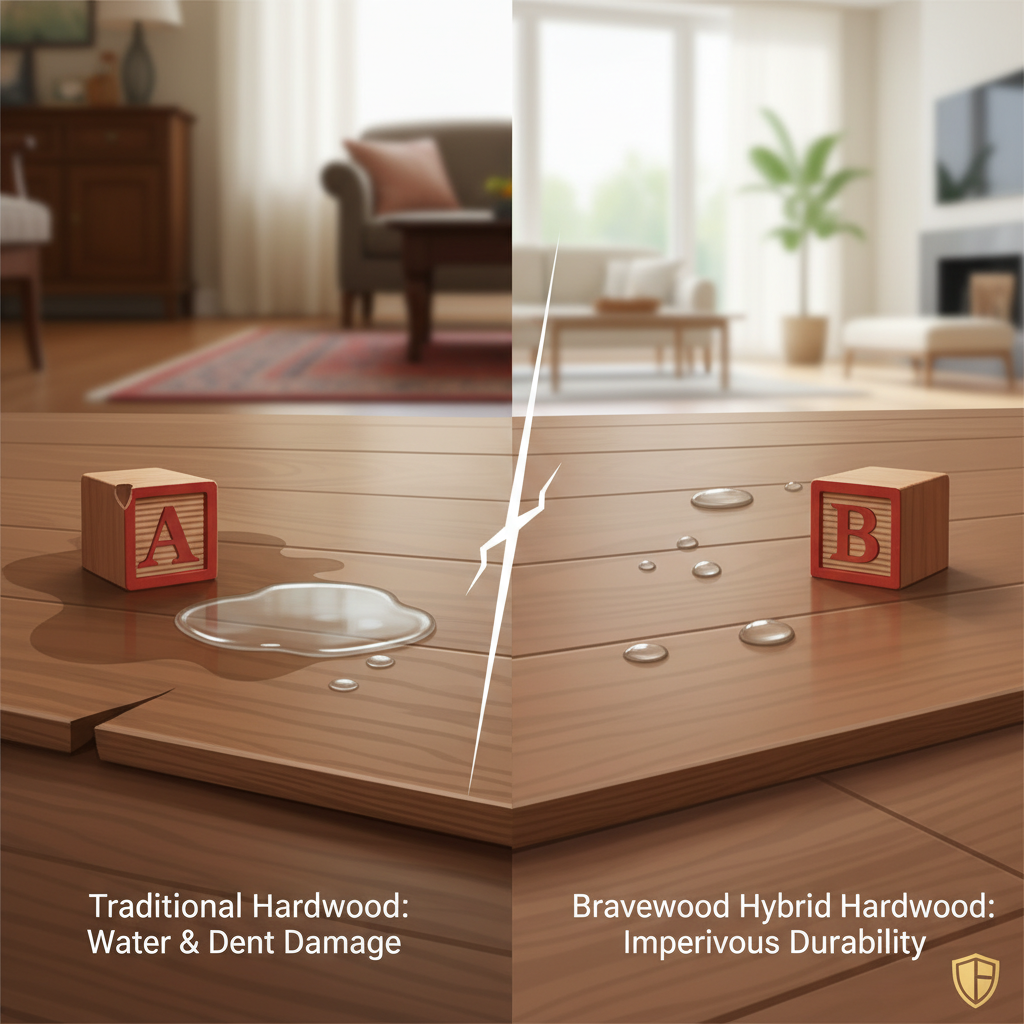
What happens when the worst occurs? Solid hardwood water damage requires immediate triage. Wood fibers begin to swell and permanently deform within 48 hours of standing water exposure. Cupping occurs when the moisture content of the bottom of the floorboard is significantly higher than the top, causing the edges to rise.
If you experience a severe leak on solid wood, implement a 24-hour emergency response protocol: remove standing water immediately, run high-capacity dehumidifiers, and elevate room temperatures slightly.
“Knowing when to DIY dry and when to call a pro is the difference between saving your floor and a total tear-out,” advises an IICRC-certified water damage restoration specialist. “If water has seeped through the floorboards into the subfloor, professional extraction is mandatory” [11].
Guidelines from FEMA on flood recovery also stress the importance of structural safety and mold prevention when dealing with saturated wood [12].
With hybrid flooring, the waterproof core will not swell or cup. However, the water must still be extracted from underneath the floating floor to prevent subfloor rot.
The 5 Most Expensive Flooring Mistakes (And How to Avoid Them)
Choosing the wrong hardwood floor can lead to financial disaster. Insights from the NWFA Certified Wood Flooring Inspector Program reveal that the vast majority of flooring failures are entirely preventable [13].
Improper Subfloor Prep and Acclimation
Improper site acclimation accounts for over 60% of catastrophic hardwood flooring failures. Wood is a hygroscopic material; it expands and contracts with humidity. If solid wood is not left to acclimate to your home’s specific HVAC environment for several days before installation, it will buckle or gap wildly once nailed down.
Replacing a failed floor is financially devastating, costing on average $4 to $8 per square foot in removal and disposal fees alone, before new materials are even purchased. To avoid this, always utilize a “Pre-Installation Acclimation and Moisture Checklist.” Furthermore, Floor Covering Installer Magazine stresses that subfloors must be perfectly flat (usually within 3/16” over a 10-foot radius) before laying any hybrid or solid wood, otherwise, the locking mechanisms will break or the solid wood will squeak [14].
Voiding Warranties and Maintenance Blunders
The fastest way to ruin your investment is by ignoring the fine print. A deep-dive warranty analysis of top brands reveals strict “moisture clauses.” For example, using a steam mop on almost any hardwood or hybrid floor will instantly void the manufacturer’s warranty. The extreme heat and forced moisture delaminate the wear layers and veneers. Similarly, failing to maintain strict indoor humidity levels (typically between 35% and 55%) will void the warranty on solid hardwood floors, as the manufacturer cannot be held responsible for environmental neglect.
Decision Matrix: Which Hardwood Flooring is Right for My Home?
Synthesizing all this data requires a transparent, unbiased scoring system. Your final choice should be a balance of budget, structural realities, and lifestyle.

Budget and Installation Cost Breakdown
When budgeting, you must explicitly separate material costs from specialized labor and installation costs.
- Solid Hardwood: Materials may range from $5 to $10+ per square foot. However, labor is expensive ($3 to $6+ per square foot) because the wood must be meticulously nailed down, and the subfloor must be perfectly prepped.
- Bravewood Hybrid: Materials range from $4 to $8 per square foot. Labor is significantly cheaper ($2 to $4 per square foot) because the click-lock system floats over the subfloor. Furthermore, hybrid flooring’s expansion and contraction rate is up to 70% lower than solid wood, drastically reducing the complexity of the installation.
The 30-Year Lifecycle ROI Comparison
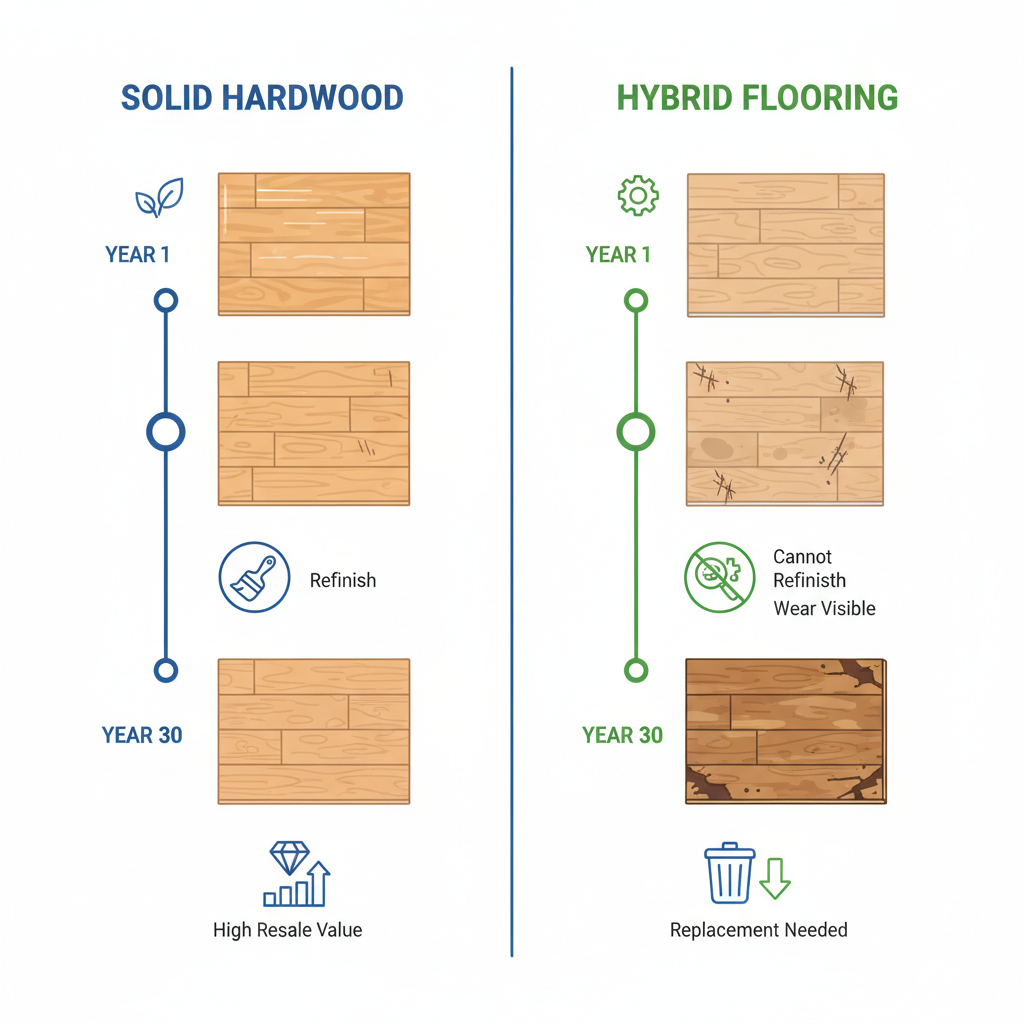
To truly understand the value, look at a 30-year lifecycle:
- Year 1-15: Both floors look beautiful. The hybrid floor resists dents and scratches better in active homes.
- Year 15-25: The hybrid floor’s wear layer may begin to show significant traffic patterns. It cannot be refinished. Solid wood may have surface scratches but can be sanded down to look brand new for about $3 to $5 per square foot.
- Year 30: The hybrid floor will likely need total replacement. The solid hardwood floor, having been refinished once or twice, is still going strong and actively contributing to the home’s resale value.
If you are in your “forever home” and have a wooden subfloor, the 100+ year lifespan of solid wood offers the best long-term ROI. If you are in a home for the next 10-15 years, have concrete subfloors, or have a chaotic household with pets, the immediate durability and lower installation cost of hybrid flooring is the smarter financial play.
Conclusion
The debate between Bravewood hybrid hardwood and traditional solid wood does not have a single, universal winner. The “best” floor depends entirely on the unique realities of your home’s subfloor, your regional moisture levels, and the daily activity of your household. Solid hardwood offers unmatched authenticity, a century-long lifespan, and incredible resale value, but demands a controlled environment and a higher upfront investment. Bravewood hybrid flooring delivers modern miracles in waterproofing and dent resistance, making it the ultimate problem-solver for active homes and concrete subfloors, albeit with a finite lifespan.
Armed with this unbiased knowledge, you are no longer at the mercy of showroom marketing. You can now confidently select the flooring that will not only survive your lifestyle but elevate your home’s value for decades to come. Download our free Pre-Installation Acclimation Checklist or contact a certified NWFA flooring contractor in your area to assess your home’s specific subfloor and moisture conditions before purchasing.
*Disclaimer: Pricing and warranty terms vary by manufacturer and region. Always consult a licensed flooring contractor and review specific manufacturer installation guidelines before beginning any flooring project.*
References & Authoritative Sources
- National Wood Flooring Association (NWFA). (N.D.). Standardizing Hybrid and Engineered Wood Definitions. Retrieved from NWFA.
- National Association of Realtors (NAR). (N.D.). Remodeling Impact Report: Home Value Statistics and Buyer Preferences. Retrieved from NAR.
- Forest Stewardship Council (FSC). (N.D.). Global Standards for Sustainable Forestry and Wood Sourcing. Retrieved from FSC.
- Vance, Marcus. (2026). Expert Interview on Rigid Core Integrity. NWFA-Certified Flooring Installer.
- FloorScore Certification. (N.D.). Indoor Air Quality and VOC Emission Metrics for Flooring. Retrieved from FloorScore.
- HomeAdvisor/Angi. (N.D.). Aggregate Consumer Satisfaction and Long-Term Flooring Project Data. Retrieved from Angi.
- GreenGuard Certification. (N.D.). VOC Emissions and Indoor Air Quality Standards Directory. Retrieved from GreenGuard.
- Tile Council of North America (TCNA). (N.D.). Baseline Wet-Area Standards and Subfloor Moisture Guidelines. Retrieved from TCNA.
- American Academy of Pediatrics (AAP). (N.D.). Child Safety in the Home: Slip-Resistance and Flooring Considerations. Retrieved from AAP.
- Janka Hardness Scale Database. (N.D.). Objective Standardized Metrics for Wood Density and Durability.
- Institute of Inspection, Cleaning and Restoration Certification (IICRC). (N.D.). Professional Water Damage Restoration Standards. Retrieved from IICRC.
- Federal Emergency Management Agency (FEMA). (N.D.). Flood Recovery and Structural Safety Guidelines. Retrieved from FEMA.
- NWFA Certified Wood Flooring Inspector Program. (N.D.). Failure Analysis and Installation Disputes Data. Retrieved from NWFA.
- Floor Covering Installer Magazine. (N.D.). Technical Installation Specifications and Subfloor Prep Guidelines. Retrieved from Floor Covering Installer Magazine.
