
If you are currently staring at a dozen flooring samples spread across your living room, paralyzed by analysis, you are not alone. Choosing between the authentic, warm aesthetics of real wood and the bulletproof, waterproof durability of modern vinyl is one of the most stressful decisions a homeowner can make. The industry certainly doesn’t make it easy, burying consumers under a mountain of confusing marketing jargon—forcing you to decipher the critical differences between “mil” and “mm,” or “waterproof” versus “water-resistant.”
This is not your standard, generic pros-and-cons list. We are bypassing the showroom gloss to bring you an evidence-based showdown. Through documented real-world torture tests, insights from certified flooring installers, and our proprietary “Lifestyle Matcher,” we are going to help you cut through the noise. Whether you are battling large dog claws, high-traffic wear, or moisture anxiety, this definitive guide will guarantee you invest in the exact floor your home’s dynamics demand.
- Deconstructing the Planks: Material Anatomy & Core Technology
- The Real-World Durability Matrix: Torture Testing Both Floors
- Damage Diagnostics & Repairability: When Life Happens
- Installation, Acoustics, and Underfoot Feel
- The Lifestyle Matcher: Which Floor is Right for You?
- Conclusion
- References & Authoritative Sources
Deconstructing the Planks: Material Anatomy & Core Technology
To truly understand what you are paying for, we have to demystify the marketing jargon and look inside the boards. In our high-resolution cross-section macro photography of both Bravewood and standard LVP planks, the structural differences become immediately apparent.
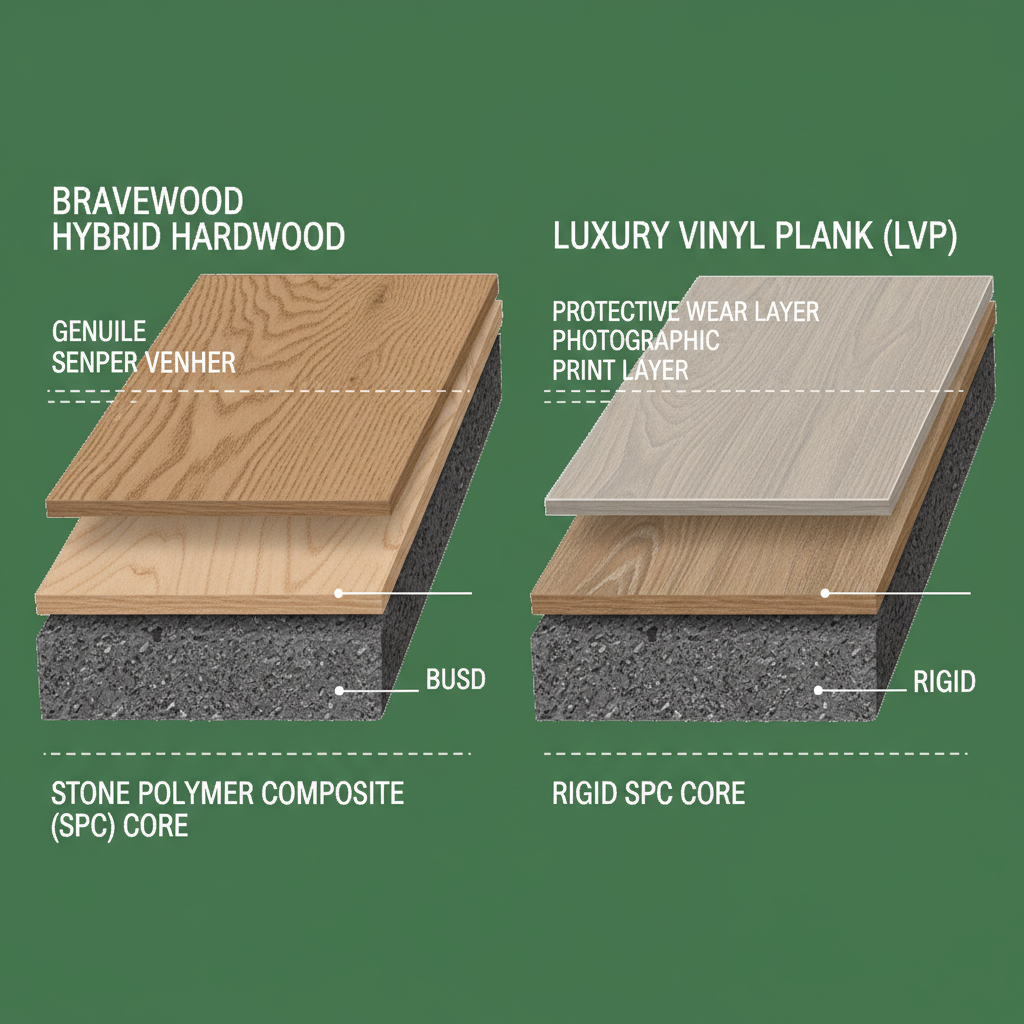
According to the National Wood Flooring Association (NWFA), which sets the strict definitions for what legally constitutes “wood flooring” versus “resilient flooring,” the distinction comes down to the wear surface [1]. LVP is a purely synthetic resilient material, whereas hybrid hardwood bridges the gap by utilizing a genuine natural resource on its surface.
What is Hybrid Hardwood (and How Does Bravewood Do It)?
If you are searching for the best flooring hybrid hardwood options, you need to understand the anatomy of the plank. Hybrid hardwood combines a real wood veneer—a thin slice of genuine hardwood—bonded to a rigid, waterproof core, typically made of Stone Polymer Composite (SPC).
Bravewood flooring utilizes a proprietary high-density SPC core beneath its authentic wood top layer. This gives you the exact grain, texture, and visual variation of a traditional hardwood floor because it is real wood on top. However, it is crucial to note the refinishing limitations: because the real-wood veneer is relatively thin (often between 0.6mm and 1.2mm), it cannot be sanded down and refinished multiple times like a solid 3/4-inch oak plank.
Despite this, the structural stability is unparalleled. As an NWFA-certified installer notes, “The introduction of the SPC core to a wood veneer essentially eliminates the expansion and contraction issues we see with traditional engineered wood. It’s dimensionally stable even in fluctuating humidity” [1].
The Truth About LVP: SPC vs. WPC and Wear Layers
LVP flooring (Luxury Vinyl Plank) has dominated the market by offering 100% waterproof capabilities at a cost-effective price point. However, not all LVP is created equal. The core is usually either WPC (Wood Plastic Composite), which is slightly softer and quieter, or SPC (Stone Plastic Composite), which is ultra-rigid and highly dent-resistant.
The most critical factor consumers confuse is the difference between overall plank thickness (measured in millimeters, or mm) and the protective wear layer (measured in mils, which is one-thousandth of an inch). A thick plank does not mean a durable surface. In our macro-photography comparisons, the visible difference between a standard 12-mil wear layer and a commercial-grade 22-mil wear layer is striking. The 22-mil layer provides a significantly thicker shield of clear polyurethane over the photographic vinyl print.
For those seeking high durability LVP, the Resilient Floor Covering Institute (RFCI) standards indicate that a wear layer of 20-mil or higher is required for true commercial grading and heavy residential traffic [2].
The Real-World Durability Matrix: Torture Testing Both Floors
Manufacturer claims look great on a brochure, but how do these materials handle daily life? To find out, we evaluated LVP vs hybrid hardwood durability using objective comparisons and standardized testing metrics, moving far beyond basic durable flooring options lists.
Scratch Resistance: Dog Claws and Heavy Furniture
When it comes to flooring scratch damage, abrasion resistance is paramount. We look to the ASTM International testing methods for abrasion to set the baseline [3].
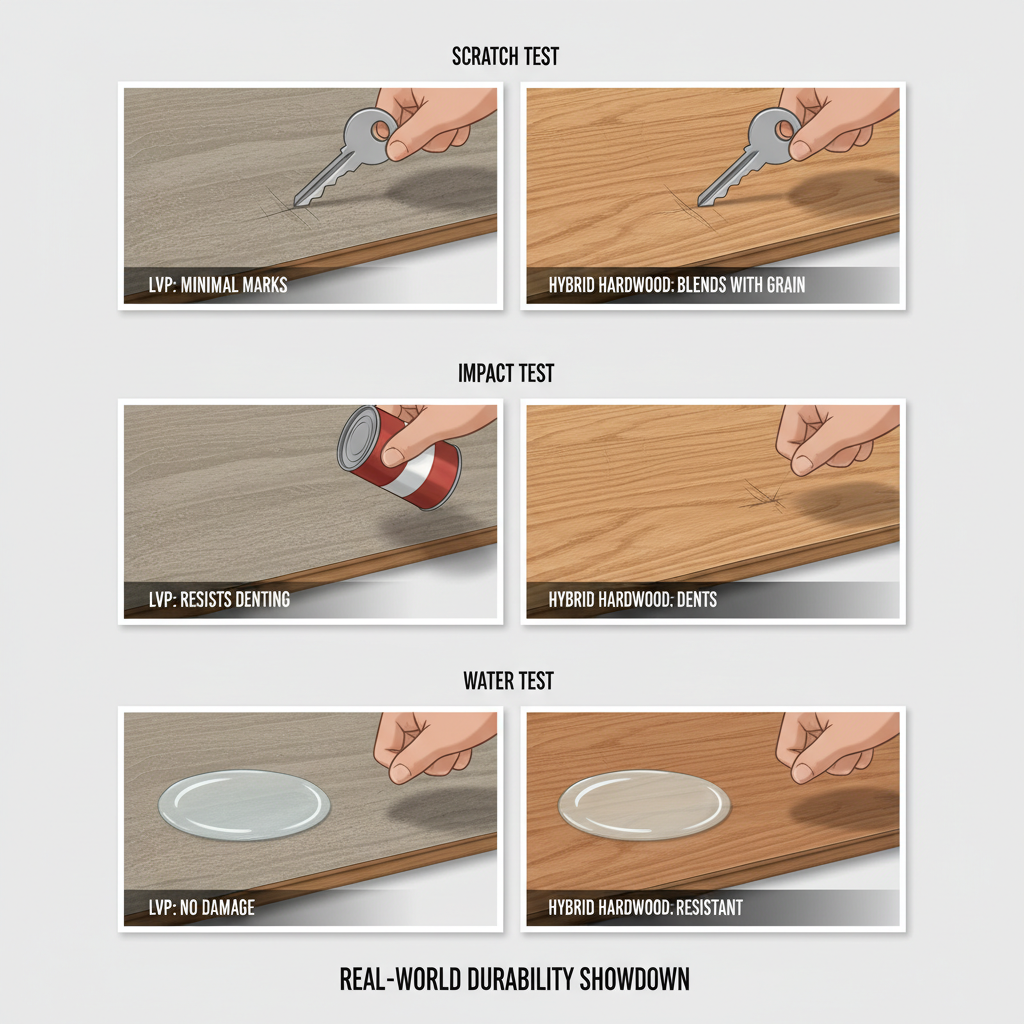
In our original video documentation of a scratch test using a standardized metal key and simulated dog claws, high durability LVP with a 20+ mil wear layer performed exceptionally well, deflecting the metal without tearing the print. However, it can still show micro-scratches in the clear coat under harsh lighting.
Bravewood hybrid hardwood, on the other hand, relies on a factory-applied aluminum oxide finish. While it doesn’t have a “mil” wear layer, its durability is measured by Janka hardness equivalents and AC (Abrasion Class) ratings. Interestingly, while a sharp object might lightly score the aluminum oxide finish, the hybrid hardwood actually hides minor scratches better than LVP because the natural wood grain and texture camouflage the visual disruption.
Dent Resistance & Drop Tests
Impact resistance is where the core technology truly matters, especially regarding everyday flooring wear and tear. In our photo sequence demonstrating a drop-test with a heavy 28-ounce canned good from a height of 36 inches, the results were revealing.
The SPC core found in both Bravewood and high-end LVP prevented catastrophic puncturing. However, the density of the attached underlayment plays a massive role in preventing dents from dropped objects or heavy furniture legs. WPC-core LVP showed a slight indentation due to its softer composition, whereas the rigid SPC core of the Bravewood plank deflected the impact entirely, proving that a denser core equates to superior dent resistance.
Moisture Resistance: Surface Spills vs. Subfloor Vapor
The term “waterproof” is heavily marketed, but it requires context to prevent hardwood moisture damage. Both LVP and Bravewood hybrid hardwood handle surface spills flawlessly. You can leave a puddle of water on top of either plank for 24 hours without the material swelling.
However, subfloor moisture vapor emissions are a different beast. As experts from the Institute of Inspection, Cleaning and Restoration Certification (IICRC) point out, “A waterproof plank does not make a waterproof floor assembly. Moisture trapped beneath a waterproof LVP or hybrid plank can lead to catastrophic mold growth and subfloor failure” [4]. Using a moisture meter to test your concrete or wood subfloor before installation is non-negotiable, regardless of the surface material’s waterproof claims.
Damage Diagnostics & Repairability: When Life Happens
Even the toughest floors experience trauma. A major pain point for homeowners is knowing what to do when flooring wear and tear or flooring scratch damage occurs. According to the Floor Consultants and Inspection Training Services (FCITS), over 60% of premature flooring failures are due to improper maintenance, making a preventative maintenance schedule your first line of defense [5].
Fixing Scratches: Hybrid Putty vs. LVP Limitations
We categorize repair solutions strictly by the depth of the scratch. In our video demonstrations repairing surface anomalies, the differences between the materials are stark.
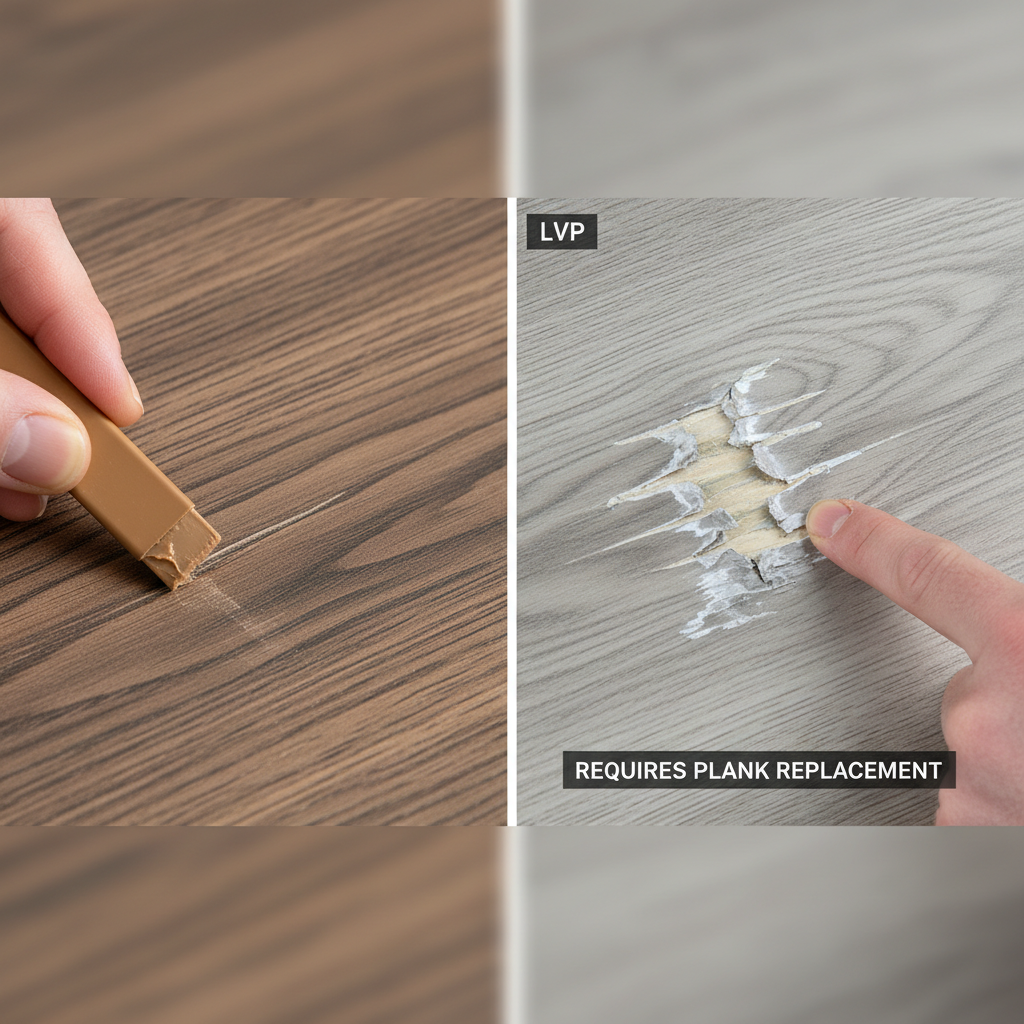
Because Bravewood features a real wood veneer, minor flooring scratch damage can often be lightly repaired using color-matched wood putty, wax sticks, or stain markers. The natural variation of the wood makes blending these repairs highly effective.
LVP has severe limitations here. As noted by Wood Floor Business Magazine detailing professional repair techniques, a deep gouge that penetrates the clear wear layer and tears the photographic vinyl print of an LVP plank cannot be sanded, filled, or stained [6]. It almost always requires a total plank replacement.
Triaging Moisture Damage: Cupping vs. Crowning
If you experience a plumbing leak, you need a triage plan: Stop the source, dry the area, assess the damage, and repair. Hardwood moisture damage typically manifests as either “cupping” (the edges of the board are higher than the center) or “crowning” (the center is higher than the edges).
Because Bravewood has an SPC core, the core itself won’t swell, but extreme, prolonged moisture could theoretically affect the wood veneer’s adhesion. LVP will not warp, but the subfloor beneath it will. An IICRC-certified water damage restoration expert advises, “If water has migrated beneath a floating floor of any kind, DIY drying with a box fan is insufficient. Professional extraction and lifting of the planks are required to save the subfloor and prevent mold” [4].
Installation, Acoustics, and Underfoot Feel
Living with a floor is a tactile and auditory experience. A true Bravewood hybrid hardwood vs LVP comparison must account for how the floor feels and sounds, as well as how easily it goes together.
The ‘Hollow Sound’ Factor and Temperature
One of the most common complaints about floating vinyl floors is the notorious “hollowness” or clicking sound when walked upon. Floor Covering Installer Magazine highlights that subfloor acoustics and preparation are paramount for floating floors [7].
Bravewood hybrid hardwood generally feels warmer to the touch and sounds more solid underfoot, mimicking traditional nail-down hardwood much more closely than vinyl. When doing a cost-analysis breakdown, remember that to achieve a similar acoustic dampening with LVP, you often need to invest in a premium, high-density acoustic underlayment, which narrows the price gap between the two materials.
Locking Mechanisms: Bravewood vs. Industry Standards
For the ambitious DIYer, the locking mechanism is everything. In our first-hand video review testing the installation of Bravewood flooring, we compared its proprietary locking system against industry standards like Uniclic and standard drop-and-lock systems. Bravewood’s precision-milled SPC joints clicked together seamlessly with minimal tapping required, making it highly accessible for a weekend warrior project compared to some brittle, lower-end LVP joints that are prone to snapping during installation.
The Lifestyle Matcher: Which Floor is Right for You?
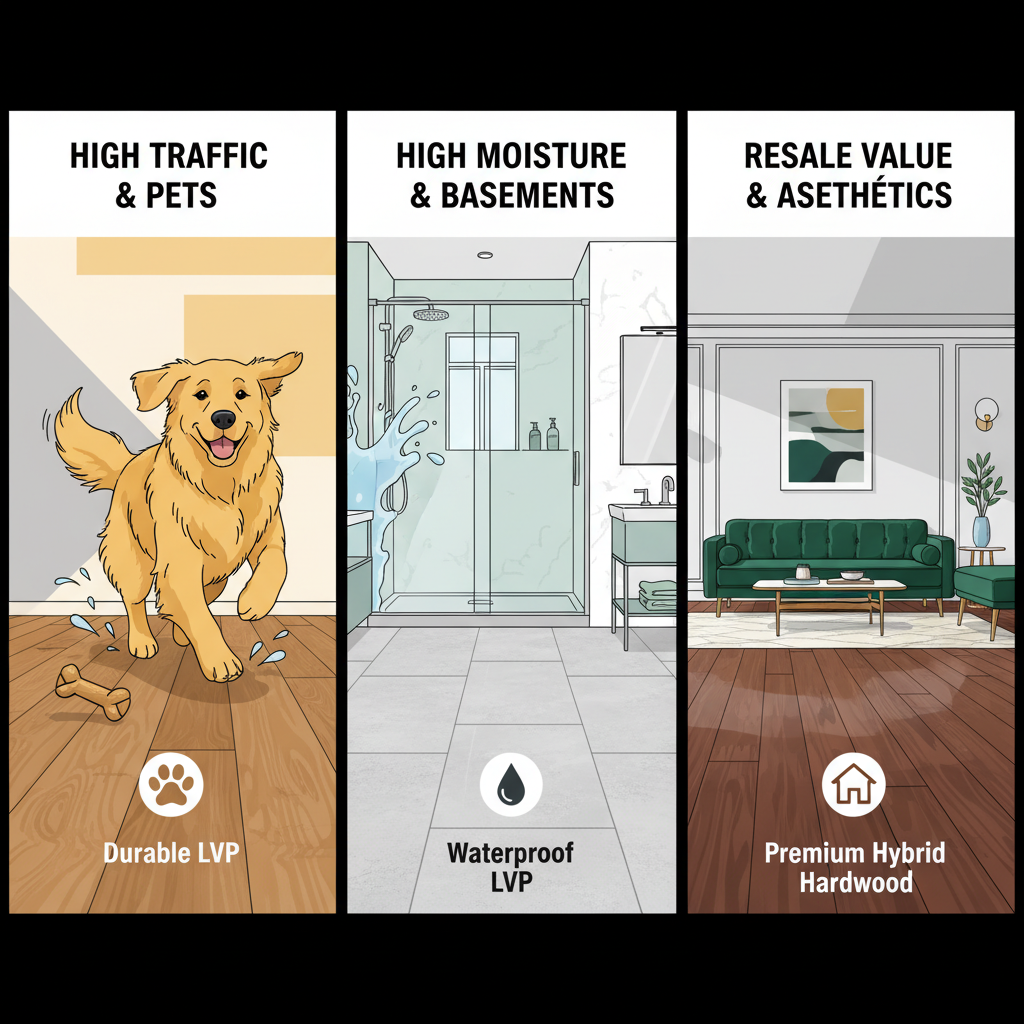
Moving beyond generic pros and cons, our proprietary Lifestyle Matcher contextualizes your Hybrid hardwood vs LVP comparison based on your specific household dynamics. Furthermore, licensed real estate appraisers consistently note that genuine wood surfaces yield better financial returns. Data from the National Association of Realtors (NAR) confirms that wood flooring upgrades offer one of the highest ROI percentages for interior projects [8].
Best for Large Dogs and High Traffic
If your home is a raceway for eighty-pound Golden Retrievers or you have constant heavy foot traffic, your best bet is either a high durability LVP with a true 20+ mil wear layer or an aluminum-oxide coated hybrid hardwood. Commercial property managers we interviewed prefer 22-mil LVP for high-wear environments due to its sheer resistance to tearing, but Bravewood remains an excellent choice if you prefer scratches to blend into a natural wood grain rather than showing up as white scuffs on a vinyl print.
Best for Bathrooms and Basements
For areas with high ambient moisture, frequent puddles, or flood risks—specifically full bathrooms and below-grade basements—LVP flooring is the undisputed champion. A 100% waterproof LVP plank provides absolute peace of mind against topical water and high humidity. In our room-by-room recommendation chart, LVP takes the top spot for any space where a plumbing fixture is present.
Best for Resale Value and Aesthetics
If your primary goal is maximizing your home’s equity and achieving a high-end, bespoke aesthetic, Bravewood flooring and hybrid hardwoods are the clear winners. Buyers can spot the repeating patterns of vinyl prints, whereas every single board of Bravewood is unique. Additionally, hybrid hardwoods generally boast better environmental impact profiles and lower VOC emissions compared to heavily plasticized vinyls, appealing to eco-conscious homebuyers and elevating the overall perceived value of your property.
Conclusion
Ultimately, the showdown between Bravewood Hybrid Hardwood and LVP doesn’t end with a single, universal winner; it ends with the right choice for your home. LVP remains the undefeated champion of absolute waterproof durability and budget-friendly, high-traffic resilience. However, Bravewood Hybrid Hardwood triumphs in delivering an authentic, warm underfoot feel, superior acoustic solidity, and the distinct advantage of being able to camouflage and repair minor surface scratches.
We highly encourage you to order physical samples of both Bravewood and a 20-mil LVP. Take a key to them, drop a heavy object on them, and view them in your home’s unique lighting before making a final purchase.
Standard DIY and Home Improvement Disclaimer: Flooring installation and water damage triage should be assessed by professionals. Always consult manufacturer warranties before attempting DIY repairs.
References & Authoritative Sources
- National Wood Flooring Association (NWFA). (N.D.). Definitions and Standards for Wood Flooring Categories. Retrieved from NWFA Official Guidelines.
- Resilient Floor Covering Institute (RFCI). (N.D.). Performance Standards and Commercial Grading for Vinyl Flooring. Retrieved from RFCI Industry Standards.
- ASTM International. (N.D.). Standardized Testing Methods for Flooring Wear, Impact Resistance, and Abrasion. Retrieved from ASTM Standards Directory.
- Institute of Inspection, Cleaning and Restoration Certification (IICRC). (N.D.). Global Standards for Water Damage Restoration. Retrieved from IICRC Guidelines.
- Floor Consultants and Inspection Training Services (FCITS). (N.D.). Diagnosing Flooring Failures and Wear Issues. Retrieved from FCITS Training Materials.
- Wood Floor Business Magazine. (N.D.). Professional Repair Techniques for Wood and Resilient Flooring. Retrieved from Wood Floor Business Trade Publication.
- Floor Covering Installer Magazine. (N.D.). Best Practices for Installation Comparisons and Subfloor Acoustics. Retrieved from Floor Covering Installer Archives.
- National Association of Realtors (NAR). (N.D.). Remodeling Impact Report: Data on ROI for Interior Home Upgrades. Retrieved from NAR Research and Statistics.
