
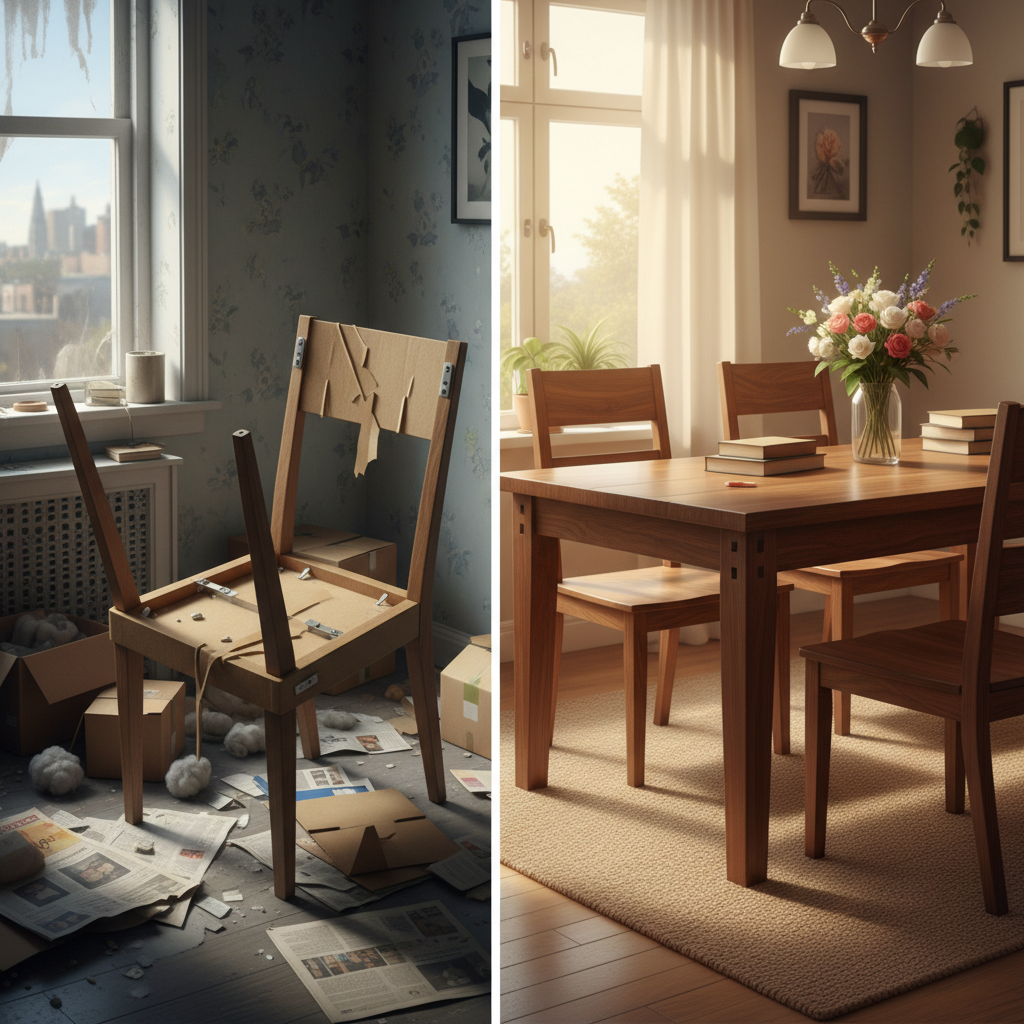
We are living in the era of disposable decor. Over the last few decades, a quiet but catastrophic shift has occurred in the way we furnish our homes, replacing generational investments with flat-packed, temporary solutions. The stark reality of modern “fast furniture” is reflected in plummeting consumer trust; according to data from ConsumerAffairs, consumer satisfaction with furniture retailers dropped precipitously from 86% in 2018 to just 56% in 2021 [1]. Buyers are increasingly frustrated by toxic materials and flimsy construction masquerading as quality.
This article serves as an engineering-backed masterclass in evaluating true structural integrity and escaping the fast furniture trap. We will explore the material science of wood, the physics of joinery, and provide a transparent look into the meticulous 3-4 week bespoke artisan process that defines Bravewood craftsmanship. From diagnosing poor quality to commissioning a legacy piece, this is your roadmap to furniture built beyond the expected.
- The Hidden Cost of “Fast Furniture”
- The Anatomy of Heirloom Quality: An Engineering Perspective
- The Bravewood Craftsmanship Difference: Building Beyond the Expected
- Preserving the Legacy: Furniture Built to Last Generations
- Conclusion
- References
The Hidden Cost of “Fast Furniture”
The proliferation of poor quality mass produced furniture is not an accident; it is the result of historical macroeconomic shifts. According to industry analyses by The Assembly NC, trade agreements in 1999 catalyzed a massive exodus of furniture manufacturing overseas, fundamentally altering the industry’s focus from longevity to rapid, high-volume production [2]. This shift birthed the fast furniture cycle, where upfront affordability masks a devastating Total Cost of Ownership (TCO). When you factor in the inevitable need to replace a cheap dining table every three to five years, the financial and environmental costs far exceed the price of a single, custom-built heirloom.
Why Mass-Produced Furniture Breaks So Easily
When flimsy wood furniture breaking becomes a routine household hazard, the culprit is almost always compromised materials and rushed manufacturing. Ready-to-assemble (RTA) furniture relies heavily on engineered woods like Medium Density Fiberboard (MDF) and particle board. These materials lack the continuous grain structure of natural wood, meaning the structural integrity relies entirely on the glue binding the wood dust together. When weight or leverage is applied, the fastener failure points—typically cam locks or shallow screws—tear directly out of the composite material.
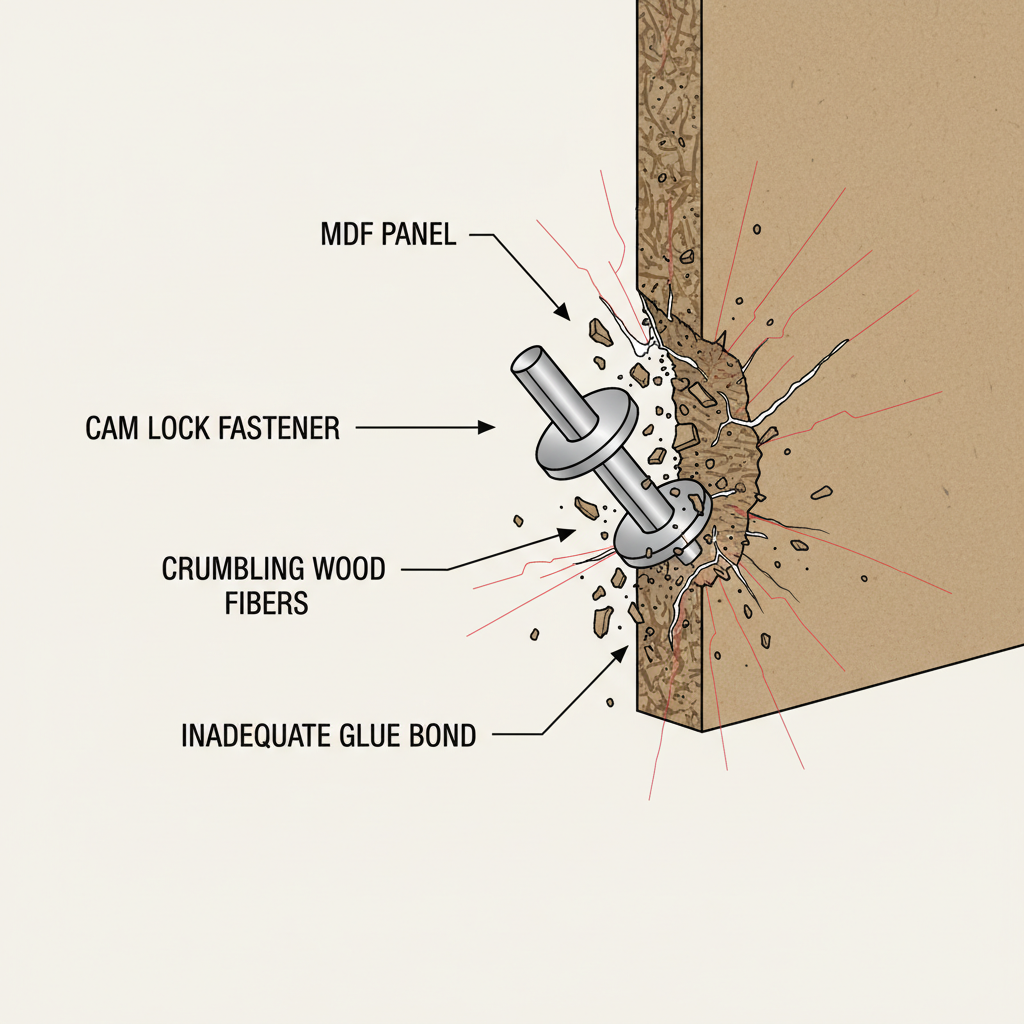
Furthermore, mass manufacturers often rush the vital kiln-drying process. Wood is hygroscopic; it breathes, expanding and contracting with ambient moisture. When furniture is built from improperly cured wood, residual stress remains trapped in the fibers. As the piece acclimates to the humidity of your home, this stress releases, leading to catastrophic structural cracking. It is vital to differentiate this from natural wood checking—minor, superficial surface cracks that add character—which is a normal part of a solid wood piece’s lifecycle and does not compromise its strength.
The Environmental and Health Toll of Disposable Decor
Beyond structural failure, there is a severe lack of durable furniture options that respect both human health and the environment. The synthetic materials used in fast furniture are often laden with toxic chemicals. Metal platings may utilize hexavalent chromium, while the adhesives and synthetic finishes on MDF frequently off-gas Volatile Organic Compounds (VOCs) like formaldehyde into your living space for years.
Eco-conscious consumers must navigate a minefield of greenwashing. Authoritative voices in ethical consumerism, such as EcoCult [3] and LeafScore [4], emphasize the importance of seeking out verified sustainability certifications, such as Oeko-Tex or European Naturtextil IVN, to ensure materials are non-toxic. Without these safeguards, disposable decor not only pollutes our indoor air but also ends up in landfills at an alarming rate, as composite woods cannot be effectively recycled or safely burned.
The Anatomy of Heirloom Quality: An Engineering Perspective
To find exceptional quality solid wood furniture, you must learn to look past the exterior finish and analyze the structural frame. True quality wood furniture is an exercise in engineering. Industry benchmarks for exceptional quality, such as BILTRITE Furniture [5] and Napa Furniture [6], are renowned for their rigorous construction standards and exhaustive 17-step hand-finishing processes. Understanding these standards transforms you from a vulnerable consumer into an informed collector.
Material Science: Solid Hardwoods vs. The “Plywood Paradox”
The foundation of durable wood products lies in the raw materials. The standard industry measurement for wood durability and density is the Janka Hardness Scale [7]. Hardwoods like oak, walnut, and teak score highly on this scale, making them ideal for high-traffic surfaces like dining tables. Furthermore, as highlighted by naturally:wood, certain species contain organic chemicals called extractives that provide natural decay and insect resistance, ensuring longevity without the need for toxic chemical pressure treatments [8].
However, material science in furniture building also introduces the “Plywood Paradox.” While consumers are rightly wary of particle board, high-grade, cabinet-quality plywood is actually superior to solid wood for specific hidden structural applications, such as drawer bottoms or cabinet backs. Because plywood is manufactured with cross-graining—alternating the direction of the wood grain in each layer—it is dimensionally stable and highly resistant to the warping and bending that can affect large, thin panels of solid wood.
The Physics of Furniture: Joinery and Structural Integrity
Integrity in furniture building is dictated by physics. When evaluating a piece, you must consider Beam Theory and Racking. Racking is the tendency of a square or rectangular frame to distort into a parallelogram under lateral stress. To prevent this, master builders employ cross-bracing, aprons, and traditional interlocking joinery.
Experts at Navillus Woodworks [9] and educational resources like CratesGalore [10] consistently point to the superiority of traditional joints—like the mortise-and-tenon and the dovetail—over modern pocket screws. A mortise-and-tenon joint physically locks the wood together, relying on mechanical strength and a massive surface area for wood glue, whereas a pocket screw concentrates all the stress onto a tiny thread of metal that will eventually strip the surrounding wood.
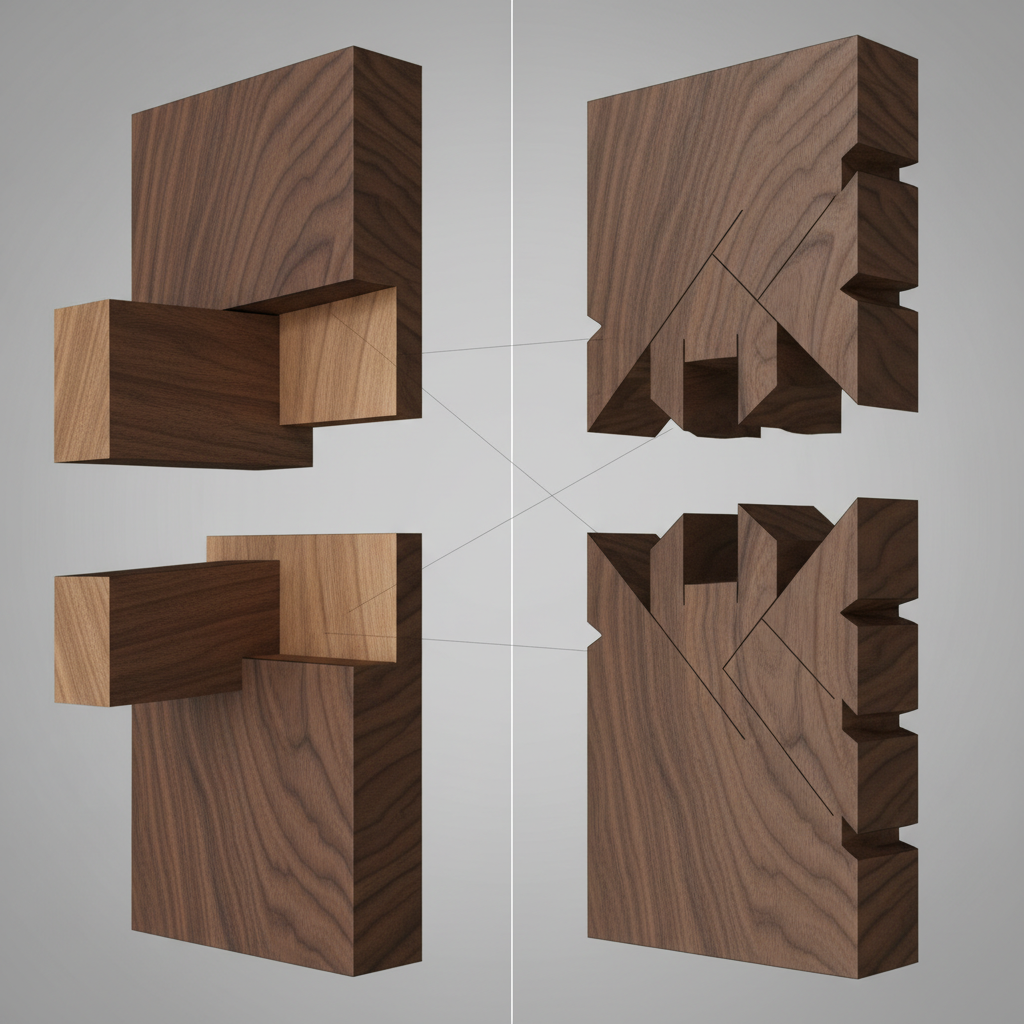
To test this in person, employ a 6-step tactile inspection guide:
- The Wobble Test: Apply firm lateral pressure to the side of a table or dresser. It should yield zero movement.
- Drawer Inspection: Pull out a drawer and look at the front corners. You should see the interlocking teeth of a dovetail joint, not staples or brad nails.
- Weight Check: Lift one end of the piece. High-density hardwoods and robust frames will be noticeably heavy.
- Underneath Examination: Look under tables for thick aprons and corner blocks screwed and glued into the frame.
- Back Panel Push: Press against the back panel of a bookshelf or cabinet. It should be firmly inset, not tacked on with flimsy cardboard.
- Finish Feel: Run your hand along the edges and undersides. Exceptional pieces are finished everywhere, sealing the wood entirely against moisture.
The Bravewood Craftsmanship Difference: Building Beyond the Expected
When seeking a definitive alternative to mass production, Bravewood craftsmanship stands out as a pinnacle of custom furniture building. Bravewood Design Official Store [11] has cultivated a highly specific aesthetic that marries the raw, organic beauty of materials like olive wood with precision engineering. This is not factory-line production; it is a bespoke artisan journey validated by glowing, verified customer testimonials directly from their Etsy storefront [12], proving that authentic craftsmanship is alive and accessible.
The Collaborative “Designed Together” Approach
Why choose Bravewood custom furniture? The answer lies in their collaborative “designed together” ethos. Unlike retail shopping, commissioning a piece from Bravewood is an interactive experience. You are not just buying a table; you are partnering with an artisan from the initial sketch to the final delivery.
This hands-on manufacturing is reflected in their exact step-by-step 3-4 week cargo production timeline. This deliberate pacing allows for careful material selection, proper acclimatization of the wood, and meticulous finishing. Furthermore, Bravewood aligns with the ethical standards championed by organizations like Trees Virginia [13] and Midwest Woodworks [14], focusing on the ethical sourcing of regional hardwoods and sustainable urban wood, ensuring your legacy piece supports local economies and responsible forestry.
Meticulous Artistry: Live-Edge Wood and Custom Epoxy Integration
Bravewood craftsmanship is perhaps best known for its masterful handling of live-edge wood and custom epoxy integration. While the market is flooded with cheap, mass-market resin pours that often yellow, crack, or look aggressively synthetic, Bravewood employs artisanal epoxy techniques.
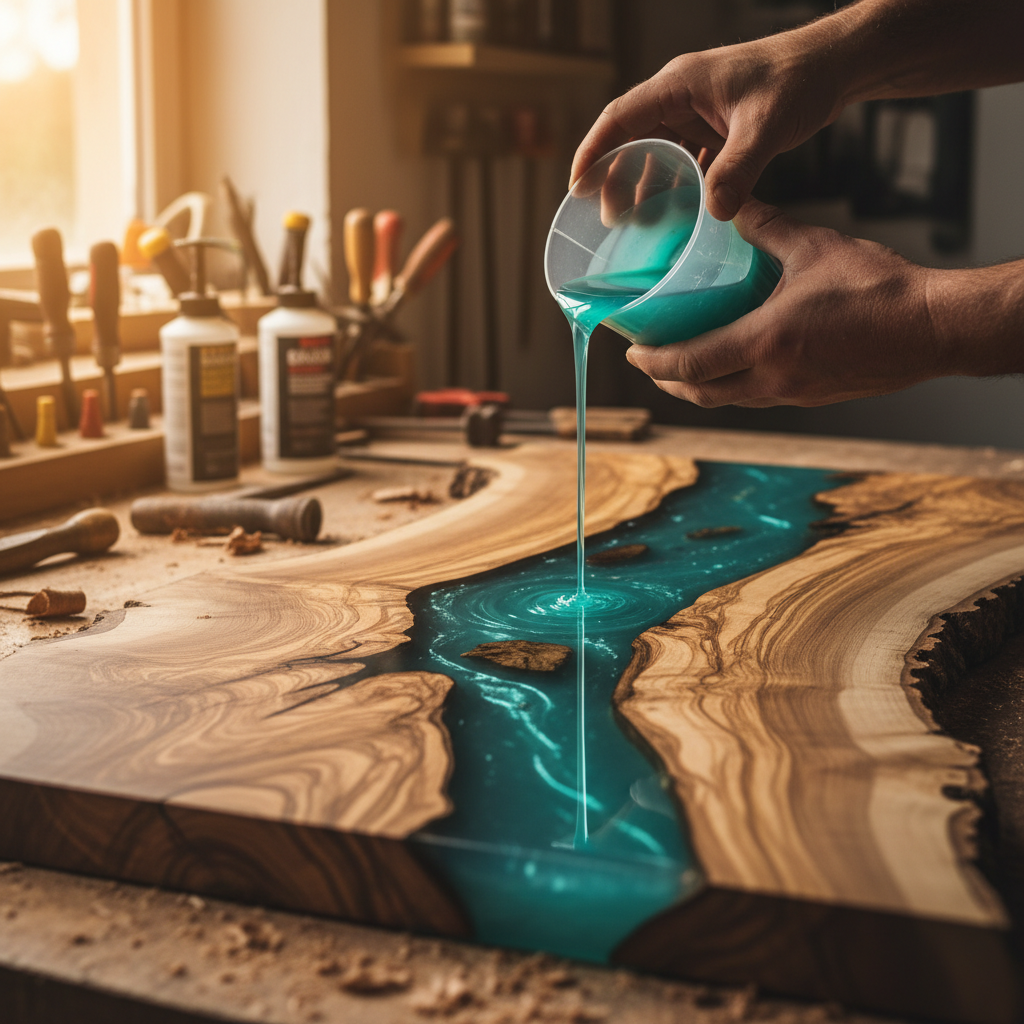
They offer highly specialized epoxy resin applications, including crystal clear, sophisticated smoke, and custom color pigments designed to complement, rather than overpower, the natural grain of the wood. The transition of a raw olive wood slab through Bravewood’s epoxy pouring and curing process involves precise temperature control, deep-pour formulas that prevent exothermic cracking, and a multi-stage sanding and polishing routine that results in a glass-like, durable finish that mass manufacturers simply cannot replicate.
Preserving the Legacy: Furniture Built to Last Generations
The ultimate goal of heirloom quality wood craftsmanship is to create furniture built to last generations. This requires a shift in consumer philosophy. As noted by artisan authorities like 5K Wood Works [15] and Knotty Dave’s Fine Woodworking [16], heirloom furniture is intentionally designed to be repaired, refinished, and passed down. Unlike a chipped veneer table that must be thrown away, a solid walnut dining table can be sanded down and brought back to life a century from now.
To ensure this longevity, proactive preservation is key. Experts at Samsen Furniture [17] advise strict environmental control. Wood thrives in a stable environment; utilizing humidifiers in the dry winter months and dehumidifiers in the humid summer prevents the drastic expansion and contraction that causes structural fatigue. Keep pieces out of direct, continuous sunlight to prevent UV bleaching, and utilize low-VOC, natural oil finishes to nourish the wood periodically.
When you calculate the Total Cost of Ownership (TCO) over a 50-year period, the math is undeniable. Purchasing a $3,000 custom Bravewood table that lasts a lifetime (and beyond) is vastly more economical than buying a $600 mass-produced table that breaks and must be replaced every five years—costing $6,000 over the same period, not to mention the environmental toll of sending ten tables to the landfill.
Conclusion
The hidden costs of fast furniture—toxic off-gassing, structural failure, and environmental degradation—are a steep price to pay for temporary convenience. By understanding the engineering principles of structural integrity, the science of wood, and the superiority of traditional joinery, you can protect your home and your wallet.
Bravewood craftsmanship offers an escape from the disposable decor cycle. Through ethical sourcing, meticulous epoxy artistry, and a transparent 3-4 week production process, they build pieces that defy the expected. We invite you to step away from the mass-market compromises and begin your collaborative “designed together” journey. Start a custom build with Bravewood today, and invest in a legacy that will gather your family for generations to come.
References
- ConsumerAffairs. (2021). Data on consumer satisfaction with furniture retailers. Retrieved from ConsumerAffairs research data.
- The Assembly NC. (N.D.). Historical macroeconomic shifts and 1999 trade agreements in the US furniture industry. The Assembly NC.
- EcoCult. (N.D.). Authority on non-toxic, natural living and ethical consumerism. EcoCult.
- LeafScore. (N.D.). Evaluating and explaining sustainability certifications. LeafScore.
- BILTRITE Furniture. (N.D.). 4th generation family-owned authority on lasting furniture. BILTRITE Furniture.
- Napa Furniture. (N.D.). Recognized manufacturer for eco-friendly, 17-step finished solid wood. Napa Furniture.
- Janka Hardness Scale. (N.D.). Standard industry measurement for wood durability and density.
- naturally:wood. (N.D.). Authority on wood performance, building, and natural decay resistance. naturally:wood.
- Navillus Woodworks. (N.D.). Master furniture maker providing insights on structural stability and wood movement. Navillus Woodworks.
- CratesGalore. (N.D.). Educational source breaking down the physics of structural integrity in woodworking. CratesGalore.
- Bravewood Design. (N.D.). Bravewood Design Official Store. Bravewood Design.
- BraveWoodDesign on Etsy. (N.D.). Verified customer testimonials and storefront. Etsy.
- Trees Virginia. (N.D.). Authority on sustainable urban wood sourcing and local woodworking directories. Trees Virginia.
- Midwest Woodworks. (N.D.). Authority on the broader benefits and ethics of custom furniture. Midwest Woodworks.
- 5K Wood Works. (N.D.). Authority on premium hardwood builds and generational longevity. 5K Wood Works.
- Knotty Dave’s Fine Woodworking. (N.D.). Expert artisan perspective on the philosophy of heirloom building. Knotty Dave’s Fine Woodworking.
- Samsen Furniture. (N.D.). Authority on long-term wood maintenance and environmental protection. Samsen Furniture.
