
Introduction
If you’ve ever felt stuck between vague self-help advice, inconsistent personal growth habits, and a nagging sense that your daily choices don’t match your values, you’re not alone. This guide offers a simple promise: an evidence-backed, start-today 8–12 week plan that turns character and values into daily micro-behaviors, stays steady when motivation dips, and shows exactly how Bravewood products operationalize the science so your progress is visible and repeatable.
What you’ll get:
- Clear definitions and the research case for character building
- The Virtues‑to‑Habits Matrix (with ready-to-use micro-commitments and reflection prompts)
- The Daily Values Practice and a weekly Values Alignment Audit (ACT‑informed)
- A Consistency Diagnostic with a 4‑week rescue protocol for relapses
- A modular 5/15/30‑minute routine builder that fits any day
- Measurement that matters (adherence, alignment, attainment) and how Bravewood tools make it easy
- A practical Bravewood product guide with selection help and illustrative case stories
- Introduction
- What Is Character Building and Why It Matters (Definitions, Core Virtues, Evidence)
- The Bravewood Method at a Glance: A Start‑Today, 8–12 Week Character‑Building Plan
- The Virtues‑to‑Habits Matrix: Micro‑Behaviors and Reflection Prompts
- Daily Values Practice + Values Alignment Audit (ACT‑Informed)
- Consistency Diagnostic: Why Habits Fail and a 4‑Week Rescue Protocol
- Personal Growth Routine Builder: 5‑, 15‑, and 30‑Minute Options
- Measurement and Tools: Track What Matters
- Bravewood Character‑Building Products: What to Choose and Why
- Case Stories: Real People Building Character and Living Their Values
- FAQs: Character Building, Personal Growth, and Bravewood Products
- What daily habits actually strengthen character?
- How long before I see results and how do I measure them?
- How do I teach character to kids vs. develop it as an adult?
- Which framework actually works (growth mindset, if–then, ACT)?
- Which Bravewood product is right for me and how do they work?
- What are the signs of values misalignment and how do I fix it?
- How does Bravewood compare to alternatives?
- Implementation Resources: Printables and Next Steps
- Conclusion
- Disclaimer
- References
What Is Character Building and Why It Matters (Definitions, Core Virtues, Evidence)
Character building focuses on strengthening stable virtues—like integrity, perseverance, empathy, and gratitude—and translating them into observable daily behaviors. Unlike generic self‑improvement, which often emphasizes outcomes (productivity, fitness, finances), character development aims at who you are becoming and how consistently you live your values in different contexts. The research base is strong: school-based social and emotional learning (SEL) programs show meaningful gains in behavior and academics (average 11 percentile points) that generalize beyond the classroom [1]. These competencies align closely with character skills outlined by the Collaborative for Academic, Social, and Emotional Learning (CASEL) [2] and are supported by behavior change guidance from the American Psychological Association (APA) [3].
Character Building vs. Personal Growth: What’s the Difference and Overlap?
Personal growth is the broader umbrella of improving thoughts, feelings, and behaviors; character building is the values‑anchored subset that emphasizes virtues and identity. The overlap matters: behavior science and APA guidance point to skills, traits, and habits that improve with deliberate practice and self-monitoring [3]. Resources from the Greater Good Science Center highlight character strengths like empathy and gratitude, and they translate them into simple practices anyone can learn and teach.
The Core Virtues to Prioritize
- Integrity: Following through on promises and aligning actions with stated values.
- Perseverance: Showing up consistently and taking one more step when it’s hard.
- Empathy/Compassion: Understanding others’ perspectives and acting with care.
- Gratitude: Recognizing and appreciating benefits, people, and moments.
These virtues are practical because they map directly to daily micro‑behaviors. For empathy and gratitude, the Greater Good Science Center provides research-backed definitions and exercises that are short, specific, and effective [6][7]. Educators will also recognize how these virtues connect to CASEL’s SEL competencies [2].
The Evidence: Why Building Character Works
- SEL and real‑world outcomes: A landmark meta-analysis found improved behavior and an average 11‑percentile‑point gain in academic performance for school-based SEL programs [1].
- Habit formation timelines: Most new habits reach a reliable level of automaticity in 8–12 weeks, with a median of about 66 days (ranges vary by behavior complexity) [4]. Expect progress in stages; this normalizes setbacks and helps you plan an arc you can sustain.
The Bravewood Method at a Glance: A Start‑Today, 8–12 Week Character‑Building Plan
The Bravewood Method unites four elements into a plan that survives low‑motivation days:
- Virtues‑to‑Habits Matrix: pick 1–2 virtues and implement micro‑habits plus a 2‑minute reflection.
- Daily Values Practice + weekly Alignment Audit: clarify top values and measure how well your time maps to them.
- Consistency Diagnostic + 4‑week rescue protocol: get back on track fast when you stall.
- Routine Builder (5/15/30): choose a time‑boxed option that fits your day.
This 8–12 week window is anchored in habit research showing most behaviors establish automaticity over roughly two to three months [4]. If–then plans (implementation intentions) are the backbone of execution; they significantly increase follow‑through across domains [5].
Your 8–12 Week Roadmap
- Weeks 1–2: Choose 1–2 virtues (e.g., integrity, empathy). Define one micro‑habit each and one if–then plan to trigger it [5]. Keep practices under 5 minutes.
- Weeks 3–4: Add a 2‑minute daily reflection and run your first weekly Values Alignment Audit (10 minutes).
- Weeks 5–8: Stack one additional micro‑habit, fine‑tune cues, and update if–then plans. Expect habits to start feeling easier after 6–9 weeks on average [4].
- Weeks 9–12: Consolidate. Keep practices brief, run weekly audits, and consider a small commitment device or accountability loop if consistency dips.

Who It’s For: Adults, Parents, and Educators
- Time‑pressed adults: Rely on the 5‑minute Minimal routine on busy days; use the 15‑minute Standard routine as your baseline.
- Parents and families: Use simple prompts and shared rituals (e.g., one-line gratitude at dinner); these practices map to SEL competencies and are classroom-ready for educators [2].
- Educators: Classroom adaptations can fit within 10 minutes and support SEL-aligned outcomes [2]; keep routines predictable and visible.
The Virtues‑to‑Habits Matrix: Micro‑Behaviors and Reflection Prompts
Use this signature matrix to translate each virtue into 3–5 micro‑habits, plus one if–then plan and a 2‑minute reflection. Implementation intentions (if–then plans) reliably boost goal attainment [5]. For gratitude and empathy, lean on Greater Good’s short, validated exercises [6][7].
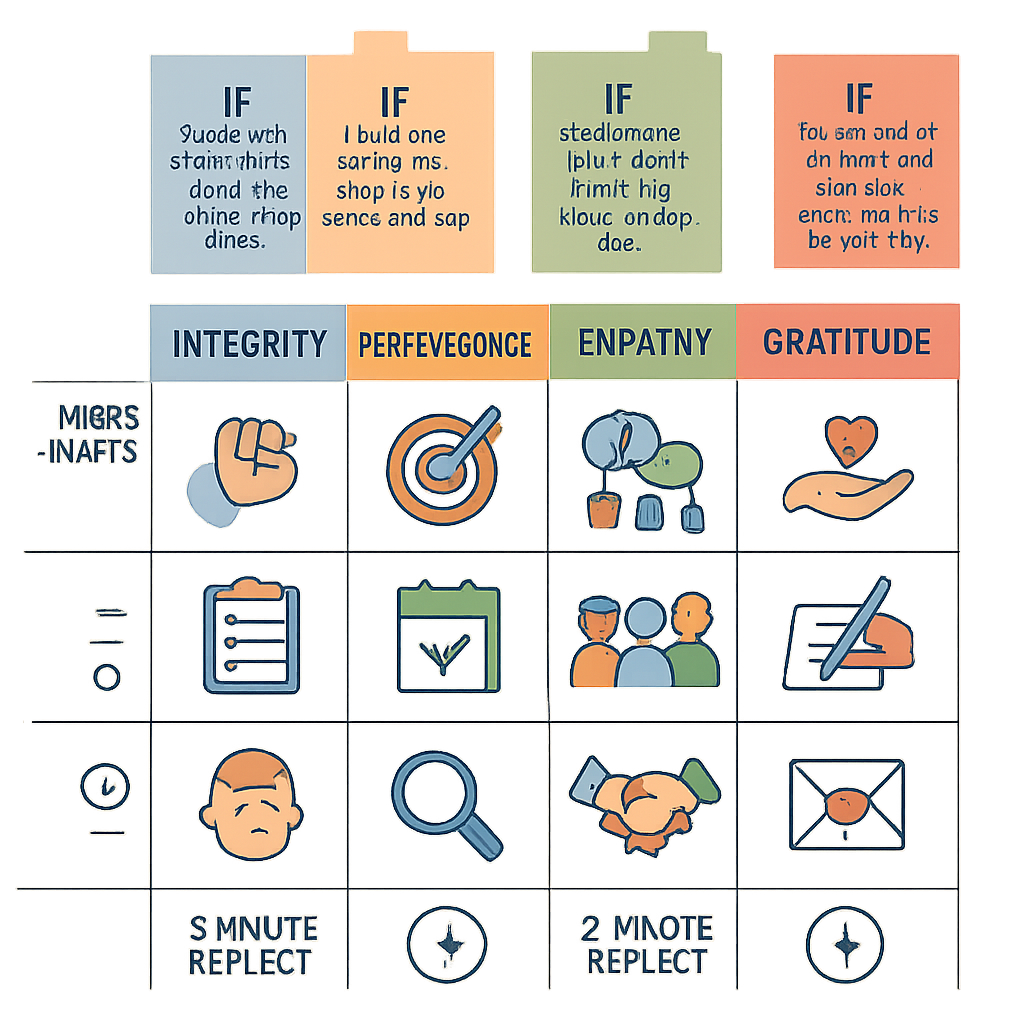
Integrity: Keep Promises Small and Visible
Integrity is values congruence in action. Brief, ACT‑informed practices help you notice values, choose aligned behavior, and accept discomfort without breaking commitments [8]. APA guidance supports self‑regulation through small, repeatable behaviors and tracking [3].
Micro‑Habits for Integrity
- Declare one promise for the day on a visible card.
- Add a 60‑second mid‑day “promise check” after lunch.
- Use habit stacking: “After I close my laptop, I’ll spend 60 seconds reviewing my promise.” The Fogg Behavior Model reminds us: make it tiny and easy so ability remains high even when motivation dips [9].
- If–then plan: “If I feel tempted to skip this call, then I’ll send a 1‑line update first to keep my word” [5].
Reflection Prompt: Did I Live My Value Today?
- “Where did I keep my word today?”
- “Where was the gap—and what’s one small repair I can make tomorrow?”
These reinforce identity-based habits by tying actions to the person you aim to be.
Perseverance: Tiny Wins and Friction Reduction
- One‑more‑rep rule: When you feel done, do one more minute/rep/page.
- Friction audit: Identify time, tools, and environmental barriers; remove one barrier per week [9].
- If–then obstacle plan: “If I get interrupted before I start, then I will restart with a 60‑second version” [5].
- Expect slow automation; perseverance grows as behaviors become more automatic over 8–12 weeks [4].
Empathy and Compassion: Perspective Taking in 2 Minutes
- Name‑Feel‑Need: Mentally name what someone might be feeling and needing.
- Two‑minute perspective switch: “What would this look like from their seat?”
- One gratitude text: Send a short message appreciating someone’s effort. These practices are supported by Greater Good’s empathy and compassion resources [7] and adapt well to CASEL‑aligned group check-ins [2].
Gratitude: One Line a Day
- Minimal entry: “Today I’m grateful for…”
- Weekly recap: Note your most meaningful moment and why it mattered. Gratitude practices are linked with well-being and are easy to sustain when designed small [6].
Family and Classroom Adaptations
- Age‑appropriate prompts (K–2: “Who helped you today?”; 3–5: “How did you help?”; Teens: “What trade‑off did you make for your values?”).
- Ten‑minute homeroom variant: quick check‑in + one empathy practice.
- Map activities to CASEL competencies for coherence across the year [2].
Daily Values Practice + Values Alignment Audit (ACT‑Informed)
Values are your chosen directions; goals and habits are how you move toward them. ACT‑informed methods help turn values into daily actions, even when it’s uncomfortable [8].
The Bravewood Values Compass: Clarify Your Top 2–3 Values
- Brainstorm many values; then narrow to your top 2–3 non‑negotiables.
- Define “in‑bounds” behaviors for each (what it looks like in real life).
- Write a friction‑proof, 1‑sentence intention per value (e.g., “I will be honest and kind in the first conversation that tests me today.”) ACT principles guide this: choose values, notice urges, take committed action [8].
If–Then Plans and Habit Stacking for Values in Action
- Create 1–2 if–then plans per value: “If my meeting runs long, then I’ll send a 2‑line integrity update” [5].
- Stack onto existing routines: “After I brush my teeth, I’ll text one gratitude.” Keep it tiny so the behavior fits any day [9].
Weekly Values Alignment Audit (10 Minutes, Once a Week)
- Time‑use map: Estimate where your hours went (work, family, health, service).
- Score alignment (0–10) for each category versus your top values.
- Pick one micro‑commitment to close the biggest gap next week. Research shows that values–behavior discrepancies correlate with reduced well-being; closing the gap matters for mental health and satisfaction [10].
Consistency Diagnostic: Why Habits Fail and a 4‑Week Rescue Protocol
Why consistency craters:
- Overreliance on motivation instead of cues and environment
- Vague goals and no if–then plans
- Missing or weak reminders; too much friction
Normalize the dip: automaticity usually takes weeks, not days [4]. Use if–then planning to recover faster [5].
Run a Friction Audit and Environment Redesign
- Identify bottlenecks (time window, tools missing, context conflicts).
- Remove one barrier per week (prep tools; set a smaller window).
- Design obvious cues and make the behavior tiny; the Fogg model shows ability is the lever to pull when motivation is low [9].
The 4‑Week Rescue Plan (Step by Step)
- Week 1: Restart with one micro‑habit and one if–then plan [5]. Track only “Did I do it? Y/N.”
- Week 2: Add habit stacking to an existing routine [9].
- Week 3: Add a light commitment device (e.g., small pledge with a friend) and a weekly check‑in.
- Week 4: Review adherence trend; adjust scope or time‑of‑day. Expect 50–80% adherence as a realistic band while rebuilding; alignment improves as consistency stabilizes [4].
Commitment Devices, Social Support, and Accountability
- Deposits or small stakes (donation if you miss).
- Public commitments (one sentence in a closed group).
- Paired practice (text “done” to a buddy). These methods complement implementation intentions and environment design [5][9][3].
Personal Growth Routine Builder: 5‑, 15‑, and 30‑Minute Options
All routines stack identity-based habits with if–then planning and brief reflection. Choose the smallest that fits your day; consistency over intensity wins over 8–12 weeks [4][5].
Minimal Effective Routine (5 Minutes)
- 60 seconds: one micro‑habit for your chosen virtue.
- 60 seconds: one if–then plan for a likely obstacle [5].
- One‑line reflection: “How did I live my value?” Identity reinforcement keeps habits sticky.
Standard Routine (15 Minutes)
- 2‑minute values check‑in: review your top 2–3 values.
- 5–8 minutes: a short practice (empathy perspective shift or gratitude text) [6][7].
- 2–3 minutes: quick adherence log and tomorrow’s if–then trigger.
Momentum Routine (30 Minutes)
- 10 minutes: deeper reflection or journaling.
- 10 minutes: friction audit update; prep tomorrow’s cues.
- 10 minutes: if–then planning for the next day’s high‑risk moments. Tie this to your weekly Alignment Audit for compound benefits.
How to Restart After Missed Days
- Shrink scope (60‑second version).
- Reset cues (attach to an immovable routine).
- Recommit publicly once this week; add one coping if–then plan for the trigger that tripped you [5].
- Expect fluctuations; judge the system, not yourself.
Measurement and Tools: Track What Matters
Track three metrics weekly:
- Adherence (% of planned actions completed)
- Alignment (0–10 score: how well time matched values)
- Attainment (progress toward one clear goal)
APA guidance underscores that self‑monitoring is a pillar of lasting behavior change [3]. Visualize these in a one‑page dashboard so adjustments are obvious.
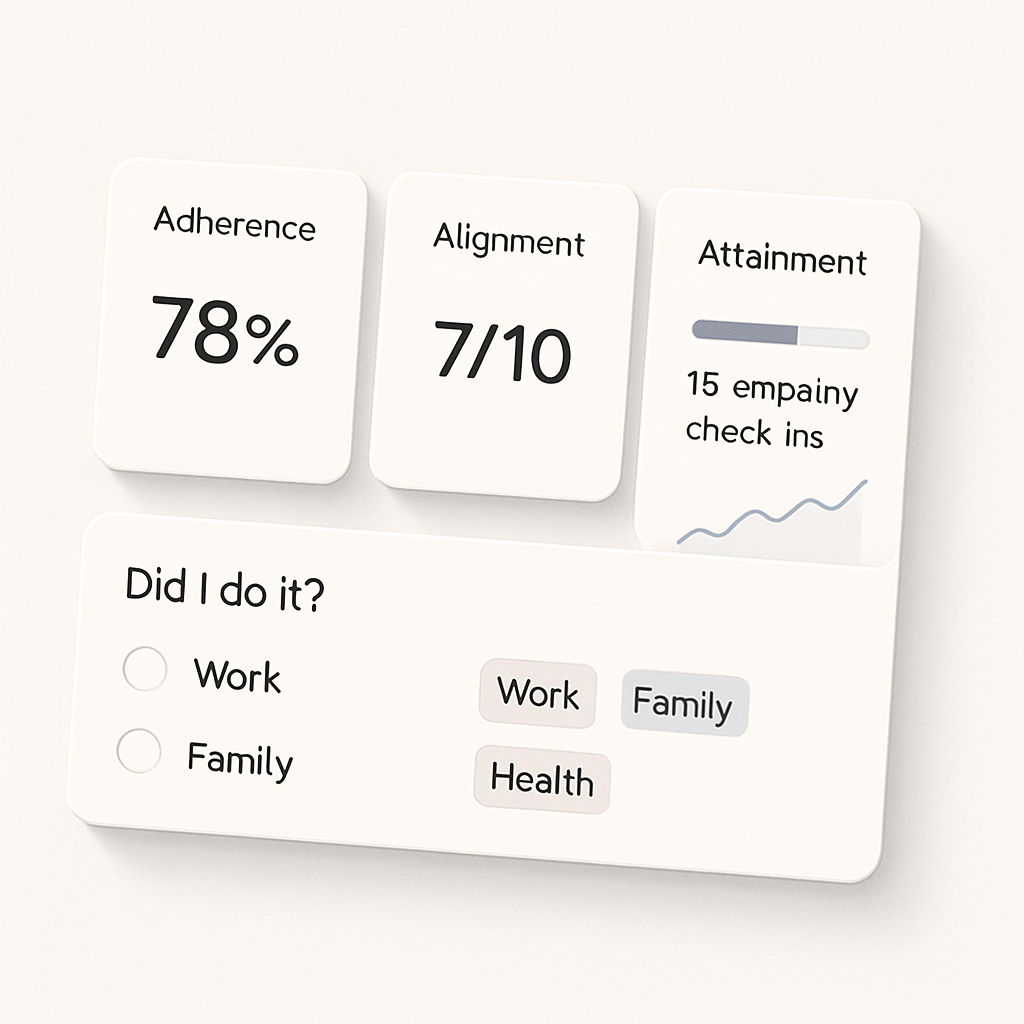
The Three Core Metrics: Adherence, Alignment, Attainment
- Adherence: Under 50%? Shrink the habit or improve cues. 50–80%? Stable; consider layering.
- Alignment: If a top value sits <6/10 for two weeks, pick one micro‑commitment to close the gap.
- Attainment: Define success clearly (e.g., “15 empathy check‑ins in 4 weeks”); adjust if progress stalls.
How Bravewood Products Operationalize the Science
- Journals: Prompt brief, daily reflection and identity reinforcement (supports adherence and alignment) [4][5][8].
- Values Cards: Fast values clarification and “in‑bounds” behaviors (ACT‑informed) [8][11].
- Habit Trackers: Simple “Did I do it?” logs; highlight adherence trends (habit formation) [4].
- Curriculum Kits (educator/family): CASEL‑aligned routines and group prompts; short SEL wins in 10 minutes [2].
Each feature maps to validated mechanisms: if–then plans [5], tiny habit design [9], values‑based action [8], and tracked practice over 8–12 weeks [4].
Downloadable Trackers and Dashboards
Offer printable and digital versions with:
- Clear definitions (what counts as “done”)
- Example entries
- Version history and update notes for transparency
Bravewood Character‑Building Products: What to Choose and Why
Cut through brand confusion with a simple taxonomy and science briefs.
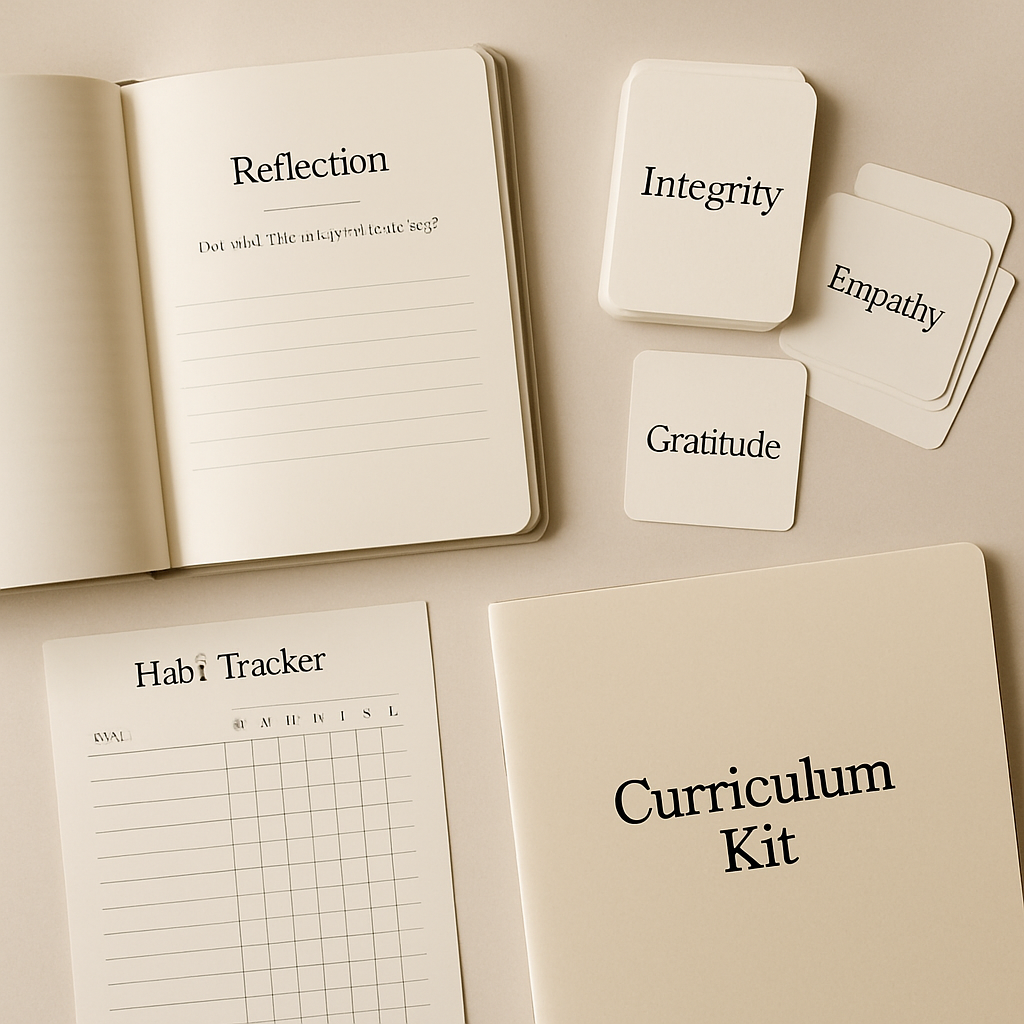
Product Taxonomy and Science Briefs
- Bravewood Journals: 2‑minute reflection prompts; identity-based habit reinforcement [4][5][8].
- Bravewood Values Cards: Clarify top values; define “in‑bounds” behaviors; trade‑off prompts [8][11].
- Bravewood Habit Trackers: One‑page adherence and alignment dashboards; weekly trends [3][4].
- Bravewood Curriculum Kits: 10‑minute SEL routines aligned with CASEL competencies for classrooms/families [2].
Mechanisms: implementation intentions [5], values-based living (ACT) [8], habit stacking and tiny steps [9], and an 8–12 week arc [4].
Which Product Should I Start With?
- Goal: Integrity or consistency? Start with Habit Tracker + Journal (5‑minute Minimal routine).
- Goal: Empathy/Gratitude (family/classroom)? Start with Values Cards + Curriculum Kit.
- Time: Only 5 minutes/day? Journal + one Values Card prompt. Have 15–30 minutes? Add an empathy exercise and a weekly Alignment Audit.
- Context: Individuals prioritize Habit Trackers; families/classrooms benefit from Values Cards and Curriculum Kits.
Bundles for Individuals, Families, and Educators
- Individual Starter: Habit Tracker + Journal (use Minimal/Standard routines). Expect early clarity in 1–2 weeks; stable automaticity in 8–12 weeks [4].
- Family Pack: Values Cards + Journal + Habit Tracker; nightly gratitude and weekly audit.
- Classroom Kit: CASEL‑aligned prompts + tracking sheets; 10‑minute homeroom implementation [2].
Evidence, Case Studies, and What Results to Expect
- What to measure: weekly adherence (%), alignment scores, and one concrete attainment goal.
- Why we’re optimistic: SEL research shows robust outcomes in behavior and academics [1]; habits stabilize over 8–12 weeks [4]; if–then planning boosts follow‑through [5].
- Transparency: Publish anonymized dashboards and a brief methodology appendix with limitations.
What Bravewood Stands For: Values, Mission, and Impact
Bravewood exists to help people live their values with small, daily integrity and compassion. Our product design principles:
- Evidence first: We map features to validated mechanisms and cite the sources.
- Accessibility: Tiny, time‑boxed practices that work on busy days.
- Transparency: Clear measurement, honest timelines, and continuous improvement.
We recommend publishing founder bios, product safety notes, and any third‑party validations as they become available.
Case Stories: Real People Building Character and Living Their Values
These anonymized composites illustrate what progress can look like with simple practices and visible metrics. They are examples, not clinical trials; individual results vary.
Time‑Pressed Professional: From Inconsistent Habits to Daily Integrity Wins
- Baseline: Adherence 28%, alignment 4/10. Struggled to follow through on small promises at work.
- Plan: Integrity micro‑habits + if–then plans; 5‑minute routine; friction audit to prep tools [5][9].
- Outcomes: Week 4 adherence 61%; Week 8 adherence 78%; alignment climbed to 7/10. Reported fewer “nagging loose ends” and more timely updates. The turning point was a tiny if–then plan for “running late” moments [5].
Parent & Family: Empathy and Gratitude Rituals That Stick
- Baseline: Dinner chaos; inconsistent routines; kids reluctant to share.
- Plan: One‑line gratitude at dinner, weekly Values Alignment Audit, Values Cards for “What helping looks like at home” [6][7][2].
- Outcomes: By Week 8, family logged 6/7 nights on average; kids initiated empathy “Name‑Feel‑Need” check‑ins twice a week. Parents reported smoother transitions and more appreciation expressed.
Educator & Classroom: 10‑Minute Homeroom SEL Wins
- Baseline: Low participation, frequent minor disruptions.
- Plan: 10‑minute homeroom routine: empathy prompt on Mondays, gratitude on Wednesdays, quick integrity “promise card” on Fridays; simple class tracker [2].
- Outcomes: By Week 12, teacher reported improved on‑task behavior during first period and more students volunteering to share. The routine aligned with SEL targets and was easy to sustain [1][2].
FAQs: Character Building, Personal Growth, and Bravewood Products
What daily habits actually strengthen character?
- Integrity: one visible daily promise + 60‑second check‑in
- Perseverance: “one‑more‑rep” rule + if–then obstacle plan [5]
- Empathy: 2‑minute perspective switch; Name‑Feel‑Need [7]
- Gratitude: one line a day [6]
Track with a simple “Did I do it?” log. APA guidance supports self‑monitoring for durable behavior change [3].
How long before I see results and how do I measure them?
- Expect early mood/clarity within 1–2 weeks; habit automaticity typically stabilizes in 8–12 weeks (median ~66 days) [4].
- Measure adherence, values alignment (0–10), and one attainment metric weekly.
How do I teach character to kids vs. develop it as an adult?
- Kids: Shorter prompts, predictable routines, and visual trackers. Map to CASEL competencies; SEL programs show meaningful outcomes [1][2].
- Adults: Tie habits to identity and values; use if–then planning and tiny steps [5][9].
Which framework actually works (growth mindset, if–then, ACT)?
- If–then plans (implementation intentions) reliably increase follow‑through [5].
- ACT techniques translate values into daily actions despite discomfort [8].
- Use both: choose values (ACT), then deploy if–then plans for reliability [5][8].
Which Bravewood product is right for me and how do they work?
- Need consistency? Start with Habit Tracker + Journal for adherence and reflection [4][5].
- Building empathy/gratitude in a family or class? Values Cards + Curriculum Kit [2][6][7].
- All products map to validated mechanisms: if–then planning [5], tiny steps [9], values‑based action [8].
What are the signs of values misalignment and how do I fix it?
- Common signs: stress, dissatisfaction, second‑guessing, and decision fatigue.
- Fix: Run a weekly 10‑minute Values Alignment Audit; pick one micro‑commitment to close the biggest gap next week. Values–behavior discrepancies are linked to reduced well‑being, so closing the gap matters [10].
How does Bravewood compare to alternatives?
Judge by mechanisms, evidence, and transparency:
- Is there a values framework?
- Are practices tiny and time‑boxed?
- Are implementation intentions encouraged?
- Is there simple tracking and a realistic 8–12 week arc?
Bravewood publishes product‑to‑mechanism maps and commits to transparent measurement.
Implementation Resources: Printables and Next Steps
Download the Virtues‑to‑Habits Matrix (PDF) and Values Compass
Start in under 10 minutes: pick one virtue, define one micro‑habit, and write one if–then plan. Include research footnotes in the PDFs (Durlak, Lally, Gollwitzer, ACT) [1][4][5][8].
Setup Checklist: First 7 Days
- Day 1: Choose one virtue and one micro‑habit (60 seconds).
- Day 2: Write one if–then plan [5].
- Day 3: Place one visible cue; remove one barrier [9].
- Day 4: Do the 5‑minute Minimal routine; log “done.”
- Day 5: 2‑minute reflection; specify tomorrow’s trigger.
- Day 6: Run your first tiny Values Alignment Audit (5–10 minutes).
- Day 7: Celebrate one tiny win; repeat next week.
Community and Service Ideas to Reinforce Empathy
- One thank‑you note per week to a helper in your community
- Family “kindness hunt” with two concrete acts before the weekend
- Class “perspective wall” where students post what a situation looks like from another seat
Short, prosocial practices strengthen empathy and community bonds [7].
Conclusion
Character building grows with you when it’s small, values‑anchored, and measured. The Bravewood Method gives you a time‑bounded, evidence‑backed system—virtues turned into micro‑habits, ACT‑informed values alignment, a realistic 8–12 week arc, and tools that make your progress visible on busy days. Start now: download the core worksheets, pick one virtue, write one if–then plan, and run your first 10‑minute Alignment Audit this week.
Call to Action
Start your 8–12 week plan today: download the Virtues‑to‑Habits Matrix and Bravewood Values Compass, take the product selection quiz, and commit to the 5‑minute daily practice for the next seven days.
Disclaimer
This content is for educational purposes and general well‑being only and is not a substitute for professional mental health, medical, or educational advice. Consult a licensed professional for individualized guidance, especially when working with minors.
References
- Durlak, J. A., Weissberg, R. P., Dymnicki, A. B., Taylor, R. D., & Schellinger, K. B. (2011). The impact of enhancing students’ social and emotional learning: A meta-analysis of school-based universal interventions. Child Development, 82(1), 405–432. Retrieved from https://srcd.onlinelibrary.wiley.com/doi/10.1111/j.1467-8624.2010.01564.x
- Collaborative for Academic, Social, and Emotional Learning (CASEL). (N.D.). Fundamentals of SEL. Retrieved from https://casel.org/fundamentals-of-sel/
- American Psychological Association. (N.D.). Making lifestyle changes that last. Retrieved from https://www.apa.org/topics/behavioral-health/healthy-lifestyle-changes
- Lally, P., Van Jaarsveld, C. H. M., Potts, H. W. W., & Wardle, J. (2009). How are habits formed: Modelling habit formation in the real world. European Journal of Social Psychology, 40(6), 998–1009. https://doi.org/10.1002/ejsp.674
- Gollwitzer, P. M., & Sheeran, P. (2006). Implementation intentions and goal achievement: A meta-analysis of effects and processes. Advances in Experimental Social Psychology, 38, 69–119. https://doi.org/10.1016/S0065-2601(06)38002-1
- Greater Good Science Center, UC Berkeley. (N.D.). Gratitude: Definition and resources. Retrieved from https://greatergood.berkeley.edu/topic/gratitude/definition
- Greater Good Science Center, UC Berkeley. (N.D.). Empathy: Definition and resources. Retrieved from https://greatergood.berkeley.edu/topic/empathy/definition
- Hayes, S. C., Luoma, J. B., Bond, F. W., Masuda, A., & Lillis, J. (2006). Acceptance and Commitment Therapy: Model, processes and outcomes. Behaviour Research and Therapy, 44(1), 1–25. https://doi.org/10.1016/j.brat.2005.06.006
- Fogg, B. J. (N.D.). Fogg Behavior Model. Retrieved from https://behaviormodel.org/
- Roccas, S., Sagiv, L., Schwartz, S. H., & Knafo-Noam, A. (2017). Personal values and behavior: Taking a cross-situational perspective. Current Opinion in Psychology, 18, 54–59. Retrieved from https://www.ncbi.nlm.nih.gov/pmc/articles/PMC6465641/
- Brown, B. (N.D.). Dare to Lead: List of Values. Retrieved from https://brenebrown.com/resources/dare-to-lead-list-of-values/
