
Introduction
If you’ve ever opened a fresh notebook only to meet ghosting, bleed-through, or a spine that starts cracking halfway through the year, you’re not alone. Too many “premium” journals rely on vague claims and pretty covers. Bravewood is different by design. We’re a handcrafted notebook brand built on transparency: we publish the materials that matter (paper composition and pH, binding method, cover provenance), we stress-test real notebooks in the lab, and we give you a simple, research-backed journaling system you can actually keep up with.
In this guide, you’ll find everything you need to pick the right Bravewood journal and use it well:
- Craftsmanship specs explained in plain language (paper, binding, leather provenance, and relevant standards like FSC, ISO 9706, and LWG) [1][2][3].
- Our durability and paper performance protocol, with head-to-head context against known names like Moleskine, Hobonichi, Paperage, and Paper Republic [5][6][7][8][26].
- A buyer’s guide to journal specs that really matter, plus pen and paper compatibility tips.
- Evidence-based benefits of personal journaling and how often to write for different goals [9][10][11][14][15].
- A 5–10 minute daily routine, printable trackers, and privacy safeguards.
- Guided writing prompts and our Craft Your Chronicle method for telling your life story—ethically and clearly [12][13][14][15][20][21][22].
- Troubleshooting for durability issues and writer’s block, plus care, repair/refill, and ethical sourcing guidance [3][4][23][24][25].
- Introduction
- Meet the Bravewood Journal: What It Is, Who Makes It, and Why It Lasts
- What Makes a Handcrafted Notebook: Craftsmanship, Binding, and Personalization
- Lab-Tested Durability and Paper Performance: Our Protocol and Results
- Buyer’s Guide: Choosing the Best Durable Journal for Daily Writing
- Evidence-Based Benefits of Personal Journaling
- Build a Daily Journaling Routine That Sticks (5–10 Minutes)
- Guided Writing Prompts for Reflection + Craft Your Chronicle System
- Troubleshooting and FAQs: Durability Issues, Writer’s Block, and Buying Questions
- Ownership Lifecycle: Care, Repair/Refill, and Ethical Sourcing
- Conclusion
- Disclaimer
- References
Meet the Bravewood Journal: What It Is, Who Makes It, and Why It Lasts
Bravewood is a handcrafted notebook designed for daily writing. We believe a journal should be a long-term companion—one you can carry, mark up, and return to for years without worrying about failing spines or ink bleed-through. Each edition is built in small batches with artisan binding, fountain-pen-conscious paper selection, and clearly disclosed materials. When applicable, we align with:
- FSC for responsible paper sourcing and chain-of-custody transparency [1].
- ISO 9706 when discussing archival/acid-free permanence criteria for paper [2].
- Leather Working Group (LWG) for audited, responsibly produced leather where leather is used [3].
Maker story and process in brief: Bravewood brings together binders and material specialists who cut, fold, and sew signatures by hand or on traditional equipment, then case them into robust covers designed for lay-flat writing. We select materials for function first—paper that balances smoothness, dry time, and resistance to bleed/feathering; thread-sewn binding for structural integrity; and durable cover options suitable for daily carry.
Transparent Specifications: Paper, Binding, and Cover Materials
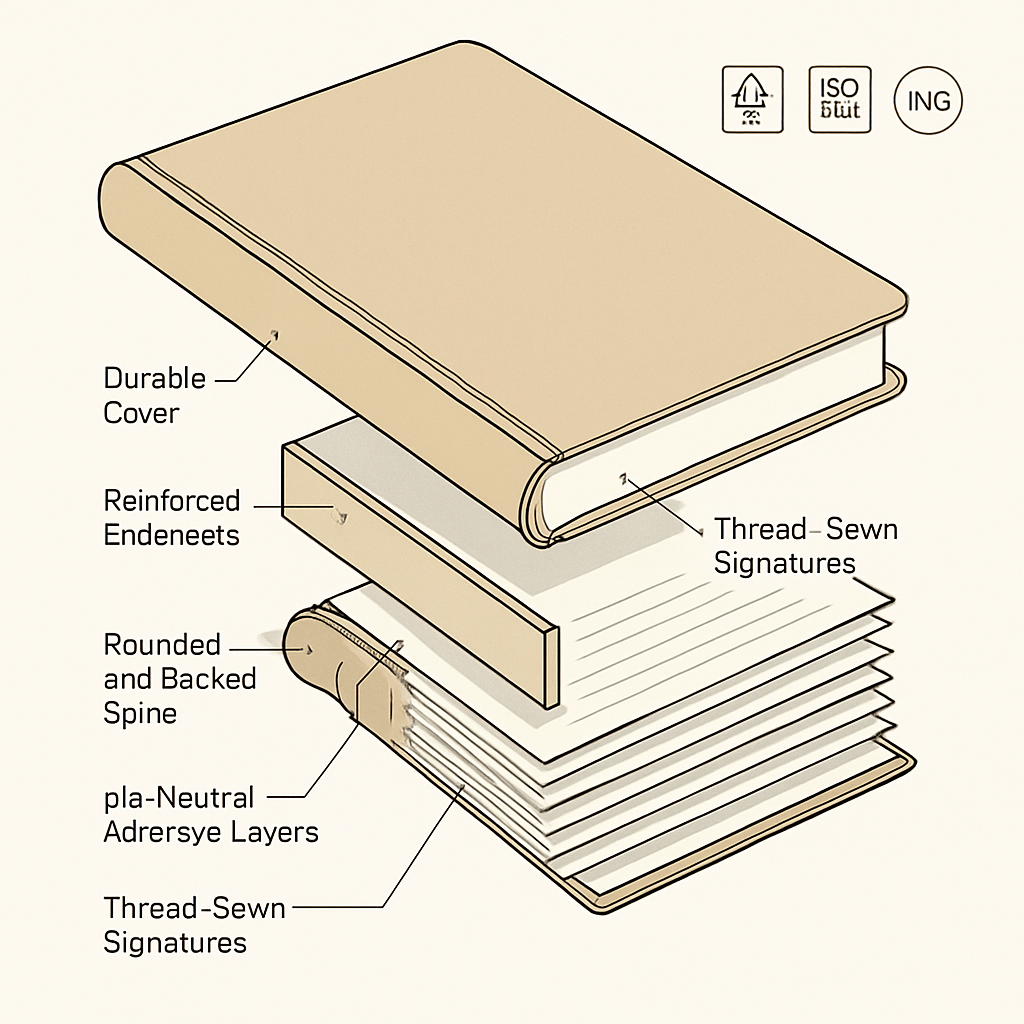
Journal specs should do more than sound good—they should tell you exactly how the notebook will behave. We disclose the following on each Bravewood product page so you can pick with confidence:
- Paper: weight (gsm), surface sizing, pH/acid-free status, and whether permanence aligns with ISO 9706 criteria for durability and longevity [2].
- Binding: thread-sewn (Smyth-sewn) signatures vs. glued/perfect-binding, and lay-flat behavior. The Guild of Book Workers recognizes thread-sewn structures as a best-practice approach for durability relative to simple perfect-binding [4].
- Adhesives: pH-neutral bookbinding adhesives chosen for flexibility and longevity (relevant at the spine and endsheets).
- Cover: durable options (e.g., leather from LWG-audited tanneries where applicable [3] or high-abrasion-resistant alternatives), plus abrasion and spill performance considerations.
- Provenance: paper and cover suppliers, and applicable certifications (e.g., FSC chain-of-custody) [1].
- Personalization: monogramming or debossing, if available.
Spec Table: At-a-Glance Bravewood Materials
To make comparison easy, we publish a consistent, date-stamped spec set on each listing. Here’s the schema you’ll see (example format, refreshed November 2025):
- Paper: weight (gsm); surface sizing; pH/acid-free; permanence notes (e.g., aligns with ISO 9706 criteria) [2].
- Binding: thread-sewn signatures; lay-flat tested; endsheet material.
- Adhesives: pH-neutral EVA/PVA blend (archival-aware).
- Cover: material (e.g., full-grain leather from LWG-audited tannery when applicable [3] or durable vegan alternative); abrasion and spill notes.
- Hardware/closure: elastic, ribbon markers, pocket details.
- Personalization: available/lead times (if offered).
- QA note: edition/date stamp and batch-level verification steps (paper performance checks; spine integrity checks).
Where to Buy Bravewood, Pricing, and Warranty
- Where to buy: Bravewood journals are sold directly through our official store and a small network of vetted stockists. Availability varies by edition and batch size.
- Pricing: depends on format, materials, and personalization. We publish full specs and value metrics (like page count and cost per page) so you can compare across sizes and editions.
- Warranty: We stand behind materials and workmanship. If you experience a manufacturing fault (e.g., premature spine failure, detached signatures, or defective cover), contact support with photos and order details. We’ll guide you through repair or replacement as appropriate. Typical timelines depend on the issue and shipping distance; our support team will set expectations up front.
- Repairs/refills: For qualifying formats, we offer repair services and guidance on refill compatibility or archival storage.
What Makes a Handcrafted Notebook: Craftsmanship, Binding, and Personalization
Handcrafted vs. Mass-Produced: Processes That Drive Durability
Not all “handmade” claims mean the same thing. In durable bookbinding, construction details matter:
- Thread-sewn signatures (Smyth-sewn) vs. perfect-bound blocks: Sewn signatures distribute stress through the fold and allow the spine to flex naturally. Perfect-binding relies primarily on adhesive; under heavy use, page detachment can occur sooner. The Guild of Book Workers documents the strength and open-ability advantages of sewn structures in conservation-minded craft practices [4].
- Lay-flat design: True lay-flat comes from sewing, flexible adhesive, and proper rounding/backing of the spine—not just from forcing the book to open.
- Adhesive quality: pH-neutral, flexible, and properly cured glues help the text block survive thousands of openings without brittle cracking.
Paper Characteristics: GSM, Sizing, and Fountain-Pen Friendliness
Paper behavior comes down to more than “thick vs. thin.”
- GSM (grams per square meter): Higher gsm often reduces show-through, but formulation matters. Surface sizing and fiber quality can make a thinner paper surprisingly ink-friendly.
- Sizing and coatings: Properly sized paper resists feathering (ink spreading along fibers) and mitigates bleed-through. Smoothness influences feel and dry time.
- Example context: Hobonichi journals use Tomoe River S—a thin, smooth paper prized by many fountain-pen users for its resistance to feathering and its unique ink shading, paired with thread-stitch binding for durability [5]. This illustrates how formulation and binding together shape the writing experience.
Personalization, Monogramming, and Refill/Repair Options
Handcrafted notebooks excel at becoming yours:
- Personalization: Monogramming/debossing (when offered) transforms a journal into a meaningful gift or a long-term personal artifact.
- Long-term ownership: Refill-compatible formats and repair services extend useful life; sewn structures are serviceable by trained binders. Clear policies and turnaround times help you plan.
Lab-Tested Durability and Paper Performance: Our Protocol and Results
We evaluate journals the same way you’ll use them: at desks, in bags, and on commutes. Our standardized protocol covers paper behavior, binding integrity, and cover resilience. For broader context, we reference public manufacturer specs and the comparative testing ethos popularized by organizations like Wirecutter, which weigh durability, paper performance, and value in their reviews [6][7][8][5].
Standardized Protocol: Pens, Spills, Drops, and Abrasion
To keep things fair and repeatable, we document conditions and steps for each test:
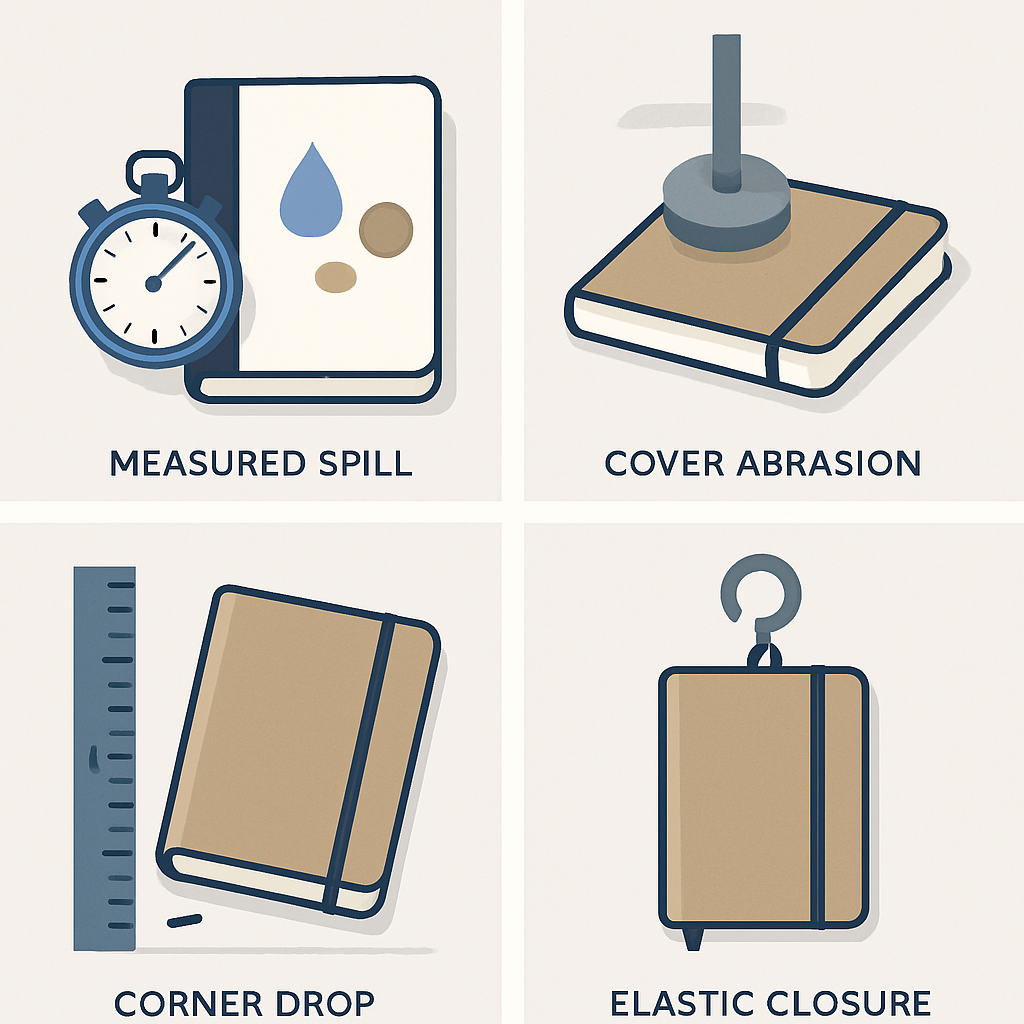
- Paper tests: We write standardized swatches with common tools—ballpoint, gel (0.5–0.7 mm), rollerball, felt-tip, and several fountain pens/inks (fine/medium nibs; dye and pigment inks). We evaluate bleed-through, ghosting, feathering, and typical drying times.
- Spill tests: We apply measured droplets of water and coffee, then blot or wipe at set intervals to assess staining, cockling, or ink migration.
- Drop tests: We drop from standard heights onto a hard surface (corner-first and flat) to check spine integrity and corner protection.
- Abrasion tests: We perform controlled rubs with a consistent medium to evaluate scuffing and color transfer on covers.
- Elastic/closure fatigue: We cycle the closure to evaluate stretch and retention.
Paper Performance Matrix: 10-Pen Bleed/Ghost/Feather Results
We score each pen/ink combo across:
- Bleed (yes/no),
- Ghosting (approximate visibility),
- Feathering (1–5 rating),
- Drying time (seconds).
This matrix allows you to match your pen preferences to compatible paper quickly. It’s also how we tune Bravewood paper selection across editions.
Cover & Binding Stress Tests: Abrasion, Spill, and Drop
We capture before/after observations for:
- Abrasion: degree of scuffing, color transfer, and surface integrity.
- Spill response: staining, cockling, and writability of the affected area after drying.
- Drop impact: spine cracking, loosened signatures, or corner deformation.
Head-to-Head Benchmarks: Bravewood vs. Moleskine, Leuchtturm1917, Hobonichi, Paperage, Paper Republic
Fair comparisons start with transparent specs:
- Moleskine publishes a broad range of durable formats and closures; details vary by line [7].
- Hobonichi specifies Tomoe River S paper and thread-stitch binding in many models, emphasizing thin-yet-strong pages [5].
- Paperage highlights 100 gsm acid-free paper and water-resistant covers in popular models [8].
- Paper Republic emphasizes vegetable-tanned leather and refillable systems, foregrounding materials transparency [26].
We use the same tests for all brands and disclose the protocol so you can understand trade-offs: ultra-thin papers may show more ghosting but offer unique fountain-pen qualities; heavier sheets may reduce ghosting at the cost of bulk. We adopt a comparison ethos similar to Wirecutter—clearly stating criteria, documenting methods, and discussing value in context [6].
Durability Score: Methodology and How to Use It
To simplify decisions, we weight performance attributes as follows:
- Paper performance: 40% (bleed/ghost/feather, fountain-pen friendliness, dry time)
- Binding integrity: 30% (lay-flat, spine resilience, page retention after drop cycles)
- Cover resilience: 20% (abrasion, spill behavior, corner protection)
- Portability/format: 10% (size/weight trade-offs, page count, carry comfort)
Interpretation tips:
- Heavy fountain-pen users should emphasize paper performance and binding.
- Travelers and commuters might weight cover resilience and portability higher.
- Value seekers can pair the score with cost-per-page to find sweet spots [6].
Buyer’s Guide: Choosing the Best Durable Journal for Daily Writing
What to Look For: Specs That Matter and Why
- Paper: Look for acid-free paper with permanence notes (evidence-aligned with ISO 9706 criteria for longevity) if you plan to archive your writing [2]. Surface sizing and gsm together predict bleed/feather resistance.
- Binding: Thread-sewn signatures with lay-flat behavior offer the best long-term experience; glued-only spines tend to fatigue faster [4].
- Cover: If you carry daily, prioritize abrasion resistance, rounded corners, and some water resistance.
- Closure and accessories: Reliable elastic, robust ribbon markers, and functional pockets reduce wear and tear in real use.
Pen and Paper Compatibility: Avoid Bleed-Through and Feathering
- Ballpoint and gel generally behave well on most writing papers; gel in 0.5–0.7 mm often balances smoothness and dry time.
- Felt-tip and wet rollerball may increase feathering on softly sized or very absorbent papers.
- Fountain pens: Match nib width and ink wetness to the paper. Thinner, well-sized papers (e.g., Tomoe River S as a category example) can shine for shading and sheen but may ghost more [5]. Heavier, more absorbent papers can reduce ghosting but may spread or extend dry time.
- Tips to minimize bleed and feather:
- Use finer nibs or drier inks; blot as needed.
- Place a blotter card behind the page.
- Avoid pressing too hard, which drives ink into fibers.
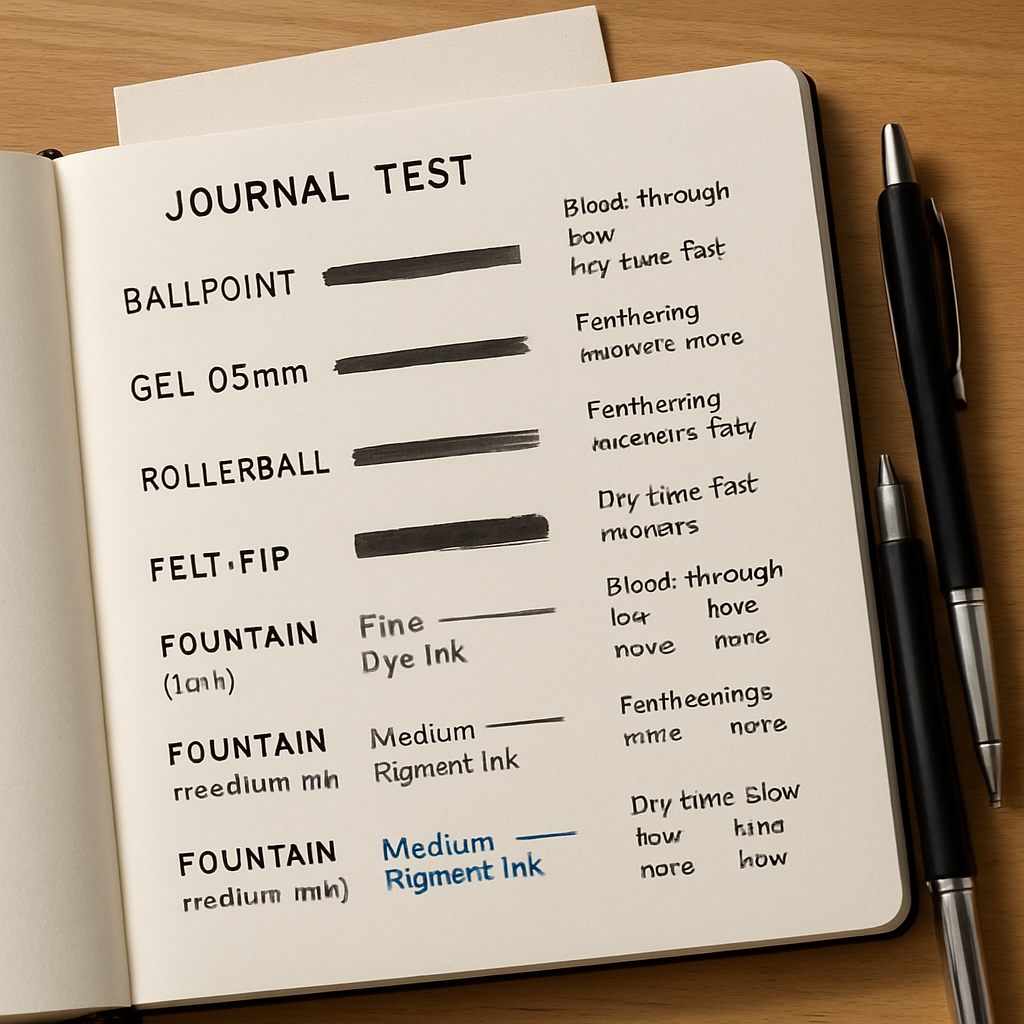
Pen Tests: Find Your Paper Match
Portability and Value: Sizes, Weight, and Cost per Page
- Formats: Pocket (highly portable), A5 (balanced page size and carry weight), B5 (roomier for sketches/notes).
- Value: Cost per page helps compare across brands and formats; many reviewers—including Wirecutter—consider this alongside durability and design [6].
- Long-term ownership: Refill-compatible or repairable formats, plus archival storage options, improve value over time.
Evidence-Based Benefits of Personal Journaling
A solid journal is only half the story; the other half is a practice you can maintain. Research on expressive writing suggests benefits for stress regulation, mood, and even aspects of cognitive processing when people follow simple, structured protocols [14][15]. Consumer-friendly summaries also highlight improvements in self-awareness and coping when journaling is used appropriately [9][10][11].
Do You Need to Journal Daily? Frequency and Timing
- Expressive writing protocols in research often involve 15–20 minute sessions over several consecutive days or weeks, and show measurable effects for many participants [14][15].
- For everyday wellbeing and habit formation, shorter, consistent sessions also help. Many people sustain 5–10 minutes most days, or 3–4 sessions/week, with positive outcomes reported in consumer-health summaries [9][10][11].
- Timing: Morning entries help set intention and productivity; evening entries help process stress and consolidate memories. Choose based on your goal and energy.
Match Your Method to Your Goal: Mood, Stress, Productivity, Memory
- Mood and gratitude: Brief gratitude logs correlate with improved mood and perspective; use one to three prompts per session [10][20][21].
- Stress and emotion processing: Expressive writing (narrating thoughts and feelings about meaningful or difficult experiences) can reduce distress for many, but it’s not a substitute for therapy—seek professional support as needed [14][15].
- Productivity and focus: Planning and short “What went well / What to improve tomorrow” reflections enhance self-regulation.
- Memory: Timeline journaling, weekly summaries, and the What–So What–Now What structure support recall and learning [12][11].
Build a Daily Journaling Routine That Sticks (5–10 Minutes)
Tiny, repeatable steps beat ambitious plans you can’t keep. We combine evidence-informed habit ideas with practical journaling tips [16][17][18][19].
The Minimal Viable Routine: One-Sentence Minimum + Habit Stacking
- One-sentence minimum: Commit to a single sentence. Most days you’ll write more; on tough days you’ll keep the streak alive.
- Habit stacking: Anchor journaling to a reliable cue (after coffee, on the train, before lights out). Behavior science shows small, cue-based routines are more likely to stick [18][19].
- Timebox: Set a 5–10 minute timer. Write until the bell rings; stop and close the book.
Morning vs. Evening: Choose the Best Time for Your Goal
- Morning: Intention, priorities, and proactive mindset.
- Evening: Reflection, stress offloading, and sleep-friendly closure.
If stress disrupts sleep, lean toward brief evening entries; if you want sharper focus, try mornings.
7-, 14-, and 30-Day Plans with Printable Trackers
- 7-day starter: One-sentence minimum + one daily prompt (gratitude or highlight).
- 14-day builder: Rotate categories (gratitude, values, emotions, productivity); add a weekly reflection.
- 30-day solidifier: Alternate short expressive writing (when appropriate) with planning/reflection days; include a weekly “Now What” action check-in.
- Trackers: Use simple checkboxes and a weekly “misses and fixes” note to troubleshoot schedule conflicts.
Privacy Safeguards to Write Honestly
- Storage: Keep your journal in a consistent place; consider a slipcover or shelf spot away from shared areas.
- Boundaries: Establish what’s “in-bounds” and “out-of-bounds” for sensitive topics. When writing about others, default to respect and consent.
- Backups: Photograph or scan select entries you’d want to preserve; keep files encrypted if they include private information.
Guided Writing Prompts for Reflection + Craft Your Chronicle System
Prompt Library: Gratitude, Values, Emotions, Relationships, Meaning
Rotate prompts to stay engaged and target outcomes:
- Gratitude (mood): “One ordinary thing I’m grateful for today is… because…” [20][21]
- Values (clarity): “A small decision I made today that aligned with my values was…”
- Emotions (processing): “Right now I feel… I think it’s because… and that tells me…”
- Relationships (connection): “A moment of kindness I gave/received today was…”
- Meaning (purpose): “The story I tell myself about this week is… The headline would be…”
Use easy/moderate/deep tiers and tag entries by outcome (stress relief, clarity, creativity). Many curated prompt collections can inspire your rotation [20][21][22].
Academic Frameworks for Reflection: What–So What–Now What
A simple structure to deepen insight and action:
- What: Describe the event or thought.
- So What: Interpret why it mattered—emotion, value, or lesson.
- Now What: Decide on one small next step.
University reflective practice resources (e.g., Gibbs or Kolb models) offer additional structures if you want more guidance [12].
Craft Your Chronicle: Outline Your Life Story Step-by-Step
Turn memories into a coherent personal chronicle:
- Scope and theme: Pick a slice (e.g., “becoming a teacher”) or a chronological sweep; both work.
- Timeline mapping: Sketch decades, homes, jobs, schools, relationships, and key turning points; cluster artifacts (photos, diplomas, programs) with each period.
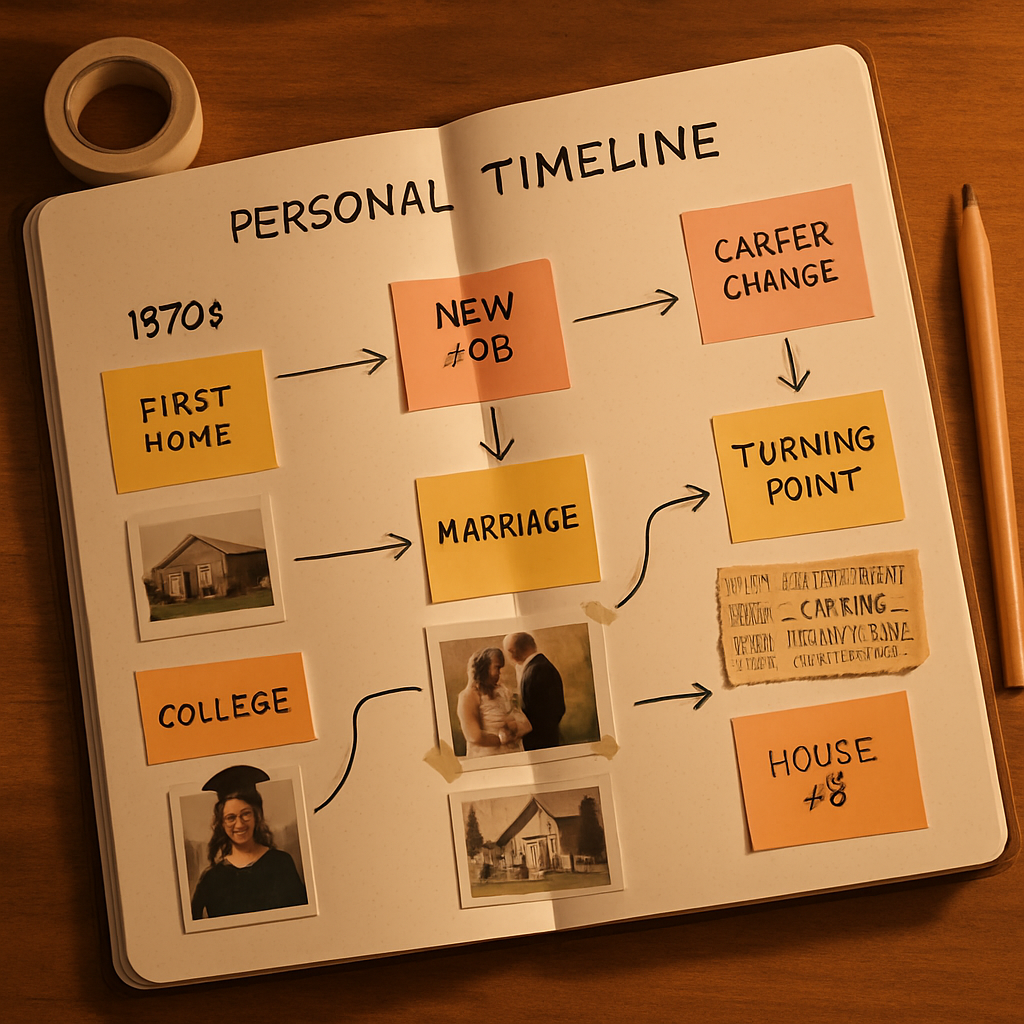
Craft Your Chronicle Timeline - Voice and scenes: Write short scenes with sensory detail; read aloud to refine rhythm.
- Fact-checking and privacy: Verify dates with artifacts and, where appropriate, interviews. Be mindful of others’ boundaries; anonymize or seek consent when needed [13][14][15].
Professionals and seasoned storytellers offer helpful frameworks for timelines and narrative flow [13][14][15].
Memory-Checking and Ethics: Verifying Without Harm
- Corroborate with artifacts: photos (metadata), resumes, certificates, obituaries, calendars.
- Cross-check with people: Ask for consent before including someone’s story; share excerpts when possible.
- Use care with sensitive material: Change names or details, or omit specifics when harm is likely.
Troubleshooting and FAQs: Durability Issues, Writer’s Block, and Buying Questions
Why Is My Spine Cracking or Pages Falling Out? (Binder’s Notes)
- Symptom: pages loosening at the gutter. Likely cause: perfect-bound adhesive failure, rough opening, or environmental stress. Prevention: prefer thread-sewn signatures; open new books gently; avoid extreme heat/cold. Conservation-minded practices from the Guild of Book Workers emphasize the durability of sewn structures and appropriate materials [4].
- Fix: For valued books, consult a binder about resewing a signature or rebacking. Avoid DIY solvents.
How Do I Prevent Ink Bleed-Through and Feathering?
- Choose paper suited to your pens; pair wetter inks with finer nibs.
- Test on the back page with your everyday pens; adjust line width or ink.
- Use a blotter or write on one side when using broad, heavily shading inks.
Fast Ways to Beat Writer’s Block (10-Minute Restart)
- Timed freewrite (5 minutes): Keep the pen moving, even if you write “I don’t know what to say.”
- Constraint prompt (3 minutes): “Write only in questions” or “Describe one sound from today.”
- Sensory swap (1 minute): Close your eyes, inhale, then name a smell, texture, or sound.
- Short walk (1 minute): Move your body and return for one final sentence.
For longer unblocks, follow a 1–2 week plan that rotates constraints and short walks. Creativity educators and university writing resources offer practical, low-pressure methods to restart momentum [24][25].
Buying, Returns, and Warranty: Quick Answers
- Where to buy: our official store and select stockists.
- Returns: unused items within a stated window; details vary by edition and retailer.
- Warranty: workmanship/materials are covered; contact support with photos and order info. We’ll confirm coverage and outline repair/replacement steps, plus expected timelines.
Ownership Lifecycle: Care, Repair/Refill, and Ethical Sourcing
Care Guide: Spills, Scuffs, Storage, and Seasonal Changes
- Spills: Blot, don’t rub. Allow pages to dry under light weight with interleaving sheets.
- Scuffs: Use a soft cloth; for leather, apply appropriate care products sparingly and test on an inconspicuous area first.
- Environment: Avoid extremes; stabilize humidity to reduce warping.
- Storage: Shelve upright, away from direct sunlight. Library of Congress guidance offers practical care and handling tips for long-lived books [23].
Repair and Refill: Keep Your Bravewood Going
- Repairs: Sewn bindings and quality cases are serviceable; reach out with photos for options.
- Refills: For refill-compatible formats, select inserts by size and paper preference; consider archiving full inserts in boxes or slipcases.
Sustainability and Ethics: Paper and Leather Sourcing
- Paper: When applicable, we align with FSC chain-of-custody to support responsible forestry and traceability [1].
- Leather: Where leather is used, we work with suppliers audited by the Leather Working Group to reduce environmental impact and improve transparency [3].
- Verification: We state certification scope (supplier/site/product) so you can verify claims with the certifying bodies’ public tools.
Conclusion
A great journal is both build and behavior. Bravewood pairs handcrafted construction and transparent specs with lab-minded testing, so you know what you’re buying—and a simple, research-backed routine so you’ll actually use it. Pick the format that fits your pens and your days, trust the sewn spine to keep pages where they belong, and let short, steady sessions turn writing into a sustaining habit.
Choose your Bravewood journal using the durability score and spec schema above, then start today with a one-sentence entry. When you’re ready, rotate prompts or begin your Craft Your Chronicle outline. Questions about repairs, refills, or warranty? Our team is here to help.
Disclaimer
This content is for informational purposes only and does not constitute medical advice. Journaling can complement—but not replace—care from a licensed professional. If writing triggers distress or trauma responses, pause and consult a qualified clinician. Product specifications and third-party certifications may change; verify current details before purchase.
References
- Forest Stewardship Council. (N.D.). What is FSC? FSC. https://fsc.org/en/what-is-fsc
- International Organization for Standardization. (N.D.). ISO 9706: Information and documentation — Paper for documents — Requirements for permanence. ISO. https://www.iso.org/standard/38980.html
- Leather Working Group. (N.D.). About Leather Working Group. Leather Working Group. https://www.leatherworkinggroup.com/
- Guild of Book Workers. (N.D.). Resources and standards on bookbinding practices. Guild of Book Workers. https://guildofbookworkers.org/
- Hobonichi. (N.D.). About the paper (Tomoe River S). Hobonichi. https://www.1101.com/store/techo/en/about/paper/
- The New York Times Wirecutter. (N.D.). Best notebooks. Wirecutter. https://www.nytimes.com/wirecutter/reviews/best-notebooks/
- Moleskine. (N.D.). Journals and notebooks. Moleskine. https://www.moleskine.com/en-us/shop/notebooks/journals/
- The Casual Reader Staff. (N.D.). Best notebooks for journaling. The Casual Reader. https://thecasualreader.com/best-notebooks-for-journaling/
- Verywell Health Staff. (N.D.). Journaling: Benefits and how to start. Verywell Health. https://www.verywellhealth.com/journaling-7498123
- PositivePsychology.com Editors. (N.D.). The benefits of journaling for mental health. PositivePsychology.com. https://positivepsychology.com/benefits-of-journaling/
- Koziol, C. (2021). The psychological benefits of journaling: A literature review and student research perspective. University of Wisconsin–La Crosse Journal of Undergraduate Research. University of Wisconsin–La Crosse. https://www.uwlax.edu/globalassets/offices-services/urc/jur-online/pdf/2021/koziol.callie.eng.pdf
- University of Cambridge Libraries. (N.D.). Reflective Practice Toolkit: Writing exercises. University of Cambridge. https://libguides.cam.ac.uk/reflectivepracticetoolkit/writingexercise
- NPR Life Kit. (2023). How to tell your own story. NPR. https://www.npr.org/2023/07/11/1186984114/how-to-tell-your-own-story
- Frattaroli, J. (2006). Experimental disclosure and its moderators: A meta-analysis. Psychological Bulletin. PubMed record. https://pubmed.ncbi.nlm.nih.gov/17201568/
- Smyth, J. M. (1998). Written emotional expression: Effect sizes, outcome types, and moderating variables. Journal of Consulting and Clinical Psychology. PubMed record. https://pubmed.ncbi.nlm.nih.gov/9520972/
- Vanilla Papers. (2019). 29 journaling tips for beginners. Vanilla Papers. https://vanillapapers.net/2019/11/13/journaling-tips/
- She Dreams All Day. (N.D.). How to start a journal: A beginner’s guide. She Dreams All Day. https://shedreamsallday.com/how-to-start-a-journal/
- Fogg, B. J. (N.D.). The Fogg Behavior Model. Behavior Model. https://behaviormodel.org/
- Duhigg, C. (N.D.). The Power of Habit (overview). CharlesDuhigg.com. https://charlesduhigg.com/the-power-of-habit/
- PositivePsychology.com Editors. (N.D.). 81+ journaling prompts for mental health. PositivePsychology.com. https://positivepsychology.com/journaling-prompts/
- Gratefulness Blog Editors. (N.D.). Self-care journal prompts. Gratefulness.me. https://blog.gratefulness.me/self-care-journal-prompts/
- Reflections from a Redhead. (N.D.). Writing prompts for self-reflection. Reflections from a Redhead. https://reflectionsfromaredhead.com/writing-prompts-for-self-reflection/
- Library of Congress. (N.D.). Care, handling, and storage of books. Library of Congress. https://www.loc.gov/preservation/care/books.html
- The Novelry. (N.D.). Writer’s block: What it is and how to overcome it. The Novelry. https://www.thenovelry.com/blog/writers-block
- The Writing Center, University of North Carolina at Chapel Hill. (N.D.). Writer’s block. UNC Writing Center. https://writingcenter.unc.edu/tips-and-tools/writers-block/
- paper republic. (N.D.). Handcrafted leather journals and refills. paper republic. https://www.paper-republic.com/
