
Introduction
If you’ve ever tried to recall a once-vivid moment only to find the details dimming, you know the ache of memories fading over time. Generic, impersonal gifts don’t help—they get tucked away and forgotten. The Bravewood Companion exists to be the opposite: a narrative-first, heirloom-quality, timeless keepsake designed to carry your story forward. It blends custom engraving (text, handwriting, line art, or photo), a private QR-linked audio layer, and an archival preservation kit—so your words, images, and voice endure. You’ll find transparent build specs, science-backed Memory Capture Protocols, and a guided workflow from unboxing to handoff. Legacy isn’t just assets—it’s values, stories, and meaning that deserve a durable home [16].
In this guide:
- What the Bravewood Companion is—and why it lasts
- Personalization (engraving, handwriting, photos) and private audio with clear proofing
- Heirloom-quality craftsmanship, testing, warranty, and care
- Archival-grade preservation: kit contents, storage ranges, digitization SOP, and backups
- Guided workflows: Memory Capture Protocol, family legacy plan, first-weekend setup, and corporate personalization at scale
- Pricing, tiers, lead times, and policies
- Buyer’s checklist and comparison
- Use cases and FAQs
- Introduction
- Meet the Bravewood Companion: A Story-First Heirloom, Not a Generic Keepsake
- Narrative-First Personalization: Engraving, Handwriting, Photos, and Private Audio
- Heirloom-Quality Craftsmanship & Longevity: Build Spec, Testing, Warranty
- Archival-Grade Preservation Kit & Methods: Keep Stories Safe for Generations
- Guided Workflows to Capture and Organize Your Legacy
- Pricing, Tiers, Lead Times, and Policies
- Buyer’s Checklist and Comparison: Bravewood vs. Mass-Market Keepsakes
- Use Cases & Inspiration: Weddings, Anniversaries, Memorials, New Family Chapters
-
FAQs: From Memory Science to Maintenance
- What is the Bravewood Companion and how is it different from other keepsakes?
- What personalization options are available (engraving, photos, handwriting, audio)?
- Is it heirloom-quality (materials, durability, care, warranty)?
- How do I use it to preserve a personal or family story?
- What are pricing, lead times, and shipping/returns?
- What makes a keepsake timeless versus trendy?
- Which materials and finishes last for generations—and how do I maintain them?
- Can personalization fade or degrade? How is it protected?
- How can I turn my life story into an heirloom object?
- What formats are best for preserving stories (engraving, inserts, audio/QR)?
- How do I ensure the story and materials last for generations?
- Can I include handwriting, photos, maps, or recipes?
- What’s the process to create and update a story heirloom?
- Why do memories fade and what helps preserve vivid detail?
- Does writing or recording stories actually help retention?
- How do I store physical mementos safely?
- Why do generic gifts feel impersonal—and what adds real meaning?
- Where do we start—and how do we get the family involved?
- How do legacy boxes and genealogy books compare?
- Verified Customer Stories & Gallery
- Conclusion
- Disclaimer
- References
Meet the Bravewood Companion: A Story-First Heirloom, Not a Generic Keepsake
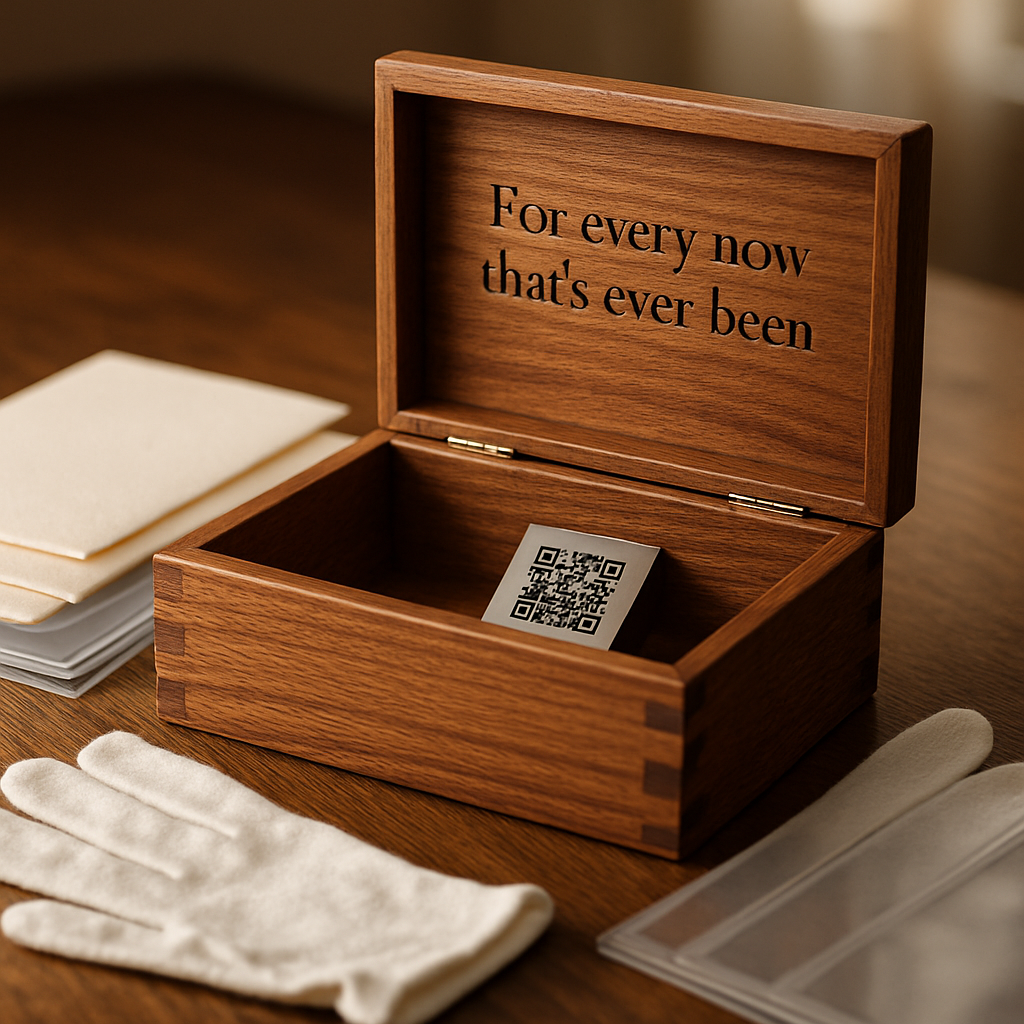
The Bravewood Companion is a finely crafted wooden vessel and guided system that preserves your narrative—physically and digitally—for generations. Unlike mass-market keepsakes that stop at names and dates, the Companion is engineered for heirloom durability and story stewardship: custom narrative engraving, a private QR-linked audio narration, and an archival kit for safe, organized additions over time. Built to heirloom standards and stewarded by transparent care, it’s meant to be handled, added to, and handed down.
We publish:
- Macro joinery and engraving photos, and finish details that demonstrate true heirloom construction [1].
- Artisan bios outlining years of experience and training.
- A preservation approach aligned with leading conservation guidance for mixed media (wood + paper + digital) [2].
What the Bravewood Companion Is—and Why It Lasts
Heirloom durability isn’t a slogan—it’s a standard. The Companion is constructed from carefully seasoned hardwoods, tight joinery, and a repairable finish system, following best practices you’d expect of heirloom furniture: stable materials, robust joinery, and a finish engineered for maintenance instead of disposal [1]. As a personal story heirloom, it integrates:
- Engravable surfaces designed for legibility and permanence
- An archival compartment for acid-/lignin-free inserts
- A private QR link to audio stories you control
- A guided Story Architecture framework to help you shape what matters
A simple component diagram (included in our product materials) shows wood species, finish system, designated engraving areas, and the archival insert compartment—all chosen to support longevity and repairability [1] [2].
Materials & Build at a Glance
- Wood species: Select stable hardwoods chosen for dimensional stability and repairability.
- Moisture content: Targeted ranges to minimize seasonal movement.
- Joinery: Traditional, mechanically strong joinery that stands up to generations of handling [1].
- Finish system: A repair-friendly finish with published safety data (SDS summary included in our materials).
- Engraving depth tolerances: Published as measured ranges to preserve legibility over decades.
Each choice is about longevity—stable wood, robust joints, and a finish you can maintain are cornerstones of heirloom life. Conservation-informed handling and care keep both wood and paper elements safe over time [2].
The Story Architecture Framework
Every Companion includes guided prompts and a simple narrative structure—milestones, values, and defining moments—plus practical archival tips. The approach is rooted in clear description, provenance, and continuity so the next steward understands what they’re receiving. We align with approachable, lay-language concepts of metadata and provenance—what it is, why it matters, and how to tag your story elements in consistent ways [3].
Narrative-First Personalization: Engraving, Handwriting, Photos, and Private Audio
Surface personalization is easy; meaningful personalization takes craft. Your Bravewood Companion can include:
- Narrative engraving (short vignettes, titles, excerpts)
- Handwriting and signatures
- Line art and symbols
- Photo engraving (with guidance on contrast and composition)
- A private, QR-linked audio story—kept intimate but shareable with those you choose
We provide a clear proofing workflow and prep standards (including scan resolution and file formats for photos/handwriting), drawing on best practices for preparing photos and media [4].
Engraving Options & Fidelity
Choose among:
- Text engraving with typographic layouts optimized for legibility
- Handwriting/signture engraving
- Line art/symbols
- Photo engraving, tuned for contrast on wood
Included vs. upgrades: Base personalization includes title and subtitle—handwriting, photo, and multi-panel layouts are available as upgrades. We publish engraving depth tolerances and show results from abrasion/UV spot tests, so you can see how legibility holds up under real-world conditions.
Narrative Templates Optimized to Space
To keep meaning high and clutter low, use our space-aware templates:
- “How We Met” vignette (2–4 concise lines)
- “Service Story” or “Origin Story” highlight
- “Values We Live By” micro-manifesto
Editorial guidance (reviewed by a personal historian) helps you select language that endures, with sensitivity notes for memorial content.
Handwriting & Photo-to-Engraving Workflow
For handwriting:
- Scan at 600 dpi (grayscale or color), minimal compression, crop tight with clean edges.
- Provide high-contrast source art (thick enough lines to hold after engraving).
For photos:
- Aim for 600–1200 dpi scans, high contrast, and clear subjects; we’ll help you preview how tonal values translate to engraved depth [4].
We publish QA checkpoints for file prep and proofing, including layout approvals and a final sign-off before production.
Private QR-Linked Audio Stories & Privacy
Attach a private audio track to your heirloom. You’ll receive:
- Hosting with encryption at rest and in transit, access limited to you and those you invite
- Role-based permissions and a clear ownership chain as part of your stewardship plan
- Export options for heirs (downloadable audio and metadata), so access persists even if platforms change
We include a simple permission setup guide and a contingency handoff plan for heirs in the event of an account transfer or closure.
Privacy & Security Note
- Encryption: AES-256 at rest, TLS in transit
- Authentication: Email-based invites with optional two-factor authentication
- Access controls: Owner, Editor, Viewer roles
- Chain of custody: Name a successor steward now; include contact info and backup email; store an export copy with your 3-2-1 backups
- Export plan for heirs: Keep a local, labeled backup and a sealed envelope with access instructions alongside your Companion
Proofing & Approval Workflow: Timelines and Revisions
- Submit: Text/artwork files per our spec
- Digital proof: Typically sent within 2–3 business days
- Revisions: Two rounds included; additional changes available at a modest fee
- Approval: Final proof sign-off required
- Production: Usually 5–10 business days post-approval (seasonal volume or complex art may extend timelines)
- Shipping: Tracking provided; signature on delivery for added security
We publish sample proofs with timestamps and a representative revision history.
Memorial Etiquette & Symbol Guide
Tone-sensitive engraving, line art, and quiet audio remembrances can comfort and honor. We include:
- Phrasing templates across traditions and secular contexts
- Symbol meanings (dove, laurel, anchor, candle, lily, Star of David, cross, crescent) with sensitivity notes
- A reminder to confirm preferences with family or faith leaders
We align with consumer guidance in memorial decisions and recommend a supportive, informed approach [5] [6].
Phrases & Traditions Template Library
Examples (space-aware):
- “Forever in our hearts • 1948–2025”
- “Loved beyond measure • Father • Teacher • Friend”
- “In loving memory of [Name] • May their light continue in us”
- “Peace, Shalom, Salam” (use with cultural care; verify preferences)
We provide character counts and cautionary notes to ensure respect and clarity [5] [6].
Heirloom-Quality Craftsmanship & Longevity: Build Spec, Testing, Warranty
We publish a transparent standard for the Bravewood Companion:
- Materials and joinery that meet heirloom expectations [1]
- Engraving depth tolerances and test protocols
- Finish SDS summary and compatible care products
- Formal QC checklist and sample defect library
- A 50-year care plan supported by a long-term warranty
We also share workshop transparency best practices used by respected craft organizations [7].
Materials, Joinery, and Finish System
Selection criteria:
- Stability and repairability of wood species
- Joinery robust enough for decades of handling [1]
- Finish designed for maintenance, not disposal
- Engraving depth tailored to wood species and finish sheen for legibility
We publish measured tolerances for seasonal movement and engraving depth, with notes on how they protect clarity over time.
Engraving Depth & Permanence Testing
Protocol summary:
- Abrasion: Standardized cycles using a soft cloth and a micro-abrasive pad, recording contrast loss and edge integrity
- UV exposure: Controlled lightbox intervals with before/after macro photography
- Humidity cycling: Observation of movement impact on edge fidelity
Results and acceptance criteria are published with photo evidence for transparency.
Finish SDS & Care Compatibility
We provide an SDS summary for our finish system and list compatible cleaning and care products (no ammonia; pH-neutral cleaners). Conservation-informed care—moderate light, stable environment—extends finish life and protects paper/photo elements housed within [2].
Quality Control, Artisan Credentials, and Workshop Transparency
Your Companion is built by named artisans whose bios detail years of experience and training. QC checkpoints occur at key stages—milling, joinery, pre-finish sanding, engraving, final finish—and each unit ships with a signed QC sheet and date stamps. Transparency benchmarks from craft leaders inform our approach to publishing process details and standards [1] [7].
50-Year Care & Repair Plan (With Warranty)
- Environment targets: Stable relative humidity and temperature (avoid attics/basements), low UV/light exposure [2]
- Annual maintenance: Gentle cleaning, inspection of joints/finish/engraving clarity, calibration of hygrometer readings
- Repairability: Minor scratches and rub-outs addressed with compatible products; larger issues handled by our shop under warranty terms
- Warranty: A long-term craftsmanship warranty with defined service steps
Annual Maintenance Checklist
- Dust with a soft, dry cloth; avoid sprayed polishes
- Inspect surfaces for scratches; address minor marks with the approved kit
- Check interior paper/inserts for signs of acidity or brittleness; replace as needed
- Verify QR audio link access and update permissions if family emails change
- Confirm placement away from heat vents or direct sunlight [2]
Repair & Refinishing Guide
Minor repairs:
- Clean, then rub out with approved compound; re-wax or oil per care guide
- Avoid sanding engraved areas; preserve depth and edge fidelity
Professional refinishing:
- If damage penetrates finish or threatens engraving clarity, contact us for refinishing support. Interventions favor conservation principles—minimal, reversible where possible—to preserve original intent.
Archival-Grade Preservation Kit & Methods: Keep Stories Safe for Generations
Archival preservation isn’t optional if you want a timeless keepsake. Your Companion includes an archival kit and a clear method for storage, digitization, backups, and metadata—aligned with leading guidance [2] [3] [4] [8].
What’s in the Preservation Kit
- Acid-/lignin-free inserts and envelopes (neutral/alkaline pH)
- Photo-safe sleeves that have passed industry-standard tests where applicable
- Cotton gloves for handling
- Provenance labels and tags with fields for names, dates, places, and subjects
- A quick-start archival guide (how to insert, label, and store)

We note pH and vendor certifications where available and align with storage guidance from preservation authorities [2].
Paper pH, Enclosures, and Provenance Tags
Neutral/alkaline pH materials and proper enclosures slow deterioration. Clear provenance tags (who/what/when/where/why) keep context intact so future family members understand significance. We provide sample label templates and instructions for consistent, findable descriptions rooted in archival best practices [3].
Storage & Environmental Controls
- RH: Aim for stability in the 30–50% range; avoid rapid swings
- Temperature: Moderate and steady; avoid hot/cold extremes
- Light: Low UV/light exposure; avoid direct sun
- Placement: Interior rooms away from vents and exterior walls [2]
Handling tips reduce risk when sorting and filing.
Simple Home Setup
- Place a small hygrometer where the Companion lives; log readings seasonally
- Use window coverings to limit UV; rotate display locations if needed
- Keep silica gel or other buffers if the room trends humid; avoid damp spaces [2]
Digitization SOP and 3-2-1 Backups
Scanning/capture:
- Photos and documents: 600 dpi (minimum) TIFF/PNG for masters; JPEG for quick sharing
- Color profile: sRGB for consistency; avoid aggressive auto-corrections
- Foldering & naming: YYYY-MM-DD_Name_Subject_Location; keep a plain-language readme
Backups: 3-2-1 plan—three copies, two different media, one off-site/cloud. Schedule periodic checks and refresh aging drives [4] [8].
Metadata Templates (Names, Dates, Places, Subjects)
We include downloadable templates for core descriptive fields (person, event, location, date, keywords). Consistent metadata makes future searches easy, and aligns with archival principles you can use at home [3].
Integrating Physical + Digital: The Story Vessel System
The Companion, archival kit, and private digital gallery work together:
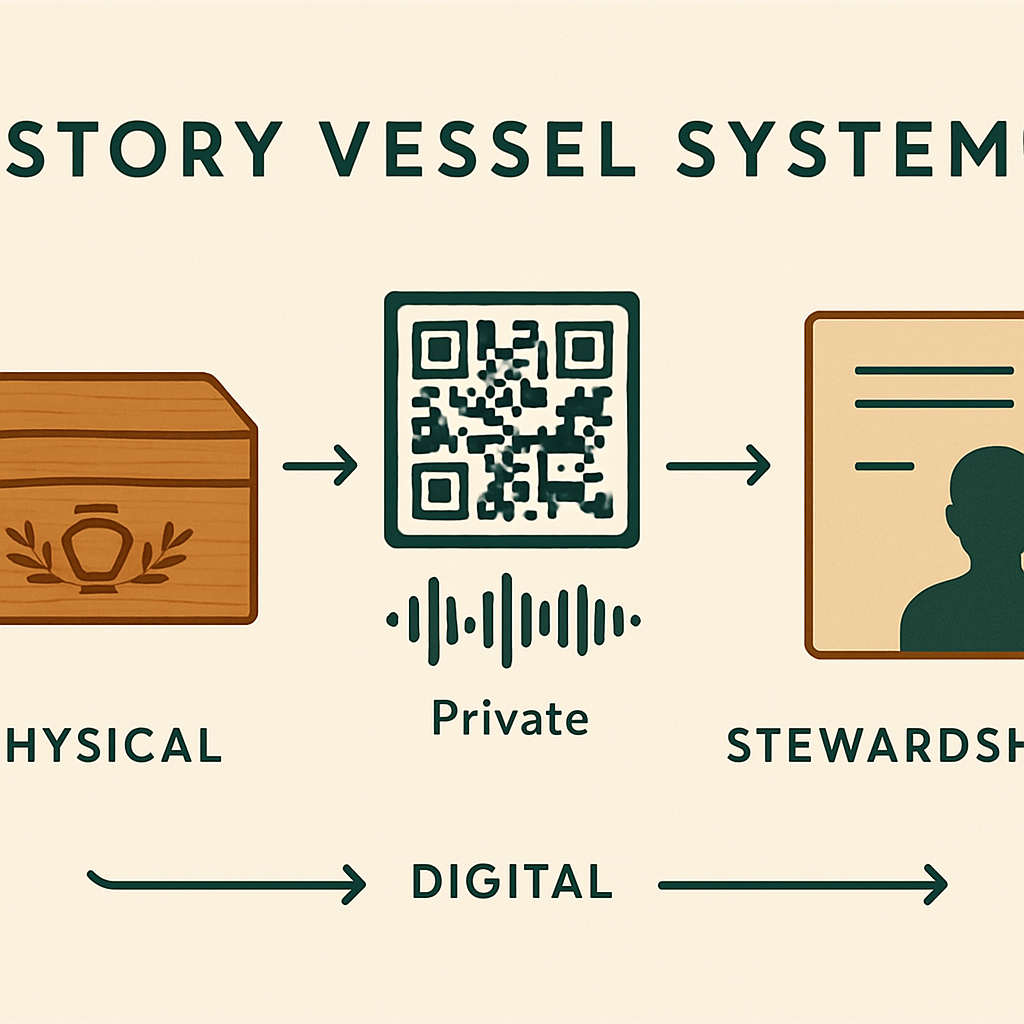
- Physical: Engraved narrative + organized inserts
- Digital: Private audio + scanned masters and backups
- Stewardship: A named heir, a chain-of-custody note, and access instructions
For families doing genealogy, we include a resource list for continued documentation and research [9].
Guided Workflows to Capture and Organize Your Legacy
Memory science shows that remembered scenes can lose richness over time, which is why it’s critical to capture and rehearse stories early—and in multiple formats [10] [11] [12] [13]. These workflows make it easy.
Memory Capture Protocol (Science-Backed)
- Capture early: Short prompts plus a photo or memento cue
- Rehearse together: Read, listen, and retell across weeks to reinforce memory traces
- Encode multimodally: Engraving + photos + private audio narration increases retrieval cues [11]
Qualitative fading of vivid details happens; proactive capture and rehearsal preserve them while they’re still crisp [10]. Spacing and cues strengthen recall [11] [13].
Spaced Rehearsal, Cues, and Multimodal Encoding
Weekly routine:
- 10 minutes: Select one prompt (“The day we first…”) and one photo
- 10 minutes: Record a 60–90 second audio vignette
- 10 minutes: Tag metadata (names, date, place, keywords)
- Monthly: Choose one excerpt for engraving or an insert update
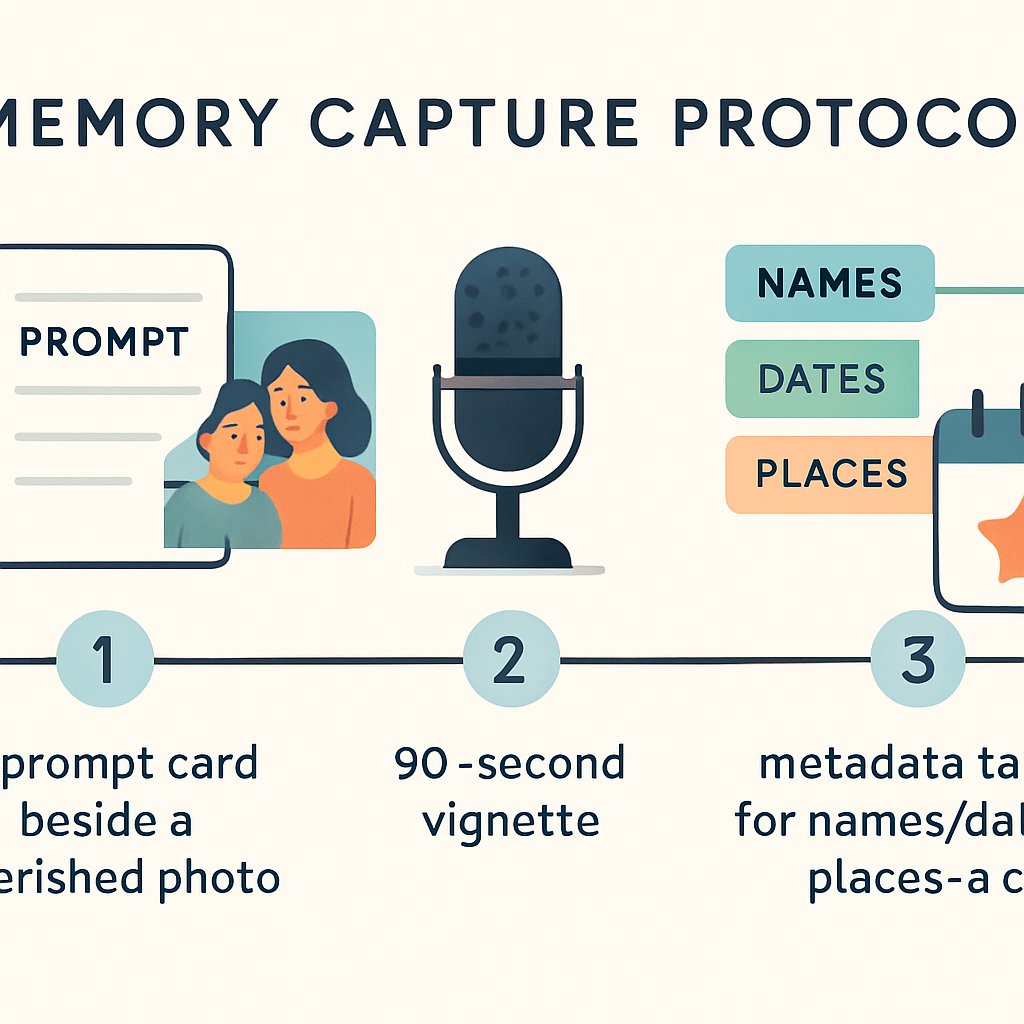
Spaced, multimodal practice and retrieval cues reinforce access over time [11] [12] [13].
Family Legacy Plan: Inventory → Digitize → Curate → Narrate → Store → Handoff
- Phase 1: Inventory—gather boxes, albums, letters; log what you have
- Phase 2: Digitize—scan at archival settings; keep masters and sharing copies
- Phase 3: Curate—select representative items and stories; avoid duplicates
- Phase 4: Narrate—write captions, record short audio; choose engraving excerpts
- Phase 5: Store—use archival enclosures; meet environmental targets
- Phase 6: Handoff—name a steward; include access info and backup plan
This phased approach reduces overwhelm and aligns with archival process and storage guidance [2] [3].
Roles, Meeting Agendas, and Decision Log
- Roles: Project Lead, Digitizer, Story Editor, Steward/Heir
- Monthly agenda: Review progress, approve metadata conventions, select next stories
- Decision log: Record choices (what to keep, what to copy, where to store) and reasons to minimize conflict later
First-Weekend Setup: From Unboxed to Organized
- Unbox: Review the care and preservation quick-start guide
- Label: Use provenance tags on 10–12 priority items
- Record: Capture a 60-second “why this matters” audio
- Store: Place the Companion in a stable environment; log RH/temperature
- Plan: Book your proofing review for the first engraving
Follow safe handling and storage basics during sorting [2].
Personalization at Scale: The Personal Meaning Matrix (Corporate/Team Gifting)
Avoid impersonal generic gifts. Use our matrix to map recipient identity (role, tenure, milestone) to story-driven engravings (shared place, value phrase, meaningful date). Data suggests generic gifting undermines appreciation: more than half of employees report receiving generic or impersonal gifts, and lack of gifting can erode loyalty; most feel appreciated within moderate budgets when the gift shows thoughtfulness [14].
When You Don’t Know Them Well: Safe, Meaningful Archetypes
- Shared place: Engrave coordinates or a skyline line-art
- Milestone date: Start date, project completion, or team founding year
- Value phrase: “Build with care,” “People first,” or your culture’s true north
Pair a short audio note of appreciation. Personal, specific cues improve perceived meaning and recall [11].
Pricing, Tiers, Lead Times, and Policies
We keep pricing and timelines clear while emphasizing our archival and narrative-first differences.
What’s Included vs. Upgrades
Base tier includes:
- Title engraving and one subtitle line
- Archival kit (core inserts, sleeves, labels, gloves)
- Story Architecture quick-start
Upgrades:
- Handwriting/signature engraving
- Photo or line-art engraving
- Multi-panel narrative layouts
- Private audio setup and extended space
We publish file requirements for upgraded options (dpi, file types) and provide visual examples at every tier.
Proofing Timeline & Revision Policy
- Digital proof within 2–3 business days of receiving files
- Two rounds of revisions included; additional revisions available
- Production typically 5–10 business days after final approval (holiday volumes or complex art may extend lead times)
- Priority service may be available seasonally
Shipping, Returns, and Damage Coverage
- Packaging: Corner protection, double-boxing, and internal immobilization
- Damage: Document with photos within 48 hours; we’ll repair or replace per policy
- Returns: Personalized items follow standard custom-goods guidelines; we’ll always work with you to make it right
- Warranty: Long-term craftsmanship warranty with clear service steps
Buyer’s Checklist and Comparison: Bravewood vs. Mass-Market Keepsakes
Use this checklist to evaluate heirloom claims and choose a truly timeless keepsake.
What Makes a Keepsake Timeless vs. Trendy
- Materials: Stable hardwoods, repairable finishes (not brittle lacquer-only shortcuts)
- Joinery: Traditional, mechanically sound connections [1]
- Repairability: Can it be refreshed without losing engraving clarity?
- Provenance: Space and tools to document who/what/when/where/why
- Conservation-friendly choices: Favor reversible, minimal interventions where possible
Comparison Criteria to Evaluate
- Build transparency: Published spec sheet, joinery, and finish SDS
- Engraving: Depth tolerances and durability testing snapshots
- Preservation: Archival kit, environmental ranges, digitization SOP, and 3-2-1 backups
- Stewardship: Named heir, access plan, and warranty support
- Evidence: QC checklist, defect library, and case photos [1] [7] [2]
How to Verify Heirloom-Quality Claims
Ask for:
- Formal spec sheets, SDS summaries, and test data (scratch/UV/humidity)
- QC documentation and warranty terms
- Photos of macro joinery and engraving fidelity
Transparency from respected craft organizations sets the benchmark for what you should see as a buyer [7].
Use Cases & Inspiration: Weddings, Anniversaries, Memorials, New Family Chapters
The Companion adapts as your story grows. Add archival inserts, capture new audio, and engrave milestone excerpts over time—safely and thoughtfully [2].
Weddings & Anniversaries
Engraving ideas:
- “How we met” vignette
- Vows excerpt
- Milestone reflection at 5, 10, 25 years
Include a short audio narration together; tag the date and place for easy retrieval. With permission, we share sample proofs and transcript excerpts (redacted for privacy).
Memorials
Tone-appropriate ideas:
- Name, dates, and a favorite line they said often
- Symbols with meaning (dove, laurel, candle) and an intimate audio remembrance
We include sensitivity-reviewed guidance and consumer considerations to help families choose with confidence [5] [6].
Growing Family Legacy
Quarterly routine:
- Add one new insert (child’s drawing, recipe card, event program)
- Update audio with a 60-second story
- Tag metadata; back up scans to your 3-2-1 plan
For ongoing organization and metadata updates, we provide resources and templates that align with family archive best practices [3] [4].
FAQs: From Memory Science to Maintenance
What is the Bravewood Companion and how is it different from other keepsakes?
It’s a story-first, heirloom-grade system: narrative engraving, archival storage, private audio, a digitization and backup plan, and a transparent build/care standard. We publish specs, finish SDS summaries, QC steps, and a 50-year care plan grounded in proven heirloom construction markers [1].
What personalization options are available (engraving, photos, handwriting, audio)?
Text, handwriting, line art, and photo engraving—with clear file specs—plus a private QR-linked audio narration. We provide sample proofs and before/after conversions to set accurate expectations [4].
Is it heirloom-quality (materials, durability, care, warranty)?
Yes—stable hardwoods, robust joinery, repairable finish, published engraving depth tolerances, durability spot tests, long-term warranty, and a practical care plan [1] [2].
How do I use it to preserve a personal or family story?
Start with our Story Architecture prompts, then add archival inserts and a short audio narration. Follow the digitization SOP and 3-2-1 backup plan to protect and share responsibly [2] [3] [4] [8].
What are pricing, lead times, and shipping/returns?
We publish tiered personalization (what’s included vs. upgrades), typical proof and production timelines, packaging standards, damage coverage, and custom-item return policies on our order page.
What makes a keepsake timeless versus trendy?
Design restraint, repairability, stable materials, strong joinery, and provenance features. Ask for spec sheets, finish data, and test evidence [1] [2].
Which materials and finishes last for generations—and how do I maintain them?
Stable hardwoods and repairable finishes are proven choices. Maintain stable environment ranges, clean with approved products, and follow the annual checklist [2].
Can personalization fade or degrade? How is it protected?
We engrave within published depth tolerances and conduct abrasion/UV spot tests. Proper environment and care preserve clarity; we show representative results with macro photos.
How can I turn my life story into an heirloom object?
Use a narrative template, choose an engraving excerpt, add inserts (letters, photos, recipes), and record a brief audio. Tag metadata consistently and back up your scans [3] [4] [8].
What formats are best for preserving stories (engraving, inserts, audio/QR)?
Each modality offers unique strengths: engraving for permanence and display, inserts for richer detail, private audio for voice and emotion. Together, they create redundancy and depth [2] [3].
How do I ensure the story and materials last for generations?
Follow storage ranges, digitize with archival settings, keep 3-2-1 backups, and assign a steward/heir with access instructions [2] [4] [8].
Can I include handwriting, photos, maps, or recipes?
Yes—scan at archival settings (typically 600 dpi) and file in acid-/lignin-free enclosures. We provide templates and handling guidance [2] [4].
What’s the process to create and update a story heirloom?
Order → proof → engraving → archival kit setup → audio recording → digitization and backups → handoff plan; then a quarterly update routine for new milestones [2] [3].
Why do memories fade and what helps preserve vivid detail?
Qualitative vibrancy can diminish; interference and decay play roles. Capture early, rehearse with spacing, and encode across modalities (text, images, audio) [10] [11] [12] [13].
Does writing or recording stories actually help retention?
Yes—writing and narration create retrieval cues and rehearsal opportunities that strengthen memory access over time [11] [12].
How do I store physical mementos safely?
Use acid-/lignin-free materials, keep RH/temperature stable, and minimize light exposure [2].
Why do generic gifts feel impersonal—and what adds real meaning?
Data shows many people receive generic or impersonal gifts, and thoughtful personalization can improve appreciation and loyalty. Story-driven engravings and brief audio notes make gifts feel genuinely seen [14].
Where do we start—and how do we get the family involved?
Use the First-Weekend Setup and the Family Legacy Plan (roles, monthly agenda, decision log). Follow archival processes and storage guidance to keep momentum and peace in the process [2] [3].
How do legacy boxes and genealogy books compare?
Legacy boxes (like the Companion) are modular, updateable, and integrate mixed media; books are excellent for curated narratives but harder to update. Many families use both: a living story vessel plus a milestone book [2] [3] [9].
Verified Customer Stories & Gallery
Memorial Stories
With consent, we share sensitive memorial examples—engravings, line art, and quiet audio remembrances—reviewed for tone and clarity. We include consumer-focused notes to support informed decisions [5] [6].
Weddings & Anniversaries
Side-by-side proof images show story excerpts transformed into engraving, along with optional audio narration snippets. Macro photos demonstrate engraving fidelity and finish sheen appropriate for legibility.
Engraving Gallery
See a curated gallery of text, handwriting, line art, and photo engravings. Each includes notes on engraving depth and finish to guide your design choices.
Conclusion
The Bravewood Companion brings heirloom craftsmanship and memory science together—so your story is engraved, organized, privately shareable, and designed to endure. With transparent build specs, durability spot tests, archival methods, and guided workflows, you get both beauty and peace of mind. Start your Bravewood Companion today: choose your personalization tier, download the Memory Capture Protocol, and book your proofing review. Preserve your story—beautifully, privately, and for generations.
Disclaimer
This article offers general archival, memorial etiquette, and privacy guidance for informational purposes only and is not medical, psychological, or legal advice. For grief-related decisions, consult a licensed counselor. For privacy/compliance questions, consult a legal professional. Product visuals/specs may evolve with continuous improvement.
References
- This Old House Editors. (N.D.). How Heirloom Furniture Is Built. This Old House. Retrieved from https://www.thisoldhouse.com/furniture/21018437/how-heirloom-furniture-is-built
- Library of Congress. (N.D.). Preservation Directorate: Caring for Your Treasures (Care, Handling, and Storage). Retrieved from https://www.loc.gov/preservation/care/
- Society of American Archivists. (2013, rev.). Describing Archives: A Content Standard (DACS) and related guidance. Retrieved from https://www2.archivists.org/standards/DACS
- The Photo Managers. (N.D.). Preserving Family Memories with Your Photo and Video Legacy. Retrieved from https://thephotomanagers.com/preserving-family-memories-with-your-photo-and-video-legacy/
- Funeral Consumers Alliance. (N.D.). Consumer Guidance for Funeral and Memorial Decisions. Retrieved from https://funerals.org/
- American Counseling Association. (N.D.). Resources for Grief and Loss; Professional Counseling Guidance. Retrieved from https://www.counseling.org/
- The Furniture Guild. (N.D.). What Heirloom Quality Really Means (Transparency and Craft Standards). Retrieved from https://blog.furnitureguild.com/heirloom-quality/
- Anderson Archival. (N.D.). How to Preserve Your Legacy: Practical Tips and Advice. Retrieved from https://andersonarchival.com/blog/how-to-preserve-your-legacy-practical-tips-and-advice/
- FamilySearch. (N.D.). Family History and Genealogy Resources. Retrieved from https://www.familysearch.org/
- Boston College. (2020). How Memories Fade. Retrieved from https://www.bc.edu/bc-web/bcnews/science-tech-and-health/psychology/how-memories-fade.html
- American Psychological Association. (N.D.). APA Dictionary of Psychology (entries on Memory, Interference theory, Spacing effect). Retrieved from https://dictionary.apa.org/
- Ohio State Wexner Medical Center. (2023). What Causes Short-Term Memory to Fade?. Retrieved from https://health.osu.edu/health/brain-and-spine/what-causes-short-term-memory-to-fade
- Wikipedia Contributors. (N.D.). Decay theory. Wikipedia. Retrieved from https://en.wikipedia.org/wiki/Decay_theory
- SnackNation Staff. (2024). Gifts for Coworkers (Employee Gifting Insights; citing Snappy, Mrs. Prindables, Giftsenda). SnackNation. Retrieved from https://snacknation.com/blog/gifts-for-coworkers/
- Melissa Tyson Designs. (N.D.). What Does “Heirloom Quality” Mean?. Retrieved from https://www.melissatysondesigns.com/blogs/news/what-does-heirloom-quality-mean
- Safewill Editorial. (2023). What Is a Personal Legacy? Beyond Assets to Values and Stories. Safewill. Retrieved from https://safewill.com/blog/posts/what-is-a-personal-legacy
